
Buy Property Brazil as Foreign Investor: Complete Guide for 2025

Imagine owning a beachfront apartment in Florianópolis, a luxury condo in São Paulo’s financial district, or a vacation rental in Rio de Janeiro—all while living thousands of miles away. For foreign investors, Brazil represents one of Latin America’s most compelling real estate opportunities, offering stunning properties at competitive prices, strong rental yields, and a welcoming legal framework. The decision to buy property Brazil as a foreign investor has never been more attractive, with the country’s economy stabilizing and property values in key markets showing consistent appreciation.
Brazil’s real estate market presents unique advantages for international buyers: no restrictions on foreign ownership in most areas, competitive pricing compared to North American and European markets, and diverse investment opportunities from urban apartments to coastal retreats. However, navigating the legal requirements, understanding tax obligations, and identifying the right locations requires careful planning and expert guidance.
Key Takeaways
- Foreign investors can freely purchase property in Brazil without residency requirements, except in restricted border and coastal security zones
- Obtaining a CPF (tax identification number) is mandatory for all foreign property buyers and can be acquired through Brazilian consulates or online
- Property prices in Brazil remain competitive compared to similar markets in North America and Europe, with strong appreciation potential in major cities
- Legal due diligence is critical , including title verification, property registration checks, and working with qualified Brazilian real estate attorneys
- Tax obligations include property transfer tax (ITBI), annual property tax (IPTU), and capital gains tax on future sales, with specific rates varying by municipality
Understanding the Legal Framework to Buy Property Brazil as Foreign Investor
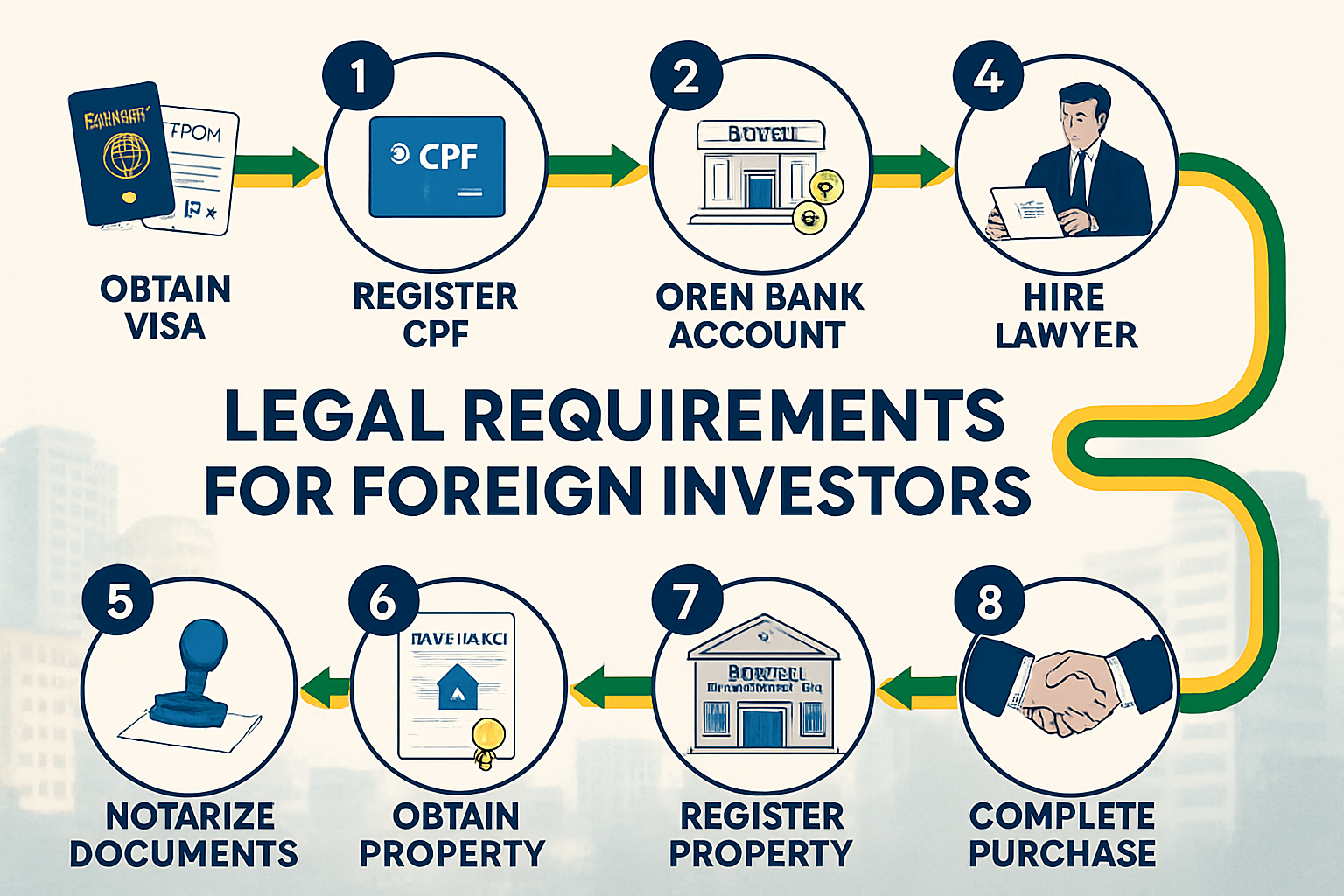
Foreign Ownership Rights in Brazil 🏛️
Brazil maintains one of the most open property ownership policies in Latin America for international investors. Foreign individuals and companies can purchase real estate with the same rights as Brazilian citizens, with only a few specific restrictions. The Brazilian Constitution guarantees property rights to foreigners, making it a secure investment destination [1].
Key legal provisions include:
- Unrestricted urban property purchases in cities and developed areas
- Rural property limitations capping foreign ownership at 25% of municipal territory
- Border zone restrictions requiring special authorization for properties within 150 kilometers of international borders
- Coastal security areas needing approval for certain beachfront locations
The legal framework has remained stable for decades, providing confidence for long-term investment strategies. Unlike some countries that impose citizenship or residency requirements, Brazil welcomes foreign capital into its real estate sector as a driver of economic development.
Essential Documentation Requirements
To buy property Brazil as a foreign investor , several critical documents must be obtained and properly authenticated:
| Document | Purpose | Where to Obtain |
|---|---|---|
| CPF (Cadastro de Pessoas Físicas – Individual Taxpayer Registry) | Brazilian tax ID number | Brazilian consulate or Federal Revenue website |
| Passport | Identity verification | Home country government |
| Proof of Address | Residency verification | Utility bills or bank statements |
| Marriage Certificate (if applicable) | Spousal consent for purchase | Home country registry |
| Power of Attorney (optional) | Authorize representative | Brazilian notary or consulate |
The CPF is absolutely essential —no property transaction can proceed without it. Foreign investors can apply for a CPF at any Brazilian consulate abroad or through the Brazilian Federal Revenue Service’s online portal. The process typically takes 2-4 weeks and requires a valid passport and proof of address [2].
For those unable to travel to Brazil for the purchase closing, a power of attorney authenticated by a Brazilian consulate allows a trusted representative to sign documents on your behalf. This document must be translated into Portuguese by a sworn translator and registered with a Brazilian notary.
Step-by-Step Process to Buy Property Brazil as Foreign Investor
Phase 1: Research and Property Selection
The journey begins with thorough market research to identify the right location and property type aligned with investment goals. Brazil’s diverse regions offer distinct opportunities—from the vibrant real estate market in Florianópolis to the established markets of São Paulo and Rio de Janeiro.
Critical research steps:
- Defines investment objectives (rental income, capital appreciation, vacation home, retirement property)
- Analyze market conditions in target cities, including price trends, rental yields, and development plans
- Identify reputable developers and real estate agencies with experience serving foreign clients
- Visit properties in person or arrange virtual tours with trusted representatives
- Evaluate neighborhood infrastructure , including transportation, schools, healthcare, and amenities
Working with established developers like Quadragon can significantly streamline the process, as they understand foreign investor needs and can guide buyers through local market nuances. Their portfolio of developments showcases quality construction standards and strategic locations.
Phase 2: Legal Due Diligence and Contract Negotiation
Once a target property is identified, comprehensive legal verification is non-negotiable. Hiring a qualified Brazilian real estate attorney protects against title defects, liens, and other legal complications.
Essential due diligence includes:
- Title search at the local Real Estate Registry ( Cartório de Registro de Imóveis )
- Property tax verification confirming all IPTU payments are current
- Zoning compliance checking that property use aligns with municipal regulations
- Structural inspection by qualified engineers (especially for older properties)
- Condominium documentation review for apartment purchases, including financial health and bylaws
The promissory purchase agreement is typically signed first, outlining terms, price, payment schedule, and conditions. This contract is legally binding and should be reviewed thoroughly by your attorney before signing.
“Foreign investors should never skip professional legal representation when purchasing Brazilian real estate. The cost of proper due diligence is minimal compared to the risks of undiscovered title problems or regulatory violations.” —Brazilian Real Estate Law Association
Phase 3: Financing and Payment Structure
While foreign investors can obtain financing in Brazil, it’s considerably more challenging than for Brazilian residents. Most international buyers opt for cash purchases or secure financing in their home countries.
Financing options:
- Cash purchase : Most straightforward, typically qualifies for negotiated discounts
- Brazilian bank financing : Limited availability for foreigners, requires substantial documentation and higher down payments (40-50%)
- Developer financing : Some projects offer installment plans, particularly for pre-construction properties
- International financing : Home equity loans or mortgages from foreign banks
Payment typically flows through:
- Initial deposit (10-30% upon signing promissory agreement)
- Installations during construction (for new developments)
- Final payment at closing and deed transfer
All international wire transfers must be registered with the Brazilian Central Bank through the RDE-IED system (Electronic Declaratory Registry – Foreign Direct Investment). This registration is crucial for future repatriation of funds when selling the property [3].
Phase 4: Closing and Property Registration
The final closing ( deed ) occurs at a notary office , where the definitive deed is signed and authenticated. Both buyer and seller (or their legal representatives with power of attorney) must be present.
Closing process timeline:
- Final property inspection (1-2 days before closing)
- Payment of closing costs and taxes (ITBI tax, notary fees, registration fees)
- Deed signing at notary (1-2 hours)
- Property registration at Real Estate Registry (2-4 weeks)
- Receipt of registered deed confirming legal ownership
The ITBI tax (Property Transfer Tax) ranges from 2-4% of the property value depending on the municipality. In addition, notary and registration fees typically add another 1-2% to closing costs. These expenses are usually the buyer’s responsibility unless negotiated otherwise.
Financial Considerations When You Buy Property Brazil as a Foreign Investor
Tax Obligations and Ongoing Costs 💰
Understanding the complete tax picture is essential for accurate ROI calculations. Brazilian property ownership involves several recurring and one-time tax obligations.
Primary taxes for foreign property owners:
| Tax Type | Rate | Payment Frequency | Notes |
|---|---|---|---|
| ITBI (Transfer Tax) | 2-4% | One-time purchase | Based on property value |
| IPTU (Annual Property Tax) | 0.5-1.5% | Annual or monthly | Varies by municipality |
| Condominium Fees | Varies | Monthly | For apartments/gated communities |
| Rental Income Tax | 15-27.5% | Monthly | If property generates rental income |
| Capital Gains Tax | 15% | For sale | Profit from property sale |
For rental properties, foreign owners must appoint a legal representative in Brazil to handle tax filings and payments. Monthly rental income is subject to progressive income tax rates, and proper declaration is mandatory to avoid penalties.
When selling, capital gains tax applies to the profit (sale price minus purchase price and improvement costs). However, if proceeds are reinvested in another Brazilian property within 180 days, the tax may be deferred [4].
Currency Considerations and Exchange Risk
Foreign investors must navigate currency exchange when transferring funds to Brazil. The Brazilian Real (BRL) can be volatile against major currencies, creating both opportunities and risks.
Currency management strategies:
- Time transfers strategically during favorable exchange rates
- Use specialized currency exchange services rather than traditional banks for better rates
- Consider hedging strategies for large transactions
- Factor exchange costs (typically 1-3%) into total investment calculations
The requirement to register foreign investment with the Central Bank actually provides a benefit: it guarantees the right to repatriate funds in foreign currency when selling, regardless of future exchange controls.
Best Locations to Buy Property Brazil as Foreign Investor
São Paulo: Economic Powerhouse 🏙️
As Latin America’s largest city and Brazil’s financial capital, São Paulo offers the most liquid real estate market with strong fundamentals for long-term appreciation.
Investment highlights:
- Strong rental demand from corporate relocations and business travelers
- Diverse neighborhoods from luxury Jardins to emerging Vila Madalena
- Established legal infrastructure with experienced professionals serving foreign clients
- Average rental yields : 4-6% annually
- Price range : $2,000-$8,000 per square meter depending on neighborhood
São Paulo’s market is particularly attractive for investors seeking stable, income-generating properties with corporate tenant pools.
Rio de Janeiro: Tourism and Lifestyle
Rio’s iconic beaches, cultural attractions, and international profile make it a perennial favorite for foreign property buyers seeking vacation rentals or lifestyle investments.
Key advantages:
- Strong tourism sector supporting short-term rental income
- Iconic locations like Copacabana, Ipanema, and Leblon
- International airport connectivity facilitating property management visits
- Average rental yields : 5-7% for well-located vacation rentals
- Price range : $2,500-$10,000 per square meter in prime beachfront areas
The vacation rental market in Rio has rebounded strongly post-pandemic, with platforms like Airbnb showing consistent occupancy rates in desirable neighborhoods.
Florianópolis: Emerging Hotspot 🏖️
Florianópolis has emerged as one of Brazil’s fastest-growing real estate markets, combining natural beauty, quality of life, and strong appreciation potential. The growth of regions like the English demonstrates the city’s expanding infrastructure and investment appeal.
Why Florianópolis attracts foreign investors:
- Exceptional quality of life with 42 beaches and year-round mild climate
- Growing tech sector attracting young professionals and digital nomads
- Strong appreciation rates of 8-12% annually in developing neighborhoods
- Lower entry prices than Rio and São Paulo ($1,500-$4,000 per square meter)
- Expanding infrastructure including new highways and airport improvements
The life in Florianópolis offers a unique blend of beach culture, outdoor activities, and modern urban amenities. For investors interested in the area, exploring developments like Tramonto or Solis provides insight into quality construction standards and strategic locations.
Other Promising Markets
Brasília : The capital city offers stable government employment, planned urban design, and consistent demand. Lower volatility but also more modest appreciation compared to coastal cities.
Salvador : Bahia’s capital combines Afro-Brazilian culture, colonial architecture, and beach access. Emerging market with significant upside potential but requires careful neighborhood selection.
Curitiba : Known for exceptional urban planning and quality of life, Curitiba attracts conservative investors seeking stability, long-term appreciation with lower risk profiles.
For a comprehensive analysis of investment locations, review this guide on best places to invest in Brazil property .
Investment Strategies for Foreign Property Buyers
Buy Pre-Construction for Maximum Appreciation
Purchasing properties during the construction phase offers significant advantages for patient investors willing to wait 18-36 months for completion.
Pre-construction benefits:
- Below-market pricing : Developers offer discounts of 15-30% compared to completed units
- Flexible payment plans : Installments during construction reduce upfront capital requirements
- Appreciation during construction : Properties typically gain 20-40% in value from launch to delivery
- Choice of best units : Early buyers select premium locations, floors, and views
- Modern specifications : New buildings feature current design standards and amenities
The advantages of buying pre-construction are particularly pronounced in growing markets like Florianópolis, where demand consistently outpaces supply. Following construction progress updates helps investors track their asset’s development.
Studio Apartments: High-Yield Strategy
Compact studio units in strategic locations offer attractive rental yields with lower capital requirements, making them ideal entry points for foreign investors.
Studio investment advantages:
- Lower purchase prices : $50,000-$150,000 in most markets
- Higher rental yields : 6-9% annually due to strong student and young professional demand
- Easier property management : Smaller spaces require less maintenance
- Faster appreciation : Compact units in developing areas see rapid value growth
- Diversification potential : Lower prices allow portfolio diversification across multiple properties
The benefits of investing in studios in Florianópolis exemplify this strategy, with strong demand from the city’s growing university population and seasonal tourism.
Vacation Rental Strategy
Brazil’s thriving tourism industry supports robust short-term rental markets in coastal and cultural destinations.
Vacation rental considerations:
- Seasonal income fluctuations : High season (December-March) generates 60-70% of annual revenue
- Management requirements : Consider professional property management services
- Regulatory compliance : Verify local short-term rental regulations and tax obligations
- Furnishing costs : Budget $10,000-$30,000 for complete furnishing and equipment
- Platform fees : Airbnb and VRBO charge 15-20% commission on bookings
Successful vacation rental investors typically achieve 7-10% net yields after all expenses, significantly higher than traditional long-term rentals but with increased management complexity.
Working with Real Estate Professionals
Choosing the Right Real Estate Agency
Selecting a reputable agency with foreign investor experience is crucial for a smooth transaction. Look for agencies that offer:
- English-speaking agents who understand international client needs
- Comprehensive market knowledge in your target area
- Legal and financial partnerships with attorneys and accountants
- After-sale support including property management and rental services
- Transparent fee structures with clearly defined commission rates
Established developers and agencies like Quadragon provide end-to-end support for foreign buyers, from initial property selection through closing and ongoing management.
The Role of Real Estate Attorneys
Never attempt to buy property Brazil as foreign investor without qualified legal representation. A specialized real estate attorney provides:
- Title verification and due diligence to ensure clean ownership
- Contract review and negotiation protecting your interests
- Tax optimization strategies minimizing legal tax obligations
- Closing representation ensuring proper document execution
- Post-purchase support for registration and compliance
Attorney fees typically range from $1,500-$5,000 depending on transaction complexity, a worthwhile investment considering the legal protections provided.
Property Management Services
For foreign investors unable to personally oversee their Brazilian property, professional management services are essential.
Management services include:
- Tenant screening and lease administration for long-term rentals
- Booking management and guest services for vacation rentals
- Maintenance coordination and emergency repairs
- Financial reporting and tax compliance
- Property inspections and condition monitoring
Management fees typically range from 8-15% of monthly rental income for long-term rentals, or 20-30% for short-term vacation rentals including all services.
Common Pitfalls and How to Avoid Them
Skipping Proper Due Diligence ⚠️
The most costly mistake foreign investors make is rushing through or skipping comprehensive property verification. Always:
- Verify ownership through official registry searches
- Confirm tax compliance with current IPTU payments
- Check for liens or legal encumbrances on the property
- Inspect physical condition with qualified engineers
- Review condominium finances for apartment purchases
Spending $1,000-$2,000 on thorough due diligence can prevent $50,000+ in future problems.
Underestimating Total Costs
Many foreign buyers focus solely on purchase price while underestimating total acquisition and ownership costs.
Complete cost calculation should include:
- Purchase price
- ITBI transfer tax (2-4%)
- Notary and registration fees (1-2%)
- Attorney fees ($1,500-$5,000)
- Currency exchange costs (1-3%)
- Furnishing (if applicable)
- Annual property tax (IPTU)
- Monthly condominium fees
- Property management fees
- Maintenance reserves
A realistic budget accounts for 8-12% above purchase price for total acquisition costs.
Ignoring Currency Exchange Timing
Poor currency exchange timing can cost thousands in unnecessary expenses. Strategies to optimize:
- Monitor exchange rates and transfer during favorable periods
- Use limit orders with currency services to automatically execute at target rates
- Avoid airport and hotel exchanges with unfavorable rates
- Compare multiple providers including banks, specialized services, and online platforms
A 5% difference in exchange rates on a $200,000 property represents $10,000 in additional costs or savings.
Neglecting Tax Registration Requirements
Failing to properly register foreign investment with the Central Bank creates serious problems for future fund repatriation. Ensure:
- RDE-IED registration is completed for all international transfers
- CPF tax ID is obtained before any transactions
- Annual tax declarations are filed even if no rental income exists
- Legal representative is appointed for tax compliance
Proper registration from the start prevents complications when eventually selling and repatriating proceeds.
Future Outlook: Brazil’s Real Estate Market in 2025 and Beyond
Brazil’s real estate market enters 2025 with positive momentum driven by economic stabilization, interest rate reductions, and continued urbanization. The 2025 market outlook for Florianópolis reflects broader national trends of increasing foreign investment and strong demand in quality developments.
Key trends shaping the market:
- Interest rate normalization : Declining rates improve affordability and stimulate demand
- Remote work migration : Professionals relocating from São Paulo and Rio to coastal cities
- Infrastructure investments : Government projects improving connectivity in secondary markets
- Sustainable development : Growing demand for eco-friendly buildings and green certifications
- Technology integration : Smart home features becoming standard in new developments
Foreign investors who buy property Brazil as foreign investors in 2025 are positioning themselves to benefit from these positive trends while acquiring assets at prices still below historical peaks.
Emerging opportunities include secondary coastal cities experiencing infrastructure improvements, urban regeneration projects in established city centers, and sustainable tourism developments in natural areas.
For investors interested in innovative approaches, exploring topics like cryptocurrency in real estate development reveals how Brazil’s market is embracing financial technology.
Conclusion: Your Path to Brazilian Property Ownership
The opportunity to buy property Brazil as a foreign investor offers compelling advantages: competitive pricing, strong appreciation potential, favorable legal framework, and diverse investment strategies. From beachfront condos in Florianópolis to urban apartments in São Paulo, Brazil’s real estate market provides options for every investment profile and budget.
Success requires careful planning, professional guidance, and thorough due diligence. By following the steps outlined in this guide—obtaining your CPF, conducting comprehensive property research, working with qualified attorneys, and understanding all tax obligations—foreign investors can confidently navigate the Brazilian market.
Your action plan:
- Define your investment objectives (rental income, appreciation, vacation home, retirement)
- Research target markets using resources like market analysis reports and development portfolios
- Obtain your CPF through a Brazilian consulate or online application
- Connect with experienced professionals including real estate agencies, attorneys, and property managers
- Visit properties personally or through trusted representatives
- Conduct thorough due diligence before signing any contracts
- Plan for ongoing management and tax compliance
The Brazilian real estate market rewards patient, informed investors who take time to understand local dynamics and work with reputable partners. Whether you’re seeking rental income, long-term appreciation, or a personal retreat in one of the world’s most beautiful countries, Brazil offers exceptional opportunities.
Ready to explore Brazilian property investment? Contact experienced real estate professionals who specialize in serving foreign investors and can guide you through every step of the process. Your Brazilian property journey begins with a single informed decision.
References
[1] Brazilian Constitution, Article 5, Section XXII – Property Rights Guarantees
[2] Brazilian Federal Revenue Service (Receita Federal) – CPF Registration Guidelines for Foreign Nationals, 2025
[3] Central Bank of Brazil – RDE-IED Registration Requirements for Foreign Direct Investment in Real Estate, 2025
[4] Brazilian Internal Revenue Code – Capital Gains Tax on Real Estate Transactions, Articles 21-23