
Investment Opportunities in Brazil: Your Complete 2026 Guide to High-Growth Markets

Brazil’s economy is roaring back to life in 2026, presenting savvy investors with a golden window of opportunity. As Latin America’s largest economy stabilizes and diversifies, investment opportunities in Brazil are attracting attention from international and domestic investors seeking high returns in emerging markets. With a population exceeding 215 million people, abundant natural resources, and a growing middle class, Brazil offers a compelling investment landscape across multiple sectors—from real estate and agriculture to technology and renewable energy.
Key Takeaways
- 🌟 Brazil’s economy is projected to grow 2.5-3% in 2026, driven by agricultural exports, infrastructure development, and digital transformation
- 🏢 Real estate markets in cities like Florianópolis and São Paulo offer exceptional returns, particularly in pre-construction developments
- 💼 Diverse sectors including agribusiness, renewable energy, technology, and tourism present multiple entry points for investors
- 📊 Government incentives and tax reforms have made Brazil more attractive to foreign direct investment
- 🔑 Understanding local regulations and partnering with experienced developers is crucial for investment success
Understanding Brazil’s Economic Landscape in 2026

Brazil’s economic trajectory has improved significantly over recent years, creating a more stable environment for investors. The country has implemented crucial fiscal reforms, reduced inflation rates, and strengthened its currency position. These macroeconomic improvements have created fertile ground for various investment opportunities in Brazil across multiple sectors.
Key Economic Indicators
The Brazilian economy demonstrates several positive trends that support investment growth:
| Economic Indicator | 2026 Status | Investment Impact |
|---|---|---|
| GDP Growth | 2.5-3.0% | Expanding market opportunities |
| Inflation Rate | 4.2-4.8% | Controlled and predictable |
| Interest Rates | Gradually declining | Lower borrowing costs |
| Currency Stability | Strengthening Real | Reduced exchange risk |
| Foreign Direct Investment | $85+ billion | Strong international confidence |
Political stability has also improved, with clearer regulatory frameworks making it easier for both domestic and international investors to navigate the Brazilian market. The government’s commitment to privatization and infrastructure development has opened new sectors to private investment.
Why International Investors Are Choosing Brazil
Several compelling factors make Brazil stand out in the global investment landscape:
- Abundant natural resources: Brazil ranks among the world’s top producers of iron ore, soybeans, coffee, and beef
- Large consumer market: Over 215 million consumers with growing purchasing power
- Strategic geographic position: Gateway to South American markets
- Technological advancement: Rapidly growing fintech and digital sectors
- Renewable energy potential: Leading position in clean energy production
Top Investment Opportunities in Brazil for 2026
Real Estate and Property Development 🏗️
The Brazilian real estate market continues to offer exceptional returns, particularly in high-growth regions. Property investment has historically been one of the most reliable ways to build wealth in Brazil, and 2026 presents unique opportunities.
Florianópolis has emerged as a premier destination for real estate investment. The city combines stunning natural beauty, excellent quality of life, and strong economic fundamentals. Quadragon specializes in high-quality developments in this thriving market, offering investors access to premium properties in strategic locations.
Why Real Estate Investment Works in Brazil
The best places to invest in Brazil property share common characteristics: strong population growth, infrastructure development, and lifestyle appeal. These factors drive consistent appreciation and rental demand.
Pre-construction investment offers particularly attractive returns. When you buy properties during the construction phase, you can secure lower prices and benefit from appreciation as the project progresses. This strategy has proven highly effective in Brazilian markets.
Key real estate investment advantages include:
- Appreciation potential: Properties in growing areas can appreciate 30-50% from purchase to completion
- Rental income: Tourist destinations and business centers offer strong rental yields
- Currency hedge: Real estate provides protection against inflation
- Tangible asset: Physical property offers security and stability
- Tax benefits: Various deductions available for property investors
Emerging Real Estate Markets
Beyond traditional centers, several emerging markets offer exceptional opportunities:
Florianópolis and surrounding areas continue to experience robust growth. The Ingleses region exemplifies this trend, combining infrastructure improvements with lifestyle appeal to drive property values higher.
Studio apartments represent a particularly interesting niche. Investing in studios in Florianópolis offers lower entry costs, strong rental demand from students and young professionals, and excellent liquidity.
Agribusiness and Agriculture 🌾
Brazil’s agribusiness sector remains a powerhouse, accounting for approximately 25% of GDP. The country’s vast agricultural lands, favorable climate, and advanced farming technologies make it a global leader in food production.
Investment opportunities in this sector include:
- Direct farmland ownership: Acquiring productive agricultural land
- Agribusiness stocks: Investing in publicly traded agricultural companies
- Agricultural funds: Diversified exposure to multiple agribusiness operations
- Supply chain companies: Logistics, processing, and distribution businesses
- Agricultural technology: Precision farming and biotech innovations
The sustainability trend is creating new opportunities in organic farming, regenerative agriculture, and carbon credit programs. Brazil’s commitment to sustainable practices enhances long-term value.
Technology and Innovation 💻
Brazil’s technology sector has exploded in recent years, with São Paulo becoming one of Latin America’s leading tech hubs. The country has produced numerous “unicorn” startups valued over $1 billion.
Key technology investment areas:
- Fintech: Digital banking, payment solutions, and financial services
- E-commerce: Online retail platforms and logistics
- Healthtech: Telemedicine and digital health solutions
- Edtech: Online education and training platforms
- SaaS: Software-as-a-service for business applications
The Brazilian government’s support for innovation through tax incentives and startup programs has accelerated technological development. Cryptocurrency and real estate integration represents one emerging frontier where technology meets traditional investment.
Renewable Energy and Sustainability ⚡
Brazil leads Latin America in renewable energy production, with hydroelectric, wind, and solar power dominating the energy matrix. The country’s commitment to reducing carbon emissions creates substantial investment opportunities.
Renewable energy investments include:
- Wind farms: Particularly in northeastern regions with consistent winds
- Solar installations: Both utility-scale and distributed generation
- Biomass energy: Converting agricultural waste into power
- Green bonds: Fixed-income securities funding environmental projects
- Energy efficiency: Companies providing sustainability solutions
The global push toward clean energy positions Brazil advantageously, as the country already generates over 80% of its electricity from renewable sources. This expertise creates export opportunities for Brazilian renewable energy technology.
Tourism and Hospitality 🏖️
Brazil’s tourism sector is rebounding strongly post-pandemic, with international visitors returning in record numbers. The country’s diverse attractions—from Amazon rainforests to pristine beaches—create year-round tourism demand.
Tourism investment opportunities:
- Hotel and resort development: Particularly in coastal and eco-tourism destinations
- Vacation rental properties: Short-term rental investments in tourist hotspots
- Tourism infrastructure: Transportation, entertainment, and service businesses
- Eco-tourism ventures: Sustainable tourism experiences
- Event venues: Conference centers and destination wedding locations
Cities like Florianópolis benefit from both domestic and international tourism, creating stable demand for hospitality investments. Living in Florianópolis offers insights into why this destination attracts so many visitors and investors.
Regional Investment Hotspots Across Brazil
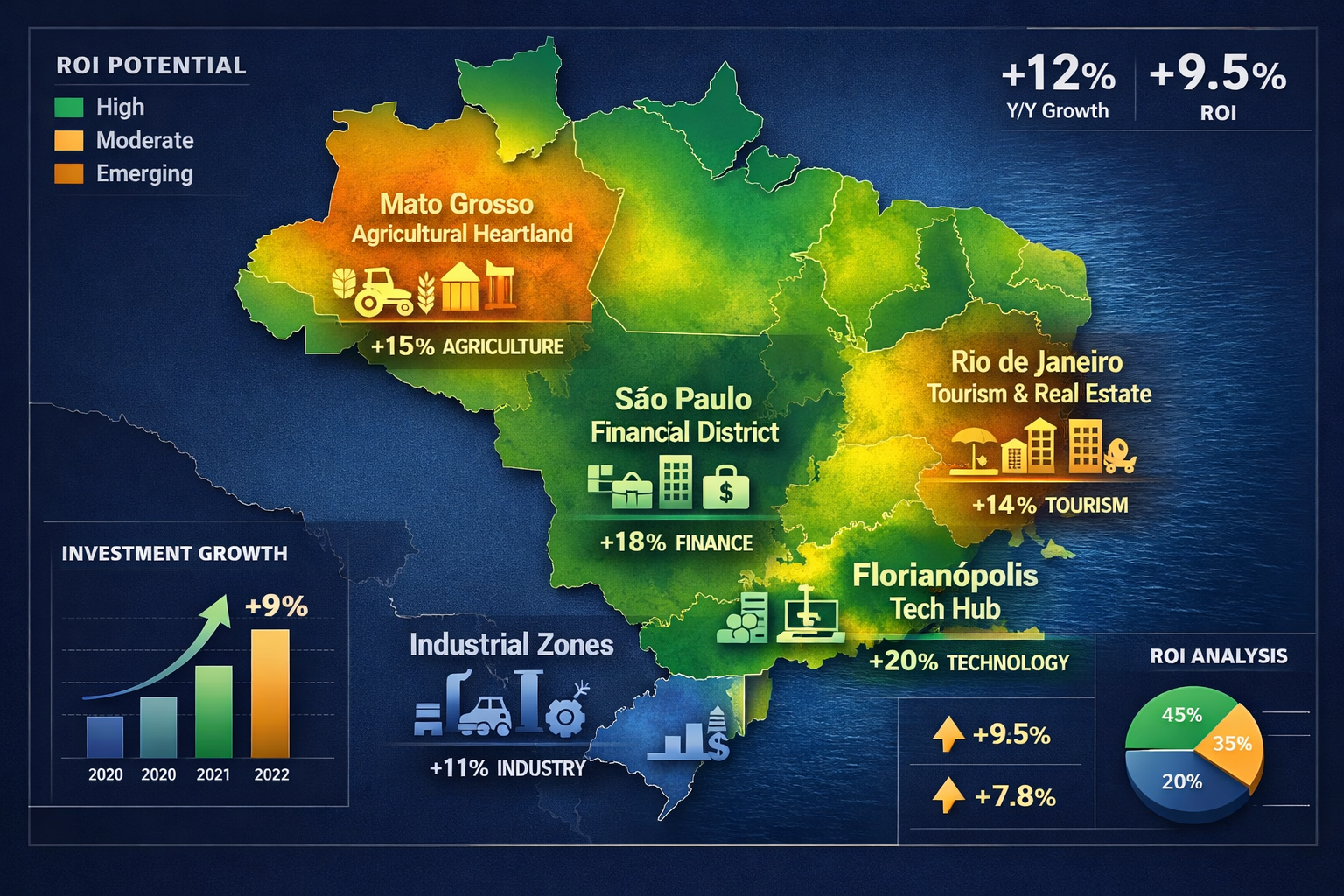
São Paulo: Financial and Business Hub
As Brazil’s largest city and financial center, São Paulo offers mature investment opportunities across all sectors. The city’s sophisticated infrastructure, skilled workforce, and concentration of corporate headquarters make it ideal for business investments.
Rio de Janeiro: Tourism and Real Estate
Rio’s iconic status as a tourist destination creates ongoing opportunities in hospitality and real estate. The city’s pre-salt oil reserves also attract energy sector investments.
Florianópolis: Technology and Quality of Life
This island city has become a magnet for technology companies and quality-of-life seekers. The real estate market in Greater Florianópolis demonstrates exceptional growth potential, driven by migration from larger cities and remote work trends.
Brasília: Government and Infrastructure
The capital city offers opportunities related to government contracting, infrastructure development, and professional services.
Agricultural Heartland: Mato Grosso and Goiás
These central states represent Brazil’s agricultural powerhouse, offering direct farmland investments and agribusiness opportunities.
Navigating Legal and Regulatory Considerations
Understanding Brazil’s legal framework is essential for successful investment. While the country has made significant progress in reducing bureaucracy, investors should be aware of key regulations.
Foreign Investment Regulations
Brazil generally welcomes foreign investment, with few restrictions outside sensitive sectors like defense and certain natural resources. Foreign investors enjoy the same rights as Brazilian nationals in most areas.
Key requirements include:
- Tax registration (CPF or CNPJ): Required for all investors
- Central Bank registration: For foreign capital entering Brazil
- Legal representation: Often necessary for property transactions
- Due diligence: Thorough investigation of investment opportunities
Tax Considerations
Brazil’s tax system can be complex, but understanding key obligations helps optimize returns:
- Capital gains tax: Typically 15-22.5% on investment profits
- Property tax (IPTU): Annual municipal property tax
- Rental income tax: Progressive rates on rental earnings
- Corporate taxes: For business investments
- Inheritance and gift taxes: State-level taxes on transfers
Working with experienced professionals who understand Brazilian tax law is crucial. Many investors structure investments through holding companies to optimize tax efficiency.
Working with Local Partners
Successful investment in Brazil often requires local expertise. Partnering with established developers provides crucial advantages:
- Market knowledge: Understanding local conditions and opportunities
- Regulatory navigation: Managing permits, licenses, and compliance
- Risk mitigation: Avoiding common pitfalls and scams
- Network access: Connections to professionals and service providers
- Cultural understanding: Navigating business customs and practices
Risk Management and Investment Strategies
Every investment carries risks, and Brazil presents both unique challenges and opportunities for risk management.
Common Investment Risks
Currency fluctuation: The Brazilian Real can be volatile against major currencies. Investors should consider hedging strategies or focus on Real-denominated returns.
Political uncertainty: While improving, Brazil’s political landscape can shift. Diversification across sectors and regions helps manage this risk.
Bureaucratic complexity: Brazil’s regulatory environment can be challenging. Professional guidance reduces complications.
Economic cycles: Like all economies, Brazil experiences ups and downs. Long-term investment horizons smooth out cyclical volatility.
Proven Investment Strategies
Diversification: Spreading investments across multiple sectors and regions reduces concentration risk. Consider combining real estate, stocks, and fixed-income investments.
Long-term perspective: Brazil rewards patient investors. Property values, in particular, tend to appreciate significantly over 5-10 year periods.
Local expertise: Working with experienced local developers provides crucial market insights and risk mitigation.
Due diligence: Thorough research and professional verification of all investment opportunities prevents costly mistakes.
Gradual entry: Starting with smaller investments while learning the market reduces initial risk exposure.
Current Market Trends Shaping Investment Opportunities
Digital Transformation
Brazil’s rapid digital adoption is creating opportunities across sectors. E-commerce penetration continues growing, fintech solutions are revolutionizing banking, and remote work is reshaping real estate demand.
Sustainability Focus
Environmental, social, and governance (ESG) considerations are increasingly important. Investments demonstrating sustainability credentials attract premium valuations and preferential financing.
Infrastructure Development
Brazil’s infrastructure investment program is modernizing transportation, energy, and communications networks. These improvements enhance the value of related investments.
Demographic Shifts
Brazil’s growing middle class and urbanization trends create sustained demand for housing, consumer goods, and services. Understanding demographic patterns helps identify emerging opportunities.
Regional Development
Smaller cities and emerging regions are experiencing accelerated growth as people seek better quality of life and lower costs. Regions like Florianópolis exemplify this trend.
Practical Steps to Start Investing in Brazil
Step 1: Define Your Investment Goals
Clarify your objectives, timeline, and risk tolerance. Are you seeking income, appreciation, or both? What investment horizon works for your situation?
Step 2: Research and Education
Study Brazilian markets, economic conditions, and specific sectors of interest. Explore current market news to stay informed about developments.
Step 3: Assemble Your Team
Identify trusted professionals including:
- Real estate developer or broker
- Tax advisor familiar with Brazilian law
- Legal counsel
- Financial advisor
- Currency exchange specialist
Step 4: Start Small and Scale
Consider beginning with a manageable investment to learn the market. Reviewing specific developments helps understand what’s available.
Step 5: Conduct Thorough Due Diligence
Verify all claims, inspect properties, review financial statements, and confirm legal compliance before committing capital.
Step 6: Execute and Monitor
Complete your investment transaction with proper documentation, then actively monitor performance and market conditions.
Step 7: Optimize and Expand
Based on experience and results, refine your strategy and consider additional investments that align with your goals.
Success Stories: Real Returns from Brazilian Investments
Real estate investors who purchased pre-construction properties in Florianópolis between 2020-2023 have seen appreciation of 35-50% by 2026. Those who bought in emerging neighborhoods experienced even higher returns as infrastructure improved.
Agribusiness investors benefited from strong commodity prices and Brazil’s expanding agricultural exports. Farmland values in productive regions increased 20-30% over the past three years.
Technology sector investments yielded exceptional returns, with several Brazilian unicorns providing early investors with multiples of 10x or more on their capital.
These success stories share common elements: thorough research, local expertise, patience, and strategic timing. They also demonstrate that investment opportunities in Brazil can deliver substantial returns when approached systematically.
Comparing Brazil to Other Emerging Markets
Brazil offers distinct advantages compared to other emerging market destinations:
Versus Mexico: Brazil has a larger domestic market and more diverse economy, though Mexico benefits from proximity to the United States.
Versus India: Brazil offers easier market access for Western investors and less competition, while India has faster GDP growth.
Versus Southeast Asia: Brazil provides stronger property rights protection and more developed financial markets, though Asian markets often have lower entry costs.
Versus Eastern Europe: Brazil offers higher growth potential and more natural resources, while Eastern Europe provides EU market access.
Brazil’s combination of market size, resource wealth, and improving governance creates a compelling investment case within the emerging markets universe.
Future Outlook: Brazil’s Investment Landscape Beyond 2026
Looking ahead, several trends will shape investment opportunities in Brazil:
Continued urbanization will drive demand for housing, infrastructure, and services in growing cities. The urban population is expected to reach 90% by 2030.
Technology adoption will accelerate across all sectors, creating opportunities in digital transformation, automation, and innovation.
Sustainability requirements will become more stringent, rewarding investments in clean energy, sustainable agriculture, and green construction.
Regional integration within Latin America will expand trade and investment opportunities across borders.
Infrastructure modernization will continue, improving logistics, reducing costs, and enhancing competitiveness.
These trends suggest that Brazil’s investment appeal will strengthen over the coming decade, particularly for investors who position themselves strategically now.
Conclusion: Seizing Brazilian Investment Opportunities in 2026
Brazil stands at an inflection point where economic stability, demographic trends, and sectoral growth converge to create exceptional investment opportunities in Brazil. From real estate developments in thriving cities like Florianópolis to technology startups in São Paulo, from vast agricultural lands to renewable energy projects, the breadth of opportunities accommodates diverse investment strategies and risk profiles.
The key to success lies in thorough preparation, local expertise, and strategic execution. Understanding Brazil’s unique characteristics—its regulatory environment, cultural nuances, and market dynamics—separates successful investors from those who struggle.
Your Next Steps
Ready to explore investment opportunities in Brazil? Consider these actionable steps:
- Contact experienced local developers who can guide you through the investment process
- Review specific investment projects like Solis or Tramonto to understand what’s available
- Consult with tax and legal professionals familiar with Brazilian investment law
- Visit Brazil to experience markets firsthand and build local relationships
- Start with a manageable investment that allows you to learn while limiting initial risk
Brazil’s economic resurgence in 2026 creates a window of opportunity that forward-thinking investors are already seizing. Whether you’re seeking steady rental income, long-term appreciation, or participation in high-growth sectors, Brazil offers pathways to achieve your investment goals.
The question isn’t whether Brazil offers compelling investment opportunities—the evidence clearly demonstrates it does. The question is whether you’ll take action to participate in this dynamic market’s growth story. With proper guidance, due diligence, and strategic planning, investment opportunities in Brazil can become a cornerstone of your wealth-building strategy.