
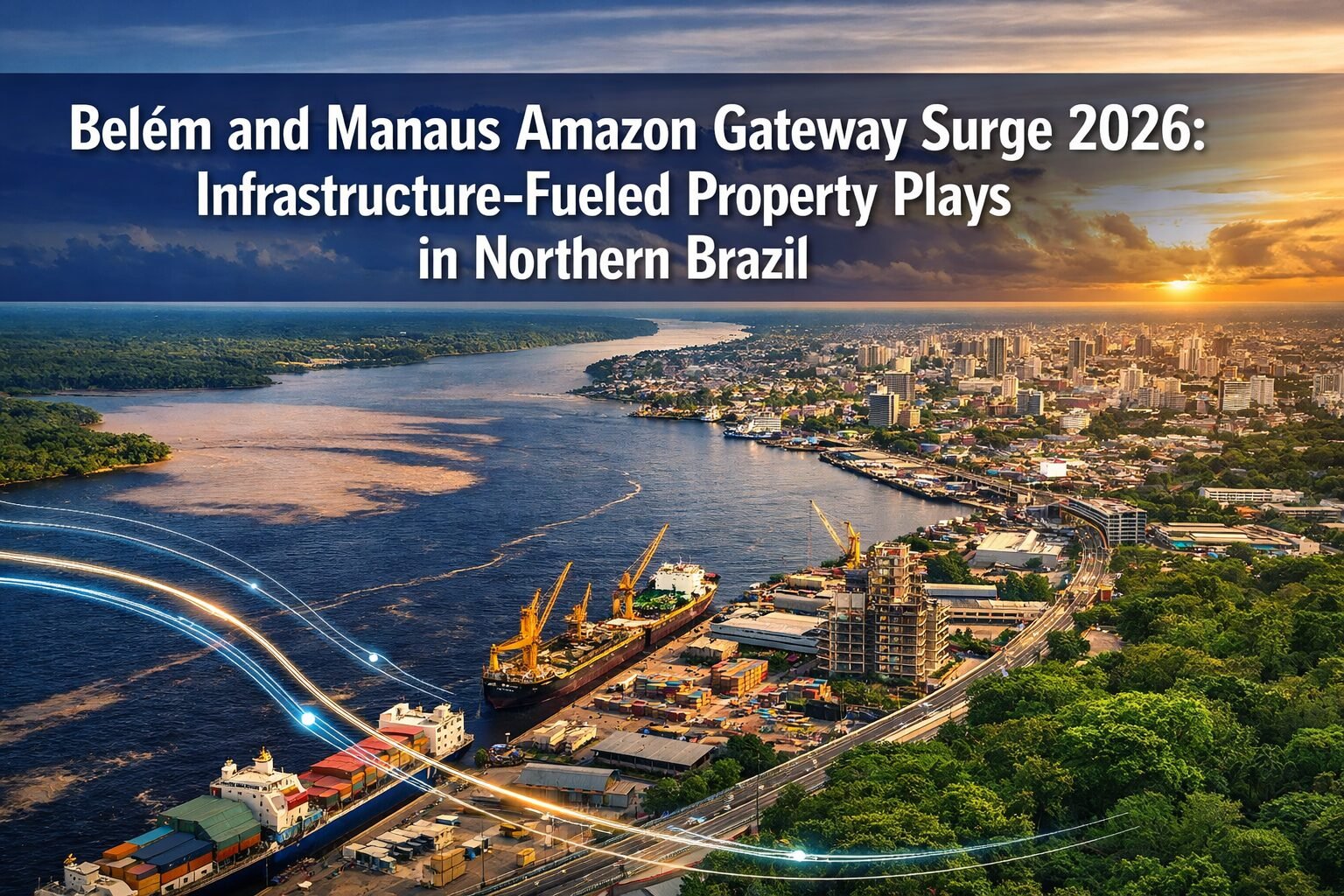
The Amazon rainforest has long remained Brazil’s final frontier for real estate development, but 2026 marks a pivotal transformation. As massive infrastructure projects reshape the connectivity of Belém and Manaus, these northern gateway cities are experiencing unprecedented property market momentum. The Belém and Manaus Amazon Gateway Surge 2026: Infrastructure-Fueled Property Plays in Northern Brazil represents a unique opportunity for investors seeking diversification beyond the saturated southern markets of São Paulo and Rio de Janeiro.
With the Brazilian government’s Novo PAC (Growth Acceleration Program) extensions driving billions in strategic investments, these Amazon cities are witnessing 20-30% property value uplifts fueled by port modernization, highway reconstruction, and bioeconomy initiatives. The convergence of logistics enhancement, eco-tourism expansion, and sustainable development financing is creating a compelling narrative for forward-thinking real estate investors.
Key Takeaways
- 🛣️ BR-319 Highway reconstruction connecting Manaus to national road networks promises to reduce shipping costs by over 80%, potentially cutting container expenses by up to $5,000 during drought periods
- 🌱 Banco do Brasil’s R$2 billion Bioeconomy Financial Hub is actively financing sustainable supply chains in Manaus and Belém, with projections to reach R$5 billion by 2030
- 🏗️ COP30 legacy infrastructure in Belém delivered cutting-edge sustainable developments including Porto do Futuro II and the Amazon Bioeconomy Park, reducing construction timelines by 62%
- 📊 Property appreciation of 20-30% is projected in strategic zones near port facilities, logistics corridors, and eco-tourism developments as infrastructure projects materialize
- 🌍 Bioceanic Corridor railway plans linking Brazilian Amazon to Peru’s China-backed Chancay Port position Manaus and Belém as critical Pacific trade gateways
Infrastructure Revolution: The Foundation of Belém and Manaus Amazon Gateway Surge 2026
BR-319 Highway: Breaking Manaus’s Geographic Isolation
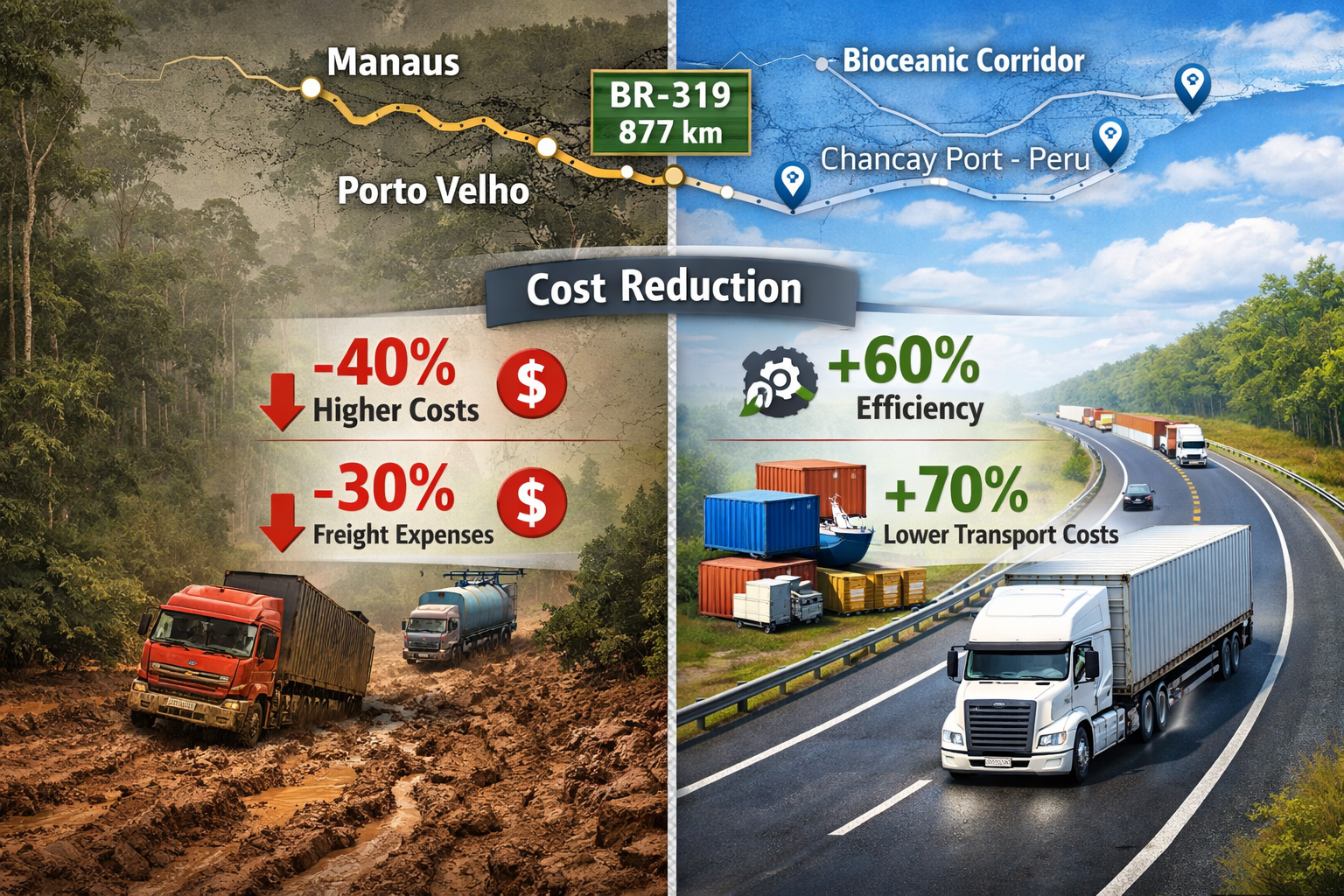
The controversial BR-319 Highway represents the most significant infrastructure catalyst for the Belém and Manaus Amazon Gateway Surge 2026. This 877-kilometer road connecting Manaus and Porto Velho gained substantial momentum in 2025 following licensing reforms that fast-track “strategic” infrastructure projects, with President Lula personally cementing support for the repaving initiative [1].
For property investors, the implications are profound. Manaus currently faces shipping costs over five times the Brazilian average due to reliance on river and air freight [2]. The BR-319 reconstruction promises to:
- Reduce logistics expenses for the Free Economic Zone of Manaus, enhancing industrial competitiveness
- Open land corridors for year-round transportation, eliminating seasonal river navigation constraints
- Attract manufacturing expansion as supply chain reliability improves
- Drive residential demand in logistics-adjacent neighborhoods and industrial corridors
However, savvy investors must balance opportunity with environmental considerations. Environmentalists warn the highway could trigger “fishbone pattern” illegal side roads, potentially accelerating deforestation [1]. This dynamic creates a premium for properties in officially designated development zones with clear environmental licensing, while speculative land purchases in unregulated areas carry significant regulatory risk.
Waterway Enhancement and Port Modernization
Beyond highways, waterway infrastructure is transforming commodity shipping capacity. IBAMA approved blasting operations on the Tocantins River’s 35-kilometer Pedral do Lourenço rock formation in May 2025, enabling year-round soybean shipping to China [1][3].
For Belém specifically, this enhancement positions the city as a critical export gateway for Brazil’s agricultural heartland. Property investors should focus on:
- Warehouse and logistics facilities near expanded port zones
- Commercial real estate serving increased port worker populations
- Mixed-use developments capitalizing on enhanced economic activity
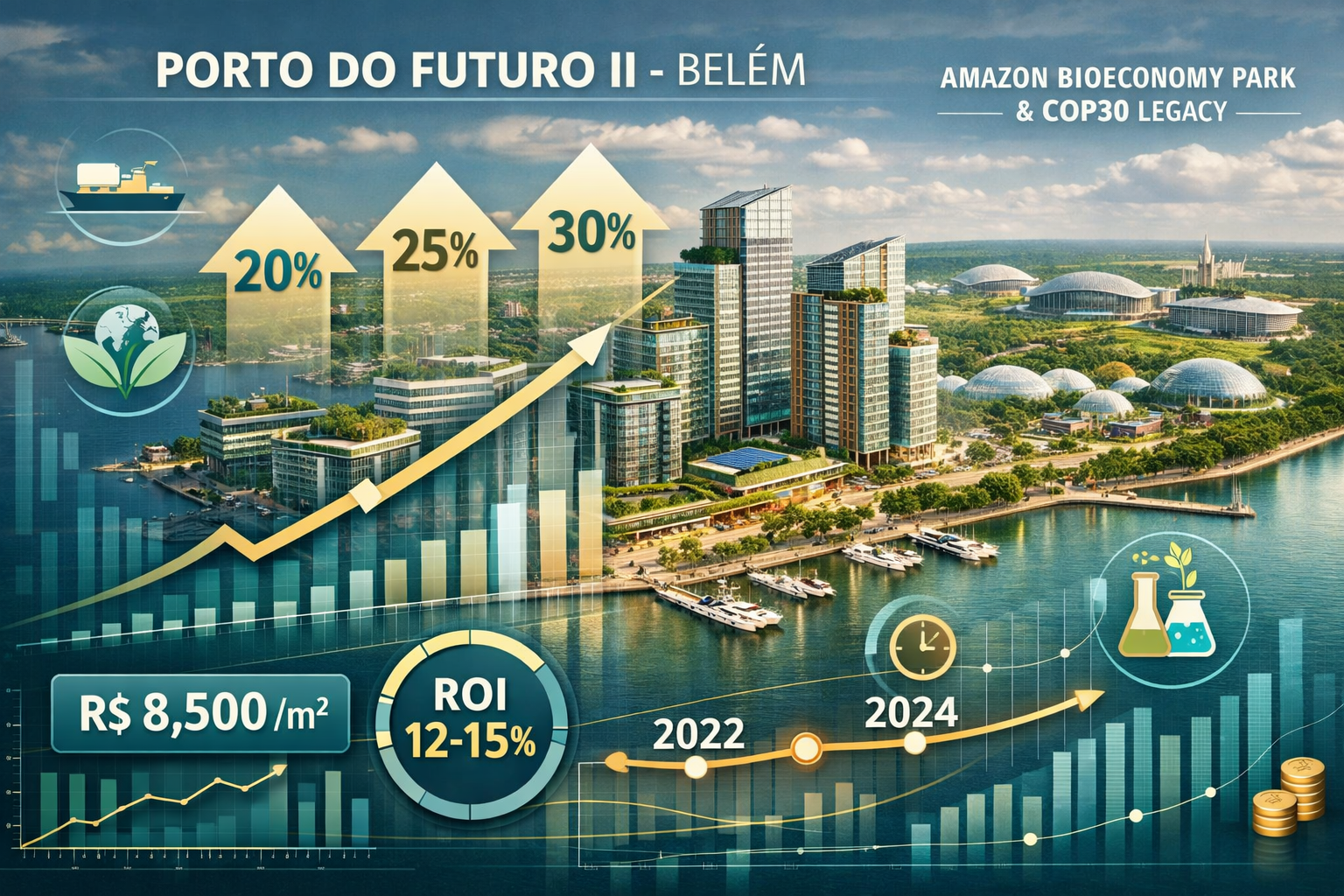
The Porto do Futuro II project in Belém exemplifies this transformation, merging early industrial architecture with modern sustainable design. Remarkably, digital integration on these projects cut construction time by 62% and saved approximately $7 million [5], demonstrating the efficiency gains driving northern Brazil’s development surge.
Bioceanic Corridor: Pacific Trade Gateway Positioning
Perhaps the most ambitious infrastructure vision involves the Bioceanic Corridor railway, linking the Brazilian Amazon to Peru’s Chancay Port—a China Belt and Road Initiative hub inaugurated in November 2025 [1]. This railway would create an entirely new logistics network connecting commodity production to Pacific markets, bypassing traditional Atlantic shipping routes.
For the Belém and Manaus Amazon Gateway Surge 2026, this positions both cities as critical nodes in South America’s evolving trade architecture. Property plays include:
- Industrial land positioned along planned railway corridors
- Intermodal facility zones where rail, river, and road transport converge
- Service sector commercial space supporting expanded trade operations
Investors exploring best places to invest in Brazil property should recognize that northern gateway cities offer fundamentally different value propositions than traditional coastal markets, with infrastructure-driven appreciation replacing beach tourism premiums.
Property Market Dynamics: Understanding the Belém and Manaus Amazon Gateway Surge 2026
Belém: COP30 Legacy and Sustainable Urban Development
Belém, the capital of Pará state with a population of 1.3 million, serves as the gateway to the Amazon at the mouth of the Pará River where it meets the Atlantic Ocean [6]. The city’s hosting of COP30 in 2025 catalyzed substantial infrastructure investment that continues to drive property appreciation in 2026.
Key Belém property sectors experiencing growth:
| Property Type | Growth Driver | Projected Appreciation |
|---|---|---|
| Waterfront Mixed-Use | Porto do Futuro II development | 25-30% (2026-2028) |
| Eco-Tourism Hospitality | Amazon Bioeconomy Park proximity | 20-25% (2026-2028) |
| Logistics Warehousing | Tocantins River navigation enhancement | 22-28% (2026-2028) |
| Sustainable Residential | COP30 green building standards | 18-23% (2026-2028) |
The Amazon Bioeconomy Park represents a particularly compelling investment thesis. This development integrates sustainable supply chain facilities with research centers focused on Amazon forest products, creating demand for:
- Residential properties for researchers and bioeconomy professionals
- Commercial office space for sustainable businesses and NGOs
- Hospitality facilities serving eco-tourism and conference attendees
Banco do Brasil’s Bioeconomy Financial Hub is providing R$2 billion in financing for sustainable supply chain initiatives across the Amazon and Atlantic Forest regions, with branches in Manaus and Belém already operational and expectations to reach R$5 billion by 2030 [4]. This dedicated financing infrastructure reduces capital access barriers for developers pursuing sustainable projects, creating a favorable environment for green real estate development.
Manaus: Free Economic Zone Expansion and Industrial Growth
Manaus presents a distinctly different investment profile centered on its Free Economic Zone—Brazil’s largest tax-incentivized industrial hub. The city’s geographic isolation has historically constrained growth, but the BR-319 Highway and bioceanic railway projects promise to fundamentally alter this dynamic.
Critical Manaus property investment considerations:
✅ Opportunity Factors:
- Industrial land near highway corridors experiencing 20-30% appreciation
- Residential demand from manufacturing sector expansion
- Commercial retail serving growing middle-class workforce
- Technology sector growth in tax-advantaged environment
⚠️ Risk Factors:
- Drought-induced freight cost volatility (up to $5,000 per container increase) [2]
- Environmental regulatory uncertainty affecting development approvals
- Dependency on federal tax incentive continuation
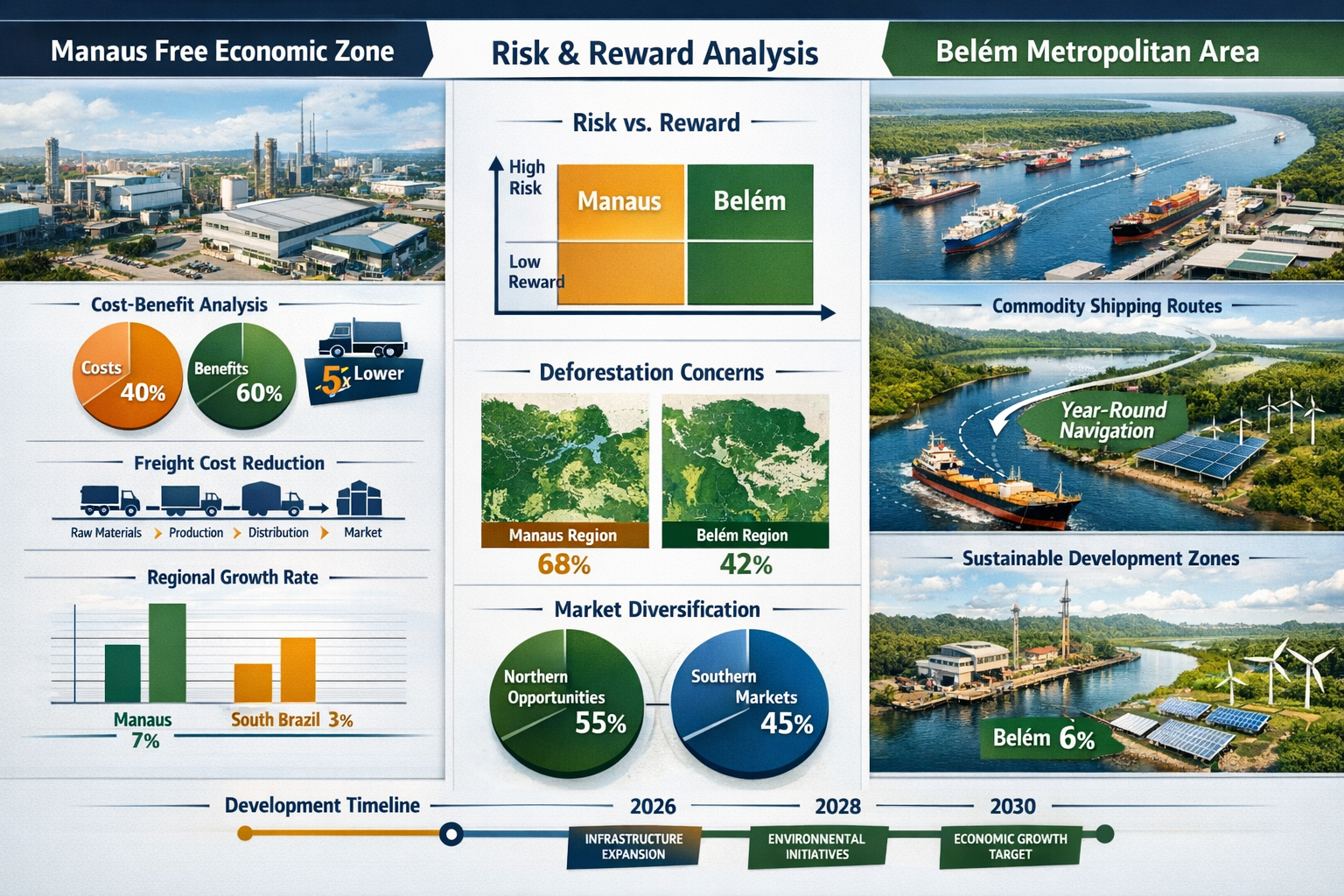
- Deforestation concerns potentially triggering investment restrictions
The Amazonas State Industry Federation has highlighted that severe droughts can increase freight costs by up to $5,000 per container [2], underscoring the critical importance of the BR-319 Highway for economic stability. Property investors should prioritize assets positioned to benefit from multimodal transportation options, reducing vulnerability to single-route disruptions.
For those considering buying pre-construction properties, Manaus offers compelling opportunities in industrial park adjacent residential developments, where workforce housing demand is projected to grow 15-20% annually through 2028.
Comparative Advantage: Northern vs. Southern Brazilian Markets
The Belém and Manaus Amazon Gateway Surge 2026 offers diversification benefits that distinguish these markets from saturated southern alternatives:
Northern Gateway Advantages:
- 🌱 Lower entry prices: 40-60% below comparable São Paulo properties
- 📈 Infrastructure-driven appreciation: Government-backed development certainty
- 🌍 Emerging trade routes: Pacific corridor positioning vs. established Atlantic routes
- 💚 Sustainability premium: ESG-focused investors prioritizing bioeconomy exposure
- 🏗️ Development stage: Early-cycle opportunities vs. mature southern markets
Considerations vs. Southern Markets:
- 📊 Liquidity constraints: Smaller buyer pools and longer transaction timelines
- 🏛️ Regulatory complexity: Environmental licensing requirements more stringent
- 🌧️ Climate factors: Seasonal flooding and drought cycles affecting construction
- 🏘️ Amenity gaps: Less developed urban infrastructure than established cities
Investors exploring various Brazilian property markets should allocate 15-25% of Brazil-focused portfolios to northern gateway cities, balancing high-growth potential with geographic and regulatory diversification.
Strategic Investment Approaches for Infrastructure-Fueled Property Plays
Targeting Infrastructure-Adjacent Development Zones
The most reliable appreciation strategy involves proximity to confirmed infrastructure projects. Investors should prioritize:
- 500-meter radius from BR-319 highway interchanges in Manaus
- Port facility expansion zones in Belém’s waterfront districts
- Bioceanic railway corridor designated areas (pending final route approval)
- Amazon Bioeconomy Park commercial zones in Belém
- Free Economic Zone expansion districts in Manaus
These zones benefit from zoning clarity, infrastructure investment certainty, and developer interest concentration, creating liquidity advantages over speculative rural land purchases.
Sustainable Development Premium Positioning
The COP30 legacy in Belém has established green building standards that command premium pricing. Properties featuring:
- ☀️ Solar energy integration
- 💧 Rainwater harvesting systems
- 🌳 Native Amazon species landscaping
- ♻️ Circular economy waste management
- 🏗️ Locally sourced sustainable materials
…are experiencing 8-12% pricing premiums over conventional developments, with this gap projected to widen as ESG investment mandates strengthen.
The R$2 billion Bioeconomy Financial Hub specifically targets sustainable projects [4], creating preferential financing access for developers meeting environmental criteria. Investors should partner with developers demonstrating:
- Environmental licensing track records in Amazon region
- Bioeconomy sector partnerships with research institutions
- Community engagement programs with indigenous and traditional populations
- Transparent sustainability reporting aligned with international standards
Timing Considerations and Market Entry Strategies
The Belém and Manaus Amazon Gateway Surge 2026 presents different timing windows for optimal entry:
Immediate Entry (2026-2027):
- Belém waterfront zones capitalizing on COP30 momentum
- Manaus industrial corridor land before BR-319 completion
- Pre-construction residential near confirmed infrastructure
Medium-Term Entry (2027-2028):
- Bioceanic railway corridor properties as route finalizes
- Secondary neighborhood residential as primary zones saturate
- Hospitality and eco-tourism facilities as visitor infrastructure matures
Long-Term Holds (2028-2030):
- Speculative land in potential expansion corridors
- Redevelopment opportunities in legacy industrial zones
- Mixed-use projects in gentrifying neighborhoods
For investors accustomed to southern Brazilian market dynamics, northern gateway cities require longer hold periods (5-7 years vs. 3-5 years) but offer correspondingly higher appreciation potential.
Risk Management and Due Diligence Essentials
Environmental and Regulatory Compliance
The Amazon region faces heightened environmental scrutiny that directly impacts property development. Critical due diligence includes:
- Environmental licensing verification: Confirm all required permits (LP, LI, LO) are secured
- Deforestation history assessment: Properties with clearing violations face severe restrictions
- Indigenous territory proximity: Developments near protected areas require additional consultations
- Climate resilience evaluation: Flood zone mapping and drought impact assessments
Environment Minister Marina Silva has shifted focus to “damage control” through strategic environmental assessments [1], signaling that regulatory oversight will intensify rather than relax. Investors must budget 15-20% additional time for environmental compliance compared to southern Brazilian projects.
Infrastructure Delivery Risk
While government commitment to northern infrastructure is strong, execution timelines carry uncertainty. Risk mitigation strategies include:
- Phased investment approaches: Initial land acquisition followed by development capital deployment as infrastructure progresses
- Diversified project exposure: Spreading investments across highway, port, and railway-dependent assets
- Political continuity monitoring: Infrastructure programs vulnerable to administration changes
- Alternative scenario planning: Ensuring projects remain viable with partial infrastructure completion
The BR-319 Highway, despite presidential support, faces ongoing environmental legal challenges that could delay completion [1]. Prudent investors should model 12-24 month buffer periods beyond official completion projections.
Market Liquidity and Exit Planning
Northern gateway cities present thinner transaction markets than southern alternatives. Exit strategy considerations include:
- Developer partnerships: Pre-arranged buyback options or joint venture structures
- Institutional buyer cultivation: Engaging pension funds and REITs seeking northern exposure
- Rental income optimization: Ensuring positive cash flow during extended hold periods
- Flexible use zoning: Properties adaptable to multiple use cases maintain broader buyer appeal
Investors should target minimum 18-month liquidity reserves to weather potential extended marketing periods, contrasting with 6-12 month standards in São Paulo or Rio de Janeiro.
Conclusion: Capitalizing on Brazil’s Northern Gateway Transformation
The Belém and Manaus Amazon Gateway Surge 2026: Infrastructure-Fueled Property Plays in Northern Brazil represents a generational opportunity to participate in the transformation of Brazil’s final development frontier. With government-backed infrastructure investments totaling billions of reais, strategic positioning in port zones, highway corridors, and bioeconomy districts offers 20-30% appreciation potential over 3-5 year horizons.
However, success requires sophisticated understanding of environmental compliance, infrastructure delivery risks, and market liquidity constraints that distinguish northern investments from established southern markets. The convergence of the BR-319 Highway reconstruction, bioceanic railway development, waterway enhancements, and R$5 billion in bioeconomy financing creates multiple value creation pathways for discerning investors.
Actionable Next Steps for Investors
- Conduct market reconnaissance: Visit Belém and Manaus to assess infrastructure progress and identify emerging neighborhoods
- Establish local partnerships: Connect with developers, legal advisors, and environmental consultants with Amazon region expertise
- Secure financing pre-approval: Explore Bioeconomy Financial Hub programs and traditional lenders familiar with northern markets
- Develop portfolio allocation strategy: Determine appropriate northern gateway exposure relative to overall Brazil investments (recommended 15-25%)
- Monitor infrastructure milestones: Track BR-319 completion phases, bioceanic railway route announcements, and port expansion timelines
- Engage sustainability consultants: Ensure all investments meet evolving environmental standards and ESG investor requirements
For investors seeking to diversify beyond traditional Brazilian property markets, the Amazon gateway cities of Belém and Manaus offer compelling risk-adjusted returns fueled by infrastructure transformation, sustainable development momentum, and strategic trade corridor positioning. The window for early-stage entry is narrowing as institutional investors recognize the opportunity—decisive action in 2026 positions investors to capture the full appreciation cycle through 2030 and beyond.
References
[1] The Amazon In 2026 A Challenging Year Ahead Now Off The Center Stage – https://news.mongabay.com/2025/12/the-amazon-in-2026-a-challenging-year-ahead-now-off-the-center-stage/
[2] 03085147.2025 – https://www.tandfonline.com/doi/full/10.1080/03085147.2025.2588934
[3] Brazil Amazon Drilling Deforestation Cop30 – https://finance-commerce.com/2025/06/brazil-amazon-drilling-deforestation-cop30/
[4] Populations Of The Amazon And Atlantic Forest To Receive Over R 2 Billion In Funding For Sustainable Supply Chains – https://cop30.br/en/news-about-cop30/populations-of-the-amazon-and-atlantic-forest-to-receive-over-r-2-billion-in-funding-for-sustainable-supply-chains
[5] Where The World Meets The Amazon A 3d Tour Cop30s Host City Of Belem – https://blog.bentley.com/insights/where-the-world-meets-the-amazon-a-3d-tour-cop30s-host-city-of-belem/
[6] Amazons Gateway Why Cop30 Belem Must Put Health And Equity Heart Climate Action – https://www.gavi.org/vaccineswork/amazons-gateway-why-cop30-belem-must-put-health-and-equity-heart-climate-action