
Brazil’s real estate landscape is undergoing a dramatic transformation as short-term rental platforms collide with traditional residential development models. In 2026, developers across São Paulo, Rio de Janeiro, and emerging markets like Florianópolis face a complex challenge: designing condominiums that satisfy both long-term residents and the lucrative tourism market while navigating an increasingly intricate web of regulations. The question of Short-Term Rental Regulation and Condo Design in Brazil: How Airbnb Rules Are Reshaping Urban Developments has moved from a niche concern to a central consideration in project planning, unit mix decisions, and amenity programming.
This regulatory evolution is forcing developers to rethink everything from unit layouts to governance structures, creating a new category of hybrid residential-tourism properties that must balance profitability with community harmony and legal compliance.
Key Takeaways
🏢 Three-layered legal complexity: Brazilian short-term rentals operate under federal law (90-day maximum), condominium association rules (which can prohibit Airbnb), and municipal regulations—all three must align for legal operation[1]
📋 Condominium power: Brazil’s Superior Court of Justice confirmed in 2021 and 2023 that condo associations can restrict or ban short-term rentals in buildings classified as “exclusively residential” through assembly votes[1]
🏗️ Design adaptation: Developers are creating dual-purpose buildings with separate zones, enhanced soundproofing, flexible amenities, and governance structures that accommodate both resident types
🌆 Municipal divergence: Cities like Rio de Janeiro and São Paulo are implementing registration requirements, safety standards, and targeted restrictions that vary significantly by location[3][4]
💼 Investment implications: Understanding regulatory frameworks is essential for developers and investors targeting high-return property locations in Brazil
Understanding Brazil’s Three-Layered Regulatory Framework for Short-Term Rentals
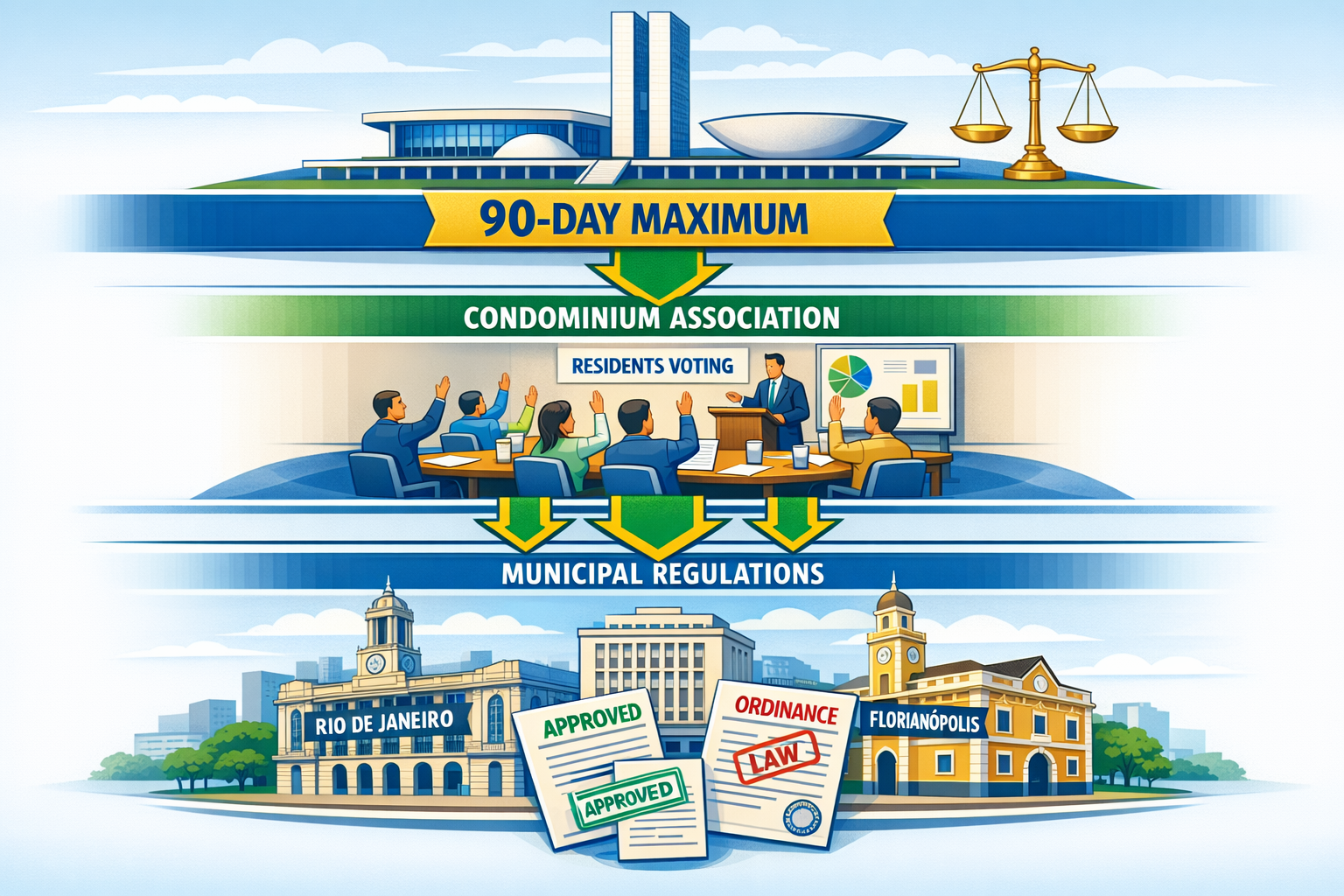
The complexity of Short-Term Rental Regulation and Condo Design in Brazil: How Airbnb Rules Are Reshaping Urban Developments stems from a unique three-tiered legal structure that creates both opportunities and obstacles for property developers.
Federal Law: The 90-Day Foundation
At the national level, Brazilian law recognizes aluguel por temporada (short-term rentals) as legitimate rental arrangements for stays up to 90 days, with no federally mandated minimum stay period[1]. This federal framework provides the baseline legal protection for short-term rental operations across the country.
According to Airbnb’s official guidance, condominiums cannot impose minimum mandatory stay periods that contradict this federal protection[2]. This creates a foundational right for property owners—but one that can be significantly restricted by other governance layers.
Condominium Association Authority: The Local Veto Power
The most significant regulatory development came through Brazil’s Superior Court of Justice (STJ) rulings in 2021 and 2023, which established that condominium associations possess substantial authority to restrict short-term rentals[1]. These landmark decisions confirmed that:
- Buildings classified as “exclusively residential” can prohibit short-term rentals entirely
- Restrictions must be approved through formal assembly votes by residents
- Decisions must be documented in official meeting minutes
- Operating without written condominium approval creates significant legal exposure
This judicial precedent fundamentally changed the development landscape. Developers now recognize that federal legality doesn’t guarantee operational viability—condominium governance has become the critical gatekeeper.
“Hosts must obtain written approval from condominium associations recorded in official meeting minutes; operating without clear authorization creates legal exposure despite federal protections.”[1]
Municipal Regulations: The Emerging Third Layer
Cities across Brazil are implementing their own registration, taxation, and safety requirements, creating a patchwork of local rules:
| City | Key Regulations (2026) | Status |
|---|---|---|
| Rio de Janeiro | PL 372/2025: Mandatory city registration, condominium approval verification, fire safety standards[3][4] | Under debate |
| São Paulo | Short-term rentals banned in subsidized social housing (May 2025)[3] | Implemented |
| Florianópolis | Registry bill to track and regulate short-term rental units[3] | Proposed |
Rio de Janeiro authorities are particularly active, exploring three revenue mechanisms: ISS (Service Tax) collection through rental platforms, a tourism-related Taxa de Estadia (accommodation fee), and mandatory property registration systems[4].
For developers evaluating market opportunities in Florianópolis, understanding these evolving municipal frameworks is essential for project feasibility analysis.
The Documentation Challenge
The most practical implication of this three-layered system is the documentation burden. Developers and investors must secure:
✅ Compliance with federal rental duration limits
✅ Written condominium association approval in meeting minutes
✅ Municipal registration and licensing (where required)
✅ Safety certification and compliance documentation
✅ Tax registration with local authorities
Without all three layers aligned, even federally legal properties may be operationally prohibited—a reality reshaping how developers approach project design from conception.
How Short-Term Rental Regulation and Condo Design in Brazil Are Transforming Development Strategies
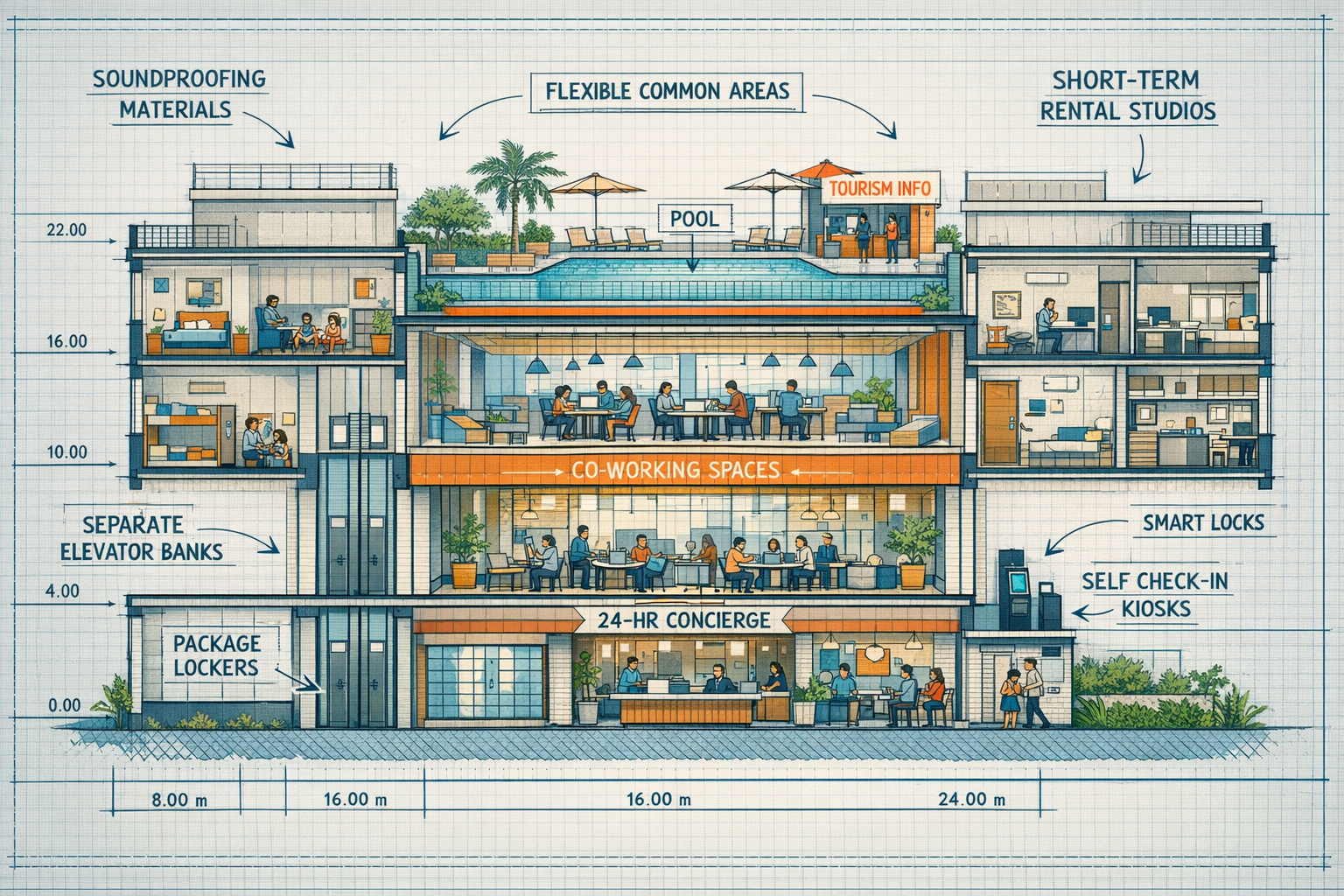
The regulatory complexity surrounding Short-Term Rental Regulation and Condo Design in Brazil: How Airbnb Rules Are Reshaping Urban Developments has forced developers to fundamentally reimagine project design, unit mix, and amenity programming. Rather than treating short-term rentals as an afterthought, forward-thinking developers are integrating regulatory compliance and hybrid-use functionality into their core design philosophy.
Unit Mix Optimization: Studios and Compact Layouts
The shift toward short-term rental accommodation is driving significant changes in unit type distribution. Developers are increasingly incorporating:
- Studio and one-bedroom units (25-45m²) optimized for tourist stays
- Compact, efficient layouts that maximize rental yield per square meter
- Flexible furniture packages that appeal to both long-term residents and short-term guests
- Smart home technology enabling remote management and self-check-in
This trend aligns with broader market dynamics in cities like Florianópolis, where studio investments are gaining traction among developers targeting hybrid residential-tourism demand.
Architectural Segregation: Dual-Zone Design
To address condominium association concerns about mixing long-term residents with transient guests, innovative developers are implementing spatial segregation strategies:
🏢 Separate elevator banks for residential and short-term rental floors
🚪 Dedicated entrance lobbies with distinct check-in facilities
🔇 Enhanced soundproofing between units and on short-term rental floors
📦 Isolated package and luggage storage areas
🏊 Tiered amenity access with different usage rules by resident type
This architectural approach allows buildings to accommodate both use cases while minimizing friction between resident groups—a critical consideration given condominium associations’ legal authority to ban short-term rentals entirely[1].
Amenity Programming: Hospitality Meets Residential
The amenity mix in new developments increasingly reflects hybrid residential-tourism programming:
Traditional Residential Amenities:
- Children’s playrooms and family recreation areas
- Quiet study rooms and libraries
- Long-term resident social spaces
Tourism-Oriented Additions:
- Co-working spaces with day-use desks
- 24-hour concierge and reception services
- Multilingual staff and signage
- Tourist information centers
- Flexible event spaces for short-term bookings
Shared Hybrid Spaces:
- Rooftop pools with extended hours
- Fitness centers with keycard access tracking
- Pet-friendly areas with clear usage policies
- Bike storage and mobility solutions
This amenity evolution is particularly evident in growing regions like Ingleses in Florianópolis, where infrastructure improvements support both residential quality of life and tourism appeal.
Governance Structure: Built-in Regulatory Compliance
Perhaps the most significant design innovation is the integration of governance mechanisms directly into condominium documentation:
📋 Pre-approved short-term rental zones designated in founding documents
⚖️ Tiered voting structures that protect minority short-term rental rights
📊 Behavior-based regulations (noise limits, occupancy caps, pool hours) rather than blanket bans
💰 Differential fee structures with higher condo fees for short-term rental units
🔐 Technology requirements (smart locks, noise monitors, guest registration systems)
Developers are learning that behavior-focused regulations rather than platform-based blanket bans typically signal that Airbnb operations remain permissible—provided hosts maintain control over guest conduct[1].
Case Study: The “Airbnb-Ready” Development Model
Leading Brazilian developers are now marketing “Airbnb-ready” or “flex-use” buildings that explicitly accommodate short-term rentals through:
- Legal pre-clearance: Condominium bylaws approved before launch with short-term rental permissions
- Operational infrastructure: Management companies, cleaning services, and guest support built into the building
- Technology integration: Building-wide systems for guest access, monitoring, and compliance
- Transparent marketing: Clear disclosure to all buyers about the building’s hybrid nature
This approach addresses the primary risk factor identified in regulatory analysis: operating without clear condominium authorization[1]. By establishing permissions upfront, developers create certainty for investors seeking properties with strong appreciation potential.
The Financial Calculus: Development Cost vs. Revenue Optimization
The design adaptations required for regulatory compliance and hybrid-use functionality add 5-12% to development costs, according to industry estimates:
Additional Cost Drivers:
- Enhanced soundproofing materials
- Duplicate infrastructure (elevators, lobbies)
- Technology systems and smart home integration
- Legal and consulting fees for governance structure
- Premium amenities and hospitality-grade finishes
Revenue Optimization Opportunities:
- Higher unit sales prices (10-15% premium for “Airbnb-ready” units)
- Differential condo fee revenue from short-term rental units
- Amenity fee income from guest usage
- Faster sales velocity to investor buyers
- Premium positioning in competitive markets
For developers, the calculation increasingly favors hybrid-design approaches, particularly in high-performance markets like Florianópolis where tourism demand remains robust.
Municipal Divergence and Future Regulatory Trends in Brazilian Short-Term Rentals

As Short-Term Rental Regulation and Condo Design in Brazil: How Airbnb Rules Are Reshaping Urban Developments continues to evolve, the divergence between municipal approaches is creating distinct regional markets with varying risk-reward profiles for developers and investors.
Rio de Janeiro: The Registration and Revenue Model
Rio de Janeiro represents the most comprehensive municipal regulatory approach currently under development. The proposed PL 372/2025 legislation would establish:
🔍 Mandatory online property registration with city authorities
✅ Condominium approval verification before registration approval
🔥 Minimum fire prevention and safety measures for all listed properties
💵 Formalized tax collection mechanisms through platform partnerships[3][4]
The city’s three-pronged revenue strategy focuses on:
- ISS (Service Tax) collection directly through rental platforms
- Taxa de Estadia (accommodation fee) similar to hotel tourism taxes
- Property registration fees creating a new municipal revenue stream[4]
This approach signals a shift from prohibition to regulated accommodation—recognizing short-term rentals as a legitimate economic activity that should be taxed and monitored rather than banned outright.
São Paulo: Targeted Restrictions and Social Housing Protection
São Paulo has taken a more selective prohibition approach, implementing restrictions that target specific property categories rather than blanket bans:
- Social housing ban (May 2025): Short-term rentals prohibited in subsidized housing programs[3]
- Neighborhood-specific regulations under consideration
- Platform data-sharing requirements for tax compliance
- Condominium association empowerment through streamlined restriction processes
This targeted strategy allows the city to protect affordable housing stock while preserving short-term rental opportunities in market-rate developments—a nuanced approach that reflects São Paulo’s diverse housing needs.
Florianópolis: The Tourism-Friendly Registry Model
As a major beach tourism destination, Florianópolis is developing a registry-based framework that balances tourism economic benefits with resident quality of life:
- Voluntary registry system (currently proposed) to track short-term rental inventory[3]
- Tourism zone designations with different regulatory standards
- Seasonal regulation variations allowing flexibility during peak tourism periods
- Integration with existing tourism infrastructure and promotion systems
For developers evaluating opportunities in Florianópolis, this tourism-friendly approach creates a more predictable regulatory environment compared to restrictive markets.
Reading the Regulatory Tea Leaves: Prohibition vs. Permission Signals
Developers and investors can assess regulatory direction by examining the type of restrictions being implemented:
Prohibition Signals (High Risk):
❌ Platform-based blanket bans
❌ Outright prohibitions in all residential zones
❌ Retroactive application to existing properties
❌ No registration or licensing pathway available
Permission Signals (Lower Risk):
✅ Behavior-focused regulations (noise, occupancy, hours)
✅ Registration and licensing systems
✅ Tax collection frameworks
✅ Safety and quality standards
✅ Zoning-based permissions
According to regulatory analysis, behavior-focused regulations targeting specific conduct issues (noise fines, occupancy limits, pool usage rules) rather than platform-based blanket bans typically indicate that Airbnb operations remain permissible if hosts maintain control over guest behavior[1].
The Condominium House Rules Strategy
Even in permissive regulatory environments, restrictive house rules can effectively prohibit short-term rentals from operating in practice. Common restrictions include[3]:
- Strict check-in/check-out time windows (e.g., only 9 AM – 5 PM weekdays)
- Prohibitive guest registration requirements
- Visitor access limitations
- Noise restrictions incompatible with tourism use
- Amenity usage restrictions during peak hours
- Excessive security deposit requirements for guests
Developers must design governance structures that prevent de facto prohibitions through overly restrictive house rules, even when condominium bylaws technically permit short-term rentals.
Future Regulatory Trends: What to Expect in 2026-2028
Industry observers anticipate several regulatory developments over the next 24-36 months:
Likely Developments:
- Standardized municipal registration systems across major cities
- Platform data-sharing agreements for tax collection and compliance monitoring
- Safety certification requirements (fire prevention, emergency exits, insurance)
- Neighborhood-level zoning rather than city-wide blanket approaches
- Differential taxation with higher rates for short-term vs. long-term rentals
Potential Disruptors:
- Federal legislation establishing national minimum standards
- Court challenges to municipal overreach
- Platform resistance to data-sharing requirements
- Resident backlash in overtouristed neighborhoods
- Economic pressure to preserve tourism revenue post-pandemic
For developers planning projects with 24-36 month development timelines, building in regulatory flexibility through adaptable governance structures and dual-use design becomes essential risk management.
Investment Implications: Regulatory Risk Assessment
When evaluating development opportunities, investors should assess regulatory risk across multiple dimensions:
| Risk Factor | Low Risk | Medium Risk | High Risk |
|---|---|---|---|
| Municipal stance | Registry system proposed | Active debate, no decision | Prohibition legislation pending |
| Condo governance | Pre-approved in bylaws | Silent on short-term rentals | Explicitly residential-only |
| Legal precedent | Court rulings favor owners | Mixed precedent | Recent prohibitions upheld |
| Tourism economy | Major tourism destination | Moderate tourism activity | Primarily residential market |
| Enforcement | Light touch, registry-based | Complaint-driven enforcement | Active prohibition enforcement |
Properties in low-risk categories command premium pricing and faster sales velocity, while high-risk properties may require significant discounts or repositioning as traditional residential developments.
Understanding these dynamics is crucial for developers considering pre-construction investments where regulatory changes during the development period could fundamentally alter project economics.
Conclusion: Navigating the Future of Short-Term Rental Regulation and Condo Design in Brazil
The intersection of Short-Term Rental Regulation and Condo Design in Brazil: How Airbnb Rules Are Reshaping Urban Developments represents one of the most significant transformations in Brazilian real estate in the past decade. The three-layered regulatory framework—federal law, condominium association authority, and municipal regulations—creates both complexity and opportunity for developers willing to adapt their design strategies.
Key Strategic Imperatives for Developers
1. Design for Regulatory Compliance from Conception
The days of treating short-term rental potential as an afterthought are over. Successful developments in 2026 integrate compliance mechanisms into foundational design decisions:
- Establish clear short-term rental permissions in founding condominium documents
- Implement architectural segregation to minimize resident friction
- Build technology infrastructure for guest management and monitoring
- Create governance structures that prevent future prohibition through assembly votes
2. Understand Local Regulatory Trajectories
Municipal regulations are diverging rapidly across Brazilian cities. Developers must:
- Monitor proposed legislation in target markets
- Assess whether local regulations signal prohibition or permission
- Build relationships with municipal authorities and tourism boards
- Participate in regulatory comment periods and industry advocacy
3. Target the Right Markets and Buyer Profiles
Not all markets are equally suitable for hybrid residential-tourism developments:
✅ High-opportunity markets: Tourism destinations with registry-based frameworks (Florianópolis, coastal cities)
⚠️ Medium-opportunity markets: Major cities with active regulatory debate but tourism economic benefits (Rio de Janeiro)
❌ High-risk markets: Primarily residential areas with prohibition trends or social housing focus
4. Communicate Transparently with All Stakeholders
Successful hybrid developments require buy-in from multiple parties:
- Investors: Clear disclosure of regulatory risks and opportunities
- Long-term residents: Transparent communication about building operations and protections
- Short-term rental operators: Documented permissions and operational guidelines
- Municipal authorities: Proactive engagement and compliance demonstration
Actionable Next Steps
For developers and investors evaluating opportunities in Brazil’s evolving short-term rental landscape:
Immediate Actions (Next 30 Days):
- Audit existing projects for short-term rental regulatory compliance across all three governance layers
- Review condominium bylaws to identify explicit permissions or prohibitions
- Assess municipal regulatory status in target markets through legal counsel
- Evaluate unit mix and amenity programming for hybrid-use optimization
Medium-Term Planning (Next 3-6 Months):
- Engage specialized legal counsel experienced in Brazilian short-term rental regulations
- Develop governance templates for Airbnb-ready condominium structures
- Create architectural standards for dual-zone design and soundproofing
- Build relationships with property management companies specializing in hybrid operations
Long-Term Strategy (Next 12-24 Months):
- Monitor regulatory developments through industry associations and legal updates
- Participate in municipal planning processes and regulatory comment periods
- Develop case studies demonstrating successful hybrid development models
- Position for market leadership in the emerging “flex-use” development category
The Opportunity Ahead
While regulatory complexity creates challenges, it also generates competitive advantages for developers who master the intersection of compliance, design, and market positioning. Properties that successfully navigate the three-layered regulatory framework, implement thoughtful hybrid-use design, and secure clear operational permissions command premium pricing and attract sophisticated investors.
For those seeking to capitalize on Brazil’s dynamic real estate market, understanding how Short-Term Rental Regulation and Condo Design in Brazil: How Airbnb Rules Are Reshaping Urban Developments is essential to making informed investment decisions. The developers who thrive in this environment will be those who view regulatory compliance not as a constraint, but as a design opportunity—creating buildings that serve both residents and the tourism economy while generating superior returns.
To explore current development opportunities that incorporate these hybrid-design principles, contact our team or review our current projects designed for the evolving Brazilian real estate landscape.
References
[1] Airbnb Rules Brazil – https://www.hostaway.com/blog/airbnb-rules-brazil/
[2] airbnb – https://www.airbnb.com/help/article/2588
[3] Watch – https://www.youtube.com/watch?v=UDp32QxWqoU
[4] Rio Airbnb Regulation Outlook – https://www.oabitat.com/en/rio-airbnb-regulation-outlook/