
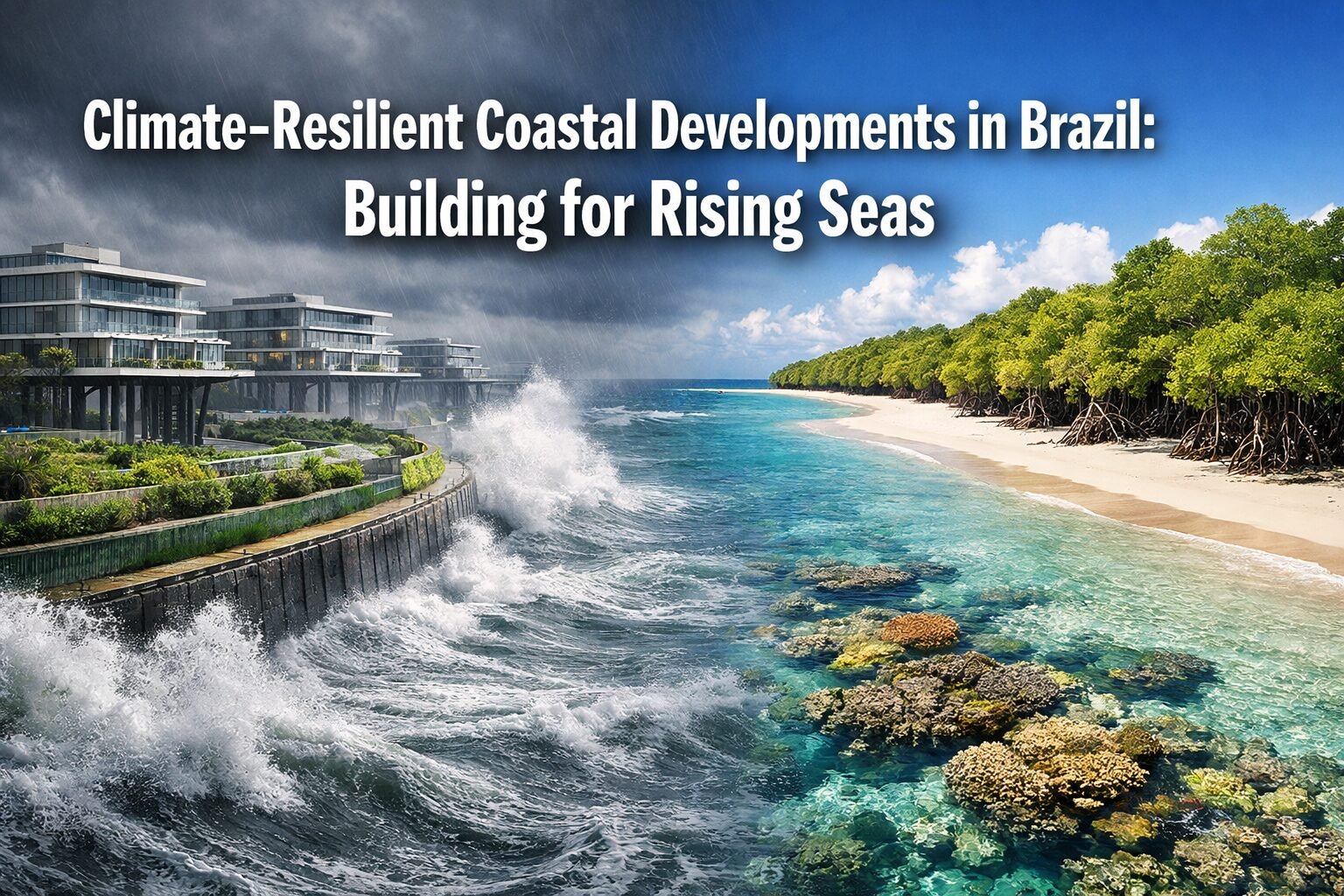
Brazil’s stunning coastline stretches over 8,500 kilometers, hosting vibrant cities, thriving tourism hubs, and millions of residents. But in 2024, the country faced a harsh wake-up call: record-breaking floods, the worst coral bleaching event in its history, and devastating storm surges that exposed the vulnerability of coastal infrastructure. As sea levels continue to rise and extreme weather events intensify, Climate-Resilient Coastal Developments in Brazil: Building for Rising Seas, Flood Risk, and Insurance Shifts has become not just a buzzword, but an urgent necessity for developers, investors, and communities alike.
The stakes are high. Traditional building methods are no longer sufficient. Insurance companies are recalculating risk premiums. Municipal governments are rewriting zoning codes. For real estate developers and property investors looking at Brazil’s most promising investment locations, understanding climate resilience is now essential to protecting capital and ensuring long-term returns.

Key Takeaways
- 🌊 Rising sea levels and extreme flooding are forcing Brazilian coastal developers to adopt elevation strategies, improved drainage systems, and flood-resistant materials
- 🏗️ New municipal climate regulations now require climate adaptation plans for construction projects in many coastal states, fundamentally changing development approval processes
- 🌿 Natural infrastructure solutions like mangrove conservation and coral reef protection provide cost-effective flood defense while sequestering carbon at rates 10x higher than tropical forests
- 💰 Insurance markets are shifting dramatically, with premiums rising for high-risk coastal properties while incentives emerge for climate-resilient construction
- 📊 Federal initiatives including Marine Spatial Planning and coastal monitoring network expansion to 18 stations by 2026 are creating new frameworks for sustainable coastal development
Understanding Brazil’s Coastal Climate Challenges in 2026
The Perfect Storm: Recent Extreme Weather Events
Brazil’s coastal regions have experienced unprecedented climate impacts in recent years. The 2024 coral bleaching crisis destroyed significant portions of reef ecosystems that historically protected coastlines from storm surges and erosion.[1] Meanwhile, catastrophic flooding in Rio Grande do Sul demonstrated how quickly traditional infrastructure can fail when faced with extreme precipitation events.
These disasters aren’t isolated incidents—they’re the new normal. Rising water temperatures, changing precipitation patterns, and increasing storm intensity are converging to create compound climate risks that affect everything from foundation stability to insurance availability.
Sea Level Rise: The Slow-Moving Crisis
While dramatic floods grab headlines, the gradual rise in sea levels poses an equally serious threat to coastal developments. Current projections suggest Brazilian coastlines could experience significant inundation over the coming decades, affecting:
- Beachfront properties and tourism infrastructure
- Port facilities and commercial zones
- Residential neighborhoods in low-lying coastal areas
- Critical infrastructure including roads, utilities, and drainage systems
For developers evaluating emerging markets like Florianópolis, understanding elevation maps and flood risk zones is now as important as analyzing market demand.
The Insurance Reality Check
The financial sector is responding to climate risk faster than many realize. Insurance companies are:
- Increasing premiums for properties in high-risk coastal zones
- Requiring climate assessments before issuing policies
- Offering discounts for buildings that meet resilience standards
- Withdrawing coverage entirely from certain vulnerable areas
This shift is fundamentally changing the economics of coastal development. Properties that ignore climate resilience may become uninsurable and unsellable, regardless of their location or amenities.
Climate-Resilient Coastal Developments in Brazil: Engineering Solutions and Design Strategies
Elevation Strategies: Building Above the Flood Line
The most straightforward defense against rising seas and flooding is simply building higher. Modern climate-resilient developments in Brazil are incorporating:
Foundation Elevation Techniques:
- Raised foundations on reinforced concrete pillars (3-5 meters above current flood levels)
- Elevated ground floors with parking or non-habitable spaces below living areas
- Adaptive design allowing for future elevation increases as sea levels rise
- Strategic site selection prioritizing naturally elevated terrain
In Rio Grande do Sul, the state government now requires municipalities requesting construction funding to submit climate change adaptation plans, ensuring elevation standards are met before projects begin.[3]
Advanced Drainage and Water Management
Keeping water away from structures is equally important as building high. Climate-resilient coastal developments now feature:
| Drainage Solution | Function | Benefits |
|---|---|---|
| Permeable paving | Allows water infiltration | Reduces runoff by 30-50% |
| Bioswales | Natural water filtration | Removes pollutants, slows flow |
| Retention basins | Temporary water storage | Prevents system overload |
| Green roofs | Absorbs rainfall | Reduces heat, manages water |
| Smart drainage systems | Automated flow control | Real-time flood response |
These systems work together to create multi-layered protection that can handle both gradual sea level rise and sudden extreme precipitation events.
Material Selection for Flood Resistance
Traditional building materials often fail catastrophically when exposed to flooding. Climate-resilient developments prioritize:
- ✅ Concrete and steel over wood in flood-prone areas
- ✅ Marine-grade finishes resistant to saltwater corrosion
- ✅ Impact-resistant windows that withstand storm debris
- ✅ Waterproof membranes and moisture barriers
- ✅ Mold-resistant materials for post-flood recovery
The initial cost premium for these materials (typically 10-15% higher) is offset by reduced maintenance, lower insurance premiums, and protection of property value.
Backup Systems and Resilient Infrastructure
When extreme weather strikes, basic services often fail. Forward-thinking developments include:
- Backup power generation (solar + battery storage)
- Independent water systems with filtration and storage
- Redundant telecommunications infrastructure
- Emergency access routes at multiple elevations
- Community shelters designed to FEMA standards
These features not only protect residents during disasters but also increase property values and marketability to climate-conscious buyers.
Natural Infrastructure: Brazil’s Coastal Defense Ecosystem
Mangroves: The Unsung Heroes of Coastal Protection
Brazil is home to the world’s second-largest mangrove area, covering its 8,500-kilometer coastline. These remarkable ecosystems provide natural barriers against rising seas and storm surges while delivering extraordinary environmental benefits.[1]
Mangrove Superpowers:
- 🌳 Carbon sequestration at rates up to 10 times greater than tropical forests
- 🌳 Carbon storage five times more per hectare than tropical forests
- 🌳 Wave energy reduction by up to 66% during storm surges
- 🌳 Erosion prevention through complex root systems
- 🌳 Biodiversity support for fisheries and wildlife
The federal government’s ProManguezal Program was developed through workshops involving over 120 representatives from public sector, academia, civil society, and traditional coastal communities, recognizing that mangrove conservation is essential infrastructure, not just environmental protection.[1]
Smart developers are incorporating mangrove preservation zones into their projects, creating buffer zones that provide natural flood defense while enhancing property appeal and ecological value.
Coral Reefs: Underwater Barriers Against Storm Damage
Despite the severe coral bleaching crisis of 2024, Brazil’s coral reefs remain critical coastal protection infrastructure. Healthy reefs protect coastlines from storm surges and erosion, functioning as natural breakwaters.
In June 2025, Brazil’s National Strategy for Conservation and Sustainable Use of Coral Reefs (ProCoral) was formally established by federal decree and presented at the UN Oceans Conference.[1] This strategy directly addresses coastal protection by:
- Mapping reef systems for integrated coastal planning
- Establishing protected zones that benefit adjacent developments
- Promoting reef restoration projects
- Monitoring reef health as an early warning system for climate impacts
Developments near healthy reef systems benefit from reduced wave action and storm damage, translating to lower insurance costs and greater long-term stability.
Integrating Green Infrastructure into Development Plans
The most resilient coastal developments combine built and natural infrastructure:
Hybrid Protection Strategies:
- Preserve existing ecosystems (mangroves, dunes, wetlands) as primary defense
- Add engineered green infrastructure (living shorelines, oyster reefs, beach nourishment)
- Design buildings to work with natural systems rather than against them
- Create buffer zones between development and coastline
- Implement adaptive management that responds to changing conditions
This approach aligns with Brazil’s Marine Spatial Planning (MSP) initiative, which is being institutionalized through federal decree to guide sustainable coastal and ocean resource use.[1] Developers who understand and work within MSP frameworks will find faster approvals and better long-term outcomes.
Climate-Resilient Coastal Developments in Brazil: Navigating New Regulations and Insurance Requirements
Municipal Climate Adaptation Requirements
The regulatory landscape for coastal development in Brazil is transforming rapidly. Following the devastating floods and climate events of recent years, many municipalities and states have implemented new requirements:
Key Regulatory Changes:
- 📋 Mandatory climate adaptation plans for construction projects seeking public funding
- 📋 Updated zoning codes incorporating flood risk mapping
- 📋 Elevation minimums based on sea level rise projections
- 📋 Green infrastructure requirements for stormwater management
- 📋 Building certification programs for climate resilience
Rio Grande do Sul pioneered this approach by requiring climate change adaptation plans from municipalities requesting state funding for construction and pavement projects.[3] Other coastal states are following suit, creating a patchwork of regulations that developers must navigate.
For investors exploring high-return property opportunities, understanding local climate regulations is essential during due diligence.
Federal Climate Initiatives Shaping Development
Brazil’s national government is taking unprecedented action on coastal climate resilience:
Climate Adaptation Plan for Ocean and Coastal Zones
The Ministry of Environment and Climate Change developed a dedicated plan addressing rising sea levels, ocean acidification, and extreme weather events. After completing public consultations in early 2025, the plan is expected to be approved by COP30.[1]
Coastal Monitoring Network Expansion
Brazil is strengthening its coastal monitoring network to include 18 stations by 2026, improving data collection for climate impacts and early warning systems.[2] This infrastructure provides developers with better data for site selection and risk assessment.
Ocean-Inclusive NDCs
For the first time, Brazil’s Nationally Determined Contributions (NDCs) acknowledge the ocean’s vital role in addressing climate change, with specific commitments to MSP, climate adaptation planning, and mangrove/coral conservation programs.[1]
These federal initiatives create both constraints and opportunities for developers who understand how to align projects with national priorities.
Insurance Market Transformation
The insurance industry is fundamentally repricing coastal risk in Brazil. Understanding these shifts is critical for project feasibility:
Insurance Market Trends:
| Risk Factor | Impact on Premiums | Mitigation Strategy |
|---|---|---|
| Flood zone location | +50-200% | Elevation, drainage systems |
| Building materials | +20-40% | Flood-resistant materials |
| Backup systems | -10-25% | Power, water redundancy |
| Green infrastructure | -15-30% | Mangroves, living shorelines |
| Climate certification | -20-35% | LEED, resilience standards |
Some insurers are now offering parametric insurance products that pay out automatically when specific climate triggers occur (storm surge height, rainfall amounts, etc.), providing faster recovery capital.
Developers should engage insurance professionals early in the design process to understand how building choices affect insurability and premiums. A project that saves 15% on construction costs but faces 100% higher insurance premiums is not a good investment.
Certification and Standards for Climate Resilience
Third-party certification programs are emerging as valuable tools for demonstrating climate resilience:
- LEED certification with climate adaptation credits
- WELL Building Standard for health and resilience
- Living Building Challenge for regenerative design
- Resilient Design Institute standards
- Local green building programs specific to Brazilian coastal contexts
These certifications provide:
- ✅ Marketing differentiation in competitive markets
- ✅ Insurance discounts and better financing terms
- ✅ Regulatory advantages in permitting processes
- ✅ Higher resale values and rental premiums
- ✅ Tenant attraction among climate-conscious buyers
Economic Opportunities in Climate-Resilient Development
Market Demand for Resilient Properties
Climate awareness is driving buyer preferences across Brazil’s coastal markets. Sophisticated investors and homebuyers increasingly prioritize:
- Long-term value protection over short-term cost savings
- Insurance availability and reasonable premiums
- Operational resilience during extreme weather
- Environmental sustainability and ecosystem integration
- Regulatory compliance with emerging standards
Properties that demonstrate climate resilience command premium pricing (typically 10-20% above comparable non-resilient properties) and experience faster sales cycles. This trend is particularly strong in emerging markets like Florianópolis, where buyers are educated about environmental issues.
Financing Advantages for Green Projects
Financial institutions are creating incentives for climate-resilient development:
- Green bonds with favorable interest rates
- Sustainability-linked loans with performance-based pricing
- Government incentive programs for climate adaptation
- International climate finance for qualifying projects
- Reduced down payment requirements for certified green buildings
These financing tools can reduce capital costs by 0.5-2.0 percentage points, significantly improving project returns over the development lifecycle.
The Appreciation Potential of Resilient Coastal Real Estate
As climate impacts intensify, the gap between resilient and non-resilient properties will widen dramatically. Consider the long-term value proposition:
Non-Resilient Property Trajectory:
- Rising insurance costs reduce affordability
- Increasing flood events damage property and reputation
- Regulatory changes require expensive retrofits
- Buyer pool shrinks as climate awareness grows
- Property values stagnate or decline
Resilient Property Trajectory:
- Stable or declining insurance costs
- Minimal damage during extreme events
- Compliance with current and future regulations
- Growing buyer pool seeking protected assets
- Property values appreciate above market rates
For investors focused on maximizing returns through early-stage purchases, climate resilience is becoming as important as location and amenities.
Case Studies: Climate-Resilient Coastal Developments in Brazil
Innovative Projects Leading the Way
While specific project names vary, several Brazilian coastal developments are pioneering climate-resilient design:
Elevated Mixed-Use Communities
New developments in flood-prone areas are incorporating ground-level commercial spaces designed to flood without damage (concrete floors, waterproof utilities, minimal inventory storage), with residential units beginning on elevated second floors. This approach maintains street-level vibrancy while protecting residents.
Mangrove-Integrated Resorts
Tourism developments are preserving and restoring mangrove ecosystems as amenities rather than obstacles, creating boardwalk nature experiences while maintaining natural flood protection. These projects demonstrate that environmental protection and profitability can align.
Floating Infrastructure
Some innovative projects are exploring floating dock systems, amphibious foundations, and water-adaptive architecture that rises and falls with tides and storm surges, representing the cutting edge of coastal resilience.
Lessons from Retrofitting Existing Developments
Not all coastal properties are new construction. Retrofitting existing buildings provides valuable lessons:
Successful Retrofit Strategies:
- Installing flood barriers and water-resistant materials on ground floors
- Adding backup power and water systems
- Improving drainage and stormwater management
- Elevating critical mechanical systems above flood levels
- Creating green infrastructure buffer zones
While retrofits are typically more expensive per square meter than building resilience into new construction, they’re essential for protecting existing investments and can increase property values by 15-25%.
Practical Implementation Guide for Developers
Site Selection and Risk Assessment
Climate-resilient development begins with smart site selection:
Critical Assessment Factors:
- Elevation mapping using LIDAR and topographic data
- Flood history and projected future risk zones
- Proximity to natural defenses (mangroves, reefs, dunes)
- Soil stability and foundation requirements
- Access to multiple transportation routes
- Availability of climate monitoring data
Brazil’s expanding coastal monitoring network (18 stations by 2026) provides increasingly sophisticated data for these assessments.[2]
Design Phase Considerations
During design, integrate climate resilience from the beginning:
- Work with architects experienced in coastal resilience
- Conduct climate vulnerability assessments
- Model multiple sea level rise scenarios
- Design for adaptability and future modifications
- Integrate natural and built infrastructure
- Plan for phased development that responds to changing conditions
Construction Phase Best Practices
During construction, maintain resilience standards:
- Use qualified contractors experienced with flood-resistant techniques
- Implement rigorous quality control for waterproofing and elevation
- Document all resilience features for insurance and certification
- Train maintenance staff on resilience system operation
- Create as-built documentation for future modifications
Post-Completion Monitoring and Adaptation
Climate resilience is not “set and forget”:
- Install monitoring systems for drainage, structural integrity, and environmental conditions
- Develop maintenance protocols for green infrastructure
- Create emergency response plans and resident education programs
- Track climate data and update risk assessments regularly
- Plan for adaptive modifications as conditions change
The Future of Climate-Resilient Coastal Developments in Brazil
Emerging Technologies and Innovations
The next generation of coastal resilience will leverage:
- AI-powered flood prediction systems for early warning
- Advanced materials including self-healing concrete and bio-based composites
- Modular construction allowing rapid adaptation to changing conditions
- Smart building systems that respond automatically to climate threats
- Blockchain-based climate insurance and risk sharing platforms
Developers who stay current with these innovations will maintain competitive advantages in increasingly sophisticated markets.
Policy Evolution and COP30 Implications
Brazil will host COP30, bringing international attention to its climate policies. Expected developments include:
- Approval of the Climate Adaptation Plan for Ocean and Coastal Zones[1]
- Expansion of Marine Spatial Planning requirements
- Increased international climate finance availability
- Strengthened building codes and resilience standards
- Greater integration of climate risk into financial regulation
These changes will create both challenges and opportunities for coastal developers.
Building a Resilient Coastal Economy
The transition to climate-resilient coastal development is not just about protecting individual properties—it’s about building a sustainable coastal economy that can thrive despite climate change. This requires:
- Collaboration between developers, governments, communities, and environmental organizations
- Long-term thinking that prioritizes multi-generational value over short-term returns
- Innovation in design, materials, financing, and governance
- Education of buyers, investors, and policymakers about climate risks and solutions
- Commitment to continuous improvement as climate science evolves
Conclusion
Climate-Resilient Coastal Developments in Brazil: Building for Rising Seas, Flood Risk, and Insurance Shifts represents the future of coastal real estate in Brazil. The devastating climate events of 2024 demonstrated that traditional building approaches are no longer viable. Rising seas, intensifying storms, and shifting insurance markets are fundamentally changing the economics of coastal development.
However, this transformation also creates tremendous opportunities. Developers who embrace climate resilience through elevation strategies, advanced drainage systems, flood-resistant materials, and integration with natural ecosystems like mangroves and coral reefs will build properties that command premium prices, attract sophisticated buyers, and appreciate faster than conventional developments.
Brazil’s expanding regulatory framework—from Rio Grande do Sul’s climate adaptation requirements to federal Marine Spatial Planning and the upcoming Climate Adaptation Plan for Ocean and Coastal Zones—provides clear direction for developers willing to lead rather than follow. The coastal monitoring network expansion to 18 stations by 2026 will provide increasingly sophisticated data to inform smart development decisions.[2]
Actionable Next Steps
For developers and investors ready to build climate-resilient coastal properties:
- Conduct comprehensive climate risk assessments for all coastal sites before acquisition
- Engage climate resilience specialists during the design phase, not as an afterthought
- Build relationships with insurers early to understand how design choices affect premiums
- Pursue climate resilience certifications to differentiate properties and access green financing
- Preserve and integrate natural infrastructure like mangroves as cost-effective flood defense
- Stay informed about evolving regulations and federal initiatives like MSP and ProManguezal
- Educate buyers about the long-term value protection of climate-resilient features
The coastal developments that thrive in 2026 and beyond will be those that view climate resilience not as a regulatory burden but as a competitive advantage and moral imperative. Brazil’s stunning coastline can support thriving communities and profitable developments—but only if we build with rising seas, flood risk, and insurance shifts in mind.
For developers interested in exploring climate-resilient opportunities in Brazil’s most promising markets, learn more about strategic coastal investments and discover how early-stage purchases can maximize returns in this transforming landscape.
References
[1] Brazil Strengthens Its Ocean Conservation Efforts – https://www.international-climate-initiative.com/en/iki-media/news/brazil-strengthens-its-ocean-conservation-efforts/
[2] Brazil Strengthens Coastal Monitoring Network 18 Stations 2026 – https://www.ioc.unesco.org/en/brazil-strengthens-coastal-monitoring-network-18-stations-2026
[3] Watch – https://www.youtube.com/watch?v=DgnKwR4mhlw
[4] Brazil Ratifies High Seas Treaty Ocean Biodiversity – https://agenciabrasil.ebc.com.br/en/meio-ambiente/noticia/2026-02/brazil-ratifies-high-seas-treaty-ocean-biodiversity