
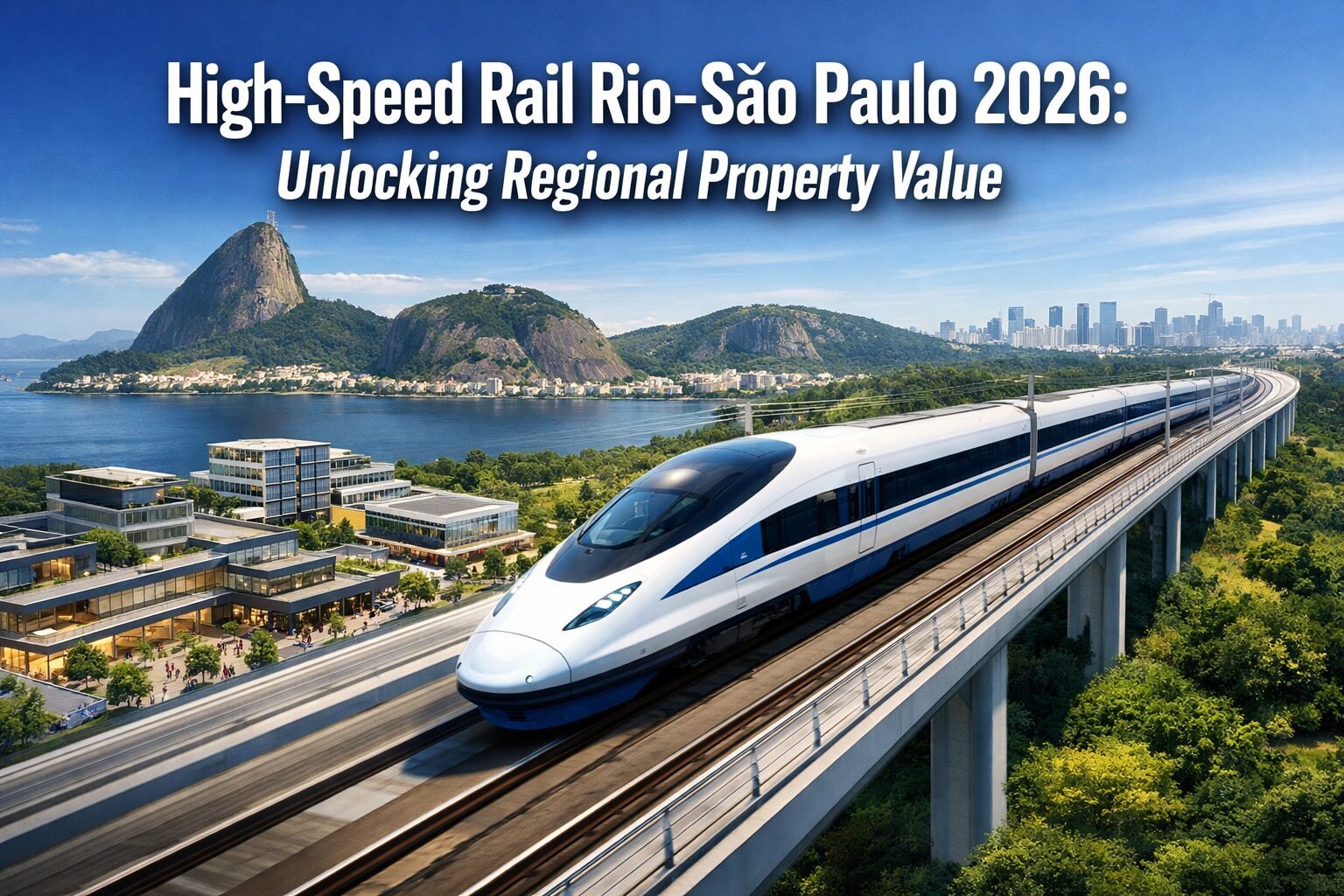
The race to connect Brazil’s two largest metropolitan areas by high-speed rail is creating unprecedented opportunities for savvy real estate investors. As High-Speed Rail Rio-São Paulo 2026: Unlocking Regional Property Value Along Proposed Corridors becomes reality, intermediate cities along the planned route are experiencing early appreciation signals that could transform regional property markets over the next decade.
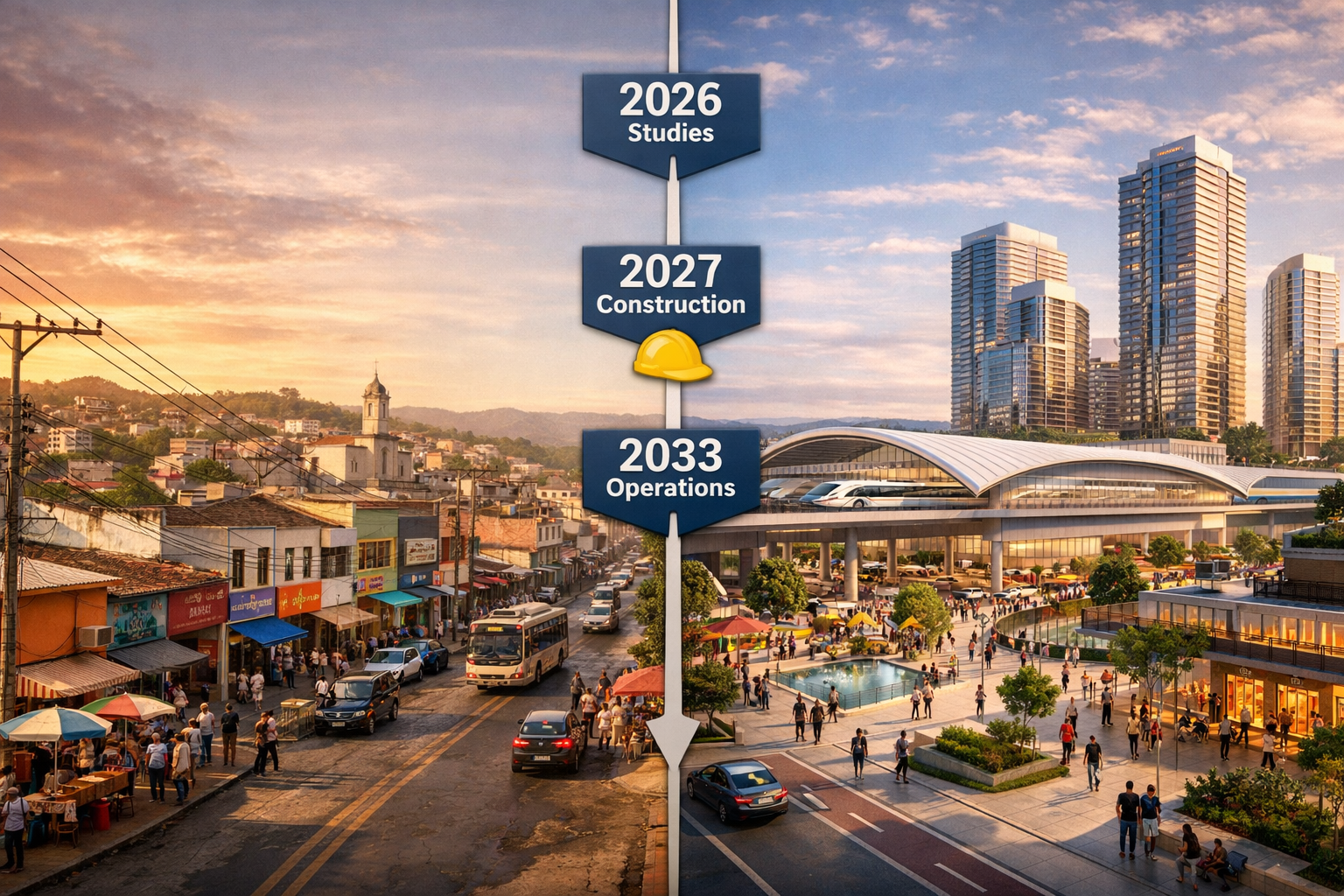
With technical studies expected to conclude by the end of 2026 and construction slated to begin in 2027, the window for strategic property acquisition in corridor towns is narrowing. Early movers who understand the infrastructure timeline and station placement dynamics stand to capture 20-30% appreciation potential before the first train departs in 2033.

Key Takeaways
- 🚄 Operational timeline pushed to 2033: TAV Brasil announced a one-year delay in February 2026, with construction beginning around 2027 after environmental studies conclude
- 💰 Intermediate cities show highest potential: Towns like Volta Redonda and São José dos Campos along the 417km corridor offer 20-30% appreciation opportunities
- 📍 Station proximity drives value: Properties within 5km of planned stations present optimal investment positioning for transit-oriented development
- ⏰ Strategic acquisition window closing: With studies completing in 2026 and construction starting 2027, early-stage investment opportunities are time-sensitive
- 🏗️ Mixed-use developments lead growth: Residential-commercial projects near future stations align with infrastructure timelines for maximum returns
Understanding the High-Speed Rail Rio-São Paulo 2026 Project
The Rio-São Paulo high-speed rail represents South America’s most ambitious passenger rail infrastructure project. TAV Brasil, which received a 99-year concession from Brazil’s National Land Transport Agency in 2023, is planning, building, and will operate this transformative corridor[2].
Project Specifications and Timeline
The main corridor spans 417 kilometers between Rio de Janeiro and São Paulo, with a possible extension to Campinas bringing the total distance to just over 510 kilometers[2]. Trains will be capable of reaching 350 km/h (217 mph), making this the fastest passenger train planned for South America[3].
Key Technical Details:
| Specification | Details |
|---|---|
| Maximum Speed | 350 km/h (217 mph) |
| Commercial Speed | 320 km/h operational |
| Travel Time | 90 minutes Rio-São Paulo |
| Main Route Distance | 417 km |
| Extended Route | 510+ km (with Campinas) |
| Passenger Capacity | 855 per train |
| Frequency | 15-minute headways |
| Annual Ridership | 71 million (projected) |
The operational start has been delayed to 2033, according to TAV Brasil CEO Bernardo Figueiredo in a February 8, 2026 announcement—pushed back one year from the previously targeted 2032[1]. This timeline adjustment actually benefits strategic investors by extending the acquisition window for undervalued corridor properties.
Station Locations and Route Details
Four main stations are planned along the route in Rio de Janeiro, São Paulo, and Campinas, with potential additional stops in Volta Redonda and São José dos Campos[4]. These intermediate stations represent the highest-value opportunities for property investors seeking to capitalize on infrastructure-driven appreciation.
The system will operate on a dedicated double-track railway separate from freight lines, equipped with state-of-the-art safety and signaling technology, using 25 kV AC overhead electrification[5]. This dedicated infrastructure ensures reliable service and positions station areas for intensive transit-oriented development.
High-Speed Rail Rio-São Paulo 2026: Property Value Dynamics Along the Corridor
Infrastructure projects of this magnitude create predictable property value patterns that informed investors can leverage. The High-Speed Rail Rio-São Paulo 2026: Unlocking Regional Property Value Along Proposed Corridors phenomenon follows established international precedents from Spain’s AVE network, France’s TGV system, and China’s extensive high-speed rail buildout.
Appreciation Patterns in Corridor Cities
Historical data from comparable high-speed rail projects globally shows that intermediate cities experience the highest percentage appreciation—often outperforming the major terminal cities. This occurs because:
- Baseline values start lower: Properties in intermediate cities have more room for appreciation compared to already-expensive Rio and São Paulo markets
- Accessibility transformation is dramatic: Travel time reductions are proportionally more significant for previously isolated communities
- Development capacity exists: Unlike saturated major metros, corridor towns have available land for new transit-oriented projects
- Economic spillover effects: Businesses and residents priced out of major cities relocate to newly-accessible intermediate locations
For the Rio-São Paulo corridor, Volta Redonda and São José dos Campos present the most compelling investment cases. Both cities offer:
- ✅ Established economic bases (steel industry and aerospace/tech respectively)
- ✅ Existing infrastructure that reduces development costs
- ✅ Available land near proposed station sites
- ✅ Current property prices 40-60% below São Paulo equivalents
- ✅ Growing professional populations seeking quality of life improvements
Transit-Oriented Development Zones
The highest-value properties cluster in concentric zones around planned station locations:
Zone 1 (0-5km from station): Premium appreciation potential of 25-35% through 2033. Ideal for mixed-use developments, residential towers, and commercial office space. These properties will command premium rents from business travelers and commuters.
Zone 2 (5-10km from station): Moderate appreciation potential of 15-25%. Suitable for residential subdivisions, retail centers, and hospitality developments. Properties benefit from station proximity while maintaining lower acquisition costs.
Zone 3 (10-15km from station): Conservative appreciation potential of 10-18%. Best for larger-scale residential developments and industrial/logistics facilities that benefit from improved regional connectivity without requiring immediate station access.
Understanding these zones allows investors to match property selection with risk tolerance and return expectations. Those seeking maximum appreciation should focus on Zone 1 acquisitions before construction begins in 2027.
Strategic Site Selection for High-Speed Rail Corridor Investments
Successful property investment along the High-Speed Rail Rio-São Paulo 2026: Unlocking Regional Property Value Along Proposed Corridors requires systematic site selection aligned with infrastructure timelines. The following framework guides optimal decision-making:

Timing Your Acquisitions
The infrastructure development timeline creates distinct investment windows:
2026 (Current Year – Study Completion Phase)
- 🎯 Optimal Action: Secure options or preliminary agreements on prime sites
- 📊 Market Condition: Prices reflect speculation but not certainty
- ⚠️ Risk Level: Moderate—project approval not yet final
- 💡 Strategy: Focus on properties with alternative value propositions if rail delays extend
2027-2029 (Early Construction Phase)
- 🎯 Optimal Action: Finalize acquisitions and begin development planning
- 📊 Market Condition: Prices rising as construction visibility increases
- ⚠️ Risk Level: Lower—project execution confirmed
- 💡 Strategy: Lock in financing while rates remain favorable; secure development permits
2030-2032 (Advanced Construction Phase)
- 🎯 Optimal Action: Complete developments for pre-operational leasing
- 📊 Market Condition: Significant appreciation already realized
- ⚠️ Risk Level: Low—completion timeline clear
- 💡 Strategy: Position properties to capture first-wave tenants and buyers
2033+ (Operational Phase)
- 🎯 Optimal Action: Harvest appreciation or hold for rental income
- 📊 Market Condition: Mature pricing reflecting operational benefits
- ⚠️ Risk Level: Minimal for infrastructure
- 💡 Strategy: Exit early positions or transition to long-term income properties
Property Type Selection by Corridor Location
Different corridor cities favor different property types based on local economic drivers:
São José dos Campos (Aerospace/Technology Hub)
- Recommended: Executive residential condominiums, co-working spaces, boutique hotels
- Target Market: Engineers, executives, business travelers
- Price Range: R$4,000-6,500 per square meter (current)
- Projected 2033: R$5,500-8,500 per square meter
Volta Redonda (Industrial/Manufacturing Center)
- Recommended: Workforce housing, retail centers, logistics facilities
- Target Market: Industrial workers, service sector employees, regional shoppers
- Price Range: R$2,800-4,200 per square meter (current)
- Projected 2033: R$3,800-5,800 per square meter
Campinas Extension Zone
- Recommended: Mixed-use developments, student housing (major universities), tech office space
- Target Market: Students, tech workers, commuters to São Paulo
- Price Range: R$5,500-7,800 per square meter (current)
- Projected 2033: R$7,200-10,200 per square meter
These projections assume successful project completion and normal market conditions. Investors should conduct detailed due diligence and consider consulting with local property investment specialists familiar with Brazilian infrastructure projects.
Due Diligence Checklist for Corridor Properties
Before committing capital to corridor properties, complete this comprehensive evaluation:
Infrastructure Verification
- ✓ Confirm official station location designations (subject to change until final approval)
- ✓ Review published environmental impact studies for route modifications
- ✓ Verify local zoning allows intended development type
- ✓ Assess existing transportation connections (roads, local transit)
- ✓ Identify planned complementary infrastructure (roads, utilities, services)
Financial Analysis
- ✓ Calculate all-in acquisition costs including taxes and fees
- ✓ Model development costs with 20% contingency buffer
- ✓ Project rental income based on conservative occupancy (75-80%)
- ✓ Stress-test scenarios with 2-year operational delays
- ✓ Confirm financing availability and terms for corridor locations
Market Assessment
- ✓ Analyze current supply and planned competing developments
- ✓ Verify local employment growth trends and economic diversification
- ✓ Review historical property appreciation rates (pre-rail announcement)
- ✓ Assess demographic trends and migration patterns
- ✓ Identify major employers and economic anchors
Legal and Regulatory
- ✓ Conduct thorough title searches and lien verification
- ✓ Review environmental restrictions and protected area boundaries
- ✓ Confirm property tax rates and potential increases
- ✓ Understand local development approval processes and timelines
- ✓ Verify compliance with federal infrastructure buffer zones
This systematic approach reduces risk and positions investments for optimal returns. For investors seeking pre-construction appreciation opportunities, understanding these factors is essential.
Financing Considerations and Project Risks
The High-Speed Rail Rio-São Paulo 2026: Unlocking Regional Property Value Along Proposed Corridors investment thesis depends on successful project completion. Understanding financing challenges and risk factors is crucial for informed decision-making.
Project Financing Status
Construction costs range from approximately US$10-20 billion (around 60 billion Brazilian reais), depending on final project scope and the Campinas extension[2]. Financing remains a major hurdle, requiring a complex mix of international investors and public support.
The project is reportedly in contact with the World Bank for potential funding partnerships, alongside private consortium members and Brazilian development banks. Technical and environmental studies expected to complete by the end of 2026 will provide the regulatory clearance necessary for final financing commitments[2].
Risk Mitigation Strategies
Prudent investors should implement these risk management approaches:
Diversification: Don’t concentrate all capital in corridor properties. Maintain portfolio balance with established markets that offer independent value drivers.
Phased Deployment: Stage property acquisitions across multiple years rather than committing all capital immediately. This allows adjustment based on project progress.
Alternative Value Sources: Select properties with intrinsic value independent of rail completion—strong local markets, existing infrastructure, established tenant demand.
Exit Flexibility: Structure investments with multiple exit options (sale, rental, redevelopment) that don’t solely depend on rail operations.
Professional Partnership: Consider partnering with experienced development firms that have successfully navigated Brazilian infrastructure projects.
Projected Ticket Prices and Ridership Impact
Understanding the rail system’s economics helps assess long-term property demand. Projected ticket prices are estimated at R$150 to R$250 (approximately US$30-50) per passenger during off-peak hours[5].
With trains designed for 855 passengers operating at 15-minute headways, the system targets an estimated 71 million passengers annually[5]. This massive ridership will create sustained demand for:
- 🏨 Hotels and short-term accommodations near stations
- 🍽️ Restaurants and retail serving travelers
- 🏢 Office space for businesses serving regional markets
- 🏠 Residential properties for workers newly able to commute
- 🚗 Parking facilities and last-mile transportation services
The travel time reduction from 5-6 hours by car to just 90 minutes by train fundamentally reshapes regional accessibility[4]. This compression of economic distance creates property value appreciation similar to infrastructure-driven growth in other Brazilian markets.
Comparing Corridor Investments to Established Markets
While the High-Speed Rail Rio-São Paulo 2026: Unlocking Regional Property Value Along Proposed Corridors offers compelling appreciation potential, investors should compare these opportunities against proven markets with immediate returns.
Risk-Return Profile Comparison
| Investment Type | Potential Return | Risk Level | Timeline | Liquidity |
|---|---|---|---|---|
| Corridor Properties (Pre-Construction) | 20-30% through 2033 | Moderate-High | 7+ years | Low-Moderate |
| Established Urban Markets | 8-15% annually | Low-Moderate | Immediate | High |
| Pre-Construction Developments | 15-25% to completion | Moderate | 2-4 years | Low |
| Income Properties (Operational) | 6-10% annual yield | Low | Immediate | Moderate |
Corridor investments offer higher potential returns but require longer holding periods and carry execution risk. Balanced portfolios should include both speculative corridor positions and stable income-producing assets.
Portfolio Allocation Recommendations
For investors with R$1-5 million to deploy:
- 30-40% in corridor speculative positions
- 40-50% in established market income properties
- 10-20% in liquid reserves for opportunistic acquisitions
For investors with R$5-20 million to deploy:
- 40-50% in corridor development projects
- 30-40% in diversified established markets
- 10-20% in alternative real estate (logistics, hospitality)
For investors with R$20+ million to deploy:
- 50-60% in corridor master-planned communities
- 25-30% in institutional-grade assets
- 10-15% in international diversification
These allocations balance growth potential with risk management. Working with experienced property advisors helps tailor strategies to individual circumstances and risk tolerance.
Environmental and Regulatory Considerations
Large infrastructure projects in Brazil require extensive environmental review and regulatory compliance. The high-speed rail project must navigate:
Environmental Impact Assessments: Comprehensive studies of the route’s effects on ecosystems, water resources, protected areas, and indigenous lands. These studies, completing in 2026, may require route modifications that affect station locations.
Land Acquisition Processes: Eminent domain procedures for right-of-way acquisition can be lengthy and contentious. Properties immediately adjacent to planned routes may face acquisition or usage restrictions.
Zoning Modifications: Local governments will likely update zoning around stations to encourage transit-oriented development. Early engagement with municipal planning departments provides advance notice of regulatory changes.
Construction Impact Periods: Properties near active construction will experience temporary disruptions (noise, traffic, access restrictions) that may affect short-term rental income or sales velocity.
Investors should factor these regulatory timelines into acquisition and development schedules. Properties requiring rezoning or special permits should build 6-12 month buffers into project timelines.
Learning from International High-Speed Rail Precedents
Global high-speed rail development offers valuable lessons for Brazilian corridor investors:
Spanish AVE Network Experience
Spain’s AVE (Alta Velocidad Española) network, which expanded rapidly in the 2000s-2010s, demonstrated that:
- Intermediate cities experienced 15-40% property appreciation in the five years following station openings
- Commercial properties outperformed residential in the first 3-5 years post-opening
- Properties within 800 meters of stations captured disproportionate value increases
- Cities with complementary economic development strategies saw sustained growth beyond initial speculation
French TGV Lessons
France’s TGV network, operational since 1981, shows:
- Long-term appreciation continues decades after opening as networks expand and ridership matures
- Station area master planning significantly influences value capture—planned developments outperform ad-hoc growth
- Secondary cities gained population and economic activity from major metros, creating sustained property demand
- Mixed-use developments near stations achieved premium valuations and rental rates
Chinese High-Speed Rail Insights
China’s massive high-speed rail buildout since 2008 reveals:
- Speculation can drive prices before construction begins, creating entry risk for late investors
- Government coordination of station area development accelerates value realization
- Overbuilding near stations can depress returns if supply exceeds demand
- Connectivity to broader networks multiplies value—stations serving multiple lines outperform single-line stops
For the Rio-São Paulo corridor, these precedents suggest focusing on well-planned, moderately-scaled developments in intermediate cities with strong economic fundamentals. Avoiding overbuilding and maintaining quality standards positions projects for sustained success.
Conclusion: Positioning for Corridor Success
The High-Speed Rail Rio-São Paulo 2026: Unlocking Regional Property Value Along Proposed Corridors represents a generational infrastructure investment that will reshape regional property markets over the next decade. With construction beginning around 2027 and operations targeted for 2033, strategic investors have a narrowing window to capture pre-development appreciation potential.
Intermediate corridor cities—particularly Volta Redonda and São José dos Campos—offer the highest percentage returns for investors who act before construction visibility drives prices higher. The 20-30% appreciation potential through 2033 rewards those who understand infrastructure timelines, station proximity dynamics, and transit-oriented development principles.
Actionable Next Steps
For Immediate Action (2026):
Conduct corridor reconnaissance: Visit proposed station locations in target cities to assess current conditions, available properties, and local market dynamics
Build local partnerships: Establish relationships with municipal planning departments, local developers, and real estate professionals familiar with corridor markets
Secure preliminary agreements: Negotiate options or conditional purchase agreements on prime sites while prices remain moderate
Complete financial modeling: Develop detailed pro formas with conservative assumptions and stress-test scenarios including 2-year delays
Engage legal counsel: Retain Brazilian real estate attorneys experienced with infrastructure-adjacent properties and development approvals
For Near-Term Planning (2027-2028):
Monitor construction progress: Track actual construction starts and timeline adherence to validate investment thesis
Finalize acquisitions: Complete property purchases as construction visibility reduces uncertainty
Secure development approvals: Begin permit processes for planned developments to align completion with operational timeline
Lock in financing: Secure construction financing while project momentum is building and lender confidence is high
Initiate pre-leasing: Begin marketing to potential tenants and buyers 18-24 months before completion
For Long-Term Success:
- Maintain portfolio diversification across corridor locations and property types
- Stay informed on project developments and timeline modifications
- Build flexibility into development plans to accommodate market changes
- Consider partnerships with established developers for larger projects
- Plan exit strategies aligned with personal investment timelines and market conditions
The transformation of the Rio-São Paulo corridor will create winners and losers among property investors. Those who combine systematic site selection, infrastructure timeline awareness, and disciplined risk management will be positioned to capture substantial appreciation as South America’s fastest train reshapes regional accessibility and economic geography.
For investors seeking to expand beyond corridor opportunities, exploring diversified Brazilian property investments provides additional portfolio balance and risk mitigation.
The race to connect Brazil’s economic powerhouses is underway. Strategic investors who act decisively in 2026 will be best positioned to unlock the regional property value this transformative infrastructure creates.
References
[1] Rio De Janeiro Sao Paulo High Speed Rail Project Faces Delay Operations Now Expected In 2033 Brazil – https://globalmasstransit.net/rio-de-janeiro-sao-paulo-high-speed-rail-project-faces-delay-operations-now-expected-in-2033-brazil/
[2] Brazil Plans South Americas Fastest Train Rio To Sao Paulo In Under 2 Hours – https://impactful.ninja/brazil-plans-south-americas-fastest-train-rio-to-sao-paulo-in-under-2-hours/
[3] Brazil Unveils 350 Km H High Speed Train Set To Transform Regional Travel And Set A New Standard For Latin American Infrastructure – https://www.travelandtourworld.com/news/article/brazil-unveils-350-km-h-high-speed-train-set-to-transform-regional-travel-and-set-a-new-standard-for-latin-american-infrastructure/
[4] Brazil High Speed Train 350kmh Latin America – https://colombiaone.com/2025/11/04/brazil-high-speed-train-350kmh-latin-america/
[5] Rio%e2%80%93s%c3%a3o Paulo High Speed Rail – https://en.wikipedia.org/wiki/Rio%E2%80%93S%C3%A3o_Paulo_high-speed_rail