

Brazil’s mortgage market stands at a pivotal crossroads in 2026. After years of punishing interest rates that kept homeownership dreams out of reach for millions, a fundamental shift is reshaping the landscape. The SELIC Rate Decline and Fixed-Rate Mortgage Expansion: How 2026’s Financing Shift Unlocks Mid-Market Demand represents more than just economic policy—it signals a transformation in who can afford to buy property and where developers should focus their efforts. With the benchmark SELIC rate currently at 15% but projected to drop significantly throughout the year, combined with innovative fixed-rate financing models, mid-market residential developers face unprecedented opportunities to capture pent-up demand from Brazil’s aspiring middle class. 🏢
This financing revolution arrives at precisely the right moment. Years of high borrowing costs have created a massive pool of qualified buyers waiting on the sidelines. Now, as monetary policy shifts and lending products evolve, these buyers are ready to enter the market—if developers can meet them with the right products at the right price points.
Key Takeaways
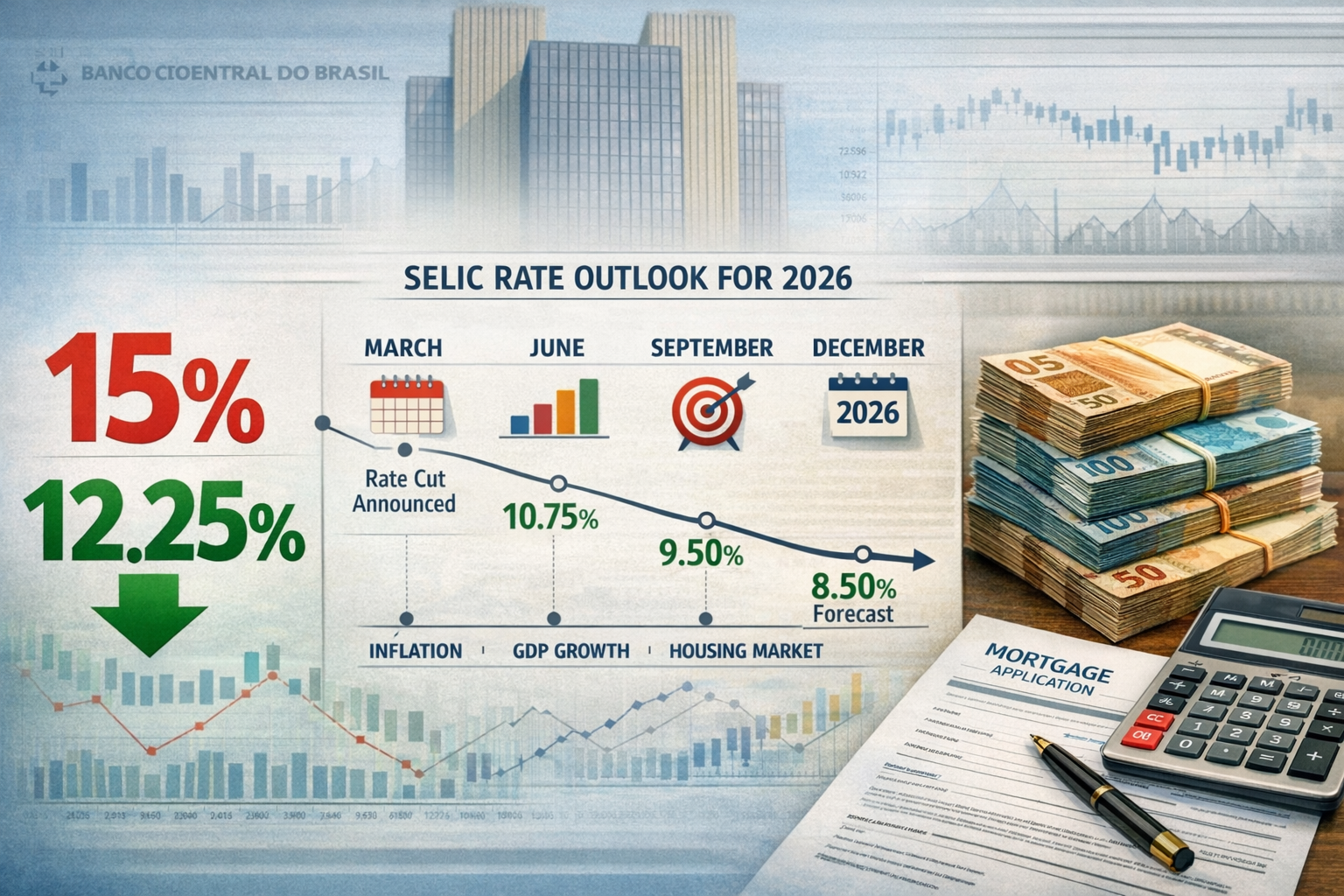
- SELIC rate is projected to drop from 15% to approximately 12.25% by end of 2026, with some economists forecasting cuts exceeding 300 basis points throughout the year [3]
- Fixed-rate mortgage products are expanding rapidly, offering payment predictability that traditional variable-rate loans cannot match
- Mid-market buyers (purchasing properties between R$300,000-R$800,000) represent the largest untapped demand segment as financing becomes more accessible
- Developers who adapt quickly to this financing shift can capture significant market share before competition intensifies
- The combination of lower rates and fixed-rate products creates a “double unlock” that simultaneously improves affordability and reduces buyer uncertainty
Understanding Brazil’s 2026 SELIC Rate Trajectory
Current Rate Environment and Economic Context
As of March 2026, Brazil’s benchmark SELIC rate stands at 15%—its highest level in nearly two decades [1]. This aggressive monetary tightening was implemented to combat inflation pressures and stabilize the Brazilian real. However, the economic landscape is shifting dramatically.
The Banco Central do Brasil has begun signaling a more accommodative stance. In January 2026, the central bank’s communication struck a “much more dovish tone,” leading analyst consensus to expect the first interest rate cut at the March 2026 meeting [3]. This represents a fundamental pivot in monetary policy that will ripple through every sector of Brazil’s economy, but perhaps nowhere more profoundly than in residential real estate.
Economist Forecasts and Rate Cut Projections
The median forecast from over 100 Brazilian economists projects the SELIC rate will reach 12.38% by the end of 2026, down from the previous 12.50% forecast that held steady for 32 weeks [2]. However, some analysts believe this consensus estimate may prove conservative.
Capital Economics projects an even more aggressive easing cycle, with more than 300 basis points of rate cuts throughout 2026—significantly exceeding widespread market expectations [3]. Their year-end forecast places the SELIC rate at 12.25% [3], representing a 275 basis point decline from current levels.
Rate Cut Timeline for 2026:
| Quarter | Projected SELIC Rate | Basis Point Change |
|---|---|---|
| Q1 2026 | 15.00% | Baseline |
| Q2 2026 | 14.00-14.25% | -75 to -100 bps |
| Q3 2026 | 13.00-13.50% | -150 to -200 bps |
| Q4 2026 | 12.25-12.38% | -262 to -275 bps |
This projected trajectory creates multiple “windows of opportunity” throughout the year as financing costs decline and buyer purchasing power expands.
Inflation Expectations and Policy Balance
The central bank’s ability to cut rates aggressively depends on inflation remaining contained. Private economists project inflation of 4.30% for 2026, above the central bank’s official target of 3% [2], but manageable enough to allow for monetary easing.
This inflation-rate balance is crucial for the real estate market in Brazil. If inflation remains stable while rates decline, real purchasing power increases—creating genuine affordability improvements rather than nominal changes that inflation erodes.
Fixed-Rate Mortgage Expansion: The Game-Changing Product Innovation

Why Fixed-Rate Products Matter in the Brazilian Context
Historically, Brazilian mortgages have been dominated by variable-rate products tied to indices like the TR (Taxa Referencial) or IPCA (consumer price index). While these products offered initial rate advantages, they exposed borrowers to significant payment uncertainty—a risk that became painfully real during recent inflation spikes.
Fixed-rate mortgages solve three critical problems:
- Payment Predictability: Borrowers know exactly what they’ll pay for the entire loan term
- Budgeting Confidence: Families can plan long-term finances without rate shock fears
- Psychological Comfort: The certainty removes a major barrier to homeownership commitment
As the SELIC Rate Decline and Fixed-Rate Mortgage Expansion: How 2026’s Financing Shift Unlocks Mid-Market Demand takes hold, these products are transitioning from niche offerings to mainstream options.
Competitive Rate Structures Emerging in 2026
Major Brazilian banks and specialized mortgage lenders are now offering fixed-rate products with rates in the 9.5% to 11.5% range for qualified borrowers—significantly below current SELIC levels. These rates become even more attractive as SELIC declines throughout 2026, since fixed-rate products lock in current market conditions for the loan duration.
Typical Fixed-Rate Mortgage Structure (2026):
- Interest Rate: 9.5% – 11.5% fixed for entire term
- Loan Term: 15-30 years
- Down Payment: 20-30% of property value
- Maximum LTV: 70-80%
- Income Requirements: Monthly payment ≤ 30% of gross income
For a mid-market property priced at R$500,000 with a 25% down payment (R$125,000), the monthly payment at 10.5% fixed for 25 years would be approximately R$3,650. This requires household income of roughly R$12,000/month—achievable for Brazil’s expanding middle class.
The Psychological Shift: From Renting to Owning
Fixed-rate products are creating a fundamental psychological shift among Brazilian buyers. The traditional calculation—”Can I afford the initial payment?”—is being replaced by “Can I afford this payment forever?” This longer-term thinking favors homeownership over renting, particularly as rental prices in major Brazilian cities continue rising.
Developers who understand this psychological dimension can structure their property offerings to emphasize payment stability and long-term value accumulation rather than just initial price points.
How the SELIC Rate Decline and Fixed-Rate Mortgage Expansion Unlocks Mid-Market Demand
Defining the Mid-Market Segment
The mid-market residential segment in Brazil’s major metropolitan areas encompasses properties priced between R$300,000 and R$800,000. This range captures:
- Two-bedroom apartments (55-75m²) in secondary neighborhoods
- Three-bedroom units (75-95m²) in developing areas
- Entry-level houses in suburban locations
- Studio and one-bedroom units in prime locations
This segment represents the largest pool of potential buyers in Brazil—families and individuals who have stable income, some savings, but have been priced out by high financing costs.
The Affordability Calculation Transformation
The combination of declining SELIC rates and fixed-rate products creates a “double unlock” effect on affordability:
Example: R$500,000 Property Purchase
| Scenario | Interest Rate | Monthly Payment | Required Income |
|---|---|---|---|
| 2025 (Variable, 14%) | 14.0% | R$4,450 | R$14,833 |
| Early 2026 (Variable, 15%) | 15.0% | R$4,750 | R$15,833 |
| Mid-2026 (Fixed, 10.5%) | 10.5% | R$3,650 | R$12,167 |
| Late 2026 (Fixed, 9.5%) | 9.5% | R$3,450 | R$11,500 |
This represents a 27% reduction in monthly payment and required income between early 2026 and late 2026—bringing hundreds of thousands of additional families into qualification range.
Geographic Demand Patterns
The SELIC Rate Decline and Fixed-Rate Mortgage Expansion: How 2026’s Financing Shift Unlocks Mid-Market Demand is creating distinct geographic demand patterns:
High-Growth Markets:
- Florianópolis and surrounding areas: Tech workers and remote professionals seeking quality of life
- Campinas and interior São Paulo: Manufacturing and service sector middle class
- Belo Horizonte suburbs: Growing professional class escaping city center prices
- Curitiba periphery: Young families seeking space and affordability
These markets combine growing employment bases, developing infrastructure, and price points that align perfectly with newly accessible financing. Developers focusing on these high-potential locations can capture first-mover advantages.
Buyer Profile Evolution
The mid-market buyer profile in 2026 differs significantly from previous years:
2026 Mid-Market Buyer Characteristics:
- Age: 28-42 years old
- Household Income: R$10,000-R$25,000/month
- Employment: Formal sector, stable jobs (3+ years)
- Down Payment Capacity: R$75,000-R$200,000 (often from FGTS + savings)
- Technology Comfort: High digital literacy, researches extensively online
- Priorities: Location, quality construction, amenities, resale potential
These buyers are sophisticated and demanding. They expect transparent pricing, professional sales processes, and developments that deliver genuine value—not just affordable pricing.
Strategic Implications for Mid-Market Developers
Product Design Optimization
Developers must align their product offerings with the new financing reality. Key design considerations include:
Unit Mix Strategy:
- Emphasize 2-bedroom units (60-75m²): Sweet spot for young families and couples
- Include compact 3-bedroom options (75-85m²): Captures growing families without premium pricing
- Offer studio/1-bedroom units: Appeals to singles and investors seeking rental income
Amenity Prioritization:
- Shared workspaces: Remote work continues growing
- Fitness facilities: Health consciousness rising among middle class
- Children’s play areas: Family-focused buyers prioritize kid-friendly environments
- Security features: Non-negotiable for most buyers
Pricing and Payment Structure Innovation
The financing shift enables creative pricing strategies:
Flexible Payment Plans:
- Extended construction-phase payments: Spread down payment over 24-36 months
- FGTS integration: Facilitate use of government savings accounts for down payments
- Graduation payment structures: Lower initial payments that increase over time as incomes rise
These structures, combined with accessible fixed-rate financing, can expand the buyer pool by 30-40% compared to traditional cash-heavy models.
Marketing Message Transformation
Sales and marketing messaging must evolve to emphasize the financing opportunity:
Key Message Pillars:
✅ “Lock in today’s rates before they rise again” (creates urgency)
✅ “Pay less per month than rent” (direct comparison to alternative)
✅ “Fixed payments for life” (emphasizes stability)
✅ “Build equity while you sleep” (long-term wealth building)
✅ “Your income grows, your payment doesn’t” (future-focused thinking)
Developers like Quadragon who master this messaging can differentiate in increasingly competitive markets.
Partnership with Financial Institutions
Proactive developers are forming strategic partnerships with banks and mortgage lenders to:
- Pre-qualify buyer pools before launch
- Offer exclusive financing packages for specific developments
- Streamline approval processes to reduce transaction friction
- Provide on-site financing specialists during sales events
These partnerships create competitive advantages that pure product differentiation cannot match.
Timing Considerations and Market Entry Windows
The 2026 Opportunity Timeline
The SELIC Rate Decline and Fixed-Rate Mortgage Expansion: How 2026’s Financing Shift Unlocks Mid-Market Demand creates distinct opportunity windows:
Q2 2026 (Current):
- Action: Launch pre-sales for Q4 2026 / Q1 2027 delivery
- Advantage: Capture early adopters who recognize financing improvement
- Risk: Rates haven’t fully declined yet; requires strong value proposition
Q3 2026:
- Action: Peak launch window as rate cuts accelerate
- Advantage: Maximum buyer awareness of financing improvements
- Risk: Competition intensifies as other developers recognize opportunity
Q4 2026:
- Action: Position for 2027 delivery with locked-in lower financing costs
- Advantage: Buyers can secure year-end rates for future delivery
- Risk: May face increased construction costs if demand surge drives input prices
Construction Timeline Alignment
Developers must align construction timelines with financing availability:
Optimal Strategy:
- Launch pre-sales: Q2-Q3 2026
- Construction start: Q3-Q4 2026
- Delivery: Q2-Q4 2027
This timeline allows buyers to secure favorable 2026 financing rates while giving developers time to manage construction costs and avoid the rush that may emerge in 2027 as the opportunity becomes widely recognized.
Risk Factors and Mitigation Strategies
Potential Headwinds
Despite the positive trajectory, several risks could impact the SELIC Rate Decline and Fixed-Rate Mortgage Expansion: How 2026’s Financing Shift Unlocks Mid-Market Demand:
Economic Risks:
- Inflation resurgence: Could slow or reverse rate cuts
- Global economic shock: External factors affecting Brazil’s economy
- Currency volatility: Real depreciation impacting purchasing power
Market Risks:
- Oversupply in specific submarkets: Too many developers chasing same opportunity
- Construction cost inflation: Demand surge driving input costs higher
- Buyer income stagnation: Economic growth not translating to wage increases
Mitigation Approaches
Diversification Strategy:
- Develop in multiple geographic submarkets to reduce location-specific risk
- Offer varied unit types and price points within mid-market range
- Maintain flexible construction timelines that can adjust to market conditions
Financial Prudence:
- Lock in construction financing early to avoid cost escalation
- Maintain conservative pre-sale thresholds (60-70%) before construction start
- Build contingency buffers (15-20%) into project budgets
Market Intelligence:
- Monitor SELIC trajectory monthly and adjust strategies accordingly
- Track competitor launches and pricing to maintain positioning
- Survey buyer sentiment regularly to understand evolving preferences
Conclusion: Seizing the 2026 Financing Revolution
The convergence of SELIC rate decline and fixed-rate mortgage expansion represents a generational opportunity for mid-market residential developers in Brazil. The SELIC Rate Decline and Fixed-Rate Mortgage Expansion: How 2026’s Financing Shift Unlocks Mid-Market Demand is not a temporary market fluctuation—it’s a structural transformation that will reshape Brazilian homeownership for years to come.
Developers who will win in this new environment share common characteristics:
🎯 Speed: Moving quickly to launch projects before competition intensifies
🎯 Buyer-Centricity: Designing products around financing accessibility, not just construction efficiency
🎯 Partnership Orientation: Collaborating with financial institutions to create seamless buyer experiences
🎯 Market Intelligence: Continuously monitoring rate trajectories and buyer sentiment
🎯 Operational Excellence: Delivering quality projects on time and budget to build reputation
The mid-market segment—long underserved due to financing constraints—now represents the highest-growth opportunity in Brazilian residential real estate. Properties priced between R$300,000 and R$800,000, particularly in emerging high-growth markets, will capture the vast majority of transaction volume growth through 2027.
Actionable Next Steps
For Developers:
- Conduct market feasibility studies in target submarkets to identify optimal locations and price points
- Establish banking partnerships to secure competitive financing packages for buyers
- Refine product designs to align with mid-market buyer priorities and budgets
- Launch marketing campaigns emphasizing financing accessibility and payment stability
- Accelerate project timelines to capture Q3-Q4 2026 launch windows
For Investors:
- Evaluate mid-market development opportunities in high-growth Brazilian cities
- Partner with experienced local developers who understand regional market dynamics
- Focus on projects with strong pre-sales (60%+) before committing full capital
- Consider pre-construction purchases to capture appreciation during construction phase
For Buyers:
- Get pre-qualified for fixed-rate mortgages now to understand purchasing power
- Research emerging neighborhoods where infrastructure improvements are planned
- Compare total cost of ownership (mortgage + fees + maintenance) versus renting
- Act in Q2-Q3 2026 to secure favorable rates before potential increases in late 2026/2027
The financing revolution of 2026 is unlocking mid-market demand at an unprecedented scale. Those who recognize this shift early and position accordingly will capture disproportionate returns as Brazil’s middle class finally gains sustainable access to homeownership. The window is open—but it won’t stay open forever. 🚀
For more information about current development opportunities and market insights, explore comprehensive resources that can help you navigate this transformative period in Brazilian real estate.
References
[1] Interestrates – https://www.bcb.gov.br/en/monetarypolicy/interestrates
[2] Brazil Economists Trim End 2026 Interest Rate Forecast After Seven Months – https://clubofmozambique.com/news/brazil-economists-trim-end-2026-interest-rate-forecast-after-seven-months/
[3] Brazil Interest Rate Announcement Jan 2026 – https://www.capitaleconomics.com/publications/latin-america-rapid-response/brazil-interest-rate-announcement-jan-2026