
São Paulo’s financial corridors are experiencing a technological revolution. As Latin America’s largest business hub enters 2026, São Paulo Corporate Office Tech Upgrades: Hybrid Work Developments for 2026 Financial Corridors are reshaping how companies operate, invest, and compete. The convergence of hybrid work models, smart building technology, and strategic real estate positioning is creating unprecedented opportunities for businesses and investors alike.
The city’s Faria Lima district alone hosts approximately 60% of Brazil’s venture capital activity and the highest concentration of unicorn companies in the region. This concentration of financial power demands cutting-edge infrastructure that supports both traditional office operations and flexible hybrid work arrangements. Companies are no longer simply leasing space—they’re investing in technology ecosystems that blend commercial functionality with residential convenience, capitalizing on São Paulo’s limited land availability and expanding transit networks.
Key Takeaways
- Hybrid infrastructure is driving office redesign: São Paulo’s financial corridors are integrating smart building technologies, IoT sensors, and flexible workspace solutions to support remote and in-office collaboration seamlessly.
- Mixed-use developments maximize limited urban space: Developers are combining commercial office space with adjacent residential units, creating live-work ecosystems that reduce commute times and increase property values.
- Government incentives accelerate tech adoption: Tax reductions through the Parque Tecnológico de São Paulo initiative and infrastructure investments totaling R$300 billion are making technology upgrades more financially attractive.
- Financial technology integration is essential: With 68 billion Pix transactions in 2025 and new payment features launching in 2026, corporate offices require advanced digital payment infrastructure and cybersecurity systems.
- Investment opportunities exist across market segments: Both prime Grade A properties in established corridors and emerging secondary locations offer distinct yield profiles for investors seeking exposure to São Paulo’s corporate real estate transformation.
Understanding São Paulo’s Corporate Office Technology Landscape in 2026
The transformation of São Paulo Corporate Office Tech Upgrades: Hybrid Work Developments for 2026 Financial Corridors reflects broader shifts in how businesses operate in post-pandemic Brazil. Companies are investing heavily in technology infrastructure that supports distributed teams while maintaining collaborative spaces for critical in-person interactions.
The Technology Stack Powering Modern Offices
Today’s corporate offices in São Paulo require far more than basic internet connectivity. The essential technology components include:
- Smart Building Management Systems: IoT sensors monitor occupancy, adjust climate control, and optimize energy consumption in real-time
- Advanced Connectivity Infrastructure: Fiber optic networks, 5G cellular integration, and redundant internet connections ensure uninterrupted operations
- Collaboration Technology: Interactive displays, high-quality video conferencing equipment, and wireless presentation systems in every meeting space
- Security and Access Control: Biometric authentication, mobile credential systems, and AI-powered surveillance protecting physical and digital assets
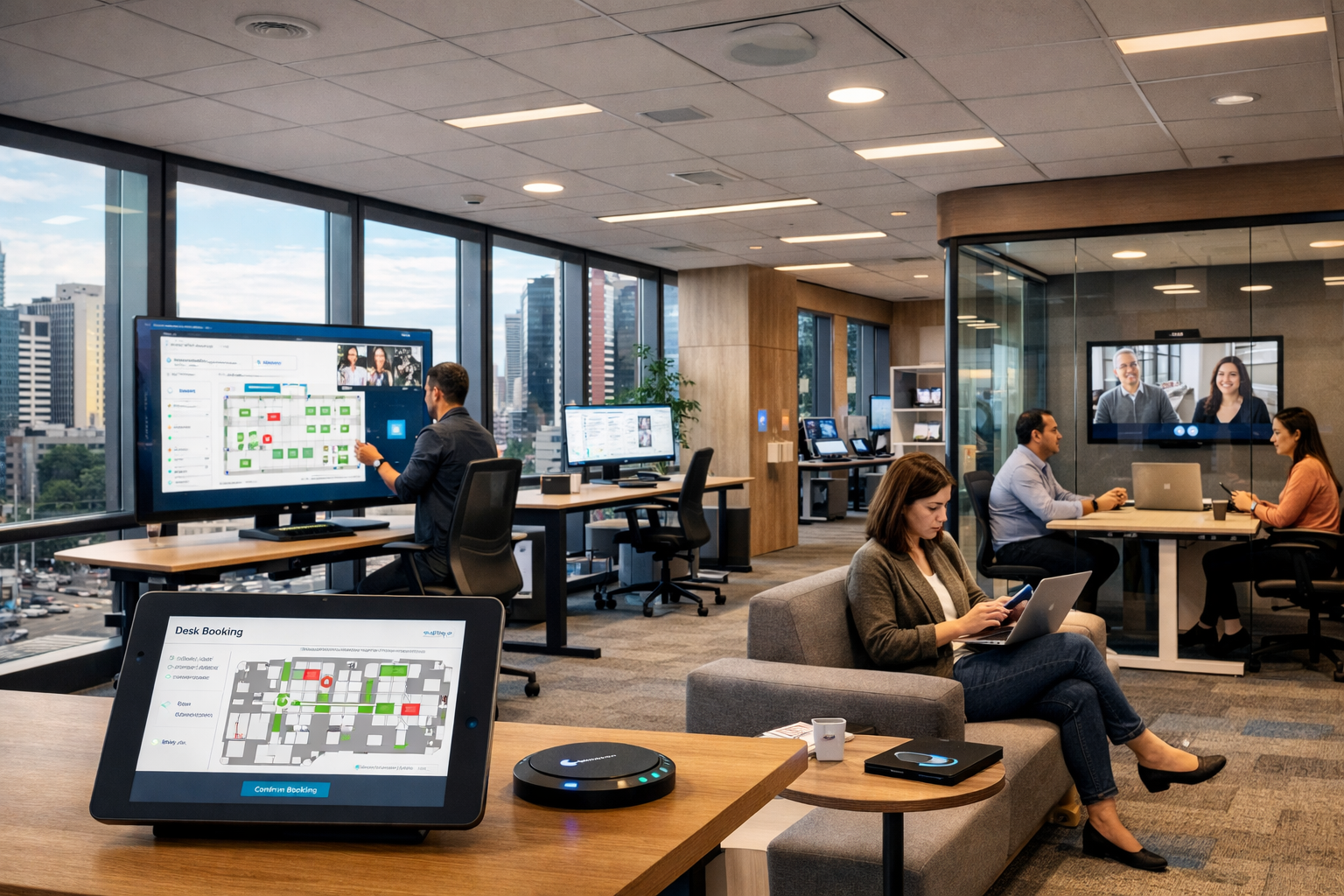
- Desk Booking and Space Management: Digital platforms allowing employees to reserve workspaces, meeting rooms, and parking spots through mobile apps
💡 Pro Tip: Companies upgrading office technology should prioritize interoperability. Systems that communicate with each other through open APIs provide greater flexibility and reduce long-term costs compared to proprietary solutions.
Financial Technology Integration Requirements
São Paulo’s position as Brazil’s financial capital means corporate offices must support sophisticated financial operations. The explosive growth of Pix—Brazil’s instant payment system—demonstrates this need. With 68 billion transactions processed in 2025 and new features like “Pix Automático” for recurring payments launching in 2026, offices require:
- Secure payment processing infrastructure for client transactions
- Compliance monitoring systems tracking regulatory requirements
- Data protection protocols meeting Brazil’s LGPD privacy standards
- Backup power systems ensuring financial operations continue during outages
The 2026 tax reform has further complicated technology requirements. Companies must now integrate mandatory ESG metrics into quarterly reporting following Law 14.793/2024 implementation, requiring upgraded tracking systems and transparency infrastructure.
Hybrid Work Models Driving Infrastructure Investment
The shift toward hybrid work arrangements has fundamentally altered what companies need from office space. Rather than simply providing desks for every employee, modern offices serve as collaboration hubs, client meeting venues, and cultural anchors for distributed teams.
Flexible Space Design Principles
São Paulo Corporate Office Tech Upgrades: Hybrid Work Developments for 2026 Financial Corridors emphasize adaptability. Leading companies are implementing:
Activity-Based Working (ABW) Layouts: Different zones optimized for specific tasks—quiet focus areas, collaborative spaces, social zones, and formal meeting rooms. Employees choose locations based on their daily activities rather than assigned seats.
Modular Furniture Systems: Reconfigurable workstations, movable walls, and multipurpose furniture allowing spaces to transform based on changing needs. A training room can become a town hall venue or be subdivided into smaller meeting spaces.
Hospitality-Inspired Amenities: Coffee bars, lounge seating, outdoor terraces, and wellness rooms creating environments that attract employees to the office rather than mandating attendance.
Technology Enabling Hybrid Operations
The physical space is only half the equation. Technology bridges the gap between remote and in-office workers:
| Technology Category | Purpose | Implementation Example |
|---|---|---|
| Room Scheduling Systems | Prevent double-booking and optimize space utilization | Touchscreen displays outside meeting rooms showing real-time availability |
| Environmental Sensors | Monitor air quality, temperature, and occupancy | IoT devices adjusting HVAC based on actual usage patterns |
| Digital Signage | Communicate company updates and wayfinding | Interactive displays in lobbies and common areas |
| Unified Communications | Seamless video/audio for hybrid meetings | Integrated systems ensuring remote participants have equal presence |
| Workplace Analytics | Track space usage and employee preferences | Dashboard reporting on which areas are utilized and when |
The Financial Case for Hybrid Infrastructure
Investing in hybrid work technology delivers measurable returns. Companies report:
- 30-40% reduction in required office space when implementing effective hybrid models
- 15-25% improvement in employee satisfaction scores related to workplace flexibility
- 20-35% decrease in real estate costs through space optimization and reduced square footage needs
- 10-15% increase in productivity from better-matched work environments
These savings often exceed the upfront technology investment within 18-24 months, making hybrid infrastructure upgrades financially attractive even for cost-conscious organizations. Investment opportunities in Brazil’s property market increasingly reflect these changing workplace dynamics.
Mixed-Use Developments: Blending Commercial and Residential
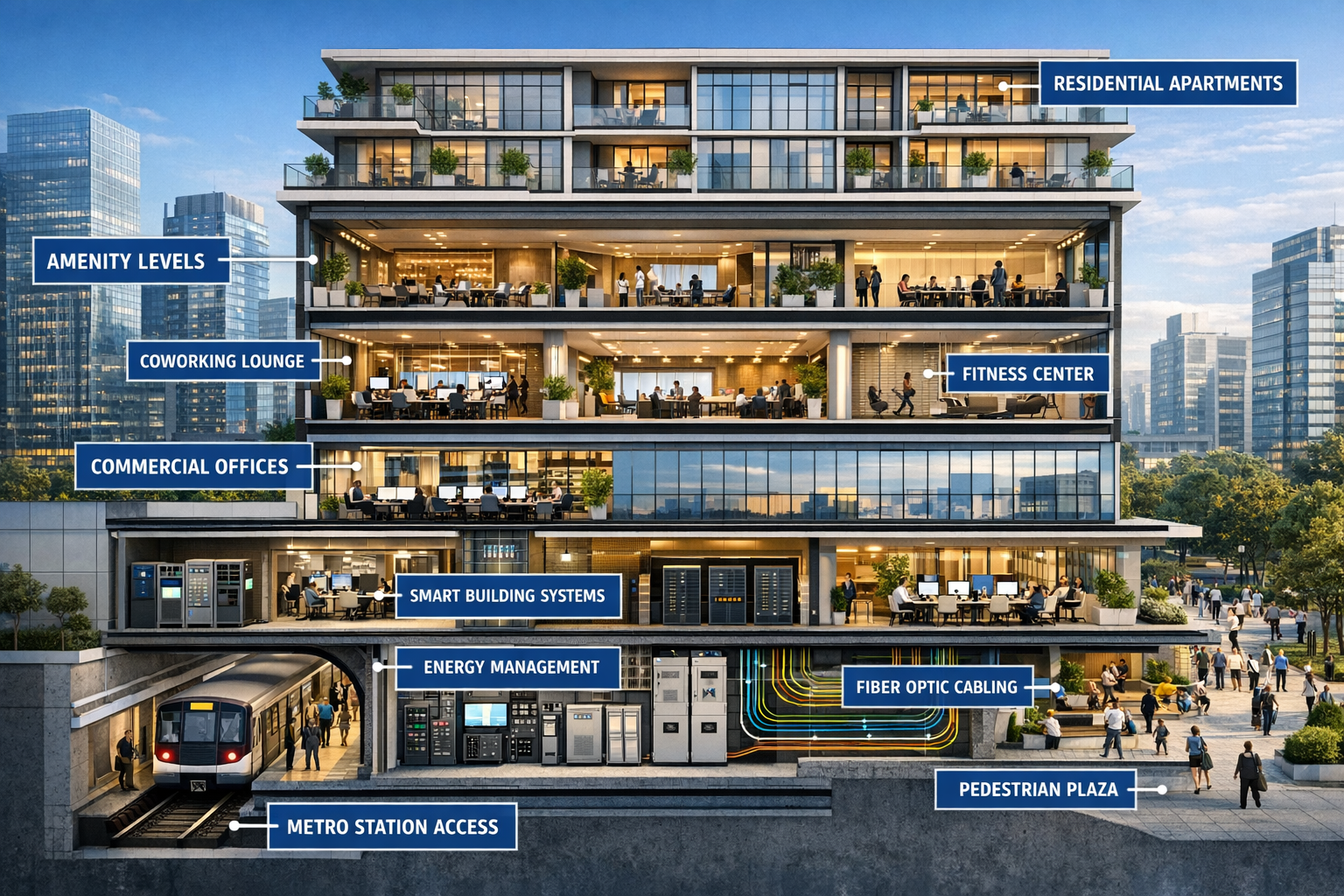
One of the most significant trends in São Paulo Corporate Office Tech Upgrades: Hybrid Work Developments for 2026 Financial Corridors is the rise of mixed-use developments. These projects combine corporate office space with residential units, retail amenities, and public spaces in integrated complexes.
Why Mixed-Use Makes Sense in São Paulo
São Paulo faces unique urban challenges that make mixed-use developments particularly attractive:
Limited Available Land: The city’s most desirable business districts have minimal vacant land, making vertical integration the most viable development strategy.
Severe Traffic Congestion: São Paulo’s notorious traffic problems mean reducing commute times delivers enormous quality-of-life improvements. Living within walking distance of work becomes a premium amenity.
Transit-Oriented Development: Expansion of São Paulo’s metro system creates opportunities for high-density development around stations, maximizing accessibility while minimizing car dependency.
Changing Work Patterns: Hybrid schedules mean professionals spend fewer days in the office but value proximity when they do commute. A 10-minute walk beats a 90-minute drive, even if taken less frequently.
Technology Integration in Mixed-Use Properties
Successful mixed-use developments require sophisticated technology infrastructure serving multiple user groups:
Unified Building Management: Single systems controlling HVAC, lighting, and security across residential and commercial zones while maintaining appropriate separation and privacy.
Shared Amenity Access: Digital platforms managing access to gyms, coworking spaces, conference rooms, and event venues available to both office tenants and residents.
Integrated Mobility Solutions: Parking management systems, bike storage with digital access, and coordination with ride-sharing and delivery services.
Separate Network Infrastructure: Distinct internet and telecommunications systems for commercial and residential users, ensuring appropriate security and service levels for each.
Investment Considerations for Mixed-Use Properties
For investors evaluating opportunities in São Paulo’s financial corridors, mixed-use developments offer distinct advantages:
✅ Diversified Income Streams: Revenue from both commercial leases and residential rentals reduces risk compared to single-use properties
✅ Premium Pricing Power: Integrated live-work environments command higher rents than comparable single-use alternatives
✅ Reduced Vacancy Risk: Residential demand often remains stable when commercial markets soften, and vice versa
✅ Long-Term Value Appreciation: Properties near transit infrastructure and in walkable neighborhoods consistently outperform isolated developments
However, these projects also present unique challenges including more complex financing structures, longer development timelines, and the need to manage different tenant types with varying expectations. Understanding market dynamics and valuation potential becomes essential for successful investment outcomes.
Government Incentives and Infrastructure Investment
São Paulo Corporate Office Tech Upgrades: Hybrid Work Developments for 2026 Financial Corridors benefit significantly from government policies designed to strengthen Brazil’s technology sector and modernize urban infrastructure.
Tax Incentives for Technology Investment
The Parque Tecnológico de São Paulo initiative provides substantial tax reductions for companies investing in research and development within city limits. Eligible companies receive:
- Reduced ISS (service tax) rates for technology services
- IPTU (property tax) exemptions for qualifying facilities
- Accelerated depreciation schedules for technology equipment
- Streamlined permitting processes for office renovations and upgrades
These incentives make São Paulo particularly attractive compared to other Brazilian cities, helping explain why the city captures approximately 60% of venture capital directed toward Brazil’s technology sector.
Infrastructure Modernization Programs
Brazil’s R$300 billion infrastructure auction announced on March 4, 2026, will channel investment into energy, road, and sanitation upgrades critical for corporate operations. For office buildings, this means:
More Reliable Power Supply: Reduced frequency and duration of outages that disrupt business operations and damage sensitive equipment.
Improved Transportation Networks: Expanded metro lines and bus rapid transit corridors reducing employee commute times and improving access to office locations.
Enhanced Telecommunications Infrastructure: Government investment in fiber optic networks and 5G deployment supporting bandwidth-intensive applications.
Water and Sanitation Upgrades: Modern systems supporting high-density office buildings and mixed-use developments.
Financing Technology Upgrades
TD SYNNEX Capital’s inauguration of Brazilian operations in April 2025 provides companies with new options for funding technology investments. Available financing solutions include:
- Equipment Leasing: Spread costs over 24-60 months while preserving capital for other investments
- Technology Refresh Programs: Structured financing for regular equipment upgrades maintaining current technology
- Bundled Solutions: Combined hardware, software, and service packages with single monthly payments
- Flexible Terms: Options for seasonal businesses or companies with variable cash flow
These financing tools lower the barrier to implementing comprehensive technology upgrades, particularly for small and medium-sized enterprises that might otherwise defer investments due to capital constraints.
Investment Opportunities in São Paulo’s Financial Corridors
For investors seeking exposure to São Paulo Corporate Office Tech Upgrades: Hybrid Work Developments for 2026 Financial Corridors, the market offers opportunities across multiple segments with distinct risk-return profiles.
Prime Grade A Office Properties
Location: Faria Lima, Vila Olímpia, Itaim Bibi Characteristics: Trophy assets with state-of-the-art technology infrastructure, LEED or similar environmental certifications, prestigious addresses
Investment Profile:
- Lower cap rates (6-8%) reflecting premium quality and location
- Stable, creditworthy tenants including multinational corporations and leading Brazilian companies
- Long-term lease structures (5-10 years) providing predictable income
- Limited value-add potential but strong preservation of capital
Technology Features: These properties typically include advanced building management systems, redundant power and connectivity, sophisticated security infrastructure, and premium amenities attracting top-tier tenants.
Value-Add Secondary Corridor Properties
Location: Brooklin, Pinheiros, emerging areas near metro expansions Characteristics: Older buildings requiring renovation, properties with below-market rents, assets with repositioning potential
Investment Profile:
- Higher cap rates (9-12%) reflecting additional risk and value-add opportunity
- Potential for significant rent increases following renovation
- Shorter lease terms requiring more active management
- Greater upside potential but higher execution risk
Upgrade Strategy: Investors acquire these properties, implement technology upgrades (modern HVAC, improved connectivity, flexible layouts), rebrand and reposition, then lease to growing companies seeking quality space at below-prime pricing.
Mixed-Use Development Projects
Location: Transit-oriented development sites throughout São Paulo’s core Characteristics: Ground-up construction or major redevelopment combining office, residential, and retail
Investment Profile:
- Development returns targeting 15-20% IRR
- Longer hold periods (7-10 years) including construction phase
- Complexity requiring experienced development partners
- Highest potential returns with correspondingly higher risk
Technology Integration: These projects incorporate smart building technology from the design phase, creating integrated systems serving multiple uses and delivering operational efficiencies impossible in single-use buildings.
Comparing Investment Segments
| Property Type | Cap Rate Range | Typical Hold Period | Technology Investment | Management Intensity | Risk Level |
|---|---|---|---|---|---|
| Prime Grade A | 6-8% | 5-7 years | Low (already equipped) | Low | Low |
| Value-Add Secondary | 9-12% | 4-6 years | High (renovation required) | Medium-High | Medium |
| Mixed-Use Development | 15-20% IRR | 7-10 years | Very High (new construction) | Very High | High |
Investors should match their strategy to their risk tolerance, capital availability, and expertise. Conservative investors seeking stable income gravitate toward prime properties, while those with development experience and higher risk tolerance pursue mixed-use projects with greater return potential.
The broader real estate market dynamics in Brazil provide context for understanding investment timing and market cycles affecting São Paulo’s corporate office sector.
Key Technology Trends Shaping 2026 Office Spaces
Several specific technology trends are particularly influential in São Paulo Corporate Office Tech Upgrades: Hybrid Work Developments for 2026 Financial Corridors during 2026:
Artificial Intelligence and Automation
Predictive Space Management: AI algorithms analyze usage patterns and predict future space needs, helping companies optimize their real estate portfolios.
Automated Climate Control: Machine learning systems adjust temperature, humidity, and air circulation based on occupancy, weather conditions, and energy costs.
Intelligent Security: Facial recognition, behavior analysis, and threat detection systems providing security while minimizing friction for authorized users.
Virtual Assistants: AI-powered chatbots helping employees book meeting rooms, report maintenance issues, and find colleagues within office buildings.
Sustainability and ESG Technology
Following Law 14.793/2024 requiring ESG reporting from B3-listed companies, offices require technology tracking:
- Energy consumption and carbon emissions at granular levels
- Water usage and waste generation metrics
- Indoor air quality and employee wellness indicators
- Sustainable material sourcing and lifecycle management
Green Building Certifications: LEED, WELL, and local certification programs require monitoring systems documenting environmental performance, driving technology adoption.
Enhanced Connectivity Solutions
5G Integration: Corporate offices are implementing private 5G networks supporting IoT devices, augmented reality applications, and bandwidth-intensive collaboration tools.
Wi-Fi 6E Deployment: The latest wireless standard delivers faster speeds, lower latency, and better performance in dense office environments with hundreds of connected devices.
Edge Computing: Processing data closer to where it’s generated reduces latency for time-sensitive applications and decreases bandwidth requirements.
Health and Wellness Technology
Post-pandemic awareness of workplace health drives adoption of:
- Touchless Interfaces: Voice control, gesture recognition, and mobile app control reducing physical contact with shared surfaces
- Air Quality Monitoring: Real-time tracking of CO2, particulates, and ventilation rates with automatic adjustments
- Occupancy Management: Systems preventing overcrowding and ensuring appropriate distancing when needed
- Wellness Amenities: Meditation rooms, fitness centers, and outdoor spaces integrated into office design
These technologies address employee concerns while demonstrating corporate commitment to health and safety, helping attract talent in competitive markets.
Navigating Challenges in Corporate Office Upgrades
While the opportunities in São Paulo Corporate Office Tech Upgrades: Hybrid Work Developments for 2026 Financial Corridors are substantial, investors and companies face several challenges:
Regulatory Complexity
Brazil’s regulatory environment requires careful navigation:
Building Codes and Permits: São Paulo’s municipal requirements for renovations and technology installations can be complex, requiring specialized local expertise.
Data Privacy Compliance: Brazil’s LGPD (Lei Geral de Proteção de Dados) imposes strict requirements on how companies collect, store, and use data from building systems and employee monitoring.
Labor Regulations: Technology affecting employee monitoring or work arrangements must comply with Brazilian labor law, which provides strong worker protections.
Tax Considerations: The 2026 tax reform altered treatment of technology investments, requiring companies to work with specialized counsel to optimize tax positions.
Technology Integration Challenges
Upgrading existing buildings presents technical obstacles:
⚠️ Legacy Infrastructure: Older buildings may lack adequate electrical capacity, network cabling, or structural support for modern technology systems.
⚠️ Interoperability Issues: Integrating new technology with existing building systems requires careful planning and sometimes custom integration work.
⚠️ Disruption During Installation: Implementing major technology upgrades while maintaining business operations requires phased approaches and careful coordination.
⚠️ Vendor Selection: Choosing technology partners with local presence, Portuguese language support, and understanding of Brazilian business practices is essential.
Financial Considerations
Technology investments require careful financial planning:
Upfront Capital Requirements: Comprehensive upgrades can cost R$500-1,500 per square meter depending on scope and existing conditions.
Ongoing Operating Costs: Technology systems require maintenance, software subscriptions, and periodic upgrades beyond initial installation.
Obsolescence Risk: Rapid technology evolution means systems may require replacement sooner than traditional building infrastructure.
Tenant Improvement Negotiations: Landlords and tenants must negotiate who pays for technology upgrades and who benefits from resulting improvements.
Understanding how real estate development projects progress provides context for realistic timelines and budget expectations for major office technology implementations.
Future Outlook: What’s Next for São Paulo’s Corporate Corridors
Looking beyond 2026, several trends will continue shaping São Paulo Corporate Office Tech Upgrades: Hybrid Work Developments for 2026 Financial Corridors:
Continued Hybrid Work Evolution
Hybrid work arrangements are becoming permanent features of corporate culture rather than temporary pandemic responses. This means:
- Ongoing Space Optimization: Companies will continue refining how much office space they need and how it should be configured
- Technology Refresh Cycles: Regular upgrades maintaining current collaboration and connectivity capabilities
- Amenity Arms Race: Competition for talent driving investment in premium office amenities and experiences
Expansion Beyond Traditional Corridors
As prime locations become saturated and expensive, development will expand to:
- Secondary Districts: Areas like Brooklin, Pinheiros, and neighborhoods near metro expansions attracting companies seeking value
- Suburban Office Parks: Technology-enabled remote work making location less critical, allowing some operations to move to lower-cost areas
- Regional Hubs: Other Brazilian cities developing corporate office markets as companies distribute operations
Technology Democratization
Advanced technology once available only in premium buildings is becoming standard:
- Declining Technology Costs: Economies of scale and competition reducing prices for smart building systems
- Standardized Platforms: Industry consolidation around common standards making implementation easier and less expensive
- Cloud-Based Solutions: Software-as-a-service models reducing upfront investment requirements
Major Events Driving Growth
São Paulo’s position as Latin America’s business capital is reinforced by major events:
Capacity LATAM 2026 (March 17-18, 2026 at Grand Hyatt São Paulo) brings together 1,000+ senior executives from carriers, data center operators, hyperscalers, and investors, highlighting infrastructure investment opportunities.
Web Summit Rio 2026 expects 40,000+ participants and 1,000 startups, serving as a bridge for foreign talent and providing platforms for local founders to access global capital. While held in Rio, this event drives corporate expansion throughout Brazil’s major cities.
These gatherings reinforce São Paulo’s status as the region’s technology and financial hub, driving continued demand for sophisticated office infrastructure.
Long-Term Institutional Commitments
Major corporate investments signal confidence in São Paulo’s future:
Santander’s announcement of a major new corporate campus (developed by GTIS Partners, opening second half of 2028) represents significant long-term commitment to the city’s corporate landscape. Such anchor projects catalyze additional development and infrastructure investment in surrounding areas.
For investors considering various real estate development opportunities, understanding these long-term trends helps identify projects positioned to benefit from São Paulo’s continued evolution as Latin America’s premier business destination.
Conclusion: Positioning for Success in São Paulo’s Evolving Office Market
São Paulo Corporate Office Tech Upgrades: Hybrid Work Developments for 2026 Financial Corridors represent a fundamental transformation of how businesses operate and how investors evaluate real estate opportunities. The convergence of hybrid work models, smart building technology, mixed-use development, and government infrastructure investment creates a dynamic environment with significant potential for those who understand the landscape.
Key Success Factors
Companies and investors can position themselves for success by focusing on:
🎯 Strategic Location Selection: Prioritize properties near transit infrastructure, in walkable neighborhoods, and within established or emerging business corridors
🎯 Comprehensive Technology Integration: Invest in flexible, interoperable systems that can adapt as work patterns and technology continue evolving
🎯 Mixed-Use Thinking: Consider how combining commercial and residential uses can create synergies, reduce risk, and command premium pricing
🎯 Sustainability Leadership: Implement ESG tracking and green building practices meeting regulatory requirements while attracting environmentally conscious tenants and employees
🎯 Local Partnership: Work with experienced Brazilian partners who understand regulatory requirements, cultural expectations, and market dynamics
Actionable Next Steps
For companies planning office upgrades:
- Conduct a technology audit assessing current infrastructure against hybrid work requirements
- Survey employees understanding their preferences for office versus remote work and desired amenities
- Evaluate financing options including leasing and structured financing to preserve capital
- Engage local experts for regulatory compliance, permitting, and implementation
- Plan phased implementation minimizing disruption while delivering improvements
For investors evaluating opportunities:
- Define investment criteria matching property types to risk tolerance and return objectives
- Analyze market segments comparing prime, value-add, and development opportunities
- Assess technology infrastructure in potential acquisitions and required upgrade costs
- Model multiple scenarios accounting for hybrid work adoption rates and space utilization changes
- Build local networks connecting with developers, brokers, and operators active in São Paulo’s market
The transformation of São Paulo’s corporate office landscape is well underway, driven by technological advancement, changing work patterns, and strategic infrastructure investment. Those who understand these dynamics and position themselves accordingly will find substantial opportunities in one of Latin America’s most dynamic real estate markets.
Whether upgrading existing facilities, developing new projects, or investing in corporate real estate, success requires understanding how technology, urban planning, and workplace culture intersect in São Paulo Corporate Office Tech Upgrades: Hybrid Work Developments for 2026 Financial Corridors. The market rewards those who anticipate trends, implement thoughtfully, and maintain flexibility as this evolution continues.