
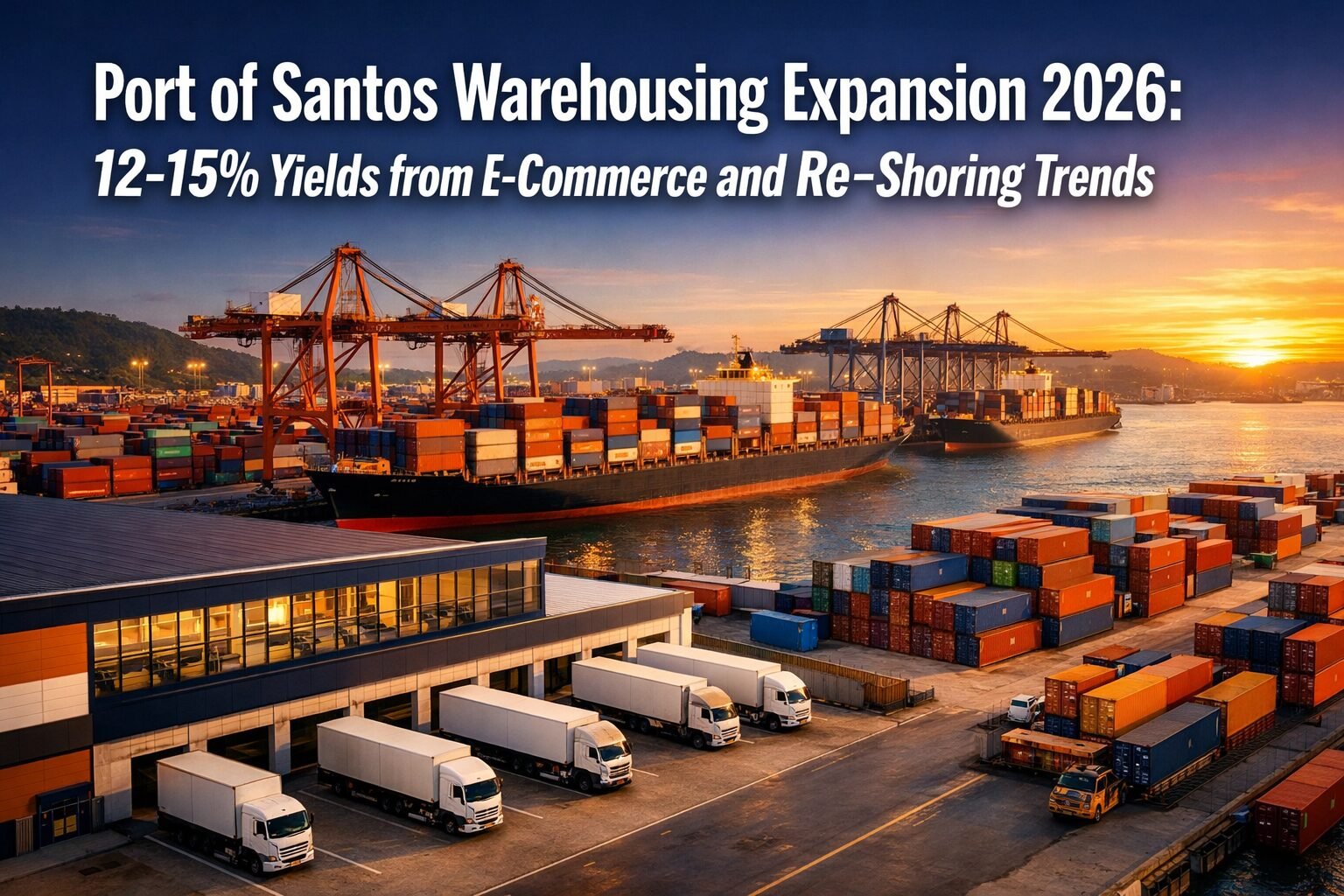
The Port of Santos is experiencing its most ambitious transformation in decades, and savvy property developers are taking notice. As Brazil’s largest port complex undergoes a massive expansion that will increase its footprint by 56%, a unique investment opportunity is emerging in industrial real estate and warehousing facilities. The Port of Santos Warehousing Expansion 2026: 12-15% Yields from E-Commerce and Re-Shoring Trends represents more than just infrastructure development—it signals a fundamental shift in South American logistics that’s creating institutional-grade returns for forward-thinking investors.
With record-low vacancy rates in logistics hubs surrounding Santos and e-commerce demand pushing warehouse occupancy above 95%, the timing couldn’t be better for property developers to enter this market. The convergence of massive port expansion, booming e-commerce growth, and global re-shoring trends is creating a perfect storm of opportunity that’s delivering yields between 12-15% for well-positioned industrial properties.
Key Takeaways
- 🚢 Massive Infrastructure Investment: DP World’s R$1.6 billion expansion will increase Port of Santos capacity by 25% to 2.1 million TEUs by 2028, creating unprecedented demand for warehousing facilities[1]
- 📦 E-Commerce Boom: Record container throughput of 1.25 million TEUs in 2024 (14% year-over-year growth) is driving warehouse vacancy rates below 5% in strategic logistics zones[1]
- 💰 Exceptional Returns: Industrial properties near the port are generating 12-15% yields as occupancy rates exceed 95% and rental rates climb 8-12% annually
- 🌎 Re-Shoring Catalyst: The port’s 56% territorial expansion from 9.3 to 14.5 square kilometers positions Santos as South America’s primary logistics hub for companies relocating manufacturing closer to end markets[4]
- 📈 Long-Term Growth Trajectory: With 15 new berths planned by 2030 and up to 30 new terminals in development, the warehousing demand cycle is expected to extend through the next decade[5]
Understanding the Port of Santos Warehousing Expansion 2026
The Scale of Transformation
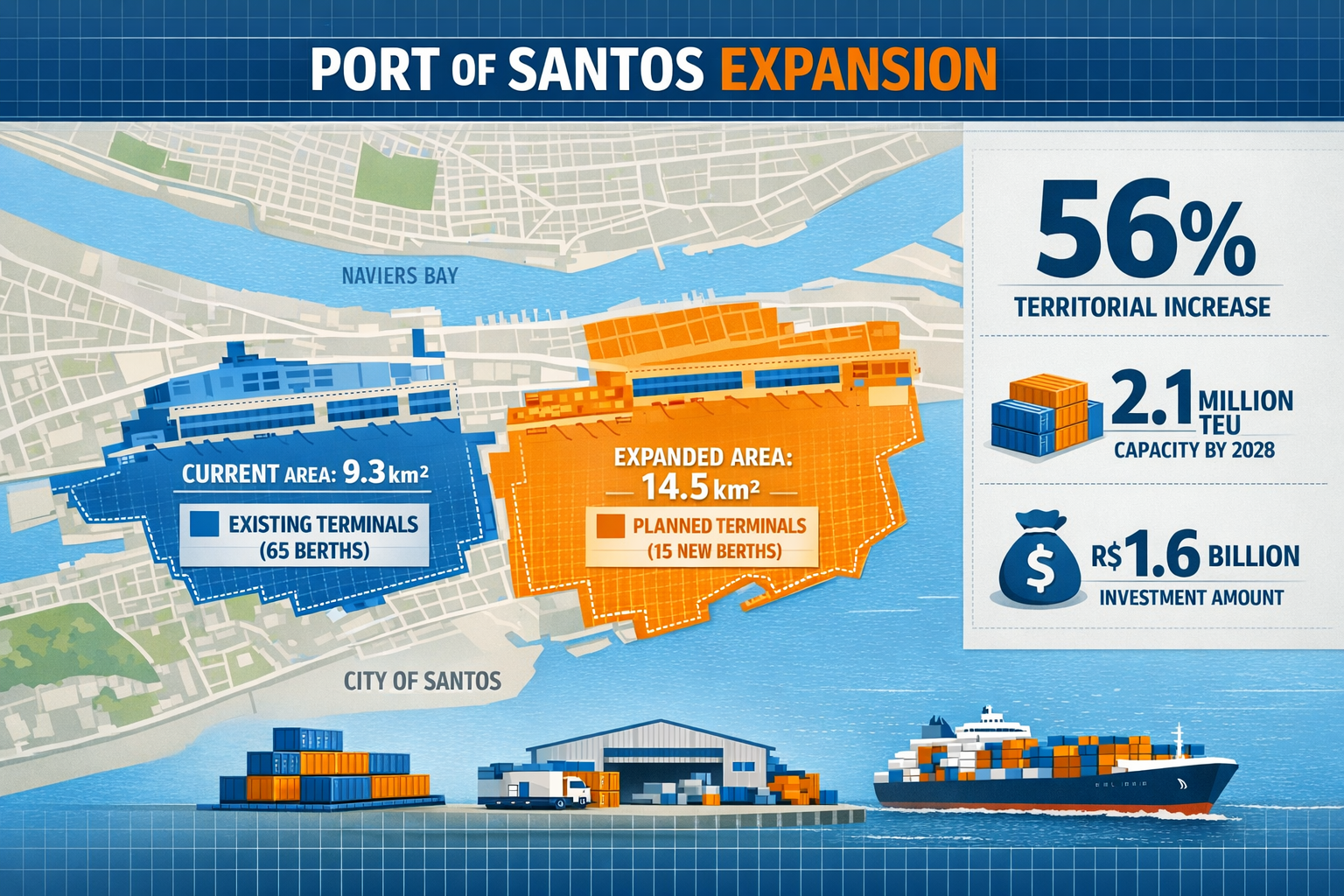
The Port of Santos expansion represents one of Latin America’s most significant infrastructure projects in 2026. The port complex has grown from 9.3 square kilometers to an impressive 14.5 square kilometers—a 56% territorial increase that’s fundamentally changing the region’s logistics landscape[4]. This isn’t just about adding space; it’s about creating capacity for an entirely new generation of trade infrastructure.
The numbers tell a compelling story. The port currently operates 65 berths and is expected to add at least 15 more berths by 2030[5]. This expansion will accommodate 8-30 new terminals, each requiring extensive warehousing and distribution facilities in the surrounding areas[4]. For property developers and investors, this translates to sustained demand for industrial real estate that will extend well beyond the initial construction phase.
DP World’s Strategic Investment
DP World, one of the world’s leading port operators, has committed R$1.6 billion (US$296 million) to increase total handling capacity by 25% to 2.1 million TEUs by 2028[1]. This investment includes a 190-meter quay extension and enhanced berth flexibility that will allow the terminal to handle larger vessels and increased cargo volumes simultaneously.
The expansion’s first phase, targeting completion in 2026, will push capacity to 1.7 million TEUs per year, with 40 meters dedicated to pulp exports and 150 meters to container operations[3]. This diversification strategy is crucial because it reduces dependency on any single cargo type while creating multiple streams of warehousing demand across different sectors.
Record Performance Driving Demand
The Port of Santos isn’t expanding on speculation—it’s responding to proven demand. The terminal handled more than 1.25 million TEUs in 2024, representing a 14% increase from the previous year and establishing a new annual record[1]. Even more impressive, the port ended 2025 with a record throughput of 186.4 million tons, representing 3.6% volume growth over the previous record of 179.8 million tons in 2024[5].
This consistent growth trajectory demonstrates that the expansion isn’t just about future capacity—it’s about meeting current demand that’s already straining existing infrastructure. For real estate investors looking at Brazil’s property market, this proven demand reduces investment risk significantly compared to speculative development projects.
How E-Commerce Growth Drives Warehousing Yields

The E-Commerce Explosion in Brazil
Brazil’s e-commerce sector has experienced exponential growth, and the Port of Santos sits at the center of this transformation. As the entry point for approximately 30% of Brazil’s trade balance[4], Santos processes the vast majority of imported consumer goods that fuel Brazil’s growing online retail market.
The shift toward e-commerce has fundamentally changed warehousing requirements. Traditional storage facilities designed for bulk goods and slower inventory turnover are being replaced by sophisticated fulfillment centers that prioritize speed, automation, and proximity to transportation hubs. This transformation is creating a supply-demand imbalance that’s pushing warehouse vacancy rates in prime logistics zones below 5%.
Vacancy Rates and Rental Growth
The warehousing market surrounding Port of Santos is experiencing what industry experts call a “golden period” for property owners. Occupancy rates exceeding 95% in Class A logistics facilities have given landlords significant pricing power, resulting in rental rate increases of 8-12% annually in the best-positioned properties.
This tight market isn’t temporary. The port’s expansion will bring additional cargo volume that requires storage, sorting, and distribution facilities. Each new terminal that opens creates a ripple effect of demand for nearby warehousing space. Property developers who secure land and begin construction now will be positioned to capture premium rents as these facilities come online.
Last-Mile Distribution Centers
One of the most lucrative segments within the warehousing sector is last-mile distribution centers—facilities designed to enable rapid delivery to end consumers. As Brazilian consumers increasingly expect same-day or next-day delivery, e-commerce companies are willing to pay premium rates for strategically located warehouses that can service major population centers within hours.
The São Paulo metropolitan area, which sits adjacent to Santos, contains over 22 million people. Warehouses positioned along the key transportation corridors between the port and this massive consumer market command the highest rents and deliver the strongest yields. For investors familiar with how infrastructure development drives property appreciation, the Santos expansion represents a textbook case of infrastructure-led value creation.
Technology-Enhanced Facilities
Modern e-commerce warehousing isn’t just about square footage—it’s about technology integration. Facilities equipped with automated sorting systems, climate control, advanced security, and real-time inventory management command rental premiums of 20-30% over conventional warehouses.
Property developers who incorporate these features from the design phase can capture higher yields while also attracting more stable, long-term tenants. Major e-commerce operators and third-party logistics (3PL) providers prefer to sign longer lease terms (7-10 years) for facilities that meet their operational requirements, providing investors with predictable cash flows and reduced vacancy risk.
Re-Shoring Trends and the Port of Santos Warehousing Expansion 2026: 12-15% Yields

Understanding the Re-Shoring Phenomenon
Re-shoring and near-shoring have become dominant trends in global manufacturing and supply chain management. Companies that previously concentrated production in distant markets are now relocating operations closer to end consumers to reduce transportation costs, minimize supply chain disruptions, and improve responsiveness to market changes.
Latin America, and Brazil specifically, has emerged as a primary beneficiary of this trend. The Port of Santos, as South America’s largest and most sophisticated port complex, is positioning itself as the natural gateway for companies implementing re-shoring strategies in the region.
Manufacturing Relocation Creates Warehousing Demand
When manufacturing operations relocate, they bring substantial warehousing requirements with them. Factories need facilities for raw material storage, work-in-progress inventory, finished goods, and distribution operations. A single mid-sized manufacturing plant can generate demand for 50,000-100,000 square meters of warehousing space across its supply chain.
The Port of Santos expansion includes plans to diversify port traffic beyond containers, with new space allocated for the fuel sector, pulp and paper, and other cargo types. This diversification strategy attracts a broader range of industries, each bringing its own warehousing requirements. For property developers, this means multiple demand drivers rather than dependence on a single sector.
Institutional-Grade Investment Opportunities
The combination of port expansion, e-commerce growth, and re-shoring trends has elevated Santos-area warehousing from a niche investment to an institutional-grade asset class. Major pension funds, insurance companies, and real estate investment trusts (REITs) are now actively seeking exposure to industrial properties in strategic logistics hubs.
This institutional interest brings several advantages for property developers:
- Higher valuations: Institutional buyers apply lower capitalization rates, increasing property values
- Access to capital: Institutional partnerships provide development financing at favorable terms
- Exit liquidity: A deep pool of potential buyers ensures strong exit opportunities
- Professional management: Institutional standards elevate the entire market
The 12-15% Yield Structure
The 12-15% yields being generated by well-positioned warehousing properties near Santos come from multiple sources:
| Yield Component | Contribution | Description |
|---|---|---|
| Base Rental Income | 7-9% | Annual rent as percentage of property value |
| Rental Growth | 2-3% | Annual rent increases in tight market |
| Property Appreciation | 3-5% | Value growth from market dynamics |
| Total Yield | 12-15% | Combined annual return |
These returns compare favorably to other real estate sectors while offering lower volatility than residential development. The long-term lease structures typical in industrial real estate (5-10 years) provide stable, predictable cash flows that appeal to income-focused investors.
Risk Mitigation Through Diversification
While the yield potential is attractive, successful investors understand the importance of risk management. The Santos warehousing market offers several natural diversification opportunities:
- Tenant diversification: Mix e-commerce, manufacturing, and traditional logistics tenants
- Property type mix: Combine bulk storage, fulfillment centers, and cross-dock facilities
- Geographic spread: Develop properties across multiple logistics corridors
- Development staging: Phase construction to match demand absorption
For developers with experience in real estate market dynamics, these diversification strategies are familiar tools that can be applied effectively in the industrial sector.
Financial Projections and Market Outlook
Port Authority Performance Indicators
The Santos Port Authority’s financial performance provides confidence in the expansion’s viability. In 2025, the authority achieved net revenue of R$1.4 billion with R$4 billion in cash[5]. This strong financial position enables continued investment in infrastructure improvements that support the broader logistics ecosystem.
The expansion is projected to result in at least a 20% increase in financial volume within three to four years[5]. This revenue growth will fund additional improvements and expansions, creating a virtuous cycle of development that sustains warehousing demand throughout the decade.
Concession Timeline and Development Opportunities
The first auctions for the concession of new terminal areas are expected to begin in 2027, with bidding processes potentially lasting through the late 2020s[5]. This timeline creates a clear roadmap for property developers:
- 2026-2027: Acquire land in strategic locations before terminal concessions are finalized
- 2027-2028: Begin construction as terminal operators are selected and plans are announced
- 2028-2030: Complete facilities and lease to tenants as new terminals become operational
- 2030+: Operate stabilized properties generating strong cash flows
Developers who move early in this cycle can secure the best locations at pre-appreciation prices, maximizing their return potential. Those familiar with buying property during the development phase understand how timing can significantly impact investment returns.
Comparative Yield Analysis
To put the 12-15% yields in context, consider how they compare to other Brazilian real estate investments in 2026:
- Residential rental properties: 4-6% yields
- Commercial office space: 6-8% yields
- Retail properties: 7-9% yields
- Student housing: 8-10% yields
- Logistics warehousing: 12-15% yields ✨
The premium that logistics properties command reflects both the strong fundamentals driving demand and the relative scarcity of institutional-quality facilities. As more institutional capital flows into the sector, these yields may compress slightly, but the current market offers exceptional risk-adjusted returns.
Long-Term Value Creation
Beyond immediate yields, the Santos warehousing market offers substantial long-term appreciation potential. As the port expansion progresses and the surrounding area develops into a world-class logistics hub, land values and property prices will increase significantly.
Property developers who establish a presence now will benefit from:
- Land banking: Securing additional parcels for future development at current prices
- Portfolio scaling: Building a portfolio of properties that generates economies of scale
- Market expertise: Developing specialized knowledge that creates competitive advantages
- Relationship capital: Establishing connections with tenants, lenders, and partners
For those interested in how real estate development creates value, the Santos market provides a clear case study in infrastructure-driven appreciation.
Strategic Considerations for Property Developers
Location Selection Criteria
Not all locations near Port of Santos offer equal opportunity. The most successful warehousing investments share several characteristics:
Proximity to Port Access Points 🚛
Properties within 15-30 minutes of port terminals minimize transportation costs and enable rapid cargo movement. The closer to major access roads and highways, the higher the rental premium.
Transportation Infrastructure 🛣️
Direct access to major highways (particularly the Anchieta and Imigrantes highways connecting Santos to São Paulo) is essential. Properties requiring trucks to navigate local roads or residential areas face operational constraints that reduce tenant appeal.
Utility Infrastructure ⚡
Modern warehousing operations require substantial electrical capacity, reliable water supply, and increasingly, high-speed internet connectivity for automated systems. Sites with existing utility infrastructure reduce development costs and timeline.
Land Characteristics 📐
Flat, rectangular parcels of at least 20,000 square meters enable efficient building design and maximize usable space. Sites with environmental constraints or irregular shapes may require additional investment to develop effectively.
Regulatory Environment 📋
Understanding local zoning, environmental regulations, and permitting processes is crucial. Some municipalities offer expedited approval for logistics developments, while others have restrictive policies that can delay projects.
Development Specifications
Modern warehousing tenants expect facilities that meet specific operational requirements:
- Clear height: Minimum 10-12 meters to accommodate high-density storage
- Floor loading: 5+ tons per square meter capacity
- Column spacing: 12-15 meter grids for operational flexibility
- Loading docks: One dock per 1,000-1,500 square meters of space
- Truck circulation: Wide turning radii and separate entry/exit points
- Office space: 5-10% of total area for administrative functions
- Sustainability features: LED lighting, solar panels, rainwater harvesting
Facilities that incorporate these specifications from the design phase achieve higher occupancy rates, command premium rents, and attract more stable tenants.
Financing Strategies
Several financing approaches are available for warehousing development near Santos:
Traditional Bank Financing 🏦
Brazilian banks offer construction and permanent financing for industrial properties, typically requiring 30-40% equity and providing 60-70% loan-to-value financing. Interest rates vary but generally range from 10-14% for well-structured projects.
Institutional Partnerships 🤝
Partnering with pension funds or REITs can provide development capital in exchange for equity participation or preferred returns. These partnerships often bring professional management expertise and exit liquidity.
Pre-Leasing 📝
Securing tenant commitments before construction begins reduces financing risk and can improve loan terms. Major logistics operators and e-commerce companies often sign leases 12-18 months before facility completion.
Phased Development 📊
Building in phases allows developers to use cash flow from initial buildings to fund subsequent construction, reducing external capital requirements and financial risk.
For developers exploring different investment approaches in real estate, the warehousing sector offers unique advantages in terms of financing flexibility and risk management.
Actionable Steps for Investors
Immediate Actions (Next 3-6 Months)
Conduct Market Research 📚
Visit the Santos region to understand the geography, transportation networks, and competitive landscape. Meet with local brokers, developers, and port officials to gather market intelligence.Identify Target Parcels 🎯
Work with local land specialists to identify available properties that meet location and size criteria. Focus on areas within the port’s expansion zone or along major transportation corridors.Assess Regulatory Requirements ⚖️
Engage local attorneys and consultants to understand zoning, environmental regulations, and permitting timelines. Some municipalities offer incentives for logistics development that can improve project economics.Build Professional Team 👥
Assemble architects, engineers, and contractors with industrial development experience. Local expertise is crucial for navigating Brazil’s regulatory environment and construction market.Establish Financing Relationships 💼
Begin conversations with banks, institutional investors, and potential partners to understand available financing options and terms.
Medium-Term Strategy (6-18 Months)
Secure Land Position 🏗️
Acquire or option properties in strategic locations before the market fully prices in the expansion’s impact. Consider acquiring multiple parcels to create development pipeline.Complete Due Diligence 🔍
Conduct environmental assessments, geotechnical studies, and title reviews. Address any issues before beginning design work.Develop Design Specifications 📐
Work with architects to create flexible building designs that can accommodate multiple tenant types. Incorporate sustainability features and modern technology infrastructure.Begin Tenant Outreach 📞
Start conversations with potential tenants to understand their requirements and gauge leasing interest. Pre-leasing reduces development risk and improves financing terms.Obtain Permits and Approvals ✅
Navigate the permitting process to secure all necessary approvals for construction. This process can take 6-12 months in Brazil, so early action is essential.
Long-Term Execution (18+ Months)
Begin Construction 🏭
Break ground on initial facilities, maintaining quality control and staying on schedule. Construction typically takes 12-18 months for warehousing projects.Execute Leasing Strategy 📋
Finalize lease agreements with tenants, ideally securing commitments before construction completion. Focus on creditworthy tenants willing to sign longer-term leases.Stabilize Operations ⚙️
Complete construction, obtain occupancy permits, and transition tenants into facilities. Implement professional property management to maintain facility quality.Monitor Market Evolution 📈
Track port expansion progress, new terminal announcements, and market absorption rates. Adjust development pipeline based on market conditions.Consider Exit or Expansion 🔄
Once properties are stabilized and generating strong cash flows, evaluate whether to hold for long-term income, sell to institutional buyers, or expand the portfolio with additional developments.
Conclusion
The Port of Santos Warehousing Expansion 2026: 12-15% Yields from E-Commerce and Re-Shoring Trends represents a rare convergence of favorable market conditions that create exceptional opportunities for property developers and investors. With the port undergoing its largest expansion in history, e-commerce driving unprecedented demand for logistics facilities, and global re-shoring trends positioning Brazil as a manufacturing destination, the warehousing market surrounding Santos is poised for sustained growth throughout the next decade.
The numbers speak for themselves: a 56% territorial expansion, 25% capacity increase, and record throughput growth demonstrate that this isn’t speculative development—it’s a response to proven demand that’s already straining existing infrastructure[1][4]. When combined with warehouse vacancy rates below 5% and rental rate growth of 8-12% annually, the foundation for 12-15% yields is solidly established.
For property developers, the key to capturing these returns lies in strategic positioning and timing. Securing well-located land before the market fully prices in the expansion’s impact, developing facilities that meet modern operational requirements, and establishing relationships with creditworthy tenants will separate successful investments from mediocre ones.
The Santos warehousing market offers more than just attractive current yields—it provides a pathway to building a portfolio of institutional-quality assets in one of Latin America’s most strategic logistics hubs. As the port expansion progresses through 2030 and beyond, early movers will benefit from both strong cash flows and substantial property appreciation.
Next Steps
For investors ready to explore the Port of Santos Warehousing Expansion 2026 opportunity:
✅ Research the market: Visit Santos to understand the geography and competitive landscape
✅ Identify target locations: Work with local specialists to find strategic parcels
✅ Build your team: Assemble experienced professionals who understand industrial development
✅ Secure financing: Establish relationships with lenders and potential partners
✅ Take action: Move decisively to secure positions before the market fully appreciates
The expansion is happening now, and the opportunities are available today. Property developers who recognize the significance of this transformation and act strategically will be positioned to capture exceptional returns while building valuable long-term assets in one of South America’s most dynamic logistics markets.
For more insights on Brazilian real estate investment opportunities and how to maximize returns through strategic development, explore additional resources on understanding market dynamics and development strategies that create value.
References
[1] Dpw Invests Over 1 Billion Reais To Expand Santos Terminal By 25 Percent – https://www.dpworld.com/en/news/usa/dpw-invests-over-1-billion-reais-to-expand-santos-terminal-by-25-percent
[2] Dpw Invests Over 1 Billion Realis To Expand Santos Terminal By 25 Percent – https://www.dpworld.com/en/news/usa/dpw-invests-over-1-billion-realis-to-expand-santos-terminal-by-25-percent
[3] Building Future Trade Santos How Dp World Expanding Purpose – https://www.3blmedia.com/news/building-future-trade-santos-how-dp-world-expanding-purpose
[4] Santos Expansion Opens Door For Up To 30 New Terminals And Zpe – https://datamarnews.com/noticias/santos-expansion-opens-door-for-up-to-30-new-terminals-and-zpe/
[5] neofeed.com.br – https://neofeed.com.br/negocios/porto-de-santos-vai-dobrar-de-tamanho-e-ganhar-mais-oito-terminais-de-cargas/en/
[6] Expansion Of The Port Of Santos Could Bring Up To 30 New Terminals Aps Projects 1 – https://www.atribuna.com.br/noticias/portomar/en/expansion-of-the-port-of-santos-could-bring-up-to-30-new-terminals-aps-projects-1.501567