
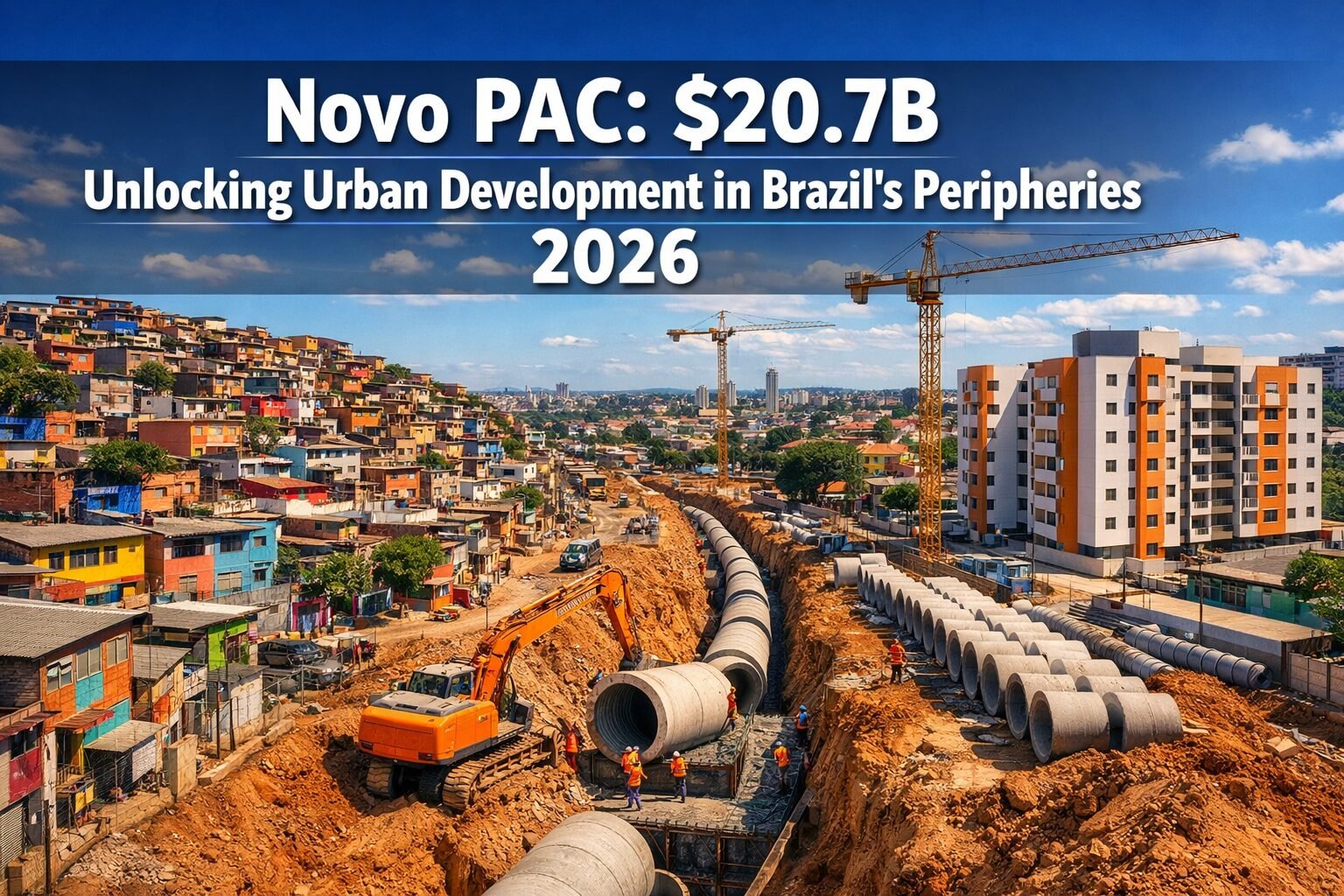
Brazil’s urban peripheries are experiencing a historic transformation in 2026. With R$20.7 billion in sanitation and mobility funding flowing into previously underserved communities, real estate developers are discovering unprecedented opportunities in secondary cities and metropolitan outskirts. The Novo PAC Sanitation Investments: Unlocking Residential Development in Brazil’s Underserved Urban Peripheries 2026 initiative represents more than infrastructure upgrades—it’s creating viable development sites where none existed before, boosting land values by 15-20% in strategic locations, and opening doors for mid-tier housing projects that align perfectly with the construction sector’s projected 3.3% growth trajectory[7].
For developers and investors tracking Brazil’s evolving property landscape, this moment represents a rare convergence: government infrastructure investment meeting housing demand in markets previously considered too risky or underdeveloped for formal residential projects.
Key Takeaways
🏗️ R$88.6 billion in sanitation auctions scheduled through 2026 across 27 major concessions, with six of nine billion-real blocks concentrated in North-Northeast regions[2]
💰 Land values increasing 15-20% in secondary cities receiving PAC infrastructure investments, creating entry points for mid-tier residential development
📊 Over 2,100 cities have registered or developed projects under Novo PAC, spanning basic sanitation, solid waste management, and urban transportation[1]
🏘️ R$23 billion allocated specifically for sanitation expansion in 287 cities, directly improving sewage collection and treatment in vulnerable communities[1]
⏱️ Strategic timing advantage: Developers can align phased projects with known PAC implementation schedules through 2027, reducing infrastructure risk
Understanding Novo PAC Sanitation Investments: Unlocking Residential Development in Brazil’s Underserved Urban Peripheries 2026
The Novo PAC (Growth Acceleration Program) represents Brazil’s most ambitious infrastructure initiative since the program’s original launch in 2007. Relaunched with renewed focus and substantially increased funding, the 2026 iteration allocates R$1.7 trillion across social, urban, and environmental infrastructure projects nationwide[3].
The Sanitation Investment Landscape
Brazil’s New Sanitation Legal Framework (Law 14.026/2020) established aggressive targets: 99% potable water coverage and 90% sewage collection and treatment by 2033. Achieving these goals requires an estimated R$900 billion in total investment[3]—a massive funding gap that Novo PAC addresses through strategic public-private partnerships and concession auctions.
The numbers tell a compelling story:
| Investment Category | Allocation | Municipalities Covered | Primary Regions |
|---|---|---|---|
| Basic Sanitation Expansion | R$23 billion | 287 cities | North, Northeast |
| Housing Contracts | R$160 billion | Nationwide | All regions |
| Favela Improvements | R$11 billion | 48 cities | Urban peripheries |
| Landslide Prevention | R$15 billion | Vulnerable areas | Coastal, hillside communities |
Source: Gov.br Novo PAC Documentation[1]
Why This Matters for Residential Development
Traditional real estate development requires baseline infrastructure: water supply, sewage systems, paved roads, and drainage. Brazil’s urban peripheries—home to millions of families—have historically lacked these essentials, making formal residential development economically unfeasible despite strong housing demand.
Novo PAC changes this equation by frontloading infrastructure investment. When sanitation systems arrive in previously underserved neighborhoods, several transformations occur simultaneously:
✅ Land becomes developable under formal zoning and construction standards
✅ Property values increase as infrastructure reduces investment risk
✅ Financing becomes available as banks recognize improved collateral quality
✅ Middle-income buyers enter the market seeking quality housing at accessible price points
For developers tracking market performance trends, these periphery transformations represent the next growth frontier beyond saturated urban cores.
The R$88.6 Billion Auction Pipeline: Regional Opportunities Through 2026
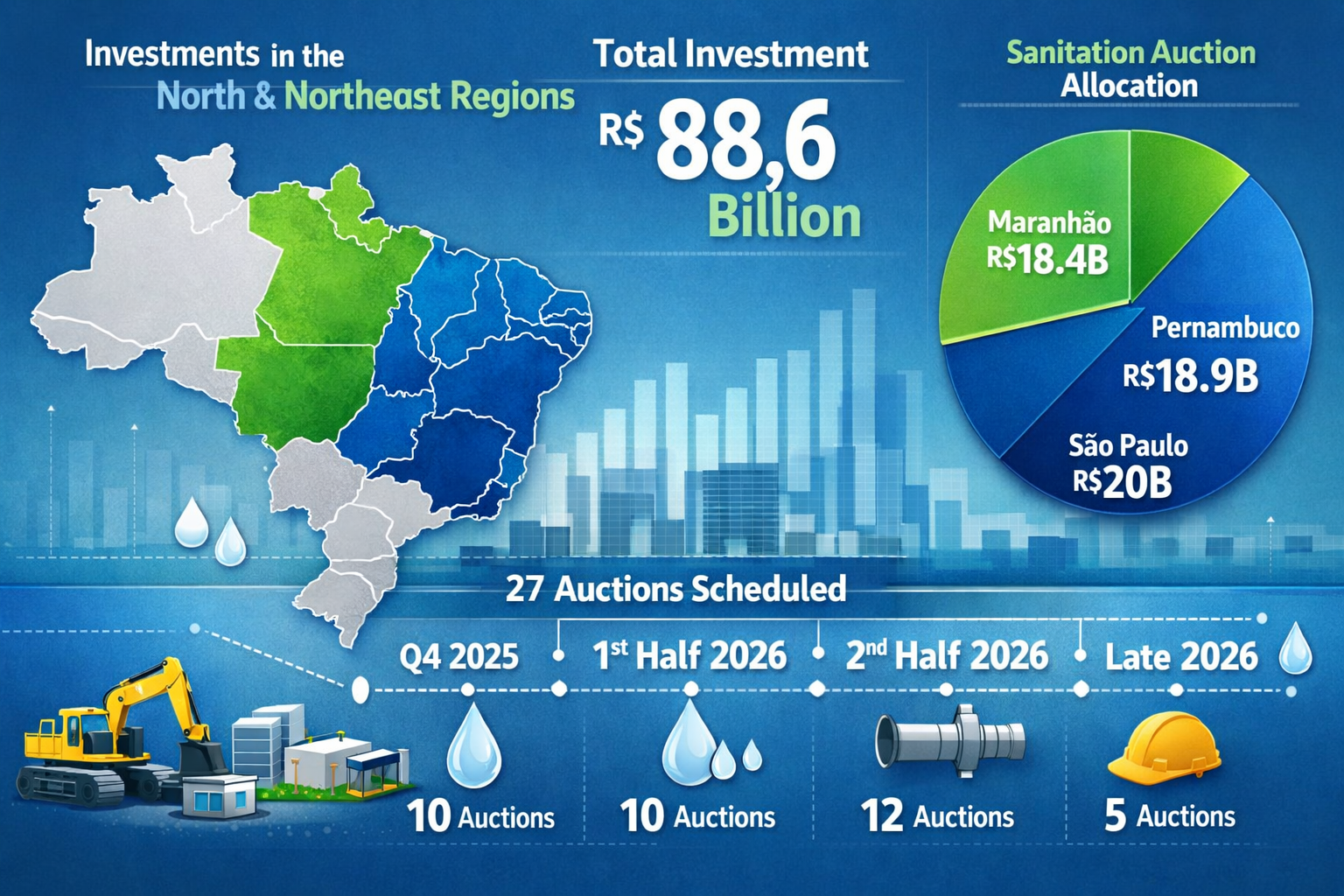
Between Q4 2025 and throughout 2026, Brazil will conduct 27 major sanitation concession auctions representing R$88.6 billion in predicted investments[2]. This unprecedented wave of privatization and infrastructure modernization creates a predictable timeline for developers planning multi-year projects.
North-Northeast Concentration: The Highest-Impact Regions
Six of the nine billion-real auction blocks are located in Brazil’s North and Northeast regions, with R$54 billion concentrated in states historically underserved by sanitation infrastructure[2]. This geographic focus creates specific opportunities:
🌟 Maranhão: The Mega-Opportunity
Maranhão’s sanitation concession covers 214 municipalities with R$18.4 billion in investments, leaving only three cities without coverage[2]. This comprehensive approach transforms entire regional markets simultaneously, creating economies of scale for developers planning multiple projects across the state.
Developer advantage: Multi-site residential projects can leverage shared infrastructure timelines, reducing per-unit development costs while accessing diverse markets within a single state.
🌟 Pernambuco: Immediate Action
The Compesa partial concession auction, scheduled for December 18, 2025, covers 185 municipalities plus the Fernando de Noronha archipelago with R$18.9 billion in estimated investments structured by BNDES[2]. This auction’s immediate timeline means infrastructure work begins in early 2026, with visible progress by mid-year.
Developer advantage: Projects initiated in Q1-Q2 2026 can phase construction to align with sanitation system completion, minimizing carrying costs while maximizing value capture from infrastructure improvements.
🌟 São Paulo’s Universaliza: The Long-Game Opportunity
São Paulo’s ambitious Universaliza project targets 218 municipalities outside Sabesp’s service area with R$20 billion in predicted investments divided into four blocks[2]. Uniquely, this project includes urban drainage systems to prevent flooding—a critical factor for residential development in flood-prone areas.
Timeline: Public consultation scheduled April-May 2026, with auction in September 2027[2]. This extended timeline favors developers with longer planning horizons who can secure land positions before infrastructure announcements drive prices higher.
Secondary State Opportunities
Beyond the mega-blocks, several states offer concentrated opportunities:
- Rondônia: Two projects totaling R$7.5 billion[2]
- Paraíba: R$3.45 billion in scheduled auctions[2]
- Alagoas: R$1.7 billion investment pipeline[2]
These smaller-scale projects often represent the highest percentage impact on local markets, where infrastructure investment can transform entire city peripheries rather than just individual neighborhoods.
Novo PAC Sanitation Investments: Unlocking Residential Development Through Strategic Timing
The most sophisticated developers recognize that timing is everything when capitalizing on infrastructure-driven development opportunities. Novo PAC’s transparent timeline and phased implementation create specific windows for maximum value capture.
The Land Value Appreciation Curve
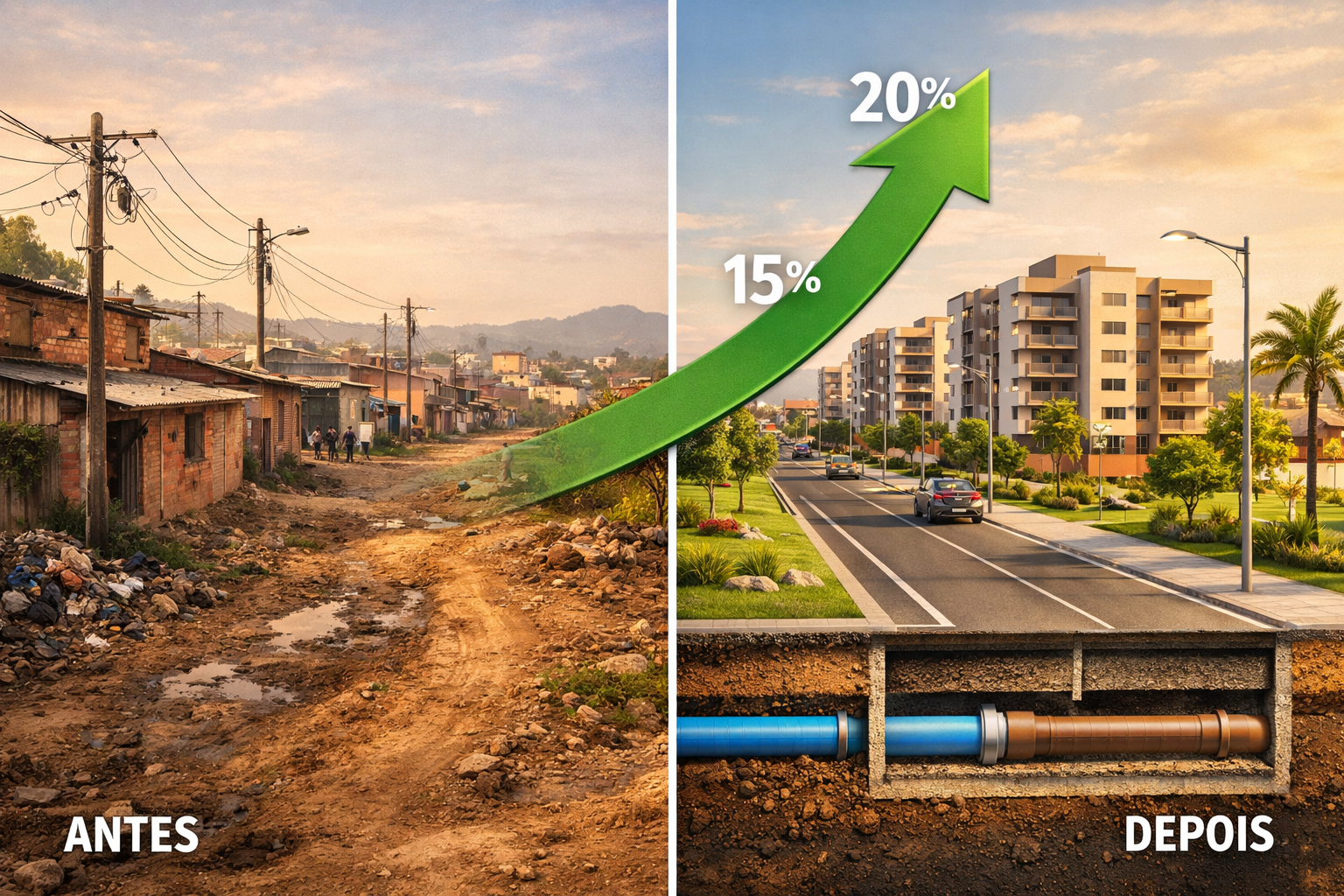
Research from Brazil’s construction sector indicates that land values in secondary cities increase 15-20% following confirmed sanitation infrastructure investments[7]. However, this appreciation doesn’t occur uniformly—it follows a predictable curve:
Phase 1 (Announcement to Auction): 3-5% initial increase as speculation begins
Phase 2 (Auction to Construction Start): 5-8% increase as certainty improves
Phase 3 (Construction to Completion): 7-12% increase as infrastructure becomes visible
Phase 4 (Post-Completion): Stabilization with ongoing appreciation tied to development activity
Strategic implication: Developers who acquire land during Phase 1 or early Phase 2 capture the full appreciation curve while maintaining lower acquisition costs. Those who wait until Phase 3 or 4 face higher land costs but reduced infrastructure risk.
Aligning Development Phases with PAC Implementation
The most capital-efficient approach involves synchronizing project phases with PAC infrastructure timelines:
Year 1 (2026): Land acquisition and planning approvals while infrastructure construction begins
Year 2 (2027): Foundation and structure work as sanitation systems near completion
Year 3 (2028): Finishing and delivery aligned with fully operational infrastructure
This phasing approach minimizes the period when developers hold completed units in areas without full infrastructure, reducing carrying costs and maximizing buyer appeal.
Mid-Tier Housing: The Sweet Spot
Novo PAC’s focus on underserved urban peripheries creates ideal conditions for mid-tier housing development—properties priced between affordable housing programs and premium urban developments. This segment benefits from:
✅ Strong demand from Brazil’s growing middle class seeking quality housing at accessible prices
✅ Government support through programs like Minha Casa Minha Vida, which contracted over 1 million new homes with R$160 billion invested through October 2024[1]
✅ Lower competition compared to saturated premium markets in established urban cores
✅ Infrastructure certainty provided by PAC investments, reducing development risk
For investors exploring opportunities in emerging markets, mid-tier housing in PAC-benefited peripheries offers compelling risk-adjusted returns.
Beyond Sanitation: Comprehensive Urban Infrastructure Transformation

While sanitation investments form the foundation of Novo PAC’s urban transformation strategy, the program’s comprehensive approach addresses multiple infrastructure deficits simultaneously, creating even stronger conditions for residential development.
Integrated Infrastructure Investment
Novo PAC allocates funding across interconnected urban systems:
🚧 Landslide Prevention and Safety: R$15 billion for retaining walls and drainage systems in vulnerable hillside communities[1], making previously unbuildable land developable while protecting existing residents.
🏘️ Favela and Vulnerable Neighborhood Improvements: R$11 billion across 48 cities for social inclusion initiatives and living condition improvements[1], often including street paving, lighting, and public space creation that enhance surrounding property values.
🚌 Urban Transportation: Investments in bus rapid transit (BRT) systems, road improvements, and mobility infrastructure that increase accessibility and reduce commute times—key factors in residential location decisions.
♻️ Solid Waste Management: Modernized collection and disposal systems that improve neighborhood aesthetics and public health, making areas more attractive to middle-income buyers.
The Multiplier Effect on Property Values
When multiple infrastructure improvements arrive simultaneously, the impact on property values exceeds the sum of individual improvements. A neighborhood receiving sanitation, paved roads, street lighting, and improved public transportation experiences transformation that fundamentally changes its market positioning.
Case example: In cities where Novo PAC combines sanitation expansion with favela improvement programs, surrounding land suitable for new development sees 20-25% value appreciation—significantly above the 15-20% average for sanitation alone[7].
Risk Mitigation for Developers
Comprehensive infrastructure investment reduces several development risks:
🛡️ Regulatory risk: Completed infrastructure ensures projects meet environmental and health standards
🛡️ Buyer financing risk: Banks more readily approve mortgages in areas with complete infrastructure
🛡️ Absorption risk: Improved neighborhoods attract buyers faster, reducing sales cycles
🛡️ Competition risk: First-mover developers establish market presence before competition intensifies
Financing and Partnership Opportunities in the PAC Ecosystem
The scale of Novo PAC creates opportunities beyond direct residential development, including partnerships with infrastructure providers and access to specialized financing.
FGTS Financing for Sanitation and Urban Mobility
Brazil recently approved US$3 billion in financing from FGTS (Workers’ Severance Indemnity Fund) specifically for sanitation and urban mobility projects[6]. This dedicated funding source provides:
- Lower interest rates compared to commercial financing
- Longer repayment terms aligned with infrastructure project timelines
- Government backing that reduces lender risk
Developers can potentially access FGTS financing for projects that integrate residential development with infrastructure improvements, particularly in mixed-use developments that include public benefit components.
BNDES Structuring and Support
The Brazilian Development Bank (BNDES) plays a central role in structuring major sanitation concessions, including the Pernambuco Compesa auction[2]. BNDES also offers:
- Project financing for qualifying residential developments
- Technical assistance for developers planning large-scale urban projects
- Guarantee programs that facilitate private sector participation
Public-Private Partnership Models
Several Novo PAC projects utilize PPP structures that allow private developers to participate in infrastructure delivery while capturing associated real estate value. These models work particularly well for:
- Transit-oriented development around new BRT stations
- Mixed-use projects combining sanitation infrastructure with residential/commercial space
- Neighborhood regeneration initiatives where private development finances public improvements
For developers with experience in innovative financing approaches, PAC-related PPPs offer sophisticated value creation opportunities.
Sector Growth Projections and Market Dynamics Through 2026
Brazil’s construction sector is projected to grow 3.3% in 2026[7], supported by housing programs, infrastructure investment, and economic recovery. However, this growth occurs against a backdrop of persistent risks that sophisticated developers must navigate.
Growth Drivers
📈 Housing program support: Continued government backing through Minha Casa Minha Vida and related initiatives maintains baseline demand
📈 Infrastructure investment: The R$1.7 trillion Novo PAC allocation creates direct construction activity and indirect development opportunities
📈 Interest rate trajectory: Expected gradual reduction in Brazil’s Selic rate improves mortgage affordability and project financing economics
📈 Urbanization trends: Continued migration to cities creates sustained housing demand, particularly in secondary cities receiving PAC investments
Persistent Challenges
Despite positive growth projections, developers face ongoing challenges:
⚠️ Inflation volatility: Construction material costs remain subject to global commodity price fluctuations
⚠️ Labor constraints: Skilled construction labor shortages in rapidly developing regions can delay projects and increase costs
⚠️ Regulatory complexity: Navigating federal, state, and municipal approval processes requires significant expertise and time
⚠️ Economic uncertainty: Brazil’s broader economic conditions can shift buyer sentiment and financing availability
Competitive Landscape Evolution
As Novo PAC transforms previously overlooked peripheries into viable development sites, competition intensifies for prime locations. Early-mover developers benefit from:
- Lower land acquisition costs before infrastructure announcements drive prices higher
- Stronger relationships with local governments and communities
- Market positioning as quality providers in emerging neighborhoods
- Portfolio diversification across multiple PAC-benefited regions
Actionable Strategies for Developers and Investors
For real estate professionals seeking to capitalize on Novo PAC Sanitation Investments: Unlocking Residential Development in Brazil’s Underserved Urban Peripheries 2026, several concrete strategies emerge:
🎯 Strategy 1: Geographic Targeting
Focus on North-Northeast states receiving disproportionate PAC investment, particularly Maranhão, Pernambuco, and secondary cities in these regions. These markets offer:
- Higher percentage infrastructure impact
- Lower baseline land costs
- Less saturated competition
- Stronger government support
🎯 Strategy 2: Timeline Alignment
Map PAC auction and implementation schedules to project planning timelines. Acquire land during Phase 1-2 (announcement to construction start) to capture maximum value appreciation while infrastructure risk declines.
🎯 Strategy 3: Product Positioning
Develop mid-tier housing products (2-3 bedroom units, 60-80m², R$250,000-450,000 price range) that align with:
- Government housing program eligibility
- Middle-class buyer affordability
- Infrastructure improvement expectations
- Local market absorption capacity
🎯 Strategy 4: Partnership Approach
Explore partnerships with sanitation concessionaires, local governments, and community organizations to:
- Access preferential land positions
- Coordinate infrastructure timing
- Reduce regulatory friction
- Build community support
🎯 Strategy 5: Portfolio Diversification
Develop projects across multiple PAC-benefited cities rather than concentrating in a single market, spreading risk while capturing regional growth trends.
For developers seeking proven expertise in emerging Brazilian markets, exploring established development companies with track records in infrastructure-driven projects provides valuable partnership opportunities.
Conclusion
The Novo PAC Sanitation Investments: Unlocking Residential Development in Brazil’s Underserved Urban Peripheries 2026 initiative represents a generational opportunity for real estate developers and investors. With R$88.6 billion in sanitation auctions scheduled through 2026, land values increasing 15-20% in strategic locations, and the construction sector poised for 3.3% growth, the conditions for profitable mid-tier housing development in previously underserved areas have never been stronger.
The key to success lies in strategic timing and geographic focus. Developers who move decisively in North-Northeast regions during 2026—acquiring land in Phase 1-2 of the infrastructure appreciation curve, aligning project timelines with PAC implementation schedules, and positioning products for middle-income buyers—will capture the greatest value from this historic infrastructure transformation.
Next Steps for Developers and Investors
- Conduct regional analysis of the 27 scheduled sanitation auctions to identify highest-potential markets
- Map PAC implementation timelines against your development capacity and capital availability
- Establish local partnerships with governments, infrastructure providers, and community organizations
- Develop financial models incorporating 15-20% land appreciation and 3.3% sector growth assumptions
- Initiate land acquisition in priority markets before auction announcements drive prices higher
For those ready to explore specific opportunities in Brazil’s evolving property landscape, reviewing current development projects provides concrete examples of successful approaches in emerging markets.
The transformation of Brazil’s urban peripheries is underway. The question for developers and investors is not whether to participate, but how strategically to position themselves for maximum value capture in this unprecedented infrastructure-driven development cycle.
References
[1] New PAC: Sustainable and Resilient Cities for a New Brazil – https://www.gov.br/fazenda/pt-br/acesso-a-informacao/acoes-e-programas/transformacao-ecologica/novo-brasil-ecological-transformation-plan/featured-programs/new-pac-sustainable-and-resilient-cities-for-a-new-brazil
[2] Brazil Will Move R$88 Billion in Sanitation Auctions by 2026 – https://exame.com/en/brazil-will-move-r-88-billion-in-sanitation-auctions-by-2026/
[3] Infrastructure – https://www.investinbrasil.com.br/content/portalinternacional/us/en/invest/sectors/infrastructure.html
[6] Brazil Approves US$3 Billion in Financing from the FGTS for Sanitation and Urban Mobility – https://www.bnamericas.com/en/news/brazil-approves-us3-billion-in-financing-from-the-fgts-for-sanitation-and-urban-mobility
[7] Brazil’s Construction Sector 2026: Housing Programs Support, Rates High, Risks Persist – https://www.fastmarkets.com/insights/brazils-construction-sector-2026-housing-programs-support-rates-high-risks-persist/