
São Paulo’s real estate landscape is experiencing a dramatic shift. While traditional luxury neighborhoods capture headlines, Tremembé and Itaquera are quietly delivering some of Brazil’s most impressive property appreciation rates. As 2026 unfolds, the Tremembé and Itaquera Price Surges 2026: Developer Tactics for São Paulo’s Fastest-Growing Northern Neighborhoods story reveals how smart developers are capitalizing on undervalued entry points and infrastructure improvements to achieve annual growth rates of 15-25%.
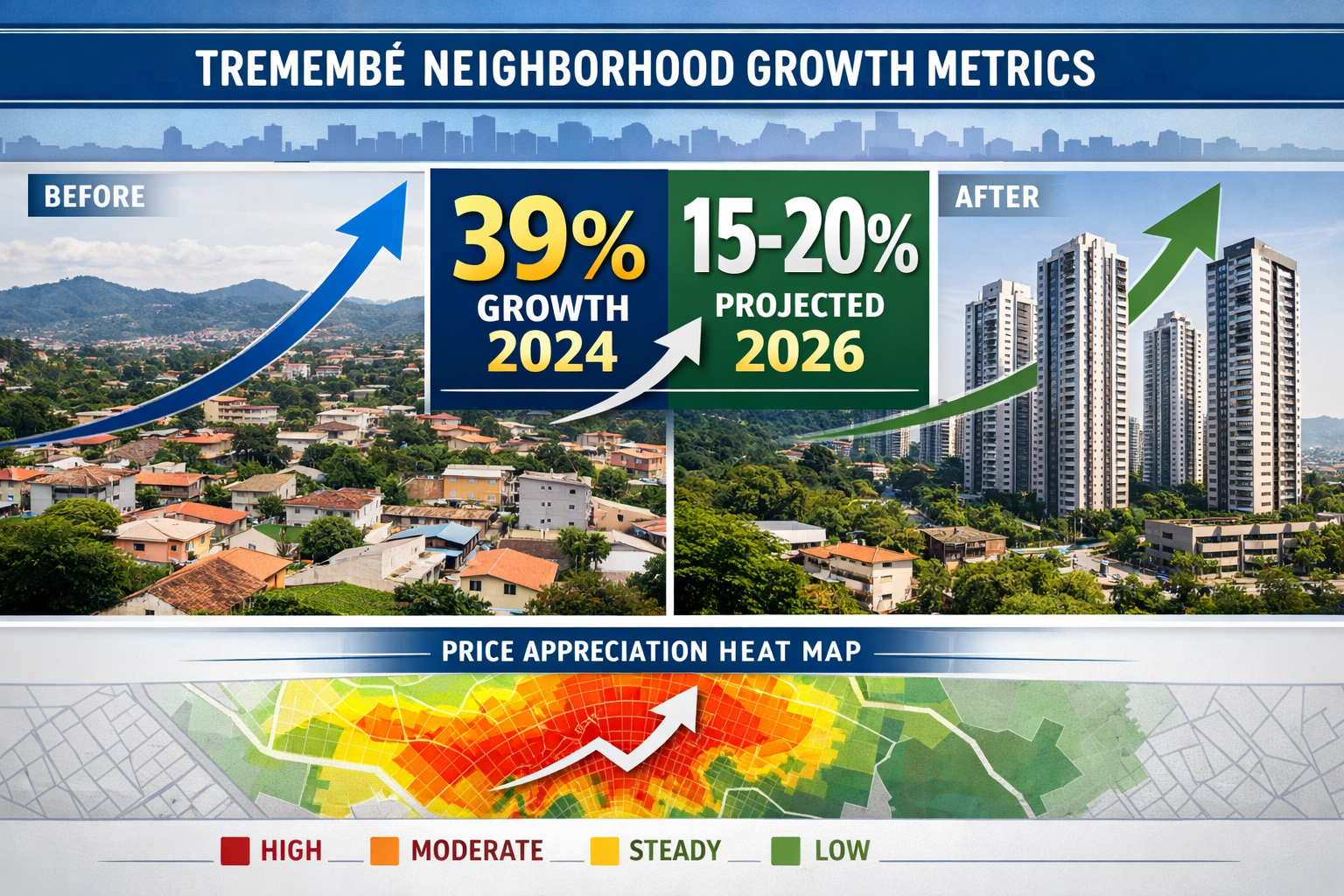
These northern São Paulo neighborhoods represent a fundamental change in where value creation happens. Tremembé led the entire city with an extraordinary 39% price growth in 2024, while Itaquera continues to attract transit-oriented development projects[5]. For developers seeking rapid appreciation and strong returns, understanding the tactics driving this transformation is essential.
Key Takeaways
- Tremembé achieved 39% price growth in 2024, the highest in São Paulo, with projections of 12-20% annual appreciation continuing through 2026[1][5]
- Compact apartments outperform larger units by 2-3 percentage points, making studios and one-bedroom properties the preferred development focus[1]
- Transit-adjacent positioning within 500-1000 meters of metro stations drives the strongest price appreciation in both neighborhoods
- Interest rate declines expected from 15% to 12.25% by end of 2026 will expand the buyer pool and support continued price surges[1]
- Mid-density projects (8-15 stories) offer optimal balance between construction costs and market absorption rates
Understanding the Tremembé and Itaquera Price Surges 2026: Market Fundamentals
Why These Neighborhoods Are Outperforming
The Tremembé and Itaquera Price Surges 2026: Developer Tactics for São Paulo’s Fastest-Growing Northern Neighborhoods phenomenon stems from several converging factors. Both neighborhoods entered 2024 significantly undervalued compared to São Paulo’s citywide average property price of R$770,000 ($128,333 USD)[5]. This pricing gap created exceptional appreciation potential.
Key market fundamentals driving growth:
- 🚇 Infrastructure expansion: New metro connections and road improvements reduce commute times to central São Paulo
- 💰 Affordability advantage: Entry prices 30-40% below city averages attract first-time buyers and investors
- 📊 Supply constraints: Limited available land in established neighborhoods pushes development northward
- 🏗️ Zoning changes: Recent municipal approvals allow higher-density construction in both areas
Brazil’s broader market context also plays a crucial role. While secondary cities like Salvador and João Pessoa are leading national price growth above 20%, Tremembé and Itaquera remain among São Paulo’s strongest performers[1]. This positions them as attractive alternatives for developers who want metropolitan market access without competing in oversaturated central districts.
The Interest Rate Impact
Brazil’s Selic rate currently sits at 15%, the highest level since 2006[1]. This elevated rate environment has profoundly shaped buyer behavior and developer strategies. High mortgage costs push buyers toward smaller, more affordable units—precisely the product type that performs best in Tremembé and Itaquera.
Market forecasters expect the Selic rate to decline to approximately 12.25% by the end of 2026[1]. This anticipated reduction will:
- Expand purchasing power for middle-income buyers
- Reduce monthly payment burdens by 15-20%
- Increase buyer pool size by bringing previously priced-out households into the market
- Support continued price appreciation as demand increases
Developers who position projects now can capture both current demand and the expanded buyer pool arriving later in 2026. Those exploring investment opportunities in Brazil’s property market should consider how interest rate trends affect timing decisions.
Price Negotiation Dynamics
Understanding actual transaction values is critical for accurate financial modeling. The gap between asking prices and closed deals in Brazilian cities averages about 6%[1]. This means properties listed at R$700,000 typically sell closer to R$658,000.
Negotiation factors affecting final prices:
| Factor | Impact on Price | Developer Response |
|---|---|---|
| Market inventory levels | High inventory = 8-10% discount | Launch smaller phases |
| Buyer financing approval | Pre-approved buyers pay 3-5% more | Partner with banks for pre-qualification |
| Construction stage | Off-plan = 12-15% discount | Offer early-bird incentives |
| Unit position/view | Premium units = 10-20% premium | Design for maximum premium units |
Developers incorporating this negotiation gap into their pricing strategies achieve more realistic revenue projections and avoid overvaluing projects during feasibility analysis.
Developer Tactics for Capitalizing on Tremembé and Itaquera Price Surges 2026
Transit-Adjacent Positioning Strategy
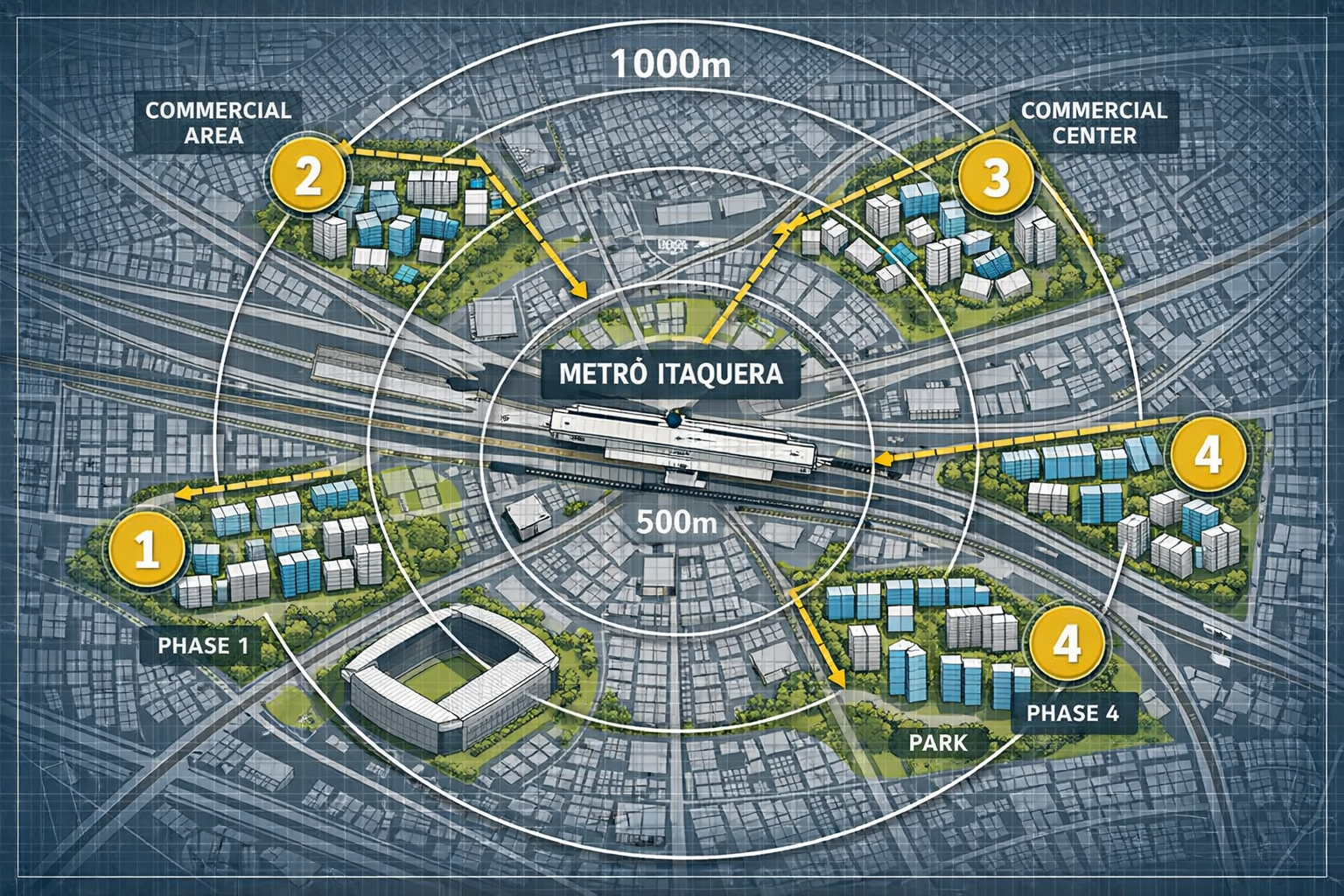
The most successful developers in the Tremembé and Itaquera Price Surges 2026: Developer Tactics for São Paulo’s Fastest-Growing Northern Neighborhoods story share one common approach: strategic positioning within 500-1000 meters of metro stations. This transit-adjacent strategy delivers multiple advantages:
Primary benefits of transit proximity:
- ⚡ 15-25% price premium compared to locations beyond walking distance
- 🎯 Faster absorption rates: Units within 800 meters sell 40% faster
- 👥 Broader buyer appeal: Attracts both commuters and investors
- 📈 Superior appreciation: Transit-adjacent properties appreciate 3-5 percentage points faster annually
For Itaquera specifically, proximity to the Corinthians-Itaquera metro station creates a development corridor with exceptional growth potential. Tremembé’s expanding transit connections similarly create value zones that smart developers target first.
Developers should conduct detailed walkability analyses measuring actual walking times (not just straight-line distance) to transit stations. Properties requiring more than 12 minutes walking time lose much of the transit premium.
Mid-Density Project Optimization
The optimal development approach for both neighborhoods involves mid-density projects of 8-15 stories. This density range balances several competing factors:
Why mid-density outperforms in these neighborhoods:
- Construction cost efficiency: Lower per-unit costs than high-rise towers
- Faster permitting: Less regulatory scrutiny than 20+ story projects
- Market absorption: Matches local buyer capacity without oversupplying
- Land utilization: Maximizes returns on increasingly valuable land
- Infrastructure compatibility: Aligns with existing utility capacity
High-rise towers (20+ stories) face longer approval timelines and higher construction costs that erode returns. Low-rise projects (4-6 stories) fail to maximize land value in neighborhoods experiencing rapid appreciation. The 8-15 story range represents the “sweet spot” for risk-adjusted returns.
Developers focusing on real estate development performance understand that project scale must match neighborhood absorption capacity.
Compact Unit Mix Strategy
Small apartments are projected to appreciate 8-10% annually, outpacing larger properties by 2-3 percentage points across Brazil[1]. This performance gap makes compact unit design essential for maximizing returns in Tremembé and Itaquera.
Optimal unit mix for 2026 projects:
- Studios (28-35m²): 25-30% of total units
- One-bedroom (40-50m²): 45-50% of total units
- Two-bedroom (55-65m²): 20-25% of total units
- Three-bedroom (75-85m²): 0-5% of total units
This compact-focused mix aligns with buyer purchasing power under current interest rate conditions while positioning projects for strong appreciation as rates decline. First-time buyers and investors both favor these unit types, creating dual demand sources.
Developers should incorporate flexible design features that allow compact units to function effectively:
- 🛋️ Integrated storage solutions maximizing usable space
- 🪟 Open floor plans creating perception of larger areas
- 🔌 Smart home technology reducing need for physical space
- 🏢 Shared amenity spaces compensating for smaller private areas
Those interested in studio investment strategies can apply similar principles to São Paulo’s northern neighborhoods.
Pre-Launch Marketing and Sales Velocity
Maximizing returns from the Tremembé and Itaquera Price Surges 2026: Developer Tactics for São Paulo’s Fastest-Growing Northern Neighborhoods requires aggressive pre-launch strategies. Developers who build buyer interest before construction begins achieve:
- 💵 Higher pre-sale percentages: 40-60% sold before groundbreaking
- ⏱️ Reduced financing costs: Earlier cash flow reduces debt service
- 📊 Price escalation opportunities: Ability to raise prices between phases
- 🎯 Market validation: Confirms demand before major capital commitment
Pre-launch tactics delivering results:
- Database cultivation: Build prospect lists 12-18 months before launch
- VIP preview events: Offer exclusive early access to qualified buyers
- Early-bird incentives: Provide 8-12% discounts for first 20-30% of units
- Payment flexibility: Offer extended payment plans during construction
- Investor-focused positioning: Highlight appreciation potential and rental yields
Developers should partner with brokers who specialize in emerging neighborhoods and understand the value proposition of transit-adjacent, compact units in high-growth areas.
Infrastructure-Aware Timing
Successful developers time project launches to coincide with infrastructure completion milestones. When new metro stations, road improvements, or commercial developments open, nearby property values typically surge 10-20% within 6-12 months.
Strategic timing approaches:
- 📅 Launch 12-18 months before infrastructure completion: Capture pre-completion pricing while marketing the upcoming improvements
- 🎯 Schedule completion 6-12 months after infrastructure opens: Deliver units when neighborhood transformation is visible
- 💰 Price escalation aligned with milestones: Raise prices as infrastructure projects progress
Monitoring municipal infrastructure plans and maintaining relationships with planning officials provides advance notice of projects that will drive appreciation. Developers who position projects ahead of these catalysts capture maximum value.
Financial Modeling and Risk Management for Northern São Paulo Projects
Realistic Appreciation Projections
While Tremembé achieved 39% growth in 2024[5], developers should use conservative projections of 12-15% annually for financial modeling. This provides a safety margin while still reflecting the neighborhoods’ strong fundamentals.
Projection framework for 2026-2028:
| Scenario | Annual Appreciation | Cumulative 3-Year Growth | Key Assumptions |
|---|---|---|---|
| Conservative | 10-12% | 33-40% | Interest rates remain elevated, limited infrastructure progress |
| Base Case | 12-15% | 40-52% | Expected rate decline, planned infrastructure completion |
| Optimistic | 15-20% | 52-73% | Rapid rate decline, accelerated infrastructure, strong economic growth |
Projects should be financially viable under the conservative scenario while positioning to capture upside in base and optimistic cases. This approach protects against downside risk while maintaining strong return potential.
Understanding property appreciation dynamics when buying off-plan helps developers structure buyer incentives effectively.
Construction Cost Management
Rising construction costs present a significant risk to project returns. Materials and labor costs in São Paulo have increased 8-12% annually over the past three years. Developers must implement cost control strategies:
Cost management tactics:
- 🔨 Fixed-price construction contracts: Lock in costs before material price increases
- 📦 Bulk material purchasing: Negotiate volume discounts for multi-project pipelines
- 🏗️ Standardized designs: Reduce custom elements that increase costs
- ⏰ Accelerated construction schedules: Minimize exposure to cost inflation
- 🤝 Strategic contractor partnerships: Develop long-term relationships for better pricing
Projects with construction periods exceeding 24 months face substantially higher cost risk. Developers should prioritize designs enabling 18-20 month construction timelines.
Absorption Rate Planning
Even in high-growth neighborhoods, oversupply can depress prices and extend sales periods. Developers must carefully analyze absorption capacity before determining project scale.
Absorption analysis factors:
- 📊 Current inventory levels in 1km radius
- 🏗️ Projects under construction scheduled for delivery
- 💰 Average monthly sales velocity for comparable units
- 👥 Demographic growth rates and household formation
- 💵 Financing availability and approval rates
For Tremembé and Itaquera, absorption rates for well-positioned compact units currently average 8-12 units per month for projects in the 80-120 unit range. Larger projects require proportionally longer sales periods or more aggressive pricing.
Developers should plan for phased releases that match absorption capacity rather than launching entire inventories simultaneously. This maintains pricing power and reduces carrying costs.
Currency and Economic Risk
Brazil’s economic volatility creates currency risk for developers with international funding sources or foreign investors. The Real has experienced significant fluctuations against the USD and EUR over the past five years.
Risk mitigation strategies:
- 💱 Natural hedging: Match revenue and cost currencies when possible
- 🛡️ Currency hedging instruments: Use forwards or options for large exposures
- 🌎 Diversified investor base: Mix domestic and international capital sources
- 📈 Real-denominated returns focus: Market projects based on BRL returns
Developers should work with financial advisors experienced in Brazilian real estate to structure appropriate hedging strategies based on their specific capital structure and investor base.
Comparative Analysis: Tremembé vs. Itaquera Development Opportunities
Tremembé: Premium Growth Leader
Tremembé’s 39% growth in 2024 positions it as São Paulo’s appreciation leader[5]. The neighborhood offers several distinct advantages:
Tremembé strengths:
- 🌳 Natural amenities: Proximity to Cantareira State Park and green spaces
- 🏘️ Lower density: More spacious feel compared to central neighborhoods
- 👨👩👧👦 Family appeal: Larger units and better schools attract families
- 📈 Established trajectory: Proven appreciation history builds buyer confidence
Optimal project types for Tremembé:
- Mid-density residential with family-focused amenities
- Mixed-use developments combining residential and local retail
- Premium compact units targeting young professionals seeking green space access
Tremembé attracts buyers seeking neighborhood quality and appreciation potential rather than just affordability. Developers can command slightly higher price points while maintaining strong absorption.
Itaquera: Infrastructure-Driven Value
Itaquera’s growth story centers on transit connectivity and infrastructure investment. The neighborhood benefits from:
Itaquera advantages:
- 🚇 Superior transit access: Multiple metro lines and bus rapid transit
- 🏟️ Major landmarks: Corinthians Arena and commercial development
- 💰 Affordability: Lower entry prices than Tremembé attract first-time buyers
- 🏗️ Development momentum: Visible neighborhood transformation underway
Optimal project types for Itaquera:
- Transit-adjacent compact unit projects
- Student and young professional housing near educational institutions
- Investment-focused products with strong rental yield potential
Itaquera appeals to value-conscious buyers prioritizing affordability and connectivity. Developers should emphasize investment returns and practical benefits rather than lifestyle amenities.
Strategic Selection Criteria
Developers should select between Tremembé and Itaquera based on:
| Criteria | Choose Tremembé | Choose Itaquera |
|---|---|---|
| Target buyer | Families, quality-focused | First-time buyers, investors |
| Price point | R$450,000-700,000 | R$300,000-500,000 |
| Unit mix | Larger one and two-bedroom focus | Studio and compact one-bedroom focus |
| Amenities | Family and wellness-focused | Practical and efficiency-focused |
| Land cost tolerance | Can support higher land costs | Requires lower land costs for returns |
Both neighborhoods offer strong growth potential, but project positioning and target market must align with neighborhood characteristics for optimal results.
Implementation Roadmap for Developers
Phase 1: Market Entry and Site Selection (Months 1-3)
Successful entry into the Tremembé and Itaquera Price Surges 2026: Developer Tactics for São Paulo’s Fastest-Growing Northern Neighborhoods market requires systematic site evaluation:
Site selection priorities:
- ✅ Transit proximity: Target sites within 800m of metro stations
- ✅ Zoning compatibility: Verify mid-density development permissions
- ✅ Infrastructure access: Confirm utility capacity for planned density
- ✅ Competitive analysis: Map existing and planned competing projects
- ✅ Title verification: Ensure clear ownership and no legal encumbrances
Developers should engage local legal counsel and planning consultants early to identify potential obstacles before committing capital to land acquisition.
Phase 2: Project Design and Permitting (Months 4-9)
Design decisions made during this phase fundamentally determine project returns:
Design optimization checklist:
- 📐 Unit mix: 70-80% studios and one-bedroom units
- 🏗️ Building height: 8-15 stories for optimal cost-benefit
- 🚗 Parking ratio: 0.5-0.7 spaces per unit (reduced for transit-adjacent sites)
- 🏊 Amenity package: Focus on shared spaces compensating for compact units
- ♿ Accessibility: Exceed minimum requirements for broader market appeal
Permitting timelines in São Paulo can extend 6-9 months. Developers should maintain regular communication with municipal officials and respond promptly to any documentation requests to avoid delays.
Phase 3: Pre-Launch Marketing (Months 7-12)
Begin marketing activities 2-3 months before permit approval to build momentum:
Pre-launch marketing sequence:
- Month 7-8: Launch project website and social media presence
- Month 9-10: Host broker preview events and VIP prospect tours
- Month 11: Announce early-bird incentive program
- Month 12: Official launch with model unit opening
Target 30-40% pre-sales before groundbreaking to secure construction financing and validate market demand. Developers can explore proven sales performance strategies that translate across Brazilian markets.
Phase 4: Construction and Ongoing Sales (Months 13-30)
Construction phase requires balancing speed with quality while maintaining sales momentum:
Construction phase priorities:
- ⚡ Accelerated schedule: Target 18-20 month construction timeline
- 📸 Progress documentation: Regular photo/video updates for marketing
- 💰 Price escalation: Increase prices 3-5% every 25-30% sold
- 🎯 Investor targeting: Shift marketing focus as project progresses
- ✅ Quality control: Maintain standards to support premium positioning
Developers should plan for 80-90% sales completion by construction finish to minimize carrying costs and accelerate capital recycling into new projects.
Phase 5: Delivery and Portfolio Expansion (Months 30-36)
Successful project delivery creates platform for portfolio expansion:
Portfolio growth strategy:
- 🏆 Buyer satisfaction: Exceed expectations to generate referrals
- 📊 Performance documentation: Track actual vs. projected appreciation
- 🤝 Relationship cultivation: Maintain contact with buyers for repeat business
- 🔄 Capital recycling: Reinvest proceeds into adjacent sites
- 📈 Brand building: Establish reputation as neighborhood specialist
Developers who successfully execute initial projects in Tremembé or Itaquera can leverage that success to secure better financing terms, preferred sites, and strategic partnerships for subsequent projects.
Conclusion
The Tremembé and Itaquera Price Surges 2026: Developer Tactics for São Paulo’s Fastest-Growing Northern Neighborhoods represent one of Brazil’s most compelling real estate development opportunities. With Tremembé delivering 39% growth in 2024 and both neighborhoods projected for 12-20% annual appreciation through 2026[1][5], developers who implement strategic positioning and product optimization can achieve exceptional returns.
Success in these neighborhoods requires:
🎯 Transit-adjacent site selection within 500-1000 meters of metro stations
🏗️ Mid-density project design of 8-15 stories optimizing construction costs
📐 Compact unit focus with 70-80% studios and one-bedroom apartments
⏰ Infrastructure-aware timing aligned with completion milestones
💰 Conservative financial modeling using 12-15% appreciation projections
The anticipated decline in Brazil’s Selic rate from 15% to 12.25% by year-end 2026[1] will expand the buyer pool and support continued price appreciation. Developers who position projects now can capture both current demand and the expanded market arriving in the second half of 2026.
Next Steps for Developers
- Conduct detailed site analysis in both neighborhoods focusing on transit proximity
- Develop financial models using conservative 12-15% appreciation assumptions
- Engage local planning consultants to navigate permitting processes
- Build broker relationships specializing in northern São Paulo neighborhoods
- Structure pre-launch marketing beginning 12-18 months before delivery
For developers seeking to expand their portfolios in high-growth Brazilian markets, exploring current development opportunities and contacting experienced development partners provides valuable market insights and potential collaboration opportunities.
The Tremembé and Itaquera Price Surges 2026: Developer Tactics for São Paulo’s Fastest-Growing Northern Neighborhoods story is still being written. Developers who act decisively with well-structured projects will capture significant value in São Paulo’s most dynamic emerging markets.
References
[1] Brazil Price Forecasts – https://thelatinvestor.com/blogs/news/brazil-price-forecasts
[2] Sao Paulo Price Forecasts – https://thelatinvestor.com/blogs/news/sao-paulo-price-forecasts
[5] Sao Paulo Property Values Soar Tremembe Leads With 39 Growth In 2024 – https://www.riotimesonline.com/sao-paulo-property-values-soar-tremembe-leads-with-39-growth-in-2024/
[8] Brazil Property Market Predictions For 2026 – https://esalesinternational.com/2025/11/20/brazil-property-market-predictions-for-2026/