
The Brazilian property market is experiencing a dramatic shift in 2026, and savvy developers are looking beyond the traditional powerhouses of São Paulo and Rio de Janeiro. While major metropolitan areas struggle with single-digit growth, secondary cities in Brazil’s Northeast are delivering extraordinary returns—with some markets surging over 20% annually. João Pessoa Emerging Opportunities 2026: High-Growth Tactics for Secondary Northeast Property Development represents a compelling investment thesis that combines urbanization trends, government housing subsidies, and infrastructure investments to create exceptional value in previously overlooked markets.
The capital of Paraíba state, João Pessoa has emerged as one of Brazil’s fastest-growing property markets, attracting luxury developers like Aston Martin and international hospitality brands like Marriott. This transformation signals a fundamental shift in how developers should approach secondary Northeast markets in 2026 and beyond.
Key Takeaways
- 🚀 Secondary Northeast cities are outperforming major metros by 3-4x, with Salvador achieving 20.63% nominal growth compared to São Paulo’s 6.11% as of late 2025
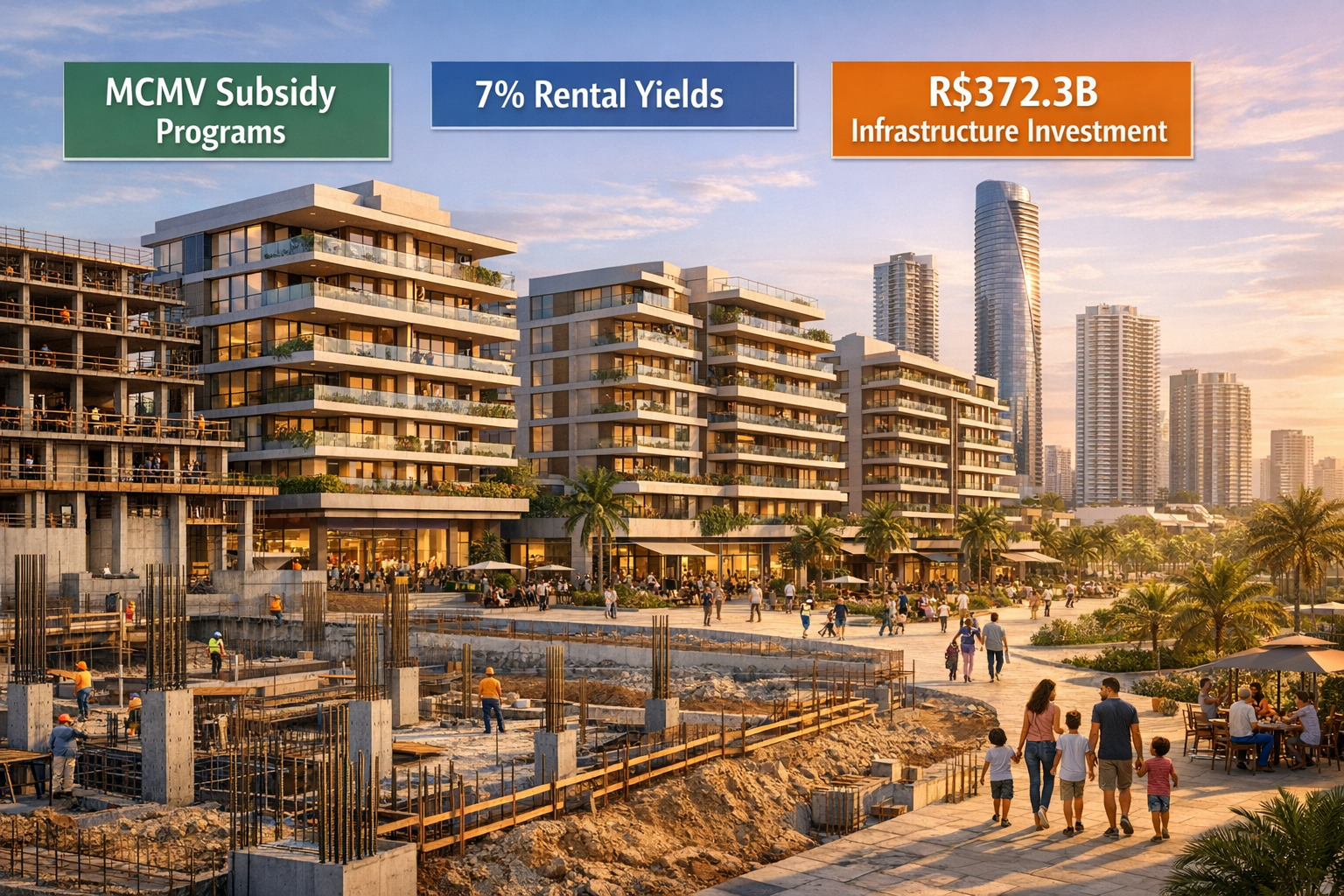
- 💰 João Pessoa delivers 7% gross rental yields while offering strong capital appreciation potential through 2026
- 🏗️ R$372.3 billion infrastructure investment across Brazil (2025-2029) is creating connectivity advantages for secondary markets
- 🏘️ Government housing programs (Minha Casa, Minha Vida and Casa Verde e Amarela) provide subsidized financing that drives demand in mid-range developments
- 🌍 Foreign investment accelerated 40% year-over-year due to favorable exchange rates and unrestricted property ownership policies
Understanding the Secondary City Advantage in Brazil’s Northeast
Why Secondary Markets Are Outperforming Traditional Hubs
The property development landscape in Brazil has fundamentally changed. While investors traditionally focused on São Paulo and Rio de Janeiro, João Pessoa Emerging Opportunities 2026: High-Growth Tactics for Secondary Northeast Property Development demonstrates how secondary cities are capturing disproportionate value.
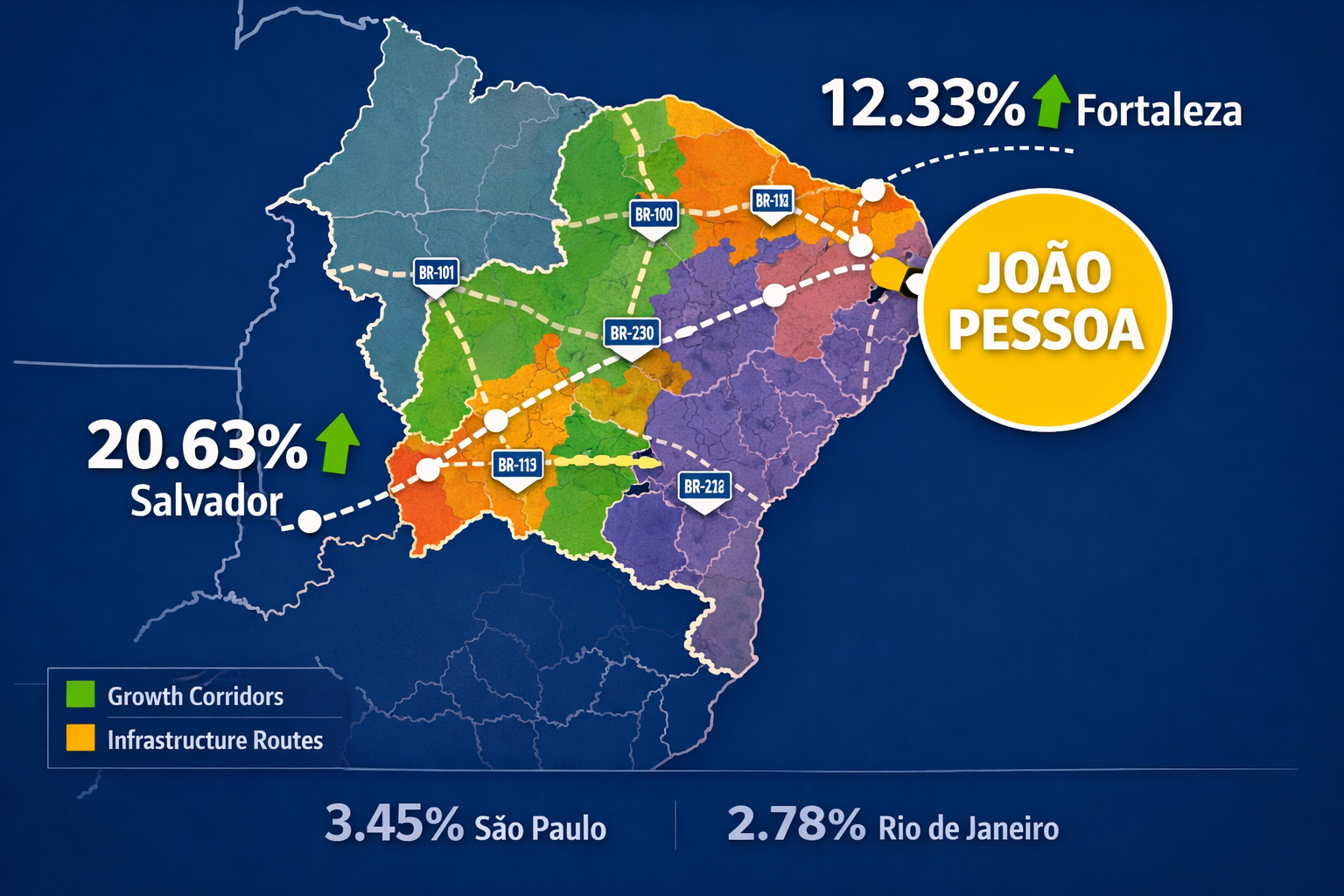
The numbers tell a compelling story. As of September 2025, Salvador achieved 20.63% nominal growth (14.31% real growth after inflation), while Fortaleza posted 12.33% nominal growth (6.44% real growth). These figures dwarf São Paulo’s 6.11% and Rio de Janeiro’s 4.62% nominal growth rates[7].
Several structural factors drive this outperformance:
Supply-Demand Imbalances: Brazil faces a housing deficit of nearly 6 million units, with secondary cities experiencing acute shortages as cautious developers have focused on established markets[7]. This creates pricing power for developers willing to enter these underserved markets.
Urbanization Migration: Economic diversification in the Northeast is drawing population from rural areas and even from saturated southern markets, creating sustained demand for housing across all price points.
Infrastructure Connectivity: The Brazilian government’s R$372.3 billion ($67 billion USD) infrastructure commitment for 2025-2029 includes fifteen highway concession auctions scheduled for 2025—the largest infrastructure program in recent Brazilian history[7]. These investments disproportionately benefit secondary cities by improving connectivity to major economic centers.
Lower Entry Costs: Land acquisition and construction costs in João Pessoa remain 40-60% lower than comparable coastal markets in the South, allowing developers to achieve superior returns on invested capital while maintaining competitive pricing.
For developers evaluating best places to invest in Brazil property, the Northeast’s secondary cities offer a compelling risk-reward profile that combines emerging market growth with manageable execution risk.
João Pessoa’s Unique Market Position
João Pessoa stands out even among high-performing Northeast markets. As Paraíba’s capital and largest city, it benefits from concentrated government investment and serves as the region’s administrative and commercial hub.
The city’s coastal location provides natural appeal for both residential and hospitality developments. With over 20 kilometers of beaches, including the famous Tambau and Cabo Branco areas, João Pessoa attracts domestic and international tourists while maintaining a lower cost of living than comparable coastal cities in the South.
Current market fundamentals in João Pessoa include:
| Metric | Value | Comparison |
|---|---|---|
| Gross Rental Yield | 7% annually | Higher than São Paulo (4-5%) |
| Projected Appreciation | 6-10% annually | Aligned with secondary city premium |
| Foreign Buyer Growth | 40% YoY | Strong international demand |
| Average Price per m² | R$6,500-9,500 | 50% below comparable southern markets |
The entrance of luxury developers like Aston Martin—announcing their first South American residential project in João Pessoa—validates the market’s potential[2][3]. This 45-story tower, developed in partnership with Setai Grupo GP, features units ranging from 1,100 to 3,000+ square feet with expected completion by 2031.
Similarly, Marriott International’s commitment to The Westin João Pessoa All-Inclusive Resort and City Express by Marriott’s plan for 30 properties across Brazil’s Northeast over 15 years demonstrates institutional confidence in the region’s growth trajectory[5][6].
High-Growth Development Tactics for João Pessoa in 2026
Leveraging Government Housing Programs for Mid-Range Projects
The Brazilian government’s expanded funding for “Minha Casa, Minha Vida” (MCMV) and “Casa Verde e Amarela” programs creates exceptional opportunities for developers targeting middle-income families in João Pessoa.
These programs provide subsidized financing that dramatically expands the qualified buyer pool. For families earning 4-10 minimum wages (approximately R$5,280-R$13,200 monthly in 2026), these programs offer:
- Reduced interest rates as low as 4.5-7% annually (compared to market rates of 10-12%)
- Extended payment terms up to 30 years
- Partial government subsidies covering 10-30% of property value depending on income bracket
- Streamlined approval processes that reduce transaction friction
For developers, structuring projects to qualify for these programs means:
✅ Guaranteed demand pipeline: Government pre-qualification of buyers reduces sales cycle uncertainty
✅ Faster inventory turnover: Subsidized financing accelerates purchase decisions
✅ Lower default risk: Government backing provides additional security
✅ Competitive differentiation: MCMV-eligible projects attract buyers who cannot access conventional financing
Optimal project specifications for MCMV alignment in João Pessoa include:
- Unit sizes: 42-70m² (2-bedroom configurations most popular)
- Price points: R$190,000-R$350,000 (within program limits)
- Location: Areas with public transportation access and basic infrastructure
- Amenities: Modest but functional—playground, basic security, parking
- Construction standards: Durable, low-maintenance materials that meet program requirements
Developers should work with experienced local legal advisors to ensure full program compliance and maximize subsidy capture. The approval process typically requires 60-90 days but provides significant competitive advantages once secured.
Strategic Site Selection in Growth Corridors
João Pessoa Emerging Opportunities 2026: High-Growth Tactics for Secondary Northeast Property Development requires careful site selection that anticipates rather than follows infrastructure development.
Primary growth corridors in João Pessoa for 2026-2030:
1. Bessa-Manaíra Expansion Zone This established middle-class neighborhood is experiencing vertical densification with improved beach access. Land prices remain 30-40% below premium Tambau area while offering similar lifestyle amenities. Target demographic: young professionals and small families seeking coastal proximity.
2. Altiplano-Bancários Corridor Located inland with university proximity, this area attracts students and academic professionals. Lower land costs (R$400-600/m²) enable higher-density projects with strong rental demand. Ideal for studio and 1-bedroom developments targeting student housing and compact units.
3. Valentina-Mangabeira Growth Axis These emerging neighborhoods benefit from recent infrastructure improvements including new road connections and commercial development. Land prices (R$250-400/m²) offer exceptional value for MCMV-targeted projects. Population growth rate exceeds 4% annually.
4. Cabo Branco-Penha Luxury Segment Premium coastal area attracting high-end developments like the Aston Martin Residences. Land costs are higher (R$1,500-2,500/m²) but support luxury pricing and international buyer interest. Focus on differentiated amenities and architectural distinction.
Site selection criteria checklist:
- ✓ Within 2km of planned infrastructure improvements (roads, transit, utilities)
- ✓ Zoning permits desired density and use (verify with municipal planning department)
- ✓ Environmental clearances obtainable within 6-month timeframe
- ✓ Land price enables target margin at market-competitive sales prices
- ✓ Neighborhood demographics align with project positioning
- ✓ Competition analysis shows undersupply in target segment
- ✓ Access to construction labor and materials logistics
Partnership Models with Established Northeast Developers
For developers new to the João Pessoa market, partnering with established local players reduces execution risk while accelerating market entry.
Setai Grupo GP, the largest privately-held real estate developer in Brazil’s Northeast, exemplifies the type of partner that brings critical local expertise. Having delivered over 8,000 residential units across its portfolio, such developers provide[2]:
- Regulatory navigation: Understanding of local permitting, environmental requirements, and political relationships
- Supply chain access: Established relationships with contractors, material suppliers, and labor sources
- Market intelligence: Deep knowledge of neighborhood dynamics, buyer preferences, and pricing sensitivity
- Sales infrastructure: Existing broker networks and sales offices that reduce go-to-market costs
- Brand recognition: Local reputation that accelerates buyer confidence and sales velocity
Partnership structure options:
Joint Venture (50/50 or 60/40): Both parties contribute capital and expertise, sharing profits proportionally. Ideal for developers seeking balanced risk-sharing and collaborative decision-making.
Development Management Agreement: Foreign or out-of-state developer provides capital while local partner manages execution for fixed fee plus performance incentive. Provides operational control while leveraging local expertise.
Land Banking Partnership: Local partner identifies and secures sites while development partner provides capital and construction expertise. Useful when land acquisition timing is critical.
Co-Investment with Revenue Share: Partners contribute different resources (land, capital, expertise) with customized profit distribution based on contribution value.
When evaluating potential partners, conduct thorough due diligence on:
- Previous project completion rates and timelines
- Financial stability and access to construction financing
- Reputation with local authorities and community stakeholders
- Quality standards in delivered projects
- Legal and tax compliance history
Experienced developers understand that buying pre-construction properties offers significant advantages, and partnering with established players helps navigate this process successfully.
Executing João Pessoa Emerging Opportunities 2026: High-Growth Tactics for Secondary Northeast Property Development
Financial Structuring and Capital Requirements
Successful execution of João Pessoa Emerging Opportunities 2026: High-Growth Tactics for Secondary Northeast Property Development requires careful financial planning that accounts for both development costs and market-specific considerations.
Typical capital requirements for mid-range João Pessoa project (100-unit development):
| Cost Category | Percentage | Amount (R$) |
|---|---|---|
| Land Acquisition | 15-20% | R$3.0-4.0M |
| Construction | 50-55% | R$10.0-11.0M |
| Professional Fees | 8-10% | R$1.6-2.0M |
| Marketing & Sales | 4-6% | R$800K-1.2M |
| Financing Costs | 6-8% | R$1.2-1.6M |
| Contingency | 5-7% | R$1.0-1.4M |
| Total Project Cost | 100% | R$17.6-21.2M |
Financing options available in 2026:
Brazilian Development Banks (BNDES): Offer favorable rates (SELIC + 1-2%) for projects meeting social housing criteria. Application process requires 3-6 months but provides substantial cost savings.
Commercial Bank Construction Loans: Traditional financing at market rates (10-12% annually) with typical 60-70% LTV. Requires proven developer track record and pre-sales commitments.
Private Equity Real Estate Funds: Growing interest in secondary market opportunities with typical 18-22% IRR requirements. Provides 100% project financing in exchange for majority equity stake.
Foreign Direct Investment: International developers can leverage favorable exchange rates and bring capital at competitive rates. No restrictions on foreign property ownership in Brazil[7].
Mezzanine Financing: Gap financing between senior debt and equity at 14-16% rates. Useful for experienced developers with strong project economics but limited equity capital.
Revenue optimization strategies:
💡 Phased Development: Structure projects in 2-3 phases to use early-phase sales proceeds to fund later phases, reducing total capital requirements by 25-35%.
💡 Pre-Sales Targets: Achieve 30-40% pre-sales before construction start to secure favorable bank financing terms and reduce market risk.
💡 Value Engineering: Identify cost savings through material substitution and design optimization without compromising quality standards. Target 8-12% cost reduction.
💡 Dynamic Pricing: Implement price escalation schedule tied to construction milestones, capturing appreciation during development cycle.
Marketing to Domestic and International Buyers
The buyer profile for João Pessoa properties in 2026 encompasses both domestic middle-class families and international investors seeking emerging market exposure.
Domestic buyer segments:
Middle-Income Families (Primary Target): Earning R$5,000-R$15,000 monthly, these buyers seek 2-3 bedroom units priced R$250,000-R$450,000. They prioritize school proximity, security, and basic amenities. Marketing emphasis: financial accessibility, neighborhood quality, family lifestyle.
Young Professionals: First-time buyers aged 25-35 seeking 1-2 bedroom units priced R$180,000-R$300,000. Value location, modern design, and lifestyle amenities. Marketing emphasis: contemporary design, connectivity, investment value.
Retirees and Pre-Retirees: Seeking coastal lifestyle at accessible price points. Prefer 2-bedroom units with lower maintenance requirements. Marketing emphasis: quality of life, climate, healthcare access, security.
International buyer segments:
Brazilian Diaspora: Brazilians living abroad (particularly in US and Europe) seeking connection to home country and investment diversification. Prefer turnkey properties with rental management services.
Foreign Retirees: Primarily from Argentina, Portugal, and Italy seeking affordable coastal retirement destinations. Require Portuguese language support and legal guidance on residency requirements.
Investment Buyers: International investors seeking emerging market exposure with 7%+ yields. Prioritize rental income potential, property management services, and exit liquidity.
Marketing channel strategies:
🌐 Digital Marketing: Invest in Portuguese and English language websites with virtual tours, financial calculators, and neighborhood information. Target cost: 3-4% of marketing budget.
🏢 Sales Offices: Physical presence in João Pessoa and São Paulo for credibility. Include model units showcasing finishes and layouts. Target cost: 30-35% of marketing budget.
🤝 Broker Networks: Commission-based relationships with local brokers (typically 4-6% of sales price). Essential for market penetration and sales velocity.
✈️ International Roadshows: Quarterly presentations in São Paulo, Miami, and Lisbon targeting diaspora and foreign investors. Target cost: 15-20% of marketing budget.
📱 Social Media Campaigns: Instagram and Facebook campaigns targeting lifestyle aspirations with neighborhood content, construction progress, and buyer testimonials.
Similar to successful approaches in other Brazilian property markets, combining digital presence with physical touchpoints creates optimal buyer engagement.
Risk Management and Timeline Optimization
Successful execution of João Pessoa Emerging Opportunities 2026: High-Growth Tactics for Secondary Northeast Property Development requires proactive risk management across multiple dimensions.
Primary risk categories and mitigation strategies:
Regulatory and Permitting Risk
- Risk: Delays in environmental licenses, construction permits, or zoning approvals
- Mitigation: Engage specialized legal counsel early; build 6-9 month permitting buffer into timeline; maintain positive relationships with municipal authorities; consider sites with existing zoning approval
Construction and Execution Risk
- Risk: Cost overruns, timeline delays, quality issues, contractor default
- Mitigation: Select contractors with proven track record; implement milestone-based payment structure; maintain 5-7% contingency budget; conduct weekly site inspections; use fixed-price contracts where possible
Market and Absorption Risk
- Risk: Slower-than-expected sales velocity, price resistance, competitive oversupply
- Mitigation: Achieve 30%+ pre-sales before construction start; implement flexible pricing strategy; maintain 12-month operating reserve; phase development to match absorption capacity
Currency and Economic Risk
- Risk: Real devaluation, inflation acceleration, interest rate increases
- Mitigation: Match revenue and cost currencies where possible; use inflation-indexed construction contracts; maintain flexible financing structure; hedge foreign exchange exposure for international capital
Political and Policy Risk
- Risk: Changes to housing programs, tax policy, or foreign ownership rules
- Mitigation: Diversify across multiple projects and locations; maintain flexibility to pivot project positioning; engage industry associations for policy advocacy
Optimal development timeline for 100-unit mid-range project:
Months 1-6: Pre-Development
- Site acquisition and due diligence
- Architectural design and engineering
- Environmental and construction permits
- Financing arrangement
- Marketing material preparation
Months 7-9: Pre-Sales and Mobilization
- Sales office opening
- Pre-sales campaign launch (target 30-40% sold)
- Construction financing closure
- Site preparation and mobilization
- Material procurement
Months 10-24: Construction
- Foundation and structure (Months 10-16)
- Envelope and systems (Months 17-21)
- Interior finishes (Months 22-24)
- Ongoing sales and marketing
- Buyer communications and updates
Months 25-27: Completion and Handover
- Final inspections and certifications
- Unit handovers to buyers
- Common area completion
- Warranty period initiation
- Final sales push for remaining inventory
Months 28-30: Post-Delivery
- Warranty service and issue resolution
- Final unit sales completion
- Property management transition
- Project financial closeout
This 30-month timeline from acquisition to full delivery represents an aggressive but achievable schedule for experienced developers. Less experienced teams should add 3-6 months buffer, particularly in permitting and construction phases.
Understanding how real estate market performance drives successful outcomes helps developers benchmark their execution against market leaders.
Comparative Analysis: João Pessoa vs. Other Brazilian Markets
To fully appreciate João Pessoa Emerging Opportunities 2026: High-Growth Tactics for Secondary Northeast Property Development, developers should understand how this market compares to alternatives across Brazil.
Market comparison matrix (2026 data):
| Market | Nominal Growth | Rental Yield | Entry Cost/m² | Infrastructure Investment | Foreign Buyer Interest |
|---|---|---|---|---|---|
| João Pessoa | 14-18% | 7.0% | R$6,500-9,500 | High | Growing |
| Salvador | 20.6% | 6.5% | R$7,000-11,000 | Very High | Moderate |
| Fortaleza | 12.3% | 6.8% | R$6,800-10,200 | High | Moderate |
| Florianópolis | 8-10% | 5.5% | R$9,500-15,000 | Moderate | Very High |
| São Paulo | 6.1% | 4.5% | R$11,000-18,000 | Moderate | High |
| Rio de Janeiro | 4.6% | 4.2% | R$9,000-16,000 | Low | Moderate |
Key insights from comparison:
João Pessoa offers balanced opportunity: While Salvador shows higher headline growth, João Pessoa provides superior rental yields with lower entry costs, creating better risk-adjusted returns for developers focused on mid-range segments.
Infrastructure advantage: The Northeast’s disproportionate share of Brazil’s R$372.3 billion infrastructure investment creates sustainable growth drivers rather than speculative appreciation[7].
Yield compression risk lower: Unlike Florianópolis where foreign demand has compressed yields to 5.5%, João Pessoa maintains 7% yields with room for capital appreciation, offering dual return sources.
Execution complexity manageable: Compared to São Paulo’s saturated, highly competitive market, João Pessoa offers clearer value propositions and less entrenched competition.
For developers evaluating where to invest in Brazilian property, João Pessoa represents a “sweet spot” combining emerging market growth with manageable execution risk and strong fundamentals.
Future Outlook and Emerging Trends Through 2030
Looking beyond 2026, several trends will shape João Pessoa Emerging Opportunities 2026: High-Growth Tactics for Secondary Northeast Property Development through the end of the decade.
Hospitality-Driven Residential Demand: Marriott’s commitment to The Westin João Pessoa All-Inclusive Resort and the broader plan for 30 City Express properties across the Northeast signals institutional confidence in the region’s tourism growth[5][6]. This hospitality expansion creates demand for:
- Short-term rental properties near resort concentrations
- Workforce housing for hospitality employees
- Mixed-use developments combining residential and commercial components
- Vacation home market targeting domestic and international buyers
Luxury Market Maturation: The Aston Martin Residences project—a 45-story tower with units exceeding 3,000 square feet—demonstrates that João Pessoa is graduating from purely mid-market to luxury segments[2][3]. This creates opportunities for:
- Ultra-luxury residential projects in premium coastal locations
- High-end amenity packages (concierge services, private beach clubs, spa facilities)
- Branded residences partnerships with international luxury brands
- Penthouses and whole-floor units targeting high-net-worth individuals
Technology Integration: Younger Brazilian buyers increasingly expect smart home technology, sustainable design, and digital connectivity. Future projects should incorporate:
- Smart home systems (lighting, climate, security) as standard features
- High-speed fiber internet infrastructure throughout buildings
- Electric vehicle charging stations in parking areas
- Solar panels and energy-efficient systems to reduce operating costs
- Digital sales and property management platforms
Sustainability Requirements: Environmental consciousness is growing among Brazilian buyers and regulators. Projects should anticipate:
- Green building certifications (LEED, AQUA-HQE) becoming market differentiators
- Rainwater harvesting and water recycling systems
- Native landscaping reducing maintenance and water consumption
- Waste reduction during construction and operation
- Climate resilience in coastal areas (sea level rise, storm surge)
Demographic Shifts: Brazil’s aging population and urbanization trends create specific opportunities:
- Universal design features accommodating aging residents
- Smaller unit sizes matching shrinking household sizes
- Community-oriented amenities fostering social connection
- Healthcare proximity becoming key location factor
- Multigenerational housing designs accommodating extended families
Regulatory Evolution: Developers should monitor potential policy changes:
- Expansion of MCMV and Casa Verde e Amarela income thresholds
- Tax incentives for sustainable construction practices
- Streamlined permitting for projects meeting social housing criteria
- Potential foreign investment restrictions (though unlikely given current policy)
- Municipal zoning updates enabling higher density in growth corridors
The convergence of these trends suggests that João Pessoa Emerging Opportunities 2026: High-Growth Tactics for Secondary Northeast Property Development will evolve from a purely opportunistic play to a sustained, mature market offering diversified development opportunities across multiple segments and price points.
Developers who establish market presence and brand recognition in 2026 will be positioned to capture disproportionate value as the market matures through 2030.
Conclusion
João Pessoa Emerging Opportunities 2026: High-Growth Tactics for Secondary Northeast Property Development represents one of the most compelling value propositions in Brazilian real estate today. While traditional markets in São Paulo and Rio de Janeiro deliver modest single-digit growth, secondary Northeast cities like João Pessoa are achieving 14-20% annual appreciation while maintaining 7% rental yields[7][8].
The convergence of multiple favorable factors—government housing subsidies through MCMV and Casa Verde e Amarela programs, R$372.3 billion in infrastructure investment, a 6-million-unit housing deficit, 40% year-over-year foreign investment growth, and institutional validation from brands like Aston Martin and Marriott—creates a unique window of opportunity for developers willing to look beyond traditional markets[2][5][7].
Key success factors for developers entering this market:
✅ Strategic site selection in growth corridors anticipating infrastructure development
✅ MCMV program alignment to access subsidized financing and expand buyer pool
✅ Local partnerships with established Northeast developers to reduce execution risk
✅ Phased development to optimize capital efficiency and match absorption capacity
✅ Balanced positioning serving both domestic middle-class families and international investors
✅ Proactive risk management across regulatory, construction, market, and economic dimensions
Actionable next steps for developers:
- Conduct market research visit to João Pessoa to assess neighborhoods, competition, and infrastructure projects firsthand
- Engage local legal counsel specializing in real estate development to understand regulatory requirements and MCMV qualification criteria
- Identify potential local partners with proven track records and complementary capabilities
- Develop preliminary financial models for target segments (mid-range MCMV-eligible, luxury coastal, compact rental-focused)
- Establish relationships with Brazilian development banks and commercial lenders to understand financing options
- Create market entry timeline with specific milestones for site acquisition, permitting, financing, and construction
The secondary cities of Brazil’s Northeast are no longer emerging—they’re arrived. Developers who recognize this shift and act decisively in 2026 will capture exceptional returns while building sustainable platforms for long-term growth in one of Latin America’s most dynamic property markets.
For developers seeking guidance on Brazilian market entry and development strategies, partnering with experienced real estate development firms can accelerate market learning and reduce execution risk.
The question is no longer whether to invest in João Pessoa and similar secondary Northeast markets, but rather how quickly developers can establish presence before the opportunity becomes widely recognized and competition intensifies.
References
[1] Aston Martin Enters South American Real Estate With Setai Partnership – https://www.cbnme.com/news/aston-martin-enters-south-american-real-estate-with-setai-partnership/
[2] Aston Martin Setai Grupo Gp Announce New Residential Project In Brazil – https://news.dupontregistry.com/blogs/lifestyle/aston-martin-setai-grupo-gp-announce-new-residential-project-in-brazil
[3] Aston Martin Luxury Residences Arrive In Brazil – https://luxus-plus.com/en/aston-martin-luxury-residences-arrive-in-brazil/
[4] Joao Pessoa Real Estate Market In 2026 – https://meiracarlos.com.br/en/rental-and-investments/joao-pessoa-real-estate-market-in-2026/
[5] Marriott Shares Updates On Caribbean And Latin American Growth In 2025 – https://lodgingmagazine.com/marriott-shares-updates-on-caribbean-and-latin-american-growth-in-2025/
[6] Pressrelease 77561 Marriott International Announces Significant Growth And Strategic Expansion In The Caribbean And Latin America In 2025 – https://www.journaldespalaces.com/en/pressrelease-77561-marriott-international-announces-significant-growth-and-strategic-expansion-in-the-caribbean-and-latin-america-in-2025.html
[7] Brazil Good Time – https://thelatinvestor.com/blogs/news/brazil-good-time
[8] meiracarlos.com.br – https://meiracarlos.com.br/en/