
.
Brazil’s real estate market is experiencing a dramatic shift in 2026. While the Selic rate hovers at 15%, making traditional fixed-income investments highly attractive, a surprising segment of the property market is thriving: studio and one-bedroom apartments. These compact units are delivering impressive 9% appreciation rates and rental yields that significantly outperform larger properties, fundamentally changing the calculus for both investors and developers.
The phenomenon of Studio and One-Bedroom Dominance 2026: Why Small Apartments Are Delivering 9% Appreciation Amid High Selic Rates represents more than just a temporary market quirk. It reflects structural changes in Brazilian demographics, affordability constraints, and investment strategies that are reshaping urban development across major cities from São Paulo to Florianópolis.
Key Takeaways
✅ Studio and one-bedroom apartments deliver 7-9% gross rental yields in prime locations, significantly outperforming larger units at 5-6.5% yields [5]
✅ Optimal unit size for maximum returns is 25-45 square meters, with monthly rents reaching R$50-R$70 per square meter in strong micro-areas [5]
✅ Lower entry costs combined with higher rental liquidity make small apartments the most profitable segment despite 15% Selic rates competing for investment capital [4]
✅ Young professionals aged 20-39 drive structural demand for compact, transit-accessible units near employment centers [4]
✅ Developers should prioritize high-density, compact condos in urban peripheries to capitalize on affordability-driven demand shifts [2]
Understanding the Small Apartment Advantage in Brazil’s High-Interest Environment
The Brazilian real estate market in 2026 operates under unique pressures. With the Selic interest rate at 15%, risk-free government bonds and fixed-income securities offer compelling returns without the management burden of physical property. Yet despite this competition, small apartments continue to attract investor capital—and for good reason.
The Yield Gap That Matters
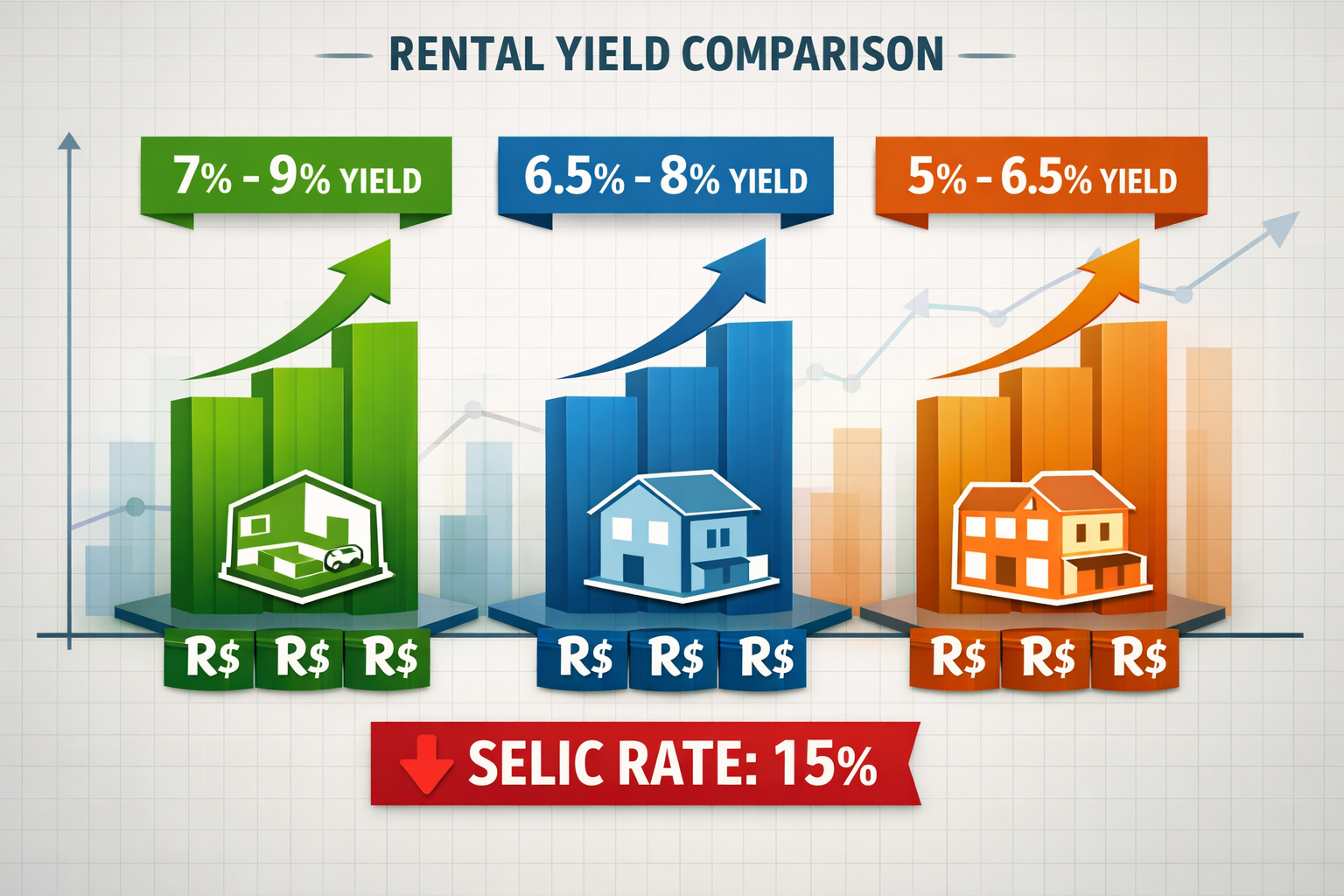
Studio and one-bedroom apartments consistently outperform larger units on rental yield metrics across Brazil’s major markets [5]. While the national average gross rental yield sits at approximately 6.4% in early 2026, compact units in strategic locations are delivering significantly higher returns:
| Property Type | Average Gross Yield | Prime Location Yield |
|---|---|---|
| Studio (< 30m²) | 7.0-8.5% | 8.0-10.0% |
| One-Bedroom (30-45m²) | 6.5-8.0% | 7.5-9.0% |
| Two-Bedroom (45-70m²) | 5.5-6.5% | 6.0-7.5% |
| Three-Bedroom (70m²+) | 5.0-6.0% | 5.5-6.5% |
These yields become particularly compelling when considering that investors require returns above 7% to justify choosing real estate over risk-free alternatives at current Selic rates [5]. Only the smallest apartment categories consistently clear this hurdle.
Why Size Matters for Returns
The optimal unit size for yield is 25-45 square meters, covering most studios and compact one-bedrooms [5]. These units command monthly rents of R$50-R$70 per square meter, translating to annual gross yields of 7-9% in strong micro-areas as of early 2026.
The mathematics are straightforward: a 30m² studio renting for R$1,800 monthly (R$60/m²) generates R$21,600 in annual rent. With purchase prices in emerging neighborhoods ranging from R$240,000-R$280,000, gross yields reach 7.7-9.0% before expenses [1].
For context on investment opportunities in Brazilian real estate markets, understanding these yield dynamics proves essential for portfolio strategy.
The Economics Behind Studio and One-Bedroom Dominance 2026
Understanding Studio and One-Bedroom Dominance 2026: Why Small Apartments Are Delivering 9% Appreciation Amid High Selic Rates requires examining both the supply and demand factors driving this market segment.
Demand Drivers: Who’s Renting Small Apartments?
The most in-demand property types for renters are studios and kitnets near transit, followed by one-to-two bedroom apartments in safe neighborhoods [5]. This demand stems from several demographic and economic factors:
🏢 Young professionals (20-39 years old) represent the primary tenant base, seeking affordable housing near employment centers [4]
🎓 Students and early-career workers prioritize location and affordability over space
💼 Remote workers need functional living spaces but spend less time at home
💰 Budget-conscious renters face affordability constraints in major cities
The structural demand is reflected in rental price data. Typical monthly rents as of early 2026 are R$1,530 ($285 USD) for studios, R$2,295 ($425 USD) for one-bedrooms, and R$3,315 ($615 USD) for two-bedrooms [1]. The pricing gap creates a natural market for compact units.
Supply-Side Economics: Why Developers Should Pay Attention
From a development perspective, small apartments offer compelling unit economics:
Lower construction costs per unit enable higher-density projects with better land utilization. A building plot that might accommodate 20 two-bedroom units can instead house 35-40 studios, dramatically improving project returns.
Faster sales velocity results from lower absolute prices. A R$250,000 studio sells more quickly than a R$600,000 three-bedroom in the same building, reducing carrying costs and improving cash flow.
Broader buyer pool includes first-time buyers, investors, and parents purchasing for college-age children—segments largely priced out of larger unit markets.
For developers exploring the advantages of studio investments in growing markets like Florianópolis, these factors create compelling business cases for compact unit development.
The Condominium Fee Factor
One critical consideration affects net yields significantly: condominium fees ranging from R$400-R$1,500 monthly can reduce net yields from 5.96% gross to approximately 4% net [1]. This impact varies by property type:
- Smaller buildings with fewer amenities impose lower fees, preserving more rental income
- Luxury towers with extensive facilities charge higher fees that disproportionately impact smaller units
- Older buildings often have lower fees but may require maintenance reserves
Smart investors target newer mid-range buildings in emerging neighborhoods where condominium fees remain reasonable while still offering security and basic amenities. This strategy maximizes net yield while maintaining tenant appeal.
Geographic Hotspots: Where Studio and One-Bedroom Dominance 2026 Is Strongest
The performance of small apartments varies significantly by location. Understanding Studio and One-Bedroom Dominance 2026: Why Small Apartments Are Delivering 9% Appreciation Amid High Selic Rates requires examining specific markets delivering superior returns.
São Paulo: The Yield Leader
São Paulo neighborhoods like Tatuapé and Mooca deliver 7-9% gross yields for studios and one-bedrooms, significantly outperforming larger units in the same areas [5]. These eastern zone neighborhoods benefit from:
✅ Extensive metro connectivity reducing commute times
✅ Lower entry prices compared to central districts
✅ Strong rental demand from young professionals
✅ Ongoing infrastructure improvements driving appreciation
Entry-level studios cost R$1,200-R$1,800 monthly ($220-$335 USD) in most São Paulo neighborhoods outside premium areas, while mid-range one-bedrooms rent for R$2,000-R$3,000 ($370-$555 USD) [1].
Florianópolis: Quality of Life Meets Returns
Florianópolis presents a unique value proposition combining lifestyle benefits with solid investment returns. The city’s growing tech sector and quality of life attract young professionals seeking compact, well-located housing.
The growth of regions like Ingleses in Florianópolis demonstrates how infrastructure development and quality of life improvements drive demand for smaller, more affordable units. For those considering life in Florianópolis, understanding the small apartment market proves essential.
Rio de Janeiro: The Short-Term Rental Wild Card
Rio presents a different opportunity profile. Short-term rental occupancy in Rio de Janeiro averages 62% at R$342 per night [1], suggesting potential for higher returns through platforms like Airbnb. However, condominium rules often block Airbnb entirely in many apartment buildings, limiting income potential for some small units [1].
Investors considering Rio must carefully verify short-term rental permissions before purchase, as this factor dramatically affects return potential.
Emerging Urban Peripheries: The Next Frontier
The highest growth potential lies in urban peripheries of major cities where:
🚇 New transit lines are under construction or recently completed
🏗️ Infrastructure investment is driving neighborhood transformation
💵 Entry prices remain 30-50% below established areas
📈 Appreciation potential exceeds rental yield in importance
These locations align perfectly with the affordability-driven demand shift characterizing 2026’s market. Developers prioritizing these areas position themselves for both immediate rental returns and medium-term capital appreciation.
Investment Strategy: Maximizing Returns from Small Apartments in 2026
Successfully capitalizing on Studio and One-Bedroom Dominance 2026: Why Small Apartments Are Delivering 9% Appreciation Amid High Selic Rates requires strategic approach to property selection, financing, and management.
The Pre-Construction Advantage
Purchasing during the pre-construction phase amplifies returns through built-in appreciation. Understanding appreciation for pre-construction buyers reveals how early-stage investment can deliver 15-25% appreciation before the building even delivers.
For small apartments specifically, pre-construction offers:
💰 Lower entry prices with extended payment terms
📈 Appreciation during construction as the neighborhood develops
🎯 First choice of units to select optimal layouts and positions
⏰ Time to arrange financing before delivery and rental commencement
Financing Considerations in a High-Selic Environment
With Selic at 15%, mortgage rates for residential property typically range from 10-13% annually depending on down payment and borrower profile [2]. This creates a challenging environment where:
- Cash purchases become more attractive to avoid interest costs
- Larger down payments (40-50%) reduce financing burden
- Rental yield must exceed financing costs for leveraged purchases to make sense
The mathematics favor cash or high-equity purchases in the current environment. A studio delivering 8% gross yield (approximately 5.5% net after expenses) generates positive cash flow only when financing costs remain below that threshold.
Property Management: Professional vs. Self-Management
Professionalization of rental management through concierge services, co-hosts, and automation is facilitating investor entry into the small-apartment market [4]. This trend supports the yield advantage by:
🔧 Reducing vacancy periods through professional marketing
🛠️ Handling maintenance issues promptly to preserve tenant satisfaction
💻 Leveraging technology for rent collection and communication
📊 Optimizing pricing based on market conditions
Professional management typically costs 8-12% of monthly rent but often pays for itself through reduced vacancy and better tenant quality. For investors managing multiple units or living outside the property’s city, professional management proves essential.
The Micro-Apartment Opportunity
Micro-apartments (sub-30 m² studios) emerged between 2018-2021 during favorable credit conditions and now target 20-39 year-old professionals [4]. These ultra-compact units represent the extreme end of the small-apartment spectrum, with:
✅ Gross rental yields generally between 4-8% in major cities
✅ Peaks at 10% in high-demand or tourist areas
✅ Lowest absolute purchase prices expanding the investor base
✅ Highest tenant turnover requiring active management
Micro-apartments work best in premium locations where proximity justifies the space compromise—near universities, major employers, or transit hubs where convenience outweighs size limitations.
Developer Perspective: Building for Studio and One-Bedroom Dominance 2026

For real estate developers, understanding Studio and One-Bedroom Dominance 2026: Why Small Apartments Are Delivering 9% Appreciation Amid High Selic Rates translates into concrete project decisions affecting profitability and sales velocity.
Unit Mix Optimization
Traditional developments often featured balanced unit mixes: 20% studios, 40% one-bedrooms, 30% two-bedrooms, and 10% three-bedrooms. The 2026 market demands recalibration:
Recommended unit mix for urban periphery projects:
- 35-40% studios (25-35m²)
- 40-45% one-bedrooms (35-45m²)
- 15-20% two-bedrooms (45-60m²)
- 0-5% larger units
This mix aligns with demand patterns while maximizing units per floor plate, improving project economics.
Amenity Strategy for Compact Living
Small apartments require thoughtful amenity design to compensate for limited private space:
🏋️ Shared fitness facilities reduce need for home exercise space
💼 Co-working lounges serve remote workers lacking home offices
🍽️ Common kitchens and dining areas enable entertaining outside cramped units
📦 Package rooms and storage address limited closet space
🌳 Rooftop gardens and terraces provide outdoor access
These amenities justify premium pricing while keeping individual unit sizes—and prices—affordable. The key is balancing amenity costs with condominium fee implications, as excessive fees erode investor returns.
Location Selection: Where to Build
The highest returns come from high-density, compact condos in urban peripheries [2] where:
📍 Transit connectivity is strong or improving
📍 Employment centers are accessible within 30-45 minutes
📍 Land costs remain reasonable relative to finished unit values
📍 Zoning permits higher-density development
📍 Neighborhood trajectory is positive with infrastructure investment
Developers should avoid premium central locations where land costs force unit prices beyond the affordability threshold that makes small apartments attractive. The sweet spot lies in emerging neighborhoods where infrastructure investment is driving transformation.
For insights into how sales performance is transforming Florianópolis’s real estate market, examining successful compact unit projects provides valuable lessons.
Construction Timeline and Market Timing
With construction progress accelerating on projects like Tramonto, timing project delivery to market conditions becomes crucial. The current environment favors:
⏱️ Faster construction timelines (18-24 months) to deliver before market conditions shift
📊 Phased releases to test pricing and adjust unit mix based on absorption
💵 Flexible payment terms to attract buyers facing financing constraints
🎯 Pre-sales targets of 30-40% before construction start to validate demand
Developers who move decisively to capitalize on current small-apartment demand while maintaining construction discipline will outperform those pursuing traditional larger-unit projects.
Risk Factors and Considerations
While the Studio and One-Bedroom Dominance 2026: Why Small Apartments Are Delivering 9% Appreciation Amid High Selic Rates trend presents compelling opportunities, investors and developers must consider several risk factors:
Interest Rate Sensitivity
The current 15% Selic rate won’t persist indefinitely. When rates decline:
⚠️ Fixed-income alternatives become less attractive, potentially increasing property demand
⚠️ Mortgage affordability improves, potentially shifting demand toward larger units
⚠️ Rental yields may compress as property values appreciate faster than rents
However, most economists project gradual Selic reduction to 10-12% by late 2027 [2], suggesting the current dynamic persists through 2026 and into 2027.
Oversupply Risk in Specific Markets
As developers recognize the small-apartment opportunity, oversupply risk increases in specific micro-markets. Warning signs include:
🚨 Multiple projects launching simultaneously in the same neighborhood
🚨 Rental vacancy rates exceeding 8-10% for extended periods
🚨 Rental price reductions to attract tenants
🚨 Extended sales periods for new launches
Careful market analysis at the neighborhood level, not just city-wide, proves essential for risk management.
Regulatory and Condominium Restrictions
Condominium rules blocking short-term rentals [1] limit flexibility for some properties. Additionally, some municipalities are considering regulations on minimum apartment sizes or maximum building densities that could affect future projects.
Investors should verify both current regulations and proposed changes before committing capital.
Quality vs. Quantity Trade-offs
The push toward smaller, more affordable units creates temptation to compromise on quality. However, poor construction quality or inadequate soundproofing in compact buildings leads to:
😟 Tenant dissatisfaction and higher turnover
😟 Difficulty commanding premium rents
😟 Negative building reputation affecting resale values
😟 Higher maintenance costs eroding returns
Maintaining construction quality while optimizing unit size represents the winning formula.
Future Outlook: Sustainability of Small Apartment Dominance
Looking beyond 2026, several factors will determine whether Studio and One-Bedroom Dominance 2026: Why Small Apartments Are Delivering 9% Appreciation Amid High Selic Rates represents a temporary phenomenon or a structural market shift.
Demographic Trends Support Continued Demand
Brazil’s urbanization continues, with young professionals increasingly concentrated in major cities. Delayed family formation, with Brazilians marrying and having children later than previous generations, extends the period when small apartments meet lifestyle needs.
Additionally, remote work flexibility enables some professionals to prioritize location over space, choosing smaller units in desirable neighborhoods over larger apartments in less convenient areas.
Affordability Constraints Persist
Even if Selic rates decline, housing affordability challenges will persist in major Brazilian cities. Wage growth continues lagging property price appreciation, making smaller units the only accessible option for many buyers and renters.
This structural affordability gap suggests sustained demand for compact, well-located units regardless of interest rate fluctuations.
Infrastructure Investment Creates New Opportunities
Brazil’s ongoing infrastructure investment, particularly in urban transit expansion, continuously creates new micro-markets where small apartments can thrive. Each new metro line or BRT corridor opens previously less-accessible neighborhoods to development.
Developers who anticipate these infrastructure improvements and acquire land early position themselves for outsized returns as connectivity drives demand.
Evolution Toward “Micro-Living” Concepts
International trends toward co-living spaces, micro-apartments with extensive shared amenities, and flexible housing solutions are beginning to influence Brazilian markets [4]. These concepts may represent the next evolution beyond traditional studios and one-bedrooms.
Early movers in this space could capture premium positioning as younger generations embrace alternative housing models prioritizing experience and location over private space.
Conclusion
Studio and One-Bedroom Dominance 2026: Why Small Apartments Are Delivering 9% Appreciation Amid High Selic Rates represents more than a temporary market anomaly—it reflects fundamental shifts in Brazilian demographics, affordability, and investment dynamics that will shape real estate development for years to come.
The evidence is compelling: small apartments deliver 7-9% gross rental yields in prime locations, significantly outperforming larger units while remaining accessible to a broader pool of buyers and renters [5]. With optimal unit sizes of 25-45 square meters commanding premium per-square-meter rents [5], these properties offer the rare combination of strong cash flow and appreciation potential.
For investors, the strategy is clear: focus on well-located studios and one-bedrooms in emerging neighborhoods with strong transit connectivity and infrastructure investment. Prioritize properties with reasonable condominium fees, verify rental restrictions, and consider professional management to maximize net returns.
For developers, the opportunity requires reimagining unit mixes to emphasize compact apartments, particularly in urban peripheries where affordability constraints drive demand. Success requires balancing density optimization with quality construction and thoughtful amenities that enhance small-space living.
Actionable Next Steps
✅ Investors: Analyze specific neighborhoods for small-apartment yield potential, focusing on transit-accessible areas with rental demand above 7% gross yields
✅ Developers: Reassess pipeline projects to increase studio and one-bedroom proportions, particularly in emerging neighborhoods with infrastructure investment
✅ Both: Monitor Selic rate trajectory and adjust strategies as interest rate environment evolves, but recognize that structural affordability challenges will sustain small-apartment demand
✅ Research: Investigate current development opportunities in growing markets to identify projects aligned with small-apartment trends
The small-apartment revolution in Brazilian real estate isn’t coming—it’s already here. Those who recognize and act on Studio and One-Bedroom Dominance 2026: Why Small Apartments Are Delivering 9% Appreciation Amid High Selic Rates will position themselves for superior returns in an increasingly competitive market.
References
[1] Brazil Buy Rent Out – https://thelatinvestor.com/blogs/news/brazil-buy-rent-out
[2] Brazil Property Market Predictions For 2026 – https://esalesinternational.com/2025/11/20/brazil-property-market-predictions-for-2026/
[4] Micro Apartments Brazil Solution Small Budgets – https://www.jarniascyril.com/international-real-estate/investing-brazil-real-estate/micro-apartments-brazil-solution-small-budgets/
[5] Brazil Rental Yields – https://thelatinvestor.com/blogs/news/brazil-rental-yields