
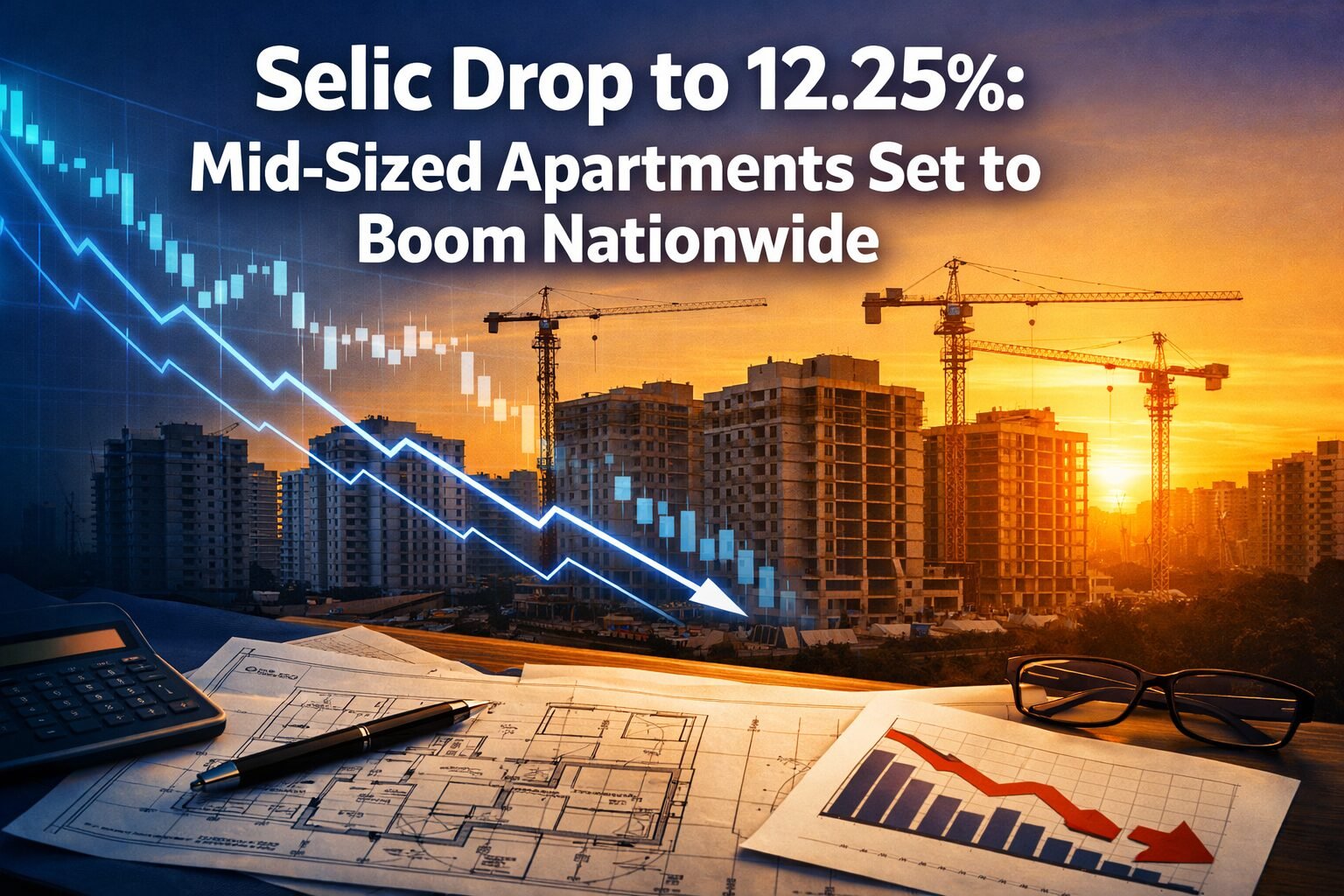
Brazil’s real estate market stands at a pivotal turning point. After years of punishing double-digit interest rates that froze buyer demand and stalled new construction, the Central Bank’s March 2026 decision to cut the Selic rate from 15% to 14.75% signals the beginning of a transformative easing cycle [1]. This Selic Drop to 12.25% by End-2026: How Rate Cuts Will Ignite Mid-Sized Apartment Launches Nationwide represents more than just monetary policy—it’s the catalyst that will reshape Brazil’s residential development landscape, particularly for the crucial mid-sized apartment segment that serves the country’s expanding middle class.
The timing couldn’t be more critical for developers and investors. With inflation falling below 4% for the first time since May 2024 and market consensus pointing toward approximately 275 basis points of total cuts throughout 2026 [1], the conditions are aligning for a dramatic expansion in both buyer purchasing power and developer confidence. Mid-sized apartments—typically ranging from 60 to 80 square meters with two or three bedrooms—stand to benefit most from this shift, as mortgage affordability improves and pent-up demand from years of high rates finally finds release.
Key Takeaways
- 📉 Historic rate reversal: Brazil’s Selic fell from 15% to 14.75% in March 2026, with consensus forecasts projecting 12.25% by year-end—a 275 basis point total reduction [1]
- 🏗️ Mid-sized unit opportunity: Two- and three-bedroom apartments (60-80m²) will see the strongest launch activity as mortgage barriers ease and buyer pools expand significantly
- 💰 Financing transformation: Each percentage point of Selic reduction can improve mortgage affordability by 8-12%, bringing hundreds of thousands of families into the buyer market
- ⚠️ Geopolitical risk factor: Middle East oil price volatility may slow the pace of cuts, with scenarios ranging from 13% (moderate) to maintaining higher rates if conflicts escalate [3]
- 🎯 Strategic timing window: Developers launching projects in Q2-Q3 2026 can capitalize on improving sentiment while construction costs remain relatively stable before demand-driven inflation
Understanding the Selic Rate Trajectory and Market Expectations

The Selic Drop to 12.25% by End-2026: How Rate Cuts Will Ignite Mid-Sized Apartment Launches Nationwide begins with understanding the monetary policy context. Brazil’s Monetary Policy Committee (Copom) delivered its first rate cut in nearly two years on March 26, 2026, reducing the benchmark Selic from 15% to 14.75% [1]. While the 0.25 percentage point reduction was smaller than the 0.50-point cut many market participants anticipated, it nonetheless marked a decisive shift toward monetary easing.
Why the Central Bank Is Cutting Now
Several factors converged to enable this policy pivot:
Inflation control success 📊: The 12-month trailing inflation rate dropped to 3.81% in February 2026, falling below the 4% threshold for the first time since May 2024 [1]. This achievement gave the Central Bank crucial room to ease policy without risking price stability.
Economic growth concerns: With Brazil’s GDP growth moderating and unemployment remaining elevated in certain sectors, policymakers recognized the need to stimulate economic activity through lower borrowing costs.
Real rate considerations: Even after cuts, Brazil maintains one of the world’s highest real interest rates (nominal rate minus inflation), providing substantial cushion for gradual easing.
Market Consensus and Forecast Revisions
As of mid-March 2026, the median estimate from over 100 Brazilian economists projected the end-2026 Selic at 12.38%, revised downward from 12.50% [4]. This consensus reflects confidence in continued disinflation and the Central Bank’s commitment to supporting growth. The real estate market in Greater Florianópolis and other major metropolitan areas has already begun responding to these expectations.
However, significant uncertainty remains. The Copom notably provided no forward guidance on future cuts, stating that decisions depend entirely on how the Middle East conflict affects commodity prices and inflation [1]. This cautious stance reflects legitimate concerns about oil prices exceeding $100 per barrel due to tensions involving Iran and potential disruptions to Strait of Hormuz shipping routes.
Scenario Analysis: Three Possible Paths
Financial analysts have outlined three distinct scenarios for the Selic trajectory through end-2026:
| Scenario | Year-End Selic | Conditions | Probability |
|---|---|---|---|
| Optimistic | 11.75-12.25% | Oil prices stabilize below $90/barrel, inflation remains subdued, 0.50-point cuts resume | 35% |
| Base Case | 12.25-12.75% | Moderate geopolitical tensions, gradual 0.25-0.50 point cuts, stable commodity prices | 45% |
| Conservative | 13.00-13.50% | Prolonged Middle East conflict, oil above $100/barrel, Central Bank pauses cuts mid-year | 20% |
Industry analysis from Tendências Consultoria suggests the Selic could fall closer to 13% by end-2026 in a moderate scenario if the Middle East conflict persists [3]. The next Copom meeting on April 28-29 will provide critical signals, with another 0.25-point cut considered likely if oil prices stabilize [1].
For real estate developers planning mid-sized apartment launches, this uncertainty requires flexible strategies that can adapt to different rate environments while capitalizing on the overall downward trend.
How Rate Cuts Expand the Buyer Pool for Mid-Sized Apartments
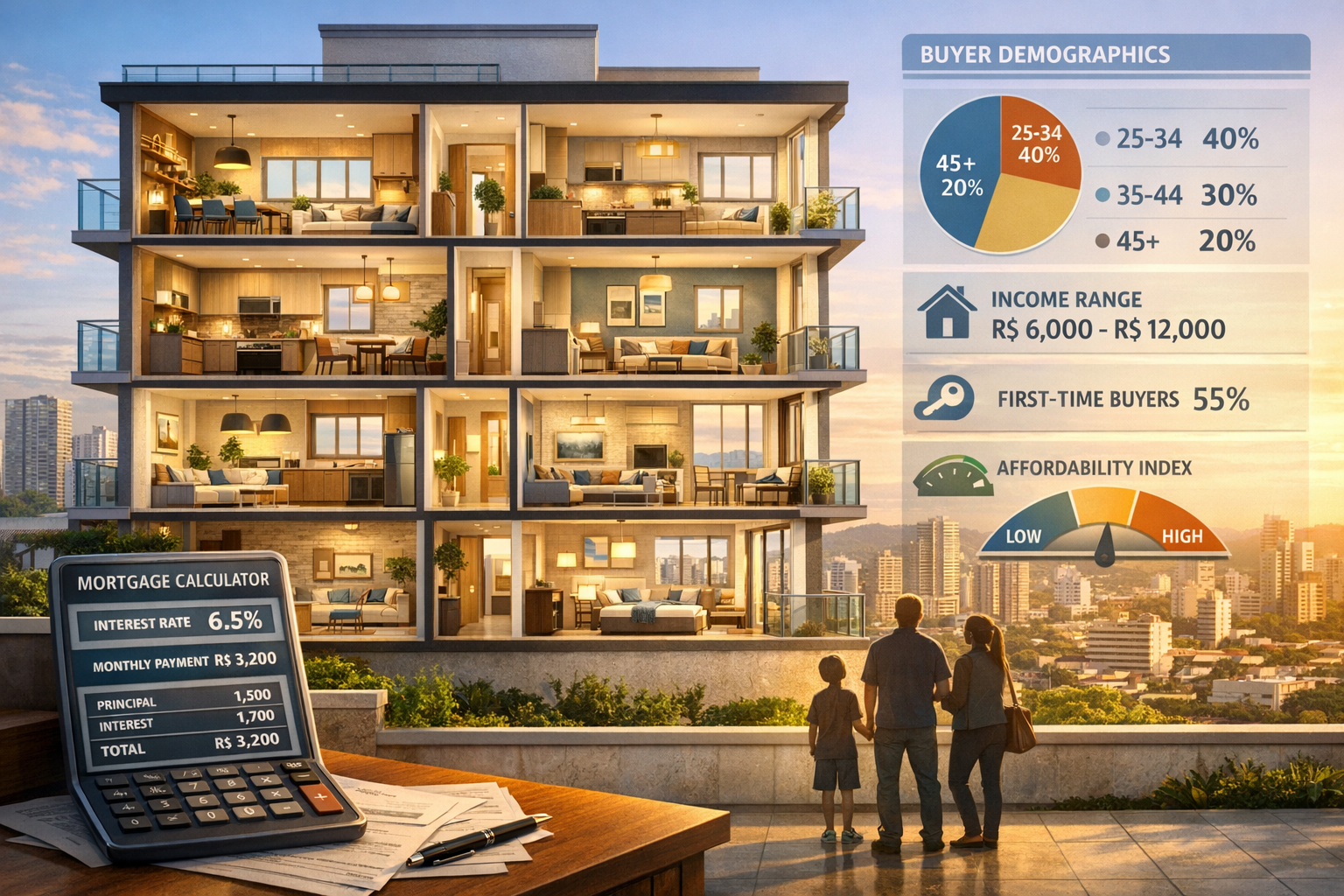
The Selic Drop to 12.25% by End-2026: How Rate Cuts Will Ignite Mid-Sized Apartment Launches Nationwide will most dramatically impact the mid-sized apartment segment—units typically between 60 and 80 square meters with two or three bedrooms. This segment serves Brazil’s crucial middle-income families, first-time buyers, and young professionals, demographics that are highly sensitive to mortgage affordability shifts.
The Mathematics of Mortgage Affordability
Interest rate reductions translate directly into improved purchasing power through lower monthly mortgage payments. Consider a typical scenario:
Example calculation for a R$400,000 mid-sized apartment:
- At 15% Selic (roughly 13% mortgage rate): Monthly payment ≈ R$4,420 over 30 years
- At 12.25% Selic (roughly 10.5% mortgage rate): Monthly payment ≈ R$3,660 over 30 years
- Savings: R$760 per month or 17% reduction in monthly burden
This R$760 monthly difference is transformative. For a family earning R$8,000-12,000 per month—the core middle-income bracket—this reduction moves the debt-to-income ratio from a prohibitive 55% down to a manageable 46%, meeting most bank lending criteria.
Expanding the Qualified Buyer Universe
Each percentage point of Selic reduction brings approximately 150,000-200,000 additional Brazilian families into mortgage qualification range, according to industry estimates. The cumulative effect of a 2.75 percentage point reduction (from 15% to 12.25%) could expand the qualified buyer pool by 400,000-550,000 households nationwide.
Key demographic groups entering the market:
🏠 First-time buyers (ages 28-38): Young professionals and couples who have been priced out since 2021-2022 when rates began climbing
👨👩👧👦 Growing families: Households currently in smaller apartments seeking to upgrade to 2-3 bedroom units as children arrive
📈 Investment buyers: Individuals seeking real estate investment opportunities who can now achieve positive cash flow with rental yields
💼 Relocating professionals: Workers moving to economic hubs like Florianópolis, São Paulo, and Brasília who need family-sized accommodations
Why Mid-Sized Units Benefit Most
While luxury apartments and compact studios will also see improved demand, mid-sized apartments capture the sweet spot of affordability improvement:
Too expensive before, affordable now: A R$350,000-500,000 mid-sized unit was out of reach for most middle-income families at 15% rates but becomes accessible at 12.25%.
Family functionality: Two- and three-bedroom layouts meet the practical needs of Brazil’s typical household size (2.8 people per household nationally).
Investment fundamentals: Mid-sized units offer better rental yields than luxury properties and stronger appreciation than micro-studios, making them attractive to both owner-occupiers and investors.
Financing availability: Banks are more willing to finance mid-market properties than luxury units, as default risk profiles are more predictable and secondary market liquidity is stronger.
The appreciation potential for buyers purchasing during construction becomes particularly compelling in this environment, as early buyers lock in pre-rate-cut pricing while delivery occurs in a lower-rate, higher-demand market.
Regional Variations in Impact
The affordability impact varies significantly by market:
High-impact markets (largest buyer pool expansion):
- São Paulo metropolitan area
- Rio de Janeiro
- Brasília
- Florianópolis (particularly growing neighborhoods like Ingleses)
- Curitiba
Moderate-impact markets:
- Belo Horizonte
- Porto Alegre
- Recife
- Salvador
Lower-impact markets (already more affordable):
- Interior cities
- Secondary markets with lower absolute prices
Developers must calibrate their launch strategies based on these regional dynamics, with metropolitan markets offering the largest absolute buyer pool expansion but also facing more competition.
Strategic Launch Timing and Financing Strategies for Developers

For developers and incorporators, the Selic Drop to 12.25% by End-2026: How Rate Cuts Will Ignite Mid-Sized Apartment Launches Nationwide creates both tremendous opportunity and strategic complexity. Success requires precise timing, innovative financing structures, and adaptive project planning that accounts for evolving rate scenarios.
Optimal Launch Windows in 2026
The rate-cutting cycle creates distinct strategic windows for new project launches:
Q2 2026 (April-June): The Early Mover Advantage ⏰
Launching in Q2 allows developers to capture improving buyer sentiment immediately after the March rate cut while competition remains relatively subdued. Projects launched now can:
- Market the “momentum story” of declining rates and improving affordability
- Secure land and construction contracts before demand-driven cost inflation accelerates
- Build sales velocity before competitors flood the market in Q3-Q4
- Lock in construction financing at still-elevated but declining rates
Q3 2026 (July-September): Peak Launch Season 🚀
If the Central Bank delivers additional cuts in May and July meetings (as base-case scenarios suggest), Q3 becomes the peak launch window. By this point:
- Buyer confidence reaches maximum levels with clear rate trajectory established
- Mortgage pre-approvals surge as banks adjust lending criteria
- Marketing campaigns can emphasize concrete affordability improvements
- Construction ecosystem (suppliers, contractors) fully mobilizes for increased activity
Q4 2026 (October-December): Late-Cycle Positioning 📊
Late-year launches capture buyers who’ve been observing the market and are now ready to commit, having seen rate cuts materialize. However, developers face:
- Increased competition from Q2-Q3 launches now in active sales
- Potential construction cost inflation as demand accelerates
- Less favorable positioning if rate cuts pause or slow
Innovative Financing Structures
To maximize sales velocity and capture the expanding buyer pool, developers should implement creative financing mechanisms:
Graduated payment structures 💳: Offer lower initial monthly payments (during construction phase) that gradually increase, allowing buyers to qualify more easily while building equity and potentially receiving salary increases.
Rate-lock guarantees: Partner with financial institutions to offer buyers guaranteed maximum mortgage rates upon delivery, removing uncertainty and accelerating purchase decisions.
Extended construction payment terms: Stretch the construction-phase payment schedule from the typical 24-36 months to 36-48 months, reducing monthly burden during the pre-delivery period when buyers often still pay rent elsewhere.
Cryptocurrency payment options: Following trends in cryptocurrency and real estate integration, accept Bitcoin and stablecoin down payments to capture tech-savvy buyers and international investors.
Partnership financing: Collaborate directly with banks to create exclusive mortgage products for project buyers, potentially offering 0.5-1.0 percentage point rate discounts versus market rates.
Project Design Considerations for Rate-Sensitive Markets
Beyond timing and financing, the physical product itself should respond to the rate environment:
Optimize unit mix: Prioritize 2-bedroom units (60-75m²) over 3-bedroom (80-100m²) to hit the maximum affordability sweet spot for newly qualified buyers.
Amenity rationalization: Focus on high-value, low-maintenance amenities (fitness center, coworking space, rooftop lounge) rather than expensive, high-operating-cost features that inflate condo fees.
Delivery timeline: Target 24-30 month construction schedules to deliver into the fully realized lower-rate environment of 2028-2029 when buyer demand peaks.
Location strategy: Prioritize emerging neighborhoods with strong infrastructure and appreciation potential over established luxury areas, as newly qualified buyers seek value and growth.
Managing Construction Cost Dynamics
The rate-cutting cycle creates a paradox: while financing costs decline, construction material and labor costs may rise as development activity accelerates. Successful developers will:
✅ Lock in supplier contracts early: Secure fixed-price agreements for major materials (steel, cement, glass) before demand surge drives inflation
✅ Negotiate contractor partnerships: Establish multi-project relationships with builders to guarantee capacity and pricing stability
✅ Implement value engineering: Continuously optimize specifications to maintain target price points as input costs evolve
✅ Monitor commodity markets: Track steel, copper, and cement futures to anticipate cost pressures and adjust project economics
✅ Build contingency reserves: Maintain 8-12% cost contingencies (versus typical 5-7%) to absorb unexpected inflation
Projects like Tramonto demonstrate how accelerated construction timelines can capture market momentum while managing cost escalation.
Sales and Marketing Adaptations
The improving rate environment demands evolved marketing strategies:
Affordability-first messaging: Lead all marketing with monthly payment comparisons showing the dramatic improvement from 2024-2025 rates to current levels.
Rate sensitivity calculators: Provide interactive online tools allowing prospects to model different rate scenarios and see real-time affordability impacts.
Urgency creation: Emphasize that early buyers secure best pricing before construction cost inflation and competitive supply drive prices higher.
Testimonial focus: Feature first-time buyers and young families who were previously priced out but can now afford quality mid-sized apartments.
Digital-first approach: Recognize that newly qualified buyers skew younger and more digitally native, requiring robust online sales infrastructure.
The strong sales performance transforming Florianópolis’s market in 2025 provides a template for capitalizing on improved market conditions.
Risk Management and Scenario Planning
Given the uncertainty around the exact pace and magnitude of rate cuts, prudent developers should:
📋 Model multiple scenarios: Build pro formas for optimistic (11.75% Selic), base case (12.25%), and conservative (13.00%) scenarios
📋 Create decision triggers: Establish clear criteria for accelerating or delaying launches based on actual Copom decisions
📋 Maintain financial flexibility: Preserve access to multiple capital sources (bank debt, equity partners, mezzanine financing) to adapt as conditions evolve
📋 Diversify project pipeline: Balance mid-sized apartment projects with other product types to avoid over-concentration in one rate-sensitive segment
📋 Monitor leading indicators: Track mortgage application volumes, bank lending standards, and competitor launch activity for early signals of market shifts
Conclusion: Capitalizing on Brazil’s Rate-Cut Opportunity
The Selic Drop to 12.25% by End-2026: How Rate Cuts Will Ignite Mid-Sized Apartment Launches Nationwide represents a generational opportunity for real estate developers, investors, and homebuyers. After years of punishing interest rates that constrained both demand and supply, Brazil’s monetary easing cycle is poised to unlock tremendous pent-up activity in the residential market.
For developers and incorporators, the path forward is clear but requires decisive action:
Act now on project planning: The Q2-Q3 2026 window offers optimal launch timing before competition intensifies and construction costs rise.
Focus on mid-sized units: Two- and three-bedroom apartments in the 60-80m² range will capture the largest expansion of qualified buyers as mortgage affordability improves by 15-20%.
Innovate on financing: Implement creative payment structures, rate guarantees, and extended terms to maximize accessibility for newly qualified buyers.
Manage costs aggressively: Lock in supplier and contractor agreements before demand-driven inflation accelerates in the construction sector.
Stay flexible: Build scenario-based strategies that can adapt if geopolitical factors slow the pace of rate cuts or if the optimistic scenario materializes faster than expected.
For buyers, particularly first-time purchasers and growing families, the message is equally clear: the affordability window is opening now. Those who act in 2026 will secure pricing and financing terms that may not be available once the market fully adjusts to lower rates and increased competition drives prices higher.
The fundamentals are aligning—inflation under control, Central Bank committed to easing, and massive pent-up demand ready to enter the market. The Selic Drop to 12.25% by End-2026 isn’t just a forecast; it’s the catalyst that will reshape Brazil’s residential landscape for years to come.
Ready to explore investment opportunities in Brazil’s evolving real estate market? Discover our current projects designed to capitalize on improving market conditions, or learn more about strategic real estate development in high-growth Brazilian markets.
References
[1] Brazil Interest Rate Cut Selic Copom March 2026 – https://www.riotimesonline.com/brazil-interest-rate-cut-selic-copom-march-2026/
[3] Watch – https://www.youtube.com/watch?v=u60MiNK9tCI
[4] Brazil Economists Trim End 2026 Interest Rate Forecast After Seven Months – https://clubofmozambique.com/news/brazil-economists-trim-end-2026-interest-rate-forecast-after-seven-months/