
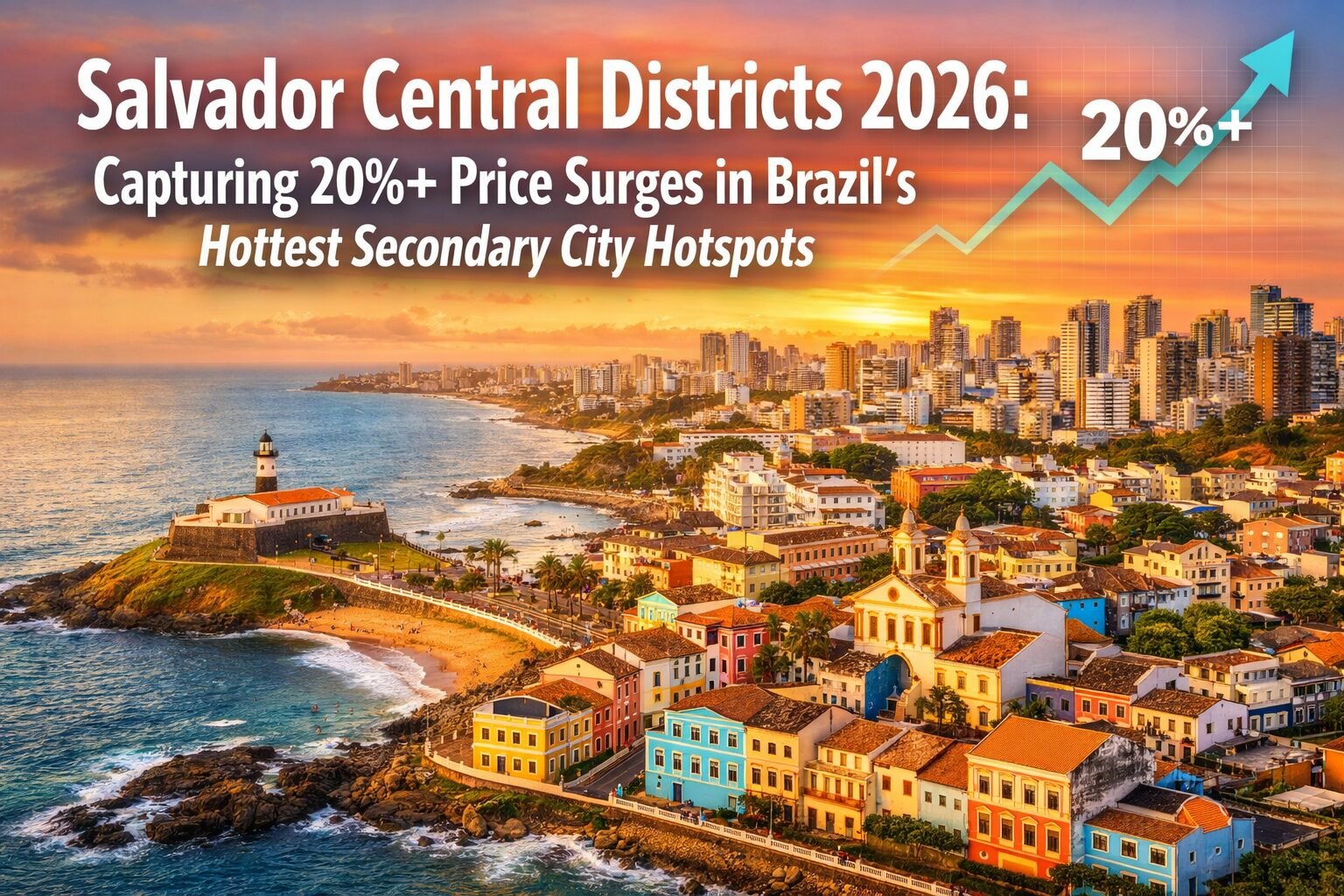
Brazil’s real estate landscape is witnessing a dramatic shift as Salvador emerges from the shadows of São Paulo and Rio de Janeiro to claim the title of the nation’s fastest-appreciating housing market. With 20.85% year-over-year price appreciation recorded as of mid-2025, Salvador Central Districts 2026: Capturing 20%+ Price Surges in Brazil’s Hottest Secondary City Hotspots represents an unprecedented opportunity for developers and investors seeking high-yield returns in emerging urban centers. While traditional powerhouse cities struggle with single-digit growth, Salvador’s central neighborhoods are experiencing explosive appreciation that’s reshaping investment strategies across Latin America.
Key Takeaways
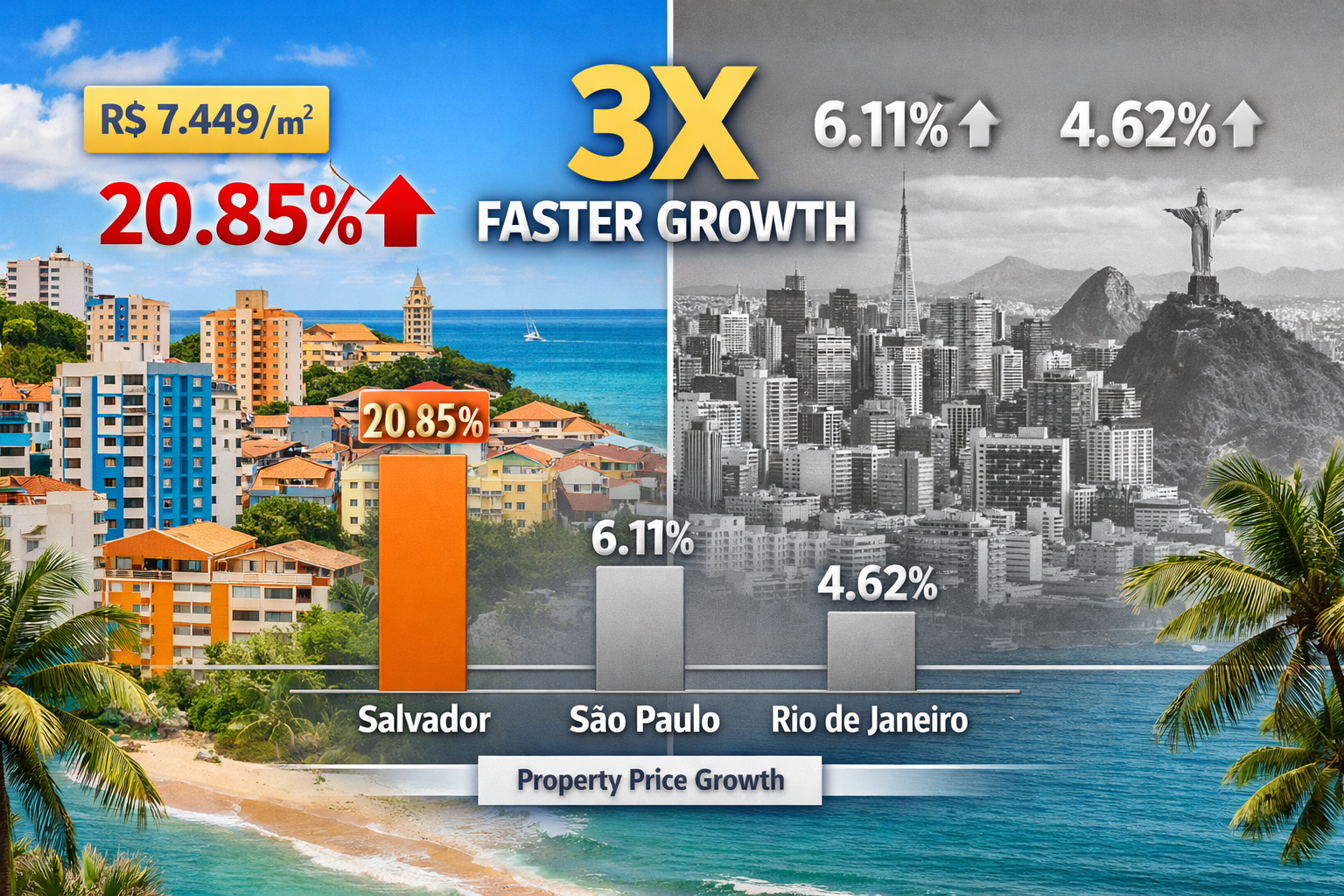
- 🚀 Salvador leads all Brazilian capitals with 20.85% annual price growth—more than triple São Paulo’s 6.11% and quadruple Rio’s 4.62%
- 💰 Central districts like Brotas surge 31.6%, offering developers targeted opportunities in secondary hotspots with exceptional yield potential
- 📊 Real inflation-adjusted growth of 14.31% confirms genuine market appreciation rather than nominal increases
- 🏗️ New construction commands 15% premiums while remaining 36% more affordable than São Paulo per square meter
- 📈 Compact apartments dominate 72% of listings, presenting optimal strategies for high-density development projects
Understanding Salvador Central Districts 2026: Capturing 20%+ Price Surges in Brazil’s Hottest Secondary City Hotspots
The Numbers Behind the Boom
Salvador’s housing market has shattered expectations throughout 2024 and 2025, delivering performance metrics that challenge conventional wisdom about secondary city investments. The 20.63% year-on-year house price growth registered in April 2025 represents the city’s strongest increase since records began in August 2010.[5] This isn’t merely a temporary spike—it reflects fundamental market transformation driven by multiple converging factors.
The average price per square meter reached R$7,449 as of June 2025, up 20.85% from the previous year.[2] Yet this figure tells only part of the story. When adjusted for Brazil’s inflation rate, Salvador delivered real price growth of approximately 14.31%,[2] confirming that buyers are experiencing genuine wealth appreciation rather than currency devaluation masquerading as market gains.
For context, Salvador’s performance dwarfs that of Brazil’s traditional real estate leaders:
| City | Annual Growth Rate | Price per m² |
|---|---|---|
| Salvador | 20.85% | R$7,449 |
| São Paulo | 6.11% | R$11,560 |
| Rio de Janeiro | 4.62% | R$10,558 |
This performance gap represents a 340% faster appreciation rate compared to São Paulo and a 450% advantage over Rio de Janeiro.[2] For developers and investors, these differentials signal a market inefficiency that savvy operators can exploit through strategic positioning in Salvador’s emerging central districts.
Why Salvador Outperforms Traditional Markets
Several structural advantages position Salvador for sustained outperformance. The city’s median housing price of R$560,000 (approximately $101,000) and average price of R$680,000 (approximately $123,000)[1] create an accessible entry point that attracts both domestic buyers and international investors seeking best places to invest in Brazil property.
The 36% price discount compared to São Paulo and 29% gap below Rio de Janeiro[2] creates compelling value propositions for buyers priced out of traditional markets. This affordability premium drives migration from saturated coastal capitals while maintaining sufficient pricing power to support developer margins.
Tourism revival following pandemic disruptions has injected fresh capital into Salvador’s economy. As Brazil’s first capital and a UNESCO World Heritage site, Salvador attracts millions of domestic and international visitors annually. This tourism infrastructure supports short-term rental markets and creates demand for compact, amenity-rich apartments that generate immediate cash flow—a critical consideration for developers managing Selic rate pressures.
Neighborhood-Level Analysis: Salvador Central Districts 2026 Price Surge Dynamics
Brotas: The 31.6% Growth Champion
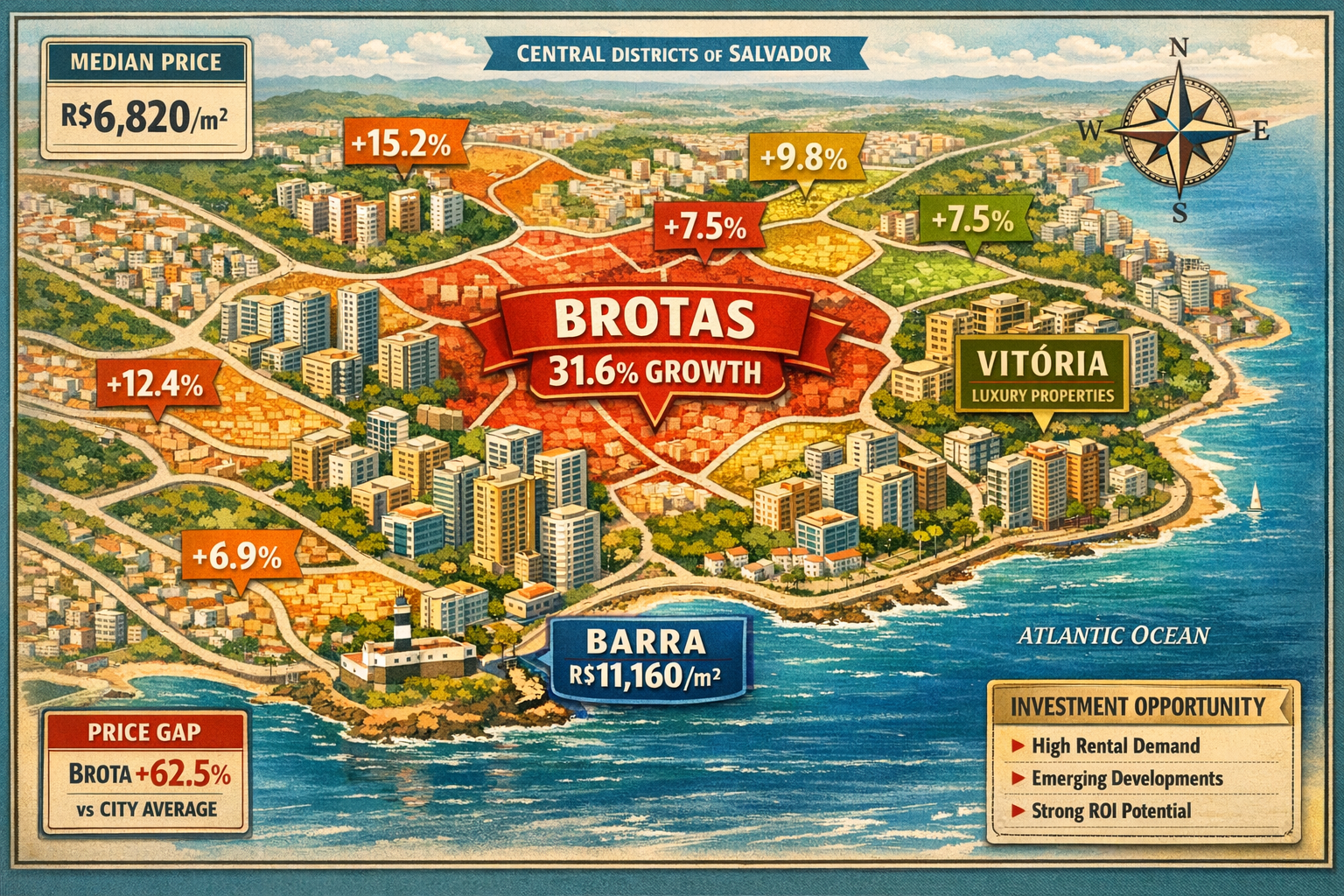
Brotas neighborhood leads Salvador’s surge with a stunning 31.6% price increase,[2] making it the city’s fastest-appreciating area and a prime target for development projects. This traditional middle-class neighborhood offers compelling unit economics for developers:
- Lower land acquisition costs compared to premium coastal zones
- Strong local demand from young professionals and families
- Proximity to universities and commercial centers ensuring consistent rental demand
- Gentrification momentum creating appreciation runway beyond current cycle
The Brotas phenomenon exemplifies how secondary central districts can outperform established luxury zones during market expansion phases. Developers who secured land positions in Brotas during 2023-2024 are now realizing exceptional returns, with pre-sale units appreciating significantly before construction completion.
Barra: Premium Performance in Established Markets
Barra, Salvador’s most expensive neighborhood, achieved 20.6% growth with prices reaching R$11,160/m²—now matching or exceeding average prices in São Paulo and Rio de Janeiro.[2] This premium coastal district demonstrates that Salvador’s appreciation extends across market segments, not just emerging areas.
Barra’s performance validates several investment theses:
✅ Luxury buyers recognize Salvador’s value proposition relative to traditional markets
✅ Ocean-view properties command sustainable premiums supporting high-end development
✅ Infrastructure improvements enhance desirability of established neighborhoods
✅ International buyer interest creates demand depth beyond domestic market
For developers, Barra represents opportunities for luxury properties ranging from R$2,500,000 to R$8,000,000 (approximately $450,000–$1,440,000), where buyers seek ocean-view 3-4 bedroom apartments of 180-350 square meters.[1] The 15% premium for new construction[1] over comparable older apartments ensures healthy margins on well-executed projects.
The 200% Neighborhood Price Gap Strategy
The price gap between neighborhoods exceeds 200% per square meter,[1] creating a sophisticated arbitrage opportunity for developers. This dispersion allows strategic positioning across multiple market segments:
Affordable Growth Districts (R$3,000-5,000/m²)
- Brotas, Federação, Ondina periphery
- Target: first-time buyers, young professionals
- Strategy: compact 1-2 bedroom units with modern amenities
Mid-Market Appreciation Zones (R$5,000-8,000/m²)
- Graça, Vitória, Canela
- Target: upgrading families, domestic investors
- Strategy: 2-3 bedroom units with security features
Premium Coastal Segments (R$8,000-12,000+/m²)
- Barra, Vitória waterfront, Ondina beachfront
- Target: luxury buyers, international investors
- Strategy: 3-4 bedroom ocean-view units with resort amenities
This segmentation enables portfolio diversification that balances risk across price points while capturing appreciation in multiple submarkets. Similar strategies have proven successful in other Brazilian markets experiencing rapid growth.
Developer Strategies for Salvador Central Districts 2026: Maximizing Returns Amid Market Dynamics
The Compact Apartment Advantage
Apartments dominate 72% of residential listings in Salvador,[1] reflecting the city’s vertical development pattern along the coast. This market structure favors developers who optimize for density and efficiency rather than horizontal sprawl.
Compact apartment projects deliver multiple advantages in Salvador’s current market:
🏗️ Land Efficiency: Maximize unit count per square meter of expensive urban land
💵 Lower Entry Prices: R$300,000-500,000 units attract broader buyer pool
⚡ Faster Absorption: Smaller units sell more quickly, accelerating capital return
🔄 Rental Flexibility: Studios and 1-bedrooms serve tourism and student markets
The 15% premium for new construction[1] ensures that well-designed compact projects command pricing power despite competitive supply. Modern amenities, enhanced security features, and lower immediate maintenance costs justify premium positioning.
Developers should prioritize:
- Studio and 1-bedroom configurations (35-55m²) for maximum market breadth
- Shared amenity spaces (coworking, fitness, rooftop areas) that enhance value perception
- Smart home technology and sustainability features appealing to younger buyers
- Flexible layouts that accommodate remote work and evolving lifestyle needs
Navigating Selic Rate Pressures
Brazil’s Selic benchmark rate fluctuations create financing challenges for both developers and buyers. However, Salvador’s strong fundamentals and appreciation rates provide cushion against rate pressures that might derail projects in weaker markets.
Strategic approaches include:
Pre-Sale Optimization
- Launch sales early to lock in buyer commitments before rate increases
- Offer attractive payment plans that reduce buyer financing dependency
- Target cash buyers and investors less sensitive to mortgage rates
Construction Timing
- Accelerate build schedules to capture current market pricing
- Phase projects to match absorption capacity without oversupplying
- Consider proven construction management approaches that maintain momentum
Partnership Structures
- Joint ventures with local operators who understand Salvador’s market nuances
- Institutional capital partnerships that provide rate-insensitive financing
- Land banking strategies that lock in acquisition costs before further appreciation
Targeting High-Yield Opportunities
The combination of 20%+ annual appreciation and 15% new construction premiums creates exceptional return profiles for well-positioned projects. Developers can achieve:
- 30-40% total returns on 18-24 month development cycles
- IRRs exceeding 25% on properly leveraged projects
- Immediate equity creation through land value appreciation during construction
These returns compare favorably to alternative investment strategies while providing tangible asset backing and inflation protection.
Focus on neighborhoods demonstrating:
✓ Consistent 15%+ annual appreciation over multiple quarters
✓ Strong absorption rates indicating demand depth
✓ Infrastructure investment signaling government commitment
✓ Demographic trends supporting long-term fundamentals
Market Outlook: Salvador Central Districts 2026 Growth Trajectory
Moderation from Explosive Highs
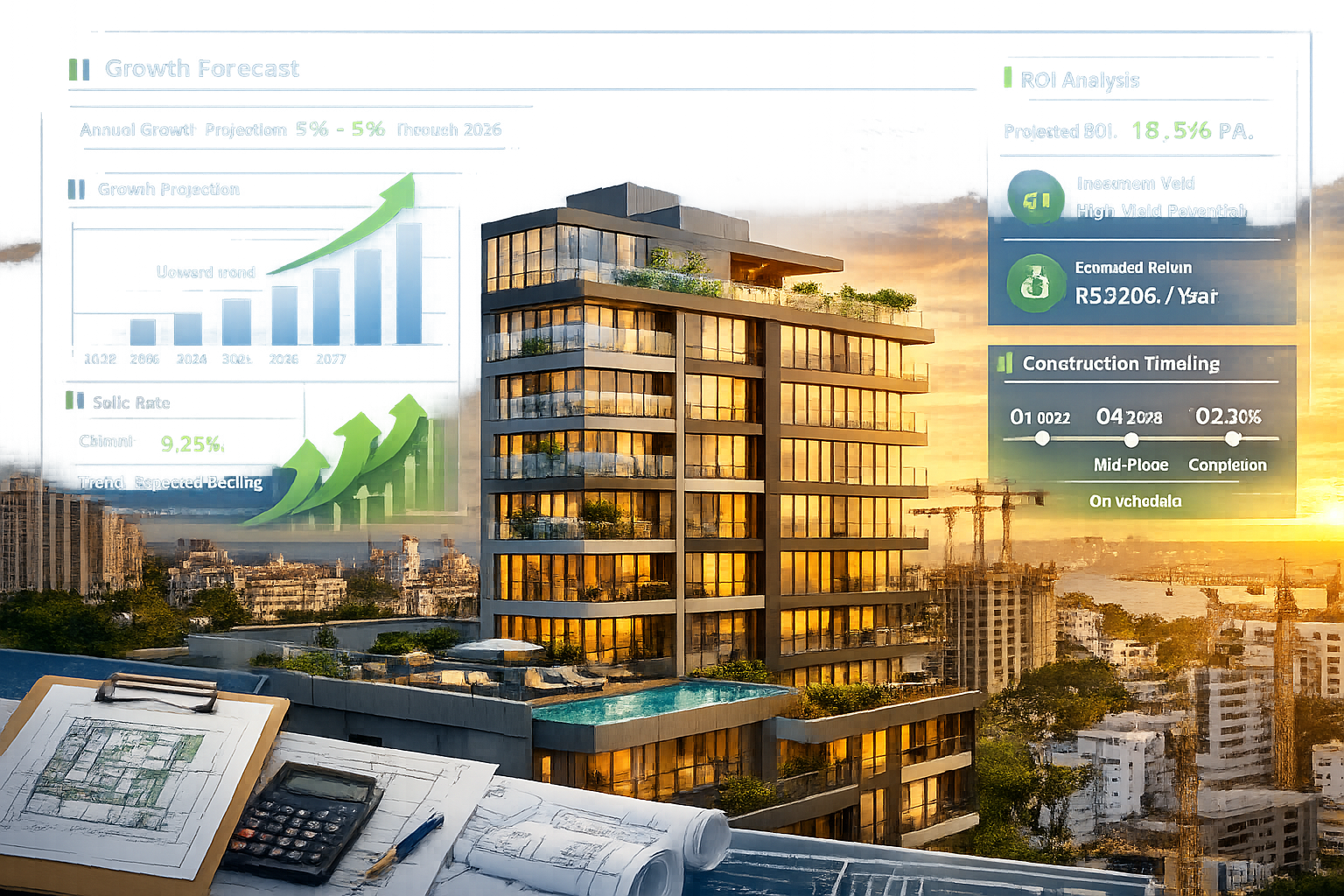
While Salvador’s 20%+ appreciation rates have captured headlines, market analysts project moderate growth of 5-8% annually through 2026,[2] reflecting market maturation and anticipated interest rate normalization after explosive 2024-2025 performance.
This moderation doesn’t signal market weakness—rather, it represents healthy consolidation after exceptional gains. Several factors support continued outperformance:
Structural Demand Drivers
- Continued migration from expensive São Paulo and Rio markets
- Tourism industry recovery supporting rental demand
- Infrastructure projects enhancing connectivity and livability
- University expansion creating student housing needs
Supply Constraints
- Limited developable coastal land maintaining scarcity premium
- Regulatory approval processes limiting new supply influx
- Construction cost inflation supporting pricing floors
- Developer consolidation reducing competitive pressure
Comparative Value
- Persistent 30%+ discount to São Paulo and Rio pricing
- International buyer interest in affordable Brazilian coastal markets
- Currency dynamics favoring foreign investment flows
- Quality of life advantages attracting remote workers
Strategic Timing Considerations
Developers evaluating Salvador Central Districts 2026 opportunities face critical timing decisions. The projected 5-8% annual growth through 2026[2] suggests that while explosive appreciation may moderate, Salvador will continue outperforming traditional markets.
Optimal Entry Windows:
Now Through Q2 2026: Capture remaining momentum from current cycle while securing land at pre-appreciation prices for future phases.
Q3-Q4 2026: Position for next appreciation wave as market digests new supply and fundamentals reassert themselves.
2027 Forward: Benefit from completed infrastructure projects and established market maturity that attracts institutional capital.
The key insight: Salvador’s transition from “emerging opportunity” to “established performer” creates different opportunities at each stage. Early movers capture maximum appreciation; later entrants benefit from reduced execution risk and proven market dynamics.
Risk Factors and Mitigation Strategies
Market-Specific Challenges
Despite Salvador’s impressive performance, developers must navigate several risk factors:
Economic Volatility 🌊
Brazil’s macroeconomic instability can impact buyer confidence and financing availability. Mitigation: Focus on cash-rich buyer segments and international investors less dependent on local financing.
Oversupply Risk 📦
Rapid appreciation attracts competitive supply that could overwhelm absorption capacity. Mitigation: Emphasize differentiation through design, amenities, and location rather than competing solely on price.
Infrastructure Delays 🚧
Government infrastructure projects may experience delays that impact neighborhood development timelines. Mitigation: Diversify across multiple neighborhoods and avoid over-concentration in areas dependent on single infrastructure projects.
Currency Fluctuation 💱
Real volatility affects international buyer purchasing power and return calculations. Mitigation: Price competitively to maintain value proposition across currency scenarios.
Due Diligence Essentials
Successful Salvador projects require thorough due diligence:
- Neighborhood-level demand analysis beyond city-wide statistics
- Competitive supply mapping identifying saturation risks
- Regulatory approval timelines factoring local government efficiency
- Infrastructure development schedules from reliable government sources
- Demographic trend validation confirming buyer profile assumptions
Developers who invest in comprehensive market intelligence gain decisive advantages in site selection, product positioning, and timing decisions that determine project success.
Conclusion: Capturing Salvador Central Districts 2026 Opportunities
Salvador Central Districts 2026: Capturing 20%+ Price Surges in Brazil’s Hottest Secondary City Hotspots represents a compelling investment thesis supported by exceptional historical performance, structural market advantages, and favorable comparative positioning. The city’s 20.85% annual appreciation rate—more than triple São Paulo’s performance—signals a fundamental market revaluation that extends beyond cyclical factors.
For developers, the opportunity centers on strategic positioning in high-growth central districts like Brotas (31.6% appreciation) while maintaining diversification across price segments to capture the 200%+ neighborhood price dispersion. The dominance of compact apartments (72% of listings) and 15% new construction premiums create clear product strategies that align with market demand.
While projected 5-8% annual growth through 2026 represents moderation from recent explosive rates, Salvador will continue outperforming traditional Brazilian markets while offering 30%+ price advantages compared to São Paulo and Rio de Janeiro. This combination of growth and affordability creates sustainable development opportunities rather than speculative bubbles.
Actionable Next Steps
For Developers:
- Conduct neighborhood-level analysis identifying specific districts with 15%+ appreciation and strong absorption
- Secure land positions in secondary central districts before further appreciation erodes margins
- Design compact apartment projects (studio to 2-bedroom) optimized for density and amenity richness
- Implement aggressive pre-sale strategies to reduce financing dependency and lock in buyer commitments
- Partner with local operators who understand Salvador’s market nuances and regulatory environment
For Investors:
- Evaluate pre-construction opportunities in proven neighborhoods like Brotas and Graça
- Consider buying properties during construction phases to maximize appreciation capture
- Diversify across price segments to balance risk and return profiles
- Monitor infrastructure development that will drive next appreciation wave
- Engage qualified local advisors for due diligence and transaction execution
Salvador’s emergence as Brazil’s fastest-appreciating housing market reflects genuine economic transformation rather than temporary speculation. The city’s combination of affordability, tourism infrastructure, cultural assets, and coastal location creates sustainable competitive advantages that will support continued outperformance. For developers and investors who act strategically, Salvador Central Districts 2026 offers exceptional opportunities to capture meaningful returns in one of Latin America’s most dynamic emerging markets.
The window for optimal positioning remains open, but as Salvador transitions from “emerging opportunity” to “established performer,” the risk-return profile will shift. Those who move decisively in 2026 will capture the best combination of appreciation potential and execution certainty—positioning themselves at the forefront of Brazil’s most exciting secondary city real estate story.
References
[1] Salvador Brazil Housing Prices – https://thelatinvestor.com/blogs/news/salvador-brazil-housing-prices
[2] Salvador Brazil Price Forecasts – https://thelatinvestor.com/blogs/news/salvador-brazil-price-forecasts
[5] Price History – https://www.globalpropertyguide.com/latin-america/brazil/price-history