
{“cover”:”Professional landscape format (1536×1024) hero image featuring bold text overlay ‘Novo PAC Infrastructure Investment Playbook 2026: Capturing 10-25% Property Premiums Through Strategic Project Timing’ in extra large 72pt white sans-serif font with dark shadow and semi-transparent navy overlay box, positioned in upper third center. Background shows aerial view of Brazilian city with modern metro construction, highway expansion, cranes, and mixed residential-commercial development zones. Split composition showing before/after infrastructure development. Color palette: deep blue, vibrant green, gold accents. High contrast, magazine cover quality, editorial style with subtle grid overlay and percentage indicators showing 10-25% premium zones.”,”content”:[“Detailed landscape format (1536×1024) image showing comprehensive infographic of Novo PAC nine priority investment axes arranged in circular diagram with icons: transportation (metro train), sustainable cities (green buildings), healthcare (hospital cross), energy (solar panels), education (graduation cap), water (droplet), digital connectivity (5G tower), social infrastructure (community center), and housing. Center displays R$45.4 billion investment figure with radiating arrows to each sector. Brazilian flag colors integrated subtly. Clean, professional financial presentation style with data visualization elements, pie charts showing budget allocation percentages, and timeline markers for 2023-2026 deployment phases.”,”Detailed landscape format (1536×1024) image depicting strategic timing chart showing property value appreciation curve over 36-month infrastructure project lifecycle. X-axis shows project phases: announcement, planning approval, construction start, 50% completion, final completion. Y-axis shows property premium percentages from 0% to 25%. Three colored curves represent different investment entry points with annotations marking optimal 12-24 month window before completion highlighted in gold. Background shows faded blueprint overlays of transit corridors and development zones. Professional financial aesthetic with calculator, growth arrows, and clock icons emphasizing timing strategy.”,”Detailed landscape format (1536×1024) image showing detailed map of Brazil with major cities (São Paulo, Rio de Janeiro, Brasília, Salvador, Fortaleza, Belo Horizonte) marked with colored pins and infrastructure project icons. Each city features callout boxes displaying specific Novo PAC projects: metro lines, BRT corridors, water treatment facilities, digital hubs. Investment amounts in billions of reais labeled per region. Connecting lines show development corridors between cities. Split-screen comparison showing current infrastructure versus planned 2026 improvements. Color-coded legend indicating project completion timelines and property premium zones in graduated heat map style from yellow to red.”]
Brazil’s $20.7 billion Novo PAC infrastructure program is quietly creating one of the most significant wealth-building opportunities in Latin American real estate. While most investors wait for projects to complete, savvy property buyers are capitalizing on a critical 12-24 month window before infrastructure finishes—when price premiums accelerate most dramatically. The Novo PAC Infrastructure Investment Playbook 2026: Capturing 10-25% Property Premiums Through Strategic Project Timing reveals how strategic investors are positioning themselves across multiple development corridors to capture substantial returns.
As Brazil enters the peak deployment phase of its New Growth Acceleration Program, understanding the timing mechanics of infrastructure-driven property appreciation becomes essential. The program allocated US$45.4 billion for the 2023-2026 period, with additional post-2026 investments of US$26.3 billion, targeting 2.5 million direct jobs and 1.5 million indirect jobs[2]. This massive capital injection is reshaping development corridors across Brazilian capitals, creating predictable patterns of property value increases that informed investors can leverage.
Key Takeaways
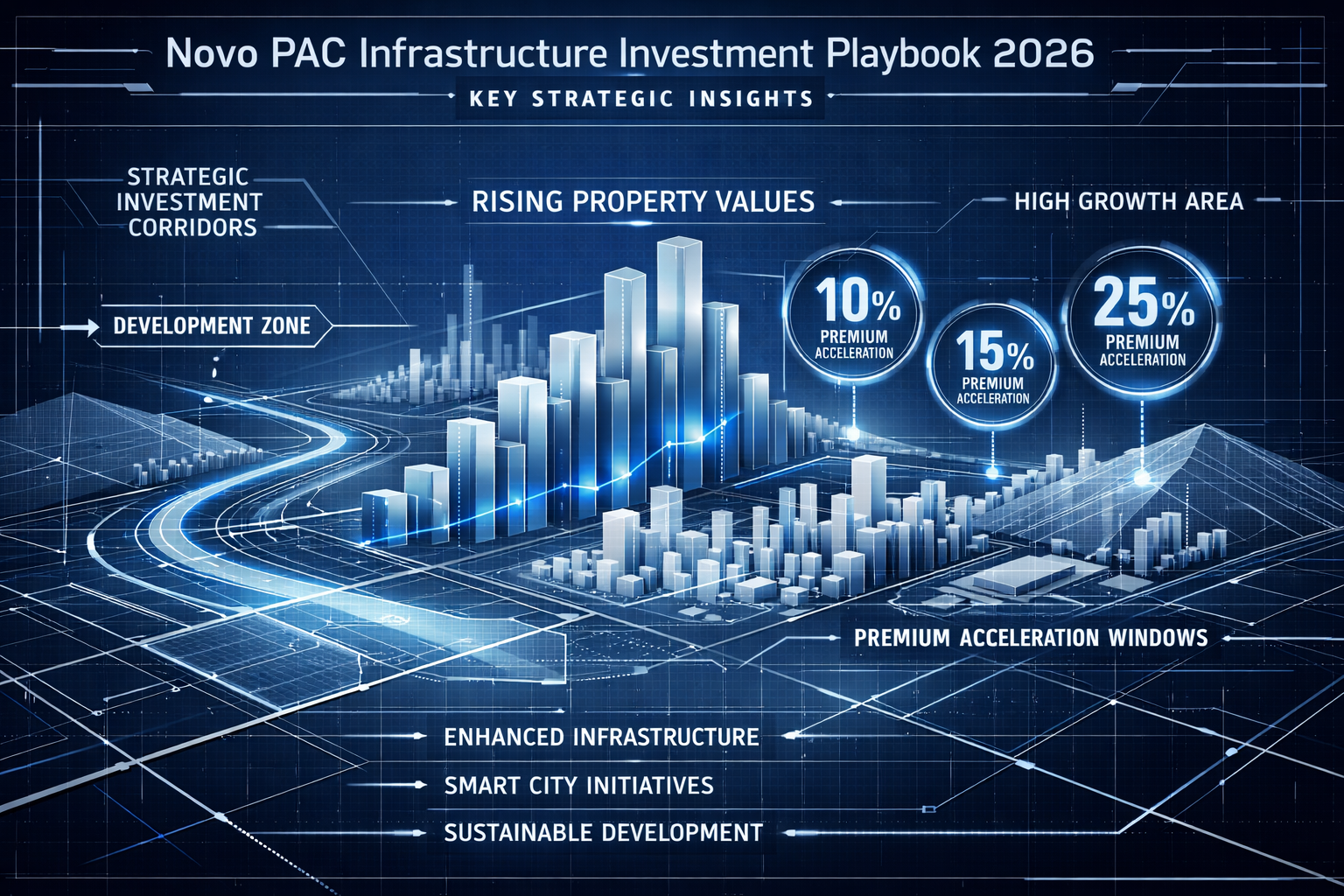
- 🎯 Optimal Entry Window: The 12-24 months before infrastructure project completion offers the highest property premium acceleration, with gains of 10-25% documented in strategic corridors
- 💰 Multi-Billion Investment Scale: Brazil’s Novo PAC allocated US$45.4 billion through 2026 across nine priority axes, creating predictable development patterns across major capitals
- 📊 São Paulo Leading 2026: São Paulo state government plans R$30 billion (US$5.62 billion) in infrastructure projects throughout 2026, representing the largest regional opportunity[6]
- 🚇 Transportation Drives Premiums: Metro extensions, BRT corridors, and highway improvements generate the most consistent property appreciation patterns
- 🌍 Global Capital Acceleration: Infrastructure secondaries reached record US$30 billion volume in 2025, with institutional investors anticipating significant acceleration in capital deployment across energy systems, communications infrastructure, and transport networks in 2026[5][8]
Understanding the Novo PAC Infrastructure Framework
The Novo PAC (New Growth Acceleration Program) represents Brazil’s most ambitious infrastructure initiative in over a decade. Launched to promote economic, social, and urban infrastructure investment, the program operates across nine priority axes: transportation, sustainable cities, healthcare, energy, education, water resources, digital connectivity, social infrastructure, and housing[2].
The Nine Investment Pillars
Each pillar creates distinct property investment opportunities:
- Transportation Infrastructure – Metro expansions, BRT systems, highway improvements
- Sustainable Cities – Urban renewal, green spaces, waste management
- Healthcare – Hospital construction, medical centers
- Energy Systems – Power generation, renewable energy projects
- Education – University campuses, technical schools
- Water Resources – Treatment facilities, distribution networks
- Digital Connectivity – 5G towers, fiber optic networks
- Social Infrastructure – Community centers, cultural facilities
- Housing Programs – Affordable housing developments
The program’s structured timeline through 2026 creates predictable deployment phases that savvy investors can track. Understanding which projects enter construction phases in 2026 versus those nearing completion provides the foundation for strategic property acquisition timing.
Investment Scale and Economic Impact
The numbers behind Novo PAC demonstrate its transformative potential:
| Investment Category | Amount (USD) | Timeline | Job Creation |
|---|---|---|---|
| Primary Investment | $45.4 billion | 2023-2026 | 2.5M direct jobs |
| Post-2026 Extension | $26.3 billion | 2027+ | 1.5M indirect jobs |
| São Paulo State 2026 | $5.62 billion | 2026 only | Regional focus |
These investments don’t distribute evenly across Brazil. Specific metropolitan regions receive concentrated capital deployment, creating infrastructure development corridors where property premiums compound most aggressively.
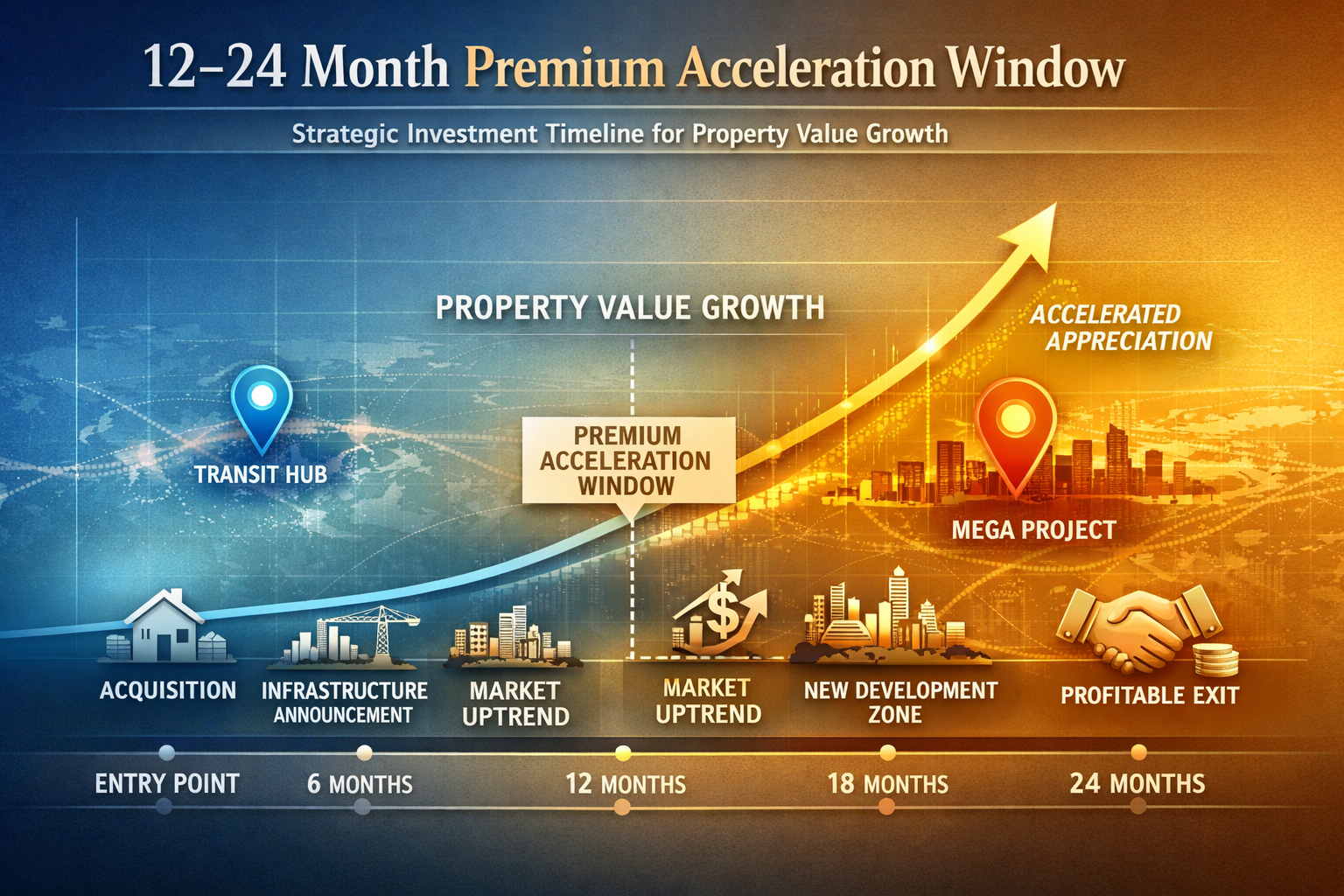
The 12-24 Month Premium Acceleration Window
The Novo PAC Infrastructure Investment Playbook 2026: Capturing 10-25% Property Premiums Through Strategic Project Timing centers on a critical insight: property values don’t appreciate linearly throughout infrastructure project timelines. Instead, appreciation follows a predictable curve with distinct acceleration phases.

The Four-Phase Infrastructure Appreciation Cycle
Phase 1: Announcement to Approval (Months 0-6)
- Property premium: 0-3%
- Market awareness: Low
- Investor activity: Minimal
- Risk level: Highest (project cancellation possible)
Phase 2: Construction Start to 50% Completion (Months 6-18)
- Property premium: 3-8%
- Market awareness: Growing
- Investor activity: Increasing
- Risk level: Moderate (delays possible)
Phase 3: 50% Completion to Final Stages (Months 18-30) ⭐ OPTIMAL WINDOW
- Property premium: 10-25%
- Market awareness: High
- Investor activity: Peak competition
- Risk level: Low (completion certain)
Phase 4: Post-Completion (Months 30+)
- Property premium: Stabilized
- Market awareness: Universal
- Investor activity: Retail buyers dominate
- Risk level: Minimal but premium already captured
The 12-24 month window before completion (Phase 3) represents the sweet spot where project completion certainty combines with remaining time for strategic acquisition before prices fully adjust to the infrastructure premium.
Why This Window Maximizes Returns
Several factors converge during this optimal period:
- Completion Certainty: Physical progress eliminates project cancellation risk
- Remaining Opportunity: Retail buyers haven’t fully entered the market
- Financing Availability: Banks approve loans more readily with visible progress
- Rental Premium Anticipation: Tenants begin seeking properties near upcoming infrastructure
- Developer Pressure: Pre-construction projects in the corridor gain urgency
Investors who understand this timing can position themselves strategically across multiple high-return locations in Brazil before mainstream market recognition drives prices to full premium levels.
City-by-City Novo PAC Deployment Strategies for 2026
Different Brazilian cities present distinct infrastructure deployment timelines and property premium opportunities in 2026. The Novo PAC Infrastructure Investment Playbook 2026: Capturing 10-25% Property Premiums Through Strategic Project Timing requires city-specific analysis to identify optimal entry points.
São Paulo: The R$30 Billion Opportunity
São Paulo state government’s commitment to R$30 billion (US$5.62 billion) in infrastructure projects throughout 2026 makes it the single largest regional opportunity[6]. Key focus areas include:
Metro Line Expansions
- Line 2-Green extension to Guarulhos
- Line 5-Lilac southern expansion
- Line 6-Orange construction acceleration
Strategic Corridors: Properties within 800 meters of new stations entering the 12-24 month completion window show the strongest premium potential.
BRT System Enhancements
- Radial Leste corridor improvements
- Integration with existing metro network
- Express lane implementations
The concentration of capital in São Paulo creates multiple simultaneous opportunities across different project timelines, allowing portfolio diversification within a single metropolitan region.
Rio de Janeiro: Transit-Oriented Development
Rio’s Novo PAC allocation focuses heavily on transportation infrastructure connecting peripheral neighborhoods to employment centers:
- BRT Transbrasil corridor completion (2026 target)
- Metro Line 3 construction acceleration
- Port area revitalization continuation
Properties in neighborhoods like Madureira, Bonsucesso, and Penha along the Transbrasil corridor represent prime 2026 opportunities as the project enters final completion phases.
Florianópolis: Regional Growth Hub
While not a primary Novo PAC capital, Florianópolis benefits from state-level infrastructure investments and strong market fundamentals driving the Greater Florianópolis real estate market. The region’s infrastructure improvements include:
- BR-101 highway expansion projects
- Airport modernization
- Coastal road improvements
- Digital connectivity enhancements
The growth of regions like Ingleses in Florianópolis demonstrates how infrastructure improvements combine with quality of life factors to drive property appreciation.
Brasília: Federal District Modernization
As the federal capital, Brasília receives targeted Novo PAC investments in:
- Metro expansion to satellite cities
- Digital infrastructure upgrades
- Sustainable city initiatives
- Government facility modernization
Properties in Águas Claras, Taguatinga, and Ceilândia benefit from improved connectivity to central employment zones.
Salvador and Fortaleza: Northeastern Opportunities
Both cities represent emerging market opportunities with lower entry costs and significant infrastructure gaps being addressed:
Salvador Focus:
- Metro Line 2 extension
- Port modernization
- Historic center revitalization
Fortaleza Focus:
- Light rail expansion
- Airport connectivity improvements
- Coastal infrastructure development
These northeastern capitals offer higher risk-reward profiles with potential premiums exceeding 25% in correctly timed corridors.
Identifying High-Premium Corridors Within Cities
Successfully implementing the Novo PAC Infrastructure Investment Playbook 2026: Capturing 10-25% Property Premiums Through Strategic Project Timing requires identifying specific corridors within each city that will experience maximum appreciation.
The 800-Meter Rule for Transit Infrastructure
Research consistently shows that properties within 800 meters (approximately 10-minute walk) of new transit stations capture the majority of infrastructure premiums. Beyond this distance, appreciation effects diminish rapidly.
Premium Gradient by Distance:
- 0-400 meters: 15-25% premium potential
- 400-800 meters: 10-18% premium potential
- 800-1,200 meters: 5-12% premium potential
- 1,200+ meters: Minimal direct impact
Multi-Project Convergence Zones
The highest premiums occur where multiple infrastructure projects converge:
✅ Metro station + BRT corridor intersection ✅ Transit hub + commercial development zone ✅ Highway improvement + new hospital/university ✅ Digital connectivity upgrade + sustainable city initiative
These convergence zones create compound appreciation effects that exceed single-project impacts.
Neighborhood Characteristic Multipliers
Infrastructure improvements don’t operate in isolation. Certain neighborhood characteristics multiply the premium effect:
High Multiplier Characteristics:
- Existing commercial activity
- Good schools within walking distance
- Low crime rates
- Mixed-use zoning permissions
- Active neighborhood associations
Low Multiplier Characteristics:
- Industrial zoning restrictions
- Flood-prone areas
- Poor existing building stock
- Limited commercial services
- High vacancy rates
Combining infrastructure timing analysis with neighborhood characteristic assessment identifies the highest-probability premium corridors.
Financing Strategies for Infrastructure-Adjacent Properties
Capturing the 10-25% premium requires not just identifying opportunities but securing favorable financing to maximize returns.
Construction-Phase Financing Advantages
Properties purchased during the construction phase of nearby infrastructure often qualify for favorable financing terms:
- Lower down payment requirements (developers seeking quick sales)
- Extended payment plans during construction period
- Price locks protecting against appreciation during build-out
- Potential rental income before infrastructure completion
The strategy of buying off-plan properties in the development phase can significantly amplify returns when timed with infrastructure project phases.
Portfolio Diversification Across Project Timelines
Rather than concentrating capital in a single corridor, sophisticated investors diversify across different infrastructure project timelines:
Sample Portfolio Allocation:
- 40% in projects 12-18 months from completion (highest probability)
- 30% in projects 18-24 months from completion (strong potential)
- 20% in projects 6-12 months from completion (quick appreciation)
- 10% in projects 24-30 months from completion (longer horizon)
This approach balances immediate appreciation potential with longer-term positioning while managing project completion risk.
Alternative Financing Mechanisms
Beyond traditional mortgages, infrastructure-focused investors increasingly leverage:
- Real estate investment funds (FIIs) focused on development corridors
- Crowdfunding platforms for fractional property ownership
- Developer partnerships offering equity participation
- International financing taking advantage of currency differentials
Some forward-thinking investors even explore cryptocurrency integration with real estate development to access alternative capital sources.
Risk Management in Infrastructure Investment Timing
While the Novo PAC Infrastructure Investment Playbook 2026: Capturing 10-25% Property Premiums Through Strategic Project Timing offers substantial return potential, prudent investors must manage several risk categories.
Project Completion Risk
Despite government commitments, infrastructure projects face potential delays:
Risk Mitigation Strategies:
- ✅ Focus on projects with 50%+ physical completion
- ✅ Verify funding allocation through official government portals
- ✅ Monitor construction progress through site visits or drone surveillance
- ✅ Diversify across multiple projects to avoid single-project dependency
- ✅ Build 6-12 month buffer into completion timeline assumptions
Market Saturation Risk
As infrastructure completion approaches, supply of new properties may exceed demand if multiple developers simultaneously launch projects:
Warning Signs:
- 🚨 More than 5 major developments within 800-meter radius
- 🚨 Vacancy rates exceeding 8% in surrounding neighborhoods
- 🚨 Declining rental yields despite infrastructure progress
- 🚨 Extended time-on-market for comparable properties
Economic Cycle Risk
Infrastructure premiums can compress during broader economic downturns:
Protective Measures:
- Maintain adequate cash reserves for holding periods
- Secure fixed-rate financing to protect against interest rate increases
- Focus on properties with strong rental demand fundamentals
- Consider neighborhoods with diverse employment bases
- Monitor national economic indicators and policy changes
Regulatory and Zoning Risk
Government policy changes can impact property values independent of infrastructure:
Key Monitoring Areas:
- Zoning regulation changes affecting building heights or use
- Property tax adjustments in infrastructure-improved areas
- Rent control or tenant protection legislation
- Environmental restrictions on development
- Historical preservation designations
Maximizing Returns Through Value-Add Strategies
Beyond timing infrastructure completion, active investors can amplify premiums through strategic property improvements:
Pre-Infrastructure Renovation Timing
Completing renovations 6-12 months before infrastructure completion positions properties for maximum rental or sale premiums:
High-ROI Improvements:
- Modern kitchen and bathroom updates
- Energy-efficient systems (solar, LED lighting)
- Smart home technology integration
- Outdoor space optimization
- Storage solutions
Rental Strategy Optimization
Properties near completing infrastructure benefit from strategic rental positioning:
Short-Term Rental Approach:
- Target business travelers using new transit connections
- Premium pricing during infrastructure inauguration period
- Flexible occupancy capturing demand spikes
Long-Term Rental Approach:
- Lock in tenants before completion at pre-premium rates
- Include rent escalation clauses tied to infrastructure completion
- Target professionals relocating for accessibility improvements
The transformation of Florianópolis’s real estate market through sales performance demonstrates how market dynamics shift as infrastructure improves.
Exit Timing Strategy
Determining optimal exit timing maximizes realized returns:
Exit Window Options:
- Pre-Completion Sale (Months 18-24): Capture 70-80% of potential premium, avoid completion risk
- Completion Sale (Months 24-30): Capture 90-100% of premium, higher buyer competition
- Post-Stabilization Sale (Months 30-36): Capture full premium plus rental income, maximum certainty
Each strategy suits different investor risk profiles and capital requirements.
Global Context: Infrastructure Investment Trends Shaping 2026
Brazil’s Novo PAC exists within a global infrastructure investment supercycle that provides important context for timing strategies.
Record Capital Deployment
Infrastructure secondaries reached a record-breaking US$30 billion in combined GP and LP-led volume in 2025, transitioning from niche to strategic allocation in 2026[5]. This institutional capital flow validates the infrastructure investment thesis and suggests continued premium support.
International Comparison: Mexico’s Parallel Initiative
Mexico’s Infrastructure Investment Plan for Development with Well-being announced an additional investment of 722 billion pesos (equivalent to 2% of GDP) for 2026[1], creating parallel opportunities across Latin America. Investors can apply similar timing strategies across borders.
Developed Market Acceleration
Global investment managers anticipate significant acceleration in capital deployment across energy systems, communications infrastructure, and transport networks to address infrastructure underinvestment in developed markets[8]. This global trend supports emerging market infrastructure premiums by validating the asset class.
Manager Competition and Capital Availability
The infrastructure investment market will see further concentration of assets among largest funds alongside emergence of new managers competing for capital[5]. This competition benefits property investors by ensuring continued capital flow into infrastructure projects, reducing completion risk.
Property Type Considerations for Infrastructure Investments
Different property types respond differently to infrastructure improvements, requiring tailored approaches within the Novo PAC Infrastructure Investment Playbook 2026: Capturing 10-25% Property Premiums Through Strategic Project Timing.
Residential Properties
Studio and One-Bedroom Units:
- Highest demand near transit hubs
- Strong rental yields from young professionals
- Quick appreciation but potential oversupply risk
Investing in studio apartments in Florianópolis offers insights into this property segment’s dynamics.
Two and Three-Bedroom Units:
- Family-oriented demand
- Moderate appreciation but stable long-term values
- Lower vacancy risk
Luxury Properties:
- Premium buyers less sensitive to transit infrastructure
- Focus on highway improvements and airport connectivity
- Longer sales cycles but higher absolute returns
Commercial Properties
Retail Spaces:
- Immediate benefit from foot traffic increases
- Higher risk if infrastructure changes traffic patterns negatively
- Premium locations at station entrances
Office Spaces:
- Moderate appreciation from improved employee accessibility
- Longer lease terms provide stability
- Focus on properties near multiple transit options
Mixed-Use Developments
Properties combining residential and commercial uses often capture the highest infrastructure premiums:
- Ground-floor retail benefits from transit foot traffic
- Upper-floor residential benefits from accessibility
- Diversified income streams reduce vacancy risk
- Higher complexity but superior risk-adjusted returns
Implementing Your 2026 Infrastructure Investment Strategy
Translating the Novo PAC Infrastructure Investment Playbook 2026: Capturing 10-25% Property Premiums Through Strategic Project Timing into action requires systematic execution.
Step 1: Infrastructure Project Mapping
Create a comprehensive database of Novo PAC projects in target cities:
- Project name and type
- Official budget allocation
- Current completion percentage
- Projected completion date
- Responsible government entity
- Recent progress updates
Resources:
- Official Novo PAC government portal
- State infrastructure department websites
- Municipal planning documents
- Construction company announcements
Step 2: Corridor Identification and Analysis
For each project entering the 12-24 month completion window:
- Map the 800-meter radius around key infrastructure nodes
- Identify existing property inventory within the corridor
- Analyze current pricing versus comparable areas
- Assess neighborhood characteristics and multiplier factors
- Calculate projected premium based on infrastructure type and timing
Step 3: Property Sourcing and Due Diligence
Sourcing Channels:
- Developer direct sales (pre-construction opportunities)
- Real estate agent networks specializing in infrastructure corridors
- Property auction platforms (distressed opportunities)
- Off-market deals through local networks
Due Diligence Checklist:
- ✅ Legal title verification
- ✅ Zoning and use permissions
- ✅ Building condition assessment
- ✅ Infrastructure project official status confirmation
- ✅ Neighborhood crime and safety data
- ✅ Comparable sales analysis
- ✅ Rental demand verification
Step 4: Financing Optimization
Compare financing options across:
- Traditional bank mortgages
- Developer financing programs
- Real estate investment funds
- International financing (if applicable)
Calculate total cost of capital including:
- Interest rates and fees
- Down payment requirements
- Opportunity cost of capital
- Currency risk (for international investors)
Step 5: Acquisition and Positioning
Execute purchases with:
- Negotiated pricing reflecting current (not projected) infrastructure status
- Contingencies protecting against project delays
- Flexible closing timelines if purchasing pre-construction
- Professional legal representation
Step 6: Active Management and Monitoring
Ongoing activities:
- 📊 Monthly infrastructure project progress tracking
- 📊 Quarterly property value assessments
- 📊 Rental market monitoring and rate optimization
- 📊 Exit strategy refinement based on market conditions
- 📊 Portfolio rebalancing across project timelines
Step 7: Strategic Exit Execution
Timing exit based on:
- Infrastructure completion status
- Market absorption rates
- Alternative investment opportunities
- Personal financial objectives
- Tax optimization considerations
Conclusion: Positioning for Infrastructure-Driven Wealth Creation
The Novo PAC Infrastructure Investment Playbook 2026: Capturing 10-25% Property Premiums Through Strategic Project Timing represents more than an investment strategy—it’s a systematic approach to participating in Brazil’s economic transformation. As the country deploys tens of billions of dollars across transportation, energy, digital connectivity, and urban development, informed investors can position themselves to capture substantial property premiums through strategic timing.
The critical insight centers on the 12-24 month window before infrastructure completion, when project certainty combines with remaining acquisition opportunity to maximize returns. By focusing on this optimal entry period, investors avoid the uncertainty of early-stage projects while capturing appreciation before mainstream market recognition drives prices to full premium levels.
Key Success Factors
🎯 City-Specific Analysis: São Paulo’s R$30 billion 2026 investment creates different opportunities than Rio’s transit focus or northeastern cities’ emerging markets
🎯 Corridor-Level Precision: Properties within 800 meters of new infrastructure nodes capture the majority of premiums
🎯 Multi-Project Diversification: Spreading investments across different infrastructure timelines manages completion risk
🎯 Active Value Enhancement: Strategic renovations and rental positioning amplify infrastructure-driven appreciation
🎯 Disciplined Risk Management: Monitoring project progress, market saturation, and economic cycles protects capital
Actionable Next Steps
For investors ready to implement this playbook in 2026:
- Identify target cities based on Novo PAC allocation and personal investment criteria
- Map infrastructure projects entering the 12-24 month completion window
- Conduct corridor analysis within 800 meters of key infrastructure nodes
- Establish local partnerships with developers, agents, and property managers
- Secure financing with favorable terms for infrastructure-adjacent properties
- Execute initial acquisitions in highest-probability corridors
- Implement monitoring systems for ongoing project tracking and portfolio optimization
The convergence of Brazil’s massive infrastructure investment, global capital deployment acceleration, and predictable property appreciation patterns creates a time-limited opportunity for strategic investors. Those who master the timing dynamics of infrastructure-driven premiums position themselves to capture substantial returns while contributing to Brazil’s economic development.
The question isn’t whether infrastructure investment will drive property premiums—the data conclusively demonstrates this effect. The question is whether investors will position themselves during the optimal window to maximize those returns. The Novo PAC Infrastructure Investment Playbook 2026 provides the framework; execution determines success.
For investors seeking to explore these opportunities in growing Brazilian markets, Quadragon’s real estate developments offer professionally managed options aligned with infrastructure growth corridors.
References
[1] Infrastructure Investment Plan For Development With Well Being 2026 2030 – https://basham.com.mx/en/infrastructure-investment-plan-for-development-with-well-being-2026-2030/
[2] Presentation Pac English – https://www.gov.br/planalto/pt-br/acompanhe-o-planalto/noticias/2023/09/alckmin-brasil-vive-bom-momento-e-tem-grandes-oportunidades-para-atrair-investimentos-com-o-novo-pac/presentation_pac_english.pdf
[5] Infrastructure Outlook 2026 – https://www.withintelligence.com/insights/infrastructure-outlook-2026/
[6] Brazils Sao Paulo State To Invest Us562bn In Infrastructure In 2026 – https://www.bnamericas.com/en/features/brazils-sao-paulo-state-to-invest-us562bn-in-infrastructure-in-2026
[8] Infrastructure Capex Supercycle Set To Accelerate In 2026 Says Ifm Investors – https://www.ifminvestors.com/en-gb/news–insights/media-centre/infrastructure-capex-supercycle-set-to-accelerate-in-2026-says-ifm-investors/