
While investors crowd into saturated markets like São Paulo and Rio de Janeiro, a dramatic shift is reshaping Brazil’s real estate landscape. Secondary cities João Pessoa and Salvador are delivering annual property price growth exceeding 20%—dramatically outpacing the country’s traditional powerhouses.[5] For developers and investors seeking to enter emerging markets before saturation, understanding João Pessoa and Salvador Development Strategies 2026: Capturing 20%+ Price Surges in Brazil’s Secondary City Leaders represents a critical competitive advantage in land acquisition, project positioning, and market timing.
This comprehensive analysis reveals the specific neighborhoods, infrastructure catalysts, and development tactics driving unprecedented appreciation in these coastal capitals. As Brazil’s elevated mortgage costs reshape buyer preferences and tourism demand surges, secondary city strategies offer developers a blueprint for capturing outsized returns in markets still early in their growth cycles.
Key Takeaways
- João Pessoa and Salvador are posting 18.9% and 16% annual price growth respectively, significantly outperforming São Paulo and Rio while certain central districts exceed 20% appreciation rates.[3][5][8]
- Strategic infrastructure projects launching in 2026—including the Ponte Salvador-Itaparica bridge beginning construction in June and Metro Line 1 extensions—will meaningfully boost property values in specific corridors.[3]
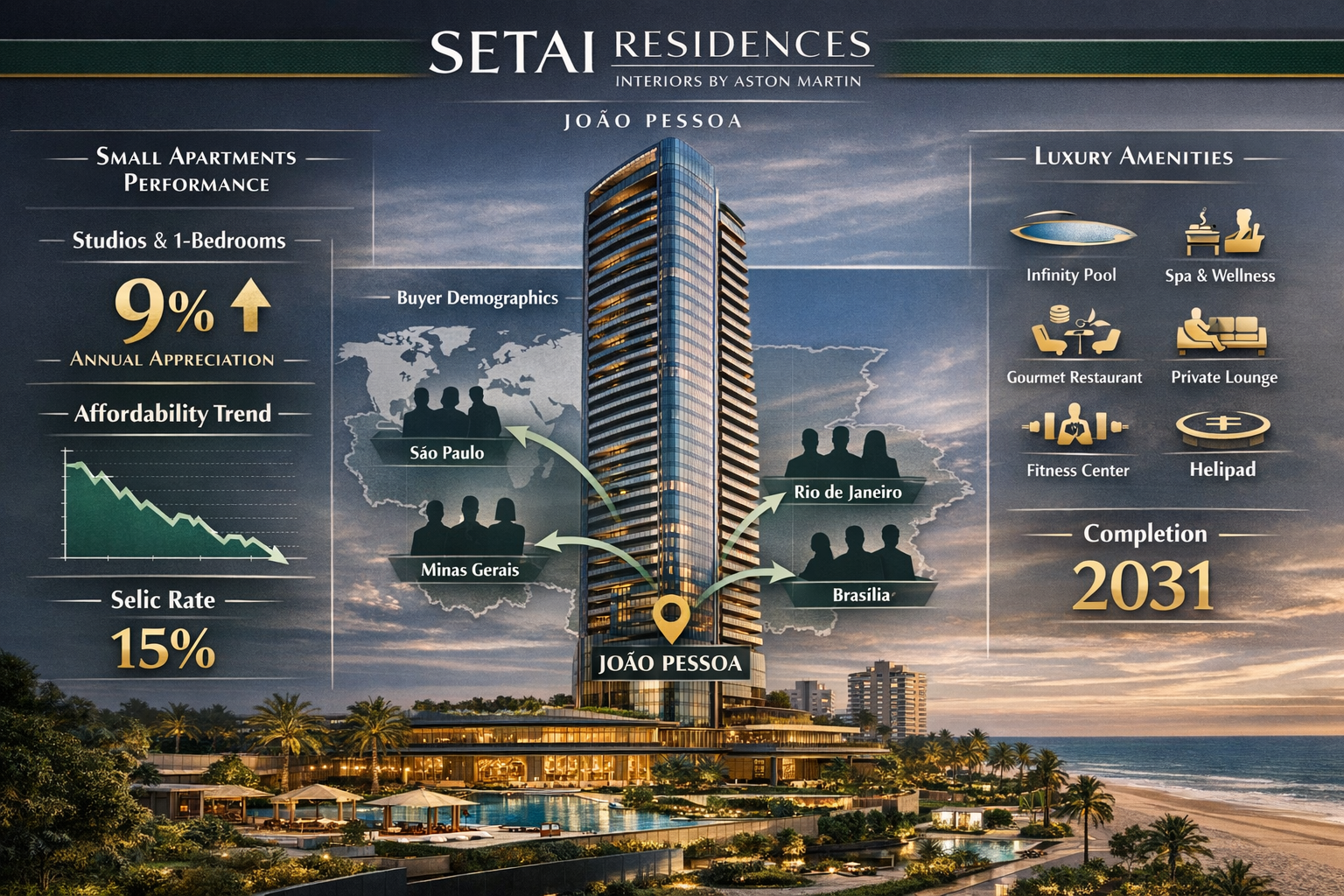
- Small apartments (studios and one-bedroom units) are appreciating near 9% annually, outperforming larger properties due to Brazil’s 15% Selic interest rate and affordability constraints.[5]
- Luxury developments targeting relocating professionals from major cities are positioning João Pessoa as a premium destination, exemplified by the Setai Residences Interiors by Aston Martin project.[2]
- Tourism demand has positioned João Pessoa as the world’s third fastest-growing destination, with five new high-end resorts under construction and Castro Pinto Airport surpassing one million annual passengers.[7]
Understanding João Pessoa and Salvador Development Strategies 2026: Market Fundamentals Driving 20%+ Growth
The Secondary City Advantage: Why These Markets Are Outperforming
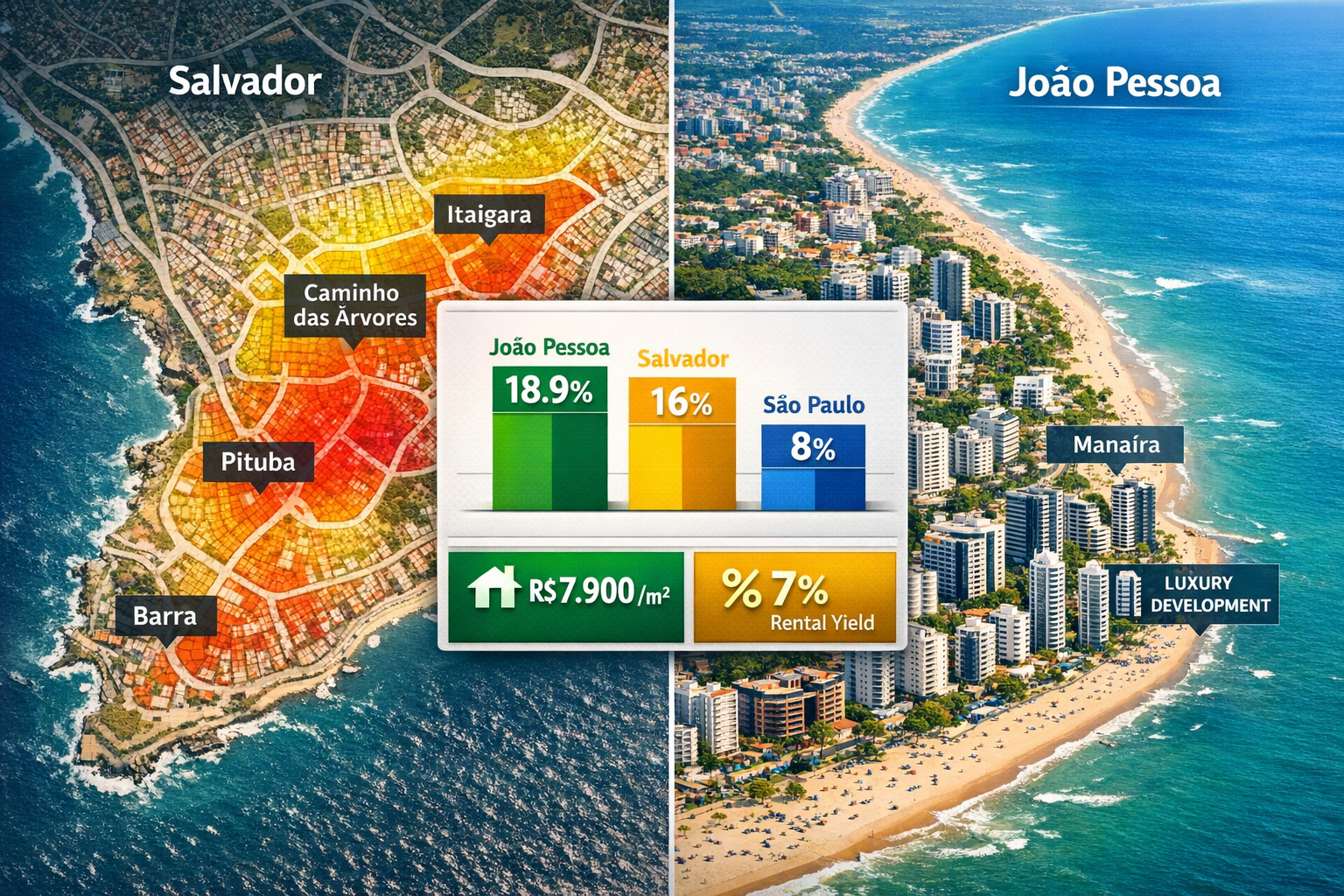
The real estate dynamics in João Pessoa and Salvador represent a fundamental market shift. As of early 2026, João Pessoa’s real estate market shows approximately 18.9% annual price growth, establishing it as Brazil’s third fastest-growing market.[8] Salvador’s advertised sale prices averaged around R$ 7,900 per square meter, representing approximately 16% growth over the previous 12 months—well above inflation and national averages.[3]
These appreciation rates contrast sharply with mature markets experiencing saturation. Central districts in Salvador are leading the country with growth rates above 20%, while secondary city hotspots in both markets are projected to potentially exceed this threshold if current momentum continues.[5]
Several structural factors explain this outperformance:
🏖️ Natural Asset Differentiation: Both cities offer pristine beaches, strong cultural heritage, and quality of life that appeals to remote professionals and retirees seeking alternatives to congested metropolitan areas.[2]
💰 Relative Affordability: Property prices remain accessible compared to São Paulo and Rio, allowing buyers priced out of primary markets to acquire quality assets while still capturing appreciation.[4]
📊 Early Growth Cycle Positioning: Unlike saturated markets, João Pessoa and Salvador are still consolidating their positions as economic and demographic growth hubs, offering developers entry points before peak competition.[2]
For those exploring investment opportunities across Brazil’s diverse markets, understanding these secondary city dynamics provides crucial context for portfolio allocation decisions.
Neighborhood-Level Strategies: Where to Position Developments
Success in João Pessoa and Salvador Development Strategies 2026: Capturing 20%+ Price Surges in Brazil’s Secondary City Leaders requires precise neighborhood selection. Not all districts deliver equal returns.
Salvador’s Top-Performing Investment Zones:
| Neighborhood | Key Characteristics | Gross Rental Yield | Investment Horizon |
|---|---|---|---|
| Pituba | Commercial hub, strong infrastructure | ~7% | 3-5 years |
| Itaigara | Upscale residential, established amenities | ~7% | 3-5 years |
| Caminho das Arvores | Premium location, high-income demographics | ~7% | 3-5 years |
| Barra | Beachfront, tourism appeal | ~7% | 3-5 years |
These neighborhoods combine strong fundamentals with strategic positioning near infrastructure improvements.[3] Developers entering Salvador should prioritize land acquisition in these corridors, where rental yields near 7% complement capital appreciation potential.
João Pessoa’s Emerging Luxury Corridors:
Neighborhoods like Manaíra and Tambaú are experiencing thriving markets driven by demand for luxury beachfront properties.[7] Analysts project continued appreciation as retirees and investors seek affordable yet high-quality living options. The development pipeline includes:
- Five new high-end resorts under construction in the Cabo Branco area
- First resort opening in early 2026 to meet rising tourism demand
- Premium residential towers targeting high-net-worth relocators[7]
The Small Apartment Opportunity: Capitalizing on Affordability Constraints
A critical insight for João Pessoa and Salvador Development Strategies 2026 involves unit sizing. Small apartments (studios and one-bedroom units) are outperforming larger properties in Brazil with appreciation rates near 9% annually due to affordability constraints.[5]
This trend reflects Brazil’s challenging financing environment, with the Selic interest rate at 15% as of January 2026—the highest since 2006.[5] Elevated mortgage costs push buyers toward smaller, more affordable units, creating specific development opportunities:
✅ Studio and one-bedroom configurations maximize buyer pool accessibility
✅ Compact luxury positioning appeals to remote professionals and investors
✅ Higher per-square-meter pricing improves project economics on smaller footprints
✅ Rental demand resilience from tourism and business travelers
Developers should consider how this sizing strategy applies to their land parcels, potentially increasing unit density while maintaining premium positioning.
Infrastructure Catalysts: Timing Development Around Major Projects
The Ponte Salvador-Itaparica Bridge: A Concrete Near-Term Driver
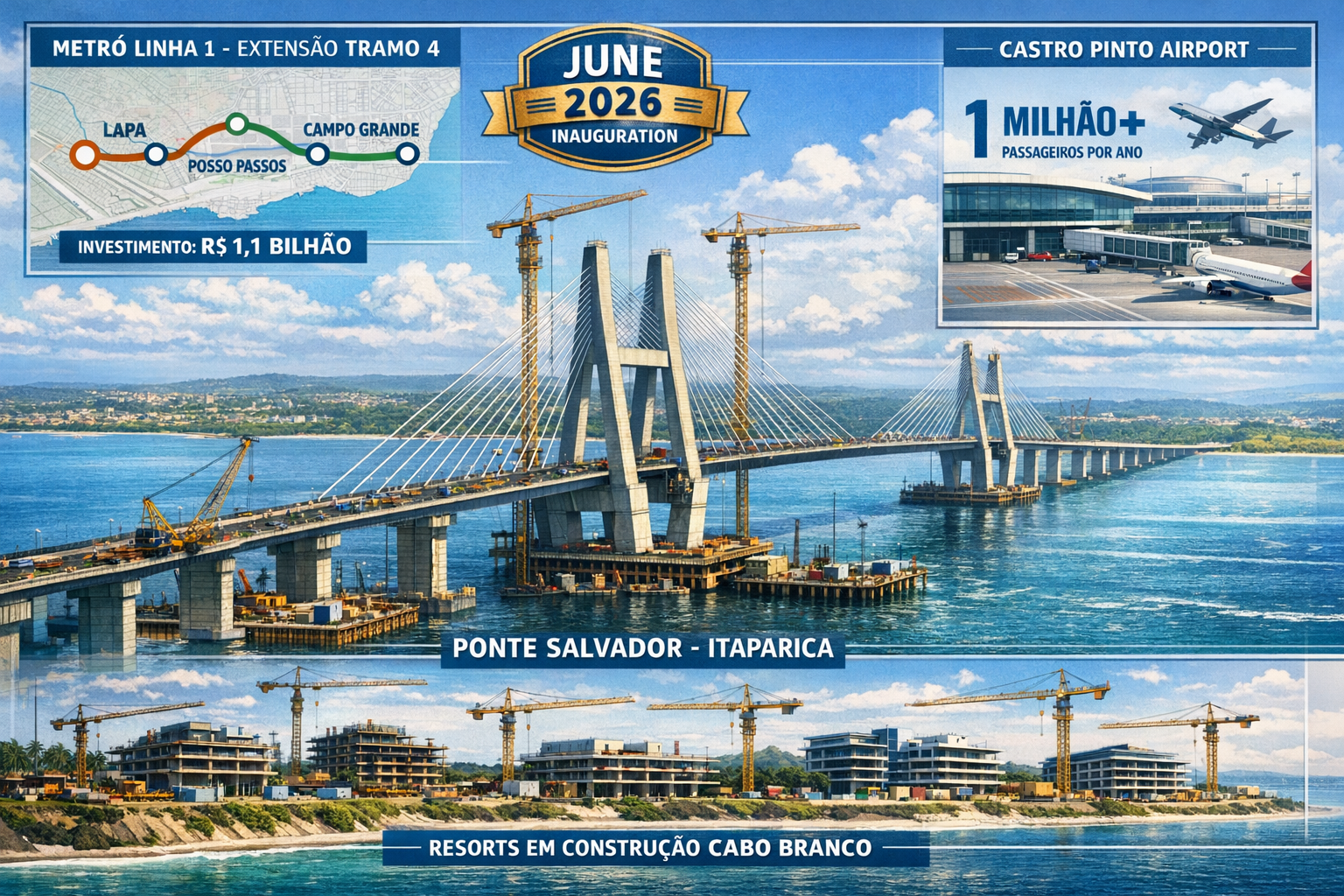
Unlike distant infrastructure promises, the Ponte Salvador-Itaparica bridge project is confirmed to begin construction in June 2026, with tunnels and viaducts on the Salvador side.[3] This represents a concrete catalyst for strategic land acquisition and development positioning.
The bridge will meaningfully boost property values in specific neighborhoods:
- Comercio: Direct connectivity improvements
- Calcada: Enhanced accessibility corridors
- Improved transportation routes: Reduced commute times to employment centers
Developers implementing João Pessoa and Salvador Development Strategies 2026: Capturing 20%+ Price Surges in Brazil’s Secondary City Leaders should analyze land parcels within these impact zones, prioritizing acquisitions that will benefit from reduced travel times and improved connectivity once construction progresses.
Strategic timing considerations:
- Pre-construction acquisition (2026): Secure land before price adjustments reflect infrastructure impact
- Construction phase positioning (2027-2029): Market projects emphasizing future connectivity benefits
- Completion proximity (2030+): Deliver units as infrastructure comes online, capturing maximum appreciation
Metro Line 1 Extension: Central Neighborhood Value Lift
Salvador’s Metro Line 1 extension (Tramo 4, from Lapa to Campo Grande) has over R$ 1.1 billion in investment with procurement steps already underway.[3] This infrastructure improvement could lift property values in central neighborhoods including:
- Campo Grande: Direct station access
- Canela: Improved connectivity to employment centers
- Graca: Enhanced accessibility for residents
Transit-oriented development strategies become particularly valuable in these corridors. Developers should consider:
🚇 Proximity to planned stations: Land within 500-800 meters captures maximum transit premium
🏢 Mixed-use configurations: Ground-floor commercial with residential above leverages foot traffic
📈 Pre-leasing strategies: Market future transit access to secure early commitments
Castro Pinto Airport: Tourism Infrastructure Supporting Demand
João Pessoa’s Castro Pinto Airport recently surpassed one million passengers annually, marking the highest movement among northeastern terminals managed by Aena Brasil.[7] This milestone supports sustained economic growth and creates specific development opportunities.
Tourism demand has positioned João Pessoa as one of the world’s top trending travel destinations for 2025 according to Booking.com and Expedia, ranking third globally in demand growth behind only Sanya, China, and Trieste, Italy.[7]
This tourism infrastructure creates demand for:
- Short-term rental optimized units: Proximity to beaches and attractions
- Resort-residential hybrid projects: Amenity-rich developments appealing to both tourists and residents
- Furnished unit programs: Turnkey solutions for investor-buyers seeking rental income
Developers can explore how similar market dynamics are playing out in other emerging Brazilian real estate markets to identify transferable strategies.
Luxury Development Positioning: Learning from the Setai Residences Model
The Aston Martin Partnership: Premium Positioning Strategy
The announcement of Setai Residences Interiors by Aston Martin as the first residential project in Brazil and South America from Aston Martin provides a case study in luxury development positioning.[2] The project features a 45-story tower within a 30,000m² complex in João Pessoa, Paraíba, with completion set for 2031.
Key strategic elements developers can analyze:
🎯 Brand Partnership Value: Leveraging internationally recognized luxury brands creates immediate market differentiation and justifies premium pricing in emerging markets.
🏗️ Design Translation: The project translates Aston Martin’s design values into residential architecture with premium materials and precision engineering, creating tangible differentiation beyond standard luxury finishes.[2]
👥 Target Market Precision: The development specifically targets high-net-worth buyers relocating from São Paulo, Rio de Janeiro, Minas Gerais, and Brasília, as well as remote professionals and investors seeking city appeal paired with tranquility.[2]
This targeting strategy acknowledges a fundamental shift: affluent buyers increasingly prioritize quality of life over proximity to traditional business centers, particularly as remote work normalizes.
Replicable Positioning Tactics for Secondary City Developments
While not every developer can partner with Aston Martin, the underlying positioning strategies apply broadly to João Pessoa and Salvador Development Strategies 2026: Capturing 20%+ Price Surges in Brazil’s Secondary City Leaders:
1. Lifestyle-First Marketing: Position properties around quality of life benefits rather than traditional investment metrics alone. Emphasize beach access, cultural amenities, and reduced congestion.
2. Remote Professional Targeting: Design amenities specifically for remote workers—coworking spaces, high-speed internet infrastructure, video conference rooms, and flexible common areas.
3. Metropolitan Relocation Messaging: Create marketing campaigns specifically targeting São Paulo and Rio residents, highlighting cost-of-living advantages and appreciation potential.
4. Long-Term Value Narrative: Communicate infrastructure improvements and economic growth trajectories to justify premium pricing and attract sophisticated investors.
5. Amenity Differentiation: In markets where luxury is still emerging, best-in-class amenities create disproportionate competitive advantages.
Developers working on residential projects in emerging markets can apply these positioning principles to capture premium pricing even in secondary cities.
Land Acquisition Strategies: Entering Before Saturation
Timing the Market: Current Opportunity Window
The fundamental question for developers considering João Pessoa and Salvador Development Strategies 2026 is timing. Several indicators suggest the opportunity window remains open but is narrowing:
📊 Growth Momentum Indicators:
- 18.9% annual price growth in João Pessoa[8]
- 16% annual growth in Salvador[3]
- Central districts exceeding 20% appreciation[5]
- Tourism demand accelerating[7]
⚠️ Competition Signals:
- Major luxury projects announced (Setai Residences)[2]
- Five new resorts under construction[7]
- Infrastructure projects moving from planning to construction[3]
This combination suggests markets are still in early-to-middle growth phases rather than late-cycle saturation. However, the window for acquiring prime land at pre-appreciation prices is closing as major projects break ground and infrastructure catalysts materialize.
Due Diligence Priorities for Secondary City Land Acquisition
Developers acquiring land in João Pessoa and Salvador should prioritize specific due diligence elements:
Infrastructure Proximity Analysis:
- Distance to planned metro stations (Salvador)
- Connectivity improvements from bridge construction (Salvador)
- Airport accessibility (João Pessoa)
- Beach and tourism attraction proximity
Zoning and Density Optimization:
- Maximum allowable height and density
- Mixed-use permissions for ground-floor commercial
- Parking requirements and potential waivers near transit
- Environmental restrictions in coastal zones
Market Timing Coordination:
- Construction timeline alignment with infrastructure completion
- Pre-sales launch timing relative to infrastructure announcements
- Delivery scheduling to capture appreciation momentum
Competitive Landscape Mapping:
- Existing luxury inventory and absorption rates
- Planned competing projects and delivery timelines
- Price positioning opportunities and gaps
Developers can reference approaches used in other high-growth Brazilian markets to inform due diligence frameworks.
Project Positioning and Unit Mix Optimization
Balancing Small Unit Performance with Project Economics
Given that small apartments are outperforming larger properties with appreciation rates near 9% annually[5], developers face a strategic decision about unit mix optimization.
Advantages of Small Unit Focus:
- ✅ Broader buyer accessibility given 15% Selic rates
- ✅ Higher per-square-meter pricing potential
- ✅ Increased unit count and sales velocity
- ✅ Strong rental demand from tourism and business travelers
Considerations for Balanced Mix:
- 🏢 Larger units appeal to relocating families from major cities
- 🏢 Penthouse and premium units capture highest per-unit margins
- 🏢 Diverse unit types reduce market concentration risk
An optimized approach might include:
| Unit Type | % of Project | Target Buyer | Pricing Strategy |
|---|---|---|---|
| Studios | 20-25% | Investors, remote professionals | Premium per-sqm |
| One-bedroom | 35-40% | Young professionals, couples | Moderate premium |
| Two-bedroom | 25-30% | Small families, upgraders | Standard market |
| Three-bedroom+ | 10-15% | Relocating families | Luxury positioning |
This distribution captures small unit appreciation dynamics while maintaining appeal to diverse buyer segments.
Amenity Strategies for Secondary City Differentiation
In secondary cities where luxury development is still emerging, amenities create disproportionate competitive advantages. João Pessoa and Salvador Development Strategies 2026: Capturing 20%+ Price Surges in Brazil’s Secondary City Leaders should incorporate:
Essential Luxury Amenities:
- 🏊 Resort-style pool and deck areas
- 🏋️ Comprehensive fitness centers
- 🎯 Coworking and business centers
- 🌳 Landscaped outdoor spaces
- 🔒 Advanced security systems
Differentiating Amenities:
- 🎨 Rooftop entertainment areas with ocean views
- 🍽️ Restaurant or café partnerships
- 🚗 Electric vehicle charging infrastructure
- 📱 Smart home technology integration
- 🏖️ Beach club or resort partnerships
These amenities justify premium pricing and create marketing differentiation in markets where such offerings remain uncommon.
Marketing and Sales Strategies for Secondary City Luxury
Targeting Metropolitan Relocators: Campaign Frameworks
Successfully executing João Pessoa and Salvador Development Strategies 2026 requires sophisticated marketing targeting buyers from São Paulo, Rio de Janeiro, Minas Gerais, and Brasília—the primary source markets for luxury secondary city buyers.[2]
Campaign Framework Elements:
1. Comparative Value Messaging:
- Cost-of-living comparisons highlighting savings
- Quality-of-life metrics (commute times, beach access, air quality)
- Appreciation potential versus saturated primary markets
2. Remote Work Enablement:
- Infrastructure quality emphasis (internet speed, coworking spaces)
- Lifestyle imagery showing work-life balance
- Testimonials from successful relocators
3. Investment Thesis Communication:
- Infrastructure catalyst timelines and impact projections
- Historical appreciation data and growth trajectories
- Rental yield potential for investor buyers
4. Risk Mitigation Messaging:
- Developer track record and financial stability
- Construction timeline transparency
- Property management and rental program options
Pre-Sales Timing and Incentive Structures
Given the infrastructure-driven appreciation dynamics in both markets, pre-sales timing becomes strategically important:
Optimal Launch Windows:
- Salvador: 6-12 months before bridge construction begins (late 2025/early 2026) to capture pre-infrastructure pricing while marketing future connectivity
- João Pessoa: Aligned with resort openings and tourism milestone announcements to leverage momentum
Incentive Structures:
- Early buyer discounts (10-15%) creating urgency
- Flexible payment plans accommodating out-of-state buyers
- Rental guarantee programs for investor buyers
- Furniture packages for turnkey delivery
These strategies help developers capture early commitments while maintaining pricing power as infrastructure catalysts materialize.
For developers interested in how pre-construction purchasing strategies create value, understanding buyer incentives in emerging markets provides crucial context.
Risk Management and Market Timing Considerations
Macroeconomic Headwinds: The Selic Rate Challenge
While João Pessoa and Salvador Development Strategies 2026: Capturing 20%+ Price Surges in Brazil’s Secondary City Leaders present compelling opportunities, developers must navigate significant macroeconomic challenges.
The Selic interest rate at 15% as of January 2026 represents the highest level since 2006.[5] This creates several implications:
🔴 Financing Constraints:
- Reduced buyer purchasing power
- Preference shift toward smaller, more affordable units
- Extended sales cycles for larger properties
🟡 Development Financing Costs:
- Higher construction loan interest expenses
- Increased pressure on project economics
- Need for stronger pre-sales to secure favorable terms
🟢 Strategic Responses:
- Focus on cash buyers and international investors less dependent on local financing
- Optimize unit mix toward smaller configurations
- Develop creative financing partnerships or in-house financing programs
- Emphasize appreciation potential to justify higher carrying costs
Competition and Market Saturation Timing
As major projects like Setai Residences and five new resorts come online[2][7], developers must assess saturation risk:
Market Absorption Monitoring:
- Track luxury inventory levels and sales velocity
- Monitor price per square meter trends for early saturation signals
- Assess new project announcements and delivery timelines
Differentiation Imperatives:
- Unique positioning becomes increasingly critical as competition intensifies
- Location advantages (beachfront, infrastructure proximity) create defensible differentiation
- Brand partnerships and amenity superiority justify premium pricing
Exit Strategy Flexibility:
- Phased development approaches allowing market response assessment
- Rental program fallbacks if sales velocity slows
- Portfolio hold strategies capturing long-term appreciation if near-term sales soften
Conclusion: Capturing Secondary City Opportunities Before Saturation
João Pessoa and Salvador Development Strategies 2026: Capturing 20%+ Price Surges in Brazil’s Secondary City Leaders represents a time-sensitive opportunity for developers and investors willing to enter emerging markets ahead of peak competition. With annual appreciation rates of 18.9% and 16% respectively—and certain districts exceeding 20%—these secondary cities are dramatically outperforming Brazil’s traditional real estate powerhouses.[3][5][8]
The convergence of multiple catalysts creates a compelling investment thesis:
✅ Concrete infrastructure projects beginning construction in 2026, including the Ponte Salvador-Itaparica bridge and Metro Line 1 extensions[3]
✅ Tourism infrastructure milestones, with Castro Pinto Airport surpassing one million passengers and João Pessoa ranking as the world’s third fastest-growing destination[7]
✅ Luxury development positioning, exemplified by the Setai Residences Interiors by Aston Martin project targeting metropolitan relocators[2]
✅ Small unit outperformance, with studios and one-bedroom apartments appreciating near 9% annually despite elevated interest rates[5]
Actionable Next Steps for Developers and Investors
Immediate Actions (Q1-Q2 2026):
Conduct neighborhood-level analysis in Salvador’s Pituba, Itaigara, Caminho das Arvores, and Barra districts, and João Pessoa’s Manaíra and Tambaú areas to identify optimal land parcels.
Assess infrastructure proximity for potential acquisitions, prioritizing locations within 500-800 meters of planned metro stations or bridge connectivity improvements.
Develop unit mix strategies emphasizing small apartment configurations (studios and one-bedroom units) to capture affordability-driven appreciation dynamics.
Create marketing frameworks targeting metropolitan relocators from São Paulo, Rio, Minas Gerais, and Brasília with comparative value messaging.
Medium-Term Strategies (2026-2027):
Time pre-sales launches to coincide with infrastructure construction milestones, maximizing marketing impact while securing pre-appreciation pricing.
Establish brand partnerships or amenity differentiation strategies to justify premium positioning in emerging luxury markets.
Monitor macroeconomic conditions and adjust financing strategies to navigate the 15% Selic rate environment.
Long-Term Positioning (2027-2030):
Align project delivery with infrastructure completion timelines to capture maximum appreciation as connectivity improvements materialize.
Develop portfolio strategies balancing near-term sales velocity with long-term hold opportunities in highest-appreciation corridors.
Assess follow-on development opportunities as initial projects establish market positioning and capture early-mover advantages.
The opportunity window for entering João Pessoa and Salvador before market saturation remains open but is narrowing as major projects break ground and infrastructure catalysts progress from planning to construction. Developers who act decisively in 2026—conducting thorough due diligence, optimizing project positioning, and executing sophisticated marketing strategies—stand to capture outsized returns in Brazil’s fastest-growing secondary city markets.
For developers seeking to understand how these strategies fit within broader Brazilian real estate investment approaches, the lessons from João Pessoa and Salvador provide a blueprint for identifying and capitalizing on emerging market opportunities before they reach maturity.
References
[1] Joao Pessoa Real Estate Market In 2026 – https://meiracarlos.com.br/en/rental-and-investments/joao-pessoa-real-estate-market-in-2026/
[2] Aston Martin Announces First Residential Project In Brazil And South America With Real Estate Developer Setai Grupo Gp – https://media.astonmartin.com/aston-martin-announces-first-residential-project-in-brazil-and-south-america-with-real-estate-developer-setai-grupo-gp/
[3] Salvador Brazil Good Time – https://thelatinvestor.com/blogs/news/salvador-brazil-good-time
[4] Buy Property In Joao Pessoa In 2026 – https://meiracarlos.com.br/en/real-estate-purchase/buy-property-in-joao-pessoa-in-2026/
[5] Brazil Price Forecasts – https://thelatinvestor.com/blogs/news/brazil-price-forecasts
[6] Projects – https://www.properstar.com/brazil/joao-pessoa-l2/buy/house/projects
[7] Joao Pessoa Brazils Rising Star In Global Tourism And Investment – https://www.riotimesonline.com/joao-pessoa-brazils-rising-star-in-global-tourism-and-investment/
[8] jpaimoveis – https://www.jpaimoveis.com