
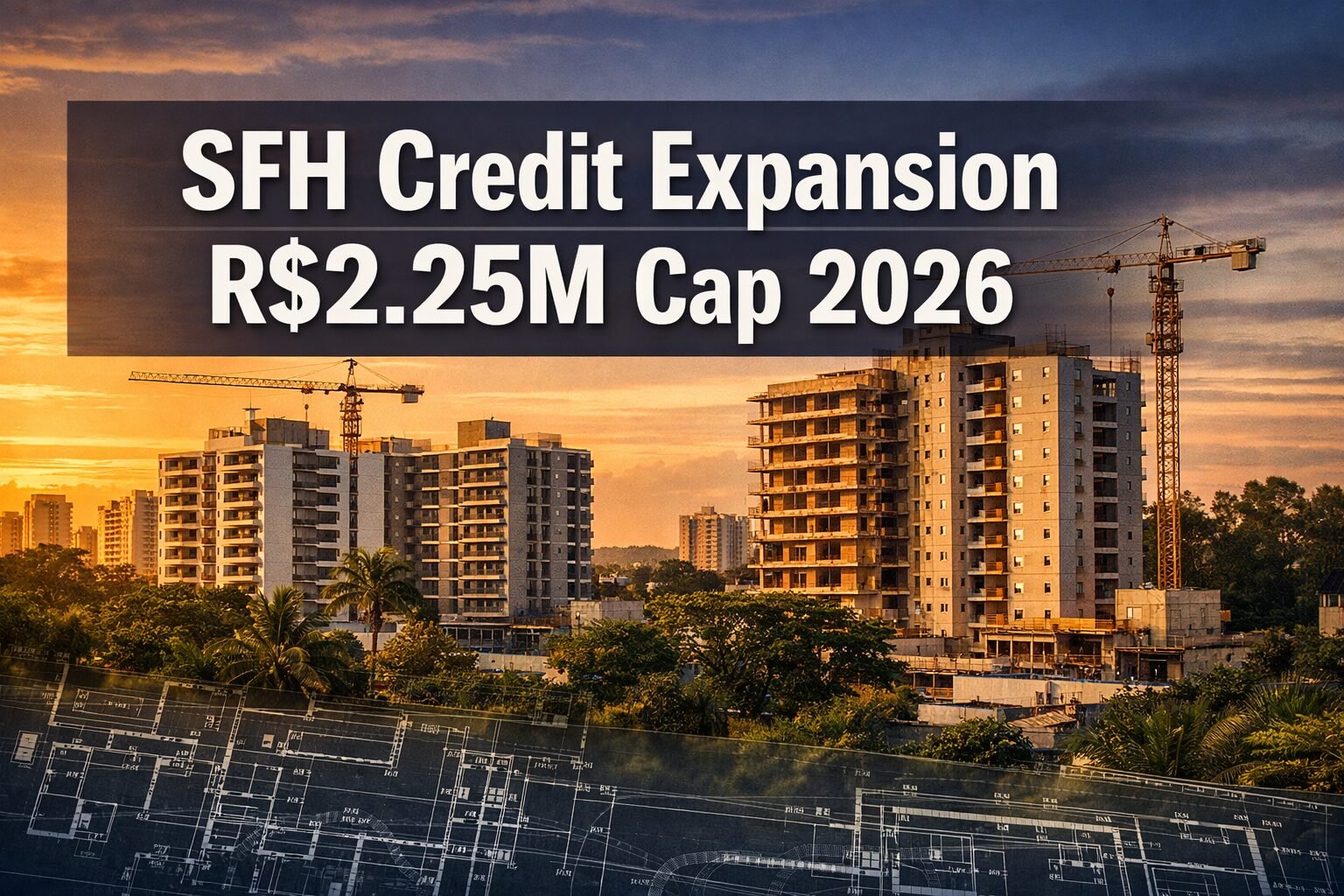
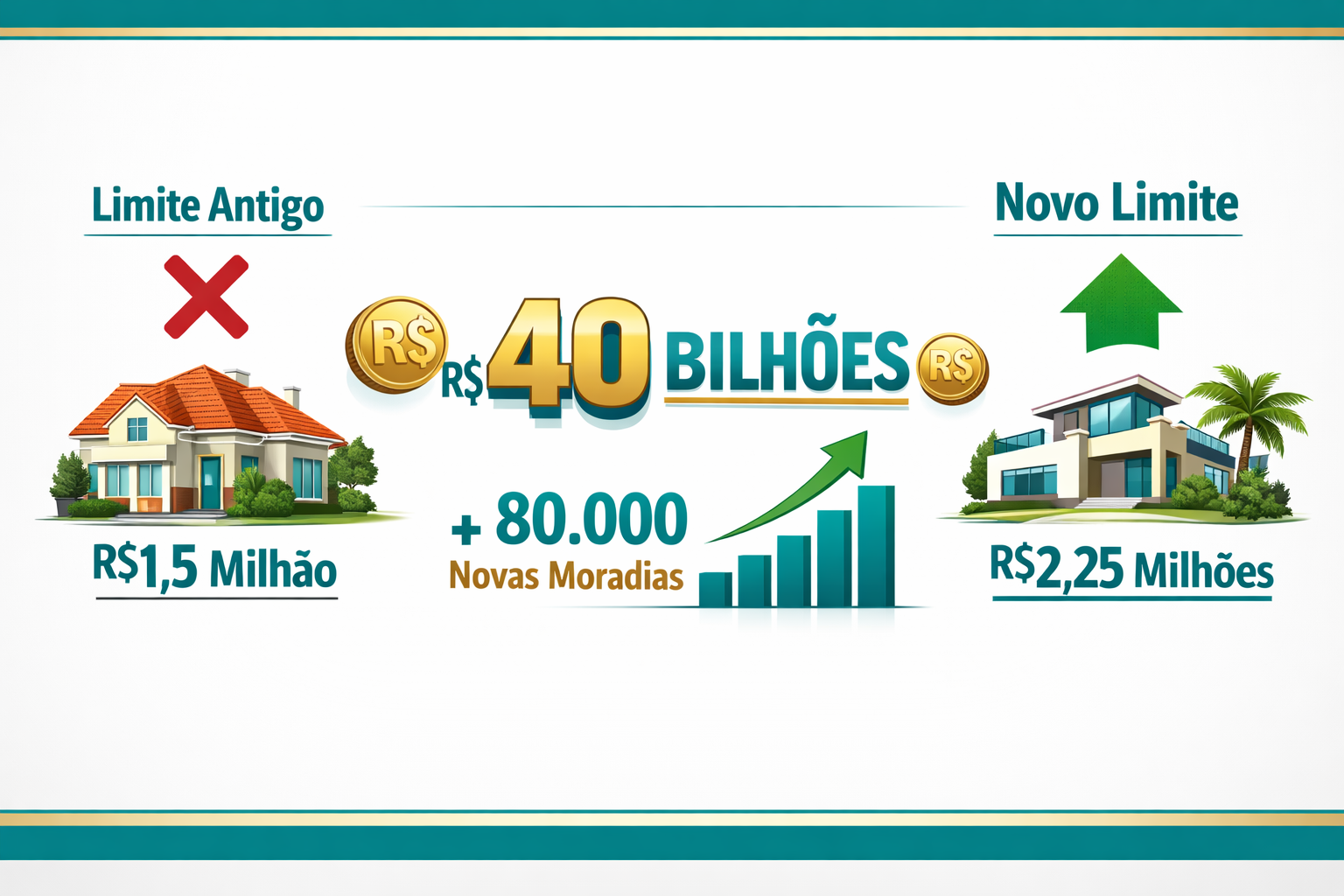
The October 2025 reforms to Brazil’s Sistema Financeiro da Habitação (SFH) did not arrive quietly. By raising the eligible property ceiling from R$1.5 million to R$2.25 million and lifting the loan-to-value (LTV) ratio to 80%, regulators unlocked an estimated R$40 billion in new credit capacity — enough to enable approximately 80,000 additional residential units across the country. For developers targeting the mid-market segment, this is not merely a policy update. It is a structural realignment that demands a rethought product pipeline, a sharper go-to-market strategy, and a precise understanding of who the new SFH buyer actually is in 2026.
This article breaks down the mechanics of the SFH Credit Expansion to R$2.25M Cap 2026: Launch Strategies for Mid-Market Residential Projects, offering actionable guidance for developers, investors, and real estate professionals navigating this expanded credit environment.
Key Takeaways 📌
- The October 2025 SFH reforms raised the property ceiling to R$2.25M and LTV to 80%, injecting R$40B into the housing credit market.
- Approximately 80,000 extra units become financially accessible to buyers previously excluded from SFH financing.
- Mid-market developers must re-engineer product specs, pricing bands, and launch sequencing to capture this expanded buyer pool.
- Coastal and high-growth urban markets — particularly in the South and Southeast — stand to benefit most from the new ceiling.
- Normalizing credit conditions reward developers who align product design with SFH eligibility from the earliest planning stages.
Understanding the October 2025 SFH Reforms and Their 2026 Impact
Before mapping launch strategies, it is essential to understand exactly what changed and why it matters at the project level.
What the New R$2.25M Cap Actually Means
Brazil’s SFH framework governs subsidized mortgage financing through institutions like Caixa Econômica Federal and private banks operating under Banco Central do Brasil regulations. Prior to October 2025, the maximum property value eligible for SFH financing was capped at R$1.5 million — a threshold that had grown increasingly misaligned with urban property values in major metropolitan areas.
The reform addressed this directly:
| Parameter | Pre-Reform | Post-Reform (2026) |
|---|---|---|
| Maximum property value | R$1,500,000 | R$2,250,000 |
| Maximum LTV ratio | ~70% | 80% |
| Estimated new credit volume | — | R$40 billion |
| Additional units enabled | — | ~80,000 |
The 50% increase in the property ceiling is significant on its own. But the LTV adjustment compounds its effect. A buyer purchasing a R$2.0 million apartment can now finance R$1.6 million through SFH channels — compared to roughly R$1.05 million under the old framework. That is a 52% increase in financeable debt for the same property.
Who Enters the Market Now?
The reform primarily unlocks access for upper-middle-income households — families with combined monthly incomes between R$15,000 and R$35,000 — who were previously forced into more expensive portfolio lending or IPCA-indexed instruments. These buyers:
- Have stable formal employment or verifiable income
- Carry moderate FGTS balances usable as down payment
- Are often upgrading from first homes, not entering the market for the first time
- Show strong preference for lifestyle-oriented locations with infrastructure
This profile is distinct from the Minha Casa Minha Vida demographic and requires a fundamentally different product and communication strategy. For a deeper look at how buyer profiles are shaping development decisions in high-growth markets, see how sales performance is transforming the Florianópolis real estate market.
SFH Credit Expansion to R$2.25M Cap 2026: Launch Strategies for Mid-Market Residential Projects
“The developer who designs for SFH eligibility from day one holds a structural pricing advantage over competitors repricing existing inventory after the fact.”
Capturing the opportunity created by the SFH Credit Expansion to R$2.25M Cap 2026 requires more than awareness. It demands deliberate decisions at every stage of the development cycle.
1. 🏗️ Product Engineering for the New Ceiling
The most immediate strategic lever is unit pricing architecture. With the ceiling at R$2.25M, developers have a clear target zone: units priced between R$1.6M and R$2.2M sit squarely within SFH eligibility while offering meaningful differentiation from entry-level stock.
Key product design principles for this band:
- Unit sizes of 80–130 sqm typically hit the right price-per-sqm ratios in high-demand urban markets
- Two to three bedrooms with flexible layouts appeal to upgrading families and investor-buyers alike
- Amenity packages (co-working, fitness, rooftop) justify premium pricing without breaching the cap
- Parking configurations should be optional or tiered to maintain base unit price within SFH limits
Developers should model pricing sensitivity carefully. A unit priced at R$2.3M — just R$50,000 above the cap — eliminates SFH eligibility entirely, potentially reducing the qualified buyer pool by 40–60% depending on the market.
2. 📍 Location Selection: Where the R$40B Flows
Not all markets benefit equally from the new ceiling. The R$40 billion in expanded credit will concentrate in cities where:
- Property values already cluster between R$1.5M and R$2.25M (meaning the old cap was a genuine constraint)
- Population growth and migration inflows sustain demand
- Infrastructure investment supports long-term appreciation
Top-priority markets in 2026:
- Florianópolis and Greater Florianópolis — where coastal lifestyle demand has pushed mid-market pricing well above the old SFH threshold
- Balneário Camboriú — ultra-premium positioning but strong spillover into adjacent municipalities
- São Paulo (select zones) — Pinheiros, Vila Madalena, Moema corridors
- Curitiba and Porto Alegre — strong middle-class demand, undersupplied mid-market stock
For developers evaluating coastal South Brazil specifically, the growth of the Ingleses region in Florianópolis illustrates how infrastructure and quality-of-life factors drive sustained valuation in exactly the price band the new SFH cap unlocks.
3. 🗓️ Launch Sequencing in a Normalizing Credit Environment
Credit normalization — the gradual return to predictable, accessible financing conditions — changes optimal launch timing. In constrained credit environments, developers often front-load launches to capture buyers before financing windows close. In a normalizing environment, phased launches become strategically superior.
Recommended launch sequencing framework:
Phase 1 — Pre-Launch (Months 1–3):
- Register project with SFH-eligible financing pre-approvals in place
- Build qualified lead database segmented by FGTS balance and income bracket
- Partner with Caixa and 2–3 private banks for simultaneous financing offers
Phase 2 — Soft Launch (Month 4):
- Release 20–30% of units to pre-registered buyers at founding-member pricing
- Use pre-launch data to calibrate final pricing for remaining phases
- Activate off-plan purchase appreciation narratives to motivate early commitment
Phase 3 — Public Launch (Months 5–8):
- Full marketing activation with SFH financing prominently featured
- Leverage normalizing credit as a demand driver in all communications
- Monitor absorption velocity weekly; adjust incentive structures accordingly
Phase 4 — Completion Phase (Months 9–18):
- Maintain residual inventory at or below R$2.25M where possible
- Offer FGTS-integrated payment structures for remaining units

Financing Architecture and Buyer Communication Strategies
Structuring SFH-Optimized Financial Packages
The 80% LTV ceiling creates a specific down payment requirement that developers must address proactively. A buyer purchasing a R$2.0M unit needs R$400,000 in equity — a meaningful sum that can be assembled through:
- FGTS contributions (often R$80,000–R$200,000 for established workers)
- Proceeds from a prior property sale (common among upgrading buyers)
- Developer-facilitated installment plans during construction
Smart developers structure their payment tables to align with these sources. Offering 20–30% of the purchase price in construction-phase installments reduces the cash burden at key delivery, making the 20% equity requirement feel manageable rather than prohibitive.
Communicating the SFH Advantage
Many mid-market buyers do not spontaneously understand the difference between SFH and portfolio lending. The developer’s sales team and marketing materials must close this knowledge gap. Key messages to convey:
- ✅ Lower interest rates — SFH rates are typically 2–4 percentage points below market portfolio rates
- ✅ Regulated amortization — predictable monthly payments under TR or IPCA indexation
- ✅ FGTS compatibility — buyers can use FGTS balances for down payment and installment payments
- ✅ Institutional security — financing backed by regulated institutions, not developer balance sheets
For investors evaluating the broader Brazilian real estate opportunity, understanding the best places to invest in Brazil for high returns provides essential geographic context for where SFH-eligible mid-market projects carry the strongest appreciation fundamentals.
Operational Considerations: From Pipeline to Delivery
Regulatory Compliance and SFH Registration
Every project targeting SFH financing must be registered and approved before sales begin. Key compliance steps include:
- INCC-linked contracts — construction cost indexation must be clearly disclosed
- Patrimônio de Afetação — segregating project assets protects buyers and is increasingly expected by SFH lenders
- Pre-approval coordination — working with Caixa’s regional offices early accelerates buyer financing timelines
- Documentation standardization — uniform income verification and FGTS documentation processes reduce sales cycle friction
Construction Pace and Delivery Risk
The R$40 billion credit injection will accelerate demand. Developers who cannot match delivery timelines to buyer expectations risk losing pre-approved financing windows. Practical mitigation strategies:
- Modular construction approaches that reduce weather and labor dependencies
- Fixed-price contracts with key subcontractors locked before launch
- Progress milestone transparency — buyers with active SFH pre-approvals need regular construction updates to maintain lender confidence
For a real-world example of how construction pace transparency builds buyer confidence, the foundation completion milestone updates at Tramonto demonstrate how proactive communication supports sustained sales momentum.
SFH Credit Expansion to R$2.25M Cap 2026: Launch Strategies for Mid-Market Residential Projects in Coastal Markets
Coastal markets deserve specific attention because they represent the highest concentration of properties that were previously just above the old R$1.5M SFH threshold. The reform effectively re-enfranchises an entire tier of coastal mid-market inventory.
The Florianópolis Case Study
Florianópolis exemplifies the dynamic. The city’s combination of natural amenities, technology sector employment growth, and lifestyle migration has driven mid-market pricing into the R$1.6M–R$2.2M band — precisely the zone the new cap unlocks. Developments in neighborhoods like Ingleses, Jurerê, and Campeche now qualify for SFH financing that was structurally unavailable 12 months ago.
This creates a first-mover advantage for developers who:
- Already have SFH-eligible projects in permitting or early construction
- Can reposition existing inventory pricing to fall within the new cap
- Understand the specific buyer profile driving coastal demand (remote workers, upgrading families, investor-residents)
For a broader view of what the Greater Florianópolis market looks like heading into this cycle, the analysis of what to expect from the Greater Florianópolis real estate market provides essential context on supply, demand, and pricing trajectories.
Developers with active projects in these markets — such as the Solis development — are already positioned to benefit from the expanded buyer pool the SFH reforms create.

Risk Factors and Strategic Guardrails
No structural opportunity arrives without risk. Developers pursuing the SFH Credit Expansion to R$2.25M Cap 2026 window should monitor:
⚠️ Interest Rate Sensitivity SFH rates are tied to the SELIC benchmark and FGTS remuneration rates. If the Banco Central do Brasil adjusts rates materially, the effective monthly payment for R$1.8M+ financed amounts could shift buyer qualification thresholds.
⚠️ Supply Surge Risk R$40 billion in new credit will attract new entrants. Markets that see a surge in SFH-eligible launches could face absorption challenges by 2027–2028. Developers should model conservative absorption rates (5–8% of inventory per month) rather than extrapolating from current demand peaks.
⚠️ Regulatory Reversion Risk Property ceiling adjustments have historically been revised. Developers should structure project economics to remain viable if the cap returns to lower levels — meaning projects should not depend entirely on SFH financing for buyer qualification.
⚠️ Construction Cost Inflation Increased demand for mid-market construction will pressure labor and materials costs. Locking supply chain contracts before launch is not optional — it is essential.
Conclusion: Turning Policy Reform into Project Success
The SFH Credit Expansion to R$2.25M Cap 2026 is one of the most consequential structural shifts in Brazilian residential real estate financing in over a decade. The combination of a higher property ceiling, an improved LTV ratio, and R$40 billion in newly accessible credit creates a genuine window for mid-market developers to accelerate pipelines, reach a broader qualified buyer base, and build projects that were previously unfinanceable for the target demographic.
Actionable next steps for developers and investors:
- Audit your existing pipeline — identify which projects fall within R$1.6M–R$2.25M and prioritize SFH registration for those
- Engage financing partners early — pre-arrange SFH credit lines with Caixa and private banks before launch, not after
- Redesign product specs if needed — adjust unit sizes, finishes, and amenity packages to hit the optimal price band
- Train your sales team on SFH mechanics — buyers need education, not just enthusiasm
- Choose locations strategically — prioritize markets where the old cap was a genuine constraint and demand fundamentals are strong
- Build in delivery buffers — protect pre-approved financing windows with realistic construction timelines
The developers who treat this reform as a design constraint — rather than just a marketing talking point — will build the most durable competitive positions in the 2026 mid-market cycle. To explore current projects already aligned with these principles, visit the full developments portfolio or get in touch directly to discuss project-specific strategies.