
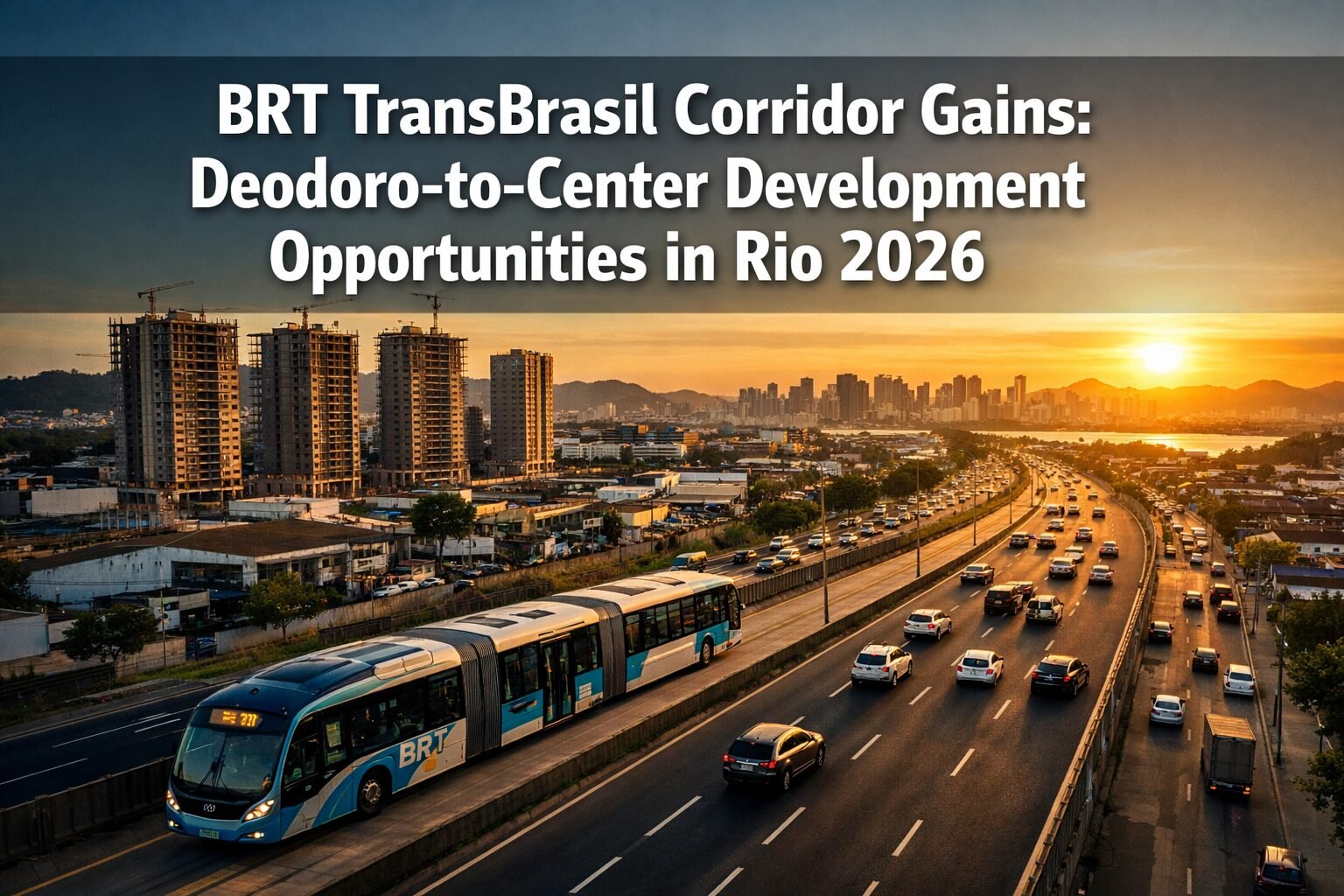
A single BRT line slashing commute times by up to 50% can add 15% annual rental yields to properties within walking distance of its stations — and that is exactly what is unfolding along Rio de Janeiro’s TransBrasil corridor in 2026. The BRT TransBrasil Corridor Gains: Deodoro-to-Center Development Opportunities in Rio 2026 represent one of the most compelling transit-oriented development stories in Latin America right now, connecting the Deodoro district to the city’s downtown core along Avenida Brasil and reshaping the economic geography of 26 neighborhoods in the process [3].
For developers, investors, and urban planners watching Brazil’s property market, this corridor is not background noise — it is the signal.
Key Takeaways 📌
- TransBrasil officially launched in February 2024, operating 20 stations across approximately 26–27 km from Deodoro to downtown Rio [3][9].
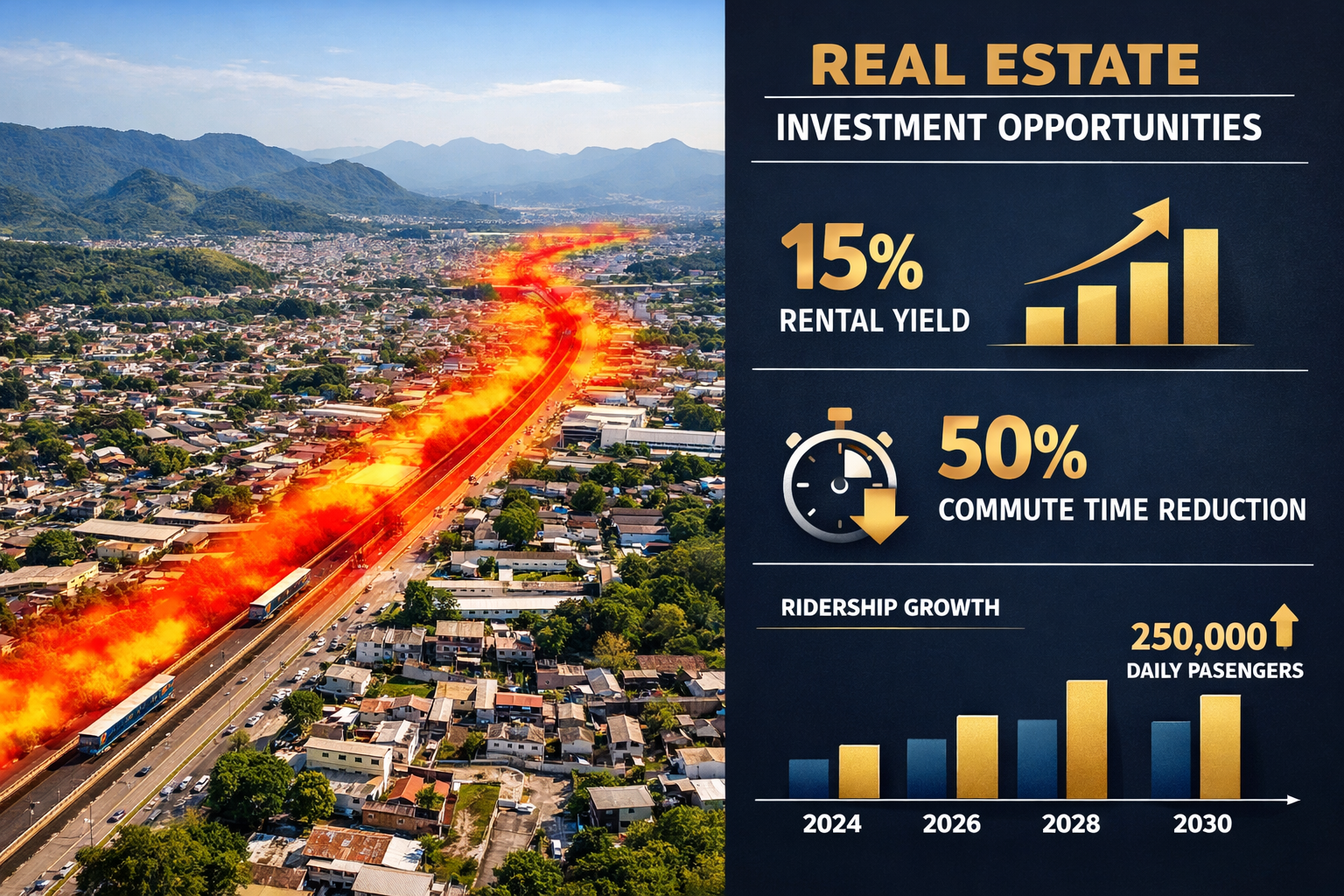
- Travel times along Avenida Brasil can drop by up to 50% during peak hours, directly boosting residential desirability along the corridor [3].
- High-density residential towers near BRT stations are generating rental yield projections of up to 15%, driven by improved accessibility and housing demand.
- Partnering with the Porto Maravilha regeneration zone creates a powerful mixed-income development axis linking the port area to the western districts.
- 2026 technical upgrades — including new articulated buses and real-time information systems — are increasing corridor capacity and rider confidence [4].
What Is the TransBrasil BRT and Why Does It Matter in 2026?
The Corridor at a Glance
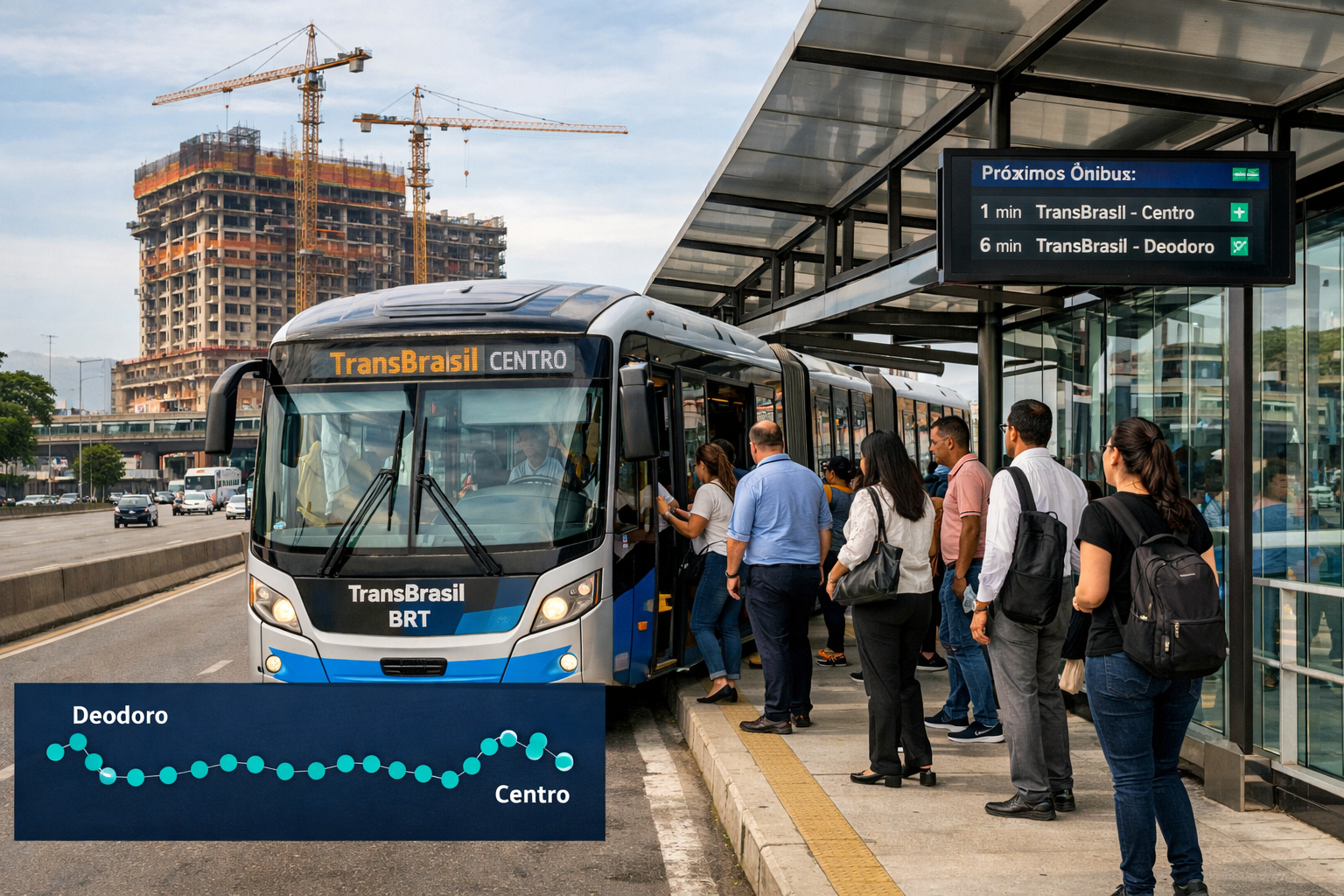
Officially inaugurated in February 2024 after nearly a decade of planning and construction delays, the TransBrasil Bus Rapid Transit system runs along Avenida Brasil — Rio’s most critical arterial road — connecting the Deodoro district in the West Zone to the National Institute of Traumatology and Orthopedics (Into) near the city center [9]. The route spans approximately 26 to 27 kilometers and serves 20 operational stations, with a total system design of 21 stations [3][9].
This is not a peripheral transit project. Avenida Brasil cuts through 26 neighborhoods where the majority of lower-income Rio residents live and work [3]. For decades, those communities endured brutal commute times — sometimes two to three hours each way — on overcrowded conventional buses. TransBrasil changes that equation fundamentally.
💬 “The TransBrasil corridor is more than infrastructure — it is a redistribution of urban opportunity along one of Rio’s most underserved axes.”
2026 Upgrades: More Capacity, Smarter Operations
In 2026, the BRT network received a meaningful set of technical upgrades designed to scale ridership and improve reliability. These include:
- 🚌 New articulated buses with higher passenger capacity per vehicle
- 📱 Real-time passenger information systems installed at key stations
- 🔗 Improved integration with intercity bus and transit networks (still under development) [4]
Rio city officials project that the TransBrasil corridor could serve upwards of 250,000 people daily by 2030 [3]. For context, Rio’s three other primary BRT lines — TransOeste, TransCarioca, and TransOlímpica — collectively cover over 115 kilometers and already serve more than 500,000 passengers daily [4]. TransBrasil adds a critical fourth axis to this network.
BRT TransBrasil Corridor Gains: Deodoro-to-Center Development Opportunities in Rio 2026 — The Investment Case
Transit-Oriented Development: The Global Playbook Applied to Rio
Every major city that has built high-quality BRT or rail infrastructure has seen a predictable pattern: property values rise fastest within 500–800 meters of stations. São Paulo’s BRT corridors, Bogotá’s TransMilenio, and Curitiba’s legendary Rede Integrada de Transporte all demonstrated this dynamic. Rio’s TransBrasil is now entering the same cycle — but with one key advantage: it is still early.
For investors who understand why buying early in a development cycle amplifies gains, the Deodoro-to-Center axis offers a window that will not stay open indefinitely.
Why Rental Yields Are Reaching 15%
Three forces are converging to push yields higher along this corridor:
| Factor | Impact on Yields |
|---|---|
| Commute time reduction (up to 50%) [3] | Increases rental demand from workers who previously avoided the area |
| Relatively low land acquisition costs | Entry prices remain below Zona Sul and Barra da Tijuca benchmarks |
| Limited quality housing stock | Undersupply of modern units near BRT stations drives premium rents |
| Growing formal employment along Avenida Brasil | Industrial and logistics hubs near Deodoro create stable tenant base |
The math is straightforward: lower purchase prices plus higher-than-average rents equals outsized yield percentages. Developers building high-density residential towers — studios and one-bedroom units targeting young professionals and essential workers — are capturing this spread most effectively.
The Deodoro District: From Olympic Legacy to Urban Catalyst
Deodoro hosted venues for the 2016 Rio Olympics, and the TransOlímpica BRT provides a secondary connection from Recreio dos Bandeirantes to Deodoro in the West Zone [5]. That Olympic infrastructure left behind sports facilities, improved road networks, and a district that was primed for residential densification — but lacked the transit connectivity to make it attractive for daily commuters.
TransBrasil fills that gap. With Deodoro now linked directly to downtown Rio in a fraction of the former travel time, the district is transitioning from Olympic legacy site to genuine urban neighborhood with a growing residential market.
Porto Maravilha + TransBrasil: The Mixed-Income Development Axis
Understanding the Porto Maravilha Regeneration Zone
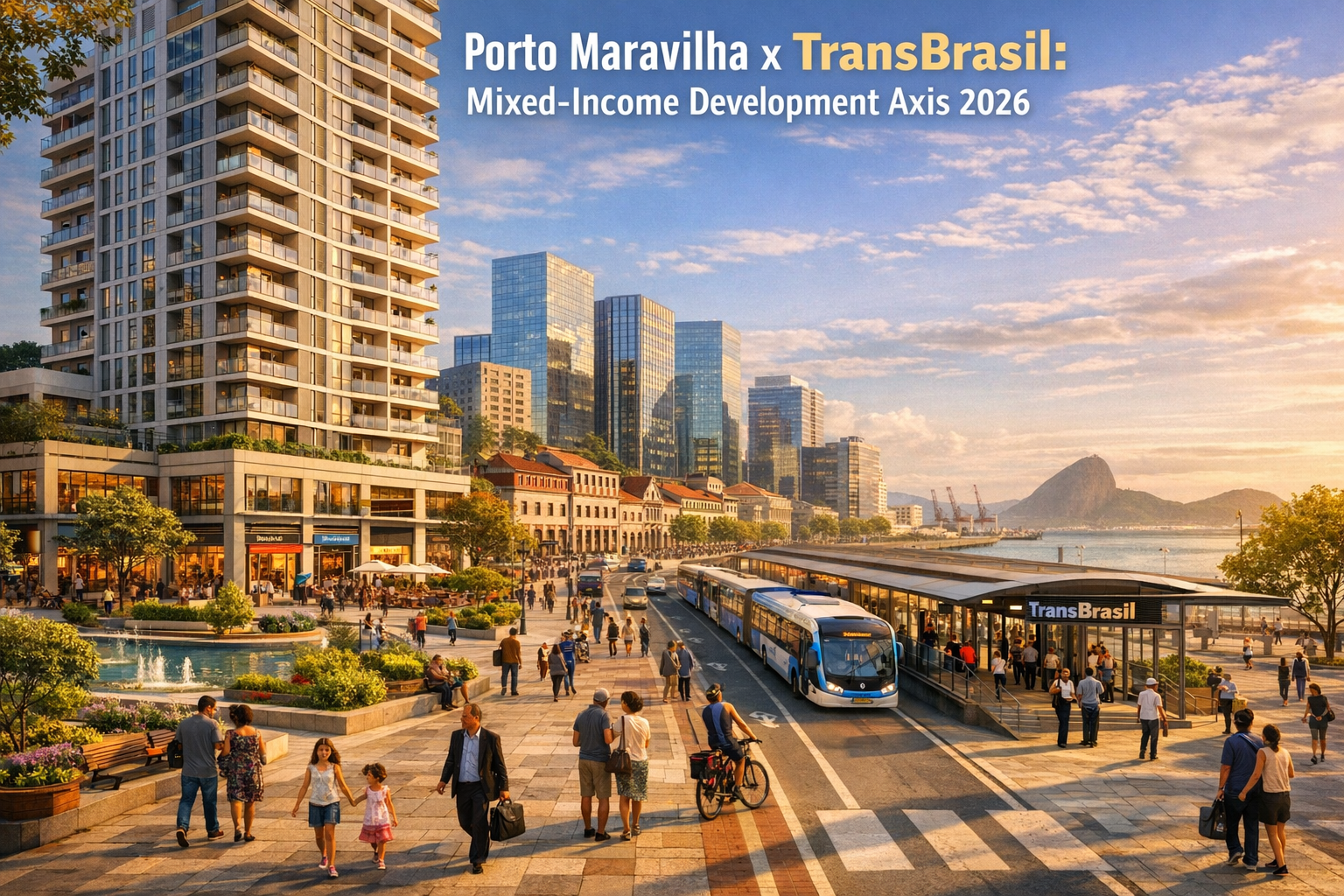
Porto Maravilha is Rio’s flagship urban regeneration project — a multi-billion-dollar redevelopment of the city’s historic port district covering approximately 5 million square meters. The project has already delivered the Museum of Tomorrow (Museu do Amanhã), the MAR art museum, and significant public realm improvements along the waterfront.
Critically, Porto Maravilha sits at the downtown end of the TransBrasil corridor. This geographic alignment creates a rare opportunity: developers can build mixed-income, mixed-use projects that capture both the regeneration premium of the port district and the transit accessibility premium of the BRT corridor simultaneously.
Structuring Mixed-Income Projects Along the Axis
Successful mixed-income development along the Deodoro-to-Center axis typically involves three components:
- Market-rate residential towers (studios to two-bedroom units) targeting young professionals who value transit access over neighborhood prestige
- Affordable or subsidized units (often financed through Minha Casa Minha Vida or similar programs) meeting social housing obligations and broadening the tenant base
- Ground-floor commercial and retail space activating the streetscape and generating additional revenue streams
This structure aligns with Brazil’s broader infrastructure investment momentum. As Brazil positions 2026 as a year to unlock infrastructure ambitions, federal financing mechanisms are increasingly available to support mixed-income projects in transit-adjacent zones [8].
Partnering Strategies for Developers
For developers new to Rio’s market, the most effective entry strategies along the TransBrasil corridor in 2026 include:
- Joint ventures with local operators who understand community dynamics in Avenida Brasil neighborhoods
- Phased development — acquiring land near secondary stations where prices have not yet fully reflected the transit premium
- Pre-sales to institutional investors seeking stable, yield-generating assets in Brazil’s largest city
- Engaging Porto Maravilha’s Urban Development Company (CDURP) for projects in the port zone end of the corridor
Those tracking the best places to invest in Brazil property for high returns will find that the TransBrasil corridor now ranks alongside more established investment zones in Rio and São Paulo.
Risks, Realities, and What Investors Must Watch
Execution Risk: Brazil’s Infrastructure Track Record
Brazil’s infrastructure projects have a well-documented history of delays and cost overruns. TransBrasil itself took nearly a decade from planning to inauguration [3]. Investors must price in:
- Expansion timeline uncertainty: Announcements regarding corridor expansion throughout 2026 should be monitored closely, though specific details remain limited [4]
- Integration gaps: Full integration with intercity bus and transit systems remains under development [3]
- Political continuity: Municipal elections and budget cycles can affect maintenance funding and service quality
Community Displacement and Gentrification Pressure
The 26 neighborhoods along Avenida Brasil are predominantly lower-income communities [3]. Rising property values — while positive for investors — can accelerate displacement if not managed through inclusive planning. Developers who engage with community organizations early and incorporate affordable housing components are better positioned for both social license and long-term project stability.
For those interested in how sales performance is transforming real estate markets in Brazil’s growing cities, the lessons from other corridors apply directly: speed of pre-sales and community trust are equally important metrics.
Currency and Macroeconomic Considerations
Brazilian real estate investments carry currency risk for international investors. The BRL/USD exchange rate, Brazil’s Selic interest rate trajectory, and inflation dynamics all affect real returns. Investors should model scenarios at multiple exchange rate assumptions and consider BRL-denominated financing where possible to create a natural hedge.
Innovative financing structures — including cryptocurrency and real estate development intersections — are also emerging as tools for structuring cross-border investments in Brazilian projects.
Key Stations and Micro-Markets Along the Corridor
Not all 20 stations offer equal opportunity. Here is a quick breakdown of the highest-potential micro-markets:
| Station Zone | Development Profile | Opportunity Level |
|---|---|---|
| Deodoro | Olympic legacy infrastructure, large land parcels | ⭐⭐⭐⭐⭐ High |
| Madureira | Established commercial hub, dense residential demand | ⭐⭐⭐⭐ Strong |
| Penha / Cordovil | Industrial adjacency, workforce housing demand | ⭐⭐⭐ Moderate |
| Caju / São Cristóvão | Porto Maravilha adjacency, regeneration upside | ⭐⭐⭐⭐⭐ High |
| Downtown (Into terminus) | Premium location, limited land availability | ⭐⭐⭐ Selective |
Deodoro and the Caju/São Cristóvão zone stand out as the two bookend opportunities — one anchored by Olympic infrastructure and western expansion, the other by the Porto Maravilha regeneration premium.
Broader Brazil Infrastructure Context: 2026 as a Pivotal Year
The TransBrasil corridor does not exist in isolation. Brazil in 2026 is executing one of its most ambitious infrastructure investment cycles in a generation. Federal highway auction programs are projecting US$215 billion in projected investments [7], and high-speed rail bidding is being restructured to accelerate private sector participation [6].
This macro backdrop matters for Rio’s BRT development story because:
- Federal co-financing for urban transit improvements is more accessible than in previous cycles
- Institutional investor appetite for Brazilian infrastructure assets is growing
- Municipal governments are under pressure to demonstrate urban mobility improvements, increasing political will for corridor maintenance and expansion
For those tracking the latest news in Brazil’s real estate and infrastructure sectors, 2026 represents a genuine inflection point — not just for Rio, but for urban development across the country.
Conclusion: Actionable Next Steps for the TransBrasil Opportunity
The BRT TransBrasil Corridor Gains: Deodoro-to-Center Development Opportunities in Rio 2026 are real, measurable, and time-sensitive. The corridor is operational, ridership is growing, and the technical upgrades of 2026 are building the case for long-term service reliability. The window for early-mover advantage — before station-area land prices fully reflect the transit premium — is narrowing.
Actionable Next Steps for Investors and Developers 🎯
- Map station-area land parcels within 800 meters of Deodoro, Madureira, and Caju stations — these three micro-markets offer the best risk-adjusted entry points in 2026.
- Engage Porto Maravilha’s CDURP to understand available incentives and zoning flexibilities for mixed-income projects at the downtown end of the corridor.
- Model high-density residential tower feasibility for studio and one-bedroom units targeting the 250,000 daily projected riders by 2030 [3] — this is your tenant base.
- Structure mixed-income components to access federal financing programs and build community trust in Avenida Brasil neighborhoods.
- Monitor 2026 expansion announcements for the TransBrasil corridor and position land acquisitions ahead of confirmed new station locations [4].
- Partner with experienced local developers who understand Rio’s regulatory environment and community dynamics along Avenida Brasil.
The corridor connecting Deodoro to Rio’s center is more than a transit project — it is a development spine for the city’s next decade of growth. Those who act on the data now will be the ones writing the case studies in 2030.
References
[1] Florianopolis Will Receive A Million Dollar Brt That Will Begin Construction In 2026 With Nearly 400 Million In Funding From The Federal Gov – https://en.clickpetroleoegas.com.br/florianopolis-will-receive-a-million-dollar-brt-that-will-begin-construction-in-2026-with-nearly-400-million-in-funding-from-the-federal-gov-btl96/
[2] RioOnWatch – https://rioonwatch.org/?p=15531
[3] In Rio De Janeiro The New TransBrasil BRT Takes Shape – https://itdp.org/2024/02/27/in-rio-de-janeiro-the-new-transbrasil-brt-takes-shape/
[4] Public Transport Rio De Janeiro – https://www.riotimesonline.com/public-transport-rio-de-janeiro/
[5] Hill Supports Rio Olympic And Paralympic Games Projects – https://www.hillintl.com/articles/hill-supports-rio-olympic-and-paralympic-games-projects/
[6] Brazil Splits Bidding To Spur High Speed Rail Build – https://www.metro-magazine.com/news/brazil-splits-bidding-to-spur-high-speed-rail-build
[7] Brazil Prepares New Highway Auction With US$215 Billion In Projected Investments – https://www.bnamericas.com/en/news/brazil-prepares-new-highway-auction-with-us215-billion-in-projected-investments
[8] Is 2026 The Year Brazil Unlocks Its Infrastructure Ambitions – https://www.agri-pulse.com/articles/24227-is-2026-the-year-brazil-unlocks-its-infrastructure-ambitions
[9] BRT TransBrasil Gets Visit From Rio’s Mayor – http://www.oec-eng.com/api/en/news/brt-transbrasil-gets-visit-rios-mayor