
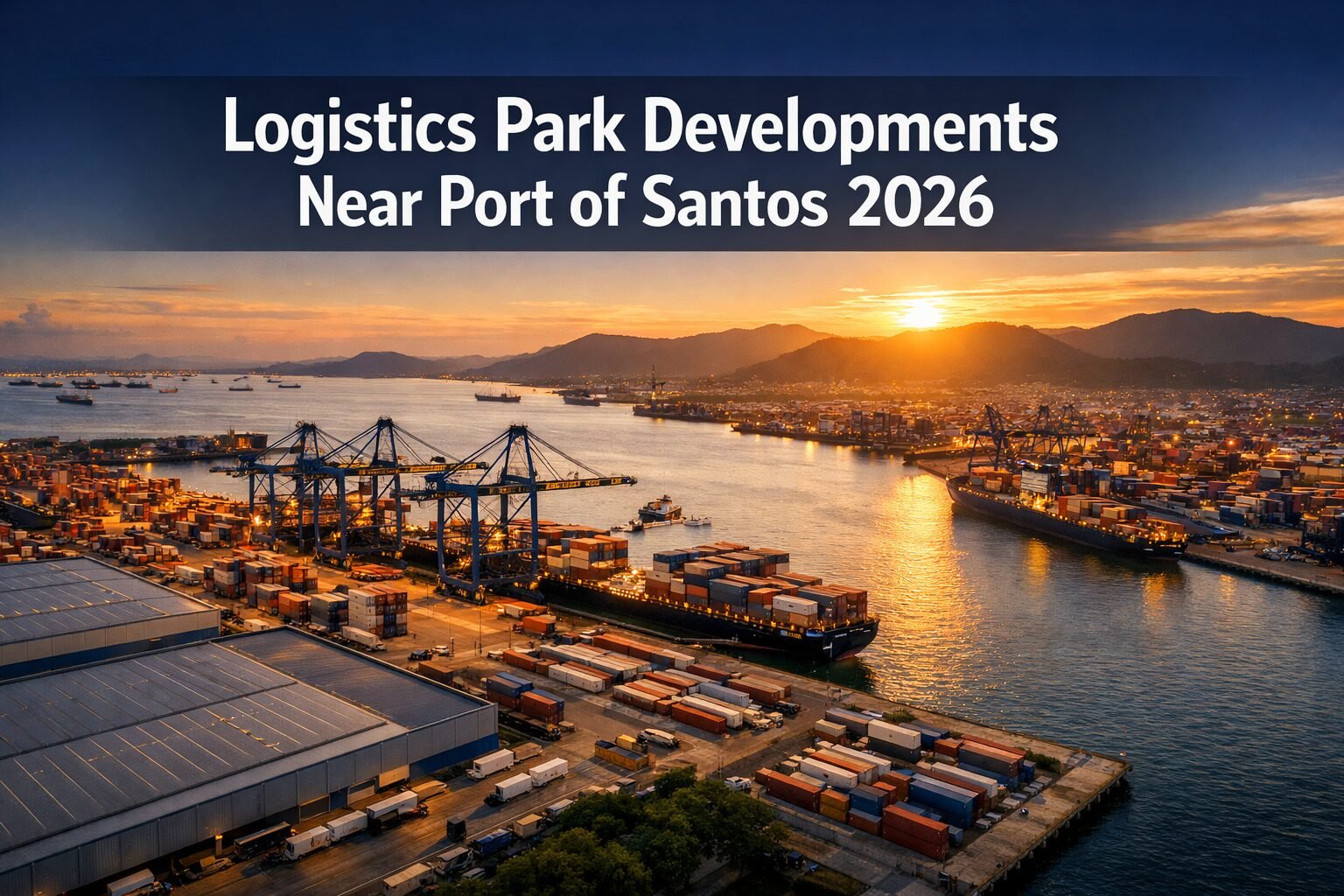
Brazil’s Port of Santos handled 1.25 million TEUs in 2024 alone — a 14% surge from the prior year — yet the surrounding logistics infrastructure has chronically lagged behind that throughput. That gap is now closing fast, and for investors paying attention, it represents one of the most compelling real-asset opportunities in Latin America. [3]
Logistics Park Developments Near Port of Santos 2026: High-Yield Strategies Amid ABC Region Expansion sits at the intersection of government-backed infrastructure investment, rising e-commerce freight demand, and a structurally undersupplied industrial property market. Even against the backdrop of Brazil’s historically high Selic rate, the combination of long-term concession models, anchor tenant demand from global shipping operators, and the ABC Region’s industrial density creates a rare resilience case for logistics real estate.
This article breaks down the key projects reshaping the Santos port corridor, the financial mechanics that make them attractive, and the strategic moves investors should consider in 2026.
Key Takeaways 📌
- R$477.9 million in new logistics park investment is entering the Santos port zone through two government-backed concession projects, creating 877 truck parking spaces. [1]
- DP World is expanding its Santos terminal quay by 190 meters, targeting 1.7 million TEUs of annual capacity — driving sustained demand for adjacent logistics services. [3]
- Tecon Santos 10, a R$6.45 billion mega-terminal, will elevate Brazil from 45th to 15th globally in container traffic once operational. [4]
- The Santos–Guarujá immersed tunnel P3 project is reshaping cross-estuary logistics connectivity, unlocking new development corridors. [7]
- Government-backed financing models and 20-year concession structures offer a hedge against short-term interest rate volatility.
The Infrastructure Pipeline Driving Logistics Park Developments Near Port of Santos 2026
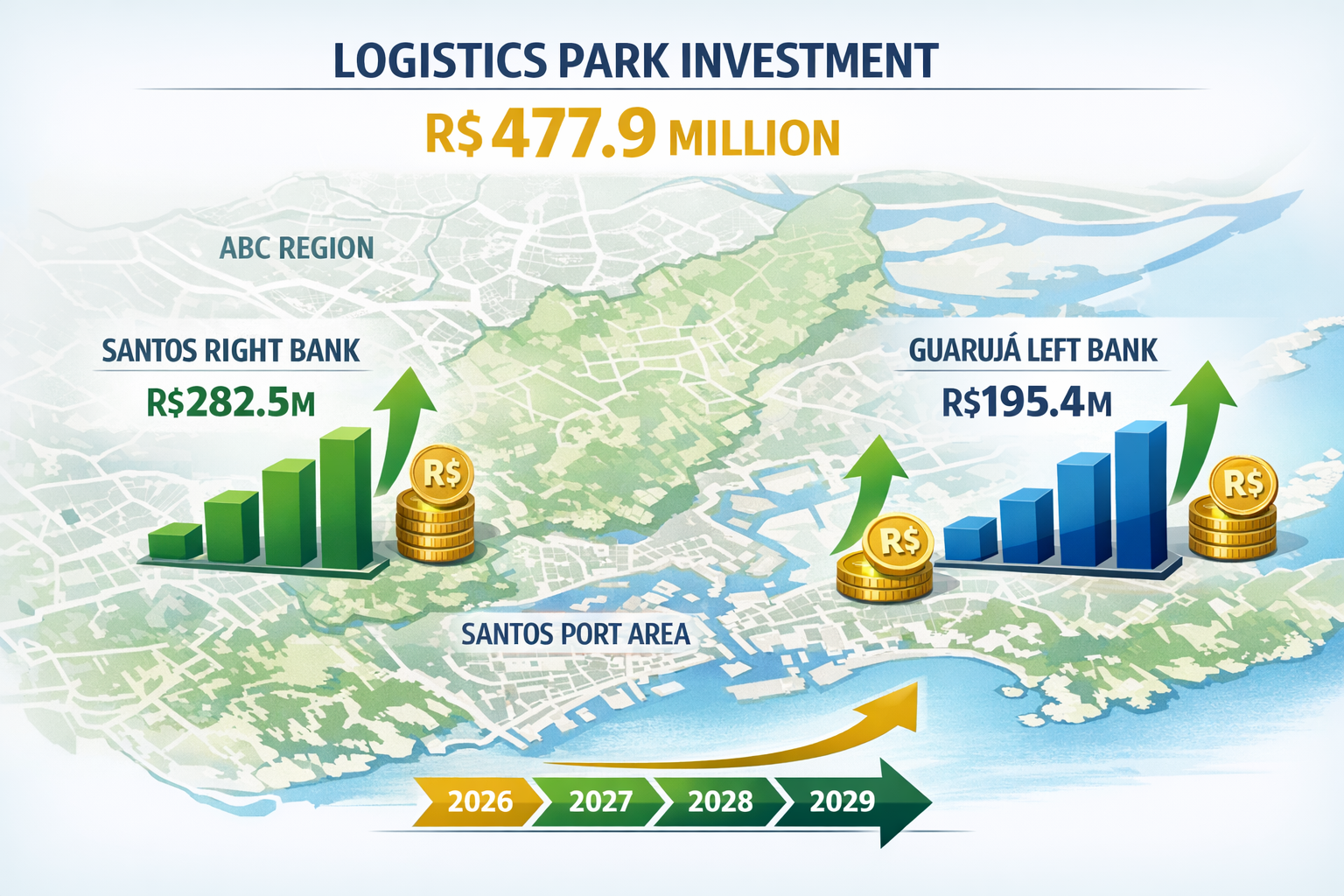
Two New Logistics Condominiums: The R$477.9 Million Anchor Investment
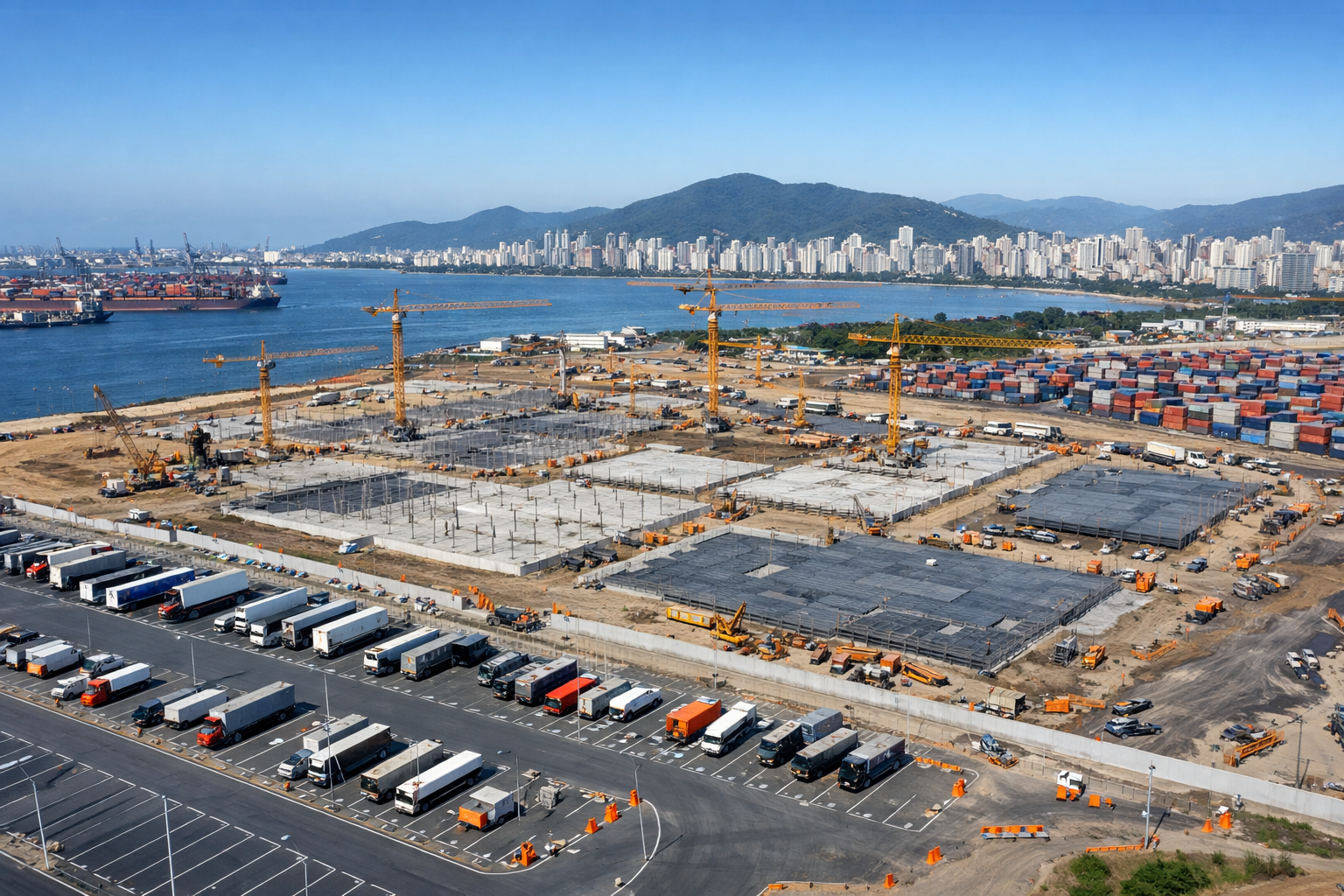
The Santos Port Authority has moved decisively. Following a December 4, 2025 auction bid opening, two major logistics condominiums are now entering the contract execution phase, with signatures expected in 2026 and completion targeted for 2029. [1][2]
Here’s how the two projects stack up:
| Feature | Santos Right Bank | Guarujá Left Bank (Vicente de Carvalho) |
|---|---|---|
| Total Investment | R$282.5 million | R$195.4 million |
| Total Area | 121,000 m² (parking) + 83,600 m² (cargo services) | 163,100 m² total |
| Truck Spaces | 460 | 417 |
| Key Services | Cargo/container maintenance, certification, refitting | Staging yard, logistics services, covered warehouses |
| Concession Term | 20 years | 20 years |
| Status | Contract phase 2026 | First logistics condominium in Guarujá |
💡 Pull Quote: “The Guarujá Left Bank complex will be the municipality’s first-ever logistics condominium — a greenfield opportunity in a port-adjacent market with zero existing competition.” [2]
The Santos Right Bank site sits near major terminals on the port’s most active corridor. Its 83,600 m² of cargo and container services — covering maintenance, certification, and refitting — positions it as a full-service logistics node rather than a simple parking facility. [2]
The Guarujá complex is arguably the more transformative of the two. With 73,500 m² of staging yard, 89,600 m² of logistics services area, and 50,200 m² of covered warehouses, it introduces an entirely new asset class to a municipality that has long served as a port support zone without formal logistics infrastructure. [2]
DP World’s Terminal Expansion: The Demand Catalyst
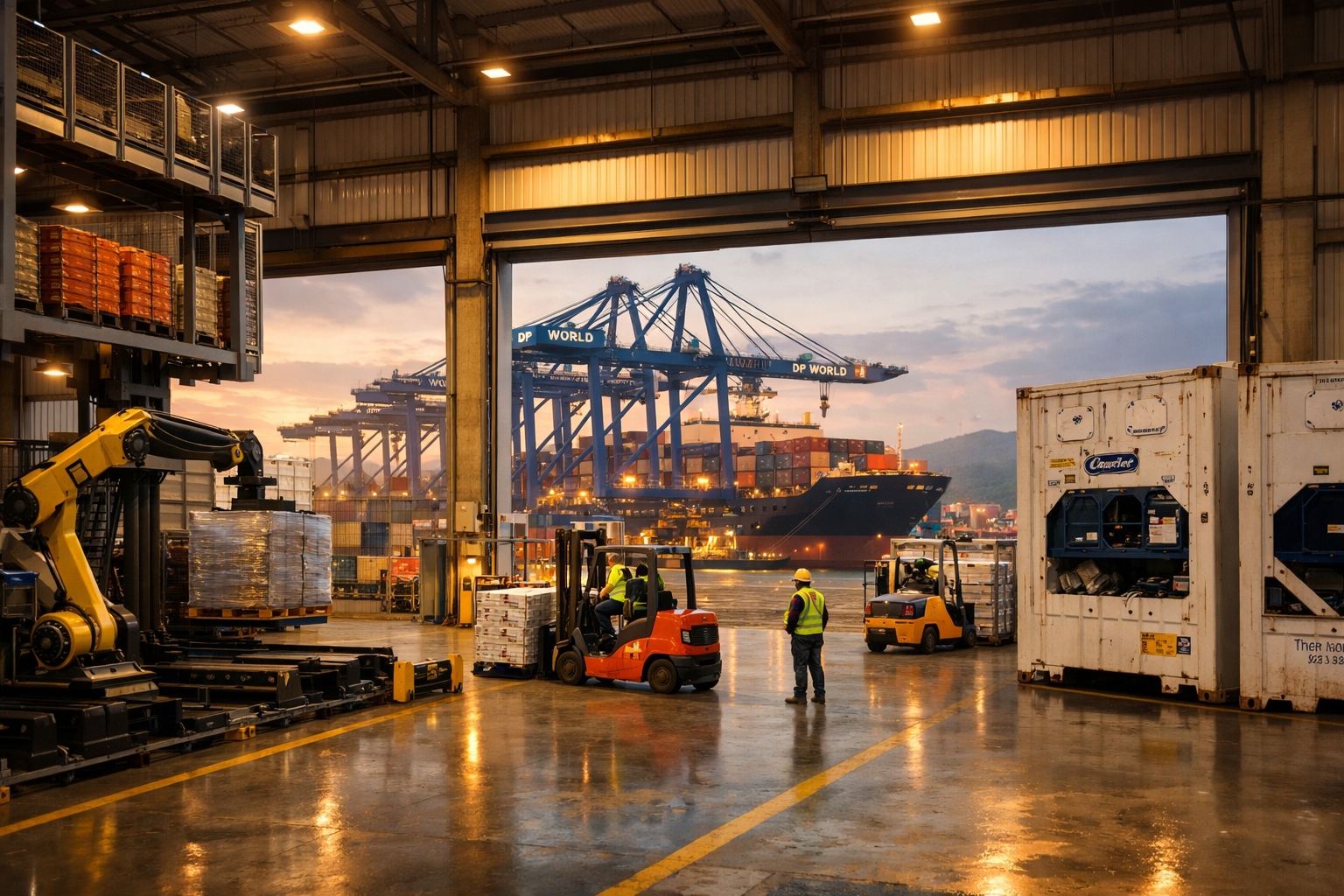
Infrastructure investment only creates value when backed by real freight demand. DP World’s ongoing Santos expansion provides exactly that anchor. The operator is adding 190 meters of quay — 40 meters dedicated to pulp exports and 150 meters for container operations — pushing annual capacity to 1.7 million TEUs. [3]
This expansion is part of a cumulative R$3 billion+ investment in Santos since 2013, aligned with Brazil’s Growth Acceleration Program (PAC). [3] For logistics park developers and investors, DP World’s commitment signals a multi-decade demand horizon — the kind of anchor that justifies long-term lease structures and supports premium rental rates.
Tecon Santos 10: The Game-Changer on the Horizon
The most dramatic single development in the Santos port ecosystem is Tecon Santos 10. Though the auction date remains pending Antaq (National Agency for Waterway Transportation) analysis as of 2026, the project’s specifications are extraordinary: [4]
- R$6.45 billion investment over 25 years
- 9 million containers of annual handling capacity added
- Four ship berths on the 621.9 m² Saboó quay site
- Minimum concession fee: R$500 million
- Global ranking impact: Brazil moves from 45th to 15th in container traffic [4]
The regulatory delay, while frustrating for some stakeholders, actually creates a window of opportunity for logistics park investors. Surrounding land values and lease rates will reprice sharply once the auction closes. Positioning before that announcement is a classic pre-event value capture strategy.
High-Yield Strategies Amid ABC Region Expansion: What Investors Need to Know
Why the ABC Region Changes the Calculus
The ABC Region — encompassing Santo André, São Bernardo do Campo, and São Caetano do Sul — forms Brazil’s densest industrial corridor outside of São Paulo’s capital core. Its proximity to Santos (roughly 60–80 km via the Anchieta and Imigrantes highways) makes it the natural hinterland for port-linked logistics operations.
As ABC Region industrial tenants increasingly outsource warehousing and distribution to port-adjacent facilities, demand for Santos-corridor logistics parks grows from both ends: port operators need staging capacity, and inland manufacturers need last-mile port access.
Key demand drivers from the ABC Region include:
- 🏭 Automotive supply chains (Volkswagen, Mercedes-Benz, Stellantis plants) requiring just-in-time port access
- 📦 E-commerce fulfillment operators seeking cross-dock facilities near Santos’ import terminals
- 🌱 Agribusiness exporters (soy, sugar, pulp) needing certified pre-shipment storage
- ⚙️ Industrial equipment importers requiring bonded warehouse services
The Santos–Guarujá Tunnel: Unlocking the Left Bank
A critical piece of the logistics connectivity puzzle is the Santos–Guarujá immersed tunnel, a R$1.2 billion P3 project signed by São Paulo state. [7] This will be Brazil’s first immersed tunnel, replacing the current ferry bottleneck between Santos and Guarujá. [6][7]
For logistics park investors, the tunnel’s impact is direct:
- Eliminates the ferry constraint that currently limits heavy truck movement to the Left Bank
- Reduces transit time between Right and Left Bank terminals from 40+ minutes to under 10 minutes
- Increases the addressable catchment area for Guarujá-based logistics facilities
- Raises land values along the Vicente de Carvalho corridor — precisely where the new logistics condominium is planned [2]
💡 Pull Quote: “The immersed tunnel doesn’t just connect two riverbanks — it integrates two logistics markets that have operated in isolation for decades, effectively doubling the functional port zone.”
Financing Models That Blunt Selic Rate Risk
Brazil’s elevated Selic rate environment is the most common objection raised against real estate investment in 2026. The counterargument for port-adjacent logistics parks rests on three structural factors:
1. Government-Backed Concession Revenue Both new logistics condominiums operate under 20-year concession agreements with the Santos Port Authority. This government-backed revenue floor reduces the risk profile significantly compared to speculative commercial real estate. [1][2]
2. Dollar-Linked Freight Revenues Port logistics services are priced in or indexed to USD-denominated freight rates. As the Brazilian Real depreciates — a common feature of high-Selic environments — logistics operators’ revenues in BRL terms actually increase, creating a natural inflation and currency hedge for property owners.
3. FIDC and FII Structures Brazilian investors can access port logistics exposure through Fundos de Investimento Imobiliário (FIIs) focused on industrial and logistics assets, or through FIDCs (credit receivables funds) backed by logistics concessionaire cash flows. These structures allow participation without direct property ownership, lowering capital requirements and improving liquidity.
For those exploring best places to invest in Brazil property for high returns, the Santos logistics corridor represents a fundamentally different risk-return profile than residential or retail real estate — one anchored in trade infrastructure rather than consumer sentiment.
Comparing Investment Entry Points
Not all exposure to Santos logistics growth requires direct participation in port concessions. The investment landscape spans several tiers:
| Entry Point | Capital Requirement | Risk Level | Liquidity | Upside Driver |
|---|---|---|---|---|
| Direct land acquisition (Left Bank) | High | Medium-High | Low | Tunnel + condominium completion |
| Logistics FII (listed) | Low | Medium | High | Rental income + cap rate compression |
| Pre-leased warehouse development | Medium-High | Medium | Low | Long-term tenant contracts |
| FIDC backed by port receivables | Medium | Low-Medium | Medium | Concession cash flows |
| Listed port operator equity | Low | High | High | Volume growth + expansion capex |
Strategic Positioning: Actionable Moves for 2026
Timing the Market: The Pre-Auction Window
The most time-sensitive opportunity in 2026 is the Tecon Santos 10 pre-auction positioning window. Once Antaq completes its analysis and a new auction date is confirmed, market attention will flood the Santos corridor. [4] Land prices, warehouse lease rates, and logistics FII valuations will all reprice upward.
The Santos Port Authority has also opened six new bidding processes for additional port infrastructure in the current cycle [5], signaling that the investment pipeline extends well beyond the two logistics condominiums already announced.
Actionable steps before the Tecon Santos 10 auction:
- ✅ Map available land parcels within 5 km of the Saboó quay site
- ✅ Engage with logistics FII managers who hold Santos-corridor assets
- ✅ Monitor Antaq’s official communications for auction timeline updates
- ✅ Assess cross-border investment structures for non-Brazilian investors
The ABC Region Expansion Multiplier
Industrial real estate investors focused on the ABC Region should view Santos logistics parks not as a competing market but as a complementary demand generator. As ABC Region manufacturers expand export volumes through Santos — particularly in automotive components and industrial goods — they require bonded storage, container stuffing/stripping, and customs clearance facilities within the port zone.
This creates a hub-and-spoke model where ABC Region industrial parks generate the cargo that fills Santos logistics condominiums. Investors with exposure to both zones capture value at both ends of the supply chain.
For context on how real estate development strategies are evolving in Brazil’s high-growth corridors, the valuation advantages for off-plan property purchases framework applies equally well to pre-completion logistics assets — early entry captures the development premium.
Due Diligence Checklist for Santos Logistics Park Investments
Before committing capital, investors should assess:
Regulatory & Concession Risk
- Confirm concession terms with Santos Port Authority documentation
- Review Antaq regulatory framework for logistics condominium operators
- Assess environmental licensing status (particularly for Left Bank wetland-adjacent sites)
Market & Demand Risk
- Validate anchor tenant commitments or letters of intent
- Analyze Santos port volume projections through 2030
- Assess competitive supply pipeline (new logistics parks in planning)
Financial & Structural Risk
- Model cash flows under multiple Selic rate scenarios (12%, 14%, 16%)
- Evaluate currency hedging options for USD-linked revenue streams
- Review FII or FIDC structure tax efficiency under current Brazilian tax law
Broader Brazil Real Estate Context
Santos logistics parks don’t exist in isolation — they are part of Brazil’s broader infrastructure investment super-cycle. For investors building diversified Brazil real estate portfolios, pairing logistics exposure with residential developments in high-growth urban markets creates a balanced risk profile.
The latest news and market updates on Brazilian real estate development provide useful context for understanding how institutional capital is flowing across asset classes in 2026. Similarly, understanding how sales performance is transforming Brazil’s real estate market offers insight into the demand dynamics shaping developer strategies nationally.
For investors curious about how digital assets are intersecting with real estate investment structures, cryptocurrency and real estate development is an emerging frontier worth monitoring — particularly for tokenized logistics asset structures.
Conclusion: The Santos Logistics Window Is Open — But Not Indefinitely
Logistics Park Developments Near Port of Santos 2026: High-Yield Strategies Amid ABC Region Expansion represents one of the clearest infrastructure-backed investment theses in Brazil’s current cycle. The convergence of factors is unusually well-aligned:
- R$477.9 million in government-backed logistics condominium investment entering construction [1][2]
- DP World’s 1.7 million TEU capacity expansion anchoring long-term freight demand [3]
- Tecon Santos 10’s R$6.45 billion mega-terminal pending auction, with transformative global ranking implications [4]
- The Santos–Guarujá tunnel unlocking an entirely new logistics development corridor [7]
- ABC Region industrial expansion generating sustained cargo volumes through the port
The Selic rate environment creates noise, but the structural signal is clear: port-adjacent logistics real estate in Brazil is entering a multi-year expansion phase backed by government concessions, global shipping operator commitments, and irreversible infrastructure investment.
Actionable next steps for investors in 2026:
- Engage a Brazil-specialized real estate advisor familiar with FII and concession structures
- Monitor Antaq’s Tecon Santos 10 timeline — the pre-auction window is the highest-leverage entry point
- Assess Left Bank land positions in Vicente de Carvalho before tunnel completion reprices the market
- Diversify across the logistics value chain — from land to FIIs to listed port operators
- Connect with developers active in Brazil’s infrastructure corridor to access off-market opportunities
To explore current investment opportunities and stay updated on Brazil’s evolving real estate landscape, visit Quadragon’s investment portfolio or get in touch directly for a consultation.
The port is expanding. The logistics parks are being built. The question is whether investors will act before the market fully prices in what is already underway.
References
[1] Port Of Santos To Build Two Logistics Parks With 877 Truck Spaces In R 477 Million Project – http://williams.com.br/port-of-santos-to-build-two-logistics-parks-with-877-truck-spaces-in-r-477-million-project/
[2] Port Of Santos To Build Two Logistics Parks With 877 Truck Spaces In R 477 Million Project – https://datamarnews.com/noticias/port-of-santos-to-build-two-logistics-parks-with-877-truck-spaces-in-r-477-million-project/
[3] Building Future Trade Santos How Dp World Expanding Purpose – https://www.3blmedia.com/news/building-future-trade-santos-how-dp-world-expanding-purpose
[4] The Auction For The Mega Terminal In Santos No Longer Has A Date Set. Understand Why. – https://www.portolivrebrasil.com.br/en/news/The-auction-for-the-mega-terminal-in-Santos-no-longer-has-a-date-set.-Understand-why./
[5] Santos Port Authority Opens Six New Bidding Processes – https://www.bnamericas.com/en/news/santos-port-authority-opens-six-new-bidding-processes
[6] Concessao Tunel Santos Guaruja – https://www.mota-engil.com/en/concessao-tunel-santos-guaruja/
[7] 62441 Sao Paulo Signs 12b P3 For Brazils First Immersed Tunnel – https://www.enr.com/articles/62441-sao-paulo-signs-12b-p3-for-brazils-first-immersed-tunnel