
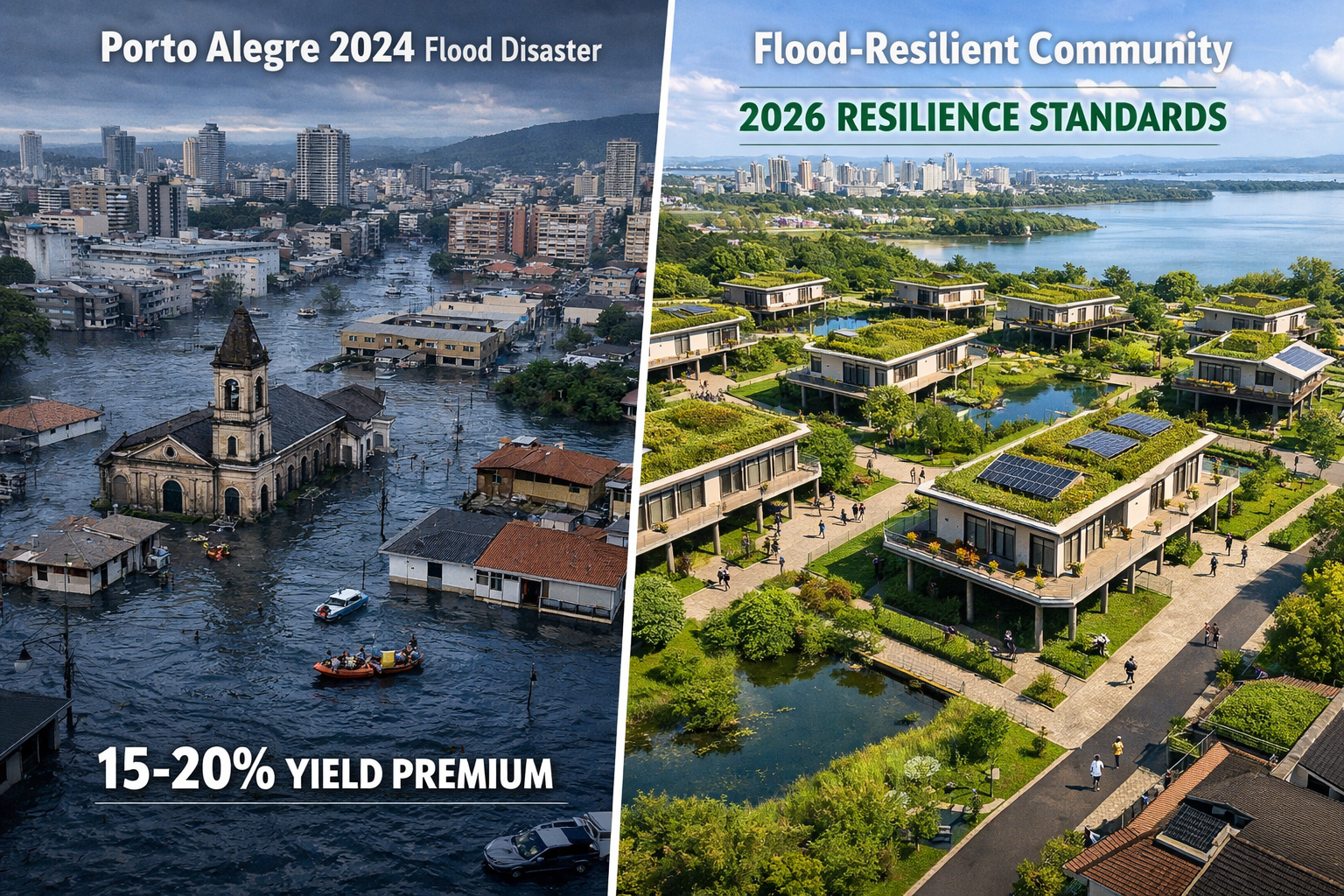
The May 2024 floods that submerged more than 80% of Porto Alegre’s neighborhoods — displacing over 600,000 people and causing an estimated R$100 billion in damages — did not kill investor appetite for Rio Grande do Sul real estate. Instead, they redirected it. Porto Alegre flood-resilient developments 2026: engineering strategies for southern Brazil property investors represent one of the most compelling risk-adjusted opportunities in the Brazilian property market today, as pioneering developers deploy elevated designs, green infrastructure, and digital flood modeling to command yield premiums of 15–20% above pre-flood benchmarks.
This is not a recovery story. It is a reinvention story — and understanding the engineering strategies behind it is now essential for any serious property investor operating in southern Brazil.
Key Takeaways 🔑
- Flood-resilient design commands a premium: Properties built to 2026 resilience standards in Porto Alegre are attracting yield premiums of 15–20% compared to conventional developments in comparable locations.
- Digital modeling is reshaping site selection: Tools like InfoWorks ICM, Civil 3D, ArcGIS Pro, and InfraWorks are now standard for flood scenario planning and resilient infrastructure design in Porto Alegre [1][3].
- Green infrastructure is a legal and financial asset: Rain gardens, vegetated swales, permeable surfaces, and river renaturalization are being integrated into developments not just for compliance, but as value-adding features [4].
- Multi-stakeholder governance is accelerating: A formal urban resilience working group — involving universities, government, and residents — is actively identifying risk zones and improving early-warning systems [2].
- Location intelligence is non-negotiable: Investors must evaluate micro-level flood zone data, not just neighborhood-level risk ratings, before committing capital.
Why Porto Alegre’s Flood Crisis Created a New Investment Paradigm
The 2024 catastrophe exposed a brutal truth: decades of urban expansion over natural floodplains, combined with inadequate drainage infrastructure, had made Porto Alegre structurally vulnerable. But crises of this scale also create rare windows of regulatory reform, infrastructure investment, and market repricing.
“The cities that rebuild smarter after climate disasters consistently outperform their pre-event investment benchmarks within five to seven years.”
Porto Alegre is now in that rebuilding phase. The municipal government, backed by federal reconstruction funding and international technical partnerships, is implementing a layered resilience strategy that directly affects which properties will appreciate and which will remain stranded assets.
For investors exploring the best places to invest in Brazil property, understanding Porto Alegre’s new risk-reward landscape is essential context — particularly when comparing it against other southern Brazilian markets that have avoided similar disruptions.
The Market Repricing Opportunity
Post-disaster markets follow a predictable pattern:
| Phase | Timeline | Investor Opportunity |
|---|---|---|
| Shock & Withdrawal | 0–6 months post-event | Distressed asset acquisition |
| Regulatory Reset | 6–18 months | Early positioning in compliant zones |
| Resilient Development Boom | 18–48 months | Premium new-build investment |
| Full Market Recovery | 4–7 years | Broad appreciation across compliant stock |
Porto Alegre entered Phase 3 in late 2025. Developers who understood the engineering requirements early are now the ones attracting institutional capital and commanding those yield premiums.
Engineering Strategies Driving Porto Alegre Flood-Resilient Developments 2026
1. Advanced Digital Flood Modeling: The Foundation of Every Decision
Before a single foundation is poured, Porto Alegre’s leading developers are running comprehensive flood scenario analyses. The city’s reconstruction effort has deployed an integrated software workflow combining Autodesk InfoWorks ICM, Civil 3D, and InfraWorks alongside ArcGIS Pro to model flooding scenarios, design containment strategies, and develop resilient infrastructure for slopes and roads across the metropolitan area [1].
This is not theoretical. These tools allow engineers to simulate:
- 📊 100-year and 500-year flood return periods
- 🌊 Storm surge behavior across different topographic zones
- 🏗️ The hydraulic impact of proposed developments on surrounding drainage
For investors, this means site selection is now data-driven at a granular level. A property 200 meters from a flood-mapped zone may carry radically different risk than one directly within it. Demanding flood modeling reports as part of due diligence is no longer optional — it is standard practice in 2026.
An interactive flood modeling system has also been implemented at the city level, providing real-time visualizations that highlight critical infrastructure impacted by rising water levels [3]. This public-facing tool gives investors and developers unprecedented transparency about risk zones before committing capital.
2. Structural Engineering: Building Above the Flood Line
The most direct engineering response to flood risk is elevation. Porto Alegre’s resilient developments are incorporating several structural strategies:
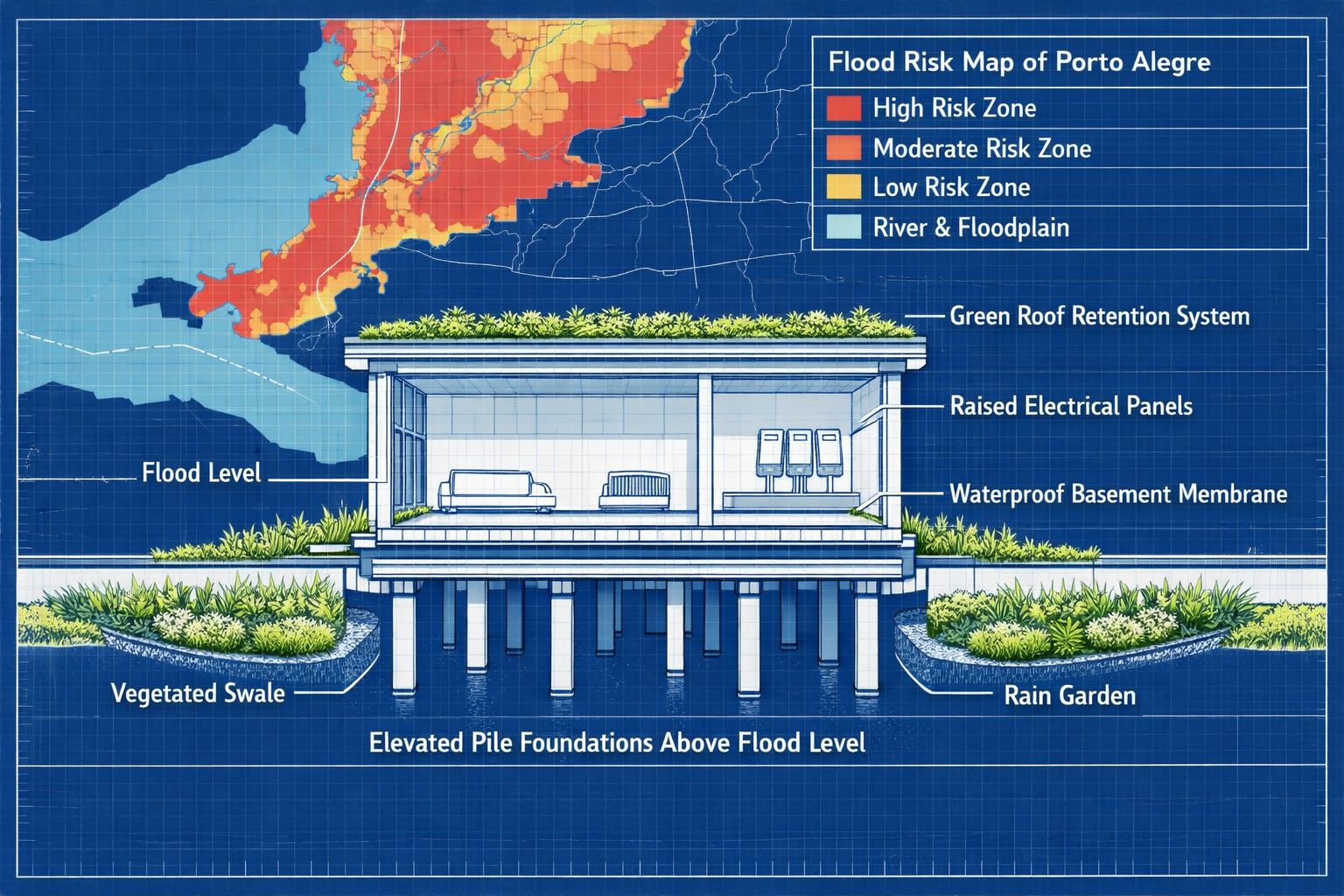
Elevated Pile Foundations Buildings are being designed with deep pile foundations that raise ground floors well above modeled flood levels. This adds construction cost — typically 8–12% above conventional foundations — but eliminates the most catastrophic flood damage scenarios.
Waterproof Basement Membranes and Flood Barriers Where underground parking or storage is required, crystalline waterproofing systems and deployable flood barriers are being integrated into structural designs. These systems can withstand hydrostatic pressure from sustained flooding events.
Raised Critical Infrastructure One of the most important lessons from 2024 was the vulnerability of electrical and mechanical systems. Infrastructure improvements have included raising electrical panels at pump stations across the city to increase resilience [3]. Developers are applying this same principle at the building level — mounting electrical switchboards, HVAC systems, and telecommunications infrastructure above flood lines.
Reinforced Ground-Floor Retail Podiums Mixed-use developments are incorporating elevated retail podiums with flood-resistant materials on lower levels, protecting commercial tenants — and their rental income — during flood events.
3. Green Infrastructure: The Multi-Benefit Investment
Porto Alegre’s climate adaptation strategy has moved decisively toward integrated green infrastructure systems that deliver flood mitigation, heat reduction, and amenity value simultaneously [4]. For property developers, this convergence is significant: green infrastructure is both a regulatory requirement and a marketable asset.
Key green infrastructure elements being integrated into resilient developments include:
- 🌿 Green roofs — reducing stormwater runoff by 50–80% while improving thermal performance
- 🌱 Rain gardens and bioretention cells — capturing and slowly releasing surface water
- 💧 Vegetated swales — channeling runoff through planted corridors rather than hard pipes
- 🌳 Small retention basins — providing temporary water storage during peak rainfall events
- 🏙️ Extensive tree planting — promoting evapotranspiration and soil infiltration
Experts emphasize that reducing impermeable surfaces is essential, as fewer permeable surfaces directly accelerate water runoff and increase flood risk [4]. Developments that maximize permeable landscaping are not just environmentally responsible — they are demonstrably lower risk, which translates directly into insurance premiums and long-term asset values.
Critically, these systems also address urban heat islands — an increasingly important consideration as southern Brazil experiences more frequent and intense heat waves alongside flooding events [4].
4. River Renaturalization: The District-Scale Strategy
Perhaps the most transformative engineering strategy emerging in 2026 is river renaturalization — the restoration and reopening of urban waterways that were previously channeled underground or paved over during decades of urban expansion [4].
“River renaturalization is not just an environmental measure — it is a drainage capacity multiplier that changes the flood risk profile of entire districts.”
When urban streams are restored to more natural courses with vegetated banks, the drainage capacity of the surrounding area increases dramatically. For property investors, developments adjacent to renaturalized waterways gain:
- ✅ Reduced flood risk from improved catchment drainage
- ✅ Premium amenity value from green corridor access
- ✅ Long-term protection as the city’s climate adaptation investment matures
Experts stress that climate adaptation in Porto Alegre must be tailored to local territorial characteristics, requiring solutions ranging from small-scale green infrastructure interventions to larger district-level projects [4]. This means investors cannot rely on blanket risk assessments — micro-location analysis within specific drainage catchments is essential.
5. Meteorological Monitoring and Early Warning Systems
A new meteorological monitoring system for Porto Alegre is currently in the advanced planning and bidding process [3]. When fully operational, this network will provide real-time rainfall and flood risk data that can trigger early warning protocols for residents and building management systems.
For property investors, buildings integrated with these alert systems will command a measurable safety premium — particularly in the residential rental market, where tenants increasingly factor disaster preparedness into leasing decisions.
Governance and Risk Assessment: The Investor’s Due Diligence Framework
Porto Alegre’s Urban Resilience Working Group
Porto Alegre has established a formal working group comprising universities, government officials, and residents specifically to build a comprehensive urban resilience plan [2]. This group is actively:
- Identifying and mapping high-risk zones across the metropolitan area
- Improving resident education and community alert systems
- Coordinating between municipal planning, infrastructure, and emergency services
For investors, the existence of this working group is a positive signal — it indicates that resilience planning is institutionalized, not ad hoc. Developments that align with the working group’s risk zone classifications will benefit from regulatory support and infrastructure investment priority.
A Practical Due Diligence Checklist for 2026
Before investing in any Porto Alegre development, verify the following:
- Flood zone classification — Is the site outside the 100-year flood boundary?
- Digital modeling compliance — Has the developer used InfoWorks ICM or equivalent modeling?
- Foundation elevation certificate — Does the ground floor exceed the modeled flood level by a safe margin?
- Green infrastructure ratio — What percentage of the site is permeable or vegetated?
- Critical infrastructure elevation — Are electrical, mechanical, and telecom systems above flood lines?
- Insurance availability — Can flood insurance be obtained at commercially viable premiums?
- Municipal resilience alignment — Is the development within a priority resilience investment zone?
Comparing Porto Alegre with Southern Brazil’s Broader Investment Landscape
Porto Alegre’s flood-resilient developments 2026 engineering strategies for southern Brazil property investors must be understood within the broader regional context. Southern Brazil’s property market is diverse, and risk profiles vary significantly across cities.
Florianópolis, for example, has emerged as a high-growth alternative market with strong infrastructure and quality of life metrics. Investors comparing options should examine the growth of the Ingleses region in Florianópolis as a contrasting case study — a market driven by lifestyle demand rather than post-disaster recovery dynamics.
For investors interested in off-plan opportunities, understanding why real estate development can amplify your gains is particularly relevant in Porto Alegre’s current cycle, where early-stage investment in resilient developments captures the largest appreciation potential as the market reprices.
The Florianópolis market also offers instructive parallels in terms of market performance and what to expect going forward, with development trends that southern Brazil investors can apply to their Porto Alegre analysis.
The Yield Premium: Why Resilience Pays in 2026
The 15–20% yield premium associated with flood-resilient developments in Porto Alegre is not speculative — it reflects several compounding factors:
Supply Scarcity
Strict new building codes mean that compliant, resilient developments are a limited subset of total market supply. Scarcity drives premium pricing.
Insurance Differentiation
Flood-resilient buildings qualify for significantly lower flood insurance premiums than conventional stock. This directly improves net rental yields for investors and reduces total occupancy costs for tenants — increasing demand.
Institutional Capital Preference
ESG-mandated institutional investors — pension funds, REITs, and international capital — increasingly require climate resilience certifications before deploying capital. Compliant Porto Alegre developments are accessing this capital pool for the first time.
Tenant Quality and Retention
Tenants who have experienced flood displacement are willing to pay meaningful rent premiums for certified resilient buildings. Retention rates in resilient developments are measurably higher, reducing vacancy drag on yields.
For investors exploring development-stage opportunities, examining specific projects with strong engineering credentials — such as those listed in Quadragon’s development portfolio — provides a benchmark for what resilience-focused construction looks like in practice in southern Brazil’s current market.
Conclusion: Actionable Steps for Investors in 2026
Porto Alegre’s post-flood transformation is producing a new class of property investment opportunity — one defined by engineering rigor, green infrastructure integration, and digital risk modeling. The developers and investors who understand these strategies are not simply recovering from a disaster; they are building a more valuable, more resilient city.
Your Next Steps 🚀
Commission a micro-location flood risk assessment using ArcGIS or equivalent tools before evaluating any Porto Alegre site. Neighborhood-level data is insufficient.
Require digital modeling documentation from developers — specifically InfoWorks ICM or Civil 3D flood scenario reports — as a non-negotiable part of due diligence.
Prioritize green infrastructure ratios when comparing developments. Properties with higher permeable surface coverage and integrated retention systems carry lower long-term risk and command stronger tenant demand.
Engage with Porto Alegre’s urban resilience working group outputs to understand which zones are receiving priority infrastructure investment — these areas will appreciate fastest.
Compare Porto Alegre’s risk-adjusted yields against other southern Brazil markets. For a broader perspective on the best investment locations across Brazil, ensure your portfolio strategy accounts for the unique recovery premium that Porto Alegre’s resilient developments currently offer.
Connect with developers who have verifiable resilience credentials — those using advanced modeling tools, integrating green infrastructure, and aligning with municipal resilience plans. For inquiries about specific development opportunities in southern Brazil, contact Quadragon directly to discuss projects that meet 2026 resilience standards.
The cities that build back smarter consistently reward patient, informed investors. In Porto Alegre in 2026, the engineering strategies are in place. The question is whether investors are positioned to benefit.
References
[1] Rebuilding Porto Alegre Brazil Infoworks Icm Civil 3d And Infraworks Workflow For Climate Resilient Infrastructure Design 2025 – https://www.autodesk.com/autodesk-university/class/Rebuilding-Porto-Alegre-Brazil-InfoWorks-ICM-Civil-3D-and-InfraWorks-Workflow-for-Climate-Resilient-Infrastructure-Design-2025
[2] Porto Alegre – https://resilientcitiesnetwork.org/porto-alegre/
[3] When Maps Become Lifelines – https://www.esri.com/about/newsroom/arcuser/when-maps-become-lifelines
[4] River Renaturalization Emerges Strategy Combat Urban Flooding – https://agenciabrasil.ebc.com.br/en/meio-ambiente/noticia/2026-04/river-renaturalization-emerges-strategy-combat-urban-flooding
[5] Full – https://www.frontiersin.org/journals/sustainable-cities/articles/10.3389/frsc.2026.1783161/full