
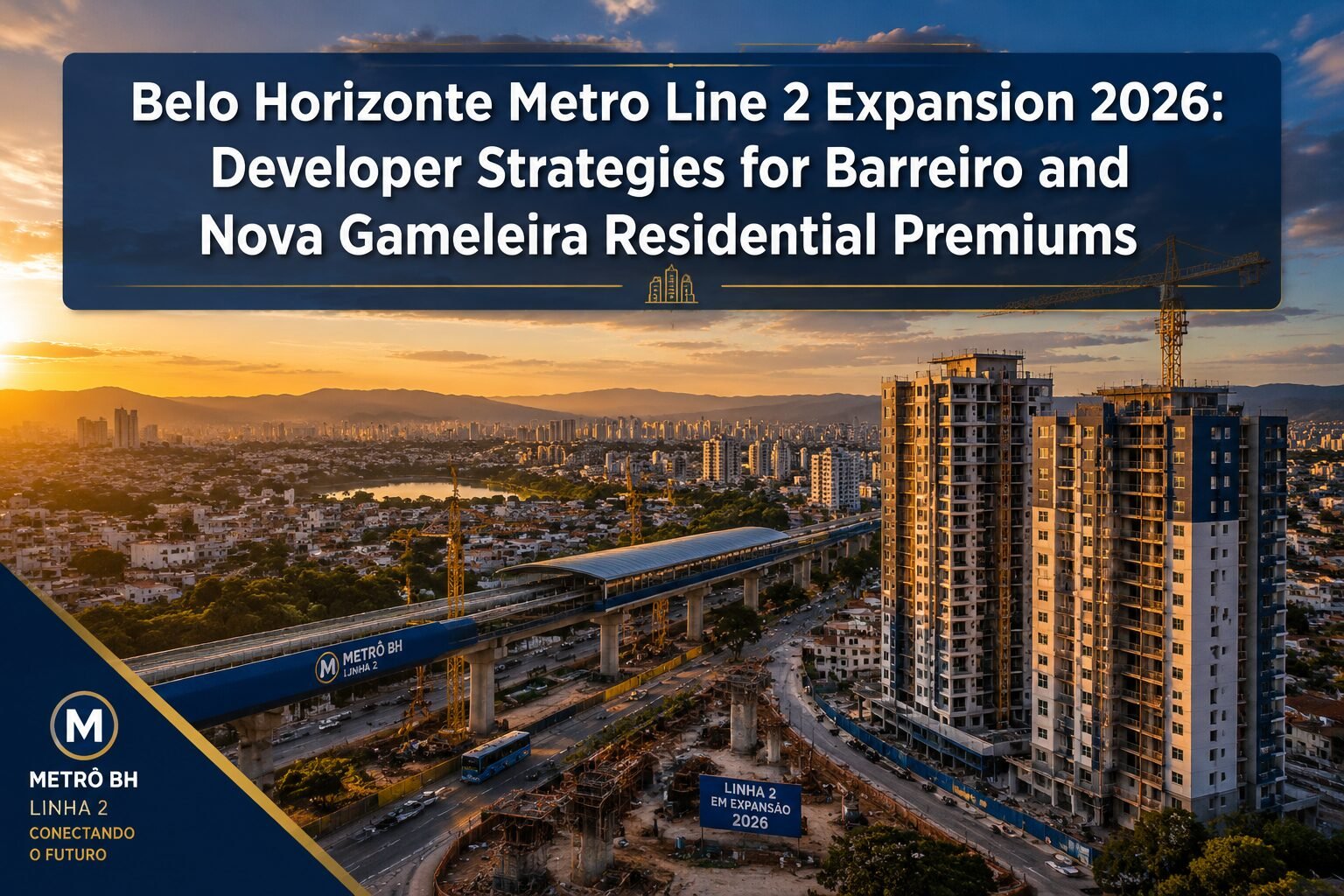
Property values within 800 meters of a new metro station typically rise between 15% and 30% before the first train ever runs — and in Belo Horizonte, that window is open right now. The Belo Horizonte Metro Line 2 Expansion 2026: Developer Strategies for Barreiro and Nova Gameleira Residential Premiums is not a distant forecast. With two stations set for inauguration in July 2026 and R$ 3.2 billion committed to the project, the western corridor of Brazil’s third-largest city is entering a transformation cycle that forward-thinking developers cannot afford to ignore [2][5].
This article breaks down the construction timeline, the neighborhoods with the highest upside, and the tactical playbook for capturing transit-oriented residential premiums in Nova Gameleira, Nova Suíça, and the broader Barreiro corridor.
Key Takeaways
- 🚇 Line 2 spans 10.5 km with seven new stations, connecting Belo Horizonte’s center-south to its western region, benefiting an estimated 90 neighborhoods [2].
- 📅 Two stations open in July 2026, with the remaining five — including Nova Gameleira and Barreiro — targeted for delivery by 2028 [5].
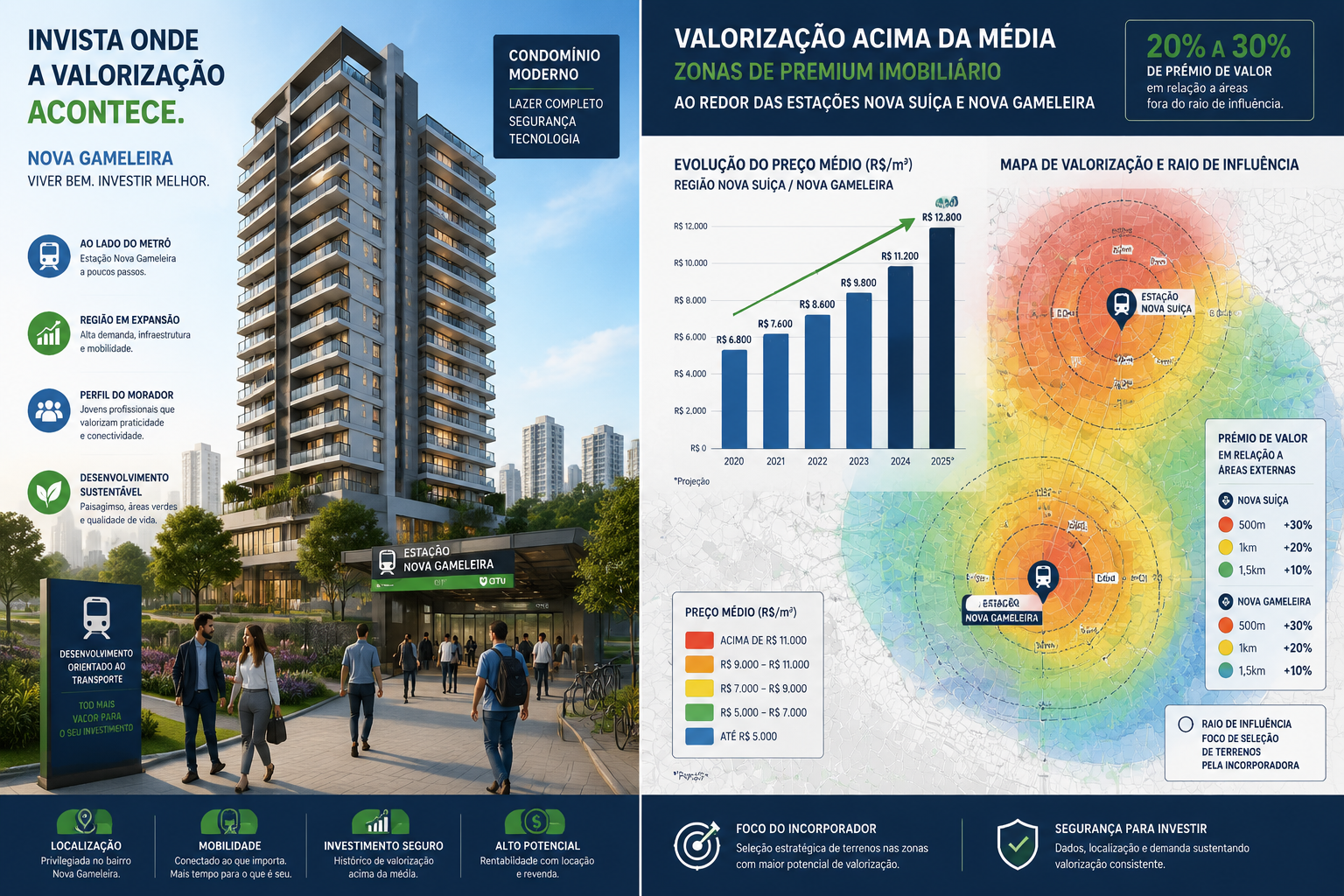
- 💰 Property value premiums of 20–30% are projected near Nova Suíça and Nova Gameleira stations, driven by transit-oriented demand from young professionals.
- 🏗️ R$ 3.2 billion in concession funding is backing the project under Grupo Comporte’s 30-year operating agreement [2].
- 📍 Site selection within 600–800 meters of confirmed station locations is the critical first-mover advantage for residential developers in 2026.
Understanding the Line 2 Route: Scope, Timeline, and the Stakes for Developers
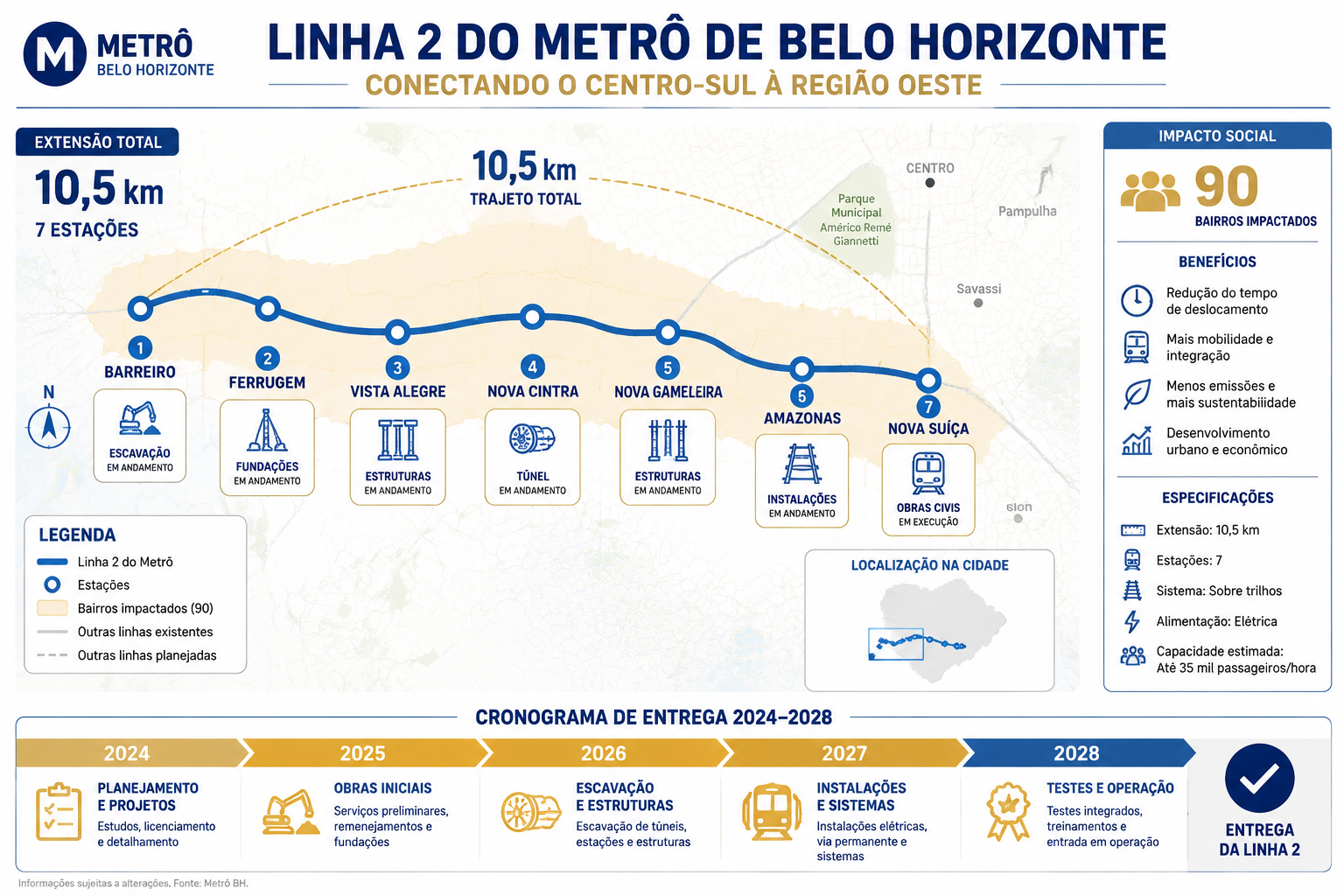
The Belo Horizonte Metro Line 2 Expansion 2026 is the most significant urban mobility investment in Minas Gerais in a generation. The Blue Line stretches 10.5 km and introduces seven new stations: Barreiro, Ferrugem, Vista Alegre, Nova Cintra, Nova Gameleira, Amazonas, and Nova Suíça [2]. The route links the city’s center-south axis to its historically underserved western region, threading through hospitals, schools, and commercial hubs that already generate enormous daily foot traffic.
Grupo Comporte took over operations in March 2023 after acquiring CBTU-MG and VDMG, signing a 30-year concession and committing R$ 3.2 billion to modernize Line 1 and build Line 2 from the ground up [2]. Construction officially started in September 2024, with Estação Amazonas being the first station built. The full system delivery is targeted for 2028 [2].
The 2026 Milestones That Matter Most
The near-term timeline is where developer opportunity crystallizes:
| Milestone | Expected Date | Significance |
|---|---|---|
| Estação Novo Eldorado delivery | March 2026 | Adds 1.6 km to existing system [2] |
| Two Line 2 stations inaugurated | July 2026 | First operational proof of concept [5] |
| Ferrugem Transposition works begin | April 2026 | Critical for Barreiro reach [3] |
| Ferrugem viaduct active construction | May 2026 | Confirmed by drone footage [7] |
| Remaining 5 stations (incl. Nova Gameleira, Barreiro) | 2028 | Full western corridor unlocked [5] |
The Amazonas station — the most advanced structurally — has completed its concrete shell and moved into finishing phases. Escalators are installed, blue visual identity signage is being applied, and surrounding urban furniture is being finalized. Full operation still depends on rail track installation and electrical network completion, with launch expected in the second half of 2026 [1].
Meanwhile, the Ferrugem Transposition — a suspended viaduct structure designed to cross the existing freight railway — has entered its intervention phase, a milestone that the Metro BH concessionaire describes as crucial for the route to physically reach the Barreiro region [3]. Drone footage from May 2, 2026 confirms active construction at the Ferrugem viaduct between Amazonas and Nova Suíça stations [7].
Passenger Capacity and Urban Scale
Once Line 2 is fully operational alongside a modernized Line 1, the combined system is projected to carry 270,000 passengers daily — 220,000 on Line 1 and 50,000 on the new Blue Line [2]. For developers, that number translates directly into a captive residential market: workers, students, and young professionals who will pay a premium to live within walking distance of a station.
Developer Strategies for Barreiro and Nova Gameleira Residential Premiums: Site Selection and Product Positioning
The Belo Horizonte Metro Line 2 Expansion 2026: Developer Strategies for Barreiro and Nova Gameleira Residential Premiums conversation starts and ends with one question: where exactly should you build, and what should you build there?
The 800-Meter Rule and Why Nova Suíça Is First-Mover Territory
Transit-oriented development (TOD) research consistently shows that the strongest property premiums cluster within 600 to 800 meters of a station entrance. Beyond that radius, the premium fades rapidly. In Belo Horizonte’s western corridor, the stations with the most immediate developer relevance in 2026 are Nova Suíça and Nova Gameleira, for distinct but complementary reasons.
Nova Suíça sits at the eastern anchor of the new line’s western segment. It already benefits from proximity to established commercial activity and has better existing infrastructure than stations deeper into the corridor. With Amazonas station approaching operational status and Ferrugem viaduct construction confirmed active [7], Nova Suíça is the logical next domino.
Nova Gameleira represents a longer-horizon play with potentially higher upside. The neighborhood has historically been undervalued relative to its geographic position — close to the Gameleira district’s commercial spine and well-connected by bus. A metro station transforms that equation entirely. Analysts tracking similar Brazilian metro expansions in São Paulo and Fortaleza have observed 20–30% price-per-square-meter increases in comparable mid-range residential submarkets within 24 months of confirmed station delivery.
Product Type: The Mid-Range Compact Condo Thesis
The demand profile in Nova Gameleira and Nova Suíça is not luxury. It is young professionals, healthcare workers, and university students — demographics that prioritize commute time over square footage. The winning product in this market is a compact, well-designed condo unit in the 35–55 m² range, priced within Minha Casa Minha Vida (MCMV) upper bands or just above, with amenities that signal modernity: co-working lounges, bike storage, smart access, and rooftop social areas.
💬 “The developer who builds the right product at the right radius before the station opens captures both the construction-phase appreciation and the post-opening demand surge — two separate return events in one project cycle.”
This double-return dynamic is well-documented in Brazilian real estate. Understanding how off-plan appreciation works in practice is essential for developers and investors entering this corridor now, before the July 2026 station openings shift market pricing permanently.
Tactical Site Selection Checklist for the Barreiro Corridor
Before committing to a land acquisition in the Nova Gameleira–Barreiro corridor, developers should verify:
- ✅ Distance to confirmed station entrance: Target under 700 meters on foot
- ✅ Zoning compatibility: Confirm ZAP (Zona de Adensamento Preferencial) or equivalent classification under BH’s Plano Diretor
- ✅ Topography: Belo Horizonte’s hilly terrain can dramatically affect walkability scores — flat or gently sloping parcels command a premium
- ✅ Existing bus integration: Stations that serve as intermodal hubs generate higher sustained ridership and residential demand
- ✅ Land tenure clarity: Avoid parcels with IPTU debt or irregular registration — metro-adjacent land has attracted speculative informal transactions
- ✅ Competition mapping: Identify existing approved projects within the 800-meter radius before pricing your land acquisition
For developers exploring how innovative financing structures — including digital asset mechanisms — can fund transit-oriented projects, emerging approaches in real estate financing offer useful context on where the industry is heading.
Risks, Timelines, and How Developers Can Hedge Against Construction Delays
No infrastructure project in Brazil runs without risk, and the Belo Horizonte Metro Line 2 Expansion 2026: Developer Strategies for Barreiro and Nova Gameleira Residential Premiums framework must account for the real possibility of timeline slippage. The Ferrugem Transposition is the single most critical bottleneck: it is a complex suspended structure crossing active freight rail, and any delay there directly pushes back the Barreiro and Nova Gameleira station openings [3].
Key Risk Factors
| Risk | Probability | Mitigation Strategy |
|---|---|---|
| Ferrugem viaduct delay | Moderate | Focus initial projects on Nova Suíça (less dependent on Ferrugem) |
| Electrical/rail installation lag at Amazonas | Low-Moderate | Already flagged as critical path item [1] |
| Regulatory/zoning changes in BH | Low | Engage municipal planning office early |
| Market saturation near early stations | Moderate | Differentiate on product quality, not just location |
| Demand shortfall if ridership underperforms | Low | 270,000 daily passenger projection is conservative [2] |
The Phased Development Approach
Smart developers are not waiting for 2028 to act — but they are also not betting everything on a single station. A phased portfolio approach works as follows:
- Phase 1 (2026): Acquire land and launch pre-sales near Nova Suíça and Amazonas, leveraging the confirmed July 2026 opening momentum [5].
- Phase 2 (2026–2027): Monitor Ferrugem viaduct progress and Nova Gameleira zoning updates. Secure options on preferred parcels without full commitment.
- Phase 3 (2027–2028): Launch Nova Gameleira and Nova Cintra projects as station delivery approaches, capturing the final pre-opening appreciation wave.
This mirrors successful strategies used in other Brazilian metro corridors. For broader context on identifying high-return property markets in Brazil, a detailed analysis of the best places to invest in Brazilian real estate provides useful comparative benchmarks.
The Barreiro Equation: Long Game, High Reward
Barreiro is the terminal station and the most transformative in terms of urban impact. The region already functions as a sub-center for BH’s western zone, with its own commercial district, hospitals, and educational institutions. Line 2 reaching Barreiro is projected to benefit 90 neighborhoods across the metropolitan area [2]. However, Barreiro is also the furthest from current construction progress and most dependent on the Ferrugem Transposition being completed [3].
For developers with a 5–7 year horizon, Barreiro land acquisition in 2026 at pre-metro prices represents the highest-upside play in the entire corridor. For those with 2–3 year exit timelines, Nova Suíça and Nova Gameleira are the more appropriate targets.
Connecting the Dots: What This Means for the Brazilian Residential Market
The Belo Horizonte metro expansion does not exist in isolation. It is part of a broader national trend of transit-led urban densification that is reshaping residential demand patterns in major Brazilian cities. Developers who have mastered this playbook in São Paulo’s metro expansions are now looking at BH’s western corridor with serious intent.
For investors and developers tracking multiple Brazilian markets simultaneously, understanding how different cities are performing is critical. Current trends in Brazil’s high-growth real estate markets offer useful comparative data, even across different regional contexts.
The Line 2 expansion also underscores a structural shift in buyer preferences. Post-pandemic, proximity to transit has replaced proximity to parking as the primary location driver for urban buyers under 35. Compact, well-connected units near metro stations are outperforming larger suburban units in virtually every Brazilian metro market tracked in 2026.
For developers interested in how sales performance is evolving in competitive urban markets, insights into how sales strategy is transforming the residential sector offer tactical lessons that translate across city boundaries.
The studio and compact-unit segment near transit hubs is particularly compelling. The investment case for compact residential units near high-density transit corridors is well-established and directly applicable to the Nova Gameleira and Nova Suíça opportunity.
Conclusion: Act Before the Trains Run
The Belo Horizonte Metro Line 2 Expansion 2026: Developer Strategies for Barreiro and Nova Gameleira Residential Premiums opportunity is time-sensitive by definition. The premium compression happens in stages — and the largest gains go to those who move before each stage closes.
With two stations confirmed for July 2026 inauguration [5], Amazonas in advanced finishing phases [1], and the Ferrugem viaduct actively under construction [7], the infrastructure risk has materially decreased. What remains is execution risk — and that is something developers can control.
Actionable Next Steps for Developers and Investors in 2026
- Commission a micro-market study for parcels within 800 meters of Nova Suíça and Nova Gameleira station coordinates — pricing data from Q1 2026 will serve as your baseline.
- Engage a BH-based urban planning attorney to verify zoning classifications and flag any Plano Diretor amendments affecting density allowances near Line 2 stations.
- Design for the actual buyer: 35–55 m² units with co-working amenities, bike infrastructure, and smart-home features targeting healthcare workers, students, and young professionals.
- Structure pre-sales launches to coincide with the July 2026 station inaugurations — market sentiment will peak at that moment.
- Monitor the Ferrugem Transposition monthly — its completion timeline is the single most important variable for the Barreiro and Nova Gameleira delivery schedule [3].
- Build a phased land option strategy rather than committing full capital to a single station area — preserve flexibility for the 2027–2028 delivery wave.
The western corridor of Belo Horizonte is not yet priced for what it is about to become. That gap between current valuation and post-metro reality is where developer returns are made.
References
[1] Watch (Amazonas Station Progress) – https://www.youtube.com/watch?v=zRCAkXyiBWQ
[2] Watch (Line 2 Route and Scope) – https://www.youtube.com/watch?v=ef7N9lRW2Z8
[3] Barreiro Mais Perto Nova Fase Da Linha 2 Em Bh – https://viatrolebus.com.br/2026/04/barreiro-mais-perto-nova-fase-da-linha-2-em-bh/
[4] Belo Horizonte Metro – https://en.wikipedia.org/wiki/Belo_Horizonte_Metro
[5] Linha 2 Metro Bh Inauguradas Julho – https://bhaz.com.br/noticias/bh/linha-2-metro-bh-inauguradas-julho/
[6] Belo Horizonte Metro Expansion Confirmed – https://www.railjournal.com/regions/central-south-america/belo-horizonte-metro-expansion-confirmed/
[7] Watch (Ferrugem Viaduct Drone Footage, May 2026) – https://www.youtube.com/watch?v=K4yuYeHTQo8