
Over R$4 billion in federal infrastructure investment has been committed to a single Amazonian city — and the developers who understand why stand to capture outsized returns for years to come. [1][2]
COP30-Driven Development in Belém: Which Residential and Mixed-Use Projects Stand to Benefit? is not just a question for climate policy watchers. It is the most pressing strategic question facing real estate investors, urban developers, and city planners operating in northern Brazil right now. The UN Climate Conference, held in Belém in 2026, has triggered an infrastructure wave that is reshaping entire neighborhoods, unlocking new mobility corridors, and creating demand for residential and mixed-use projects that did not exist three years ago.
This article uses COP30 as a lens to identify the specific neighborhoods, infrastructure corridors, and project types most likely to see accelerated approvals, sustained public investment, and strong demand uplift — and explains how developers can position themselves to capture those benefits.
Key Takeaways 🗝️
- R$4 billion+ in federal infrastructure investment is creating permanent urban legacy assets in Belém, directly boosting residential and mixed-use real estate values [2]
- Six major infrastructure corridors — including linear parks, road expansions, and drainage systems — define the highest-priority development zones in 2026
- 26,000+ new accommodation beds were created for COP30, permanently expanding Belém’s hospitality and short-term rental market [1]
- Climate resilience and social equity are now baseline expectations for projects seeking public support and financing in the city [6][8]
- Developers who align projects with bioeconomy, sustainable design, and SDG frameworks gain access to international financing and policy fast-tracking [3][10]
The Infrastructure Map: Where COP30 Money Is Flowing
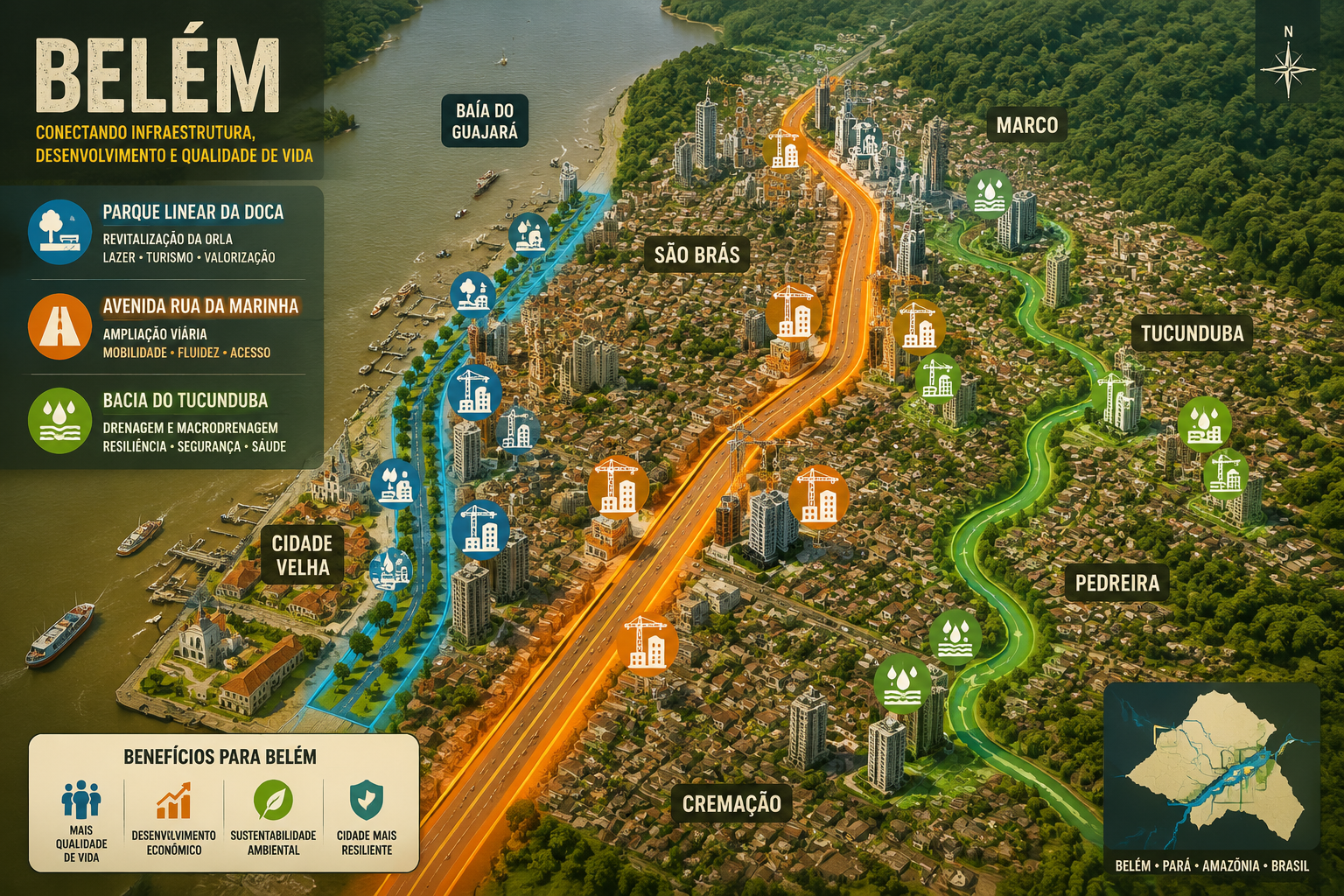
Understanding COP30-driven development in Belém starts with mapping where public money has actually landed. Federal and state governments did not distribute investment evenly across the city. Instead, spending concentrated along specific corridors and around key anchor projects — and those anchors are now pulling private capital in their direction.
The Doca Linear Park Corridor
With 97% of works completed by August 2025, the Doca Linear Park transformed a neglected urban canal into a premium leisure and mobility spine. [2] The project delivered:
- 🌳 200 newly planted trees
- 🚴 Dedicated bike paths and walkways
- 🏋️ Outdoor gyms and children’s playgrounds
- ☕ Commercial kiosks and lookout points
This is not a park. It is a value creation engine. Properties adjacent to completed linear parks in Latin American cities typically see 15–25% appreciation premiums within five years of opening. The Doca corridor is now one of Belém’s most compelling locations for mid-to-high-end residential towers with ground-floor retail — the classic mixed-use formula that performs best near activated public space.
The Tamandaré Basin Corridor
Running 1.4 kilometers, the Tamandaré Linear Park was set for completion in September 2025. [2] Like the Doca project, it combines drainage and sewage infrastructure with landscape improvements, bike paths, and community amenities. The dual function — flood control and placemaking — is critical for developers. It means that previously unbuildable or flood-prone land adjacent to the canal is now entering the developable land market.
“Infrastructure that solves flooding and creates parks simultaneously is the most powerful land-value catalyst in tropical cities.”
Residential projects targeting the Tamandaré corridor benefit from both improved buildability and a newly activated public realm that justifies premium pricing.
The Rua da Marinha Mobility Corridor
A 3.5-kilometer road expansion that widened streets from 2 to 6 lanes and linked six previously disconnected neighborhoods created one of the most significant development corridors in recent Belém history. [2] Mobility improvements of this scale do three things for real estate:
- Reduce effective commute times, expanding the catchment area of employment centers
- Create ground-floor retail demand along newly trafficked arterials
- Enable higher-density zoning as infrastructure capacity arguments are resolved
Mixed-use projects along the Rua da Marinha corridor — combining residential floors above commercial ground floors — are well-positioned to capture both the mobility premium and the retail demand generated by increased daily traffic volumes.
Which Project Types Stand to Benefit Most?
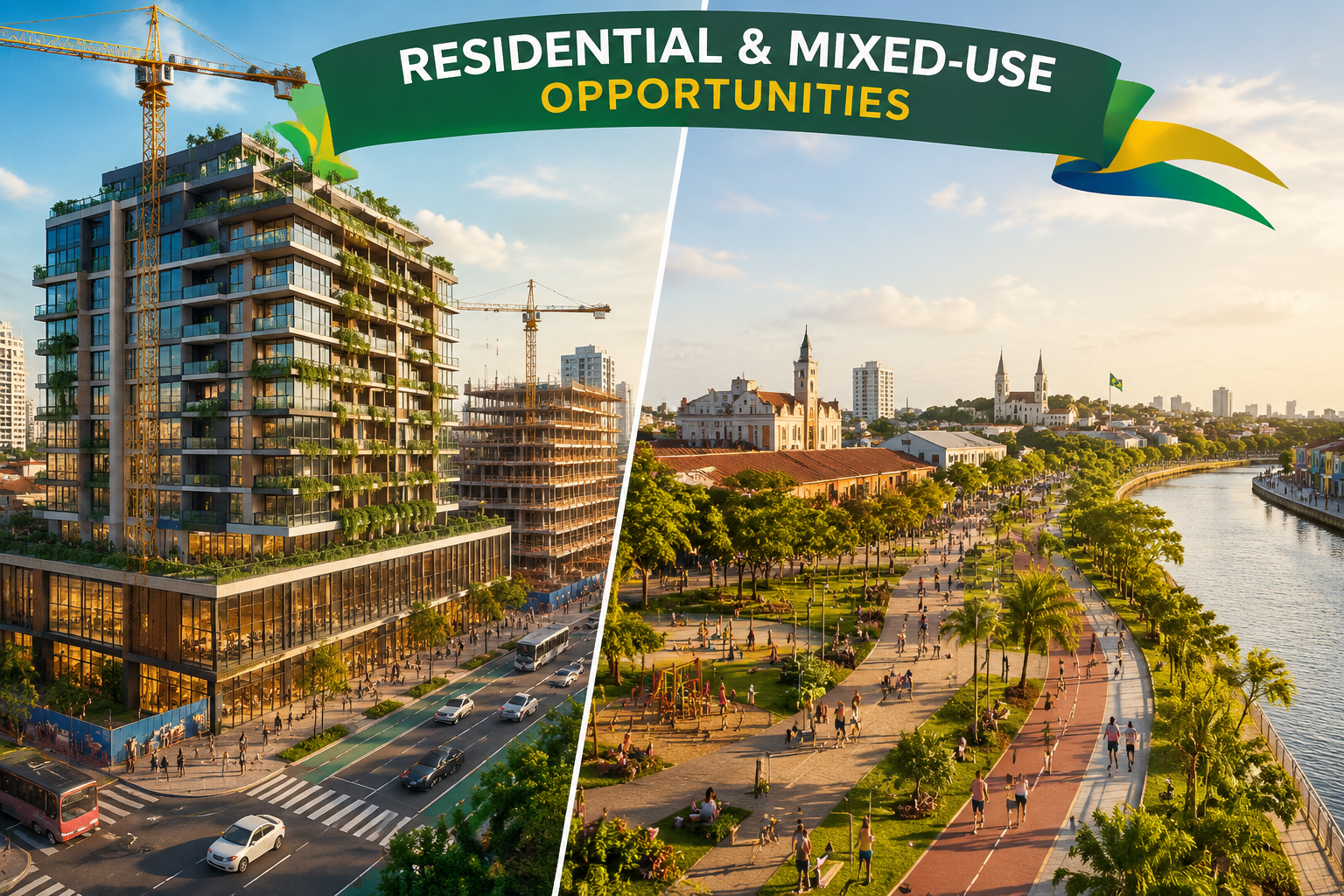
COP30-driven development in Belém has not created uniform opportunity. Different project types benefit from different aspects of the infrastructure wave. Here is a breakdown of the highest-potential categories:
🏢 Mixed-Use Residential Towers Near Linear Parks
The combination of activated public space, improved drainage, and new mobility infrastructure creates ideal conditions for mid-to-high-density mixed-use towers. These projects typically feature:
| Floor Range | Use Type | Demand Driver |
|---|---|---|
| Ground + 1 | Retail / F&B / Services | Increased foot traffic from parks |
| 2–4 | Commercial offices / Co-working | COP30 legacy business activity |
| 5+ | Residential apartments | Premium views, park access |
| Rooftop | Amenity deck / Green space | Sustainability positioning |
This typology aligns directly with what international investors and ESG-focused funds are seeking in emerging market cities. Developers who can demonstrate SDG alignment — particularly around clean energy, resilient design, and community access — gain access to financing structures that are simply unavailable to conventional projects. [3]
For investors considering how off-plan purchases can amplify returns in high-momentum markets, understanding why real estate development can maximize your gains when buying pre-launch is essential context — the same dynamics apply in Belém’s newly activated corridors.
🏨 Short-Term Rental and Hospitality-Hybrid Projects
The federal government facilitated the creation of over 26,000 new accommodation beds for COP30 attendees, including approximately 11,500 seasonal rental beds in houses and apartments. [1] This was not a temporary measure — it permanently expanded Belém’s hospitality infrastructure and demonstrated the city’s capacity to absorb international visitor volumes at scale.
The legacy effect is significant: Belém now has a proven short-term rental market with international visibility. Hospitality-hybrid projects — residential buildings with managed short-term rental programs — are a natural fit for neighborhoods near the Ver-o-Peso complex and the waterfront.
The Ver-o-Peso Complex renovation, the largest open-air market in Latin America, received R$66 million in total investment including R$11.2 million for sewage system upgrades, with 90% of works complete by August 2025. [2] The area surrounding this landmark is now primed for mixed-use development that captures both tourist traffic and local residential demand.
🌿 Bioeconomy-Integrated Mixed-Use Developments
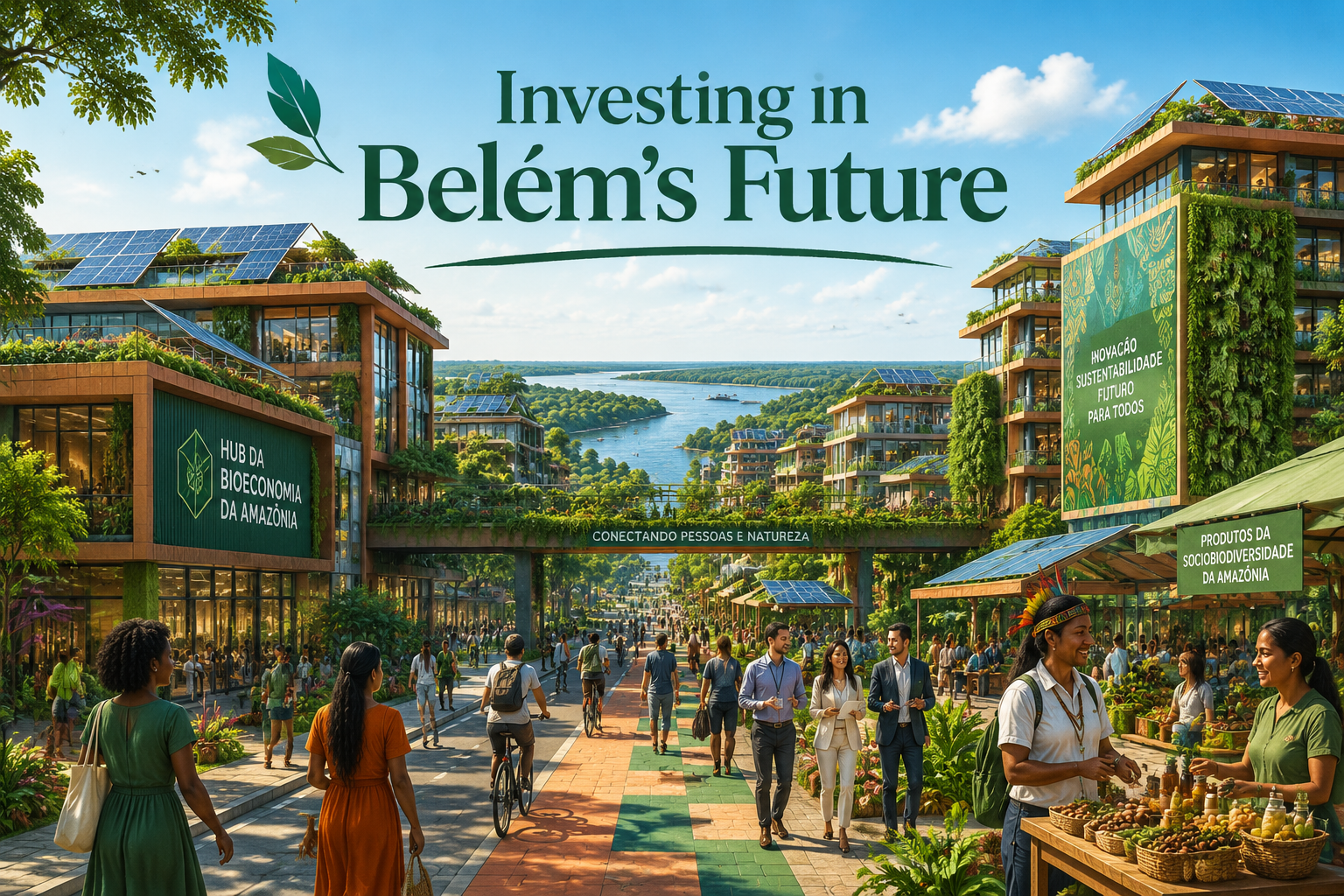
One of the most distinctive aspects of COP30-driven development in Belém is the explicit integration of bioeconomy infrastructure alongside urban improvements. [2] Federal investments included bioeconomy initiatives that signal a long-term economic repositioning of the Amazon region — away from extractive industries and toward sustainable value chains in food, pharmaceuticals, cosmetics, and carbon markets.
For developers, this creates an opportunity to design mixed-use projects that incorporate bioeconomy business infrastructure: research and development spaces, sustainable co-working environments, and residential components that attract the professionals driving this sector. Projects of this type are well-aligned with the SDG Pavilion themes that engaged 120+ partners from 90+ countries during COP30. [3]
🏘️ Climate-Resilient Social Housing
The Belém Call for Action on Housing launched during COP30 emphasized sustainable construction, affordability, and climate resilience as core priorities. [4] Habitat for Humanity’s participation in COP30 further highlighted the disproportionate climate risks facing informal settlements and the urgent need for climate-resilient residential development. [8]
This signals a policy environment that will increasingly fast-track and financially support housing projects that meet climate resilience standards — particularly those addressing informal settlement upgrading near the Tucunduba Basin, where macro-drainage works reached 83% completion by August 2025. [2]
Equity Considerations: The Risks Developers Must Address
Not all analysis of COP30-driven development in Belém is optimistic. Academic research has documented that construction projects associated with the conference have reproduced long-standing social inequalities and environmental injustices in the city. [6] Displacement of lower-income communities, uneven distribution of infrastructure benefits, and gentrification pressure are documented risks.
Developers who ignore these dynamics face real business risks:
- ⚠️ Community opposition that delays approvals
- ⚠️ Reputational risk with ESG-focused investors
- ⚠️ Regulatory exposure as equity-focused policies tighten
- ⚠️ Loss of access to international climate finance that requires social safeguards
The practical response is to build community benefit agreements into project design from the earliest stages — including affordable unit set-asides, local hiring commitments, and genuine community consultation processes. Projects that demonstrate equity alignment are better positioned for both public support and international capital. [9]
Neighborhood Spotlight: The Highest-Priority Zones in 2026
Based on the infrastructure investment map, six zones in Belém represent the highest concentration of COP30-driven development opportunity:
| Zone | Key Infrastructure Driver | Best Project Type |
|---|---|---|
| Doca Canal Area | Linear Park (97% complete) | Premium mixed-use residential |
| Tamandaré Basin | Linear Park + drainage | Mid-density residential |
| Ver-o-Peso Waterfront | Market renovation + sewage | Hospitality-hybrid / retail |
| Rua da Marinha Corridor | 6-lane road expansion | Ground-floor retail + residential |
| Tucunduba Basin | Macro-drainage (83% complete) | Climate-resilient social housing |
| Port / River Terminal Area | Modernized terminals | Mixed-use commercial + hospitality |
The port and river terminal area deserves special mention. Federal investment in river and port terminal modernization [2] positions this zone for the kind of waterfront mixed-use transformation seen in cities like Recife and Porto Alegre — where former industrial waterfronts became premium residential and commercial destinations over a 10–15 year horizon.
How Developers Can Position Projects for COP30-Era Success
The strategic window for COP30-driven development in Belém is real, but it is not unlimited. Infrastructure investment creates a 5–10 year window of accelerated appreciation before markets fully reprice the improvements. Here is how developers can act decisively:
✅ Practical Steps for Developers and Investors
- Map your site against the six infrastructure corridors identified above — proximity to completed or near-complete public works is the single strongest predictor of near-term value uplift
- Engage with SDG and climate finance frameworks early — projects that qualify for green bonds or climate-aligned financing access cheaper capital and faster approvals [3][10]
- Design for climate resilience from day one — flood-resistant foundations, passive cooling, and green infrastructure are no longer optional in Belém’s regulatory environment [8]
- Include bioeconomy-compatible spaces in mixed-use programs — co-working, research, and sustainable business infrastructure attract tenants aligned with the city’s economic future
- Build community benefit agreements into project governance before seeking approvals — this reduces opposition risk and strengthens ESG credentials [6]
- Consider hospitality-hybrid models for waterfront and park-adjacent sites — the proven short-term rental demand created by COP30 does not disappear after the conference [1]
For investors comparing Brazilian real estate opportunities across different markets, a broader look at the best places to invest in Brazil for high property returns provides useful context for positioning Belém within a national portfolio strategy.
Developers tracking how major events reshape urban real estate markets may also find useful parallels in how real estate market performance is transforming high-growth Brazilian cities — the demand dynamics triggered by infrastructure investment follow recognizable patterns across different geographies.
For those evaluating studio and compact unit formats as part of a mixed-use program — a format particularly well-suited to hospitality-hybrid models — the advantages of investing in studio apartments from a real estate development perspective offer directly applicable insights.
Finally, investors considering off-plan entry points in high-momentum markets should understand how pre-launch real estate purchases can amplify investment returns — a strategy that applies directly to Belém’s current development cycle.
Conclusion: Act on the Infrastructure, Not Just the Headlines
COP30 generated enormous global attention for Belém. But the real opportunity for residential and mixed-use developers is not the conference itself — it is the permanent infrastructure legacy that the conference forced into existence: completed linear parks, expanded mobility corridors, upgraded sanitation systems, modernized waterfront terminals, and a proven international hospitality market.
The six infrastructure corridors identified in this article — Doca Canal, Tamandaré Basin, Ver-o-Peso Waterfront, Rua da Marinha, Tucunduba Basin, and the Port Terminal area — define the geography of opportunity in Belém for the next decade. Projects positioned along these corridors, designed to meet climate resilience and equity standards, and structured to access international climate finance are the ones most likely to deliver strong returns while contributing to a genuinely better city.
Actionable next steps for developers and investors:
- 🗺️ Commission a site analysis mapped against the six infrastructure corridors
- 📋 Engage a sustainability consultant to assess SDG and green finance eligibility
- 🤝 Begin community engagement processes before formal approvals are sought
- 🏗️ Prioritize mixed-use typologies that combine residential, commercial, and bioeconomy-compatible spaces
- 📊 Monitor Belém’s zoning and approval pipeline for fast-tracked projects in the identified zones
To explore how leading developers are approaching high-growth Brazilian markets and to connect with professionals who understand infrastructure-driven real estate cycles, get in touch with our team or browse our current development portfolio for examples of projects built around long-term urban value creation.
References
[1] Cop Buildings Pavilion – globalabc.org
[2] With Most Projects Over 90 Complete Belem Prepares To Welcome The World – cop30.br
[3] Sdg Pavilion Cop30 Hub Action And Hope Belém – un.org
[4] Cop30 In Belem A Lackluster Agreement And A Major Climate Gap – construction21.org
[5] Takeaways Architects Cop30 Brazil – archpaper.com
[6] 10714839.2025 – tandfonline.com
[7] Cop30 Begins Bringing It Closer To Home – savills.co.uk
[8] Habitat Cop30 – habitat.org
[9] Cop30 Belem Putting People Heart Climate Action – iom.int
[10] Cop30 – cif.org