

Brazil’s construction sector faces a housing deficit of over 5.8 million units — yet the industry still loses an estimated 30% of project budgets to waste, rework, and schedule overruns on conventional masonry sites [1]. That gap between demand and delivery efficiency is exactly why Brazil Industrialized Construction in 2026: Where Prefab, Modular, and Panelized Systems Actually Cut Costs has moved from a niche conversation to a mainstream procurement decision.
But the buzzword cycle around “prefab” and “modular” has outpaced the evidence. Not every project type benefits equally. Some sectors see dramatic savings; others see cost overruns disguised as innovation. This article cuts through the noise to show where industrialized systems genuinely improve project economics in Brazil — and where they don’t.
Key Takeaways 📌
- Brazil’s modular construction market is projected to grow from ~USD 660 million (2025) to USD 1.08 billion by 2033 at a 6.4% CAGR [7]
- Social housing, public infrastructure, logistics warehouses, and data centers are the clearest winners from industrialized systems
- Cost savings come primarily from labor reduction, schedule compression, and lower financing costs — not from cheaper materials
- Luxury residential and highly customized projects rarely benefit and often cost more with modular approaches
- Brazil’s labor constraints and housing deficit pressure are the structural drivers making industrialized construction a durable trend, not a fad
The Market Reality: Steady Growth, Not a Revolution
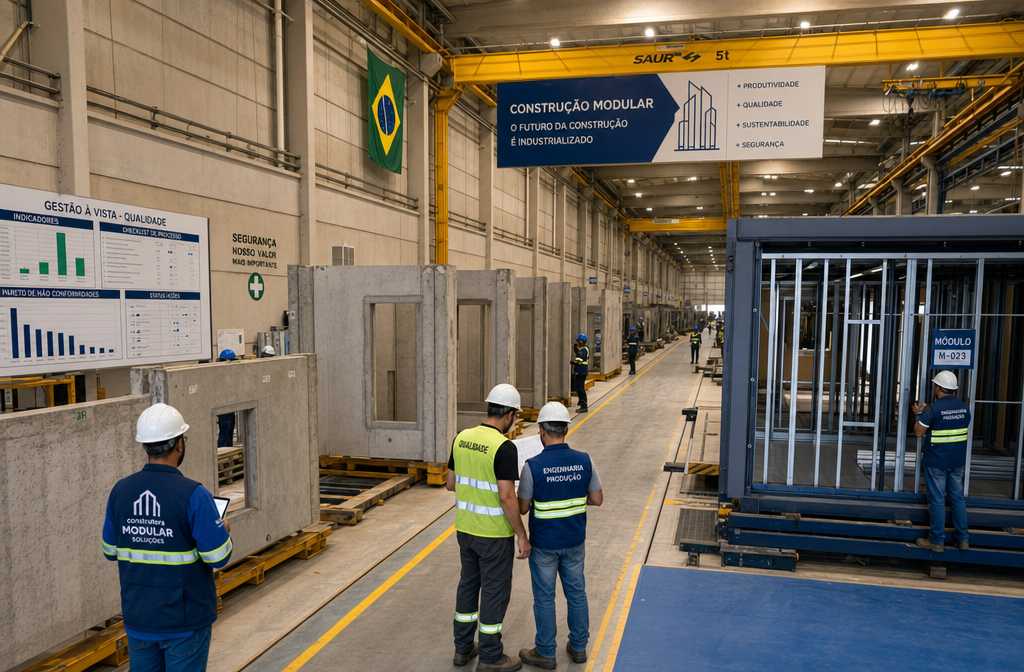
The phrase “industrialized construction” covers three distinct systems that are often conflated:
| System | How It Works | Best Use Case |
|---|---|---|
| Prefabricated | Components (beams, slabs, columns) made offsite, assembled on-site | Industrial, commercial, infrastructure |
| Modular (Volumetric) | Entire rooms or units built offsite, transported and stacked | Social housing, hotels, dormitories |
| Panelized | Flat wall, floor, or roof panels made offsite, assembled on-site | Residential, schools, clinics |
Understanding which system fits which project is the first step to actual cost control.
Brazil’s modular construction market is on a measured growth path — projected revenue of approximately USD 660.6 million in 2025, climbing to USD 1.0832 billion by 2033 at a compound annual growth rate of 6.4% [7]. That’s steady, not explosive. It signals that industrialized methods are becoming embedded in mainstream project pipelines rather than remaining pilot experiments.
💡 Pull Quote: “Industrialized construction in Brazil is not replacing conventional methods wholesale — it is capturing specific project types where repetition, scale, and speed create genuine economic advantages.”
The broader prefabricated buildings market in Brazil is also expanding, driven by urbanization pressure, a growing middle class, and increasing government procurement of standardized facilities [2]. Latin America as a whole is seeing governments and NGOs accelerate prefab ecosystems, with Brazil as the largest single market [5].
However, Brazil’s construction sector in 2026 still faces high interest rates and macroeconomic risks that make financing costs a critical variable in any build-versus-buy decision for industrialized components [10]. This context matters: the faster a project can be completed, the less time it spends accruing financing costs — which is one of the most underappreciated advantages of schedule compression.
Where Brazil Industrialized Construction in 2026 Actually Delivers Cost Savings
🏘️ Social Housing: The Strongest Economic Case
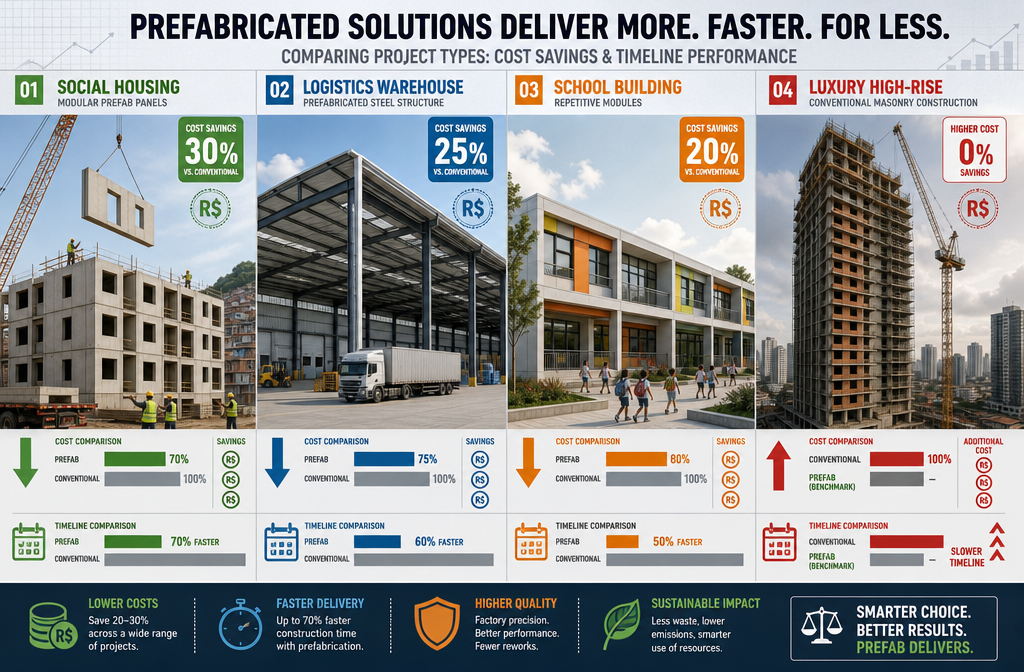
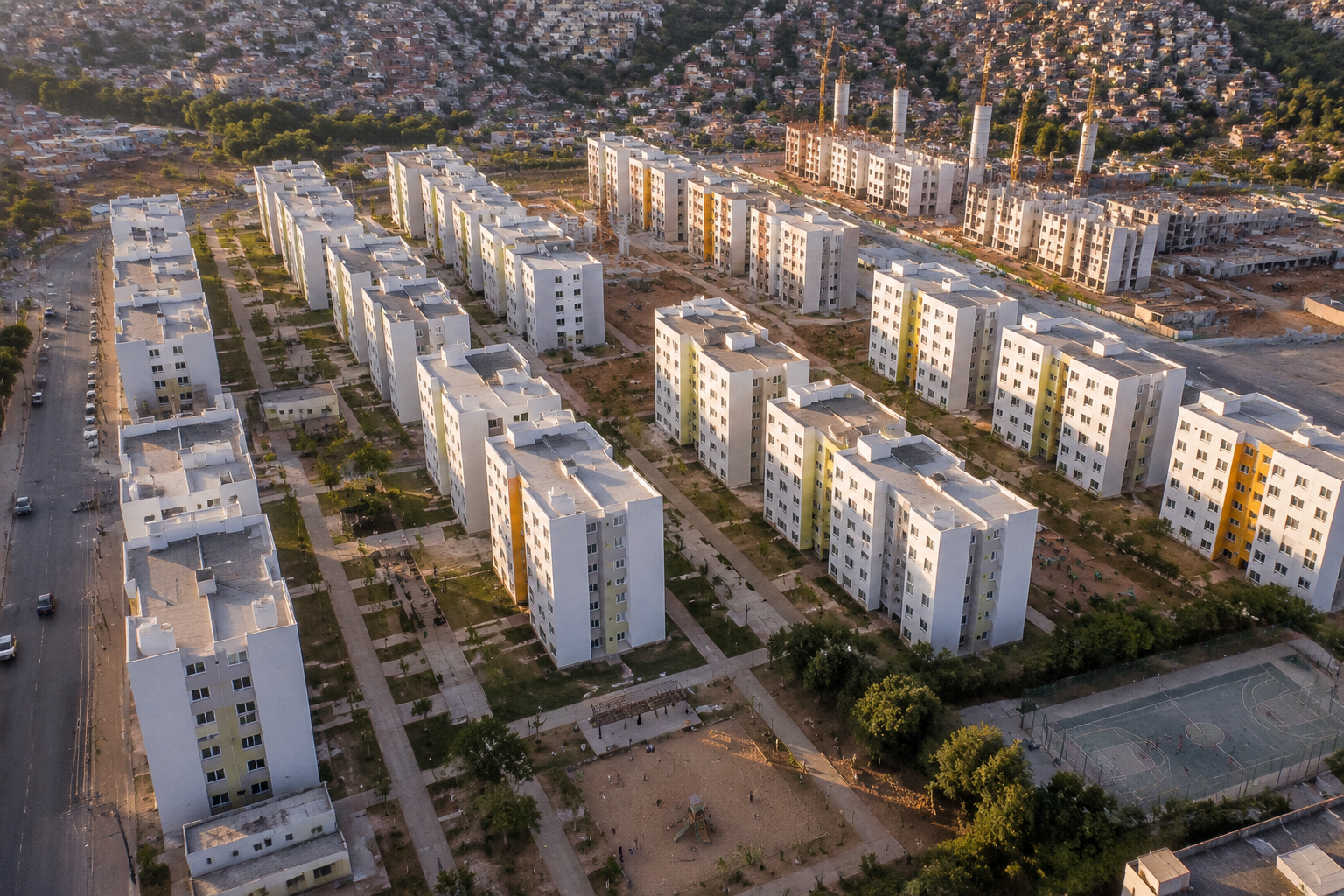
The clearest cost advantage for industrialized construction in Brazil sits squarely in social housing. With a deficit exceeding 5.8 million units — concentrated in urban peripheries — the economics of repetition are powerful [1].
Here’s why it works:
- Standardized layouts allow panelized or volumetric modules to be manufactured in bulk, driving down per-unit production costs
- Faster assembly reduces the on-site labor hours that are both expensive and increasingly scarce in Brazil’s skilled trades market
- Shorter project timelines directly reduce interest expense on construction financing, which at current Brazilian rates represents a significant share of total project cost
- Reduced rework from factory-controlled quality versus site-built masonry
Brazil has been actively studying filled-panel systems adapted from North American practice, which can reduce construction time by up to 60% compared to conventional masonry while also improving acoustic and thermal performance [4]. For social housing programs operating under tight per-unit cost caps, that time compression translates directly into budget compliance.
Public entities at federal, state, and municipal levels are increasingly specifying prefabricated solutions for social housing delivery — particularly where standardized layouts and repetitive modules maximize economies of scale [1].
For investors evaluating real estate development opportunities in Brazil’s growing urban markets, understanding how industrialized methods affect project timelines and returns is increasingly important when assessing off-plan purchases.
🏫 Public Infrastructure: Schools, Clinics, and Administrative Buildings
Repetitive public buildings are the second-strongest use case for industrialized construction in Brazil in 2026.
A typical public school or health clinic has:
- Standardized room dimensions
- Repetitive structural bays
- Predictable MEP (mechanical, electrical, plumbing) routing
- No premium placed on architectural uniqueness
These characteristics are exactly what modular and panelized systems are optimized for. Off-site production of classroom modules, for example, allows a school to be assembled in weeks rather than months — critical for disaster-recovery projects and for municipalities trying to meet enrollment deadlines [1].
Key cost drivers in public buildings:
- ✅ Reduced on-site labor supervision costs
- ✅ Fewer weather-related delays
- ✅ Standardized procurement reduces material price volatility exposure
- ✅ Factory quality control reduces post-handover defect claims
The Brazilian federal government’s procurement frameworks have been gradually expanding to accommodate prefabricated specifications, and this trend is accelerating as infrastructure backlogs grow [5].
🏭 Logistics Warehouses and Data Centers: The Private Sector Sweet Spot
In the private commercial sector, modular and prefabricated systems show their strongest competitive advantage in logistics warehouses and data centers.
Why these asset classes?
- Both require long-span structural systems that prefabricated steel and concrete excel at delivering
- Speed-to-revenue is paramount: a logistics hub delayed by six months costs its operator in lost lease income and supply chain disruption
- Data centers have highly standardized technical requirements that align well with modular construction logic
- Metal structural systems and prefabricated panels support the high bay heights and clear spans these buildings require
- Relocatability of some modular systems reduces lifecycle cost per usable square meter
Brazil’s e-commerce and logistics boom — particularly in secondary cities near major consumer markets — has created strong demand for fast-track warehouse construction where prefabricated steel structures are already the default choice for experienced developers.
For those exploring the best locations for high-return property investment in Brazil, logistics-adjacent markets in São Paulo state, Minas Gerais, and the South are seeing significant industrialized construction activity driven by this demand.
🏨 Hotels, Student Housing, and Dormitories: Volumetric Modular’s Niche
Volumetric modular construction — where entire rooms are built and fitted out in a factory — finds its best private residential application in hotels, student housing, and worker dormitories.
The logic:
- Identical room layouts repeated dozens or hundreds of times
- High labor content in fit-out (bathrooms, kitchens, fixtures) that benefits from factory conditions
- Predictable delivery schedule critical for hotel opening deadlines
Brazil’s expanding higher education sector and the growth of purpose-built student accommodation (PBSA) in university cities create a natural market for this approach. Similarly, large infrastructure projects in remote locations (mining, energy, agribusiness) have long used modular worker camps — a proven application with decades of Brazilian precedent.
Where Industrialized Systems Fail to Cut Costs — And Why
Honesty about limitations is what separates a useful analysis from a sales pitch.
Industrialized construction typically does NOT save money in:
| Project Type | Why It Fails |
|---|---|
| High-end custom residential | Uniqueness destroys the economies of repetition; custom molds and tooling cost more than skilled site labor |
| Complex mixed-use urban infill | Irregular sites, tight access, and unique floor plates eliminate modular logistics advantages |
| Low-rise masonry in low-labor-cost markets | Where skilled masonry labor is cheap and abundant, the capital cost of prefab components isn’t justified |
| Small-scale one-off projects | Setup, transport, and crane costs have high fixed components that don’t amortize over small volumes |
⚠️ Critical Point: The cost savings from industrialized construction are not primarily from cheaper materials — prefabricated components often cost more per unit than raw materials. Savings come from labor hours, schedule compression, and financing cost reduction. Projects that don’t have high labor intensity or long schedules rarely see net savings.
This is why developments in premium urban markets — like the high-specification residential projects emerging in Florianópolis’s growing real estate market — often combine industrialized structural systems with conventional finishing, capturing speed benefits without sacrificing design flexibility.
The Labor Constraint Factor: Brazil’s Hidden Driver
One structural factor that makes industrialized construction increasingly attractive in Brazil in 2026 is skilled labor scarcity.
Brazil’s construction workforce faces:
- An aging cohort of experienced tradespeople
- Young workers preferring formal employment over informal construction site work
- Geographic mismatch between labor supply and project locations
- Rising wage costs in competitive urban markets
Factory-based production concentrates skilled labor in controlled environments with better productivity, quality oversight, and working conditions. This matters not just for cost but for recruitment and retention — a factory job is easier to staff than a remote construction site.
The prefabricated home market in Brazil is responding to this dynamic, with manufacturers investing in production capacity to serve both the social housing and private residential segments [3].
For developers tracking construction progress and delivery reliability — like the accelerated foundation work seen at active Brazilian developments — industrialized methods offer a more predictable production curve than conventional site-based construction.
Regulatory and Financial Ecosystem: 2026 Update
Brazil’s regulatory environment for industrialized construction has been evolving:
- ABNT technical standards for prefabricated concrete and steel systems have been updated to accommodate modern modular approaches
- Caixa Econômica Federal financing programs increasingly accept prefabricated construction for social housing funding eligibility
- Environmental licensing for factory-based production is generally simpler than for large conventional sites, reducing permitting risk
- Minha Casa Minha Vida program updates have created procurement pathways for prefabricated social housing delivery [9]
The macroeconomic environment in 2026 remains challenging — high base interest rates mean that financing costs are a significant project expense [10]. This paradoxically strengthens the case for industrialized construction: any system that compresses the construction schedule by 30–50% directly reduces the months of financing cost exposure.
Investors looking at studio apartments and compact residential units in high-demand urban markets — a segment where studio investment in Florianópolis has shown strong returns — should understand how construction methodology affects delivery timelines and therefore investment returns.
Choosing the Right System: A Decision Framework
Before specifying an industrialized system, development teams should evaluate five criteria:
Repetition factor — How many identical or near-identical units/bays/rooms does the project contain? Below ~20 repetitions, economies of scale rarely materialize.
Labor market conditions — Is the project in a high-wage urban market or a labor-scarce location? Higher labor costs improve the prefab business case.
Schedule sensitivity — Does a faster completion date have measurable financial value (reduced financing, earlier revenue, penalty avoidance)?
Transport logistics — Can large prefabricated elements be delivered to the site without prohibitive transport costs? Remote sites with poor road access can eliminate the cost advantage.
Design flexibility requirement — How much architectural customization does the project require? Higher customization erodes the industrialized cost advantage.
Projects that score positively on at least three of these five criteria are strong candidates for industrialized construction. Projects scoring positively on only one or two should proceed with caution and conduct detailed cost modeling before committing to prefab specifications.
For developers and investors exploring active projects that apply modern construction methodologies, reviewing current developments in the Florianópolis market provides useful benchmarks for how Brazilian developers are integrating construction efficiency into project delivery.
Conclusion: Act on Evidence, Not Enthusiasm
Brazil Industrialized Construction in 2026: Where Prefab, Modular, and Panelized Systems Actually Cut Costs comes down to a simple principle: industrialization saves money where repetition, labor intensity, and schedule sensitivity align. It costs money where they don’t.
The market data is clear — a 6.4% CAGR through 2033 reflects genuine adoption, not hype [7]. The housing deficit of 5.8 million units creates durable demand for faster, more cost-efficient delivery methods [1]. And Brazil’s labor market dynamics are pushing the economics further in favor of factory-based production each year.
Actionable Next Steps ✅
- Developers: Audit your project pipeline for repetition factor and schedule sensitivity before defaulting to conventional masonry
- Investors: Ask developers specifically how construction methodology affects delivery timelines and financing cost exposure in any off-plan purchase
- Public sector buyers: Prioritize prefabricated specifications for schools, clinics, and social housing where standardized layouts are already required
- Industry professionals: Invest in supply chain relationships with certified prefab manufacturers now — capacity constraints will tighten as adoption accelerates
- Anyone evaluating Brazilian real estate: Connect with specialists who understand how construction methodology affects project returns to make informed decisions
The industrialized construction opportunity in Brazil in 2026 is real — but it rewards specificity over enthusiasm. Know your project type, run the numbers, and build where the economics actually work.
References
[1] Brazil Engineering And Modular Construction – trade.gov
[2] Brazil Prefabricated Buildings Market – mordorintelligence.com
[3] Brazil Prefabricated Home Market Size 2026 Tech Regions Ij3se – linkedin.com
[4] Brazil Copies The Usa And Canada To Create Completely Silent Houses With Filled Panels That Reduce Construction Time By Up To 60 Eliminate T Afch – en.clickpetroleoegas.com.br
[5] Latin America Prefabricated Construction Industry Report 2025 Governments And Ngos Accelerate Scalable Sustainable Prefab Ecosystems Forecast To 2029 – globenewswire.com
[7] Brazil Modular Construction Market – grandviewresearch.com
[9] Brazil Construction Industry Report 2026 160200758 – finance.yahoo.com
[10] Brazils Construction Sector 2026 Housing Programs Support Rates High Risks Persist – fastmarkets.com