
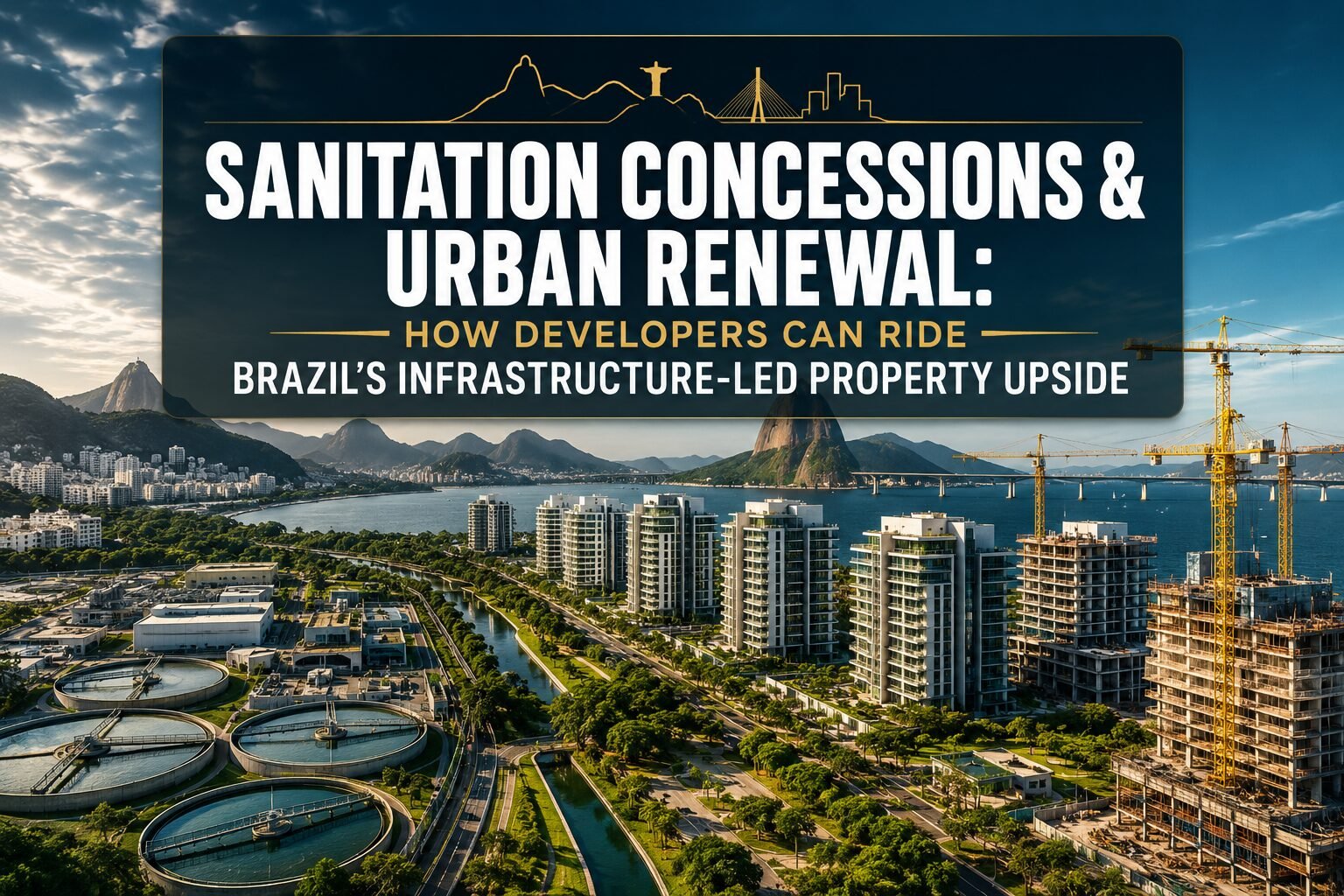
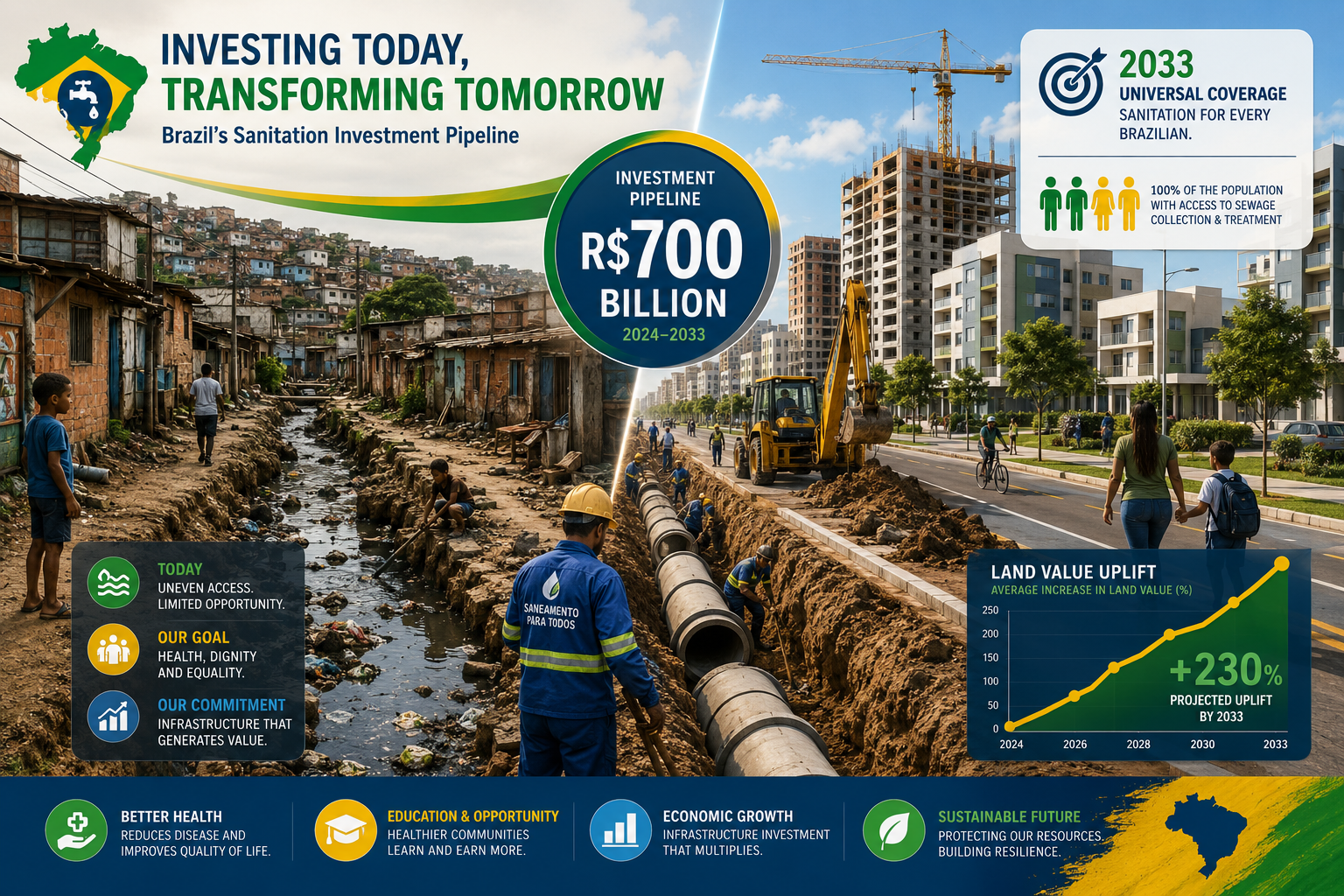
Brazil’s 2020 Legal Framework for Sanitation (Lei nº 14.026) has unlocked a projected R$700 billion in private investment commitments — and the developers who understand how to position around these concessions before land prices fully reprice stand to capture extraordinary returns. Sanitation concessions and urban renewal: how developers can ride Brazil’s infrastructure-led property upside is not a theoretical exercise. It is an active, time-sensitive playbook already reshaping land values from Pará to Santa Catarina. [1]
The core insight is deceptively simple: when basic sanitation arrives in an underserved area, formal housing absorption rates jump by double digits, land values begin repricing within 6 to 18 months of a concession award, and entire micro-markets shift from informal to bankable. [1] The challenge — and the skill — lies in identifying which concessions will actually be executed on schedule, underwriting the land value uplift correctly, and avoiding the trap of overpaying for hype that never converts into permits and pipes.
Key Takeaways 📌
- R$700 billion in projected private sanitation investment is flowing through Brazil’s post-2020 legal framework, creating measurable land value uplift corridors.
- Concession awards trigger land repricing within 6–18 months, but developers must distinguish between awarded and operational concessions to avoid overpaying.
- Urban renewal projects like Porto Maravilha demonstrate that infrastructure-linked financing mechanisms (CEPACs) can produce 60–80% property value increases over three years.
- States like Maranhão, Pará, and Santa Catarina represent the next frontier of infrastructure-led development opportunity in 2026.
- Disciplined underwriting — anchored to infrastructure delivery milestones, not announcements — separates profitable plays from speculative traps.
The Sanitation Investment Surge: Understanding the Scale of Opportunity
Brazil’s sanitation deficit has historically been one of the most significant drags on formal real estate development in secondary and tertiary cities. Before Lei nº 14.026, the country’s fragmented public utility model meant that vast urban peripheries lacked sewage collection entirely, making formal mortgage-backed housing economically unviable for developers and lenders alike.
The 2020 framework changed the incentive structure fundamentally. By mandating 99% potable water coverage and 90% sewage collection and treatment by 2033, and by opening the sector to private concessionaires, the law created a race among operators to bid for service territories — and a corresponding race among developers to identify which territories would be transformed first. [1]
Where the Money Is Flowing in 2026
The concession pipeline is not evenly distributed. Understanding the geographic concentration of capital is the first step in any infrastructure-led development thesis.
| State / Region | Operator / Concession | Committed Investment |
|---|---|---|
| Pará | Aegea (statewide) | ~US$4 billion [3] |
| Greater Rio de Janeiro | Iguá Saneamento (CEDAE Block 2) | R$7.286 billion grant fee [4] |
| Maranhão | Upcoming 2026 auction (214 municipalities) | ~US$3.4 billion [3] |
| Santa Catarina | State utility modernization | >US$5.4 billion [3] |
| Pernambuco | Two microregion concessions (Dec 2025) | ~US$3.5 billion committed [3] |
| Cariacica, ES | Aegea + Cesan PPP | R$580 million over 30 years [5] |
💡 Pull Quote: “The concession award is the starting gun, not the finish line. Developers who buy land on announcement day are often buying at peak speculation prices — before any pipe has been laid.”
Why Sanitation Specifically Moves Land Values
Not all infrastructure has equal impact on property values. Road improvements reduce commute times; power grid upgrades reduce operating costs. Sanitation, however, is a binary enabler for formal housing. Without it:
- Banks will not extend mortgages on properties in areas without sewage connections
- Municipal authorities will not issue habite-se (occupancy certificates)
- Middle-income buyers will not pay formal market prices
When sanitation arrives, all three constraints lift simultaneously. This creates a compressed repricing event — not a gradual appreciation curve — which is why the 6–18 month window after concession award is so critical for land acquisition. [1]
For developers exploring the best locations for high-return property investment in Brazil, understanding which municipalities sit inside active concession perimeters is now a core part of site selection. Best places to invest in Brazil property
Porto Maravilha and the CEPAC Model: Sanitation Concessions and Urban Renewal in Action
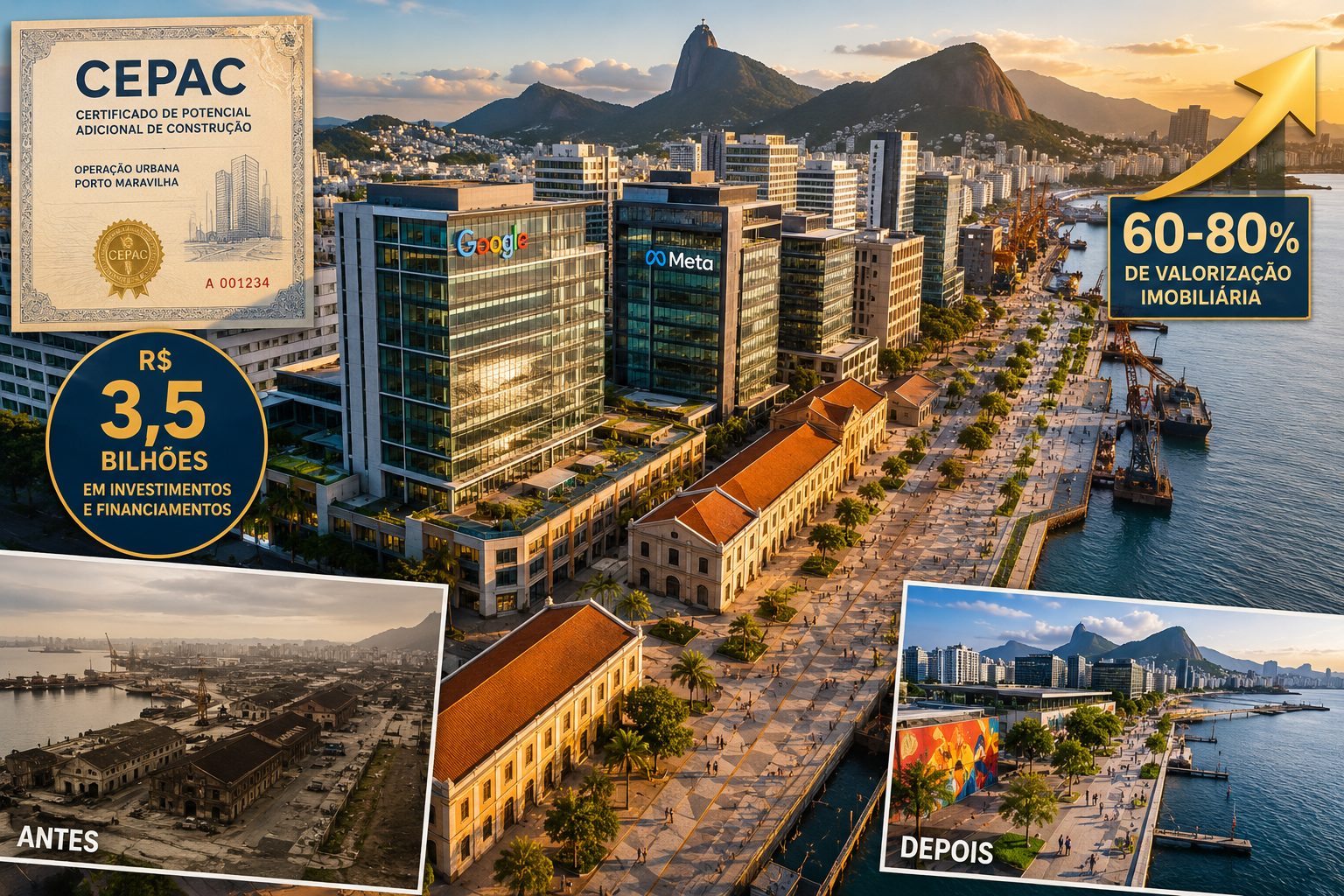
No case study better illustrates sanitation concessions and urban renewal: how developers can ride Brazil’s infrastructure-led property upside than Porto Maravilha in Rio de Janeiro. The R$8 billion urban renewal initiative transformed 5 million square meters of derelict waterfront into one of Latin America’s most sought-after mixed-use districts — and it did so using a financing mechanism that every developer working near concession corridors should understand. [2]
How CEPACs Work (And Why They Matter to Developers)
The Porto Maravilha project was financed primarily through Certificates of Additional Construction Potential (CEPACs) — tradable instruments that grant holders the right to build above baseline zoning limits within a defined urban operation perimeter. The project raised approximately R$3.5 billion through CEPAC sales, with proceeds funding drainage upgrades, sewage infrastructure, road reconstruction, and public space improvements. [2]
The result: 60–80% property value increases over three years, and the arrival of anchor tenants including Google and Meta, which validated the district as a credible business address. [2]
What developers can learn from this model:
- ✅ Infrastructure financing precedes value creation — CEPACs are sold before construction begins, meaning the market is pricing in future infrastructure delivery
- ✅ Anchor public investment de-risks private capital — when a municipality commits R$8 billion to a perimeter, private developers are not taking a leap of faith
- ✅ Zoning uplifts compound the infrastructure premium — higher FAR (floor area ratio) allowances mean the same land parcel can support significantly more buildable area
- ✅ Timing the entry matters — CEPAC prices rose as infrastructure milestones were hit, rewarding early buyers and punishing late entrants
Applying the Porto Maravilha Lens to Current Concession Corridors
The CEPAC model is not unique to Rio. Municipalities across Brazil are increasingly pairing sanitation concession perimeters with urban operation instruments (Operações Urbanas Consorciadas) that generate additional construction rights. Developers who map the overlap between:
- Active or upcoming sanitation concession boundaries
- Declared urban operation perimeters
- Municipal master plan (Plano Diretor) upzoning proposals
…will find the highest-conviction land acquisition opportunities available in Brazil in 2026.
Iguá Saneamento’s expansion into Greater Rio de Janeiro through the CEDAE Block 2 concession — secured with a R$7.286 billion grant fee — is already generating exactly this kind of secondary repricing in municipalities within the concession’s service territory. [4] Similarly, Iguá’s long-running Agreste Saneamento PPP in Alagoas, serving 377,000 residents under a 30-year agreement, demonstrates how sustained operator presence stabilizes the investment thesis over a full development cycle. [6]
Underwriting Infrastructure-Led Deals: Avoiding the Hype Trap
This is where most developers lose money. The narrative around sanitation-driven land appreciation is now widely understood — which means land sellers in concession corridors have already priced in some portion of the anticipated uplift. Disciplined underwriting requires separating announcement value from delivery value.
The Infrastructure Delivery Milestone Framework
Rather than underwriting to a single “concession awarded” trigger, experienced developers use a staged milestone framework:
| Milestone | Typical Land Price Impact | Developer Action |
|---|---|---|
| Concession tender announced | +5–15% (speculative) | Monitor; do not acquire |
| Concession awarded to operator | +10–25% (confirmed) | Begin site identification |
| Operator financing secured | +15–30% | Negotiate LOIs, option agreements |
| Construction mobilization visible | +25–50% | Execute acquisitions |
| First connections operational | +40–80% | Underwrite launches |
💡 Pull Quote: “Buy on the shovel, not on the press release. The gap between a concession announcement and the first operational connection can be 24–36 months — and land prices can correct significantly in between.”
Key Underwriting Variables for Sanitation-Adjacent Land
1. Concession operator track record Operators like Aegea and Iguá have demonstrated consistent execution across multiple states. [3][5][6] New or untested operators introduce delivery risk that must be discounted into land acquisition pricing.
2. Regulatory clarity and tariff approval Concession economics depend on approved tariff schedules. Contested tariff reviews can delay operator investment timelines by 12–24 months.
3. Municipal master plan alignment Sanitation infrastructure alone does not create development rights. Confirm that the target municipality’s Plano Diretor permits the density and use mix required for the intended product type.
4. Existing informal occupation density Heavily occupied informal areas within concession perimeters create resettlement risk and timeline uncertainty. Greenfield or lightly occupied parcels adjacent to concession boundaries offer cleaner execution paths.
5. Absorption rate benchmarks Double-digit increases in formal housing absorption are documented in areas receiving new sanitation services [1], but the baseline absorption rate matters. A market absorbing 50 units per month that jumps to 65 is very different from a market absorbing 200 units that jumps to 240.
Santa Catarina: A Case Study in Infrastructure-Driven Market Maturity
Santa Catarina illustrates what a mature infrastructure investment cycle looks like for property developers. With the state utility committing over US$5.4 billion to modernize and expand water and wastewater infrastructure [3], the state has seen sustained formal housing demand growth — particularly in coastal municipalities where sanitation coverage gaps previously constrained development density.
Florianópolis, the state capital, demonstrates how infrastructure investment compounds with lifestyle demand to create durable appreciation. The growth of the Ingleses region in Florianópolis is a direct example of how infrastructure upgrades, quality of life improvements, and developer activity reinforce each other in a virtuous cycle.
For developers evaluating studio and compact unit formats — which are particularly well-suited to sanitation-adjacent urban renewal zones where land costs are elevated — the advantages of investing in studios in Florianópolis offer a useful framework for product-market fit analysis.
The Florianópolis real estate market performance data further demonstrates how infrastructure-supported markets translate into measurable sales velocity improvements — the kind of data that underwrites a credible absorption assumption in a development feasibility model.

Building the Development Playbook: Practical Steps for 2026
Translating the macro thesis into executable development strategy requires a structured approach. Below is a condensed playbook for developers seeking to capitalize on sanitation concessions and urban renewal: how developers can ride Brazil’s infrastructure-led property upside without overpaying for speculative land.
Step 1: Map Active and Upcoming Concession Perimeters
Start with publicly available data from FUNASA, ANA (Agência Nacional de Águas), and state-level regulatory agencies. Cross-reference with trade sources tracking upcoming auctions — Maranhão’s 2026 concession covering 214 municipalities represents one of the largest near-term opportunities on record. [3]
Step 2: Score Municipalities by Development Readiness
Not every municipality within a concession perimeter is equally developable. Score each target on:
- 📊 Current formal housing absorption rate
- 🏗️ Existing developer pipeline (competition risk)
- 📋 Plano Diretor zoning flexibility
- 🔗 Proximity to employment anchors and transport corridors
- 💧 Estimated time to first operational sanitation connections
Step 3: Structure Land Acquisitions to Manage Delivery Risk
Use option agreements with milestone-linked exercise triggers rather than outright purchases. Structure options to expire if the operator fails to achieve defined construction milestones within a specified window. This transfers delivery risk back to the land seller while preserving the upside.
Step 4: Design for the Emerging Demand Profile
Sanitation-enabled markets typically see the strongest initial demand from first-time buyers accessing Minha Casa Minha Vida (MCMV) financing or lower-tier mortgage products. Product design should prioritize:
- Compact 2-bedroom and studio units in the R$200,000–R$350,000 range
- Efficient common areas that minimize maintenance costs
- Proximity to public transport (infrastructure investment often clusters)
For developers already active in markets like Florianópolis, projects such as Tramonto and Solis demonstrate how thoughtful product positioning in infrastructure-supported markets translates into strong pre-sales performance.
Step 5: Monitor the Conasa Model for Smaller City Opportunities
Conasa’s full water and sewage concessions in cities like Itapema (Santa Catarina) and Santo Antônio de Pádua (Rio de Janeiro), with contracts extending to 2035, illustrate how smaller cities can offer lower land acquisition costs with equivalent infrastructure-driven appreciation dynamics. [7] These markets are often overlooked by institutional developers focused on state capitals — creating genuine alpha for mid-size regional developers.
The Broader Urban Renewal Equation
Sanitation concessions and urban renewal: how developers can ride Brazil’s infrastructure-led property upside ultimately depends on understanding that sanitation is rarely the only infrastructure investment arriving in a given corridor. Concession operators typically coordinate with municipal governments on:
- Drainage and stormwater management upgrades — which reduce flood risk and unlock previously uninsurable parcels
- Road paving and sidewalk programs — which improve accessibility and formal address registration
- Street lighting and public space improvements — which shift neighborhood perception and attract retail investment
Each of these secondary investments compounds the initial sanitation-driven land value uplift. Developers who model only the sanitation impact will systematically underestimate total appreciation potential — but those who model all secondary effects without discounting for execution risk will overestimate it.
The discipline lies in weighting each infrastructure element by its probability of delivery within the development timeline, not by its theoretical maximum impact.
For developers interested in how alternative financing structures — including emerging digital asset mechanisms — can complement infrastructure-linked development strategies, the intersection of cryptocurrency and real estate development offers additional perspective on capital structure innovation in the Brazilian market.
Conclusion: Actionable Next Steps for Infrastructure-Savvy Developers
Brazil’s sanitation privatization wave is the most significant structural driver of real estate value creation in the country’s history. The R$700 billion investment pipeline, the Porto Maravilha precedent, and the active concession awards across Pará, Pernambuco, Santa Catarina, and the upcoming Maranhão auction all point to a multi-year window of infrastructure-led property upside. [1][2][3]
But the opportunity is not self-executing. The developers who will capture it are those who:
- Map concession perimeters now — before land prices fully reprice on announcement
- Underwrite to delivery milestones — not to press releases or auction results
- Structure acquisitions with option agreements — to manage operator execution risk
- Design products for the emerging demand profile — first-time buyers, compact formats, MCMV-compatible pricing
- Monitor secondary infrastructure investments — drainage, roads, and lighting that compound the sanitation premium
The window between concession award and operational connection is where the most attractive risk-adjusted land acquisition opportunities exist. In 2026, that window is open in multiple Brazilian states simultaneously — a convergence that has not existed before in the country’s infrastructure history.
Developers who approach this moment with analytical rigor, geographic specificity, and structured deal mechanics will find that Brazil’s infrastructure-led property upside is not hype. It is a quantifiable, underwritable thesis — and it is available right now.
References
[1] Sanitation Concessions In Brazil The 2026 Development Playbook For Housing Linked Growth Corridors – Sanitation concessions in brazil the 2026 development playbook for housing linked growth corridors
[2] Porto Maravilha Urban Renewal – riodejaneiro.ai
[3] Brazil Water Infrastructure Deals Update – trade.gov
[4] Igua To Acquire Concession In Cedae Water And Wastewater Services – ig4capital.com
[5] Ppp Cariacica Aegea Will Universalize City Sewage – bndes.gov.br
[6] Operations – ri.igua.com.br
[7] Sanitation – infraasset.com