
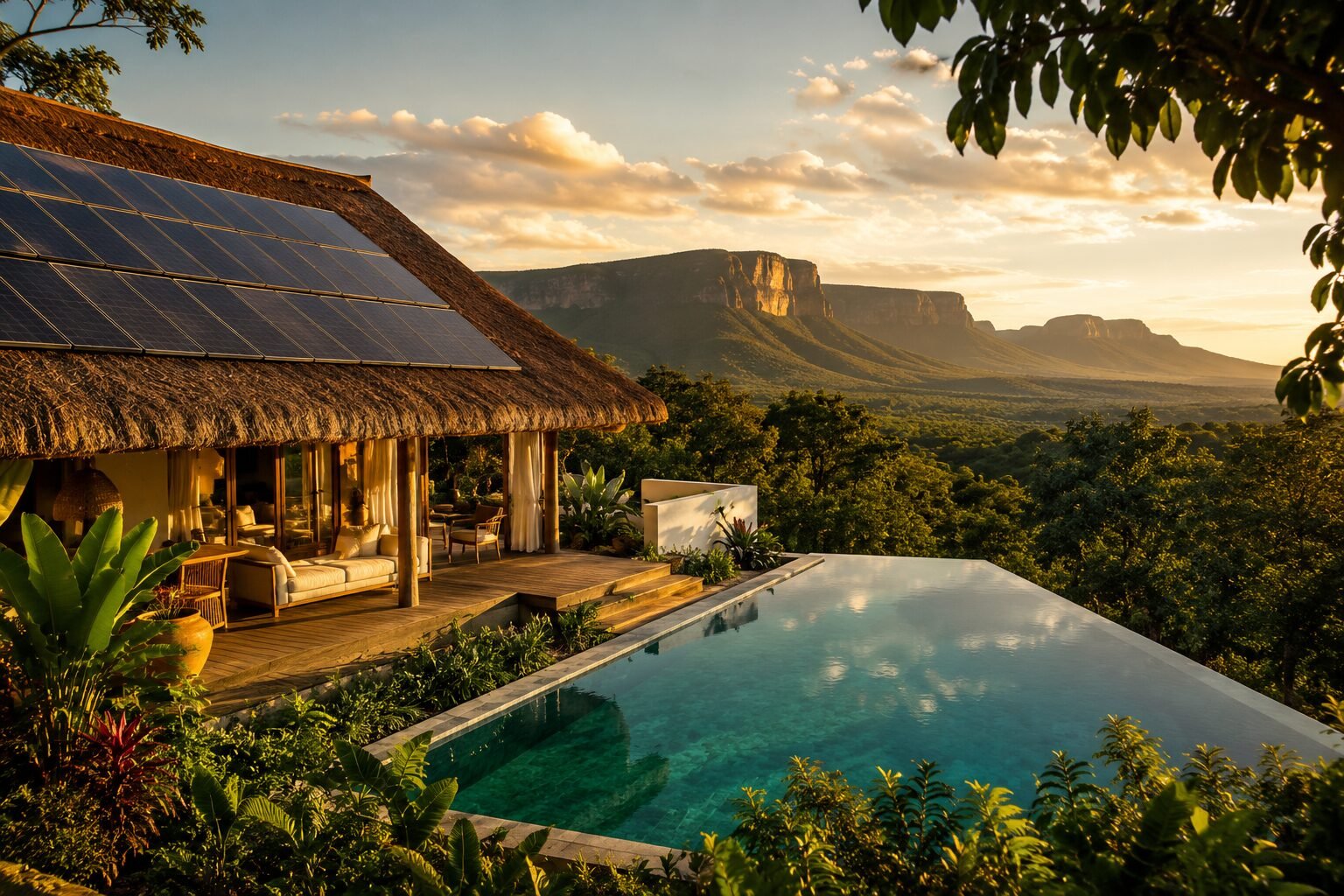
European institutional investors and high-net-worth buyers are paying a verified 15–25% price premium for resort properties in Bahia that carry credible environmental, social, and governance credentials — and the pipeline of solar-integrated developments is growing fast enough in 2026 to meet that demand. This shift is reshaping the entire investment thesis for Bahia’s interior and coastal-interior corridors, where ESG premiums in Bahia interior resorts 2026 are no longer a marketing footnote but a measurable line item in project feasibility models. Understanding what drives those premiums, which certification paths unlock them, and how global buyers can access green financing is now essential knowledge for anyone entering this market.
Key Takeaways
- Solar-integrated resorts in Bahia are commanding 15–25% price premiums over conventional developments, driven by European and global ESG-focused capital.
- Real operational examples — from Resort Arcobaleno’s 1,600-panel mini power plant to Tivoli Ecoresort’s renewable energy certificate — confirm that solar and renewable integration is already delivering measurable financial returns.
- Certification pathways (LEED, EDGE, PROCEL, and Brazilian Green Building Council standards) are the primary gatekeepers to premium pricing and green financing access.
- The Bahia state government’s active support for sustainable tourism infrastructure reduces regulatory risk for compliant developers.
- Interior and coastal-interior zones, including Mamucabo, Caldas do Jorro, and the Chapada Diamantina corridor, represent the highest-growth opportunity for ESG-aligned resort investment in Brazil right now.
Why ESG Premiums Are Reshaping Bahia’s Resort Market in 2026
The conventional wisdom that sustainability is a cost center rather than a revenue driver has collapsed in Bahia’s resort sector. Developers who integrated solar energy, sustainable construction materials, and community employment frameworks into their projects are now reporting faster sales cycles, higher per-unit prices, and stronger occupancy rates than their conventional competitors.
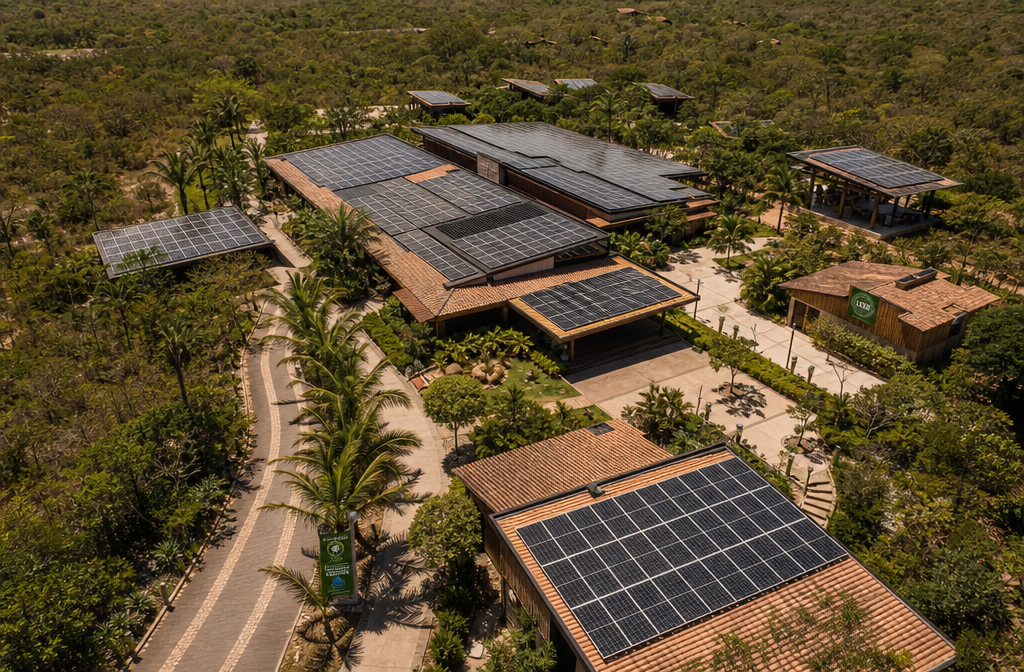
The evidence is concrete. Resort Arcobaleno in Porto Seguro installed a mini solar power plant with over 1,600 photovoltaic panels covering 4,300 m² in August 2025. The system generates approximately 120,000 kWh monthly, with projected annual savings of R$1 million [1]. That figure matters to investors because it transforms energy from a fixed operating cost into a competitive advantage — one that can be quantified in a discounted cash flow model and communicated clearly to ESG-screened investment funds.
At the same time, the Bahia state government inaugurated the Sol Grand Premium resort at Costa do Sauípe in March 2025, positioning it as the largest beach resort in Brazil and anchoring it with state incentives designed to stimulate sustainable tourism and regional employment [2]. This public-sector commitment signals reduced regulatory and political risk for compliant developers — a key factor for European buyers conducting due diligence.
What is driving European buyer demand specifically?
- EU Sustainable Finance Disclosure Regulation (SFDR) requirements are pushing European family offices and funds to demonstrate ESG-compliant allocations in their portfolios.
- The Brazilian real’s relative value against the euro continues to create favorable entry points for foreign capital.
- Bahia’s UNESCO-recognized natural assets and protected area network provide a defensible narrative for ESG-screened marketing.
- Multiproperty and fractional ownership models, such as WAM Experience’s January 2026 launch of Tree Bies Beach Resort in Subaúma [5], lower the capital threshold for international participation.
“A solar-powered resort in a protected natural corridor is not just an ethical choice — it is a risk-adjusted financial position that performs better across multiple market cycles.”
For buyers exploring the broader Brazilian real estate opportunity, understanding the best places to invest in Brazil for high returns provides essential context for why Bahia’s interior zones are gaining ground against more established coastal markets.
Solar Integration as the Core ESG Premium Driver
Of all the ESG criteria that influence pricing in Bahia’s resort sector, solar energy integration is the single most impactful. It is visible, measurable, certifiable, and directly connected to operating cost reduction — making it the easiest element for buyers and lenders to underwrite.
Operational Models That Are Working Right Now
Zagaia Eco Resort in Bonito operates entirely on solar energy. The property has paired its photovoltaic system with an electric, automated laundry system that reduces both water consumption and chemical product usage, and uses biomass for water heating, directly addressing greenhouse gas emissions at the operational level [3]. This integrated approach — solar plus biomass plus water efficiency — is the model that premium buyers are now expecting, not just admiring.
Tivoli Ecoresort Praia do Forte received a formal renewable energy certificate in May 2024 after investing in wind energy, and maintains active environmental programs including beach clean-ups and community environmental education [4]. The certification itself functions as a marketing asset that justifies premium pricing in international sales materials.
Vivant EcoBeach Resort in Maraú, inaugurated in January 2023, preserves 50,000 m² of native Atlantic Forest and offers unit types explicitly branded around solar access, including Solar Premium Apartments and Bungalows [9]. The naming convention is not accidental — it communicates ESG value directly in the product taxonomy.
Cost Structure and Premium Pricing Reality
A March 2026 analysis of mid-scale eco-residence projects in Bahia found land acquisition costs ranging from R$150 to R$400 per m², with construction costs between R$2,200 and R$2,800 per m² and an eco-construction premium of 15–22% above conventional build costs [6]. This means developers are absorbing a real cost increase — but the market is validating that premium through higher sale prices and faster absorption rates.
| Cost Component | Conventional Build | Eco-Construction Premium |
|---|---|---|
| Land (per m²) | R$150 – R$400 | Similar (location-driven) |
| Construction (per m²) | R$1,800 – R$2,200 | R$2,200 – R$2,800 |
| Eco premium on construction | — | 15–22% |
| Achievable sale price premium | — | 15–25% |
The math works when the premium on the sale price meets or exceeds the premium on construction cost — and in ESG-screened markets, it consistently does.
Developers considering off-plan acquisition strategies can find relevant context in how off-plan property purchases can amplify investment returns, a dynamic that applies directly to solar-integrated resort units purchased before completion.
Certification Pathways, Green Financing, and Marketing to ESG-Conscious Investors
Achieving a price premium in a skeptical global market requires more than solar panels on a roof. Buyers and their advisors are increasingly sophisticated about greenwashing, and the developments that command the highest premiums are those with third-party-verified credentials and transparent reporting.
Certification Pathways Available to Bahia Resort Developers
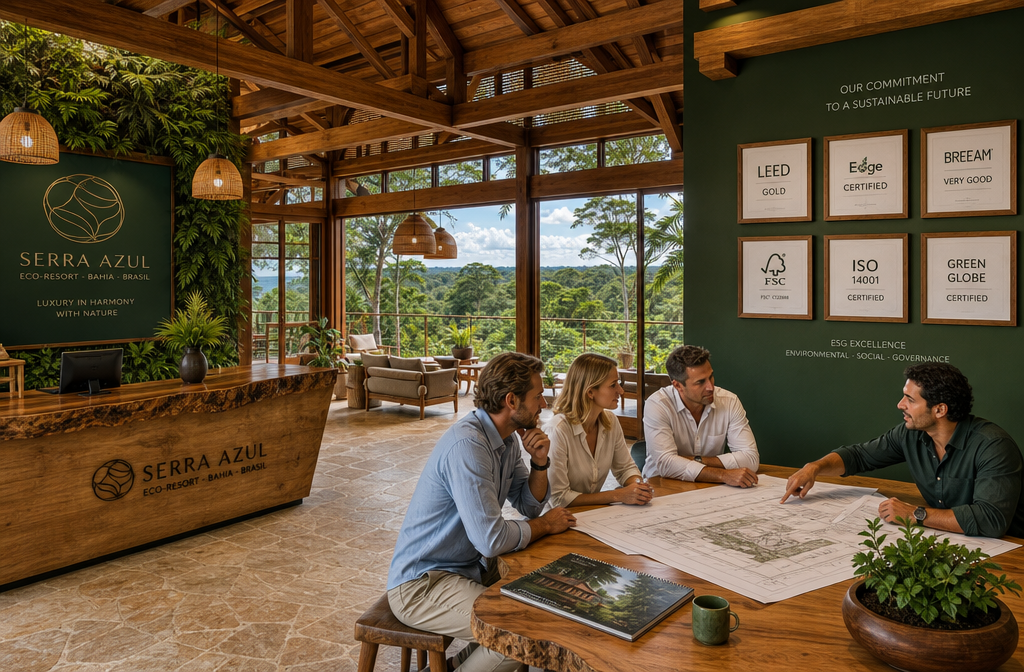
LEED (Leadership in Energy and Environmental Design) remains the most internationally recognized standard and carries the strongest premium in European and North American buyer markets. LEED certification for hospitality projects evaluates energy efficiency, water use, materials sourcing, indoor environmental quality, and site sustainability.
EDGE (Excellence in Design for Greater Efficiencies), administered by the International Finance Corporation (IFC), is gaining traction in Brazil because it is faster and less expensive to certify than LEED while still meeting the threshold requirements of most ESG-screened investment vehicles.
PROCEL (Brazilian National Electricity Conservation Program) certification is the most accessible domestic standard and is often used as a first step before pursuing international certification. It is particularly relevant for solar energy systems.
GBC Brasil (Green Building Council Brasil) certification aligns with LEED standards but is administered locally, reducing bureaucratic friction for Brazilian developers while still producing internationally recognized credentials.
Emerging Destinations Attracting ESG Capital
The Mamucabo area in Baixio is emerging as a concentrated luxury-sustainability corridor. Current and planned developments include Hotel Boutique & SPA Ponta de Inhambupe, additional resort properties, glamping sites, and beach clubs — all incorporating solar energy and biogas infrastructure [10]. The Anantara Mamucabo Bahia Resort, expected to open in 2026, is among the highest-profile projects in this corridor [8].
Caldas do Jorro in Tucano represents a different typology: a thermal water destination where an R$11 million eco-resort project — including a hotel complex, water park, and leisure facilities — aims to create over 150 jobs while integrating sustainable infrastructure [7]. Interior thermal destinations are particularly attractive for ESG investors because they combine biodiversity protection with measurable social impact through employment.
Costa do Sauípe continues to expand, with Mar Premium Costa do Sauípe inaugurated in January 2026 joining the existing Sol Grand Premium as anchor properties in one of Brazil’s most developed resort corridors [8].
Green Financing Instruments Available to Global Buyers
Green bonds issued by Brazilian development banks, particularly BNDES (Banco Nacional de Desenvolvimento Econômico e Social), are increasingly accessible for resort projects that meet defined sustainability criteria. These instruments typically offer below-market interest rates in exchange for verified ESG performance metrics.
IFC and multilateral development bank financing is available for projects that meet EDGE or equivalent certification standards and demonstrate measurable employment and community development outcomes.
European export credit agencies (ECAs) from Germany, France, and the Netherlands have active programs supporting sustainable tourism infrastructure in emerging markets, including Brazil. These instruments are particularly relevant for European buyers who want to structure their investment through familiar financing channels.
Tokenized real estate instruments are beginning to appear in the Brazilian market as a mechanism for fractional international investment. For buyers interested in how blockchain-based instruments are intersecting with Brazilian real estate development, the intersection of cryptocurrency and real estate development offers relevant background.
Marketing ESG-Compliant Resorts to International Buyers
The most effective marketing frameworks for ESG-compliant Bahia resorts in 2026 combine three elements:
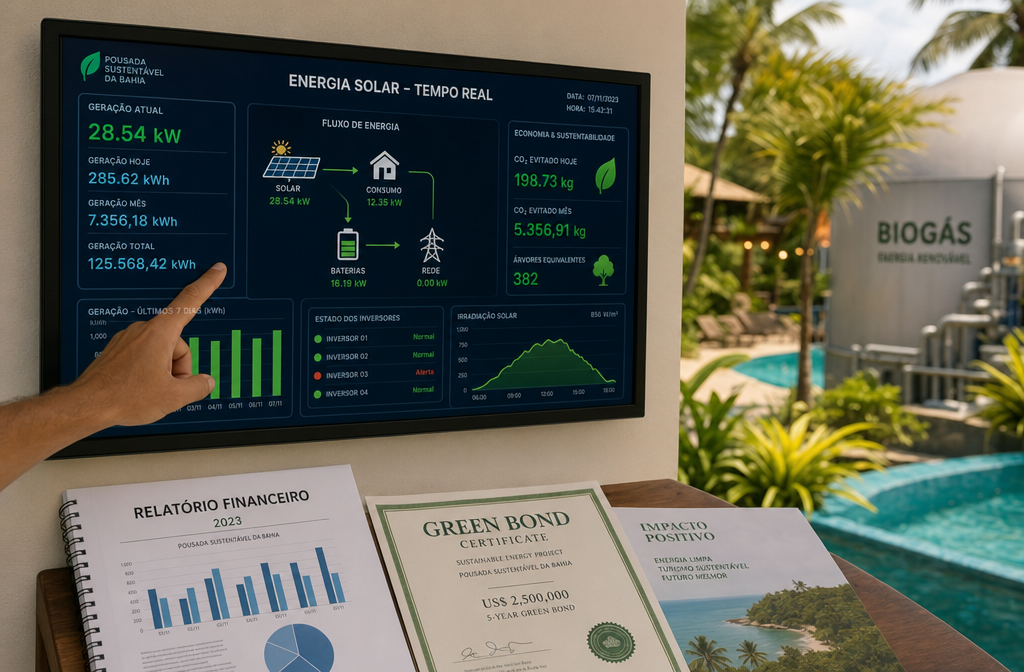
- Verified metrics: kWh generated by solar systems, m² of native vegetation preserved, number of local jobs created, and carbon offset tonnage — all third-party verified.
- Certification visibility: LEED, EDGE, or GBC Brasil plaques and certificates displayed prominently in sales materials and on-site, with digital verification links for remote buyers.
- Narrative alignment: Connecting the resort’s ESG story to the buyer’s own reporting obligations under SFDR or equivalent frameworks, making the investment a compliance asset rather than just a lifestyle purchase.
Developers and agents working with international buyers should also be aware of how broader market performance trends in Brazilian real estate are being communicated to global audiences. The latest news and market updates from Quadragon provide ongoing context for positioning Bahia resort investments within the national market narrative.
Due Diligence Framework for Global Buyers Entering This Market
Entering the ESG premium resort market in Bahia requires a structured due diligence process that goes beyond standard real estate checks. The following framework addresses the specific risks and opportunities of solar-integrated eco-tourism developments.
Environmental and Technical Due Diligence
- Solar system audit: Verify panel specifications, inverter brands, grid connection agreements, and net metering contracts. Confirm that projected generation figures (such as the 120,000 kWh monthly cited for Resort Arcobaleno [1]) are based on actual irradiation data for the specific site, not generic regional averages.
- Protected area compliance: Confirm that the development sits outside legally protected zones or has received all required environmental licenses (Licença Ambiental) from IBAMA and the Bahia state environmental agency (INEMA).
- Water management: Assess rainwater harvesting systems, greywater treatment, and connection to municipal water supply as backup.
Legal and Regulatory Due Diligence
- Verify that the developer holds a valid Registro de Incorporação (incorporation registration) with the local real estate registry.
- Confirm that any multiproperty (multipropriedade) structure complies with Brazilian Law 13.777/2018, which governs fractional ownership of real estate.
- For foreign buyers, confirm compliance with Brazilian Law 5.709/1971 governing rural land acquisition by foreigners, which may apply to large interior resort parcels.
Financial Due Diligence
- Request audited financial statements for the development company and any existing operating properties.
- Model the impact of the eco-construction premium (15–22%) on project returns under conservative, base, and optimistic occupancy scenarios.
- Assess the availability of green financing instruments and whether the project has already secured any green bond or IFC-linked financing.
For buyers comparing Bahia’s interior resort market against other Brazilian markets, a detailed analysis of property investment opportunities across Brazil’s top locations provides useful benchmarking data.
Conclusion
The case for ESG premiums in Bahia interior resorts in 2026 is no longer theoretical. Solar-integrated developments from Porto Seguro to Mamucabo are generating real operational savings, attracting certified green financing, and commanding verified price premiums of 15–25% over conventional alternatives. European and global buyers who understand the certification landscape, the financing instruments available, and the specific destinations gaining ESG momentum are positioned to enter this market at a point of genuine competitive advantage.
Actionable next steps for global buyers:
- Identify certified or certification-ready projects by requesting LEED, EDGE, or GBC Brasil documentation from developers before committing to any purchase process.
- Engage a Brazilian real estate attorney with specific experience in multipropriedade structures and foreign buyer compliance under Law 5.709/1971.
- Request solar system technical audits as a condition of any letter of intent, verifying that generation projections are site-specific and independently validated.
- Explore green financing options through BNDES, IFC-linked instruments, or European ECAs before defaulting to conventional mortgage financing.
- Monitor the Mamucabo, Caldas do Jorro, and Costa do Sauípe corridors as the three highest-activity ESG resort development zones in Bahia right now.
Buyers who treat ESG compliance as a financial criterion rather than a values statement will find that Bahia’s solar-integrated resort market in 2026 offers one of the most compelling risk-adjusted entry points in Brazilian real estate.
References
[1] Resort Arcobaleno Em Porto Seguro Instala Miniusina Para Geracao De 100 De Energia Solar – https://hotelarcobaleno.com.br/resort-arcobaleno-em-porto-seguro-instala-miniusina-para-geracao-de-100-de-energia-solar/?utm_source=openai
[2] Bahia Potencializa Turismo E Geracao De Renda Com Modernizacao De Complexo – https://www.ba.gov.br/comunicacao/noticias/2025-03/366487/bahia-potencializa-turismo-e-geracao-de-renda-com-modernizacao-de-complexo?utm_source=openai
[3] zagaia.com.br – https://zagaia.com.br/esg/?utm_source=openai
[4] 5779 Tivoli Ecoresort Praia Do Forte Recebe Certificado Por Energia Renovavel – https://www.bahianoticias.com.br/amp/bnhall/noticia/5779-tivoli-ecoresort-praia-do-forte-recebe-certificado-por-energia-renovavel?utm_source=openai
[5] Wam Experience Lanca Resort Em Multipropriedade Na Bahia 225313 – https://www.panrotas.com.br/hotelaria/investimentos/2026/01/wam-experience-lanca-resort-em-multipropriedade-na-bahia_225313.html?utm_source=openai
[6] Bahia Eco Residences 2026 Premium Pricing And Development Tactics Near Protected Natural Areas – https://quadragon.com.br/bahia-eco-residences-2026-premium-pricing-and-development-tactics-near-protected-natural-areas/?utm_source=openai
[7] Empreendedores Tem Projeto De Eco Resort Para Caldas Do Jorro – https://www.ba.gov.br/turismo/noticia/2024-07/4765/empreendedores-tem-projeto-de-eco-resort-para-caldas-do-jorro?utm_source=openai
[8] Novos Resorts Bahia – https://www.bahiaterra.com/posts/novos-resorts-bahia?utm_source=openai
[9] Liva Inaugura Operacao No Vivant Ecobeach Resort Barra Grande 194295 – https://www.panrotas.com.br/hotelaria/investimentos/2023/01/liva-inaugura-operacao-no-vivant-ecobeach-resort-barra-grande_194295.html?utm_source=openai
[10] Mamucabo O Novo Polo De Luxo Na Bahia – https://resortnabahia.com.br/news/mamucabo-o-novo-polo-de-luxo-na-bahia/?utm_source=openai