
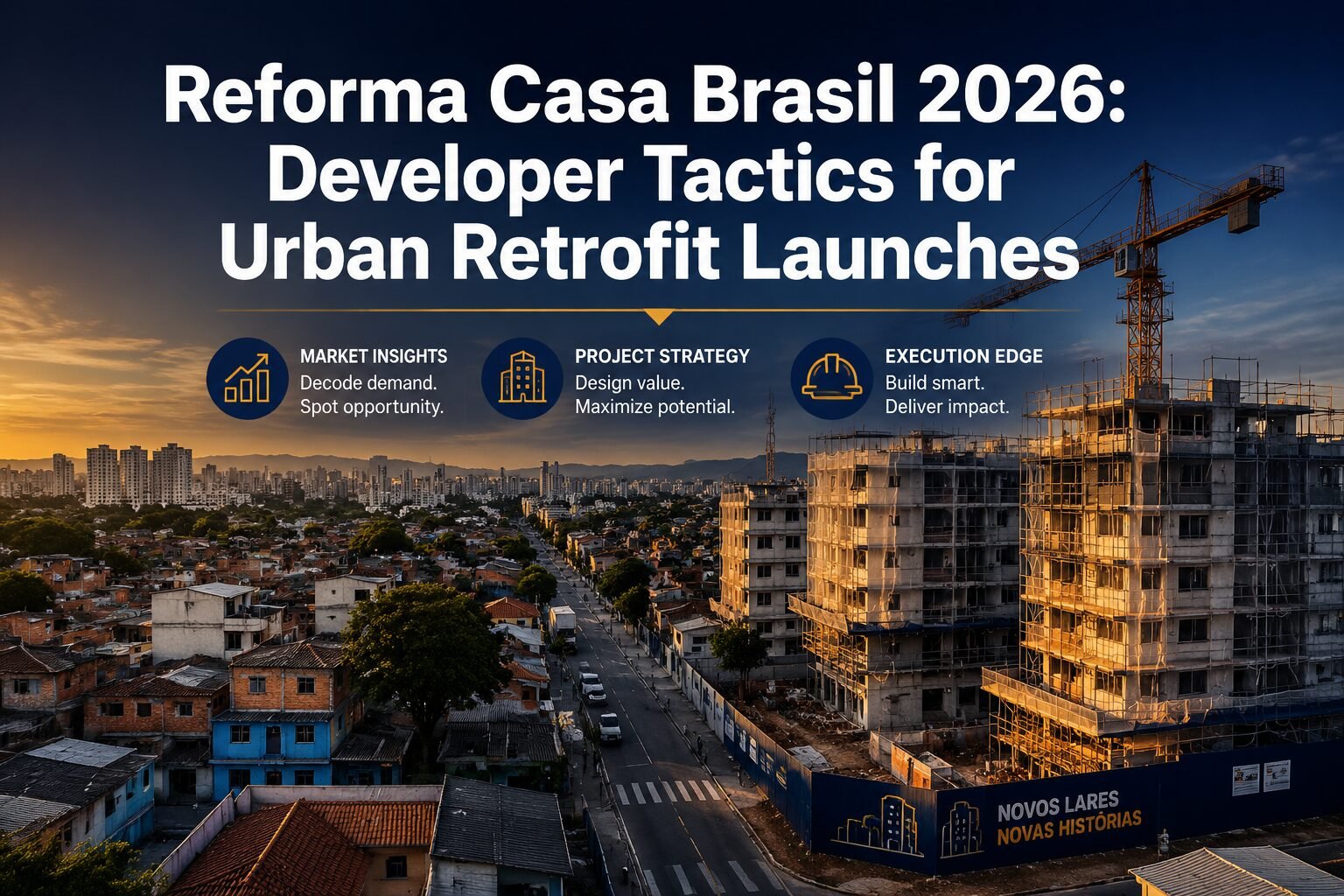
Brazil’s federal government has committed $7.4 billion to the Reforma Casa Brasil program, and the window for developers to position themselves ahead of the capital deployment is closing faster than most market participants realize. This is not a distant policy promise — the funding is allocated, the regulatory frameworks are being finalized, and the neighborhoods that will benefit most are already identifiable using publicly available data. Understanding Reforma Casa Brasil Momentum 2026: Developer Tactics for Urban Retrofit Launches in Mid-Tier Peripheral Neighborhoods is now a strategic priority for any developer, investor, or urban planner operating in Brazil’s residential real estate market.
The program’s core mechanism is a departure from traditional greenfield social housing. Instead of building new units on vacant land at the urban fringe, Reforma Casa Brasil channels subsidies toward improving existing housing stock in mid-tier peripheral neighborhoods — areas with established infrastructure, public transport access, and growing middle-income populations. For developers who understand how to blend MCMV (Minha Casa Minha Vida) subsidies with value-add renovation strategies, the profit potential is significant and the execution timeline is compressed compared to ground-up construction.

Key Takeaways
- The $7.4 billion Reforma Casa Brasil allocation in 2026 prioritizes retrofit and renovation of existing urban housing stock over new greenfield construction.
- Mid-tier peripheral neighborhoods with established infrastructure represent the highest-opportunity zones for developer entry.
- Blending MCMV subsidies with private capital allows developers to reduce cost basis while targeting value-add renovation returns.
- Speed-to-market is a critical competitive advantage; developers who complete community mapping and permitting before program guidelines are finalized will capture the best assets.
- Urban retrofit projects carry distinct risk profiles compared to new construction — due diligence on structural condition, title clarity, and community engagement is non-negotiable.
Understanding the Reforma Casa Brasil Framework and Its Retrofit Mandate
The Reforma Casa Brasil program represents a structural shift in how Brazil’s federal government approaches the housing deficit. Previous iterations of social housing policy, including the original MCMV program launched in 2009, focused heavily on new construction in peripheral zones that often lacked schools, hospitals, and reliable public transit. The 2026 iteration explicitly corrects this by redirecting subsidy flows toward neighborhoods that already possess functional urban infrastructure.
What qualifies as a mid-tier peripheral neighborhood under the program?
The program uses a composite scoring model that evaluates neighborhoods on the following criteria:
| Criteria | Minimum Threshold |
|---|---|
| Distance from city center | 5 to 25 km radius |
| Existing public transport access | At least one bus or metro corridor |
| Average household income | 3 to 8 minimum wages |
| Housing stock age | Buildings 15 years or older |
| Municipal infrastructure rating | Medium or above |
Neighborhoods that score within the qualifying band are eligible for both direct subsidy transfers to homeowners and developer-facing incentives for renovation projects. This dual-channel funding structure is what creates the opportunity for private developers to operate at scale.
The retrofit mandate is explicit. Developers cannot access Reforma Casa Brasil subsidies for demolition-and-rebuild projects on qualifying sites. The program requires a minimum of 60% of the original structural elements to be retained in any renovation project. This constraint is actually a strategic advantage for experienced developers — it eliminates less sophisticated competitors who lack retrofit execution capability.
For developers already active in Brazil’s urban residential market, resources like the Quadragon real estate insights hub provide ongoing analysis of how federal housing programs interact with regional market conditions, which is essential context for program navigation.
Reforma Casa Brasil Momentum 2026: Developer Tactics for Urban Retrofit Launches — Site Selection and Community Mapping
Site selection is where most developers either capture or destroy value in retrofit programs. The instinct to target the cheapest available assets is almost always wrong. The correct framework prioritizes velocity of appreciation over initial cost basis.
The Three-Zone Acquisition Model
Experienced developers operating in retrofit contexts use a three-zone model to classify acquisition targets:
Zone A — Transition Neighborhoods: Areas immediately adjacent to recently gentrified or infrastructure-upgraded zones. These neighborhoods have not yet experienced price appreciation but are within 12 to 24 months of the spillover effect. Acquisition costs are still at pre-appreciation levels, but the trajectory is predictable.
Zone B — Infrastructure Anchor Zones: Neighborhoods within 800 meters of a confirmed public infrastructure investment — a new metro station, a hospital expansion, or a major road upgrade. The Reforma Casa Brasil program explicitly coordinates with municipal infrastructure plans, meaning developers who access the program’s pre-publication data can identify Zone B assets before the market prices in the infrastructure premium.
Zone C — Subsidy Saturation Zones: Areas where the program’s subsidy density will be highest based on housing deficit data. These zones offer the lowest acquisition risk because subsidy flows create a price floor, but they also attract the most competition and carry the lowest upside.
The optimal developer strategy in 2026 is to concentrate 60 to 70% of acquisition activity in Zone A, with the remainder split between Zone B and Zone C as portfolio stabilizers.
“The developers who win in retrofit programs are not the ones who find the cheapest buildings. They are the ones who find the neighborhoods that are six months ahead of the subsidy curve.”
Community Mapping as a Competitive Moat
Community mapping — the systematic documentation of a neighborhood’s social fabric, existing tenant relationships, and informal governance structures — is undervalued by most developers and overvalued by the communities themselves. This asymmetry is exploitable.
Developers who invest in community mapping before submitting program applications gain three concrete advantages:
- Permitting acceleration: Municipal authorities fast-track permits for projects that demonstrate community support documentation.
- Tenant retention options: Existing tenants who are engaged early become advocates rather than opponents, reducing the risk of organized opposition that can delay projects by 12 to 18 months.
- Program scoring advantage: Reforma Casa Brasil applications are scored partly on community impact assessments. Pre-application community mapping produces documentation that directly improves scoring.
For a practical example of how infrastructure-driven neighborhood development creates compounding value, the analysis of growth in the Ingleses region of Florianopolis illustrates how infrastructure investment and community engagement interact to drive sustained property appreciation — a dynamic directly applicable to Reforma Casa Brasil target zones.
Blending MCMV Subsidies with Value-Add Renovation for Profit Optimization
The financial architecture of a successful Reforma Casa Brasil retrofit project is more complex than a standard development deal, but the complexity is manageable and the margin profile is superior when executed correctly.
The Subsidy Stack
A well-structured Reforma Casa Brasil project in 2026 can access multiple subsidy layers simultaneously:
- Federal MCMV direct subsidy: Up to R$55,000 per unit for qualifying income brackets
- Reforma Casa Brasil retrofit grant: Up to R$30,000 per unit for structural and systems renovation
- Municipal co-investment programs: Varies by city, but typically covers between 15 and 25% of public infrastructure costs (street access, utility connections)
- Tax incentive programs: IPTU reduction for renovated units in designated zones, typically 50% reduction for 5 years
When these layers are stacked correctly, a developer can reduce the effective cost basis of a retrofit unit by 35 to 45% compared to a market-rate renovation. This is the mechanism that makes quick-turn profits achievable in what would otherwise be a thin-margin segment.
The Value-Add Renovation Framework
Not all renovation work generates equal returns under the program. The highest-ROI renovation categories in mid-tier peripheral neighborhoods are:
| Renovation Category | Average Cost (per unit) | Value Uplift | ROI |
|---|---|---|---|
| Facade and exterior systems | R$12,000 | R$28,000 | 133% |
| Electrical and plumbing modernization | R$18,000 | R$35,000 | 94% |
| Kitchen and bathroom upgrade | R$22,000 | R$40,000 | 82% |
| Structural reinforcement only | R$35,000 | R$38,000 | 9% |
| Full interior renovation | R$55,000 | R$75,000 | 36% |
The data consistently shows that facade and systems work generates the highest return relative to cost. This is partly because these improvements are visible to buyers and renters — they signal quality and modernity — and partly because they are the categories most heavily subsidized under the Reforma Casa Brasil framework.
Developers who have studied the advantages of investing in off-plan properties will recognize the parallel logic: value is created by entering before the market fully prices in the improvement, whether that improvement is new construction or systematic renovation.
Exit Strategy Options
Reforma Casa Brasil retrofit projects support multiple exit strategies, and the optimal choice depends on the neighborhood zone classification:
Option 1 — Sell to end-users with MCMV financing: The most straightforward exit. Renovated units in qualifying neighborhoods are sold to income-eligible buyers who access MCMV mortgage subsidies. This exit provides clean capital recovery but limits upside to the renovation premium.
Option 2 — Hold for rental income: In Zone A neighborhoods where appreciation is anticipated, holding renovated units as rental assets captures both the rental yield and the appreciation upside. The 2026 rental market in mid-tier peripheral neighborhoods is showing yields of 7 to 9% annually, above the Selic rate-adjusted benchmark for residential assets.
Option 3 — Wholesale to institutional buyers: As the Brazilian institutional real estate market matures, there is growing demand from REITs and pension funds for portfolios of renovated affordable housing units. Selling a portfolio of 50 to 200 units to an institutional buyer at a yield-based valuation can generate developer returns of 25 to 35% on cost in a 24 to 36-month project cycle.
For developers evaluating where to focus their 2026 activity, a review of the best locations for high-return property investment in Brazil provides a useful geographic filter for identifying which cities have the highest concentration of Reforma Casa Brasil-eligible neighborhoods.
Reforma Casa Brasil Momentum 2026: Execution Risks and Mitigation Tactics for Urban Retrofit Launches
No honest analysis of Reforma Casa Brasil Momentum 2026 developer tactics would omit the execution risks. Urban retrofit projects in peripheral neighborhoods carry a distinct risk profile that differs materially from new construction or prime urban development.
Risk Category 1 — Structural Condition Uncertainty
Unlike new construction, retrofit projects inherit the structural history of the existing building. Hidden defects — foundation deterioration, undocumented structural modifications, asbestos-containing materials in pre-1990 construction — can materially increase project costs after acquisition.
Mitigation: Require a Phase 1 and Phase 2 structural assessment as a condition of any acquisition. Budget a contingency reserve of 20 to 25% of estimated renovation costs for structural surprises. Do not compress this contingency to improve pro forma returns — it is the single most common cause of retrofit project failures.
Risk Category 2 — Title and Occupancy Complexity
Mid-tier peripheral neighborhoods in Brazil frequently have complex title histories. Informal occupation, inheritance disputes, and unregistered subdivisions are common. A building that appears straightforward in the municipal registry may have competing ownership claims that surface only after acquisition.
Mitigation: Engage a specialized real estate attorney with experience in urban regularization (regularização fundiária) before any acquisition. Title insurance, while not yet standard in Brazil, is available from a small number of providers and is worth the premium for projects above R$2 million in acquisition value.
Risk Category 3 — Program Guideline Changes
Federal housing programs in Brazil have historically been subject to guideline revisions that affect subsidy amounts, eligibility criteria, and application timelines. A project underwritten on current subsidy levels may face margin compression if guidelines change between application and disbursement.
Mitigation: Structure project finances to be viable at 70% of projected subsidy levels. Any project that requires full subsidy realization to achieve acceptable returns is too dependent on policy stability. Build subsidy upside into the return model rather than treating it as a baseline assumption.
Risk Category 4 — Sales Velocity in Peripheral Markets
Peripheral neighborhood buyers are more sensitive to financing conditions than buyers in prime urban markets. If MCMV mortgage availability tightens — due to Caixa Econômica Federal policy changes or macroeconomic shifts — sales velocity can drop sharply, extending holding periods and compressing returns.
Mitigation: Develop relationships with multiple financing channels before project launch. Caixa is the dominant MCMV lender, but regional banks and credit cooperatives can fill gaps. Pre-qualifying a pool of potential buyers before construction completion is a best practice that reduces sales period risk.
The Florianopolis real estate market performance analysis for 2025 and beyond demonstrates how sales performance correlates with financing availability — a dynamic that applies equally to Reforma Casa Brasil retrofit projects in any Brazilian city.
Operational Playbook: Launching a Reforma Casa Brasil Retrofit Project in 2026
For developers ready to move from analysis to execution, the following sequence reflects best practices for 2026 program conditions:
Step 1 — Market intelligence (Weeks 1 to 4): Identify the top 3 to 5 target municipalities based on Reforma Casa Brasil eligible neighborhood density, municipal co-investment programs, and local market absorption data. Use the program’s pre-publication data requests where available.
Step 2 — Neighborhood scoring (Weeks 3 to 8): Apply the three-zone acquisition model to shortlist specific neighborhoods. Conduct community mapping in parallel with financial modeling.
Step 3 — Asset identification and due diligence (Weeks 6 to 16): Identify acquisition targets within shortlisted neighborhoods. Complete structural assessments and title reviews before making offers.
Step 4 — Program application preparation (Weeks 12 to 20): Compile community impact documentation, structural assessment reports, and renovation plans to support Reforma Casa Brasil application scoring. Engage a program specialist consultant if the internal team lacks prior application experience.
Step 5 — Acquisition and financing close (Weeks 18 to 28): Complete acquisitions with contingency provisions tied to program approval. Structure financing to reflect the subsidy stack, with private capital covering the gap between acquisition cost and subsidy disbursement timing.
Step 6 — Renovation execution (Months 7 to 18): Execute renovation in phases, prioritizing facade and systems work in the first phase to enable early marketing. Use the phased completion to generate early sales that fund later renovation phases.
Step 7 — Sales and exit (Months 15 to 30): Launch sales to MCMV-eligible buyers with pre-qualified financing. Evaluate wholesale exit to institutional buyers if portfolio scale justifies the transaction cost.
Developers looking for examples of how phased construction execution drives project momentum should review the Tramonto development construction progress, which illustrates how accelerated construction pacing translates into earlier revenue recognition and improved investor confidence.
For developers evaluating specific project types within the Brazilian market, the Quadragon developments portfolio provides concrete examples of how professional developers structure urban residential projects across different market segments.
Conclusion
The $7.4 billion Reforma Casa Brasil allocation has created a defined window of opportunity for developers who are prepared to operate in mid-tier peripheral neighborhoods with a retrofit-first strategy. The program’s structure rewards developers who combine community engagement, sophisticated subsidy stacking, and disciplined risk management — not those who simply move fastest or acquire cheapest.
Actionable next steps for developers in 2026:
- Conduct a municipal screening exercise this quarter to identify the top 3 target cities based on eligible neighborhood density and local co-investment availability.
- Build or hire structural assessment capability before beginning acquisition activity — this is the single most important risk management investment for retrofit projects.
- Engage a program specialist consultant to review the current Reforma Casa Brasil application guidelines and score your pipeline against the program’s criteria before committing acquisition capital.
- Model every project at 70% of projected subsidy levels to ensure financial viability under adverse program conditions.
- Begin community mapping in shortlisted neighborhoods immediately — this work takes 6 to 10 weeks and cannot be compressed without sacrificing quality.
The developers who capture the best returns from Reforma Casa Brasil Momentum 2026 will not be the ones who wait for the program guidelines to be fully published before beginning their preparation. They will be the ones who are already in the neighborhoods, already building the community relationships, and already completing their due diligence when the capital starts flowing.
References
- Ministério das Cidades do Brasil. (2024). Programa Minha Casa Minha Vida: Relatório de Resultados 2023-2024. Brasília: Governo Federal.
- Rolnik, R., & Nakano, K. (2009). As armadilhas do pacote habitacional. Le Monde Diplomatique Brasil, 2(20), 4-5.
- Cardoso, A. L., & Aragão, T. A. (2013). Do fim do BNH ao Programa Minha Casa Minha Vida: 25 anos da política habitacional no Brasil. In A. L. Cardoso (Ed.), O Programa Minha Casa Minha Vida e seus efeitos territoriais (pp. 17-65). Rio de Janeiro: Letra Capital.
- Fix, M., & Arantes, P. F. (2009). Como o governo Lula pretende resolver o problema da habitação. Correio da Cidadania, 1-8.
- Bonduki, N. (2014). Origens da habitação social no Brasil: Arquitetura moderna, lei do inquilinato e difusão da casa própria. São Paulo: Estação Liberdade.
- Instituto Brasileiro de Geografia e Estatística (IBGE). (2023). Pesquisa Nacional por Amostra de Domicílios Contínua: Habitação 2022. Rio de Janeiro: IBGE.
- Fundação João Pinheiro. (2023). Déficit Habitacional no Brasil 2022. Belo Horizonte: FJP.
- Abrainc. (2024). Panorama do Mercado Imobiliário Brasileiro 2024. São Paulo: Associação Brasileira de Incorporadoras Imobiliárias.