

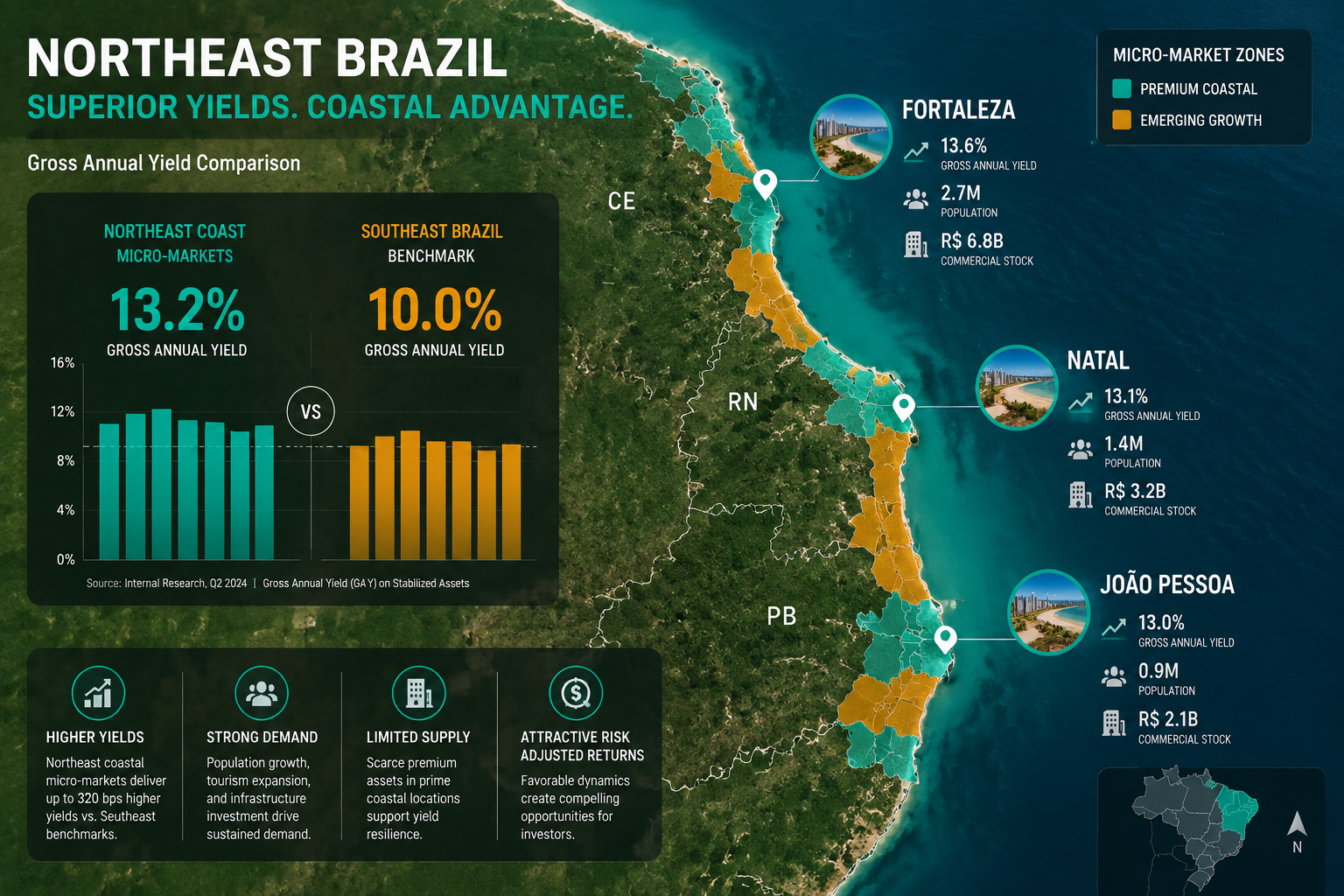
Foreign investors who bought beachfront units in João Pessoa in early 2025 are now looking at gross annual yields of 13.2% — roughly 30% higher than comparable short-term rental assets in São Paulo or Rio de Janeiro [4]. That gap is not accidental. It is the product of low acquisition costs, long average guest stays, and a surge in international arrivals that grew 50% in the first two months of 2026 alone [3]. For investors willing to move beyond the obvious markets, Airbnb yield optimization 2026: micro-market strategies for foreign investors in Northeast Brazil tourism hubs represents one of the most compelling short-term rental opportunities in Latin America right now.
Key Takeaways
- João Pessoa posted a 13.2% gross annual yield for short-term rentals in February 2026, outperforming Southeast Brazil benchmarks by approximately 30%.
- International tourism to Northeast Brazil rose 50% in the first two months of 2026, driven by expanded direct flight routes.
- A May 2026 STJ ruling now requires two-thirds condominium approval for short-term rentals, making property-type selection a critical compliance step.
- Tax Reform Decree No. 12.955 (April 2026) classifies rentals under 90 days under hotel-industry tax rules, increasing the importance of accurate financial modeling.
- Micro-market selection — prioritizing durable demand drivers and supply-constrained sub-markets — is the primary lever for achieving net returns of 12-15%.
Why Northeast Brazil Outperforms on Short-Term Rental Yields
The Fundação Getulio Vargas (FGV) calculated that Airbnb contributed R$99.8 billion to Brazil’s economy in 2024, supported 627,600 jobs, and generated R$8 billion in direct taxes [5]. That scale matters because it signals a mature, institutionally recognized market — not a speculative niche. Yet within that national market, the Northeast stands apart for three structural reasons.
1. Low entry prices relative to rental income potential. Property acquisition costs in coastal cities like João Pessoa, Maceió, and Natal remain significantly below those in São Paulo or Florianópolis. When the numerator (rental revenue) stays competitive and the denominator (purchase price) falls, yield expands automatically.
2. Long average guest stays. João Pessoa’s average guest stay is nine days [4]. Longer stays reduce turnover costs, lower cleaning frequency, and smooth out occupancy volatility — all of which protect net margins.
3. Expanding international access. New direct international flight routes into Fortaleza, Recife, and João Pessoa have been a demand catalyst. The 50% jump in international arrivals in early 2026 [3] is not a one-off spike; it reflects airline capacity decisions that take years to reverse.
Micro-Market Data Snapshot: Paraíba and Ceará
| Market | Active Listings | Avg. Daily Rate | Avg. Monthly Revenue | Occupancy Rate |
|---|---|---|---|---|
| João Pessoa, PB | 4,974 | $85 | $566 | 26.7% |
| Juazeiro do Norte, CE | 178 | $42 | $225 | 28.4% |
| Northeast avg. (coastal) | — | — | — | ~27% |
| Southeast benchmark | — | — | — | ~32-35% |
Sources: [8][9]
At first glance, the Northeast’s occupancy rate of roughly 27% looks lower than Southeast benchmarks. That is partly a data artifact: many Northeast listings are seasonal or semi-active. For full-time, professionally managed units in prime coastal zones, occupancy rates climb considerably higher. The key insight is that daily rate and acquisition cost together drive yield more than raw occupancy in these markets.
For investors exploring the best locations for high returns in Brazilian property, the Northeast coastal corridor consistently appears alongside Southern beach hubs as a top-tier candidate.
Airbnb Yield Optimization 2026: Navigating the New Regulatory Landscape
The single biggest shift affecting Airbnb yield optimization 2026: micro-market strategies for foreign investors in Northeast Brazil tourism hubs is a pair of regulatory changes that landed within weeks of each other in early-to-mid 2026.
The STJ Condominium Ruling (May 7, 2026)
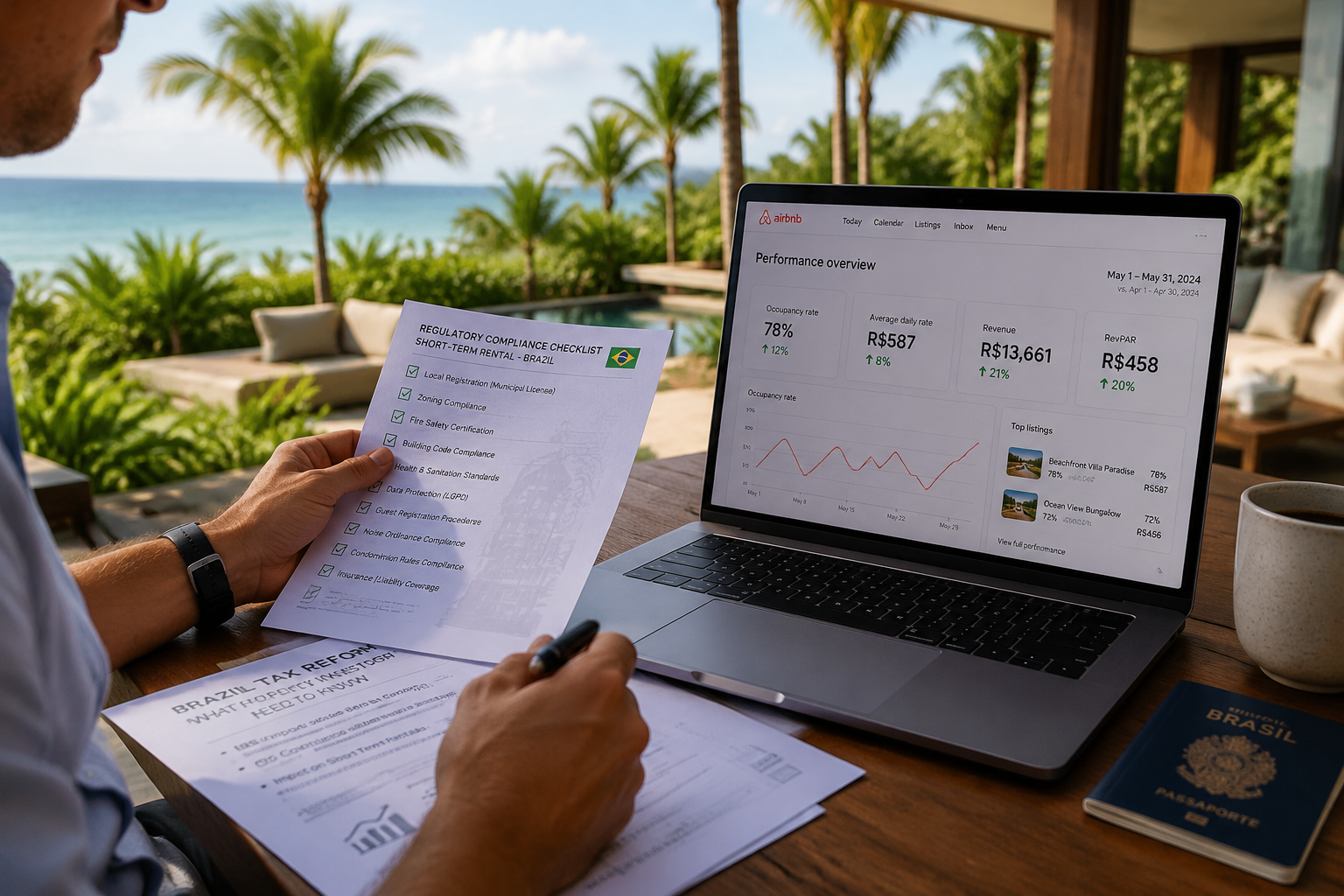
Brazil’s Superior Tribunal de Justiça ruled on May 7, 2026, that short-term rentals via platforms like Airbnb in condominiums require approval from at least two-thirds of residents [1]. The decision hands condominium assemblies meaningful power to restrict or outright ban short-term rentals in their buildings.
For foreign investors, this ruling has three direct implications:
- Pre-purchase due diligence is now non-negotiable. Buyers must review existing condominium bylaws and, where possible, obtain written confirmation of the building’s stance on short-term rentals before signing any purchase agreement.
- Purpose-built short-term rental developments carry a structural advantage. Buildings designed and marketed specifically for vacation or investment use — where the condominium assembly is already aligned — are far less exposed to retroactive restrictions.
- Airbnb’s pushback is ongoing but uncertain. The platform launched a national campaign and a petition that gathered over 110,000 signatures opposing the ruling [2]. Legislative relief is possible but not guaranteed in the near term.
Tax Reform Decree No. 12.955 (April 30, 2026)
Published on April 30, 2026, this decree stipulates that short-term rentals of less than 90 days are subject to the same tax rules as the hotel industry [7]. This is a meaningful cost increase for individual hosts who previously operated under lighter personal income tax regimes.
Practical steps investors should take:
- Engage a Brazilian tax advisor familiar with the new decree before closing any purchase.
- Model net yields using hotel-equivalent tax rates, not historical personal income tax assumptions.
- Evaluate whether operating through a legal entity (PJ structure) offers a more favorable effective tax rate under the new framework.
- Factor in Salvador’s new ISS (Service Tax) on platform-based rentals [6] as a precedent that other Northeast municipalities may follow.
“The regulatory environment in 2026 rewards investors who treat compliance as a competitive advantage, not a bureaucratic obstacle. Buildings with clear legal standing attract better guests, command higher rates, and face fewer operational disruptions.”
For a broader view of how off-plan purchases can build in compliance advantages from day one, the analysis on why real estate development can amplify your gains is directly relevant.
Micro-Market Selection: The Core Strategy for 12-15% Net Returns
Regulation sets the floor. Micro-market selection determines the ceiling. Achieving net returns of 12-15% in 2026 requires moving beyond city-level analysis to neighborhood and sub-market precision [10].
Durable Demand Drivers to Prioritize
Not all tourism demand is equal. The most resilient short-term rental markets share specific demand characteristics:
- Niche tourism events. Juazeiro do Norte in Ceará draws consistent religious pilgrimage traffic year-round, creating demand that is largely decoupled from weather seasonality. Its 28.4% occupancy rate [9] reflects this baseline demand floor.
- Wellness and medical tourism. Several Northeast coastal cities are developing medical tourism clusters. Properties near certified wellness centers or private hospitals benefit from longer stays and guests who are less price-sensitive.
- Family and leisure stays. João Pessoa’s nine-day average stay [4] is driven heavily by family leisure travel. Units with multiple bedrooms, kitchen facilities, and proximity to calm beaches command a premium in this segment.
- Proximity to metropolitan hubs. Properties within 90 minutes of Recife, Fortaleza, or Salvador capture weekend and long-weekend demand from domestic urban travelers, which fills gaps between international bookings.
Supply Constraints as a Return Amplifier
High demand matters less if supply grows faster. The sub-markets with the strongest long-term yield outlook are those where new supply faces physical or legal friction:
- Coastal preservation zones where new construction is restricted by environmental regulations.
- Historic center districts in cities like Olinda (UNESCO World Heritage Site) where building permits are tightly controlled.
- Beachfront parcels where the combination of land scarcity and high acquisition costs naturally limits new entrants.
Investors should map active listing growth rates alongside new construction permits in any target sub-market. A neighborhood where listings grew 5% last year but permits for new residential units are near zero is structurally attractive.
Comparing Short-Term vs. Long-Term Rental Returns in Northeast Brazil
| Metric | Short-Term Rental (Airbnb) | Long-Term Rental |
|---|---|---|
| Gross annual yield (João Pessoa) | 13.2% | 5-7% (estimated) |
| Average stay | 9 days | 12+ months |
| Management intensity | High | Low |
| Regulatory exposure | High (STJ ruling, tax reform) | Lower |
| Revenue seasonality | Moderate-high | Minimal |
| Upside from optimization | Significant | Limited |
The yield differential is substantial, but so is the management requirement. Foreign investors who do not plan to be on-site should budget for a professional property management partner — typically 15-25% of gross revenue in Northeast Brazil markets — and model net yields accordingly.
For investors considering purpose-built developments that are designed to reduce these friction points, exploring available developments in the region provides a useful benchmark for what professionally structured investment properties look like in practice.
Operational Strategies to Maximize Airbnb Revenue Per Unit
Selecting the right micro-market is necessary but not sufficient. Within any given market, operational decisions can move net revenue by 20-30%.
Dynamic Pricing and Seasonal Calibration
Northeast Brazil has two primary peak seasons: the European winter (December through March, when international arrivals peak) and Brazilian school holidays (July and January). A well-calibrated dynamic pricing strategy should:
- Set base rates 15-25% above annual average during peak international arrival months.
- Apply minimum-stay requirements of 5-7 nights during peak periods to reduce turnover costs.
- Offer moderate discounts for stays of 14+ nights during shoulder seasons to maintain occupancy without dropping below breakeven daily rates.
Listing Quality and Positioning
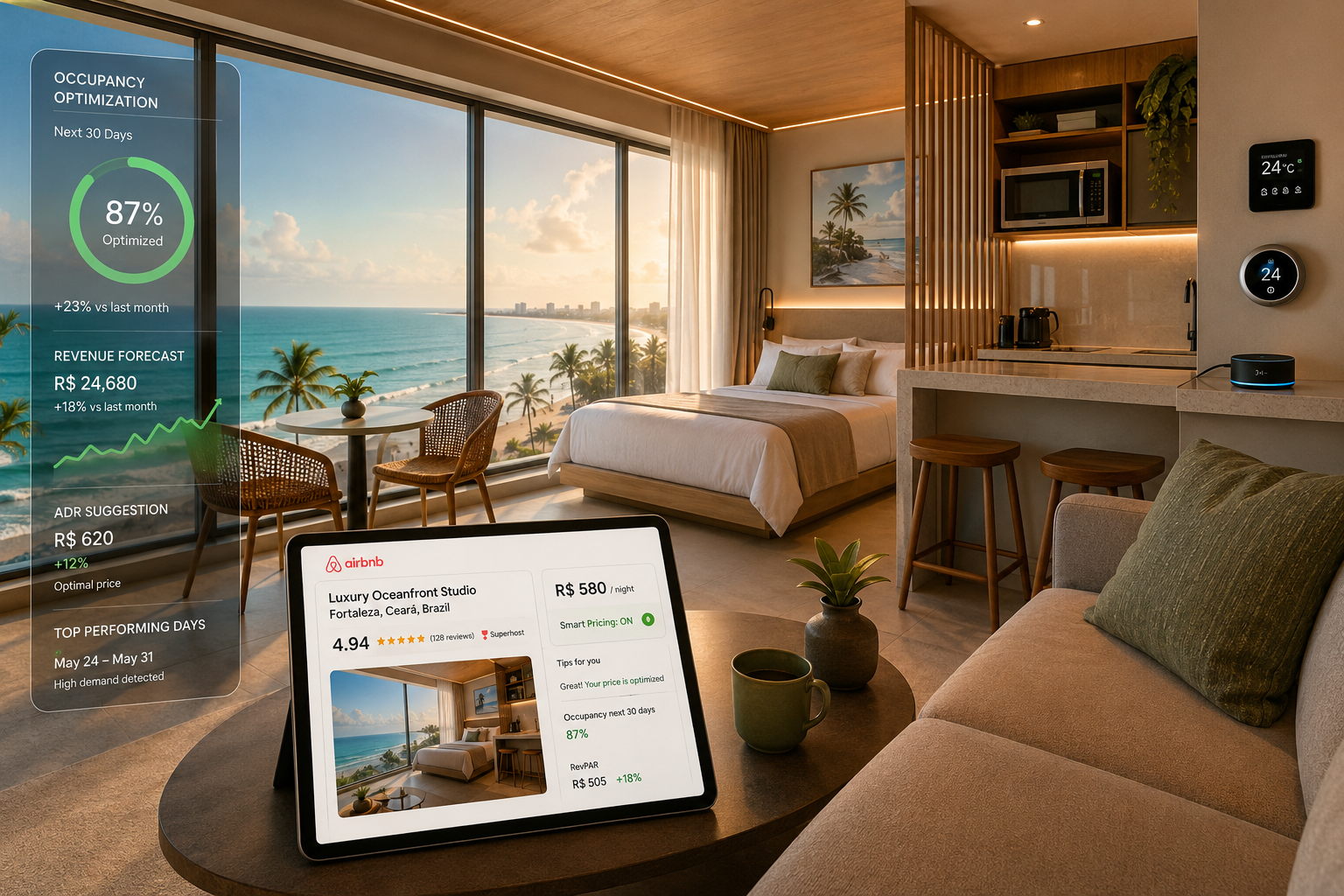
In markets like João Pessoa where 4,974 active listings compete for guests [8], listing quality is a direct revenue driver:
- Professional photography consistently increases click-through rates and booking conversion on Airbnb’s platform.
- Bilingual listings (Portuguese and English, ideally also Spanish and French) capture the international demand that drove the 50% arrival surge in early 2026 [3].
- Superhost status reduces Airbnb’s algorithm suppression and increases visibility in search results without additional advertising spend.
Amenity Prioritization for the Northeast Guest Profile
The Northeast leisure and family traveler has specific preferences that differ from urban business travelers:
- Air conditioning is non-negotiable given the regional climate.
- Outdoor spaces (terraces, pools, beach access) command a 20-35% rate premium over comparable interior units.
- Reliable high-speed internet has become a baseline expectation, not a differentiator — but its absence is a significant negative review trigger.
- Parking is valued more highly in Northeast coastal cities than in walkable urban centers.
Investors evaluating specific developments should assess how well the unit mix and amenity package align with this demand profile. Projects like the Solis development offer a useful reference point for how purpose-built investment properties are structured to meet these criteria.
For investors interested in how studio and compact unit formats perform specifically in short-term rental contexts, the analysis of investing in studios from a real estate development perspective provides transferable insights on unit economics, even though it focuses on a different geography.
Due Diligence Checklist for Foreign Investors in 2026
Given the regulatory complexity introduced by the STJ ruling and the April 2026 tax reform, foreign investors should complete the following steps before committing capital:
Legal and Compliance
- Confirm the target property or development is not subject to condominium restrictions on short-term rentals.
- Verify that the development’s bylaws explicitly permit short-term rental activity.
- Obtain a legal opinion on the applicable tax treatment under Decree No. 12.955 for the specific property type and ownership structure.
- Check whether the target municipality has introduced or is considering ISS or similar platform taxes.
Financial Modeling
- Model gross yield using current market data (not developer projections).
- Subtract hotel-equivalent taxes, property management fees (15-25%), platform fees (Airbnb typically charges hosts 3%), and maintenance reserves (budget 5-8% of gross revenue).
- Stress-test net yield at 20% below projected occupancy to assess downside resilience.
Market Validation
- Review active listing counts and revenue data for the specific neighborhood, not just the city.
- Assess new supply pipeline through municipal construction permit data.
- Confirm demand driver durability (flight routes, tourism infrastructure, recurring events).
For investors who want to understand how cryptocurrency and alternative financing structures interact with Brazilian real estate acquisition, the overview of crypto and real estate development as an investment frontier addresses an increasingly relevant question for international capital flows.
Conclusion
Airbnb yield optimization 2026: micro-market strategies for foreign investors in Northeast Brazil tourism hubs is not a passive investment thesis. It requires precise market selection, proactive regulatory compliance, and active operational management. But the data is clear: gross yields above 13% in João Pessoa [4], a 50% surge in international arrivals [3], and a platform that generated R$99.8 billion in economic activity in a single year [5] collectively describe a market with real, durable upside.
The regulatory environment has tightened in 2026, and that is ultimately good news for disciplined investors. The STJ ruling [1] and the tax reform decree [7] will push casual or non-compliant operators out of the market, reducing supply pressure in well-managed, legally structured properties. Investors who do the compliance work upfront will face less competition and command stronger pricing power.
Actionable next steps for foreign investors in 2026:
- Narrow your target to two or three specific coastal sub-markets using neighborhood-level occupancy and revenue data.
- Engage a Brazilian real estate attorney and tax advisor before any purchase — the regulatory landscape changed materially in the first half of 2026.
- Prioritize purpose-built short-term rental developments with condominium bylaws that explicitly permit platform-based rentals.
- Build a property management partnership into your financial model from day one, not as an afterthought.
- Contact a specialist developer with regional expertise to evaluate specific projects aligned with your yield targets.
For investors ready to take the next step, reaching out directly to a qualified regional developer is the most efficient way to align available inventory with a specific return profile.
References
[1] Stj Muda Jogo Do Airbnb Locacao Por Temporada Agora Passa Pelo Condominio – https://www.infomoney.com.br/minhas-financas/stj-muda-jogo-do-airbnb-locacao-por-temporada-agora-passa-pelo-condominio/?utm_source=openai
[2] Airbnb Reage A Decisao Do Stj E Mobiliza Anfitrioes Setor Movimenta Bilhoes E Preocupa Mercado De Aluguel Por Temporada – https://paraibabusiness.com.br/airbnb-reage-a-decisao-do-stj-e-mobiliza-anfitrioes-setor-movimenta-bilhoes-e-preocupa-mercado-de-aluguel-por-temporada/?utm_source=openai
[3] Litoral Do Nordeste Atrai Investidores Estrangeiros Para Imoveis Por Temporada – https://revistane.com.br/2026/05/11/litoral-do-nordeste-atrai-investidores-estrangeiros-para-imoveis-por-temporada/?utm_source=openai
[4] O Nordeste No Topo Do Yield Por Que O Airbnb Em Joao Pessoa Rende 30 Mais Que No Sudeste Os Dados Reais – https://nordestenotopo.com.br/paraiba/o-nordeste-no-topo-do-yield-por-que-o-airbnb-em-joao-pessoa-rende-30-mais-que-no-sudeste-os-dados-reais/?utm_source=openai
[5] Fgv Aponta Que Airbnb Movimenta Quase R 100 Bilhoes Na Economia Brasileira Em Um Ano – https://www.mercadoeeventos.com.br/noticias/fgv-aponta-que-airbnb-movimenta-quase-r-100-bilhoes-na-economia-brasileira-em-um-ano/?utm_source=openai
[6] Airbnb Ganha Imposto Em Salvador Cpi Em Sao Paulo E Novas Regras No Rio – https://www.infomoney.com.br/business/airbnb-ganha-imposto-em-salvador-cpi-em-sao-paulo-e-novas-regras-no-rio/?utm_source=openai
[7] O Que Esta Acontecendo Com O Airbnb No Brasil Em 2026 – https://portas.com.br/investimentos/legislacao-tributacao/o-que-esta-acontecendo-com-o-airbnb-no-brasil-em-2026/?utm_source=openai
[8] Para%c3%adba – https://www.airroi.com/airbnb-data/brazil/para%C3%ADba?utm_source=openai
[9] Juazeiro Do Norte – https://www.airroi.com/airbnb-data/brazil/cear%C3%A1/juazeiro-do-norte?utm_source=openai
[10] Airbnb Yield Optimization Beyond Regulations 2026 Micro Market Selection For 12 15 Returns In Southern Beach Hubs – https://quadragon.com.br/airbnb-yield-optimization-beyond-regulations-2026-micro-market-selection-for-12-15-returns-in-southern-beach-hubs/?utm_source=openai