
Construction costs in Brazil climbed 6.73% over the 12 months ending March 2026 — a figure that quietly erodes developer margins faster than most pro formas account for. Brazil’s 2026 construction cost reality: managing 5–6% annual inflation in labor and materials without killing project margins is no longer a theoretical exercise. It is the central operational challenge facing every developer, contractor, and real estate investor active in the country today. Understanding where these pressures originate, how they compound across a project timeline, and which tactical responses actually work is the difference between a viable development and a loss-making one.
Key Takeaways
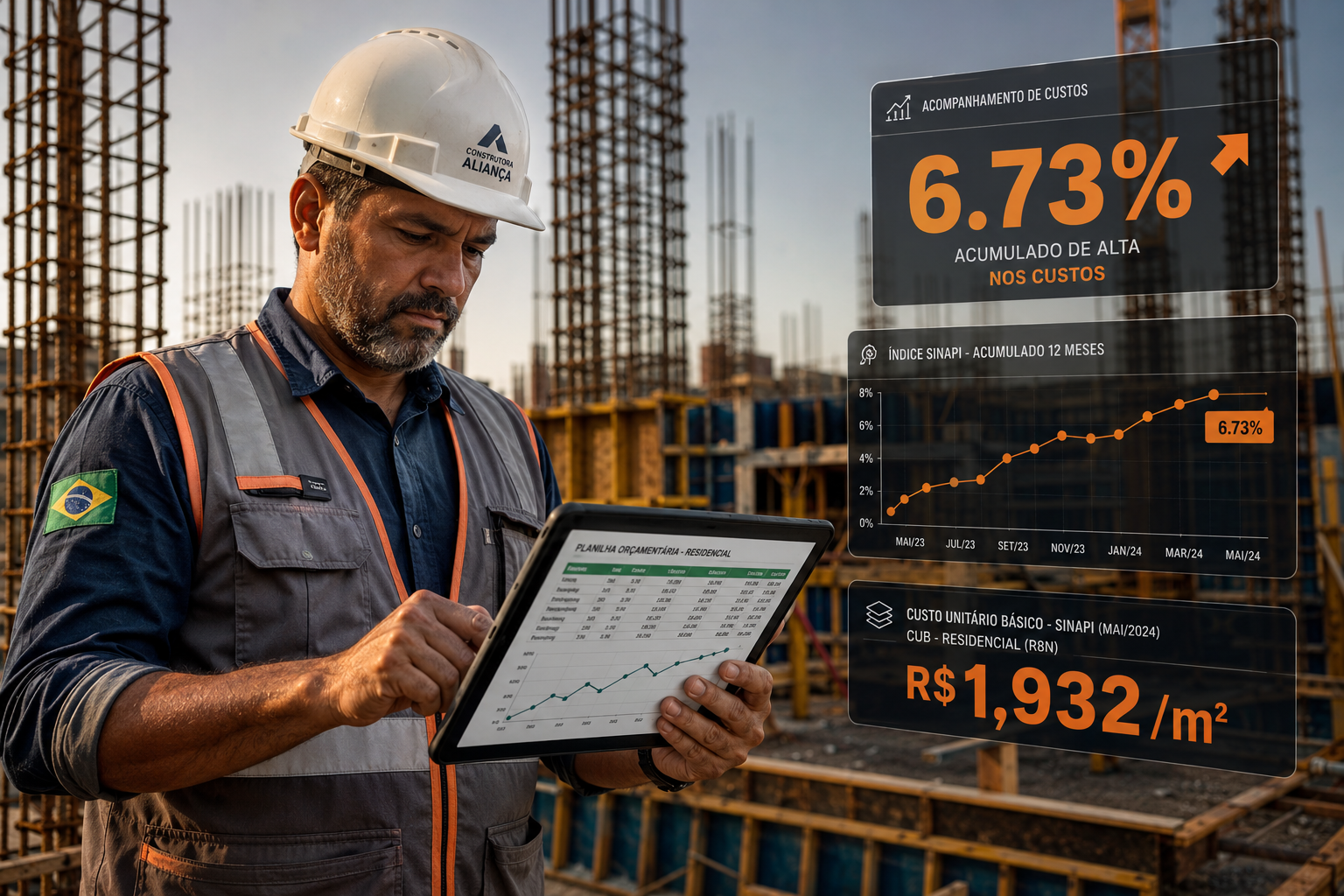
- SINAPI data shows a 6.73% cumulative construction cost rise over 12 months to March 2026, with the average cost reaching R$1,932.27 per square meter.
- Labor costs surged 9.12% year-on-year through February 2026, driven by a shortage of qualified tradespeople.
- Material costs rose 4.2% over the same period, amplified by higher fuel prices linked to global supply chain disruptions.
- The INCC recorded its highest April increase since 2011, signaling that inflation pressure is not yet stabilizing.
- Developers who embed indexation clauses, adopt prefabrication, and restructure procurement contracts can protect margins even in this environment.
The Numbers Behind the Pressure: What the Data Actually Says
Before any tactical response is possible, the cost picture must be read clearly. Brazil’s construction sector entered 2026 under a convergence of pressures that individually would be manageable but collectively are severe.
SINAPI’s March 2026 report recorded a 0.37% monthly increase in construction costs, bringing the 12-month cumulative figure to 6.73% [2]. The average cost per square meter reached R$1,932.27, broken down as R$1,089.78 for materials and R$842.49 for labor [2]. These are national averages — regional variation exists, and developers in high-demand coastal markets like Florianópolis face additional localized pressures on top of these baselines.
Labor is the sharper edge of the blade. The National Index of Construction Cost (INCC) recorded a 9.12% increase in labor costs over the 12 months to February 2026, driven primarily by a shortage of qualified professionals [3]. Skilled tradespeople — electricians, plumbers, concrete finishers — are in short supply relative to the volume of projects underway. This is a structural issue, not a cyclical one, and it will not self-correct quickly.
Materials are not far behind. Material costs rose 4.2% over the same period, with fuel prices acting as a significant amplifier [3]. The disruption to global oil transit routes, particularly the closure of the Strait of Hormuz, pushed petroleum derivative prices higher, directly affecting transport costs, asphalt, PVC, and polymer-based materials [1]. In April 2026, the INCC recorded its highest single-month increase for that calendar month since 2011, with materials and equipment costs rising 1.38%, services up 1.12%, and labor up 0.52% [5].
The macro environment compounds the problem. The Câmara Brasileira da Indústria da Construção (CBIC) cut its 2026 GDP growth forecast for the sector from 2% to 1.2%, citing high interest rates and geopolitical uncertainty [1]. High Selic rates increase financing costs for both developers and buyers, compressing demand at the same time that supply-side costs are rising. This is a margin squeeze from both directions.
| Cost Component | 12-Month Change (to Feb/Mar 2026) | Current Average (R$/m²) |
|---|---|---|
| Materials | +4.2% | R$1,089.78 |
| Labor | +9.12% | R$842.49 |
| Total (SINAPI) | +6.73% | R$1,932.27 |
Sources: SINAPI via Revista Construa [2]; INCC via Buildv [3]
Contract Structuring and Indexation: The First Line of Defense
The most immediate lever available to developers is contract design. A fixed-price contract signed in early 2025 that did not include indexation clauses has, by mid-2026, transferred significant wealth from the developer to the contractor — or, if the contractor absorbed it, created a project execution risk as the contractor cuts corners or defaults.
Indexation clauses are not optional in this environment. A well-structured contract should reference SINAPI or INCC as the adjustment benchmark, with clear intervals — typically monthly or quarterly — and caps that protect both parties from extreme single-period swings. The clause should specify which component (labor, materials, or blended) applies to which portion of the contract value.
Key contract structuring principles for 2026:
- Split the contract by cost type. Labor-intensive scopes (formwork, finishing, installation) should be indexed to the labor component of INCC. Material-heavy scopes (structural steel, electrical, plumbing) should reference the materials sub-index or specific commodity benchmarks.
- Include a price review trigger. Define a threshold — for example, a 3% cumulative SINAPI movement since the last adjustment — that automatically triggers a contract review meeting. This prevents disputes from accumulating into project-stopping conflicts.
- Negotiate payment schedules tied to physical progress, not calendar dates. This aligns cash flow with actual cost exposure and reduces the developer’s risk of paying for work not yet completed when costs rise.
- Add a force majeure clause that explicitly covers commodity price shocks. The fuel price disruptions of 2026 were foreseeable in broad terms but not in specific magnitude. A well-drafted clause protects both parties.
For developers active in markets where buying off-plan can amplify investment returns, the contract structure between developer and construction partner is just as important as the sales contract with buyers. Misalignment between these two sets of obligations is where margin destruction typically begins.
Procurement Strategy: Locking In Prices Before They Move
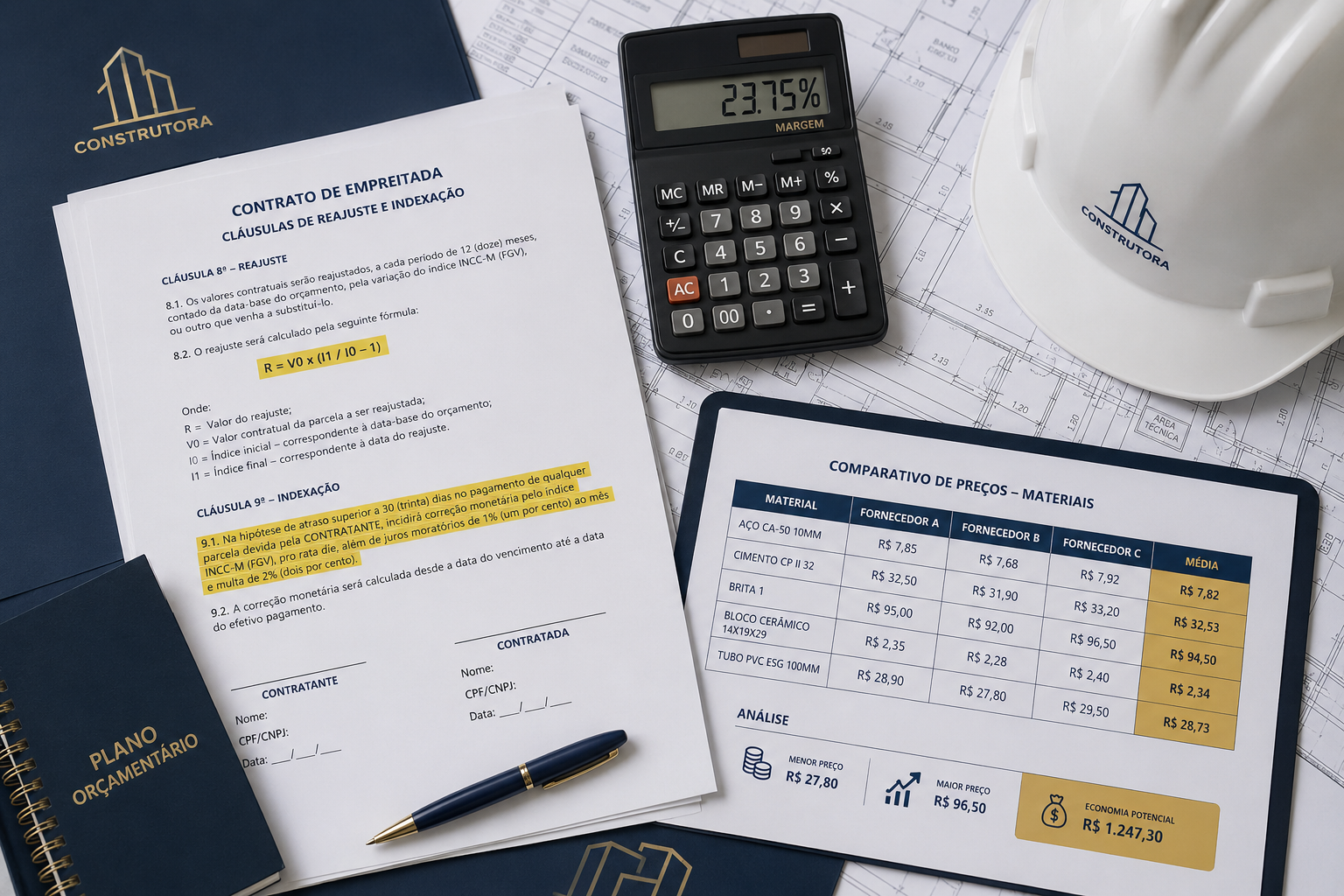
Contract design addresses how costs are shared once they move. Procurement strategy addresses whether they move at all — or at least, how much of the exposure can be hedged in advance.
Forward purchasing for high-volatility materials is one of the most effective tools available. Steel rebar, copper wire, and cement are the three materials with the greatest price volatility in the Brazilian construction market. Developers who can commit to purchase volumes 90 to 180 days in advance — and who have the storage capacity or supplier relationship to support this — consistently outperform those who buy at spot prices.
The practical steps:
- Map material consumption by project phase. A detailed bill of quantities, broken down by month, allows procurement to match purchasing to consumption rather than buying in bulk without a consumption plan.
- Negotiate volume agreements with suppliers. Even without full forward pricing, a volume commitment often secures a price ceiling or a preferred customer discount that partially offsets inflation.
- Diversify the supplier base. Single-supplier dependency for critical materials is a margin risk. A backup supplier relationship, even if more expensive, provides negotiating leverage and supply security.
- Monitor fuel price indices monthly. Given that fuel costs now directly drive material prices [1], tracking Petrobras pricing cycles and adjusting procurement timing accordingly is a legitimate cost management tool.
For labor procurement, the dynamic is different. The shortage of qualified tradespeople means that the traditional approach of hiring subcontractors at the start of each phase is increasingly expensive and unreliable. Developers who maintain preferred subcontractor relationships — with continuity across multiple projects — secure better rates and priority scheduling. This is particularly relevant in growth markets like Florianópolis, where the real estate market’s strong performance has created intense competition for skilled labor.
Technology-assisted procurement is gaining traction among larger developers. Construction management platforms that integrate cost databases, supplier pricing feeds, and project schedules allow procurement teams to identify the optimal purchase window for each material category. The upfront investment in these tools is typically recovered within one or two projects through avoided cost overruns [7].
Prefabrication and Industrialized Construction: Structural Margin Protection
The labor cost problem — a 9.12% year-on-year increase driven by structural workforce shortages [3] — cannot be solved through better hiring alone. The underlying supply of skilled tradespeople is not growing fast enough to meet demand. The strategic response is to reduce the quantity of on-site skilled labor required per square meter built.
Prefabrication and industrialized construction methods achieve this by shifting work from the construction site to a controlled factory environment, where productivity is higher, waste is lower, and labor requirements per unit of output are significantly reduced.
The most accessible entry points for Brazilian developers in 2026 are:
- Precast concrete panels and columns. Structural elements produced off-site and assembled on-site reduce formwork labor by 30–50% on eligible projects. The upfront cost premium is typically 8–12%, but the labor savings and schedule compression often produce a net positive margin outcome.
- Modular bathroom and kitchen pods. Wet areas are the most labor-intensive and defect-prone parts of residential construction. Factory-produced pods arrive on-site fully fitted and are craned into position, eliminating weeks of on-site tiling, plumbing, and electrical work.
- Light Steel Framing (LSF) for low-rise residential. LSF systems are gaining market share in Brazil’s residential sector as an alternative to traditional masonry. The system reduces on-site labor hours significantly and is less sensitive to the shortage of masonry tradespeople.
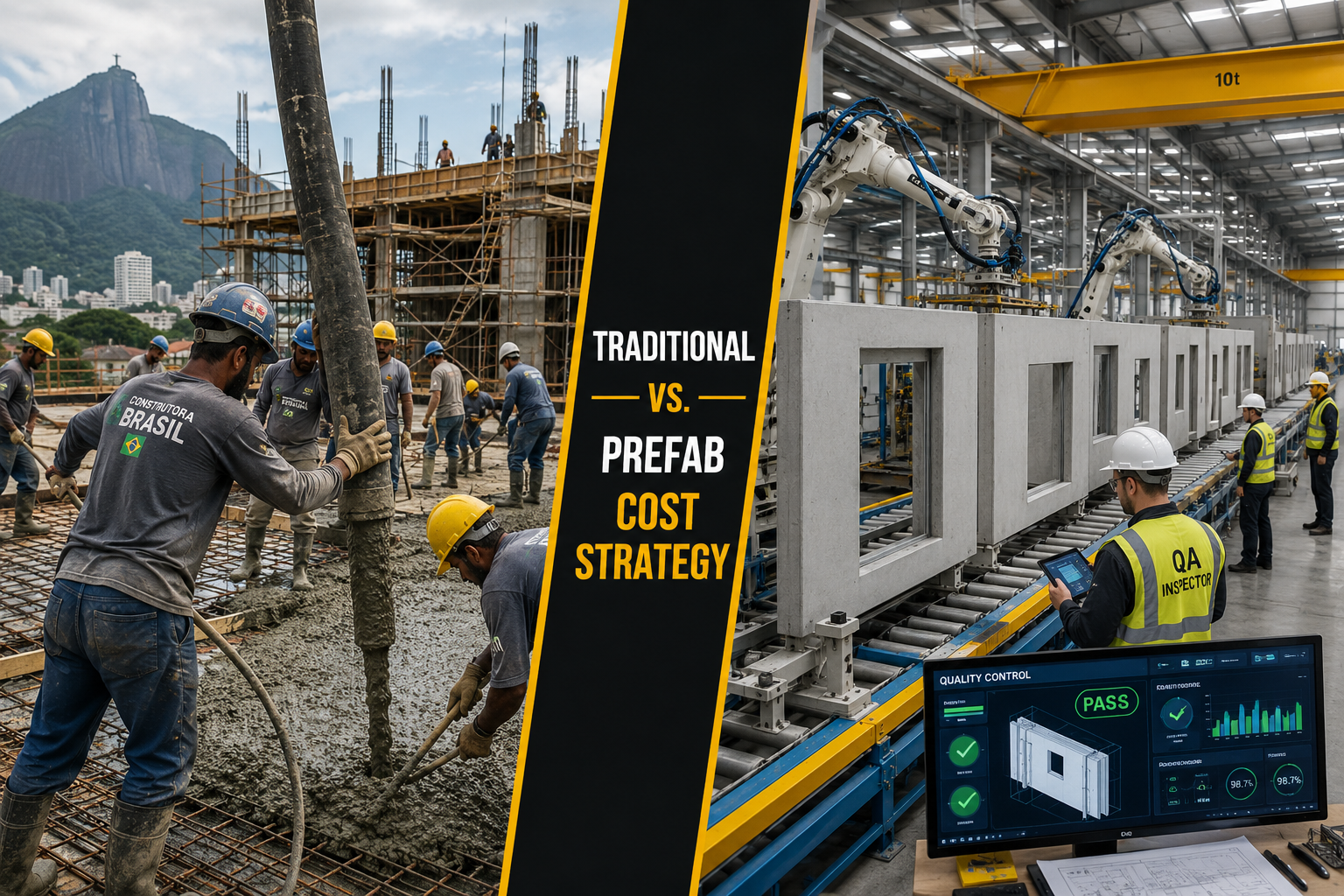
The transition to industrialized construction requires upfront investment in design standardization and supplier relationships. Developers who standardize their unit layouts across a portfolio — rather than customizing each project — unlock the full cost benefit of prefabrication. This is one reason why purpose-built studio and compact apartment developments are well-positioned in the current cost environment: their standardized floor plates are ideal for industrialized construction methods.
The margin math is compelling. If labor represents roughly 44% of total construction cost (as the SINAPI breakdown suggests) and prefabrication reduces on-site labor hours by 25–35% on eligible scopes, the potential margin recovery is 3–5 percentage points on total project cost — enough to fully offset the current rate of annual cost inflation.
Operational Efficiency and Project Management: Protecting Margins Through Execution
Even with the best contracts and procurement strategies, margin erosion continues if project execution is inefficient. Construction projects in Brazil lose an estimated 10–15% of their budget to rework, idle time, and poor sequencing — losses that are invisible in the cost indices but very visible in the final accounts.
Lean construction principles, adapted from manufacturing, address these execution losses directly. The core practices include:
- Last Planner System (LPS): A collaborative scheduling method that involves subcontractors in weekly planning, dramatically reducing the idle time caused by predecessor tasks not being completed on schedule.
- Pull planning: Scheduling work backward from the completion date, identifying constraints in advance rather than discovering them during execution.
- Daily production tracking: Measuring actual output against planned output every day, allowing course corrections before small delays become large overruns.
Digital project management tools are increasingly accessible to mid-sized Brazilian developers. Platforms that integrate BIM (Building Information Modeling) with cost management and scheduling allow project managers to identify cost variances in real time, rather than discovering them at the end of a billing period [7].
For developers tracking the progress of active projects, the kind of transparent construction progress reporting that builds buyer confidence also serves as an internal discipline mechanism — teams that report progress publicly tend to manage it more rigorously.
Workforce training and retention deserves specific attention given the labor shortage driving cost increases. Developers who invest in training programs for semi-skilled workers — upgrading them to skilled status — create a proprietary labor supply that is partially insulated from market wage pressure. This is a medium-term investment with a 12–24 month payback horizon, but in a market where skilled labor costs rose 9.12% in a single year [3], the return on investment is substantial.
Pricing Strategy and Sales Timing: The Revenue Side of Margin Management
Cost management is only half the equation. The other half is ensuring that sales prices reflect current and anticipated costs, and that the timing of sales commitments aligns with cost certainty.
Launching sales before cost certainty is established is one of the most common sources of margin destruction in Brazilian real estate development. A project launched at 2024 prices, with construction beginning in 2025 and completing in 2027, faces three years of cost inflation against a fixed revenue base. The solution is not to delay launches — which has its own costs — but to build inflation assumptions into pricing models and to use indexation on installment payments.
Key pricing principles:
- Model costs at INCC +1% as a conservative baseline for projects with 24–36 month construction timelines in the current environment.
- Index installment payments to INCC. This is standard practice in Brazil’s off-plan market and is legally well-established. Buyers who understand the rationale accept it; it is the developer’s primary revenue-side hedge against construction cost inflation.
- Sequence launches to match procurement certainty. If steel prices are volatile, delay the launch of steel-intensive phases until a supply agreement is in place.
Developers exploring high-return property investment locations in Brazil should factor regional cost variation into their location selection. Markets with lower baseline construction costs — even if slightly less liquid — may offer better risk-adjusted returns when cost inflation is running at 6–7% annually.
The employment growth that the construction sector experienced in 2025 demonstrates that demand fundamentals remain intact [6]. The challenge is not a lack of buyers or projects — it is the cost structure of delivering those projects profitably. Developers who solve the cost management problem are positioned to capture significant market share as less-prepared competitors struggle.
Conclusion
Brazil’s 2026 construction cost reality — managing 5–6% annual inflation in labor and materials without killing project margins — demands a response that is both strategic and operational. The data is unambiguous: SINAPI shows a 6.73% cumulative cost rise, labor costs are up 9.12%, and the INCC recorded its highest April increase since 2011. These are not temporary distortions. They reflect structural labor shortages, fuel price volatility, and a high-interest-rate environment that will persist through the medium term.
The developers who will emerge from this period with intact margins are those who act on multiple fronts simultaneously:
- Restructure contracts now to include SINAPI or INCC indexation clauses, split by cost type, with automatic review triggers.
- Shift procurement from reactive to proactive — forward purchasing for steel, copper, and cement; volume agreements with suppliers; fuel index monitoring.
- Invest in prefabrication and industrialized construction to reduce on-site labor dependency, targeting a 25–35% reduction in skilled labor hours on eligible scopes.
- Implement lean construction practices to eliminate the 10–15% execution waste that compounds on top of market-driven cost increases.
- Align sales pricing and installment indexation with realistic cost projections, using INCC +1% as a conservative planning baseline.
The construction sector’s reduced growth forecast of 1.2% for 2026 reflects the difficulty of the environment — but difficulty is not impossibility. For developers with the right cost management infrastructure, this environment is also a competitive filter that rewards operational discipline. The next step is an honest audit of current contract structures, procurement practices, and project management systems — and a commitment to close the gaps before the next cost index report arrives.
References
[1] Cenario De Incertezas E Juros Altos Reduzem Expectativa De Crescimento Da Construcao Para 12 Em 2026 – https://cbic.org.br/cenario-de-incertezas-e-juros-altos-reduzem-expectativa-de-crescimento-da-construcao-para-12-em-2026/?utm_source=openai
[2] Custo Da Construcao Civil Sobe 037 Em Marco Segundo O Sinapi – https://revistaconstrua.com.br/construcao/custo-da-construcao-civil-sobe-037-em-marco-segundo-o-sinapi/?utm_source=openai
[3] Panorama Da Construcao Civil 2026 Pib Custos Emprego E Infraestrutura – https://buildv.com.br/2026/05/panorama-da-construcao-civil-2026-pib-custos-emprego-e-infraestrutura/?utm_source=openai
[4] Custo Da Construcao Avancou 023 Veja Por Estados – https://mistobrasil.com/2026/03/12/custo-da-construcao-avancou-023-veja-por-estados/?utm_source=openai
[5] Petroleo Mais Caro Eleva Custo Da Construcao E Abril Tem A Maior Alta No Mes Desde 2011 – https://cbic.org.br/petroleo-mais-caro-eleva-custo-da-construcao-e-abril-tem-a-maior-alta-no-mes-desde-2011/?utm_source=openai
[6] Construcao Civil Cresce Com A Forca Do Emprego Mas Juros E Custos Pressionam O Setor – https://www.infomoney.com.br/economia/construcao-civil-cresce-com-a-forca-do-emprego-mas-juros-e-custos-pressionam-o-setor/?utm_source=openai
[7] Custos Construcao Civil 2026 – https://inmeta.com.br/custos-construcao-civil-2026/?utm_source=openai