
Global adaptation financing needs are currently 12 to 14 times greater than actual capital flows — a gap that is reshaping how beachfront developers, municipalities, and institutional investors approach coastal real estate in 2026 [5]. That structural deficit is not a warning sign for cautious investors; it is an opening for those who understand how to align green finance instruments with compliant coastal projects.
This article unpacks the most actionable Coastal Sustainability Plays 2026: Green Finance Tactics for Beachfront Developments, from blue bond frameworks and nature-based infrastructure to ESG-linked tax incentives and emerging wellness-niche monetization strategies. Whether the goal is a luxury beachfront tower in a high-growth coastal market or a resilience-focused mixed-use project, the financing landscape has changed substantially — and the developers who move first will capture the most value.
Key Takeaways
- Adaptation financing needs are 12-14 times larger than current flows, creating a structural opportunity for green finance instruments in coastal real estate.
- New blue bond methodologies and national sustainable taxonomies are unlocking ESG-linked capital for compliant beachfront developments in 2026.
- Nature-based coastal infrastructure delivers up to 91% better carbon efficiency and 30% cost savings compared to conventional construction methods.
- Blended finance structures — combining public grants, multilateral lending, and private ESG equity — are the dominant model for de-risking large coastal projects.
- Scarcity-driven niches such as kitesurf destinations and coastal wellness communities are generating premium valuations that attract foreign ESG investors.

The 2026 Green Finance Landscape for Coastal Real Estate
Why the Funding Gap Is Now an Opportunity
S&P Global’s 2026 sustainability trends report confirms that financing needs for resilient coastal and climate-adaptive development will intensify throughout the year, with blended finance solutions and multilateral lending identified as the primary bridges for closing funding gaps [6]. For beachfront developers, this creates a rare alignment: public institutions need private capital partners, and private investors need the de-risking that public co-investment provides.
The World Resources Institute reinforces this view, noting that adaptation investments and insurance cost pressures are rising globally, and that innovative financing mechanisms — not traditional bank loans alone — will define which projects get built [5]. In practical terms, this means a beachfront developer in 2026 who structures a project around ESG compliance, measurable climate resilience outcomes, and recognized green certification standards can access capital at meaningfully lower costs than one who does not.
National Sustainable Taxonomies Unlock ESG-Linked Capital
One of the most consequential shifts for coastal real estate finance in 2026 is the maturation of national sustainable taxonomies. These regulatory frameworks define which economic activities qualify as environmentally sustainable, directly determining which projects can access green bonds, sustainability-linked loans, and ESG-mandated institutional funds.
For markets like Brazil — where coastal development in regions such as Florianopolis is experiencing strong foreign demand — the national taxonomy creates a compliance pathway that was previously unavailable. Developers who align project design with taxonomy criteria can now access:
- Green project finance loans at preferential interest rates from development banks
- Sustainability-linked bonds (SLBs) with coupon step-downs tied to measurable environmental KPIs
- ESG equity from international institutional investors with explicit sustainable mandate requirements
- Public co-investment from municipal and federal resilience programs
For context on how the Florianopolis coastal market is evolving, the real estate market outlook for Greater Florianopolis provides useful regional context on demand drivers and infrastructure trends that directly influence green finance eligibility.
Blue Bonds: A New Instrument for Coastal Projects
In January 2026, Kestrel released a formal methodology for evaluating municipal bonds that finance water-, coastal-, and ocean-related projects — a framework designed to bring clarity and credibility to blue finance within the U.S. municipal bond market [3]. This development matters for private coastal developers because it establishes the evaluation criteria that institutional buyers use when assessing blue bond issuances.
What qualifies for blue bond financing?
| Project Type | Blue Bond Eligibility Criteria |
|---|---|
| Living shoreline restoration | Measurable habitat creation, carbon sequestration data |
| Elevated waterfront promenades | Sea-level rise protection through 2100, public access |
| Mangrove buffer zones | Biodiversity metrics, storm surge attenuation |
| Sustainable marina infrastructure | Wastewater treatment, fuel spill prevention systems |
| Coastal wellness and eco-resort facilities | Net-zero energy, water recycling, low-impervious coverage |
Developers who structure projects to meet blue bond eligibility criteria gain access to a growing pool of institutional capital that is specifically mandated to deploy into ocean and coastal assets. The key is documentation: measurable outcomes, third-party verification, and alignment with recognized standards such as the ICMA Green Bond Principles or the new Kestrel blue bond methodology.
Nature-Based Infrastructure: The Cost and Carbon Advantage
The 91% Carbon Efficiency Finding
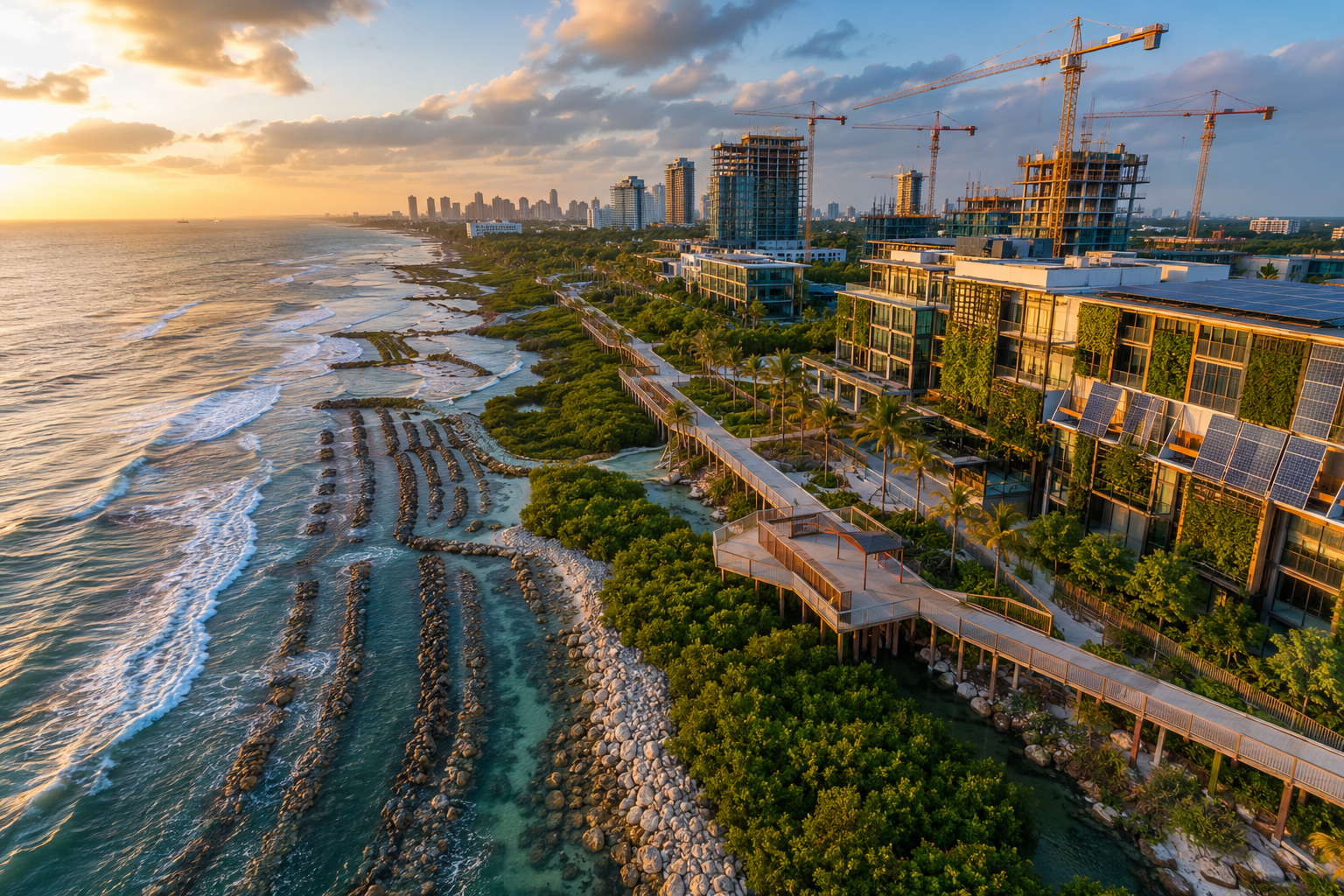
Research published in March 2026 through the American Society of Landscape Architects presents a compelling financial and environmental case: fully embracing nature-based design approaches for coastal infrastructure yields a 91% improvement in carbon efficiency and an average 30% cost savings compared to traditional hard-engineering methods [4]. For beachfront developers, these numbers translate directly into project economics.
A 30% reduction in infrastructure costs on a large-scale coastal development is not a marginal improvement — it is the difference between a viable project and one that cannot attract equity. Combined with the carbon efficiency gains that qualify projects for carbon credit monetization and green certification premiums, nature-based design is rapidly becoming the financially rational default choice, not merely an ethical one.
Practical Nature-Based Strategies for Beachfront Developments
Living shorelines replace seawalls and riprap with oyster reefs, marsh grasses, and submerged aquatic vegetation. They provide equivalent or superior storm protection at lower long-term maintenance costs while generating measurable ecosystem services that can be monetized through blue carbon credits.
Dune restoration and management creates natural buffers that protect beachfront structures without the permitting complexity and visual impact of hard barriers. Restored dunes also enhance the aesthetic value of beachfront properties, supporting premium pricing in luxury segments.
Bioswales and permeable surfaces manage stormwater on-site, reducing municipal infrastructure dependency and qualifying projects for stormwater credit programs in many jurisdictions.
Mangrove and coastal forest buffers deliver the highest carbon sequestration rates of any coastal ecosystem and are increasingly recognized as investable assets through blue carbon frameworks. The World Economic Forum highlighted six ventures in April 2026 that are turning blue carbon solutions into investable pathways, connecting ecosystem restoration with viable business models and direct community benefits [7].
Real-World Proof Points in 2026
New York City completed the first phase of the $200 million Battery Coastal Resilience Project on June 8, 2026, raising the waterfront esplanade in Lower Manhattan to protect against projected sea-level rise through 2100 [1]. The engineering firm Stantec confirmed the completion, noting that the elevated promenade preserves public access to an iconic urban waterfront while delivering measurable climate protection [8].
Simultaneously, the Boston Green Ribbon Commission launched a Coastal Resilience Financial Blueprint initiative on June 1, 2026, engaging a consultant team led by Arcadis to assess the total cost of inaction, quantify the benefits of resilience investments, identify funding gaps, and map potential public and private financing options across Boston’s waterfront [2]. These two flagship projects demonstrate that the institutional appetite for coastal resilience investment is not theoretical — it is being deployed at scale right now.
For developers active in high-growth coastal markets, these precedents matter. They establish valuation methodologies, financing templates, and regulatory frameworks that can be adapted to private beachfront developments in markets ranging from the U.S. Eastern Seaboard to Brazil’s Atlantic coast.
Green Finance Tactics: Structuring Deals That Attract ESG Capital
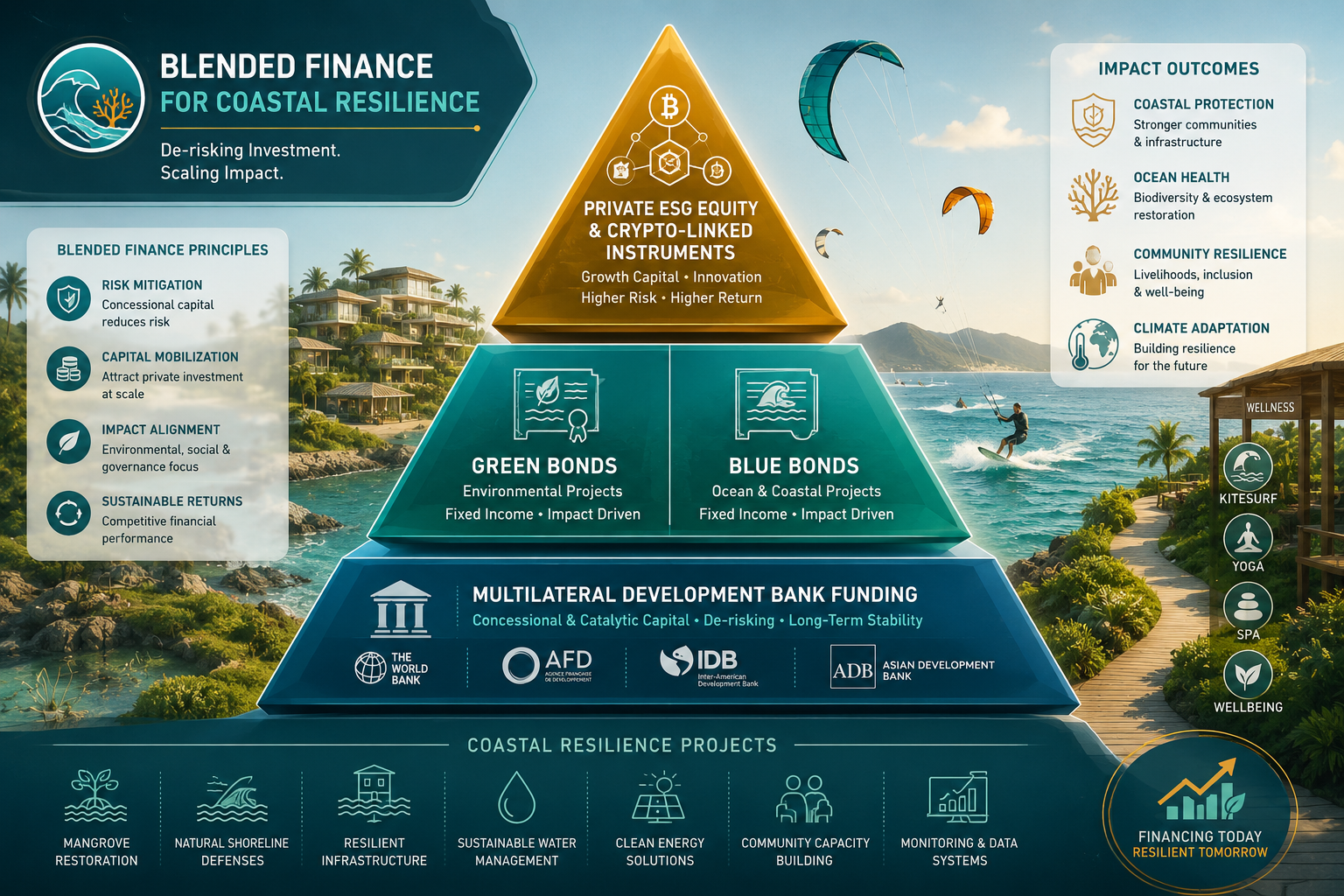
Coastal Sustainability Plays 2026: Green Finance Tactics for Beachfront Developments — The Blended Finance Model
The most effective financing structure for large coastal developments in 2026 combines multiple capital layers, each with a different risk-return profile. This blended finance approach allows developers to de-risk projects sufficiently to attract institutional ESG equity while maximizing leverage on concessional public capital.
Typical blended finance stack for a coastal development:
- Concessional grants and subsidies — Climate resilience grants from federal or municipal programs, often covering 10-20% of infrastructure costs for qualifying nature-based elements
- Multilateral development bank (MDB) loans — Below-market-rate debt from institutions such as the IFC, IDB, or national development banks, available to projects meeting sustainability taxonomy criteria
- Green bonds or blue bonds — Fixed-income instruments issued to institutional investors, with proceeds ring-fenced for eligible green or blue project components
- Sustainability-linked loans (SLLs) — Commercial bank debt with interest rates tied to ESG performance indicators, incentivizing ongoing compliance
- ESG equity — Private equity or real estate investment trust capital from funds with explicit sustainable mandates, often requiring third-party green certification
“The developers who structure their projects around measurable sustainability outcomes from day one — not as an afterthought — are the ones who will access the lowest-cost capital and the deepest investor pools in 2026 and beyond.”
Monetizing Scarcity: Kitesurf and Coastal Wellness Niches
One of the most underappreciated green finance tactics in 2026 involves the premium valuation that scarcity-driven coastal niches command. Kitesurf destinations and coastal wellness communities represent a convergence of environmental asset quality and lifestyle demand that is attracting significant foreign ESG investment.
Locations with consistent wind conditions, clean water, and protected natural environments are genuinely scarce. That scarcity is not just a marketing claim — it is a defensible moat that supports premium pricing, high occupancy rates, and strong resale values. For green finance purposes, it also means that the environmental assets underpinning the development’s value proposition are directly aligned with the sustainability credentials required for ESG-linked capital.
Coastal wellness developments — incorporating biophilic design, organic food systems, air and water quality monitoring, and low-impact recreational infrastructure — are increasingly structured to meet green building certification standards (LEED, EDGE, AQUA) that unlock preferential financing terms.
For investors exploring the best places to invest in Brazil property, coastal markets with strong wind and water conditions are attracting exactly this type of ESG-aligned foreign capital. The Tramonto development and the Solis project in Florianopolis exemplify how beachfront developments can integrate sustainability credentials with premium lifestyle positioning to attract both domestic and international buyers.
Cryptocurrency and Tokenized Green Assets
An emerging tactic in coastal sustainability finance involves the tokenization of green assets — carbon credits, blue carbon certificates, and even fractional ownership of nature-based infrastructure — on blockchain platforms. While still nascent, this approach is gaining traction as a way to democratize access to coastal resilience investments and create liquid secondary markets for previously illiquid environmental assets.
For developers interested in how digital finance instruments are intersecting with real estate, the analysis of cryptocurrencies and real estate development provides relevant context on how these instruments are being integrated into project financing structures.
ESG Compliance Checklist for Beachfront Developers
Before approaching green finance markets, developers should assess their projects against the following criteria:
- Environmental impact assessment completed and publicly disclosed
- Nature-based infrastructure incorporated into site design with measurable outcome targets
- Green building certification pathway identified (LEED, EDGE, AQUA, or equivalent)
- Carbon accounting methodology established, covering both embodied and operational emissions
- Community benefit plan documented, addressing local employment, coastal access, and ecosystem services
- Third-party verification partner engaged for ongoing ESG performance monitoring
- National sustainable taxonomy alignment confirmed with legal counsel
Developers in the Florianopolis region can also reference the growth of the Ingleses region for insight into how infrastructure investment and environmental quality are driving property values in coastal markets that are increasingly attractive to ESG-focused capital.
For those evaluating the financial upside of early-stage coastal investment, the analysis of why buying pre-launch can amplify returns is directly relevant to green-certified beachfront projects where sustainability credentials are embedded from the design phase.
Conclusion
The convergence of national sustainable taxonomies, new blue bond frameworks, and proven nature-based infrastructure economics has created a genuinely favorable environment for Coastal Sustainability Plays 2026: Green Finance Tactics for Beachfront Developments. The financing gap is real, but so is the institutional appetite to close it — provided developers bring compliant, well-structured projects to market.
Actionable next steps for developers and investors:
- Audit current or planned projects against national sustainable taxonomy criteria and identify which green finance instruments are accessible based on project characteristics.
- Engage a blue bond or green bond structuring advisor early in the development process — not after design is complete — to ensure project components are documented for bond eligibility.
- Commission a nature-based infrastructure feasibility study to quantify the cost savings and carbon efficiency gains available through living shorelines, dune restoration, and bioswale systems.
- Identify scarcity-driven value propositions in the project’s location — wind conditions, water quality, biodiversity — and structure ESG marketing materials around these defensible environmental assets.
- Build a blended finance stack that layers concessional grants, MDB loans, green bonds, and ESG equity to minimize the cost of capital while maximizing project scale.
- Explore blue carbon monetization by engaging with verified carbon standard programs that can generate ongoing revenue from coastal ecosystem restoration components.
The developers and investors who treat sustainability not as a compliance cost but as a capital access strategy will define the leading coastal projects of the next decade. The tools, frameworks, and institutional capital are available in 2026 — the competitive advantage belongs to those who deploy them first.
References
[1] Mayor Mamdani Completes First Phase Of Battery Coastal Resilienc – https://www.nyc.gov/mayors-office/news/2026/06/mayor-mamdani-completes-first-phase-of-battery-coastal-resilienc?utm_source=openai
[2] Boston Green Ribbon Commission To Develop Coastal Resilience Financial Blueprint Names Consultant Team Led By Arcadis – https://greenribboncommission.org/2026/06/boston-green-ribbon-commission-to-develop-coastal-resilience-financial-blueprint-names-consultant-team-led-by-arcadis/?utm_source=openai
[3] Kestrel Launches Blue Bond Methodology For The U.s. Municipal Bond Market – https://www.businesswire.com/news/home/20260129568652/en/Kestrel-Launches-Blue-Bond-Methodology-for-the-U.S.-Municipal-Bond-Market?utm_source=openai
[4] New Coastal Infrastructure Should Be Nature Based – https://www.asla.org/news-insights/dirt/new-coastal-infrastructure-should-be-nature-based?utm_source=openai
[5] 6 Opportunities Sustainable Finance 2026 – https://www.wri.org/technical-perspectives/6-opportunities-sustainable-finance-2026?utm_source=openai
[6] 2026 Sustainability Trends – https://www.spglobal.com/sustainable1/en/insights/2026-sustainability-trends?utm_source=openai
[7] Blue Carbon Solutions Investable Pathways Coastal Restoration – https://www.weforum.org/stories/2026/04/blue-carbon-solutions-investable-pathways-coastal-restoration/?utm_source=openai
[8] First Phase Lower Manhattans Battery Coastal Resilience Project Complete – https://www.stantec.com/en/news/2026/first-phase-lower-manhattans-battery-coastal-resilience-project-complete?utm_source=openai