
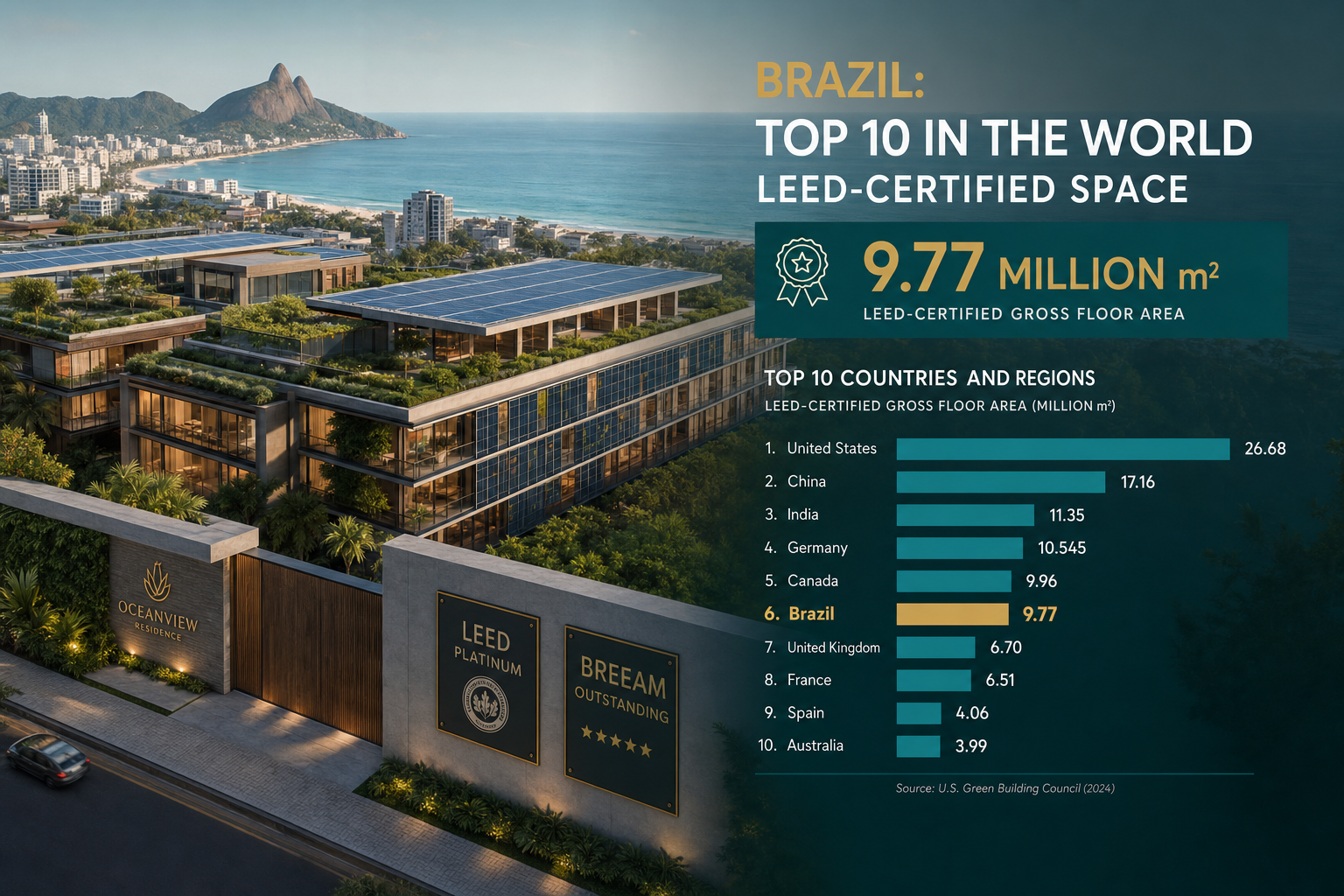
Brazil ranked among the top 10 countries globally for LEED-certified space in 2024, with nearly 9.77 million gross square meters certified — a figure that places it ahead of many larger economies and signals a mature, competitive green building market [4]. For premium residential developers operating along Brazil’s coastline in 2026, that foundation is not merely a badge of national pride. It is a strategic asset. Zero Energy Building Certifications 2026: LEED and BREEAM Tactics for Premium Residential Developments in Coastal Brazil has become one of the most consequential topics in the country’s luxury real estate sector, as ESG-focused foreign capital, Paris Agreement compliance pressures, and a new generation of Brazilian green certification frameworks converge on the same moment.
Key Takeaways
- Brazil is a top-10 global LEED market, giving coastal developers access to deep local expertise and supply chains for pursuing LEED Gold, Platinum, and LEED Zero overlays.
- GBC Brasil’s Net Zero Building Certification — covering Energy, Carbon, Water, and Waste — is designed to layer directly on top of LEED or BREEAM, creating a dual-certification strategy uniquely suited to Brazilian coastal luxury projects.
- LEED Zero Energy requires 12 months of measured operational performance, making early energy modeling and on-site renewable integration non-negotiable from the design phase.
- GRESB’s 2026 Real Estate Assessment recognizes both LEED and BREEAM as accepted green building schemes, making dual certification a direct pathway to institutional and EU-linked capital.
- Coastal Brazil’s solar irradiance, prevailing sea breezes, and premium buyer demographics create an unusually favorable environment for achieving true zero-energy performance at scale.
Why Zero Energy Certification Is Now a Financial Imperative for Coastal Brazil
The conversation around green building in Brazil has shifted decisively. What was once a marketing differentiator has become a financing requirement. International real estate funds operating under EU Sustainable Finance Disclosure Regulation (SFDR) Article 8 and Article 9 frameworks increasingly require that portfolio assets hold recognized green certifications. The GRESB 2026 Real Estate Assessment scheme list explicitly confirms that LEED and BREEAM — including residential variants such as LEED BD+C: Homes/Mid-Rise and BREEAM New Construction International — remain accepted schemes for demonstrating ESG performance [4].
For developers targeting foreign capital or listing assets within ESG-aligned vehicles, this is not abstract policy. It is a hard requirement at the point of capital allocation.
Three financial pressures are converging simultaneously in 2026:
- Green bond eligibility — Brazilian real estate projects seeking green bond financing from multilateral development banks or international lenders must demonstrate alignment with recognized certification frameworks.
- GRESB scoring — Institutional investors use GRESB scores to compare fund performance. Assets with LEED or BREEAM certification contribute directly to higher GRESB ratings, improving a fund’s competitiveness.
- Premium pricing power — Certified zero-energy residences command measurable price premiums in coastal markets such as Florianópolis, Fortaleza, and Recife, where high-net-worth domestic and international buyers increasingly prioritize sustainability credentials.
Developers exploring the best places to invest in Brazil property will find that coastal markets with strong tourism infrastructure and international buyer interest are precisely the locations where zero-energy certification delivers the greatest financial return.
Understanding the Certification Landscape: LEED, BREEAM, and GBC Brasil Net Zero
Navigating Zero Energy Building Certifications 2026: LEED and BREEAM Tactics for Premium Residential Developments in Coastal Brazil requires a clear understanding of how three distinct but complementary frameworks interact.
LEED and LEED Zero: The Established Path
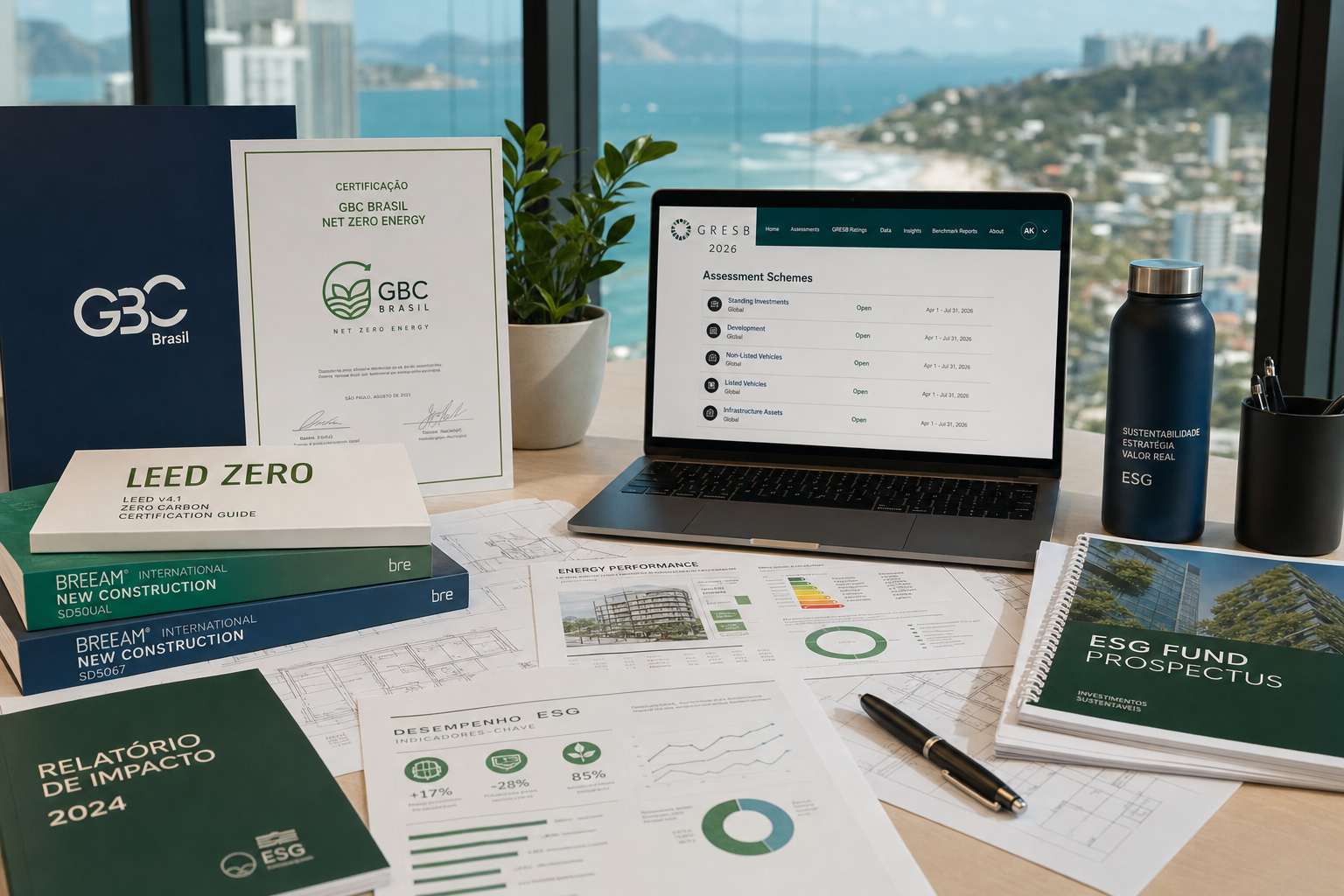
LEED (Leadership in Energy and Environmental Design) remains the most established international certification system for premium Brazilian projects [4]. The residential track — LEED BD+C: Homes and Mid-Rise — evaluates buildings across categories including energy efficiency, water use, indoor environmental quality, materials, and site sustainability.
LEED Zero is a separate add-on certification from USGBC/GBCI that sits on top of a base LEED certification. It offers four distinct labels:
| LEED Zero Label | Core Requirement |
|---|---|
| Zero Energy | 100% annual site energy offset via renewables |
| Zero Carbon | Net zero operational carbon emissions |
| Zero Water | Net zero water consumption |
| Zero Waste | 90%+ waste diversion from landfill |
Each LEED Zero label requires a minimum of 12 months of actual, measured operational performance data — not modeled projections. This means the path to LEED Zero begins at the design stage, with energy modeling, renewable energy system sizing, and metering infrastructure all planned from day one.
For coastal Brazilian projects, the LEED Zero Energy pathway is particularly achievable. Brazil’s Northeast and South coast receive among the highest solar irradiance levels in the world. A well-designed luxury residential tower in Florianópolis or Natal can realistically combine rooftop photovoltaic systems, building-integrated PV facades, and contracted off-site renewable energy to reach the 100% offset threshold.
BREEAM International: The European Capital Gateway
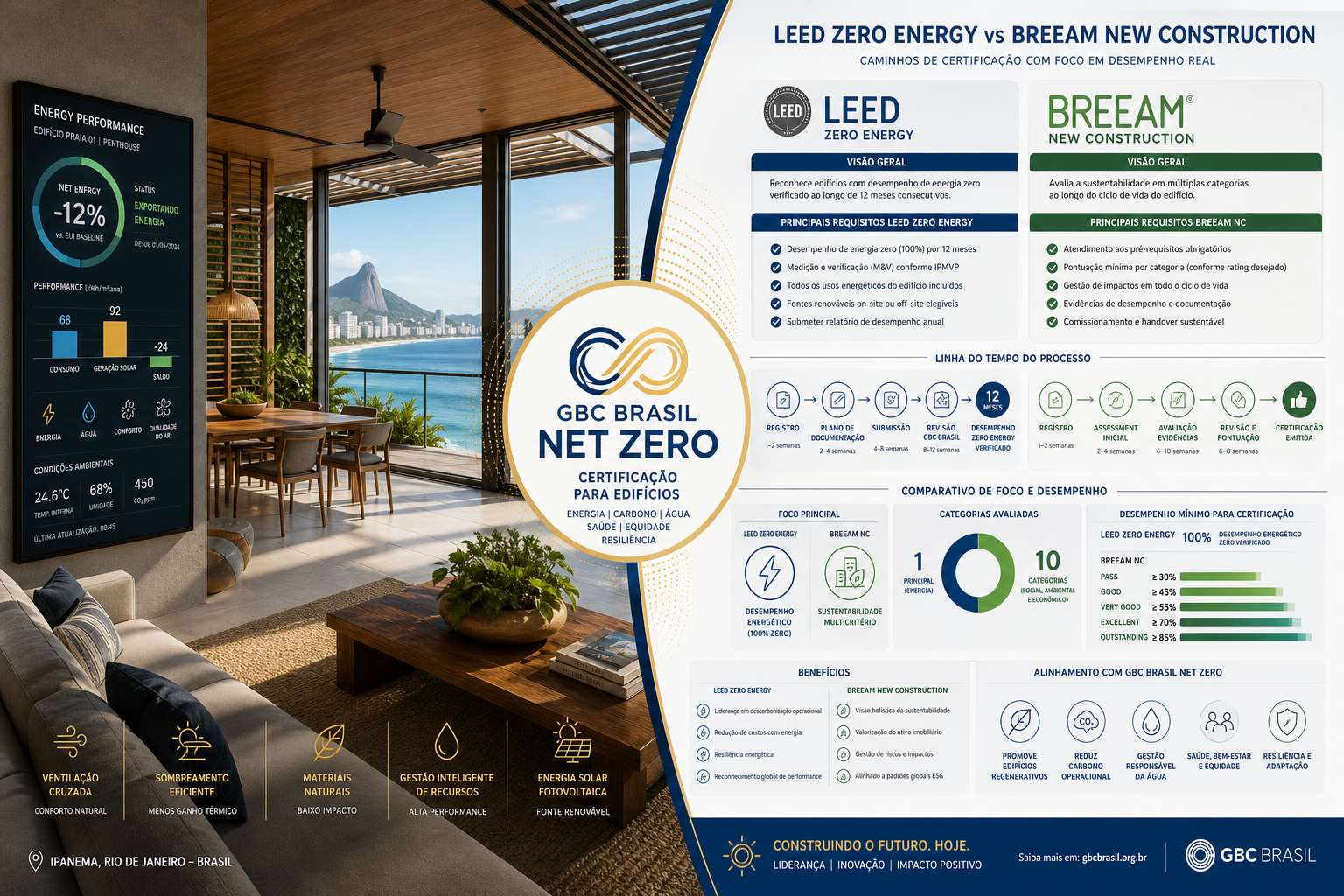
BREEAM (Building Research Establishment Environmental Assessment Method) is the world’s longest-running green building certification system [2]. While LEED dominates Brazil’s certification landscape by volume, BREEAM New Construction International carries distinct advantages for developers targeting European institutional investors.
BREEAM’s rating levels — Pass, Good, Very Good, Excellent, and Outstanding — are well-recognized within EU investment frameworks. A BREEAM Excellent or Outstanding rating on a Brazilian coastal residential project signals credibility to European family offices, pension funds, and impact investors who are more familiar with BREEAM than LEED.
Key BREEAM categories relevant to coastal Brazilian residential projects include:
- Energy — Operational energy performance and renewable energy integration
- Water — Efficiency and rainwater harvesting (highly relevant given coastal rainfall patterns)
- Health and Wellbeing — Thermal comfort, natural ventilation, and daylighting
- Ecology — Protection and enhancement of coastal biodiversity
- Resilience — Flood risk and climate adaptation measures
GBC Brasil Net Zero: The Local Amplifier
GBC Brasil, the country’s Green Building Council affiliate, launched a dedicated Net Zero Building Certification under the WorldGBC Advancing Net Zero project [5]. The framework offers four labels — Net Zero Energy, Carbon, Water, and Waste — tied to real operational performance rather than design projections.
Critically, the GBC Brasil certification is explicitly designed to be used alongside LEED or BREEAM rather than as a standalone replacement [5]. This creates a powerful dual-certification strategy: pursue LEED or BREEAM for holistic sustainability credentials, then layer GBC Brasil Net Zero Energy on top to demonstrate verified operational performance to Brazilian and international audiences simultaneously.
“The combination of an internationally recognized base certification with GBC Brasil’s Net Zero label gives coastal Brazilian developers a story that works in both São Paulo boardrooms and Amsterdam investment committees.”
Practical Tactics for Achieving Zero Energy Certification in Coastal Brazil
Translating certification frameworks into built outcomes requires a disciplined, phased approach. The following tactics address the specific conditions — climatic, regulatory, and market — of premium coastal Brazilian residential development.
Tactic 1: Integrate Energy Modeling from Concept Design
The 12-month performance requirement for both LEED Zero and GBC Brasil Net Zero Energy means that buildings must be designed to perform, not just modeled to comply. Engage an energy consultant at the concept design stage to run dynamic thermal simulations using actual coastal climate data. Target a site Energy Use Intensity (EUI) low enough that on-site renewables can realistically offset 100% of annual consumption.
Passive design strategies that reduce baseline energy demand include:
- Natural cross-ventilation using prevailing sea breezes to reduce mechanical cooling loads
- High-performance glazing with appropriate shading coefficients for coastal solar angles
- Thermal mass optimization to moderate diurnal temperature swings
- Green roofs and living walls that reduce urban heat island effect and improve insulation
Tactic 2: Size Renewable Energy Systems for Zero-Energy Performance
Rooftop photovoltaic systems are the primary renewable energy tool for Brazilian coastal residential buildings. For mid-rise and high-rise projects where rooftop area is insufficient to offset 100% of energy demand, LEED Zero Energy also accepts contracted off-site renewable energy — a practical solution available through Brazil’s growing renewable energy certificate (REC) market.
Building-integrated photovoltaics (BIPV) — PV panels embedded in facades, balcony railings, and shading elements — can meaningfully increase total system capacity without consuming additional rooftop area. This approach is particularly well-suited to the architectural language of premium coastal residential towers.
Tactic 3: Plan for Metering and Data Infrastructure
Both LEED Zero and GBC Brasil Net Zero require granular, verified energy consumption data over a 12-month period. Smart metering infrastructure — covering whole-building consumption, renewable generation, and individual unit sub-metering — must be specified during the construction documentation phase. Retrofitting metering systems after occupancy is expensive and often technically compromised.
Tactic 4: Pursue Dual Certification Strategically
For projects targeting international capital, a dual LEED + GBC Brasil Net Zero Energy certification is the strongest possible position. For projects with significant European investor exposure, consider BREEAM New Construction International as the base certification, with GBC Brasil Net Zero as the operational performance overlay.
The choice between LEED and BREEAM as the base system should be driven by:
- Target investor geography — North American and Latin American investors recognize LEED; European investors recognize BREEAM [2]
- Local consultant availability — Brazil’s deep LEED consultant ecosystem [4] gives LEED a practical advantage in most coastal cities
- Project typology — LEED BD+C: Homes/Mid-Rise is purpose-built for residential; BREEAM New Construction International requires adaptation for local regulatory context
Developers reviewing current premium residential developments in coastal Brazil can observe how leading projects are already incorporating sustainability as a core value proposition rather than an afterthought.
Tactic 5: Align with GRESB Reporting Requirements from Day One
If the project will be held within an institutional fund or real estate investment vehicle, GRESB alignment should be built into the project’s data management systems from the outset. The GRESB 2026 Real Estate Assessment recognizes both LEED and BREEAM as qualifying schemes and tracks operational performance metrics including energy intensity, carbon emissions, and water consumption.
Establishing baseline data collection protocols during construction — rather than scrambling to reconstruct historical data after GRESB reporting begins — saves significant time and cost.
The Coastal Brazil Advantage: Why This Market Is Uniquely Positioned
Coastal Brazil offers a combination of natural, demographic, and market conditions that make zero-energy residential certification more achievable — and more commercially valuable — than in most global markets.
Natural advantages:
- Among the world’s highest solar irradiance levels, particularly in the Northeast
- Consistent prevailing sea breezes that enable natural ventilation strategies
- Abundant rainfall supporting rainwater harvesting for water-neutral performance
- Mild coastal temperatures that reduce baseline heating and cooling loads
Market advantages:
- Brazil’s top-10 global LEED ranking means local expertise, certified professionals, and supply chains are readily available [4]
- Premium coastal markets attract high-net-worth buyers who value sustainability credentials and are willing to pay for them
- Growing domestic ESG investment culture, with Brazilian pension funds and family offices increasingly applying sustainability screens
The real estate market in Greater Florianópolis exemplifies this dynamic. The region’s combination of high quality of life, strong infrastructure growth, and international buyer interest makes it one of Brazil’s most compelling locations for zero-energy premium residential development. Projects like Tramonto and Solis demonstrate how premium coastal developments in this region are raising the bar for design quality and sustainability integration.
For investors considering the financial upside, the advantages of investing in off-plan developments are amplified when zero-energy certification is built into the project from the earliest stages — because the premium pricing power is locked in before construction costs are incurred.
Common Pitfalls and How to Avoid Them
Even experienced developers encounter avoidable mistakes when pursuing zero-energy certification for the first time. The most common include:
Treating certification as a post-construction exercise. Both LEED Zero and GBC Brasil Net Zero require 12 months of operational data. Projects that begin the certification process after construction is complete lose at least a year of lead time. Certification strategy must begin at project inception.
Undersizing renewable energy systems. Energy models prepared during design are often optimistic. Build in a 10-15% performance buffer when sizing PV systems to account for real-world shading, soiling, and degradation.
Neglecting embodied carbon. LEED and BREEAM both award credits for low-embodied-carbon materials. In coastal environments, material durability against salt air and humidity is also a certification consideration. Specifying materials that are both low-carbon and durable for coastal conditions requires early coordination between sustainability consultants and structural engineers [9].
Ignoring water certification pathways. Brazil’s coastal rainfall patterns make Net Zero Water a realistic target alongside Net Zero Energy. Pursuing both labels simultaneously under GBC Brasil’s framework adds minimal incremental cost when rainwater harvesting and greywater recycling systems are designed in from the start [5].
Conclusion: Actionable Next Steps for Developers in 2026
Zero Energy Building Certifications 2026: LEED and BREEAM Tactics for Premium Residential Developments in Coastal Brazil is not a future-facing aspiration — it is a present-tense competitive requirement for any premium coastal developer seeking institutional capital, premium pricing, or long-term asset value resilience.
The strategic path forward is clear:
Appoint a LEED AP or BREEAM Assessor at concept design stage — not after planning approval. Early integration of certification strategy into design decisions is the single highest-leverage action available.
Commission a climate-responsive energy model using actual coastal site data before schematic design is finalized. Use this model to size renewable energy systems for verified zero-energy performance, not just code compliance.
Plan metering infrastructure as a first-class building system — on par with electrical, mechanical, and plumbing. Granular, verified data is the foundation of every zero-energy certification pathway.
Pursue dual certification — LEED or BREEAM as the base system, GBC Brasil Net Zero Energy as the operational performance overlay. This combination maximizes credibility with both domestic and international capital sources.
Align GRESB reporting requirements with project data systems from day one to ensure the asset is immediately competitive within institutional real estate fund structures.
Coastal Brazil’s solar resources, market sophistication, and established LEED ecosystem make it one of the world’s most favorable environments for achieving genuine zero-energy residential performance. The developers who act on this opportunity in 2026 will define the benchmark that all others will be measured against.
For those ready to explore how these principles are being applied in live coastal developments, Quadragon’s current project portfolio offers a direct view of what premium sustainable residential development looks like in practice along Brazil’s most dynamic coastlines.
References
[1] 3rd Party Rating Systems – Net Zero Modules – https://sftool.gov/Content/attachments/3rd%20Party%20Rating%20Systems%20-%20Net%20Zero%20modules.pdf
[2] BREEAM – https://breeam.com
[4] Brazil Ranks Among Top 10 2024 Global LEED Green Building Ranking – https://www.gbci.org/brazil-ranks-among-top-10-2024-global-leed-green-building-ranking
[5] GBC Brasil Launches Net Zero Building Certification Through WorldGBC Project – https://worldgbc.org/article/gbc-brasil-launches-net-zero-building-certification-through-worldgbc-project/
[7] Brazil Ranks Among the Top Five Countries for LEED Certification Worldwide – https://www.constructing-sustainable-future.com/en/brazil-ranks-among-the-top-five-countries-for-leed-certification-worldwide/
[9] How UBQ Supports the Building Construction Industry Obtaining LEED and BREEAM Certifications – https://www.ubqmaterials.com/how-ubq-supports-the-building-construction-industry-obtaining-leed-and-breeam-certifications/
[10] List of Zero Carbon Building Certifications – https://www.soletairpower.fi/list-of-zero-carbon-building-certifications/