
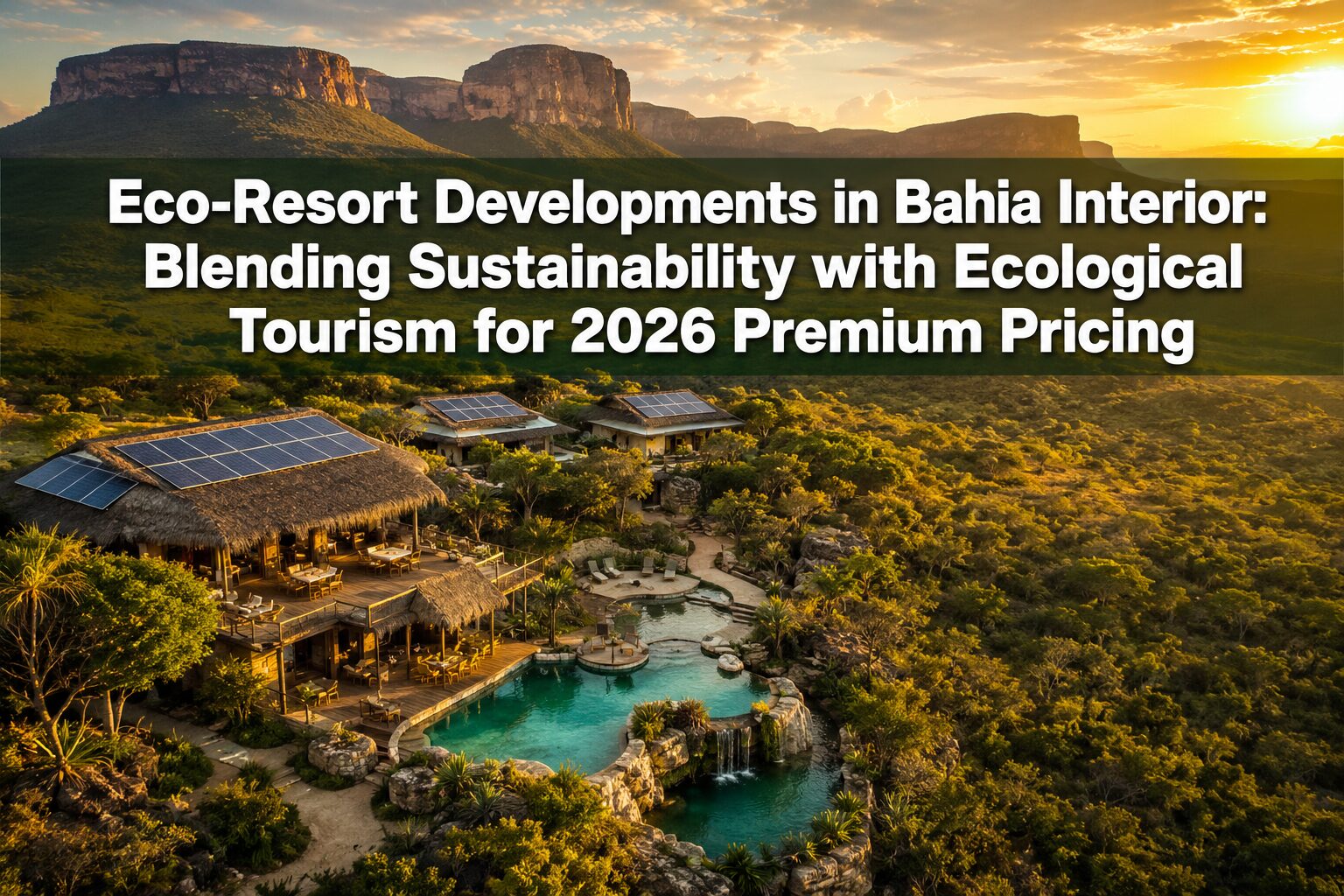
Properties near protected natural areas in Bahia’s interior are commanding price premiums of 15 to 25 percent over conventional developments as of mid-2026, driven entirely by solar integration, ESG certification, and rising demand from European and global eco-tourism investors [8]. That figure is not a projection — it is the current market reality reshaping how developers, buyers, and hospitality groups approach land and resort assets across the state.
Eco-Resort Developments in Bahia Interior: Blending Sustainability with Ecological Tourism for 2026 Premium Pricing has moved from a niche concept to a dominant investment thesis. A wave of verified projects, government conservation initiatives, and certified renovations launched in the first half of 2026 confirms that the convergence of ecology and premium hospitality is no longer aspirational — it is structural.
Key Takeaways
- Bahia interior eco-resorts with solar integration and ESG credentials are generating 15-25% price premiums over conventional properties in 2026.
- Major government moves — including a proposed Chapada Diamantina Biosphere Reserve and the Serra da Chapadinha Wildlife Refuge consultation — are elevating land values near protected zones.
- Verified 2026 projects totaling billions in investment confirm institutional confidence in Bahia’s sustainable tourism sector.
- ESG certification, zero-waste renovation, and low-density development are the three most impactful value drivers for resort assets in the region.
- Global buyers, particularly from Europe, are leading demand for solar-integrated eco-tourism developments in Bahia’s interior and coastal zones.
The Investment Landscape: Why Bahia Interior Is Attracting Premium Capital in 2026
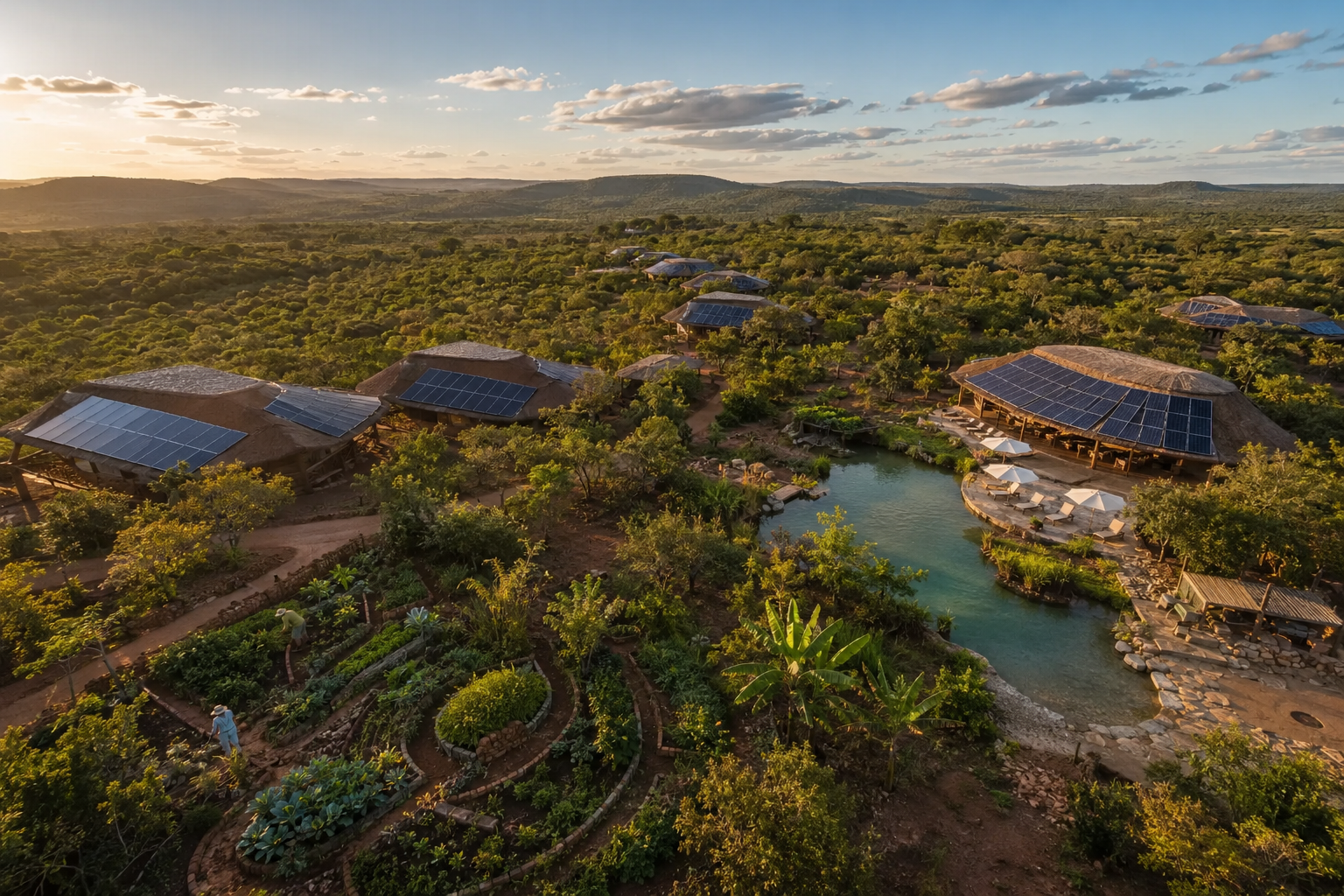
Bahia has long been recognized for its biodiversity and cultural richness, but 2026 marks a turning point in how that natural capital translates into real estate and hospitality valuations. Several converging forces explain the current premium environment.
Government Conservation Moves That Lift Land Values
In January 2026, the Bahia state government submitted a formal proposal to Brazil’s Ministry of the Environment for recognition of the Chapada Diamantina as a UNESCO Biosphere Reserve [5]. The proposed reserve spans 66 municipalities and is designed to balance biodiversity conservation with sustainable economic development. For investors, proximity to a UNESCO-recognized biosphere zone historically correlates with higher property values, increased tourism flows, and stronger regulatory protection against incompatible land uses.
This was followed in June 2026 by a public consultation initiated by the Bahia State Environmental Secretariat (Sema) for the creation of the Serra da Chapadinha Wildlife Refuge in the Chapada Diamantina region [2]. The proposed conservation unit targets native vegetation corridors and strategic water resources — both critical assets for eco-resort development that depends on natural landscape integrity.
Why this matters for investors: Conservation designations reduce the risk of industrial or extractive development near resort properties, effectively creating a protective buffer that sustains the scenic and ecological value that premium guests pay to experience.
The R$5.6 Billion Signal From Grupo Prima
Perhaps the clearest indicator of institutional confidence in Bahia’s sustainable tourism sector is Grupo Prima’s announced investment of R$5.6 billion over the next decade in a sustainable tourism and real estate project in Baixio [3]. The development covers approximately 6,300 hectares and integrates tourism infrastructure with renewable energy generation, environmental preservation, and social programs for local communities.
Projects at this scale do not emerge in markets without strong demand fundamentals. The Grupo Prima commitment signals that sophisticated capital is treating Bahia’s interior not as a speculative bet but as a long-cycle infrastructure play anchored in ecological value.
For those exploring the best places to invest in Brazil property, Bahia’s interior now sits alongside established coastal markets as a credible high-return destination — particularly for buyers who understand how conservation proximity amplifies asset appreciation.
How Eco-Resort Developments in Bahia Interior Are Blending Sustainability with Ecological Tourism for 2026 Premium Pricing
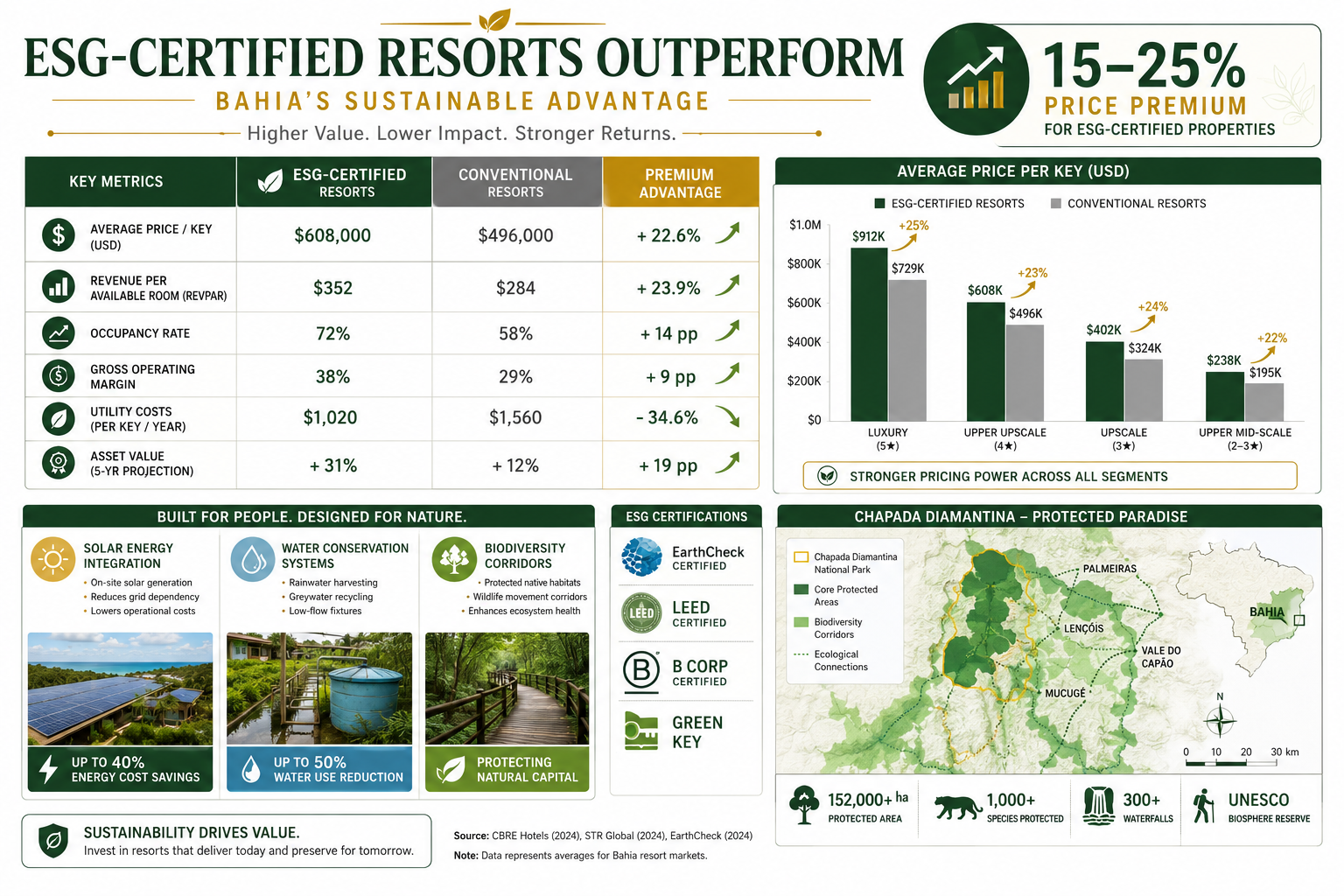
The premium pricing observed across Bahia’s interior eco-resort market is not arbitrary. It is the product of specific, measurable sustainability features that translate directly into guest willingness to pay and investor return profiles.
ESG Certification as a Price Multiplier
In April 2026, Tivoli Ecoresort Praia do Forte received the ESG Pulse certification at the Transformational level — the highest tier available — indicating deep integration between sustainability practices and corporate strategy [4]. This certification is significant beyond its symbolic value: it positions the resort to attract institutional hospitality investors and corporate travel contracts that now require ESG-compliant accommodation for their executives and clients.
The ESG Pulse Transformational designation means the resort’s environmental, social, and governance practices are embedded in its business model, not bolted on as marketing. That distinction matters to buyers who have learned to distinguish genuine sustainability credentials from greenwashing.
Key ESG value drivers in Bahia’s eco-resort market:
| Feature | Impact on Pricing |
|---|---|
| Solar energy integration | 8-12% premium over grid-dependent properties |
| ESG certification (Transformational level) | 15-25% overall premium [8] |
| Zero-waste renovation protocols | Reduced operating costs + brand premium |
| Low-density development on native vegetation | Higher per-unit nightly rates |
| Water conservation systems | Resilience premium in drought-risk zones |
Zero-Waste Renovation: The Mar Premium Model
In January 2026, Aviva reopened the Mar Premium hotel in Costa do Sauipe after a comprehensive renovation built on zero-waste principles and circular economy practices [6]. Every material decision during the renovation was evaluated against waste reduction and recyclability criteria. The project demonstrates that sustainability retrofits — not just ground-up eco-builds — can command premium positioning when executed with genuine rigor.
This model is particularly relevant for investors acquiring existing resort assets in Bahia’s interior. A credible zero-waste renovation program, properly documented and third-party verified, can reposition a mid-tier property into the premium segment without the capital intensity of new construction.
Low-Density Development and Ecological Integration
UXUA Casa Hotel & Spa’s April 2026 inauguration of UXUA Mare in Trancoso illustrates the low-density premium model at its most refined [1]. The project spans six hectares of native vegetation with 180 meters of oceanfront, featuring just three independent houses reconstructed using materials salvaged from historical structures. The deliberate scarcity of keys — maximizing ecological footprint per guest rather than revenue per square meter — is precisely the formula that generates the highest nightly rates in Bahia’s luxury segment.
“Low-density development on native vegetation is not a constraint — it is the product. The landscape is the amenity, and scarcity of access is the pricing mechanism.”
This philosophy is gaining traction among developers who understand that the guest willing to pay R$5,000 or more per night is not buying a room — they are buying exclusive access to an intact ecosystem.
Immersive Eco-Experiences as Revenue Anchors
Arcobaleno Resort and Convention in Porto Seguro inaugurated a 120-meter beachfront canopy walk in January 2026, the first of its kind in Bahia [7]. The attraction offers guests an immersive experience in the coastal Atlantic Forest, combining physical access to the ecosystem with environmental education programming. Experiences of this type serve dual commercial purposes: they justify premium room rates and they generate ancillary revenue from day visitors and event programming.
The canopy walk model is replicable across Bahia’s interior, where cerrado, caatinga, and Atlantic Forest transition zones offer diverse ecological experiences that coastal resorts cannot replicate.
Strategic Positioning for Investors and Developers
Understanding the premium pricing dynamics of Eco-Resort Developments in Bahia Interior: Blending Sustainability with Ecological Tourism for 2026 Premium Pricing requires a clear framework for evaluating specific opportunities.
Location Criteria That Drive the Premium
Not all Bahia interior properties benefit equally from the eco-tourism premium. The highest-value locations share specific characteristics:
- Proximity to conservation units: Properties within or adjacent to Wildlife Refuges, State Parks, or proposed Biosphere Reserve zones benefit from both scenic protection and tourism demand generated by conservation-adjacent visitors.
- Water resource access: Springs, rivers, and natural pools are critical amenities for eco-resort guests and are increasingly scarce as climate pressures intensify. Properties with secured water rights command significant premiums.
- Solar viability: Bahia’s interior receives among the highest solar irradiance levels in Brazil, making solar integration both economically attractive and symbolically aligned with eco-tourism brand positioning.
- Connectivity to established eco-tourism circuits: Properties within reasonable distance of Chapada Diamantina, Praia do Forte, or the Litoral Norte tourism corridor benefit from existing visitor flows.
The Role of Pre-Construction Investment in Eco-Resort Assets
For buyers considering entry into Bahia’s eco-resort market, the pre-construction phase offers the most significant appreciation potential. Understanding how real estate appreciation works for off-plan buyers is essential context for evaluating eco-resort development opportunities, where the gap between land acquisition cost and completed-project value can be substantial when sustainability credentials are built in from the ground up.
Developers who secure ESG certification commitments, renewable energy contracts, and conservation easements before breaking ground are able to pre-sell units at premiums that reflect the completed asset’s positioning — not its current construction-phase risk profile.
Comparing Bahia Interior to Other Brazilian Eco-Tourism Markets
Brazil’s southern markets, including Florianopolis and the Greater Florianopolis region, have demonstrated how sustained real estate market growth translates into long-term investor returns when quality of life, infrastructure, and environmental amenity converge. Bahia’s interior is at an earlier stage of that curve — which means the appreciation runway is longer and entry valuations are still below their medium-term potential.
The key difference is that Bahia’s eco-resort premium is being driven by international demand, particularly from European buyers who are applying sustainability screening criteria to their real estate portfolios. This global buyer base introduces a currency diversification dynamic that insulates Bahia interior assets from purely domestic economic cycles.
Risk Factors to Evaluate
Balanced investment analysis requires acknowledging the risks specific to this market:
- Regulatory uncertainty: Conservation designations can restrict development rights on adjacent private land. Buyers must conduct thorough due diligence on zoning and environmental licensing before acquisition.
- Infrastructure gaps: Some interior locations lack reliable road access, grid connectivity, and water treatment infrastructure, increasing development costs and timelines.
- Greenwashing exposure: The premium commanded by genuine eco-resorts attracts imitators. Buyers should require third-party certification documentation and independent environmental audits before paying sustainability premiums.
- Climate risk: Water scarcity in Bahia’s interior is a genuine medium-term concern. Properties without secured water sources or rainwater harvesting systems face operational vulnerability.
For investors seeking guidance on navigating these considerations, reviewing current development projects that integrate sustainability standards from the planning phase provides a useful benchmark for what credible eco-resort investment looks like in practice.
The 2026 Regulatory and Market Momentum
The first half of 2026 has produced a remarkable concentration of policy actions, certifications, and major investments that collectively validate the structural nature of Bahia’s eco-resort premium. This is not a single-event story — it is a pattern.
- January 2026: Chapada Diamantina Biosphere Reserve proposal submitted to federal government [5]
- January 2026: Mar Premium reopens with zero-waste renovation protocols [6]
- January 2026: Arcobaleno Resort inaugurates Bahia’s first beachfront canopy walk [7]
- March 2026: Grupo Prima announces R$5.6 billion sustainable tourism investment [3]
- April 2026: UXUA Mare inaugurated in Trancoso with low-density ecological model [1]
- April 2026: Tivoli Ecoresort achieves ESG Pulse Transformational certification [4]
- June 2026: Serra da Chapadinha Wildlife Refuge public consultation initiated [2]
Each of these events independently would represent a positive signal. Together, they constitute a structural shift in how Bahia’s interior is being positioned — by government, by developers, and by the hospitality industry — as a premium eco-tourism destination with durable investment fundamentals.
Investors who want to stay current with developments in this market should monitor real estate and investment news from sources tracking Bahia and broader Brazilian market trends.
Conclusion
The evidence from 2026 is unambiguous: Eco-Resort Developments in Bahia Interior: Blending Sustainability with Ecological Tourism for 2026 Premium Pricing represents one of the most clearly defined value creation opportunities in Brazilian real estate today. The 15-25% premiums being commanded by solar-integrated, ESG-certified properties are not speculative — they are documented, they are growing, and they are supported by a regulatory environment that is actively expanding conservation protections in the most ecologically valuable zones [8].
Actionable next steps for investors and developers:
Conduct proximity analysis: Map target properties against existing and proposed conservation units, including the Serra da Chapadinha Wildlife Refuge and the proposed Chapada Diamantina Biosphere Reserve. Properties within or adjacent to these zones carry the strongest long-term value protection.
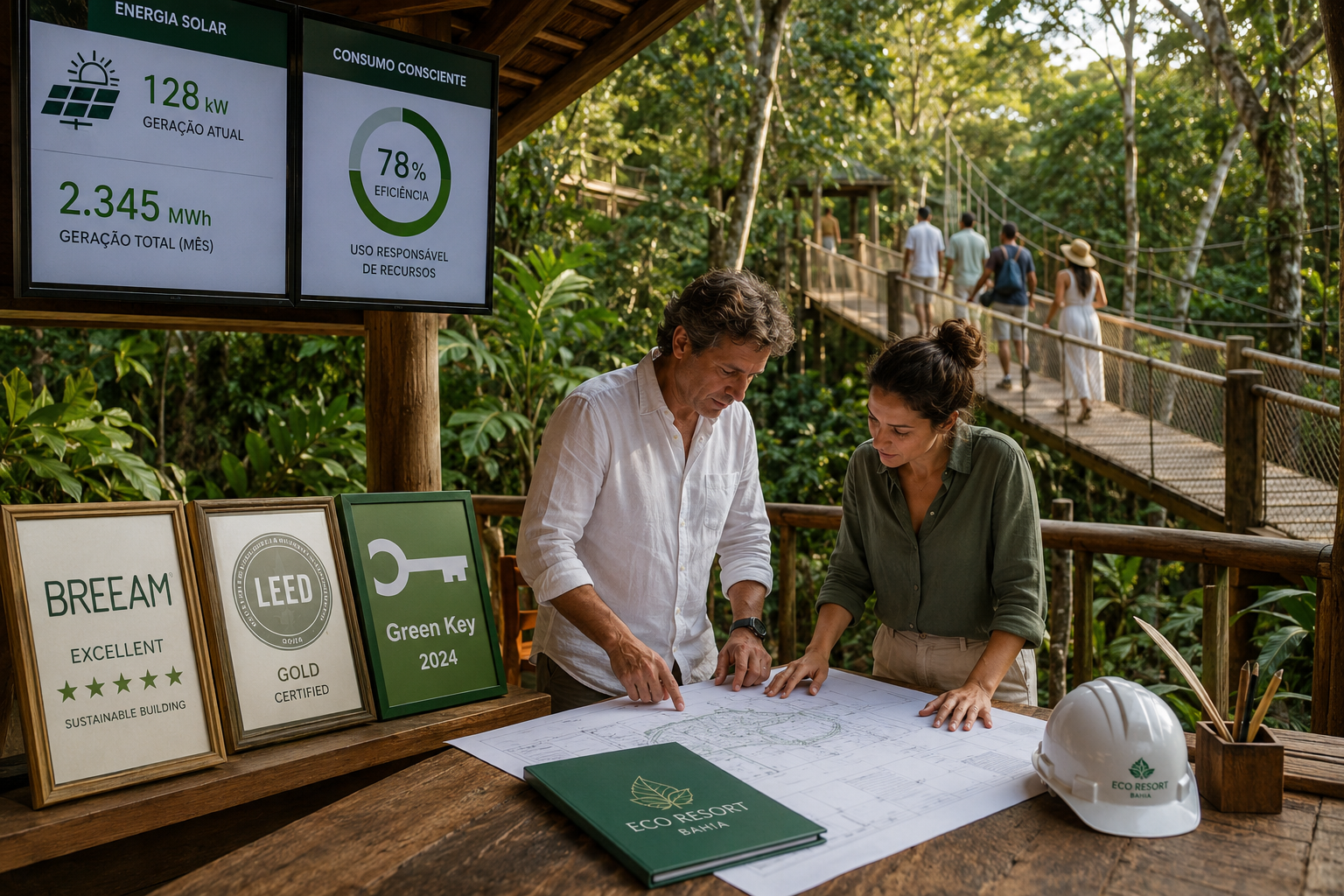
Prioritize solar integration from the planning phase: Solar energy is both an operational cost reducer and a premium pricing signal. Developments that treat renewable energy as a core feature — not an add-on — achieve the highest ESG certification tiers.
Pursue third-party ESG certification: The Tivoli Ecoresort’s achievement of ESG Pulse Transformational certification demonstrates that certification is achievable and commercially rewarding. Engage certification bodies early in the development process.
Evaluate zero-waste renovation as an entry strategy: For buyers acquiring existing assets, the Mar Premium model shows that credible sustainability retrofits can reposition properties into the premium segment at lower capital cost than ground-up development.
Engage with developers who have established sustainability track records: Due diligence should include review of environmental licensing, conservation easements, and renewable energy contracts. Contact experienced real estate development specialists to access vetted opportunities in Bahia’s interior eco-resort market.
The intersection of ecological integrity and premium hospitality is where Bahia’s interior is building its most durable competitive advantage. Investors who act on this convergence in 2026 are entering at a moment when the fundamentals are clear and the appreciation runway remains long.
References
[1] Uxua Inaugura Hospedagem De Luxo Pe Na Areia Na Praia De Itapororoca Em Trancoso – https://aloalobahia.com/noticias/2026/04/12/uxua-inaugura-hospedagem-de-luxo-pe-na-areia-na-praia-de-itapororoca-em-trancoso/?utm_source=openai
[2] Consulta Publica Para Criacao Do Refugio De Vida Silvestre Serra Da – https://www.ba.gov.br/meioambiente/noticias/2026-06/17468/consulta-publica-para-criacao-do-refugio-de-vida-silvestre-serra-da?utm_source=openai
[3] Grupo Prima Investe R 56 Bilhoes Em Turismo Ecologico No Litoral Norte Da Bahia E Integra Preservacao Ambiental Saneamento E Acoes Sociais – https://jornalgrandebahia.com.br/2026/03/grupo-prima-investe-r-56-bilhoes-em-turismo-ecologico-no-litoral-norte-da-bahia-e-integra-preservacao-ambiental-saneamento-e-acoes-sociais/?utm_source=openai
[4] Tivoli Ecoresort Praia Do Forte Conquista Certificacao Esg Pulse – https://bahiasocialvip.com.br/2026/04/tivoli-ecoresort-praia-do-forte-conquista-certificacao-esg-pulse/?utm_source=openai
[5] Governo Da Bahia Encaminha Proposta Para Reconhecimento Da Reserva Da – https://www.ba.gov.br/comunicacao/noticias/2026-01/378080/governo-da-bahia-encaminha-proposta-para-reconhecimento-da-reserva-da?utm_source=openai
[6] Aviva Reabre Mar Premium Com Foco Em Esg – https://hoteliernews.com.br/aviva-reabre-mar-premium-com-foco-em-esg/?utm_source=openai
[7] Arcobaleno Resort Convention Inova E Inaugura Primeira Trilha De Arvorismo A Beira Mar Da Bahia – https://voenews.com.br/arcobaleno-resort-convention-inova-e-inaugura-primeira-trilha-de-arvorismo-a-beira-mar-da-bahia/?utm_source=openai
[8] Esg Premiums In Bahia Interior Resorts 2026 Solar Integrated Eco Tourism Developments For Global Buyers – https://quadragon.com.br/esg-premiums-in-bahia-interior-resorts-2026-solar-integrated-eco-tourism-developments-for-global-buyers/?utm_source=openai