
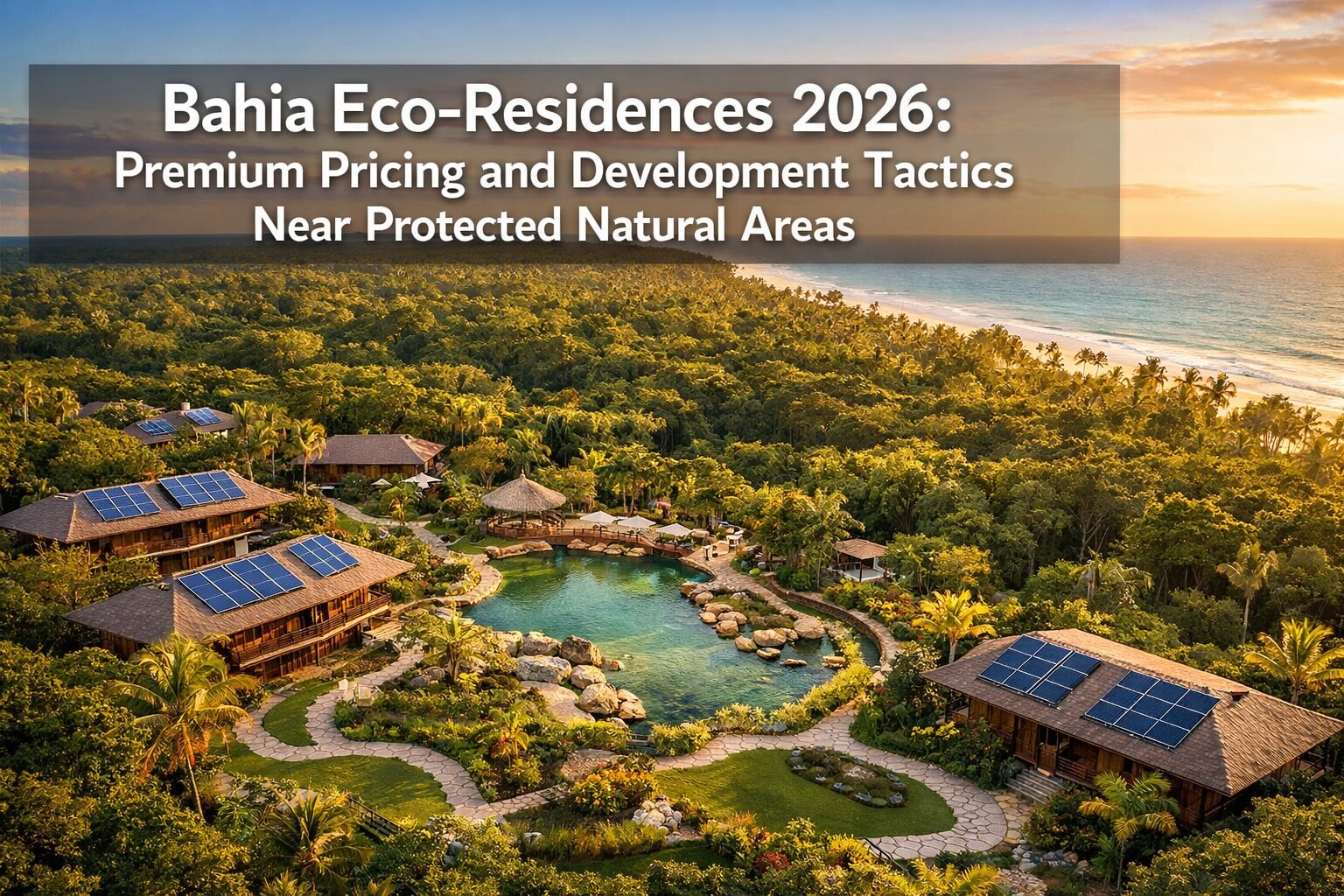
The Brazilian coastline is experiencing a remarkable transformation. In Bahia’s interior regions, a new generation of eco-conscious developments is redefining luxury real estate. Bahia Eco-Residences 2026: Premium Pricing and Development Tactics Near Protected Natural Areas represent more than just sustainable construction—they embody a fundamental shift in how developers approach land use, conservation, and profitability in one of Brazil’s most biodiverse regions. 🌿
As international buyers seek authentic connections with nature and Brazilian investors recognize the long-term value of environmental stewardship, eco-residences near protected areas are commanding unprecedented premiums. This article explores the development strategies, regulatory frameworks, cost structures, and return-on-investment projections that are shaping this qualitative growth segment.
Key Takeaways
- Premium positioning: Eco-residences near Bahia’s protected areas command 25-40% price premiums over conventional properties due to scarcity, exclusivity, and sustainability features
- Regulatory navigation: Successful developers work closely with environmental agencies (INEMA) to secure permits while maintaining conservation commitments through buffer zones and restoration requirements
- Infrastructure investment: Solar systems, rainwater harvesting, and greywater recycling add 15-22% to construction costs but deliver measurable ROI through operational savings and enhanced marketability
- Target demographics: North American and European remote workers, wellness-focused retirees, and eco-tourism entrepreneurs drive demand for nature-connected properties with strong rental potential
- Market momentum: Brazil’s coastal regions are entering a new appreciation cycle, with eco-tourism destinations showing particularly robust growth trajectories through 2026 and beyond
Understanding the Bahia Eco-Residence Market Landscape in 2026
The Rise of Sustainable Living in Northeast Brazil
Brazil’s Northeast region has emerged as a focal point for sustainable development. The state of Bahia, with its 1,100+ kilometers of coastline and vast interior Atlantic Forest remnants, offers unique opportunities for developers who understand the intersection of conservation and commerce.
Recent projects demonstrate this trend. Casa Daia Bungalows, which opened in 2025 in Ceará’s western coast, showcases how environmentally sensitive design can create commercially viable eco-resort infrastructure[2]. Meanwhile, in Bahia proper, established properties like the 15-year-old eco-boutique hotel in Barra Grande—featuring solar-powered water heating, composting waste management, and eco-conscious construction on 11,000 m² of beachfront land—prove the long-term viability of sustainable hospitality models[1].
Protected Areas as Premium Positioning Tools
Proximity to protected natural areas creates inherent scarcity. Environmental preservation zones in Bahia include:
- APA (Área de Proteção Ambiental): Sustainable use conservation units allowing limited development
- RPPN (Reserva Particular do Patrimônio Natural): Private natural heritage reserves
- Permanent Preservation Areas (APPs): Riparian zones, hillsides, and coastal vegetation
Developments adjacent to these zones benefit from guaranteed viewsheds, biodiversity corridors, and the assurance that neighboring land cannot be subdivided or overdeveloped. This permanence justifies premium pricing strategies.
Target Demographics Driving Demand
The buyer profile for Bahia Eco-Residences 2026 includes:
- Remote workers from North America and Europe seeking warm weather, strong internet connectivity, and nature immersion
- Wellness-focused retirees prioritizing clean air, organic food access, and outdoor recreation
- Eco-tourism entrepreneurs looking for rental-ready properties in established or emerging destination markets
- Conservation-minded Brazilians from São Paulo, Rio de Janeiro, and Brasília seeking second homes with environmental integrity
According to market analysis, demand for sustainable living and second homes in coastal destinations is rising sharply, with investors seeking properties that deliver both lifestyle benefits and strong rental returns[4].
Bahia Eco-Residences 2026: Development Tactics and Regulatory Framework
Navigating Environmental Licensing (Licenciamento Ambiental)
Developing near protected areas requires sophisticated regulatory navigation. The three-phase licensing process in Bahia involves:
Phase 1: Preliminary License (LP)
- Environmental impact assessment (EIA/RIMA for larger projects)
- Public hearings with local communities
- Demonstration of project viability and location suitability
- Timeline: 6-12 months
Phase 2: Installation License (LI)
- Detailed engineering plans incorporating environmental controls
- Erosion prevention, waste management, and water treatment systems
- Environmental compensation measures (often reforestation requirements)
- Timeline: 4-8 months
Phase 3: Operation License (LO)
- Final inspection confirming compliance with approved plans
- Ongoing monitoring requirements
- Renewable every 2-5 years depending on project impact
- Timeline: 2-4 months
Pro tip: Engage environmental consultants and legal specialists familiar with INEMA (Instituto do Meio Ambiente e Recursos Hídricos da Bahia) protocols before land acquisition. Properties with existing environmental studies or prior licensing can reduce approval timelines by 40-60%.
Land Acquisition Strategies Near Conservation Units
Smart developers employ several tactics when acquiring land adjacent to protected areas:
Buffer Zone Opportunities: Properties within 10-kilometer buffer zones around conservation units face additional restrictions but also benefit from reduced competition and enhanced natural amenities. Prices in these zones typically run 20-35% below comparable coastal parcels without restrictions, yet command similar final sale prices after development due to sustainability premiums.
RPPN Creation: Establishing a Private Natural Heritage Reserve on a portion of your property (typically 30-50% of total area) provides:
- Property tax exemptions (IPTU reductions up to 100%)
- Priority in environmental licensing
- Marketing differentiation as conservation-committed development
- Potential carbon credit revenue streams
Community Partnership Models: Following the example of urban regeneration initiatives like those implemented by Pentagrama Projetos em Sustentabilidade e Regeneração in Brasilia and Curitiba, developers can create “agrihood” concepts that combine residential development with ecosystem restoration[3]. These projects benefit from UNEP incubation programs and enhanced community acceptance.
Zoning and Density Considerations
Bahia municipalities near protected areas typically enforce lower density requirements:
| Zone Type | Maximum Density | Minimum Lot Size | Building Coverage |
|---|---|---|---|
| Urban Eco-Zone | 15-25 units/hectare | 600-1,000 m² | 20-30% |
| Rural Conservation | 2-5 units/hectare | 5,000-10,000 m² | 10-15% |
| APA Buffer | 1-3 units/hectare | 10,000+ m² | 5-10% |
Lower density translates to larger lots, higher per-unit land costs, but significantly enhanced premium positioning. The best places to invest in Brazil property often feature these lower-density, higher-value characteristics.
Premium Pricing Strategies for Bahia Eco-Residences 2026
Cost Structure Analysis
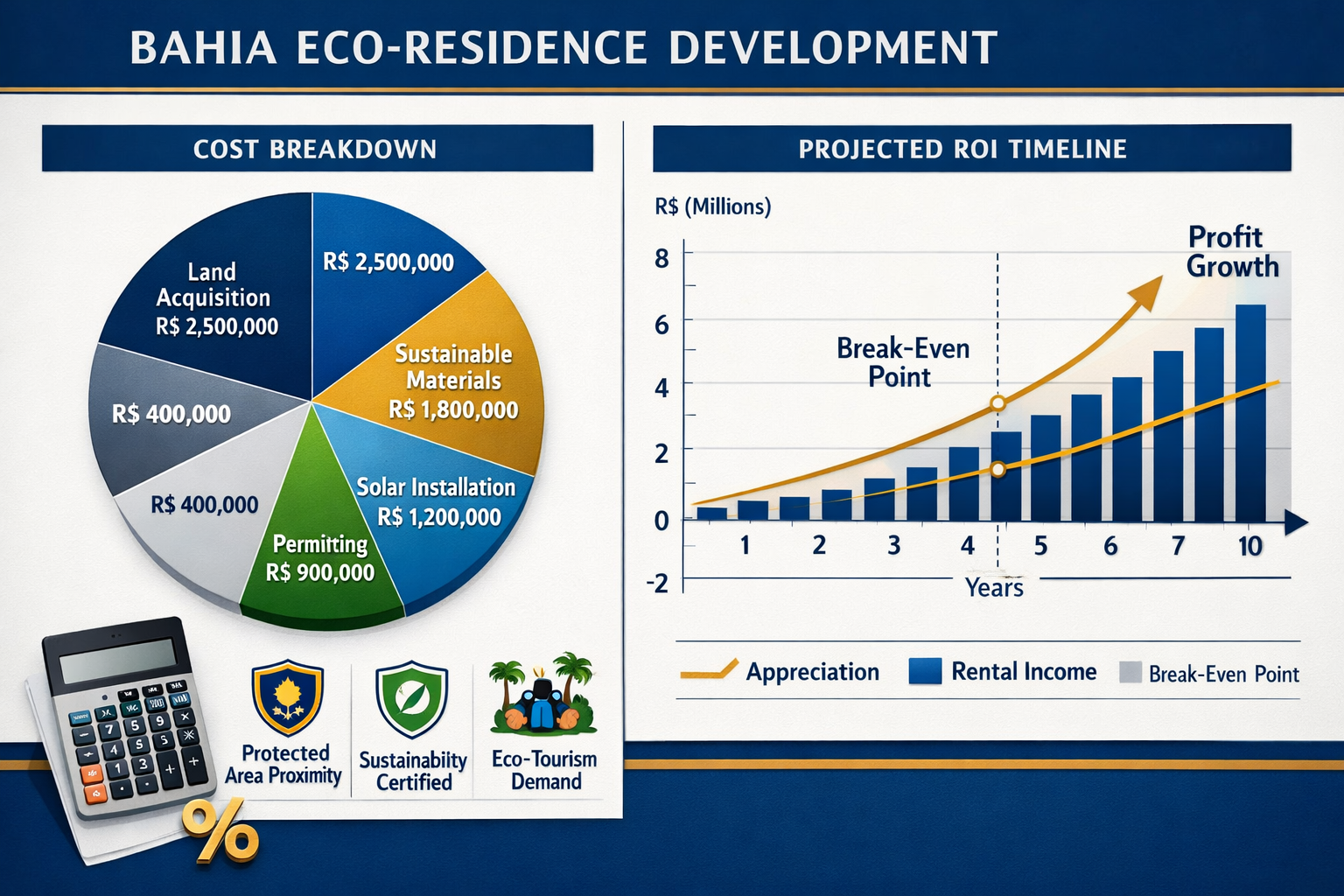
Understanding the true cost of sustainable development is essential for accurate pricing. Here’s a comprehensive breakdown for a mid-scale eco-residence project (10-unit development on 5 hectares):
Land Acquisition: R$150-400 per m² depending on location, access, and existing infrastructure
- Interior Bahia near protected forest: R$150-250/m²
- Coastal proximity (5-15km from beach): R$300-400/m²
Infrastructure Development:
- Road access and utilities: R$80,000-150,000 per unit
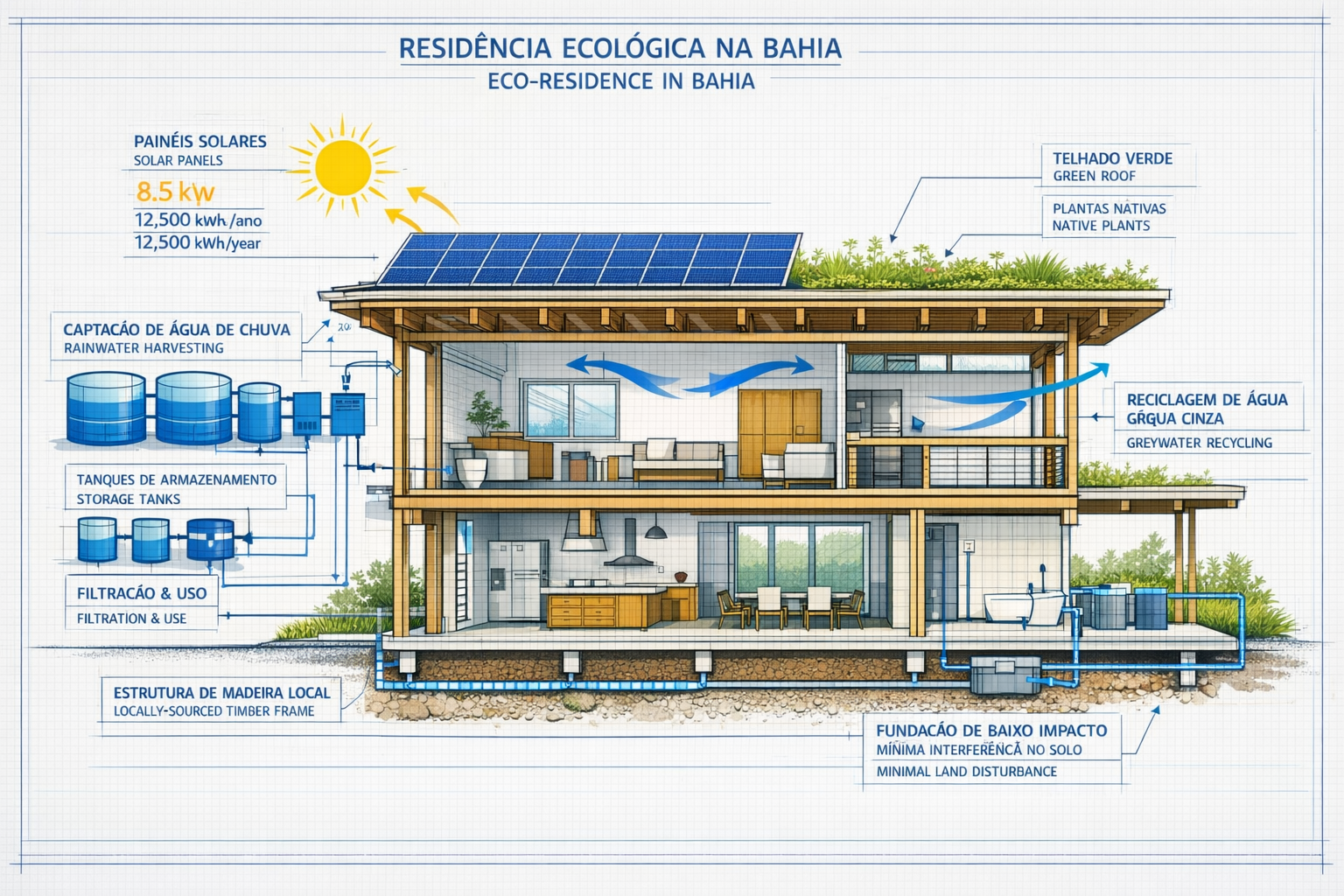
- Solar system (8-12 kW per residence): R$45,000-65,000
- Rainwater harvesting (15,000L capacity): R$18,000-28,000
- Greywater treatment system: R$22,000-35,000
- Well drilling and water treatment: R$35,000-55,000
Construction Costs:
- Conventional construction: R$2,200-2,800/m²
- Eco-construction premium: +15-22% (R$2,530-3,416/m²)
- Sustainable materials, natural ventilation design, thermal mass optimization
Soft Costs:
- Environmental licensing: R$45,000-120,000 (project-wide)
- Architecture and engineering: 8-12% of construction value
- Legal and permitting: R$25,000-45,000
- Marketing and sales: 4-6% of gross sales value
Total Development Cost (120m² residence): R$520,000-780,000 per unit
Premium Pricing Justification
Eco-residences near protected areas command premiums through multiple value propositions:
Scarcity Premium (15-25%): Limited developable land near conservation units creates inherent exclusivity. Trancoso, Bahia—a global luxury hotspot attracting European and celebrity buyers—demonstrates how coastal scarcity drives premium pricing for designer villas and estate-sized plots[4].
Sustainability Premium (10-20%): Buyers increasingly value:
- Zero or negative carbon footprint
- Energy independence through solar systems
- Water self-sufficiency
- Organic waste management
- Non-toxic building materials
Lifestyle Premium (20-30%): Intangible benefits include:
- Guaranteed nature access and biodiversity
- Wellness-oriented environment
- Community of like-minded residents
- Alignment with personal values
Rental Income Premium (15-25%): Eco-properties generate higher rental rates and occupancy due to:
- Growing eco-tourism market
- Unique positioning in booking platforms
- Wellness retreat potential
- Corporate sustainability event hosting
Combined Premium Range: 25-40% above comparable conventional properties
Pricing Models and Market Positioning
Entry-Level Eco-Residence (80-100m²):
- Development cost: R$450,000-580,000
- Market price: R$650,000-850,000
- Target: Young professionals, remote workers, first-time eco-buyers
Mid-Market Eco-Residence (120-160m²):
- Development cost: R$620,000-880,000
- Market price: R$950,000-1,350,000
- Target: Families, retirees, rental investors
Luxury Eco-Estate (200-300m²):
- Development cost: R$1,100,000-1,800,000
- Market price: R$1,800,000-3,200,000
- Target: High-net-worth individuals, international buyers, wellness entrepreneurs
The established eco-boutique hotel in Barra Grande, listed at R$8 million for an 11,000 m² property with 18 rooms/bungalows, provides a benchmark for larger-scale eco-hospitality investments[1].
ROI Projections and Financial Performance
Development Timeline and Cash Flow
Phase 1: Planning and Permitting (12-18 months)
- Land acquisition and due diligence
- Environmental studies and licensing
- Architectural design and engineering
- Cash outflow: 25-30% of total project cost
Phase 2: Infrastructure and Construction (14-20 months)
- Site preparation and infrastructure installation
- Unit construction and sustainable system integration
- Landscape restoration and native planting
- Cash outflow: 60-65% of total project cost
Phase 3: Marketing and Sales (8-24 months, overlapping with Phase 2)
- Pre-sales beginning at 40-50% construction completion
- Final sales and unit delivery
- Cash inflow: 100% of sales revenue
- Remaining costs: 10-15% of total project cost
Total Development Cycle: 34-48 months from land acquisition to final unit delivery
Revenue Scenarios and Profit Margins
Conservative Scenario (25% premium, 90% sell-through):
- Average unit price: R$1,000,000
- Units sold: 9 of 10
- Gross revenue: R$9,000,000
- Total development cost: R$6,500,000
- Net profit: R$2,500,000
- Profit margin: 27.8%
- ROI: 38.5%
Moderate Scenario (32% premium, 100% sell-through):
- Average unit price: R$1,150,000
- Units sold: 10 of 10
- Gross revenue: R$11,500,000
- Total development cost: R$6,500,000
- Net profit: R$5,000,000
- Profit margin: 43.5%
- ROI: 76.9%
Optimistic Scenario (40% premium, 100% sell-through + rental income):
- Average unit price: R$1,300,000
- Units sold: 10 of 10
- Gross sales revenue: R$13,000,000
- Developer-retained rental units: 2 units
- Annual rental income per unit: R$120,000
- Total rental income (3 years): R$720,000
- Combined revenue: R$13,720,000
- Total development cost: R$6,500,000
- Net profit: R$7,220,000
- Profit margin: 52.6%
- ROI: 111.1%
These projections align with broader market trends. The real estate market performance in Florianópolis demonstrates how strategic positioning and quality development drive exceptional returns in Brazil’s coastal markets.
Operational Cost Savings for Buyers
A key selling point for eco-residences is long-term operational savings:
Energy Savings:
- Solar system production: 800-1,200 kWh/month
- Grid electricity cost avoided: R$600-900/month
- Annual savings: R$7,200-10,800
- System payback period: 5-7 years
Water Savings:
- Rainwater harvesting: 60-80% of non-potable needs
- Greywater recycling: 30-40% additional savings
- Municipal water cost avoided: R$180-280/month
- Annual savings: R$2,160-3,360
Maintenance Savings:
- Natural ventilation reduces HVAC maintenance
- Durable sustainable materials reduce replacement cycles
- Native landscaping reduces irrigation and chemical inputs
- Estimated annual savings: R$3,000-5,000
Total Annual Operational Savings: R$12,360-19,160 per residence
Over a 20-year ownership period, these savings total R$247,200-383,200—a significant component of total cost of ownership that justifies higher acquisition prices.
Case Studies: Successful Bahia Eco-Residence Developments
Luminous Bahia: Intentional Community Model
The Luminous Bahia project represents an innovative approach to eco-residence development, creating an intentional community centered on conservation and ecological regeneration of the Atlantic Forest region[5]. This model demonstrates how developers can:
- Create shared values: Attract buyers committed to conservation principles
- Reduce infrastructure costs: Shared facilities (community center, organic gardens, water treatment) lower per-unit expenses
- Enhance marketability: Community-oriented projects appeal to specific demographics willing to pay premiums
- Ensure long-term stewardship: Resident-managed conservation easements protect property values
Key Takeaway: Intentional community models work best for 20+ unit developments where economies of scale justify shared infrastructure and governance structures.
Barra Grande Eco-Boutique Hotel: Hospitality Integration
The established beachfront eco-hotel in Barra Grande, operating successfully for 15+ years with 18 rooms/bungalows on 11,000 m² of land, demonstrates the viability of mixing residential and hospitality uses[1]. Development tactics include:
- Phased development: Initial hotel operation generates cash flow for residential phase expansion
- Proven sustainability systems: Solar water heating and composting demonstrate operational viability to residential buyers
- Built-in rental management: Hotel infrastructure provides turnkey rental management for residential owners
- Premium positioning: Established hospitality brand enhances residential unit desirability
This mixed-use approach is particularly relevant for developers entering the eco-residence market, as hospitality operations provide immediate revenue while residential units appreciate.
Urban Regeneration Lessons: Agrihood Concepts
While focused on urban contexts, the agrihood projects implemented in Brasilia and Curitiba by Pentagrama Projetos offer valuable lessons for rural eco-residence developers[3]:
- Ecosystem restoration as amenity: Native forest restoration and food production become primary selling features
- UNEP support: International backing through programs like BioCidades Empreendedoras provides credibility and potential funding
- Community engagement: Early stakeholder involvement reduces opposition and accelerates permitting
- Triple-bottom-line metrics: Measuring environmental, social, and economic outcomes attracts impact investors
Developers can adapt these urban regeneration principles to rural contexts, positioning eco-residences as regenerative rather than merely sustainable.
Overcoming Development Challenges
Financing Sustainable Construction
Traditional bank financing often undervalues sustainability features. Strategies to overcome this include:
Green Bonds and Impact Investment: Specialized funds focused on environmental outcomes may provide favorable terms for certified green developments.
Pre-Sales Financing: Higher pre-sale requirements (40-50% vs. 30-35% for conventional projects) reduce bank dependency and demonstrate market validation.
Phased Development: Smaller initial phases (4-6 units) allow developers to prove concept, achieve premium pricing, and self-finance subsequent phases.
Strategic Partnerships: Collaborating with established eco-tourism operators or conservation organizations can provide credibility and access to specialized financing networks.
For developers exploring investment opportunities in the Brazilian property market, understanding these alternative financing structures is essential.
Infrastructure Challenges in Remote Locations
Developing near protected areas often means limited existing infrastructure:
Grid Electricity: Solar-plus-battery systems eliminate grid dependency but require higher upfront investment (R$65,000-95,000 per residence for fully off-grid systems).
Water Supply: Well drilling costs vary dramatically (R$35,000-120,000) depending on depth and water quality. Comprehensive hydrological studies before land acquisition are essential.
Road Access: Unpaved or poorly maintained access roads can add R$150,000-400,000 to project costs. Negotiate cost-sharing with municipalities or adjacent landowners.
Internet Connectivity: Starlink and other satellite internet services have transformed remote property viability, but factor R$3,000-5,000 per unit for equipment and installation.
Balancing Conservation and Profitability
The tension between environmental protection and financial return requires careful navigation:
Minimum Viable Density: Calculate the minimum number of units needed to achieve target returns given land costs and infrastructure requirements. Projects with fewer than 6-8 units often struggle to justify infrastructure investments.
Conservation Easements: Permanently protecting 40-60% of property through RPPNs or easements enhances marketing but reduces developable area. Model various scenarios to find optimal balance.
Restoration Requirements: Environmental compensation often requires reforestation of degraded areas at costs of R$15,000-30,000 per hectare. Budget these costs early and consider marketing restored areas as amenities.
Ongoing Monitoring: Operation licenses require environmental monitoring reports (typically R$8,000-15,000 annually). Factor these costs into HOA budgets or development reserves.
Marketing and Sales Strategies for Premium Eco-Residences
Target Market Segmentation
International Buyers (30-40% of market):
- Marketing channels: International property portals, eco-tourism publications, sustainability conferences
- Key messages: Investment diversification, lifestyle transformation, environmental legacy
- Sales process: Virtual tours, English-speaking sales team, legal support for foreign ownership
Brazilian Urban Professionals (35-45% of market):
- Marketing channels: São Paulo and Rio de Janeiro real estate events, wellness expos, corporate sustainability networks
- Key messages: Weekend retreat, family health, appreciation potential
- Sales process: Site visits from major cities, financing options, rental management services
Eco-Tourism Entrepreneurs (15-25% of market):
- Marketing channels: Hospitality investment forums, Airbnb Superhost networks, wellness retreat associations
- Key messages: Rental income projections, turnkey management, established destination markets
- Sales process: Pro forma financial models, property management partnerships, operational support
Content Marketing and Storytelling
Successful eco-residence marketing emphasizes narrative over specifications:
Conservation Impact Stories: Document native species returning to restored areas, carbon sequestration achievements, water quality improvements.
Resident Testimonials: Feature early buyers discussing lifestyle transformation, health improvements, community connections.
Behind-the-Scenes Development: Share construction process, sustainable material sourcing, local artisan partnerships.
Educational Content: Publish guides on sustainable living, eco-tourism trends, conservation finance—positioning the developer as a thought leader.
Similar to strategies used in marketing studio apartments in Florianópolis, content marketing builds trust and attracts qualified buyers.
Pricing Psychology and Sales Tactics
Anchoring with Luxury Comparables: Position eco-residences against Trancoso luxury villas or international eco-resorts rather than local conventional properties.
Time-Limited Incentives: Offer early-bird pricing (5-10% discount) for first 30% of units sold to accelerate sales velocity.
Bundled Amenities: Include solar systems, water treatment, and landscaping in base price rather than as options—simplifying decision-making and emphasizing value.
Rental Guarantee Programs: Offer 12-24 month rental income guarantees (at 60-70% of projected rates) to reduce buyer risk perception.
Sustainability Certifications: Pursue LEED, AQUA-HQE, or similar certifications to provide third-party validation of environmental claims.
Future Outlook: Bahia Eco-Residences Beyond 2026
Market Trends Shaping the Next Decade
Climate Migration: As temperatures rise globally, Brazil’s coastal regions will attract increasing numbers of climate refugees from both Northern Hemisphere and drought-affected Brazilian regions.
Remote Work Permanence: The normalization of remote work creates sustained demand for lifestyle-oriented locations with reliable internet connectivity.
Regenerative Development Standards: Beyond sustainability, buyers will increasingly expect developments to actively restore ecosystems—raising the bar for new projects.
Tokenization and Fractional Ownership: Cryptocurrency integration in real estate development may enable fractional ownership of eco-residences, expanding the buyer pool.
Wellness Tourism Growth: Brazil’s eco-tourism regions are experiencing robust growth, with wellness retreats and kitesurf towns showing particularly strong appreciation[4].
Regulatory Evolution
Stricter Environmental Standards: Expect tightening regulations around protected area buffers, native vegetation preservation, and water resource management—favoring developers who exceed current requirements.
Carbon Credit Integration: Properties that sequester carbon through reforestation may generate tradable credits, creating additional revenue streams.
Green Building Incentives: Municipal and state governments may introduce tax incentives, expedited permitting, or density bonuses for certified sustainable developments.
Community Benefit Requirements: Future licensing may require demonstrated benefits to local communities—employment, infrastructure improvements, or conservation funding.
Competitive Landscape
As eco-residence development proves profitable, competition will intensify:
First-Mover Advantages: Developers entering now secure prime locations before prices rise and regulations tighten.
Brand Differentiation: Establishing a reputation for quality sustainable development creates barriers to entry for competitors.
Portfolio Approach: Successful developers will likely expand to multiple Bahia locations, leveraging learned expertise and brand recognition.
Consolidation Risk: Large hospitality groups or international developers may enter the market, bringing capital but potentially commoditizing the sector.
Understanding market trends in the Greater Florianópolis region provides insights into how coastal Brazilian markets evolve as they mature.
Conclusion
Bahia Eco-Residences 2026: Premium Pricing and Development Tactics Near Protected Natural Areas represent a compelling opportunity at the intersection of environmental stewardship and financial performance. The convergence of rising sustainability consciousness, remote work flexibility, and Brazil’s coastal appreciation cycle creates ideal conditions for developers who understand both conservation principles and market dynamics.
Key Success Factors
✅ Regulatory expertise: Navigate environmental licensing proactively with experienced consultants
✅ Infrastructure investment: Budget 15-22% premiums for sustainable systems that deliver long-term value
✅ Market positioning: Target international buyers, urban professionals, and eco-tourism entrepreneurs with differentiated messaging
✅ Financial modeling: Build conservative scenarios accounting for longer approval timelines and higher construction costs
✅ Conservation commitment: Authentic environmental stewardship creates marketing differentiation and regulatory goodwill
Actionable Next Steps
For developers considering entry into this market:
- Conduct market research: Visit established eco-developments in Bahia, interview buyers, and assess competitive positioning
- Engage environmental consultants: Identify potential sites and conduct preliminary environmental assessments before land acquisition
- Build financial models: Create detailed pro formas incorporating all sustainability premiums and operational savings
- Establish partnerships: Connect with conservation organizations, eco-tourism operators, and sustainable material suppliers
- Start small: Consider 4-6 unit pilot projects to prove concept before scaling to larger developments
The Bahia eco-residence market is entering a growth phase that rewards early movers who combine environmental integrity with business acumen. Properties that deliver authentic sustainability, guaranteed nature access, and operational efficiency will continue commanding premium pricing as demand intensifies through 2026 and beyond.
For developers seeking to understand broader market dynamics in Brazil’s coastal regions, exploring life in Florianópolis and regional development projects provides valuable comparative insights.
The future of Brazilian coastal development is sustainable, premium-positioned, and conservation-oriented. Developers who embrace this reality today will shape—and profit from—the eco-residence market of tomorrow. 🌴
References
[1] Eco Friendly Beach Hotel For Sale In Barra Grande Bahia R8 Million – https://www.brazilbeachhouse.com/properties/2026/1/10/eco-friendly-beach-hotel-for-sale-in-barra-grande-bahia-r8-million
[2] Casa Daia Bungalows Northeast Brazil Houses – https://www.e-architect.com/brazil/casa-daia-bungalows-northeast-brazil-houses
[3] news.un – https://news.un.org/en/story/2026/02/1166880
[4] Best Cities To Invest In Brazilian Real Estate 2026 Edition – https://www.brazilbeachhouse.com/blogg/2025/12/1/best-cities-to-invest-in-brazilian-real-estate-2026-edition
[5] Luminous Bahia – https://www.ic.org/directory/luminous-bahia/