
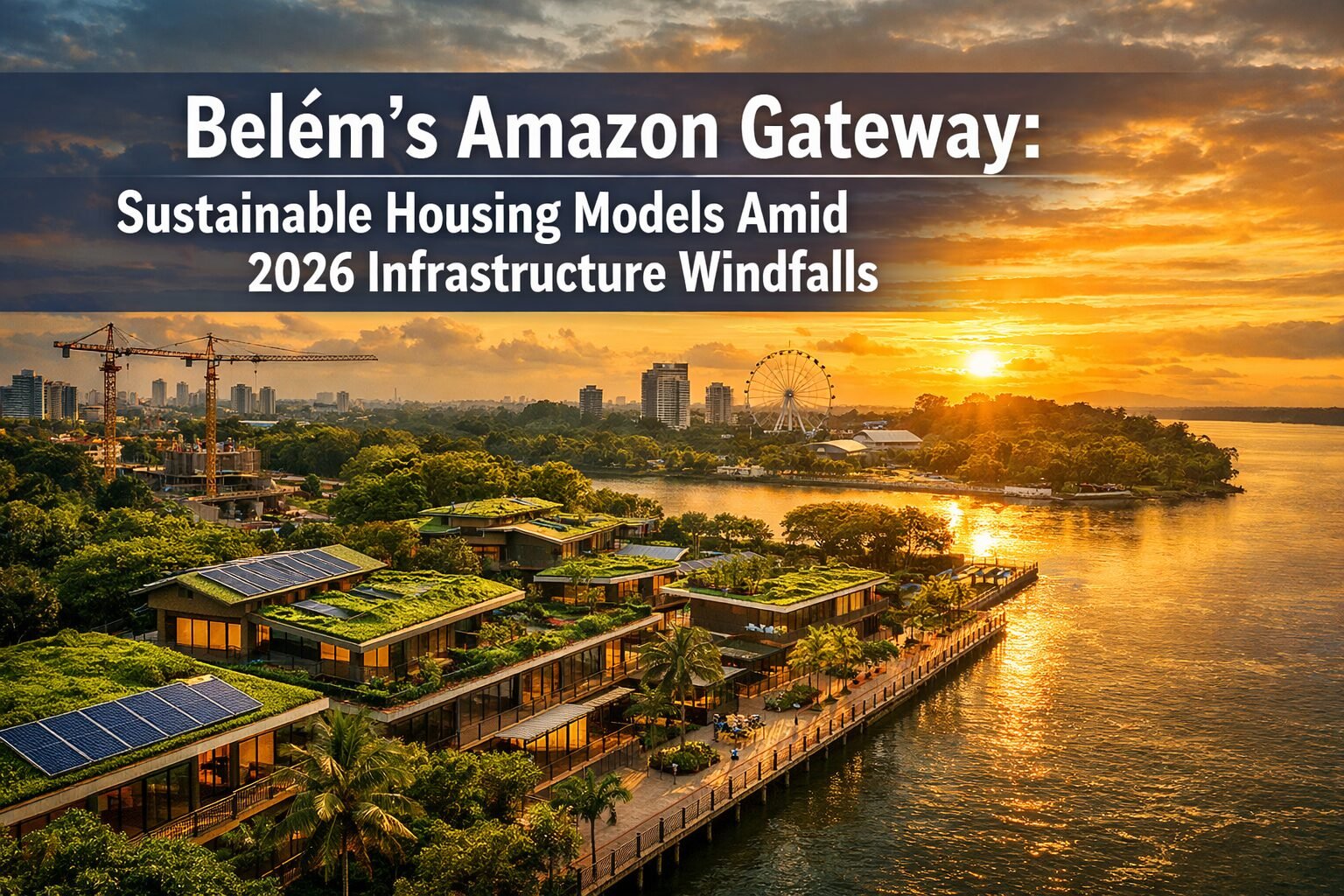
The Amazon’s gateway city is experiencing an unprecedented transformation. As Belém prepares to showcase itself on the global stage following COP30, the city has become Brazil’s most compelling frontier for sustainable residential development. Belém’s Amazon Gateway Developments: Sustainable Housing Models Amid 2026 Infrastructure Windfalls represent a unique convergence of federal investment, environmental urgency, and untapped market potential that savvy developers and investors cannot afford to ignore.
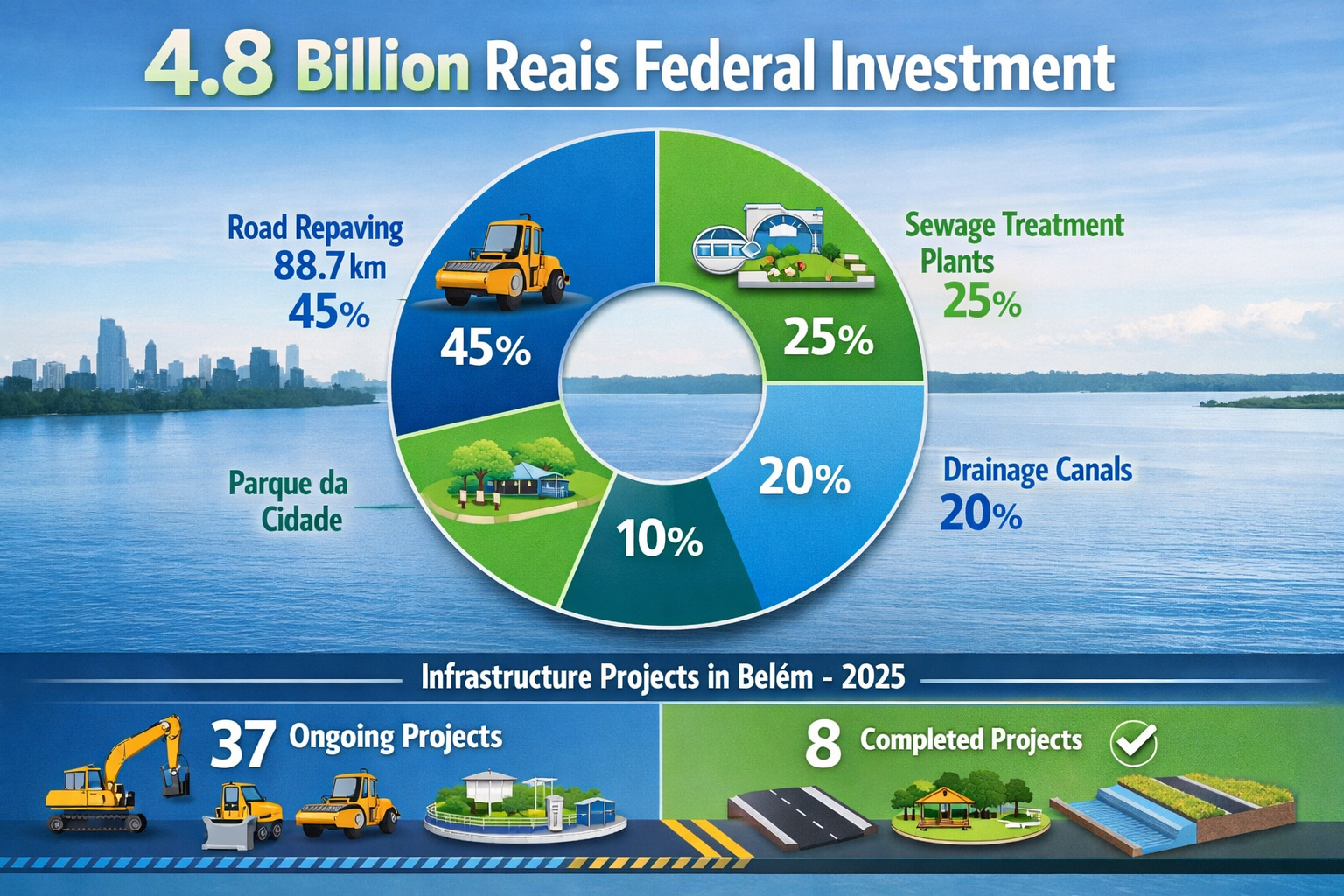
With 4.8 billion reais ($891 million) in federal funding already deployed for infrastructure improvements[2], Belém stands at a critical juncture. The city’s strategic position as the Amazon’s primary urban center, combined with ambitious sustainability mandates and demographic growth, creates conditions for residential projects that can command 20%+ premiums through innovative eco-focused designs—a premium level not yet saturated in markets like Brasília or Cascavel.
Key Takeaways
🌿 Federal Investment Surge: Belém received 4.8 billion reais in infrastructure funding, with 37 ongoing projects including road repaving, sewage treatment, and drainage systems as of 2025[2]
🏘️ Sustainable Housing Premium: Net-zero residential developments in Belém can target 20%+ price premiums by addressing northern demographics and climate adaptation needs
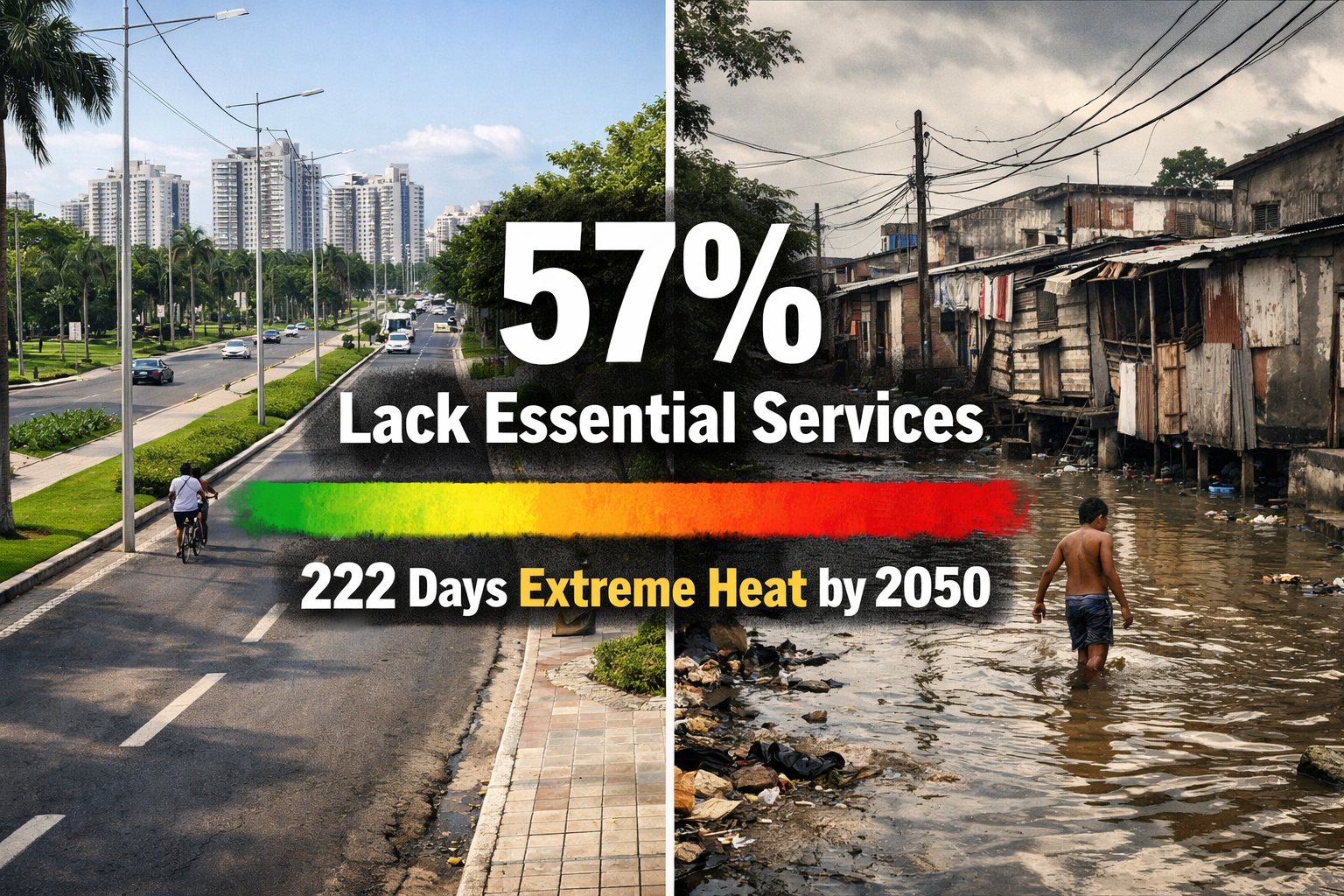
🌡️ Climate Urgency: Projections show 222 days of extreme heat by 2050, creating immediate demand for climate-resilient housing solutions[2]
📊 Market Gap: 57% of baixadas residents lack essential services, representing massive opportunity for inclusive development models[2]
🌳 COP30 Legacy Infrastructure: The 500,000-square-meter Parque da Cidade and riverfront revitalizations provide anchor amenities for adjacent residential developments[1]
The Infrastructure Windfall Reshaping Belém’s Urban Landscape
Novo PAC Investment Breakdown
The federal government’s commitment to Belém extends far beyond typical urban renewal. As of August 2025, the city has witnessed the completion of 8 major infrastructure projects while 37 remain underway, creating a construction ecosystem that rivals any major Brazilian metropolitan area[2]. This represents the largest concentrated investment in northern Brazil’s urban infrastructure in decades.
The scope of improvements includes:
- 88.7 kilometers of road repaving across central and peripheral districts
- Multiple sewage treatment plants addressing decades of underinvestment
- Drainage canal rehabilitation spanning four main river basins
- Riverfront revitalization projects connecting urban areas to waterways
For real estate developers, this infrastructure boom creates immediate opportunities. Areas adjacent to newly paved roads and improved drainage systems are experiencing rapid land appreciation, while neighborhoods near completed sewage treatment facilities are shedding decades-old stigma. Those exploring investment opportunities in Brazil’s property market should recognize Belém’s unique position as an emerging high-yield frontier.
Parque da Cidade: The Green Anchor
Perhaps the most transformative element of Belém’s infrastructure windfall is Parque da Cidade, a 500,000-square-meter civic park that served as the main COP30 venue[1]. Inaugurated in 2024, this massive green space represents more than just a conference facility—it’s a permanent public landmark designed to anchor sustainable urban development for decades.
The park’s design incorporates:
- 🌳 Native Amazonian vegetation corridors
- 💧 Integrated stormwater management systems
- 🚶 Pedestrian and cycling infrastructure
- 🏛️ Cultural and educational facilities
Residential developments within a 2-kilometer radius of Parque da Cidade are positioned to capture significant premiums, similar to properties near São Paulo’s Ibirapuera Park or Rio’s Flamengo Park. The difference? Belém’s market remains largely untapped by sophisticated developers who understand how to monetize proximity to world-class public amenities.
The Uneven Distribution Challenge
Despite these impressive investments, infrastructure improvements have shown uneven distribution patterns. Benefits have concentrated in upscale neighborhoods while low-income areas remain underserved[2]. This disparity presents both a challenge and an opportunity for developers committed to inclusive growth models.
57% of residents in low-lying baixadas (informal neighborhoods) lack essential services like sewage and face high flooding risk[2]. Forward-thinking developers can address this gap through mixed-income projects that leverage government incentives for social housing while capturing market-rate premiums on upgraded units.
Sustainable Housing Models: Belém’s Amazon Gateway Developments Lead the Way
Net-Zero Design for Northern Demographics
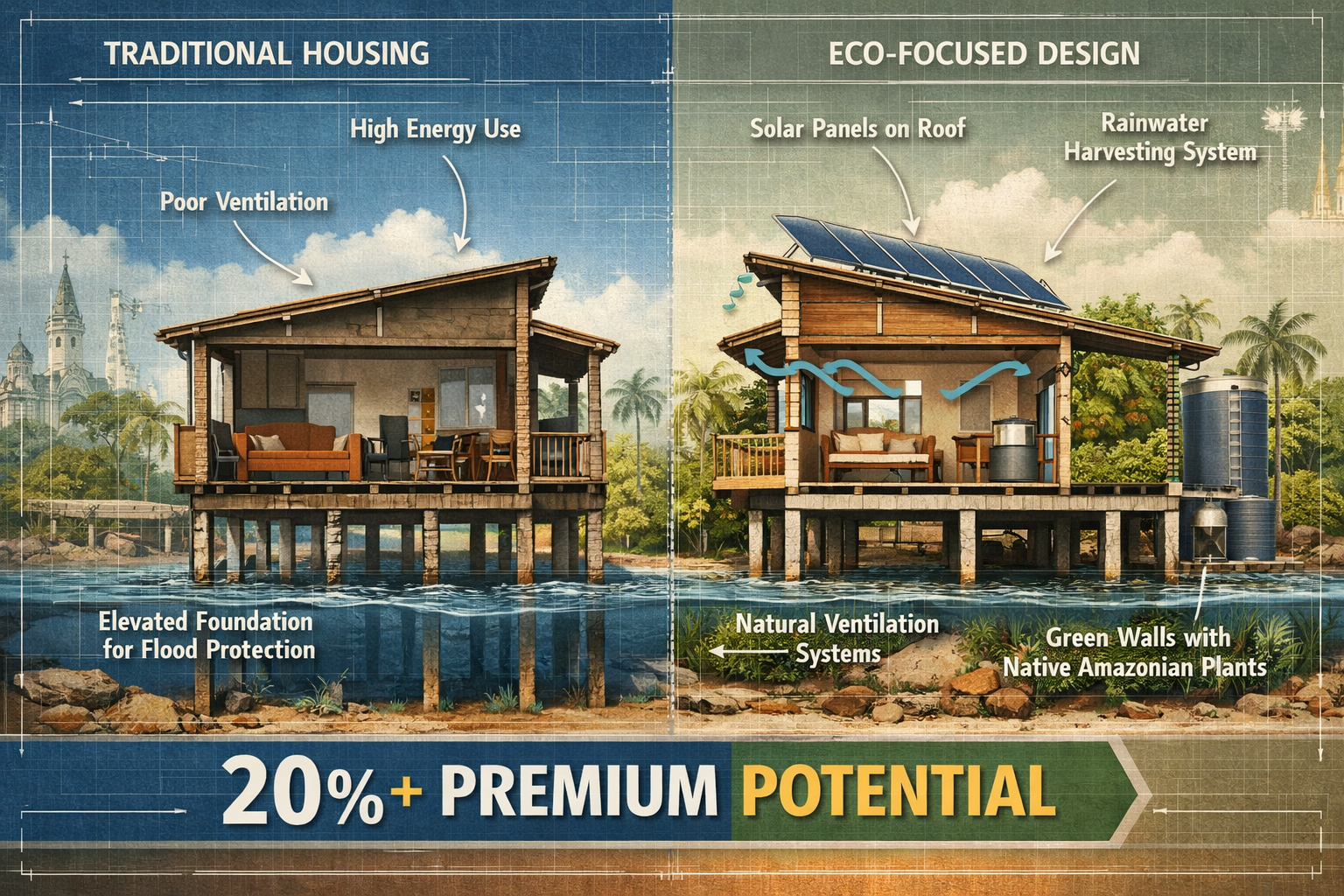
Belém’s climate presents unique challenges that traditional Brazilian housing models fail to address. With projections of 222 days of extreme heat by 2050—driven by tree loss in poor neighborhoods[2]—residential developments must prioritize passive cooling, natural ventilation, and energy efficiency.
Successful sustainable housing models in Belém incorporate:
| Design Element | Function | Premium Impact |
|---|---|---|
| Elevated Foundations | Flood protection in baixadas | +8-12% |
| Solar Panel Integration | Energy cost reduction | +15-20% |
| Green Roof Systems | Heat island mitigation | +10-15% |
| Natural Ventilation | Passive cooling | +5-10% |
| Rainwater Harvesting | Water security | +8-12% |
| Native Landscaping | Biodiversity compliance | +12-18% |
These features address real needs while differentiating projects in an emerging market. Developers who have succeeded with early-stage property investments in other Brazilian cities understand that timing is critical—entering Belém’s market now, before saturation, maximizes returns.
Learning from Manaus: The Prosman+ Model
The Prosman+ relocation initiative in nearby Manaus provides a proven blueprint for sustainable development in Amazonian cities. This project successfully relocated 2,400+ families from flood-prone areas across a 340,000-square-meter zone serving 60,000 residents[1]. Remarkably, the project reduced development time by 62% through digital modeling and Building Information Modeling (BIM) technologies.
Key lessons from Prosman+ applicable to Belém developments:
✅ Digital Planning: BIM reduces construction timelines and costs ✅ Community Engagement: Early stakeholder involvement prevents delays ✅ Flood Resilience: Elevated construction and drainage integration ✅ Mixed-Use Design: Commercial spaces support residential viability ✅ Phased Development: Incremental delivery maintains cash flow
Developers entering Belém can leverage these proven methodologies while avoiding the trial-and-error costs that Manaus projects absorbed. The transformation happening in real estate markets across Brazil demonstrates that early adopters of innovative models capture disproportionate returns.
Biodiversity Mandates Create Competitive Advantages
Unlike saturated markets in southern Brazil, Belém’s developments must comply with biodiversity mandates that actually enhance project value rather than merely adding regulatory burden. COP30’s legacy includes heightened environmental scrutiny that rewards genuinely sustainable projects with:
- 🏆 Expedited permitting processes
- 💰 Access to green financing at preferential rates
- 📈 Marketing differentiation in international markets
- 🌍 ESG compliance attracting institutional investors
Projects that integrate native Amazonian species, preserve existing vegetation corridors, and demonstrate measurable biodiversity outcomes can access financing mechanisms unavailable to conventional developments. This creates a moat around early-mover sustainable projects that competitors will struggle to replicate.
Belém’s Amazon Gateway Developments: Investment Strategies for 2026 and Beyond
Target Demographics and Unit Mix
Understanding Belém’s demographic composition is essential for optimizing unit mix and pricing strategies. The city’s population includes:
Primary Target Segments:
Environmental Professionals (15-20% of market)
- Research scientists, NGO workers, government environmental agencies
- Preference for 1-2 bedroom units with home office space
- Willingness to pay premium for sustainable features
- Average unit size: 55-75 m²
Federal Government Employees (25-30% of market)
- Stable income, long-term residents
- Family-oriented 2-3 bedroom units
- Value proximity to government facilities
- Average unit size: 75-95 m²
Regional Business Owners (20-25% of market)
- Commerce, logistics, services
- Mixed residential/commercial preferences
- Status-conscious, amenity-focused
- Average unit size: 85-120 m²
Young Professionals (30-35% of market)
- Growing tech and creative sectors
- Studio and 1-bedroom units
- Prioritize location over size
- Average unit size: 35-55 m²
This demographic mix supports developments that combine market-rate units (60-70%) with workforce housing (30-40%), maximizing both social impact and financial returns. Developers familiar with studio apartment investments in other Brazilian markets will recognize similar dynamics in Belém’s young professional segment.
Riverfront Revitalization Opportunities
The Novo PAC riverfront revitalizations create prime development sites along Belém’s extensive waterfront. These areas offer:
Strategic Advantages:
- 🌊 Waterfront Access: Premium views and recreational amenities
- 🚇 Transportation Hubs: Proximity to improved transit infrastructure
- 🏛️ Cultural Districts: Integration with heritage preservation zones
- 🌳 Green Corridors: Connection to Parque da Cidade and urban forests
Properties within 500 meters of revitalized riverfront areas can command 25-35% premiums over comparable inland units. This premium exceeds typical waterfront valuations in Brazilian cities due to the combination of improved infrastructure, environmental significance, and limited supply.
Developers should target mixed-use projects that incorporate:
- Ground-floor commercial (15-20% of GLA)
- Mid-rise residential towers (8-12 floors)
- Rooftop amenities maximizing river views
- Integrated mobility (bike storage, EV charging)
Financial Modeling for Sustainable Premiums
Conservative financial models for Belém’s sustainable housing developments should incorporate:
Revenue Assumptions:
- Base market rate: R$ 6,500-8,500/m² (2026 pricing)
- Sustainable design premium: +20-25%
- Riverfront location premium: +25-35%
- Early-buyer discounts: -10-15%
- Net achievable pricing: R$ 8,500-11,000/m²
Cost Considerations:
- Land acquisition: R$ 800-1,500/m² (buildable area)
- Sustainable construction premium: +12-18% over conventional
- Infrastructure connection fees: R$ 150-250/m²
- Marketing and sales: 4-6% of revenue
- Total development cost: R$ 5,500-7,200/m²
Return Metrics:
- Gross margin: 35-45%
- IRR target: 22-28% (3-year development cycle)
- Cash-on-cash return: 18-24%
These returns significantly exceed typical Brazilian residential development projects (15-20% IRR) while maintaining conservative assumptions. The key is executing before market saturation, similar to successful early-stage developments in other emerging Brazilian markets.
Risk Mitigation Strategies
While Belém presents exceptional opportunities, prudent developers must address specific risks:
Political Risk:
- Federal funding continuity depends on political stability
- Mitigation: Structure projects with private financing backstops
- Diversify across multiple neighborhoods to reduce concentration
Climate Risk:
- Extreme heat and flooding threaten construction timelines
- Mitigation: Incorporate weather delays in schedules (15-20% buffer)
- Use climate-resilient materials and construction methods
Market Absorption Risk:
- Limited historical data on sustainable premium acceptance
- Mitigation: Phased releases testing price sensitivity
- Pre-sales targets of 30-40% before construction start
Regulatory Risk:
- Environmental permitting can be unpredictable
- Mitigation: Early engagement with environmental agencies
- Hire local specialists with COP30 project experience
The COP30 Legacy Effect on Long-Term Value
Global Visibility and International Buyers
COP30’s designation of Belém as host city has permanently elevated the city’s international profile[5]. This visibility extends beyond the conference itself, creating lasting effects:
- 🌍 International media coverage positioning Belém as sustainability leader
- 🏢 Multinational organizations establishing permanent regional offices
- 🎓 Research institutions investing in Amazonian study centers
- 💼 Green finance institutions seeking local investment opportunities
These dynamics attract international buyers who prioritize sustainability credentials and are less price-sensitive than domestic purchasers. Developments with English-language marketing and international payment options can capture this segment, which typically represents 5-10% of units in gateway cities but pays 15-25% premiums.
Health and Equity Integration
COP30’s emphasis on health and equity in climate action[3] creates opportunities for developers to differentiate through wellness-focused amenities:
High-Value Wellness Features:
- Air quality monitoring and filtration systems
- Biophilic design with indoor vegetation
- Fitness facilities with outdoor connections
- Community health programming spaces
- Mental health-supporting design elements
Projects that authentically integrate these elements appeal to health-conscious buyers while aligning with Belém’s post-COP30 identity as a leader in equitable climate solutions.
Closing the Gaps: Inclusive Development Models
The COP30 legacy includes heightened attention to closing gaps between privileged and underserved communities[6]. Developers who embrace inclusive models can access:
Government Incentives:
- Tax credits for mixed-income developments (up to 15% of project costs)
- Subsidized land for projects with 30%+ social housing
- Expedited permitting for certified inclusive projects
- Access to BNDES financing at preferential rates
Market Advantages:
- Reduced community opposition and protest delays
- Positive media coverage and brand building
- ESG compliance attracting institutional capital
- Long-term neighborhood stability and appreciation
The most successful Belém developments in 2026 and beyond will be those that view social inclusion not as a regulatory burden but as a competitive advantage.
Conclusion: Seizing Belém’s Sustainable Housing Opportunity
Belém’s Amazon Gateway Developments: Sustainable Housing Models Amid 2026 Infrastructure Windfalls represent a rare alignment of government investment, environmental imperative, and market opportunity. The 4.8 billion reais in federal infrastructure funding[2], combined with COP30’s lasting legacy and urgent climate adaptation needs, has created conditions for residential developments that can achieve 20%+ premiums while addressing genuine social and environmental challenges.
The window for early-mover advantage is narrow. As more developers recognize Belém’s potential, competition will intensify, premiums will compress, and land costs will rise. Those who act now—with sustainable designs tailored to northern demographics, strategic locations near infrastructure improvements, and inclusive development models—will capture disproportionate returns.
Actionable Next Steps
For developers and investors ready to participate in Belém’s transformation:
Conduct Site Visits: Personally assess neighborhoods adjacent to completed infrastructure projects and Parque da Cidade
Build Local Partnerships: Establish relationships with Belém-based architects, engineers, and environmental consultants with COP30 experience
Secure Strategic Land: Target riverfront parcels within 2km of Parque da Cidade or along improved drainage corridors
Develop Sustainability Credentials: Obtain LEED, AQUA-HQE, or equivalent certifications to access green financing
Engage Community Stakeholders: Begin dialogue with baixadas communities for inclusive development opportunities
Model Financial Scenarios: Build detailed pro formas incorporating sustainable premiums and government incentives
Explore Financing Options: Contact BNDES and international green finance institutions about preferential terms
The Amazon’s gateway city is open for business. Belém’s unique combination of infrastructure investment, sustainability mandates, and demographic growth creates opportunities that won’t remain available indefinitely. Developers who understand how to deliver net-zero housing tailored to northern Brazil’s climate and culture will find Belém to be one of the highest-yield markets in the country.
For those seeking to diversify beyond saturated southern markets, Belém offers what every sophisticated investor seeks: genuine competitive advantages, strong fundamentals, and timing that favors bold action. The question is not whether Belém will emerge as a major residential market—the infrastructure investments and global attention guarantee that outcome. The question is whether you’ll position yourself to capture the outsized returns available to those who act while the opportunity remains fresh.
To explore how these strategies can be applied to your investment portfolio, contact experienced real estate professionals who understand emerging Brazilian markets and sustainable development models.
References
[1] Where The World Meets The Amazon A 3d Tour Cop30s Host City Of Belem – https://blog.bentley.com/insights/where-the-world-meets-the-amazon-a-3d-tour-cop30s-host-city-of-belem/
[2] Belem Faces Its Social And Natural Demons As Host To Cop30 – https://news.mongabay.com/2025/10/belem-faces-its-social-and-natural-demons-as-host-to-cop30/
[3] Amazons Gateway Why Cop30 Belem Must Put Health And Equity Heart Climate Action – https://www.gavi.org/vaccineswork/amazons-gateway-why-cop30-belem-must-put-health-and-equity-heart-climate-action
[4] Global Citizen Festival Amazonia 2025 Impact – https://www.globalcitizen.org/en/content/global-citizen-festival-amazonia-2025-impact/
[5] cop30.br – https://cop30.br/en
[6] What To Expect At Cop30 Closing The Gaps In Bel%c3%a9m – https://www.worldwildlife.org/news/stories/what-to-expect-at-cop30-closing-the-gaps-in-bel%C3%A9m/
[7] 20251106 Cop30 Host City Belem Heart Of The Issues And Gateway Amazon – https://www.france24.com/en/environment/20251106-cop30-host-city-belem-heart-of-the-issues-and-gateway-amazon
[8] The Assessment At Cop30 – https://forestdeclaration.org/the-assessment-at-cop30/
[9] Takeaways Architects Cop30 Brazil – https://www.archpaper.com/2025/11/takeaways-architects-cop30-brazil/