
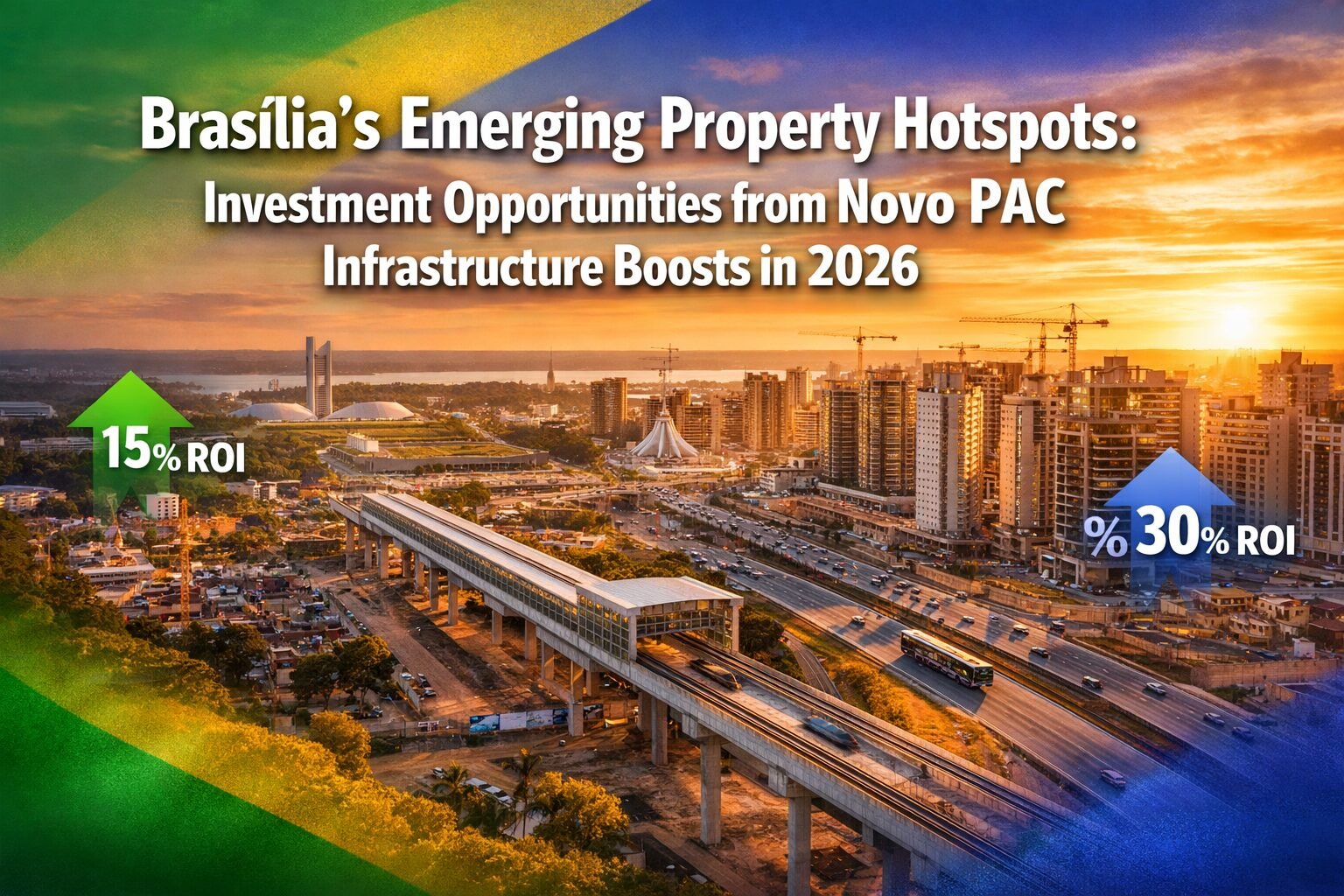
Brazil’s capital city stands at the threshold of a transformative infrastructure revolution. Brasília’s Emerging Property Hotspots: Investment Opportunities from Novo PAC Infrastructure Boosts in 2026 represent a unique convergence of federal investment, urban expansion, and undervalued real estate markets poised for exceptional growth. As the Novo PAC (Programa de Aceleração do Crescimento) channels billions of reais into transit corridors, public works, and urban connectivity projects, savvy investors are positioning themselves in strategic neighborhoods ahead of anticipated completion dates in 2027.
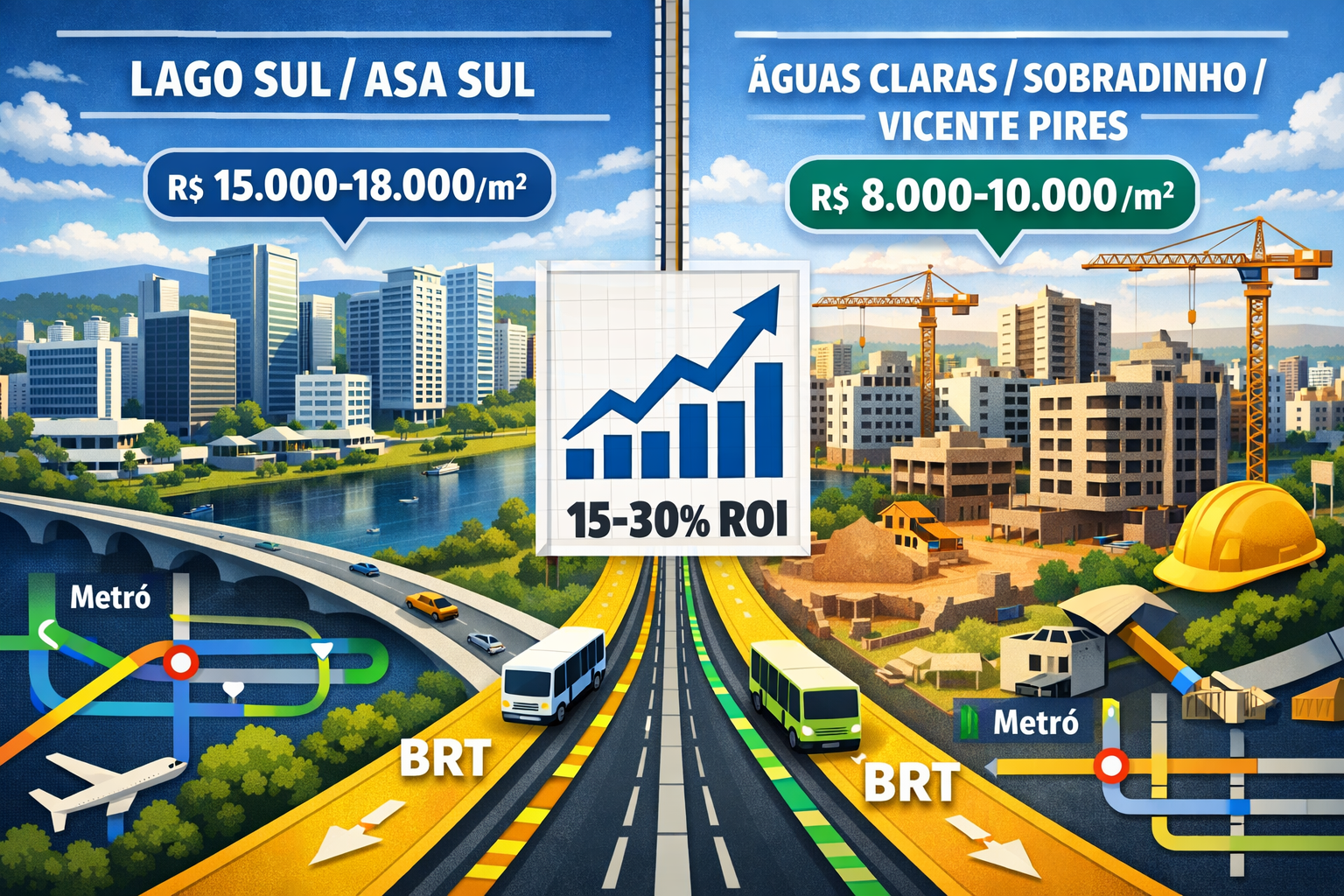
The capital’s property landscape is experiencing a fundamental shift. While traditional luxury zones like Lago Sul and Asa Sul continue commanding premium prices of R$15,000-R$18,000 per square meter, emerging neighborhoods such as Águas Claras, Sobradinho, Vicente Pires, and Noroeste offer compelling entry points at R$8,000-R$12,000 per square meter[3]. These areas are not merely affordable alternatives—they represent the epicenter of Brasília’s next growth phase, strategically positioned along planned metro extensions and BRT (Bus Rapid Transit) corridors that will reshape urban accessibility and property values.
For investors seeking best places to invest in Brazil property, understanding Brasília’s unique regulatory environment, infrastructure timeline, and neighborhood dynamics becomes essential. The convergence of federal incentives, technological integration, and transit-oriented development creates a rare window for 15-30% ROI potential before infrastructure completions trigger rapid appreciation.
Key Takeaways
✅ Strategic neighborhoods like Águas Claras, Sobradinho, Vicente Pires, and Noroeste offer entry prices 40-50% below established areas while positioned along major infrastructure corridors
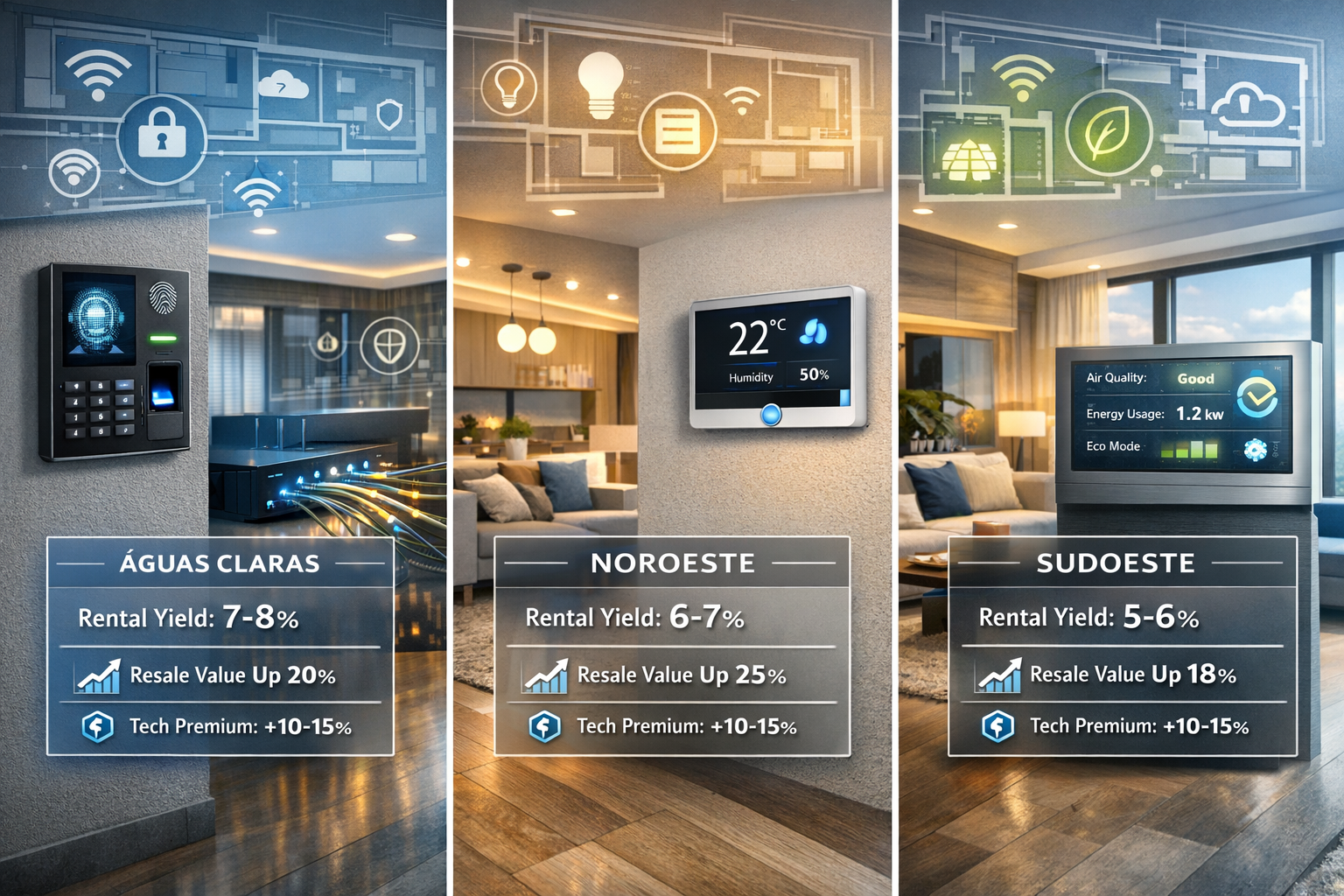
✅ Metro-DF Line 2 expansion and BRT corridors to Sobradinho are expected to generate 5-15% rent increases and significant capital appreciation in proximity areas by 2027[2]
✅ Technology integration is accelerating, with 20% of Brasília homes expected to feature automation systems by 2026, creating premium pricing for tech-optimized properties[2]
✅ Novo PAC infrastructure investments provide predictable catalysts for property appreciation, with historical data showing 15-30% value increases following transit corridor completions
✅ Regulatory incentives unique to Brazil’s capital, including federal tax benefits and streamlined approval processes, enhance investment returns compared to other Brazilian cities
Understanding Brasília’s Property Market Landscape in 2026
Current Market Fundamentals and Pricing Dynamics
Brasília’s property market exhibits distinct pricing tiers that reflect both established prestige and emerging opportunity zones. The average apartment price in the capital sits at approximately R$683,000 ($127,000 or €109,000) for a typical 70-square-meter unit[3]. However, this average masks significant variation across neighborhoods that investors must understand to identify optimal entry points.
Central established areas including Asa Sul and Asa Norte command R$10,000-R$12,000 per square meter, reflecting their mature infrastructure, proximity to government institutions, and established commercial ecosystems[3]. These zones offer stability and consistent rental demand from government employees and diplomats but limited appreciation potential given their already premium valuations.
Luxury waterfront zones such as Lago Sul and Lago Norte represent the market’s upper echelon at R$15,000-R$18,000 per square meter[3]. While these areas demonstrate wealth preservation characteristics, their high entry costs and limited supply constrain accessibility for most investors seeking growth-oriented opportunities.
Mid-range growth corridors including Águas Claras and Guará present the sweet spot for value-conscious investors. Two-bedroom apartments in these neighborhoods range between R$500,000-R$700,000, positioning them as affordable yet developmentally dynamic areas[3]. These zones benefit from ongoing infrastructure improvements while maintaining price points that attract both owner-occupiers and renters.
Emerging frontier neighborhoods like Vicente Pires, Sobradinho, and Noroeste represent the highest-risk, highest-reward segment. Properties in these areas often trade at R$8,000-R$10,000 per square meter, offering 30-40% discounts to central locations while positioned along planned infrastructure corridors that will fundamentally alter accessibility and desirability.
The Novo PAC Infrastructure Revolution
The Novo PAC (Programa de Aceleração do Crescimento) represents Brazil’s most ambitious infrastructure investment program, with substantial allocations directed toward Brasília’s urban mobility and connectivity projects. Understanding these specific initiatives is crucial for identifying which neighborhoods will experience the most dramatic value appreciation.
Metro-DF Line 2 Expansion stands as the flagship transit project. Currently under advanced planning studies, this extension will connect underserved neighborhoods to the existing metro network, with completion targets set for 2027[2]. Historical data from similar metro expansions in São Paulo and Rio de Janeiro demonstrates that properties within 500 meters of new stations experience 5-15% rent increases and capital appreciation of 20-35% within three years of service commencement[2].
BRT Corridors to Sobradinho represent another transformative project. Sobradinho, currently one of Brasília’s most affordable administrative regions, will gain direct rapid transit connections to central employment hubs. This infrastructure investment is expected to reduce commute times by 40-50%, making the area viable for a broader demographic of professionals and families. Properties positioned along the BRT corridor offer exceptional pre-completion investment opportunities.
Road network expansions and highway improvements funded through Novo PAC will enhance connectivity between satellite cities and the Plano Piloto (central planned area). These improvements reduce the “distance penalty” that currently suppresses values in peripheral neighborhoods, creating appreciation potential as accessibility improves.
Public works and amenities including new schools, healthcare facilities, and recreational spaces are being strategically distributed across emerging neighborhoods. These quality-of-life improvements complement transit investments, creating holistic neighborhood transformations that support sustained property value growth.
Regulatory Environment and Investment Incentives
Brasília’s status as Brazil’s federal capital creates unique regulatory characteristics that investors must understand. The city operates under special federal oversight, with planning decisions influenced by both local and national priorities. This dual governance structure creates both constraints and opportunities.
Federal tax incentives for property investment in designated development zones offer reduced capital gains taxation and accelerated depreciation schedules. These incentives specifically target neighborhoods aligned with Novo PAC infrastructure corridors, effectively subsidizing early investment in strategic areas.
Streamlined approval processes for new construction in growth corridors reduce development timelines compared to other Brazilian cities. The federal government’s interest in demonstrating successful urban planning in the capital translates to faster permitting and fewer bureaucratic obstacles for projects aligned with master plan objectives.
Preservation restrictions in UNESCO World Heritage-designated areas (primarily the Plano Piloto) limit new construction in central zones, creating supply constraints that support values in established areas while redirecting development pressure toward emerging neighborhoods. This dynamic ensures that growth corridor investments benefit from both infrastructure improvements and supply-demand imbalances.
Foreign investment regulations in Brasília mirror national frameworks but benefit from federal oversight that tends toward transparency and consistency. International investors can acquire property with relative ease, though partnering with local legal expertise remains advisable for navigating documentation requirements and tax optimization strategies.
Brasília’s Emerging Property Hotspots: Neighborhood-by-Neighborhood Investment Analysis
Águas Claras: The Tech-Forward Growth Leader
Águas Claras has emerged as Brasília’s fastest-developing neighborhood, combining metro connectivity, modern planning, and aggressive technology integration. The neighborhood’s vertical development model, featuring high-rise residential towers with integrated commercial spaces, creates urban density unusual for Brasília while maintaining the capital’s characteristic green spaces.
Current pricing in Águas Claras ranges from R$8,500-R$11,000 per square meter for standard units, with tech-optimized apartments commanding R$10,000-R$13,000 per square meter[3]. Two-bedroom units typically trade between R$550,000-R$750,000, offering accessible entry points for individual investors while maintaining quality construction standards.
Infrastructure advantages include existing metro connectivity via the Orange Line, which provides 20-minute access to central government districts. The neighborhood’s master plan incorporates dedicated cycling infrastructure, pedestrian-priority zones, and integrated public transportation, creating a mobility ecosystem that reduces car dependency—a significant quality-of-life advantage in a city known for traffic congestion.
Technology integration sets Águas Claras apart from competing neighborhoods. Approximately 35% of new construction projects incorporate comprehensive home automation systems, biometric access control, fiber optic connectivity, and energy-efficient building systems[2]. These features attract younger professionals and tech-sector employees, creating rental demand that supports premium pricing and low vacancy rates.
Investment thesis: Águas Claras represents a balanced risk-reward profile. The neighborhood has already experienced significant appreciation (approximately 80% growth since 2015) but continues benefiting from ongoing development, technology adoption, and metro network effects. Investors should focus on tech-optimized properties within 800 meters of metro stations, targeting 12-18% total returns (combining rental yield and appreciation) over a 3-5 year horizon.
Risks to consider include potential oversupply as numerous projects reach completion simultaneously, and the neighborhood’s relative youth means community character remains evolving. However, strong fundamentals and continued infrastructure investment mitigate these concerns for medium-term investors.
Sobradinho: The Frontier Opportunity
Sobradinho represents Brasília’s highest-risk, highest-reward investment opportunity. Currently one of the capital’s most affordable administrative regions, the neighborhood is positioned for transformation through planned BRT corridor development and Novo PAC-funded public works improvements.
Current pricing in Sobradinho ranges from R$6,000-R$8,500 per square meter, offering 40-50% discounts to central Brasília locations[3]. Two-bedroom apartments trade between R$350,000-R$550,000, creating accessibility for first-time investors and those seeking multiple-unit portfolios.
Infrastructure catalysts center on the planned BRT corridor connecting Sobradinho to central employment districts. Current commute times of 60-90 minutes during peak periods will reduce to 35-45 minutes upon BRT completion, fundamentally altering the neighborhood’s viability for professionals working in government and private sector positions downtown. Historical precedents from BRT implementations in Curitiba and Rio demonstrate that corridor properties appreciate 25-40% in the three years following service commencement.
Novo PAC investments in Sobradinho extend beyond transit to include new schools, healthcare facilities, and recreational infrastructure. These quality-of-life improvements address historical deficits that have constrained the neighborhood’s appeal, creating conditions for demographic shifts toward younger families and professionals.
Site selection strategies in Sobradinho should prioritize properties within 300-500 meters of planned BRT stations, balancing proximity benefits with noise and congestion considerations. Secondary criteria include access to planned educational facilities and commercial developments that will serve the expanding population.
Investment thesis: Sobradinho offers 25-35% appreciation potential by 2028-2029, assuming BRT completion proceeds on schedule. However, this opportunity carries elevated risk given infrastructure timeline uncertainties and the neighborhood’s current limited amenities. Investors should adopt a 5-7 year time horizon and focus on newer construction or properties requiring minimal renovation.
Risks to consider include infrastructure delays (common in Brazilian public works projects), current limited commercial and entertainment options, and the neighborhood’s distance from central Brasília. These factors create potential holding period challenges and rental market constraints until infrastructure improvements materialize.
Vicente Pires: The Suburban Value Play
Vicente Pires occupies a unique position in Brasília’s property landscape—a suburban administrative region experiencing rapid formalization and infrastructure development. The neighborhood’s evolution from informal settlements to planned residential communities creates both opportunities and complexities for investors.
Current pricing in Vicente Pires ranges from R$7,000-R$10,000 per square meter depending on specific sub-neighborhoods and construction quality[3]. Two-bedroom units typically trade between R$450,000-R$650,000, positioning the area as a mid-range option with growth potential.
Infrastructure improvements funded through Novo PAC include road network expansions, water and sewage system upgrades, and public transportation enhancements. These investments address historical deficits that have constrained property values, creating appreciation catalysts as the neighborhood achieves parity with more established areas in basic services.
Demographic trends favor Vicente Pires, with the area attracting young families seeking larger properties and outdoor space at accessible price points. The neighborhood’s suburban character, featuring single-family homes and low-rise condominiums with green spaces, appeals to buyers priced out of central locations but seeking quality-of-life advantages over denser urban environments.
Investment thesis: Vicente Pires offers 15-22% appreciation potential over 3-5 years as infrastructure improvements complete and the neighborhood’s formalization process concludes. The area particularly suits investors seeking rental income from family-oriented tenants, with typical yields of 5-7% annually before appreciation.
Site selection strategies should prioritize properties in fully regularized sub-neighborhoods with completed infrastructure, avoiding areas still undergoing legal formalization. Proximity to planned commercial centers and schools enhances rental appeal and long-term value retention.
Risks to consider include the neighborhood’s ongoing formalization process, which creates legal complexities for some properties, and limited public transportation connections that maintain car dependency. Investors must conduct thorough due diligence on property titles and regulatory status before acquisition.
Noroeste: The Premium Growth Corridor
Noroeste represents Brasília’s newest planned neighborhood, incorporating contemporary urban planning principles including mixed-use development, sustainability requirements, and technology integration. The neighborhood’s premium positioning and strict development standards create a distinct market segment.
Current pricing in Noroeste ranges from R$11,000-R$14,000 per square meter, reflecting the neighborhood’s modern construction, central location, and integrated amenities[3]. Two-bedroom units typically trade between R$700,000-R$950,000, positioning Noroeste as a premium option below luxury waterfront zones but above mid-range alternatives.
Sustainability requirements mandated in Noroeste’s master plan include green building certifications, renewable energy integration, and water conservation systems. These features attract environmentally conscious buyers and create long-term operational cost advantages that support rental competitiveness and resale values.
Technology integration in Noroeste rivals Águas Claras, with approximately 40% of properties featuring comprehensive home automation systems by 2026[2]. The neighborhood’s fiber optic infrastructure and smart building management systems create appeal for tech professionals and international residents.
Infrastructure advantages include proximity to central government districts (10-15 minute commutes), integrated commercial and entertainment options within walking distance, and planned metro connectivity through future network expansions. The neighborhood’s walkability and mixed-use character reduce car dependency while maintaining accessibility.
Investment thesis: Noroeste offers 12-18% appreciation potential over 3-5 years, driven by continued development completion, technology adoption, and the neighborhood’s establishment as a preferred location for upper-middle-class professionals. Rental yields typically range 4-6% annually, below mid-range neighborhoods but supported by premium tenant quality and low vacancy rates.
Risks to consider include higher entry costs that limit investor accessibility and potential oversupply as numerous luxury projects reach completion. The neighborhood’s premium positioning also creates sensitivity to economic cycles and government employment trends.
Guará: The Established Value Alternative
Guará represents a mature neighborhood offering stability, established infrastructure, and moderate appreciation potential. While lacking the dramatic growth catalysts of frontier neighborhoods, Guará provides lower-risk exposure to Brasília’s property market with consistent rental demand.
Current pricing in Guará ranges from R$8,000-R$10,500 per square meter, positioning the neighborhood as a mid-range option with completed infrastructure[3]. Two-bedroom units typically trade between R$500,000-R$700,000, offering accessibility for value-conscious investors.
Infrastructure completeness distinguishes Guará from emerging neighborhoods. The area features established schools, healthcare facilities, commercial centers, and public transportation connections, eliminating infrastructure risk while limiting dramatic appreciation catalysts.
Demographic stability supports consistent rental demand, with the neighborhood attracting middle-class families and government employees seeking affordable, established communities. Vacancy rates typically remain below 5%, supporting reliable rental income streams.
Investment thesis: Guará offers 8-12% appreciation potential over 3-5 years, driven primarily by general market growth rather than specific catalysts. Rental yields typically range 5-7% annually, creating total return profiles of 13-19%—competitive with higher-risk alternatives when adjusted for stability and lower volatility.
Site selection strategies should prioritize properties near commercial centers and metro-accessible locations, maximizing rental appeal and long-term liquidity. Newer construction (post-2015) offers advantages in energy efficiency and modern layouts that command rental premiums.
Risks to consider include limited appreciation upside compared to emerging neighborhoods and the area’s mature development status, which constrains dramatic value growth. However, these characteristics also reduce downside risk during market corrections.
Infrastructure Timeline and Investment Sequencing for Maximum Returns
Understanding Novo PAC Project Schedules
Successful investment in Brasília’s Emerging Property Hotspots: Investment Opportunities from Novo PAC Infrastructure Boosts in 2026 requires understanding infrastructure project timelines and positioning acquisitions ahead of completion milestones that trigger value appreciation.
Metro-DF Line 2 expansion follows a multi-phase development schedule:
- 2026: Environmental impact studies completion and final route confirmation
- Early 2027: Construction commencement on priority segments
- Late 2028-Early 2029: Initial service launch on core corridor segments
- 2030: Full network completion and integration with existing lines
Historical data from metro expansions in other Brazilian cities demonstrates that property values appreciate in distinct phases:
- Planning announcement: 3-8% initial appreciation as speculators enter
- Construction commencement: 5-12% appreciation as timeline certainty increases
- Service launch: 15-25% appreciation as accessibility benefits materialize
- Post-launch maturation: 10-15% additional appreciation over 2-3 years
Optimal investment timing occurs during the planning-to-construction transition, capturing the majority of appreciation phases while minimizing speculative premium costs. For Metro-DF Line 2, this window extends through late 2026 and early 2027.
BRT corridor to Sobradinho follows an accelerated timeline:
- 2026: Final design completion and contractor selection
- Mid-2027: Construction launch
- Late 2028: Service commencement on initial segments
- 2029: Full corridor completion
BRT projects typically generate faster appreciation cycles than metro expansions due to shorter construction periods and lower technical complexity. Investors should target acquisitions in 2026 to capture maximum appreciation before construction visibility drives speculative demand.
Road network and public works improvements follow distributed timelines across multiple neighborhoods:
- Ongoing through 2026: Vicente Pires infrastructure formalization
- 2026-2027: Águas Claras commercial center expansions
- 2027-2028: Noroeste final development phase completions
- 2026-2029: Sobradinho schools and healthcare facilities
These distributed timelines create neighborhood-specific investment windows that sophisticated investors can exploit through strategic sequencing.
Strategic Investment Sequencing
Phase 1 (2026): Establish positions in Sobradinho corridor properties ahead of BRT construction commencement. Target properties within 300-500 meters of planned stations, focusing on newer construction requiring minimal renovation. Allocate 30-40% of investment capital to this highest-risk, highest-reward segment.
Phase 2 (Late 2026-Early 2027): Acquire Metro-DF Line 2 corridor properties in Águas Claras and connecting neighborhoods as construction timeline certainty increases. Focus on tech-optimized units that will command premium rents as metro accessibility enhances the neighborhood’s appeal to professionals. Allocate 35-45% of investment capital to this balanced risk-reward segment.
Phase 3 (2027): Diversify into Vicente Pires formalization beneficiaries and Noroeste final-phase projects to capture infrastructure completion appreciation while reducing portfolio concentration in transit-dependent assets. Allocate 20-30% of investment capital to these stabilization positions.
This sequencing approach balances early-stage high-growth opportunities with later-stage stabilization positions, creating portfolio resilience against infrastructure timeline uncertainties while maximizing exposure to appreciation catalysts.
Financing Strategies and Capital Structuring
Brazilian property financing in 2026 operates within a complex interest rate environment, with the Selic rate influencing mortgage costs and investment returns. Understanding financing options and optimal capital structures enhances investment returns.
Mortgage financing for property acquisition typically offers:
- Interest rates: 9-12% annually for qualified borrowers
- Loan-to-value ratios: 70-80% for primary residences, 50-60% for investment properties
- Terms: 15-30 years with fixed or variable rate structures
Cash acquisition eliminates interest costs but reduces capital efficiency. In appreciating markets, leveraged acquisitions generate superior returns on equity despite financing costs. Investors should model both scenarios using conservative appreciation assumptions (10-15% annually) to determine optimal leverage ratios.
Developer financing for pre-construction purchases often provides favorable terms:
- Interest rates: 6-9% annually (below market mortgages)
- Down payments: 20-30% with extended payment schedules
- Completion risk: Balanced against below-market pricing and favorable financing
For investors seeking exposure to emerging developments, developer financing creates accessibility while maintaining capital for diversification across multiple properties.
Foreign exchange considerations affect international investors. Brazilian real volatility creates both risks and opportunities, with currency depreciation enhancing acquisition affordability while potentially constraining exit proceeds. Investors should consider:
- Natural hedging: Generating rental income in reais to match property value currency
- Staged capital deployment: Averaging exchange rate exposure across multiple acquisition dates
- Exit timing flexibility: Maintaining holding period flexibility to optimize currency conversion timing
Technology Integration and Smart Property Premiums
The Rise of Connected Living in Brasília
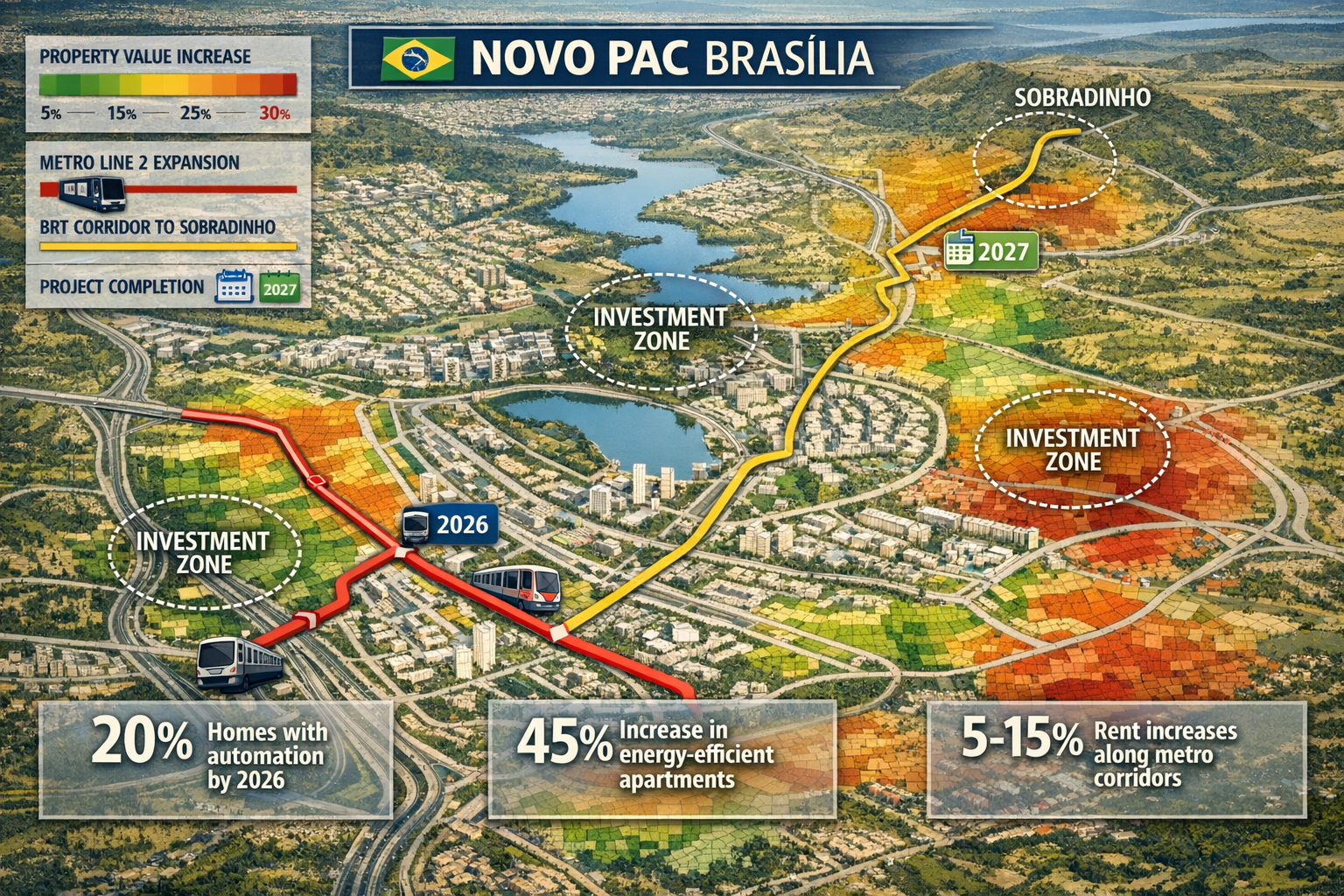
Brasília’s property market is experiencing a technology revolution that creates distinct value tiers between traditional and smart-enabled properties. By 2026, approximately 20% of the capital’s homes are expected to feature automation systems, with this share increasing to 45% for energy-efficient apartments[2]. Understanding these trends enables investors to position portfolios for maximum appreciation and rental competitiveness.
Home automation systems increasingly standard in new construction include:
- Climate control: Smart thermostats and zoned HVAC management reducing energy costs by 15-25%
- Lighting systems: Automated LED networks with occupancy sensing and remote control
- Security integration: Biometric access control, video surveillance, and intrusion detection
- Entertainment systems: Integrated audio-visual networks and streaming infrastructure
Building-level technology in premium developments includes:
- Fiber optic infrastructure: Gigabit-speed internet connectivity supporting remote work and streaming
- Smart building management: Centralized systems monitoring energy consumption, water usage, and maintenance needs
- EV charging infrastructure: Dedicated parking spaces with electric vehicle charging stations
- Shared amenity booking: Digital platforms for reserving common spaces and facilities
Energy efficiency features create operational cost advantages that support rental premiums:
- Solar panels: Rooftop installations reducing electricity costs by 40-60%
- Water conservation: Rainwater harvesting and greywater recycling systems
- Thermal efficiency: Advanced insulation and window systems reducing HVAC demands
- LED lighting: Building-wide efficient lighting reducing electricity consumption
Quantifying Technology Premiums
Tech-optimized properties in Águas Claras, Noroeste, and Sudoeste command measurable premiums:
- Purchase prices: 10-15% higher than comparable traditional properties
- Rental rates: 12-18% premium for fully automated units
- Vacancy rates: 30-40% lower due to enhanced tenant appeal
- Resale velocity: 25-35% faster sales due to broader buyer appeal
These premiums create superior investment returns despite higher acquisition costs. A model comparison illustrates the advantage:
| Property Type | Purchase Price | Monthly Rent | Annual Yield | 5-Year Appreciation | Total Return |
|---|---|---|---|---|---|
| Traditional 2BR | R$600,000 | R$3,000 | 6.0% | 50% (R$300,000) | 80% |
| Tech-Optimized 2BR | R$690,000 | R$3,500 | 6.1% | 65% (R$448,500) | 95% |
The tech-optimized property generates 15 percentage points higher total returns over five years, offsetting the 15% higher acquisition cost through enhanced rental income and superior appreciation.
Investment Strategies for Technology-Forward Properties
New construction focus: Prioritize properties in developments incorporating technology infrastructure from design phases rather than retrofitted solutions. Integrated systems offer superior functionality and lower maintenance costs.
Developer reputation: Partner with established developers known for quality technology implementation and post-sale support. Technology systems require ongoing maintenance and updates that reputable developers facilitate through warranty programs and service partnerships.
Future-proofing: Evaluate whether technology infrastructure accommodates emerging standards including 5G connectivity, IoT device expansion, and evolving smart home platforms. Properties with adaptable systems maintain relevance as technology evolves.
Tenant demographics: Technology premiums concentrate in neighborhoods attracting younger professionals, tech sector employees, and international residents. Águas Claras, Noroeste, and areas near university campuses demonstrate strongest demand for smart-enabled properties.
Rental marketing: Emphasize technology features in listing descriptions and property tours. Professional photography showcasing automation interfaces, energy monitoring dashboards, and smart amenity access enhances perceived value and justifies premium pricing.
Regulatory Navigation and Due Diligence Essentials
Understanding Brasília’s Unique Legal Framework
Brasília’s status as Brazil’s federal capital creates a distinctive regulatory environment that investors must navigate. The city operates under federal oversight through multiple agencies, with planning decisions reflecting both local and national priorities.
UNESCO World Heritage designation for the Plano Piloto (central planned area) imposes preservation restrictions on modifications, renovations, and new construction. These constraints limit supply in central locations while redirecting development pressure toward emerging neighborhoods—a dynamic that supports investment thesis for growth corridors.
Federal development incentives target neighborhoods aligned with national urban planning objectives. Properties in designated development zones benefit from:
- Reduced capital gains taxation: 15-20% lower rates for properties held 5+ years in qualified zones
- Accelerated depreciation: Enhanced tax deductions for rental property owners
- Streamlined permitting: Faster approval processes for renovations and improvements
Environmental regulations in Brasília exceed requirements in many Brazilian cities, reflecting the capital’s role as a planning showcase. New construction must meet elevated sustainability standards including:
- Minimum green space ratios: 30-40% of development area preserved as landscaping
- Water conservation requirements: Mandatory low-flow fixtures and rainwater harvesting in buildings exceeding 20 units
- Energy efficiency standards: Minimum thermal performance and renewable energy integration
These regulations create initial cost premiums but generate long-term value through operational efficiency and enhanced market appeal.
Essential Due Diligence Procedures
Title verification represents the foundational due diligence step. Brazilian property law requires careful examination of ownership history, liens, and encumbrances. Investors should:
- Engage qualified legal counsel specializing in Brasília real estate transactions
- Conduct comprehensive title searches extending 20+ years to identify potential ownership disputes
- Verify property boundaries through professional surveys matching registered descriptions
- Confirm tax compliance ensuring all IPTU (property tax) obligations are current
Construction quality assessment for existing properties should include:
- Professional inspections evaluating structural integrity, systems functionality, and maintenance needs
- Condominium document review examining financial health, maintenance reserves, and governance
- Building code compliance confirming adherence to current safety and accessibility standards
Neighborhood verification extends beyond property-specific factors to community dynamics:
- Infrastructure status: Confirming completion of promised utilities, roads, and public services
- Development pipeline: Researching planned projects that may affect property values (positively or negatively)
- Crime statistics: Reviewing public safety data and trends
- School quality: Evaluating educational options affecting family tenant appeal
Financial modeling should incorporate Brazil-specific considerations:
- Currency fluctuation scenarios: Modeling 10-20% real appreciation/depreciation impacts
- Inflation adjustments: Incorporating 4-6% annual inflation in operating cost projections
- Vacancy assumptions: Using conservative 10-15% vacancy rates for emerging neighborhoods
- Maintenance reserves: Allocating 1-2% of property value annually for upkeep and repairs
Working with Local Partners
Real estate agents specializing in investment properties provide market intelligence and transaction facilitation. Select agents demonstrating:
- Neighborhood expertise: Deep knowledge of specific target areas including off-market opportunities
- Investor focus: Experience with rental property acquisitions rather than primary residence sales
- Professional credentials: CRECI (Conselho Regional de Corretores de Imóveis) registration and positive references
Property managers become essential for investors lacking local presence. Evaluate managers based on:
- Portfolio size: Sufficient scale to provide professional services while maintaining personalized attention
- Technology platforms: Digital rent collection, maintenance tracking, and owner reporting systems
- Tenant screening: Rigorous qualification processes minimizing vacancy and payment defaults
- Fee structures: Competitive rates (typically 8-12% of monthly rent) with transparent cost disclosure
Legal counsel should provide comprehensive transaction support including:
- Purchase agreement review: Ensuring contract terms protect investor interests
- Entity structuring: Optimizing ownership structure for tax efficiency and liability protection
- Regulatory compliance: Navigating foreign investment reporting and tax obligations
- Dispute resolution: Providing litigation support if conflicts arise
Tax advisors familiar with Brazilian and international taxation optimize investment returns through:
- Cross-border tax planning: Minimizing double taxation for foreign investors
- Depreciation optimization: Maximizing allowable deductions against rental income
- Capital gains strategies: Timing sales and utilizing exemptions to reduce tax burdens
- Estate planning: Structuring ownership to facilitate efficient wealth transfer
For investors seeking comprehensive property solutions, partnering with experienced local teams transforms complex regulatory landscapes into navigable pathways toward successful investments.
Risk Mitigation and Portfolio Diversification Strategies
Infrastructure Timeline Risks
Construction delays represent the primary risk factor for investments predicated on Novo PAC infrastructure completion. Brazilian public works projects historically experience timeline extensions averaging 15-30% beyond initial schedules. Mitigating strategies include:
Conservative timeline assumptions: Model investment returns using completion dates 12-18 months beyond official projections. Properties generating acceptable returns under delayed scenarios provide downside protection while maintaining upside exposure if projects complete on schedule.
Diversification across infrastructure types: Avoid concentration in single-project dependencies. Portfolios combining metro corridor properties, BRT-adjacent investments, and road network beneficiaries reduce exposure to any single project’s timeline uncertainties.
Interim value drivers: Prioritize properties offering appreciation catalysts beyond infrastructure completion, including neighborhood gentrification, technology integration, and commercial development. Multiple value drivers create resilience against infrastructure delays.
Staged capital deployment: Rather than concentrating acquisitions in single time periods, distribute purchases across 12-24 months. This approach averages infrastructure timeline risk while maintaining flexibility to adjust strategies as project developments unfold.
Market Cycle Considerations
Brazilian real estate markets demonstrate cyclical characteristics influenced by interest rates, economic growth, and political stability. The 2026 investment environment reflects:
Interest rate trajectory: Following elevated rates in 2024-2025, the Selic rate is expected to stabilize in the 9-11% range through 2026-2027[5]. This environment supports property investment returns exceeding fixed-income alternatives while maintaining mortgage accessibility for buyers.
Economic growth projections: Brazil’s GDP growth forecasts of 2.0-2.5% annually through 2027 support employment stability and household formation—fundamental drivers of housing demand[1]. Brasília’s government-employment concentration provides additional economic stability relative to private-sector-dependent cities.
Political cycle impacts: Presidential and congressional elections create policy uncertainty affecting infrastructure funding and regulatory frameworks. Investors should monitor political developments and maintain flexibility to adjust strategies as policy priorities evolve.
Currency volatility: The Brazilian real’s historical volatility creates both risks and opportunities for international investors. Strategies to manage currency exposure include:
- Natural hedging: Matching rental income currency (reais) with property value currency
- Staged repatriation: Converting rental proceeds to home currency periodically rather than accumulating large real balances
- Exit timing flexibility: Maintaining ability to delay sales during unfavorable exchange rate periods
Geographic and Property Type Diversification
Neighborhood diversification reduces concentration risk while capturing multiple appreciation catalysts. A balanced portfolio might include:
- 35% Águas Claras: Established growth corridor with metro connectivity and technology integration
- 25% Sobradinho: High-risk, high-reward BRT corridor opportunity
- 20% Noroeste: Premium segment providing portfolio stability
- 20% Vicente Pires: Suburban value play with formalization catalysts
Property type diversification addresses varying tenant demographics and market cycles:
- Two-bedroom apartments: Core holding for young professionals and small families
- Studio and one-bedroom units: Capturing single professionals and students
- Three-bedroom units: Targeting established families seeking space
- Commercial properties: Diversifying beyond residential into retail or office space
Development stage diversification balances immediate income with appreciation potential:
- Completed properties: Generating immediate rental income with lower risk
- Pre-construction purchases: Offering below-market pricing with completion risk
- Value-add renovations: Creating forced appreciation through strategic improvements
For investors exploring diverse development opportunities, understanding how different property types and stages complement portfolio objectives becomes essential.
Exit Strategy Planning
Liquidity considerations vary significantly across Brasília neighborhoods. Established areas like Asa Sul and Águas Claras demonstrate average sales timelines of 60-90 days, while emerging neighborhoods like Sobradinho may require 120-180 days to achieve optimal pricing. Investment timelines should accommodate these liquidity differences.
Tax optimization requires strategic timing:
- Long-term capital gains rates (properties held 5+ years) offer 15-20% lower taxation than short-term rates
- Primary residence exemptions eliminate capital gains taxation for properties used as principal residence for 5+ years (subject to value limits)
- 1031-equivalent exchanges allow tax deferral when reinvesting proceeds into qualifying replacement properties
Market timing flexibility provides advantages during exit phases. Investors maintaining financial capacity to delay sales during market downturns avoid forced liquidations at unfavorable pricing. Strategies to maintain flexibility include:
- Conservative leverage: Limiting debt to 50-60% of property value creates equity cushions
- Liquidity reserves: Maintaining 6-12 months of operating expenses in accessible accounts
- Diverse income sources: Avoiding dependence on property cash flow for personal expenses
Staged exit strategies for multi-property portfolios involve:
- Harvesting appreciation: Selling properties reaching target return thresholds while maintaining portfolio core
- Rebalancing: Rotating from mature, fully-appreciated properties into emerging opportunities
- Legacy holding: Retaining highest-quality properties for long-term wealth preservation and income generation
Conclusion: Positioning for Success in Brasília’s Property Revolution
Brasília’s Emerging Property Hotspots: Investment Opportunities from Novo PAC Infrastructure Boosts in 2026 represent a convergence of federal infrastructure investment, urban expansion, and undervalued real estate markets that creates exceptional opportunities for informed investors. The capital’s unique position as Brazil’s political center, combined with ambitious transit and public works projects funded through the Novo PAC program, establishes predictable catalysts for property appreciation in strategic neighborhoods.
The analysis reveals clear investment priorities:
🏆 Águas Claras offers balanced risk-reward profiles with existing metro connectivity, aggressive technology integration, and continued development momentum supporting 12-18% annual total returns.
🚀 Sobradinho presents frontier opportunities with 25-35% appreciation potential by 2028-2029, contingent on BRT corridor completion but offering exceptional returns for investors comfortable with infrastructure timeline risks.
🏘️ Vicente Pires provides suburban value plays with 15-22% appreciation potential as infrastructure formalization completes and the neighborhood achieves service parity with established areas.
💎 Noroeste delivers premium segment exposure with 12-18% appreciation potential, sustainability features, and technology integration attracting upper-middle-class professionals.
🏛️ Guará supplies portfolio stability with 8-12% appreciation potential, established infrastructure, and consistent rental demand from government employees.
Successful investment strategies incorporate several critical elements:
Timing optimization: Acquiring properties during the planning-to-construction transition phase captures maximum appreciation while minimizing speculative premiums. For Metro-DF Line 2 corridor properties, this window extends through late 2026 and early 2027. For BRT corridor investments in Sobradinho, immediate action maximizes pre-construction appreciation potential.
Technology integration: Prioritizing smart-enabled properties with home automation, energy efficiency, and connectivity infrastructure generates 10-15% rental premiums and 25-35% faster resale velocity, offsetting higher acquisition costs through superior total returns.
Infrastructure proximity: Targeting properties within 300-500 meters of planned transit stations captures maximum accessibility benefits while balancing noise and congestion considerations. Historical data demonstrates that proximity properties experience 5-15% rent increases and 20-35% capital appreciation within three years of service commencement[2].
Regulatory navigation: Leveraging federal tax incentives for designated development zones, understanding UNESCO preservation constraints, and partnering with qualified local professionals transforms Brasília’s complex regulatory environment into competitive advantages.
Risk mitigation: Diversifying across neighborhoods, infrastructure types, and development stages creates portfolio resilience against timeline uncertainties and market cycles while maintaining exposure to appreciation catalysts.
Actionable Next Steps
For investors ready to capitalize on Brasília’s Emerging Property Hotspots: Investment Opportunities from Novo PAC Infrastructure Boosts in 2026, implementing a structured action plan maximizes success probability:
Immediate Actions (Next 30 Days):
- Establish local partnerships: Identify and vet real estate agents, legal counsel, and property managers specializing in investment properties in target neighborhoods
- Conduct market research: Visit Brasília to personally evaluate neighborhoods, infrastructure projects, and property options
- Develop financial models: Create detailed return projections incorporating conservative infrastructure timelines, currency fluctuation scenarios, and operating cost assumptions
- Secure financing: Explore mortgage pre-approval or establish capital deployment schedules for cash acquisitions
Near-Term Actions (30-90 Days):
- Execute initial acquisitions: Prioritize Sobradinho BRT corridor properties and Metro-DF Line 2 locations in Águas Claras ahead of construction commencement
- Implement due diligence: Conduct comprehensive title verification, construction quality assessments, and neighborhood verification for target properties
- Establish property management: Engage qualified managers for rental property operations, tenant placement, and maintenance coordination
- Optimize tax structures: Work with advisors to implement entity structures and reporting frameworks maximizing tax efficiency
Medium-Term Actions (90-180 Days):
- Portfolio expansion: Add diversification positions in Vicente Pires, Noroeste, or Guará to balance high-growth Sobradinho and Águas Claras holdings
- Technology integration: Prioritize tech-optimized properties in subsequent acquisitions to capture premium pricing and rental demand
- Performance monitoring: Track infrastructure project progress, property values, and rental market dynamics to inform ongoing strategy adjustments
- Network development: Build relationships with other investors, developers, and market participants to access off-market opportunities and market intelligence
Long-Term Actions (6-12 Months):
- Strategic rebalancing: Evaluate portfolio composition and adjust based on infrastructure developments, market conditions, and return performance
- Value-add initiatives: Implement strategic renovations or technology upgrades to force appreciation and enhance rental competitiveness
- Exit planning: Develop specific criteria and timelines for harvesting appreciation in mature positions while maintaining core holdings
- Market expansion: Consider geographic diversification into other high-return Brazilian property markets as Brasília positions mature
The convergence of Novo PAC infrastructure investments, technology integration trends, and undervalued emerging neighborhoods creates a rare investment window in Brasília’s property market. Investors who act decisively in 2026, positioning ahead of 2027-2028 infrastructure completions, stand to capture 15-30% ROI potential while building long-term wealth through Brazil’s capital city.
The opportunity requires sophisticated analysis, local expertise, and strategic execution—but for those willing to navigate complexity, Brasília’s Emerging Property Hotspots: Investment Opportunities from Novo PAC Infrastructure Boosts in 2026 offer exceptional risk-adjusted returns in one of Latin America’s most stable and strategically important cities.
Ready to explore investment opportunities in Brazil’s most promising property markets? Contact our team to discuss how strategic property investments can build your wealth portfolio, or explore our current development projects to see quality construction and investment opportunities firsthand.
References
[1] Brazil Property Market Predictions For 2026 – https://esalesinternational.com/2025/11/20/brazil-property-market-predictions-for-2026/
[2] Investing Real Estate Brasilia Guide Market Returns Neighborhoods – https://www.jarniascyril.com/international-real-estate/investing-brazil-real-estate/investing-real-estate-brasilia-guide-market-returns-neighborhoods/
[3] Brasilia How Much Apartment – https://thelatinvestor.com/blogs/news/brasilia-how-much-apartment
[4] Brazils Construction Sector 2026 Housing Programs Support Rates High Risks Persist – https://www.fastmarkets.com/insights/brazils-construction-sector-2026-housing-programs-support-rates-high-risks-persist/
[5] Brazil Property Market In 2026 A Strategic Outlook For Investors – https://www.exclusiverealtybrasil.com/article/brazil-property-market-in-2026-a-strategic-outlook-for-investors
[7] Best Cities To Invest In Brazilian Real Estate 2026 Edition – https://www.brazilbeachhouse.com/blogg/2025/12/1/best-cities-to-invest-in-brazilian-real-estate-2026-edition