
Brazil Property Investment: Your Complete Guide to Real Estate Success in 2025 🇧🇷
Imagine owning a beachfront apartment in one of the world’s most vibrant countries, where your investment grows while you enjoy rental income from tourists eager to experience Brazil’s natural beauty. Brazil property investment has emerged as one of the most compelling opportunities in Latin America, offering foreign investors a unique combination of affordable prices, strong rental yields, and significant appreciation potential. With the Brazilian real estate market showing renewed strength in 2025 and government policies becoming increasingly investor-friendly, now is the perfect time to explore what this dynamic market has to offer.
Key Takeaways
- Brazil offers exceptional value for property investors, with prices significantly lower than comparable markets in North America and Europe, while delivering competitive rental yields of 5-8% annually
- Foreign investors have equal rights to Brazilian citizens when purchasing property, with a straightforward legal process requiring only a CPF tax number and proper documentation
- Strategic locations like Florianópolis, São Paulo, and Rio de Janeiro provide diverse investment opportunities ranging from vacation rentals to long-term residential properties
- The Brazilian real estate market is experiencing growth in 2025, driven by economic stabilization, infrastructure improvements, and increasing domestic and international demand
- Professional guidance is essential for navigating legal requirements, currency considerations, and property management to maximize returns on your investment
Understanding the Brazil Property Investment Landscape

The Brazilian real estate market presents a fascinating paradox for international investors. Despite being the world’s ninth-largest economy, property prices remain remarkably accessible compared to other major markets. This affordability, combined with Brazil’s natural attractions, growing middle class, and tourism industry, creates a compelling investment thesis.
Current Market Conditions in 2025
Brazil’s property market has shown remarkable resilience and growth potential entering 2025. Following years of economic adjustment, the country has achieved greater monetary stability, with inflation under control and interest rates becoming more favorable for real estate transactions. The real estate market in Florianópolis exemplifies this positive trend, with strong sales performance and sustained demand.
Key market indicators include:
- Property prices appreciating 8-12% annually in prime locations
- Rental vacancy rates below 5% in major tourist destinations
- Foreign investment increasing by 15% year-over-year
- Construction activity accelerating in coastal regions
- Mortgage availability improving for both locals and foreigners
Why International Investors Choose Brazil
Foreign investors are drawn to brazil property investment for several compelling reasons that extend beyond simple financial returns. The country offers a lifestyle component that few markets can match—pristine beaches, vibrant culture, year-round warm weather, and a welcoming population.
Investment advantages include:
✅ Affordability: Property prices 40-60% lower than comparable beach destinations in Europe or North America
✅ Rental Income: Strong tourism industry generates consistent short-term rental demand
✅ Appreciation Potential: Emerging markets historically deliver superior long-term capital gains
✅ Diversification: Geographic and currency diversification for international portfolios
✅ Lifestyle Benefits: Personal use opportunities in one of the world’s most beautiful countries
Best Locations for Brazil Property Investment
Location selection is perhaps the most critical decision in any real estate investment strategy. Brazil’s vast geography offers diverse options, each with distinct characteristics, target markets, and return profiles. Understanding these regional differences helps investors align their property choices with their financial goals and risk tolerance.
Florianópolis: The Island Paradise for Investors
Florianópolis has emerged as the crown jewel of Brazilian coastal real estate investment. This island city in Santa Catarina state combines natural beauty with modern infrastructure, creating an ideal environment for both vacation rentals and long-term appreciation. The growth of regions like Ingleses demonstrates how strategic development enhances property values over time.
Investment highlights:
- Average property prices: $2,000-$4,000 per square meter
- Rental yields: 6-9% annually for well-managed properties
- Appreciation rates: 10-15% annually in developing neighborhoods
- Tourism strength: Over 2 million visitors annually
- Quality of life: Consistently ranked among Brazil’s best cities
The city offers various micro-markets, from the bustling northern beaches perfect for vacation rentals to the sophisticated southern neighborhoods attracting affluent residents. Exploring available developments provides insight into the diverse investment opportunities across different price points and property types.
São Paulo: Urban Investment Powerhouse
As Brazil’s financial capital and largest city, São Paulo presents a completely different investment profile. This metropolis of 22 million people offers stability through consistent rental demand from professionals, students, and corporate relocations. Unlike beach destinations, São Paulo properties generate year-round income with lower seasonality.
Key investment considerations:
| Factor | Details |
|---|---|
| Market Type | Long-term residential and commercial |
| Average Yields | 4-6% annually |
| Price Range | $1,500-$8,000+ per square meter |
| Tenant Profile | Professionals, executives, students |
| Vacancy Risk | Low (2-4%) in prime neighborhoods |
Rio de Janeiro: Iconic Location with Calculated Risks
Rio de Janeiro remains Brazil’s most internationally recognized city, offering iconic properties with views of Sugarloaf Mountain, Copacabana Beach, and Christ the Redeemer. However, this market requires more sophisticated analysis due to economic challenges and security considerations in certain areas.
Strategic approach for Rio:
- Focus on established neighborhoods like Leblon, Ipanema, and Botafogo
- Target properties in buildings with robust security infrastructure
- Consider the Olympic legacy infrastructure improvements
- Evaluate properties based on proximity to metro stations
- Work with experienced local property managers
Emerging Markets Worth Watching
Beyond the major cities, several emerging markets offer exceptional value for early-stage investors willing to accept higher risk for potentially superior returns. The best places to invest in Brazil property include these rising stars:
🌟 Balneário Camboriú: The “Dubai of Brazil” with dramatic high-rise development
🌟 Búzios: Sophisticated beach town with European ambiance
🌟 Natal: Northeastern coastal city with year-round sunshine and affordable prices
🌟 Gramado: Mountain resort town attracting domestic tourism
The Brazil Property Investment Process: Step-by-Step Guide
Navigating the Brazilian property acquisition process requires understanding both legal requirements and practical considerations. While the system is generally straightforward for foreign investors, proper preparation and professional guidance ensure smooth transactions and legal compliance.
Legal Requirements for Foreign Investors
Brazil maintains an open and welcoming policy toward foreign property investment. Unlike some countries with restrictive ownership rules, Brazil grants foreigners nearly identical rights to domestic buyers, with only a few specific exceptions (such as rural properties exceeding certain sizes or properties in border security zones).
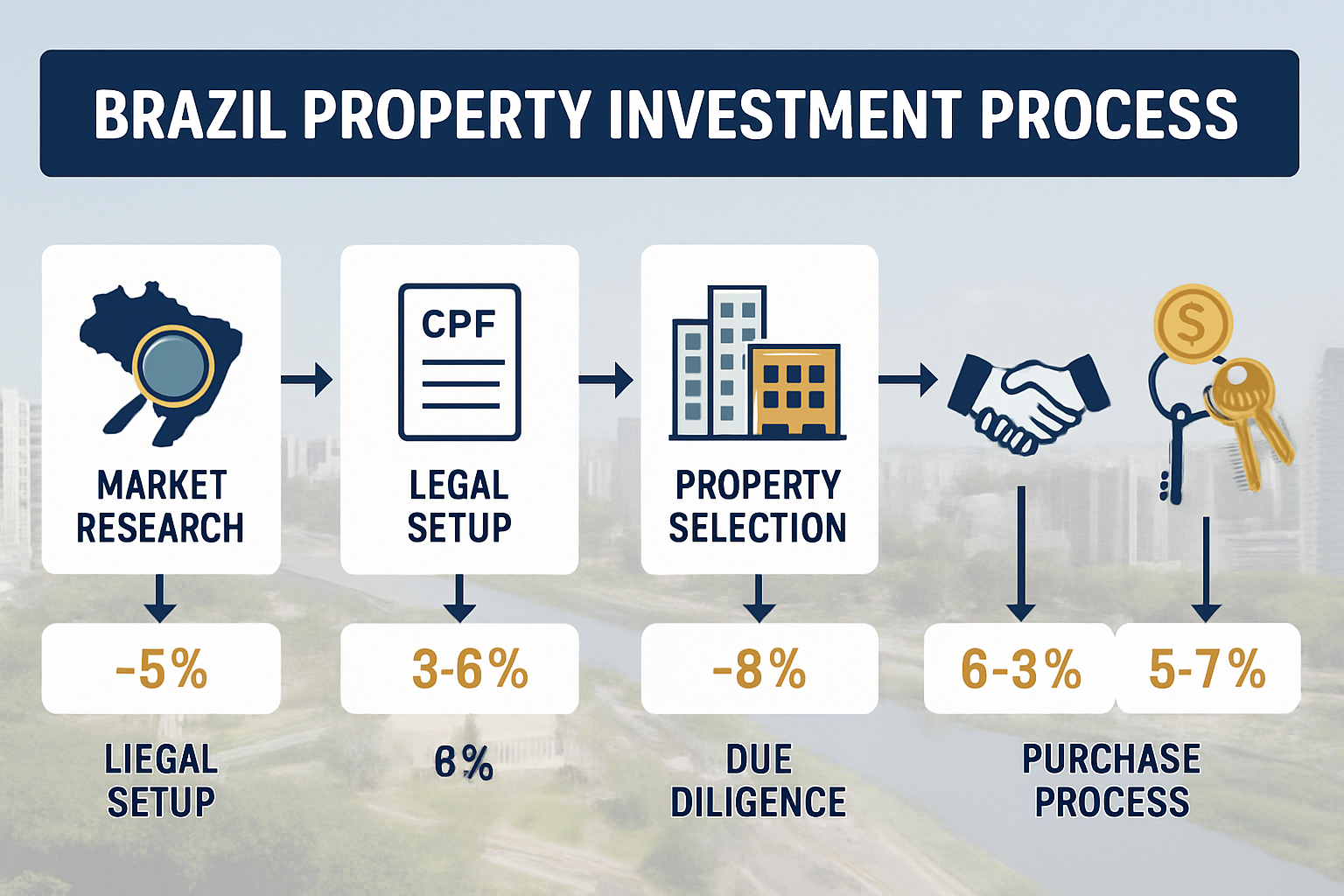
Essential legal steps:
-
Obtain a CPF (Cadastro de Pessoas Físicas): This Brazilian tax identification number is mandatory for all property transactions. Foreign investors can obtain a CPF through Brazilian consulates abroad or directly in Brazil with passport documentation.
-
Open a Brazilian Bank Account: While not strictly required, having a local bank account simplifies transactions, utility payments, and rental income management. Most major banks accommodate foreign investors with proper documentation.
-
Hire a Real Estate Lawyer: Professional legal representation protects your interests, verifies property titles, ensures proper contract terms, and manages the registration process. Budget approximately 1-2% of property value for legal fees.
-
Conduct Due Diligence: Verify the property’s legal status, confirm the seller’s ownership rights, check for liens or encumbrances, and ensure all property taxes are current.
-
Complete the Purchase Contract: Brazilian property transactions typically involve a preliminary contract (compromisso de compra e venda) followed by the final deed (escritura pública) executed before a notary.
Financial Considerations and Currency Management
Managing the financial aspects of brazil property investment requires careful attention to currency exchange, fund transfers, and tax implications. The Brazilian real (BRL) fluctuates against major currencies, creating both opportunities and risks for foreign investors.
Financial planning essentials:
💰 Currency Transfer: Use specialized foreign exchange services rather than traditional banks to save 2-4% on exchange rates. Ensure all international transfers are properly documented for tax purposes.
💰 Payment Structure: Most Brazilian property purchases require 20-30% down payment, with the balance due at closing. Pre-construction purchases may offer extended payment plans.
💰 Transaction Costs: Budget for additional expenses including:
- Transfer tax (ITBI): 2-3% of property value
- Registration fees: 0.5-1% of property value
- Legal fees: 1-2% of property value
- Real estate agent commission: 5-6% (typically paid by seller)
💰 Ongoing Costs: Monthly expenses include property tax (IPTU), condominium fees, utilities, and property management (typically 8-10% of rental income).
Buying Off-Plan: Maximizing Returns Through Pre-Construction
One of the most profitable strategies in Brazilian real estate involves purchasing properties during the construction phase. This approach, known as buying “na planta” (on the blueprint), offers significant advantages for investors willing to wait 18-36 months for completion. The appreciation potential when buying off-plan can substantially enhance overall returns.
Pre-construction benefits:
- Lower entry prices: 20-30% below completed property values
- Extended payment terms: Spread payments over construction period
- Appreciation during construction: Property values increase as building progresses
- Customization options: Some developers allow finish selections
- New property condition: No immediate maintenance or renovation costs
Investors should carefully evaluate developer reputation, construction progress, and market absorption rates. Visiting ongoing construction projects provides valuable insight into build quality and timeline adherence.
Property Types and Investment Strategies
Successful brazil property investment requires matching property type with investment objectives, management capacity, and market conditions. Different property categories serve distinct purposes and deliver varying return profiles.
Studio and One-Bedroom Apartments: The Vacation Rental Powerhouse
Smaller units in tourist destinations offer the highest rental yields and easiest management. These properties attract couples and solo travelers seeking affordable accommodations in prime locations. The advantages of investing in studios in Florianópolis demonstrate how this property type maximizes returns in beach markets.
Ideal for investors seeking:
- Maximum rental yield (7-10% annually)
- Lower acquisition costs ($80,000-$150,000)
- Strong vacation rental demand
- Simplified property management
- Easy future resale to other investors
Multi-Bedroom Apartments: Family Market and Long-Term Rentals
Larger apartments (2-3 bedrooms) serve both vacation rental and long-term residential markets. These versatile properties accommodate families, groups, and local residents, providing flexibility to adjust strategy based on market conditions.
Strategic advantages:
- Diversified tenant pool reduces vacancy risk
- Higher absolute rental income despite lower yields
- Appeals to both investors and end-users for resale
- Suitable for personal use by investor families
- Better performance during economic downturns
Luxury Properties: Premium Positioning
High-end properties in exclusive locations target affluent buyers and renters willing to pay premium prices for exceptional quality, views, and amenities. This segment requires larger capital investment but offers prestige and potential for significant appreciation.
Luxury market characteristics:
- Price points: $500,000-$3,000,000+
- Target market: International buyers, wealthy Brazilians, corporate executives
- Rental yields: 3-5% (lower yields offset by appreciation potential)
- Management intensity: Requires white-glove service and attention to detail
- Market liquidity: Longer selling periods but premium pricing
Commercial Properties: Alternative Investment Avenue
Commercial real estate—including retail spaces, offices, and mixed-use developments—offers different risk-return profiles than residential properties. These investments typically involve longer lease terms, professional tenants, and different tax treatment.
Commercial investment considerations:
- Lease terms: 3-5 years with built-in escalation clauses
- Tenant responsibility: Often includes maintenance and property taxes
- Higher due diligence: Requires market analysis and tenant creditworthiness assessment
- Professional management: Specialized commercial property managers necessary
- Economic sensitivity: More vulnerable to economic cycles than residential
Maximizing Returns: Property Management and Rental Strategies
Acquiring the property represents only the beginning of your investment journey. Effective property management and strategic rental positioning determine actual returns and long-term success in the Brazilian market.
Professional Property Management vs. Self-Management
The decision between hiring professional management or handling operations independently significantly impacts both returns and investor workload. For foreign investors living abroad, professional management is typically essential.
Professional management services include:
- Tenant screening and lease negotiation
- Rent collection and financial reporting
- Maintenance coordination and emergency response
- Legal compliance and contract administration
- Marketing and vacancy management
- Financial reporting and tax documentation
Management fee structures:
- Long-term rentals: 8-10% of monthly rent
- Vacation rentals: 15-25% of rental income
- Additional fees: Often charged for tenant placement, maintenance coordination
Vacation Rental vs. Long-Term Rental Strategy
Choosing between short-term vacation rentals and long-term residential leases represents a fundamental strategic decision with significant implications for returns, management intensity, and risk exposure.
Vacation Rental Advantages:
✨ Higher gross yields (often 50-100% more than long-term)
✨ Personal use opportunities during low season
✨ Flexibility to adjust pricing based on demand
✨ Property remains furnished and ready for owner visits
Vacation Rental Challenges:
⚠️ Higher management intensity and costs
⚠️ Seasonal income fluctuations
⚠️ Greater wear and tear on property and furnishings
⚠️ Platform fees (Airbnb, Booking.com charge 15-20%)
⚠️ Regulatory compliance requirements
Long-Term Rental Benefits:
✨ Stable, predictable monthly income
✨ Lower management requirements
✨ Reduced turnover costs
✨ Less property wear and tear
✨ Simpler tax reporting
Optimizing Occupancy and Revenue
Maximizing rental income requires strategic pricing, effective marketing, and excellent guest/tenant experiences that generate positive reviews and repeat business.
Revenue optimization tactics:
- Dynamic Pricing: Adjust rates based on seasonality, local events, and demand patterns
- Professional Photography: High-quality images increase booking rates by 40-60%
- Multi-Platform Listing: Distribute across Airbnb, Booking.com, VRBO, and local platforms
- Guest Experience: Exceptional service generates five-star reviews and repeat bookings
- Strategic Amenities: WiFi, air conditioning, and beach equipment are essential in coastal markets
- Minimum Stay Requirements: Balance occupancy rates with cleaning cost efficiency
Tax Implications and Legal Compliance
Understanding Brazilian tax obligations ensures legal compliance and helps investors accurately calculate net returns. Brazil’s tax system applies to both residents and non-residents earning income from Brazilian properties.
Property Ownership Taxes
IPTU (Property Tax): Annual municipal property tax ranging from 0.5-1.5% of assessed property value, paid in monthly installments or with discount for annual payment.
ITR (Rural Property Tax): Applies only to rural properties, with rates varying based on property size and productive use.
Income Tax on Rental Revenue
Rental income earned by non-resident foreign investors faces a flat 15% withholding tax, deducted by the tenant or property manager before payment. This rate applies regardless of income amount, unlike the progressive rates for Brazilian residents.
Tax reporting requirements:
- Monthly income tax payments through DARF (federal tax payment form)
- Annual declaration of foreign-owned property to Central Bank
- Proper documentation of all expenses and deductions
- CPF tax number maintained in good standing
Capital Gains Tax on Property Sales
When selling Brazilian property, foreign investors face a 15% capital gains tax on the profit (sale price minus acquisition cost and improvements). The tax applies to the gain calculated in Brazilian reais, meaning currency fluctuations can impact the effective tax rate.
Tax planning strategies:
- Document all property improvements to increase cost basis
- Consider timing of sale relative to currency movements
- Explore reinvestment provisions that may defer taxation
- Consult tax professionals in both Brazil and your home country
- Understand tax treaty provisions between Brazil and your residence country
Inheritance and Estate Planning
Foreign-owned Brazilian property becomes subject to Brazilian inheritance law upon the owner’s death. Proper estate planning prevents complications and ensures smooth transfer to heirs.
Estate planning considerations:
- Brazilian inheritance tax (ITCMD): 4-8% depending on state
- Succession process can be lengthy without proper planning
- Consider holding property through corporate structures
- Ensure will addresses Brazilian assets specifically
- Coordinate planning with professionals in both countries
Risks and Challenges in Brazil Property Investment
Like any international investment, brazil property investment involves specific risks that require acknowledgment and mitigation strategies. Informed investors who understand these challenges can implement appropriate safeguards.
Currency Fluctuation Risk
The Brazilian real has historically experienced significant volatility against major currencies. While this creates opportunities to acquire properties during favorable exchange periods, it also affects rental income value when converted to foreign currencies and impacts capital gains calculations.
Currency risk mitigation:
- View investment returns in local currency terms
- Consider natural hedging through Brazilian real-denominated income
- Avoid excessive leverage in foreign currencies
- Take long-term perspective that smooths short-term fluctuations
- Use currency forward contracts for large planned transactions
Economic and Political Volatility
Brazil’s history includes periods of economic instability and political uncertainty that can impact property values and rental demand. However, the country’s democratic institutions, large domestic market, and natural resources provide fundamental economic resilience.
Risk management approaches:
- Diversify across multiple properties or locations
- Focus on markets with strong local demand fundamentals
- Maintain adequate cash reserves for carrying costs
- Select properties with multiple use scenarios (vacation/long-term rental flexibility)
- Partner with experienced local professionals who navigate changing conditions
Property Management Challenges
Distance management of Brazilian properties presents logistical challenges, particularly for investors residing abroad. Language barriers, cultural differences, and time zones complicate direct oversight.
Management solutions:
- Engage reputable property management companies with proven track records
- Establish clear communication protocols and reporting schedules
- Use technology platforms for remote monitoring and financial tracking
- Visit properties periodically to maintain standards and relationships
- Build relationships with trusted local contacts beyond formal management
Legal and Bureaucratic Complexity
Brazilian bureaucracy can be challenging, with processes sometimes taking longer than expected and requiring patience and persistence. Documentation requirements are extensive, and procedures vary by municipality.
Navigating bureaucracy effectively:
- Work with experienced real estate attorneys from the beginning
- Allow extra time for all official processes
- Maintain meticulous records of all transactions and documentation
- Understand that processes may take 2-3 times longer than initially estimated
- Build relationships with local professionals who understand the system
Future Outlook: Brazil Property Investment in 2025 and Beyond
The Brazilian real estate market enters 2025 with positive momentum driven by several favorable trends. Understanding these dynamics helps investors position their portfolios for optimal returns.
Economic Stabilization and Growth
Brazil’s economy has achieved greater stability with controlled inflation, responsible fiscal management, and growing consumer confidence. These macroeconomic improvements create a favorable environment for real estate appreciation and rental demand growth.
Positive economic indicators:
- GDP growth projections: 2.0-2.5% annually
- Inflation targeting: 3-4% range maintained
- Interest rates: Declining trajectory supporting mortgage availability
- Employment: Improving labor market conditions
- Consumer confidence: Rising domestic purchasing power
Infrastructure Development
Significant infrastructure investments are transforming Brazilian cities and enhancing property values in strategic locations. Transportation improvements, utility upgrades, and urban development projects create appreciation opportunities for well-positioned properties.
Key infrastructure initiatives:
- Metro and light rail expansions in major cities
- Airport modernization improving tourism accessibility
- Highway improvements connecting coastal regions
- Port developments supporting economic growth
- Technology infrastructure enabling remote work
Tourism Recovery and Growth
Brazil’s tourism industry has fully recovered from pandemic disruptions and continues expanding. International visitor numbers are reaching new records, driving strong demand for vacation rental properties in beach destinations and cultural centers.
Tourism trends supporting property investment:
- International arrivals projected to grow 8-10% annually
- Domestic tourism expanding with rising middle class
- Average visitor spending increasing
- Tourism infrastructure improvements
- Brazil’s global profile rising with major events
Demographic Shifts
Brazil’s demographic evolution creates sustained housing demand. Urbanization continues as people move from rural areas to cities seeking economic opportunities. Additionally, household formation rates remain strong as younger generations establish independent residences.
Demographic drivers:
- Urban population: 87% and growing
- Household size: Decreasing, creating more housing units needed
- Middle class: Expanding with greater purchasing power
- Remote work: Enabling relocation to lifestyle destinations
- Aging population: Creating demand for specific property types
Taking Action: Your Next Steps in Brazil Property Investment
Understanding the Brazilian property market is the first step; taking informed action transforms knowledge into profitable investment. Whether you’re ready to purchase immediately or still in the research phase, following a structured approach increases success probability.
Immediate Action Steps
For investors ready to move forward with brazil property investment, these concrete steps initiate the process:
1. Define Your Investment Objectives
Clarify your goals, timeline, budget, and risk tolerance. Determine whether you’re seeking maximum rental yield, long-term appreciation, personal use, or a combination. This clarity guides all subsequent decisions.
2. Research and Select Target Markets
Narrow your focus to 2-3 specific cities or regions that align with your objectives. Study market conditions, price trends, rental demand, and future development plans. The best places to invest in Brazil property provides valuable market insights.
3. Build Your Professional Team
Assemble trusted advisors including a real estate attorney, property manager, accountant familiar with cross-border taxation, and a reputable real estate agent or developer. Quality professionals are worth their fees many times over.
4. Obtain Your CPF
Apply for your Brazilian tax identification number through the nearest consulate or directly in Brazil. This process takes 2-4 weeks and is prerequisite for all property transactions.
5. Visit Target Markets
Nothing replaces on-the-ground experience. Visit your shortlisted locations, view properties, meet your professional team, and develop firsthand understanding of neighborhoods, amenities, and market dynamics. Experiencing life in Florianópolis or your chosen destination provides invaluable perspective.
Exploring Development Opportunities
Working directly with reputable developers offers advantages including payment flexibility, new construction warranties, and professional project management. Reviewing available developments and specific projects like Tramonto or Solis provides concrete examples of current investment opportunities.
Staying Informed
The Brazilian real estate market evolves continuously. Staying current with market trends, regulatory changes, and economic developments protects your investment and reveals new opportunities. Following market news and updates keeps you informed about important developments.
Getting Expert Guidance
For personalized advice tailored to your specific situation, connecting with experienced professionals who understand both the Brazilian market and international investor needs provides invaluable support throughout your investment journey.
Conclusion: Embracing the Brazil Property Investment Opportunity
Brazil property investment represents one of the most compelling opportunities in today’s global real estate market. The combination of affordable entry prices, strong rental yields, appreciation potential, and lifestyle benefits creates a unique value proposition that few markets can match. While challenges exist—currency fluctuations, bureaucratic complexity, and economic volatility—informed investors who approach the market with proper preparation, professional guidance, and realistic expectations can achieve exceptional returns.
The Brazilian market in 2025 offers particular advantages with economic stabilization, infrastructure improvements, tourism growth, and favorable demographic trends all supporting property values and rental demand. Whether you’re attracted to the beachfront beauty of Florianópolis, the urban dynamism of São Paulo, or the iconic appeal of Rio de Janeiro, opportunities exist across various price points, property types, and investment strategies.
Success in Brazilian real estate requires more than simply purchasing property—it demands strategic location selection, effective property management, tax planning, and ongoing market engagement. By following the guidance outlined in this comprehensive resource, building a qualified professional team, and maintaining a long-term perspective, investors can navigate the Brazilian market confidently and profitably.
The time to explore brazil property investment is now. With the market showing strong momentum, prices still accessible compared to mature markets, and Brazil’s fundamental attractions unchanged, the opportunity to establish positions in this dynamic market remains compelling. Take the first step today by defining your objectives, researching target markets, and connecting with professionals who can guide your journey. Your Brazilian property investment adventure awaits—one that promises not just financial returns, but also connection to one of the world’s most vibrant and beautiful countries. 🏖️🏢📈