
The Brazilian real estate market is experiencing a transformative moment in 2026. Brazil’s 2026 Property Price Boom: Top Neighborhoods Poised for 50-80% Gains Driven by Metro Line 6 and Novo PAC represents one of the most significant investment opportunities in Latin America’s largest economy. With massive infrastructure projects reshaping urban connectivity and government programs injecting billions into development, savvy investors and developers are positioning themselves to capture extraordinary returns in strategically located neighborhoods.
The convergence of three powerful catalysts—São Paulo’s Metro Line 6-Laranja opening in October 2026, the federal Novo PAC urban mobility investments, and Rio de Janeiro’s ambitious port renewal initiative—is creating price premiums of 10-25% near project sites. These infrastructure improvements are fundamentally altering commute patterns, accessibility, and quality of life across Brazil’s major metropolitan areas. 🚇
For developers and investors seeking high-return opportunities in Brazilian property markets, understanding which neighborhoods will capture the lion’s share of appreciation is critical. Properties in infrastructure-connected areas are projected to deliver 50% to 80% cumulative growth over the next five years—substantially outperforming citywide averages.[1][2]
Key Takeaways
- Infrastructure-driven appreciation: Neighborhoods along Metro Line 6-Laranja and Novo PAC corridors are forecast to see 7-12% annual price growth in 2026, with five-year cumulative gains reaching 50-80%.[1][2]
- Price premiums emerge early: Properties near completed infrastructure projects command 10-25% premiums, with price boosts beginning 12-24 months before project completion as buyers anticipate benefits.[1][2]
- Small units outperform: Studios and one-bedroom apartments are appreciating at 9% annually, outpacing larger properties due to affordability constraints and strong demand from buyers priced out of premium segments.[2]
- Undervalued opportunities: Brasilândia trades at significant discounts despite being the terminus for Line 6-Laranja, positioning it as the top undervalued area for five-year outperformance.[1]
- Interest rate tailwinds ahead: Brazil’s Selic rate is expected to decline from 15% to approximately 12.25% by year-end 2026, potentially expanding the buyer pool and accelerating demand.[2]
Understanding Brazil’s 2026 Property Price Boom: The Infrastructure Revolution
Brazil’s property market in 2026 is fundamentally different from previous cycles. Rather than being driven solely by economic growth or credit expansion, this boom is anchored in tangible infrastructure improvements that permanently enhance property values through improved accessibility and reduced commute times.
The Three Pillars of Growth
The current property price surge rests on three major infrastructure initiatives that represent the largest coordinated urban development effort in Brazil’s recent history:
1. Metro Line 6-Laranja (São Paulo) 🚊
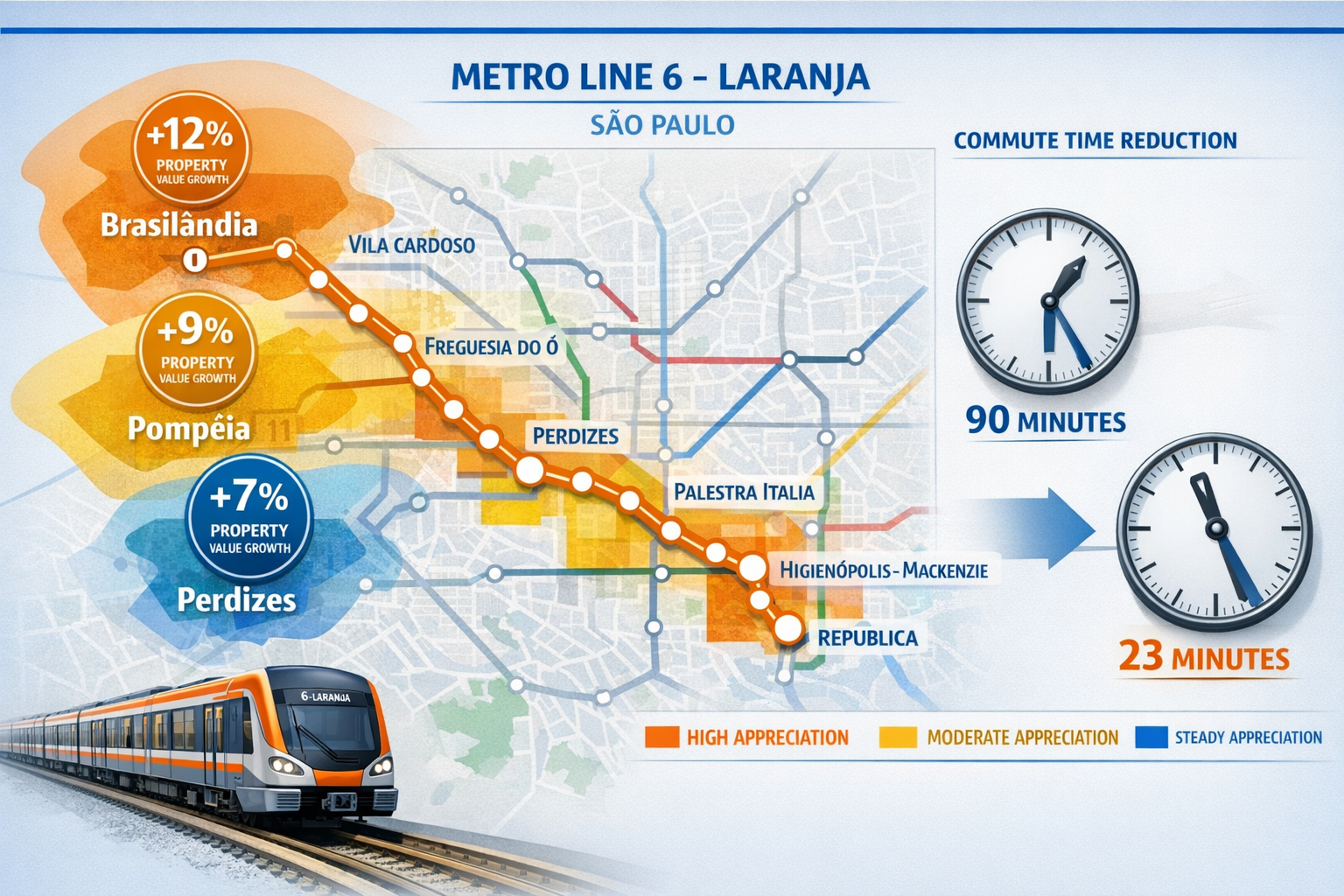
Opening in October 2026, this 15-kilometer metro line will transform connectivity for over 600,000 daily passengers. The impact is staggering: commute times from Brasilândia to central São Paulo will plummet from 90 minutes to just 23 minutes.[1]
This isn’t a marginal improvement—it’s a fundamental restructuring of urban accessibility that makes previously peripheral neighborhoods viable for professionals working in São Paulo’s business districts. The line connects underserved western neighborhoods to the broader metro network, creating immediate value uplift.
2. Novo PAC Urban Mobility Investments
The federal government’s New Growth Acceleration Program (Novo PAC) is channeling substantial resources into urban mobility across multiple Brazilian capitals. These investments extend beyond São Paulo to include:
- Bus rapid transit (BRT) corridors in secondary cities
- Metro expansions in Rio de Janeiro and Brasília
- Road infrastructure improvements connecting residential areas to employment centers
- Digital infrastructure supporting smart city initiatives
The program represents a coordinated national effort to address Brazil’s chronic infrastructure deficit, with particular emphasis on projects that enhance daily mobility for middle-class residents.
3. Rio de Janeiro Port Region Renewal
Rio’s ambitious port area redevelopment is transforming a formerly industrial waterfront into a mixed-use district combining residential, commercial, and cultural spaces. This project mirrors successful urban renewal initiatives in Barcelona and Hamburg, creating entirely new neighborhoods in previously underutilized areas.[2]
National Price Growth Context
Brazil’s residential property prices are expected to increase 6% to 10% in nominal terms throughout 2026, with secondary cities significantly outpacing major capitals.[2] This national growth provides the backdrop against which infrastructure-connected neighborhoods are delivering exceptional outperformance.
The broader market dynamics include:
- Limited supply: New construction has not kept pace with household formation, creating structural supply constraints
- Urbanization trends: Continued migration to major metropolitan areas drives demand for well-connected housing
- Formalization of economy: Growing middle class seeking homeownership as wealth-building strategy
- International interest: Foreign investors recognizing value opportunities in Latin America’s largest economy
For those exploring investment opportunities across Brazil’s diverse markets, understanding these macro trends provides essential context for neighborhood-level decisions.
Top Neighborhoods Poised for 50-80% Gains: Detailed Forecasts
Brazil’s 2026 Property Price Boom: Top Neighborhoods Poised for 50-80% Gains Driven by Metro Line 6 and Novo PAC is most concentrated in specific corridor neighborhoods where infrastructure improvements deliver maximum impact. Here’s a detailed analysis of the top-performing areas:
São Paulo Metro Line 6-Laranja Corridor
Brasilândia: The Undervalued Opportunity 💎
Current Status: Significantly undervalued compared to established neighborhoods
Projected 2026 Growth: 10-12%
Five-Year Cumulative Gain: 60-80%
Key Catalyst: Metro Line 6-Laranja terminus station
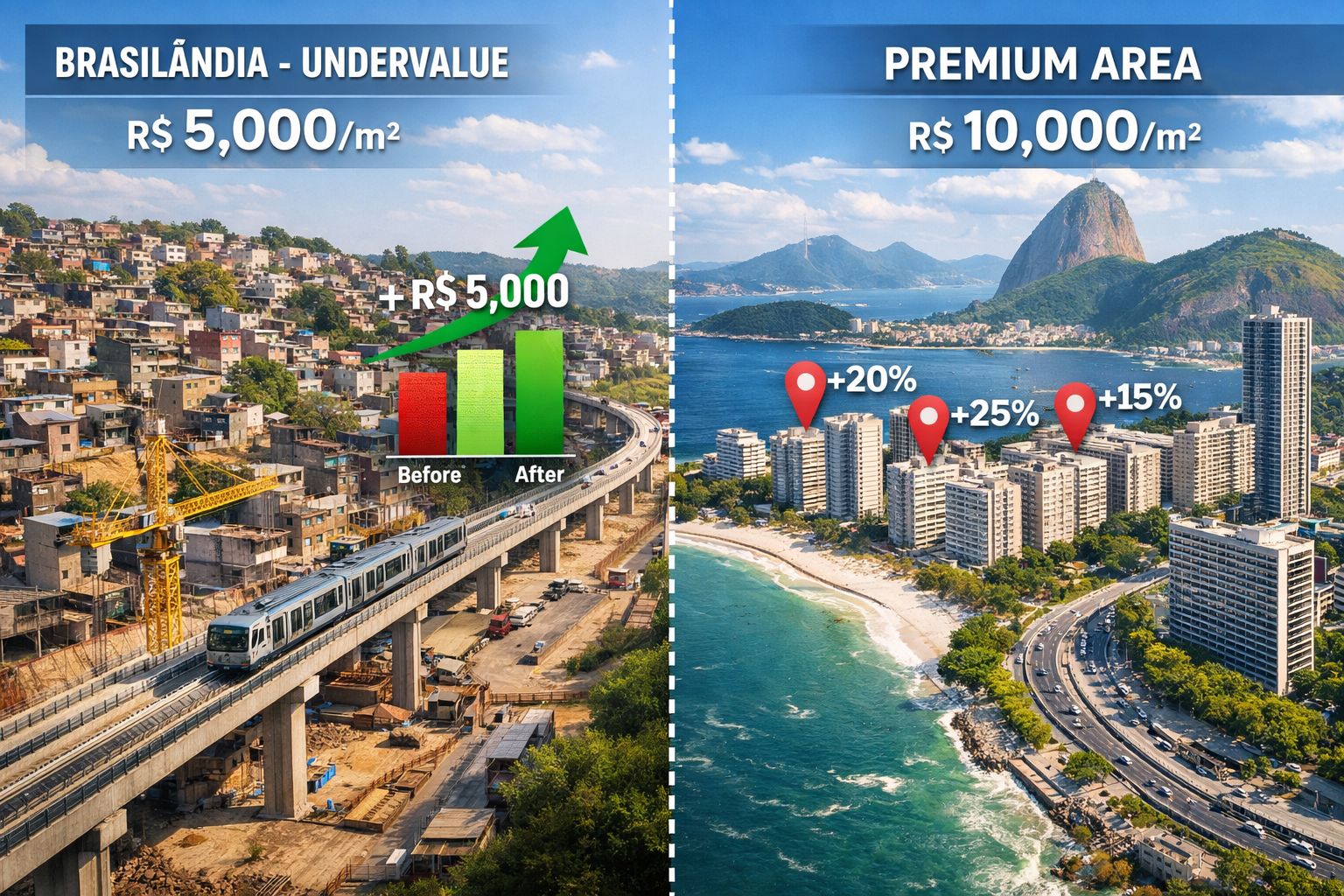
Brasilândia represents the single best value opportunity in São Paulo’s property market for long-term investors. As the western terminus of Line 6-Laranja, this neighborhood will experience the most dramatic transformation in accessibility.[1]
Why Brasilândia Outperforms:
- Maximum commute reduction: The 67-minute time savings represents the largest improvement of any station on the line
- Current price discount: Properties trade at 40-60% below comparable units in established western neighborhoods
- Development pipeline: New residential projects launching in anticipation of metro opening
- Demographic shift: Young professionals and families priced out of Perdizes and Pompéia seeking affordable alternatives
The neighborhood’s current undervaluation creates asymmetric upside. While established areas along the line will see solid appreciation, Brasilândia’s discounted entry point positions it for the highest percentage gains as the metro transforms it from peripheral to connected.
Perdizes: Established Quality with Infrastructure Boost 🏢
Current Status: Premium established neighborhood
Projected 2026 Growth: 8-10%
Five-Year Cumulative Gain: 50-65%
Key Catalyst: Enhanced metro connectivity via Line 6-Laranja
Perdizes already commands premium prices due to its quality housing stock, tree-lined streets, and proximity to universities. The addition of metro access removes its primary weakness—limited public transit options—and solidifies its position as a top-tier residential area.
Investment Thesis:
- Wealth preservation: Lower risk profile than emerging neighborhoods
- Rental demand: Strong appeal to university students and young professionals
- Commercial development: New retail and dining options following metro stations
- Price floor: Established demand provides downside protection
For conservative investors seeking steady appreciation with lower volatility, Perdizes offers compelling risk-adjusted returns.
Pompéia: The Balanced Play ⚖️
Current Status: Mid-tier established neighborhood
Projected 2026 Growth: 9-11%
Five-Year Cumulative Gain: 55-70%
Key Catalyst: Multiple Line 6-Laranja stations
Pompéia strikes an attractive balance between Brasilândia’s high-risk/high-reward profile and Perdizes’s conservative stability. The neighborhood will host three stations on Line 6-Laranja, creating multiple nodes of development activity.[1]
Competitive Advantages:
- Multiple access points: Three stations provide broader coverage than single-station neighborhoods
- Mixed housing stock: Options from affordable studios to family apartments
- Cultural amenities: Established dining, shopping, and entertainment infrastructure
- Price-to-value ratio: Better value than Perdizes with similar quality of life
Metro Line 2-Verde Extension Areas
Anália Franco: Eastern Zone Transformation 🌆
Current Status: Developing commercial and residential hub
Projected 2026 Growth: 7-9%
Five-Year Cumulative Gain: 45-60%
Key Catalyst: Line 2-Verde extension improving eastern zone connectivity
Anália Franco benefits from both metro expansion and the broader development of São Paulo’s eastern zone. The neighborhood’s large shopping center and office complexes create employment anchors that drive residential demand.[1]
Vila Formosa: Emerging Value 📈
Current Status: Working-class neighborhood with improvement trajectory
Projected 2026 Growth: 8-10%
Five-Year Cumulative Gain: 50-65%
Key Catalyst: New metro access transforming commute patterns
Vila Formosa represents a middle-ground opportunity—more established than Brasilândia but with similar upside potential due to current undervaluation relative to improved accessibility.
Rio de Janeiro Port Region
Porto Maravilha District: Urban Renewal Play 🏗️
Current Status: Active redevelopment zone
Projected 2026 Growth: 9-12%
Five-Year Cumulative Gain: 55-75%
Key Catalyst: Port area renewal creating new mixed-use neighborhood
Rio’s port region renewal is creating an entirely new neighborhood from formerly industrial land. This represents a different investment thesis than metro-adjacent properties—a bet on successful urban placemaking rather than pure infrastructure connectivity.[2]
Risk Considerations:
- Execution risk: Project completion timelines may extend
- Market acceptance: New neighborhoods require time to establish character
- Regulatory changes: Government priorities may shift
However, for investors with longer time horizons, the potential to acquire property in what could become Rio’s premier waterfront district offers substantial upside.
Comparative Neighborhood Performance Table
| Neighborhood | 2026 Growth | 5-Year Gain | Risk Level | Primary Catalyst |
|---|---|---|---|---|
| Brasilândia | 10-12% | 60-80% | High | Line 6 terminus |
| Pompéia | 9-11% | 55-70% | Medium | Multiple Line 6 stations |
| Perdizes | 8-10% | 50-65% | Low | Line 6 connectivity |
| Vila Formosa | 8-10% | 50-65% | Medium | Line 2 extension |
| Porto Maravilha | 9-12% | 55-75% | Medium-High | Port renewal |
| Anália Franco | 7-9% | 45-60% | Medium | Line 2 + commercial |
Investment Strategies for Capturing 50-80% Gains
Understanding Brazil’s 2026 Property Price Boom: Top Neighborhoods Poised for 50-80% Gains Driven by Metro Line 6 and Novo PAC is only the first step. Successful investors must implement specific strategies to capture these returns while managing risk.
Strategy 1: Small Unit Focus 🏠
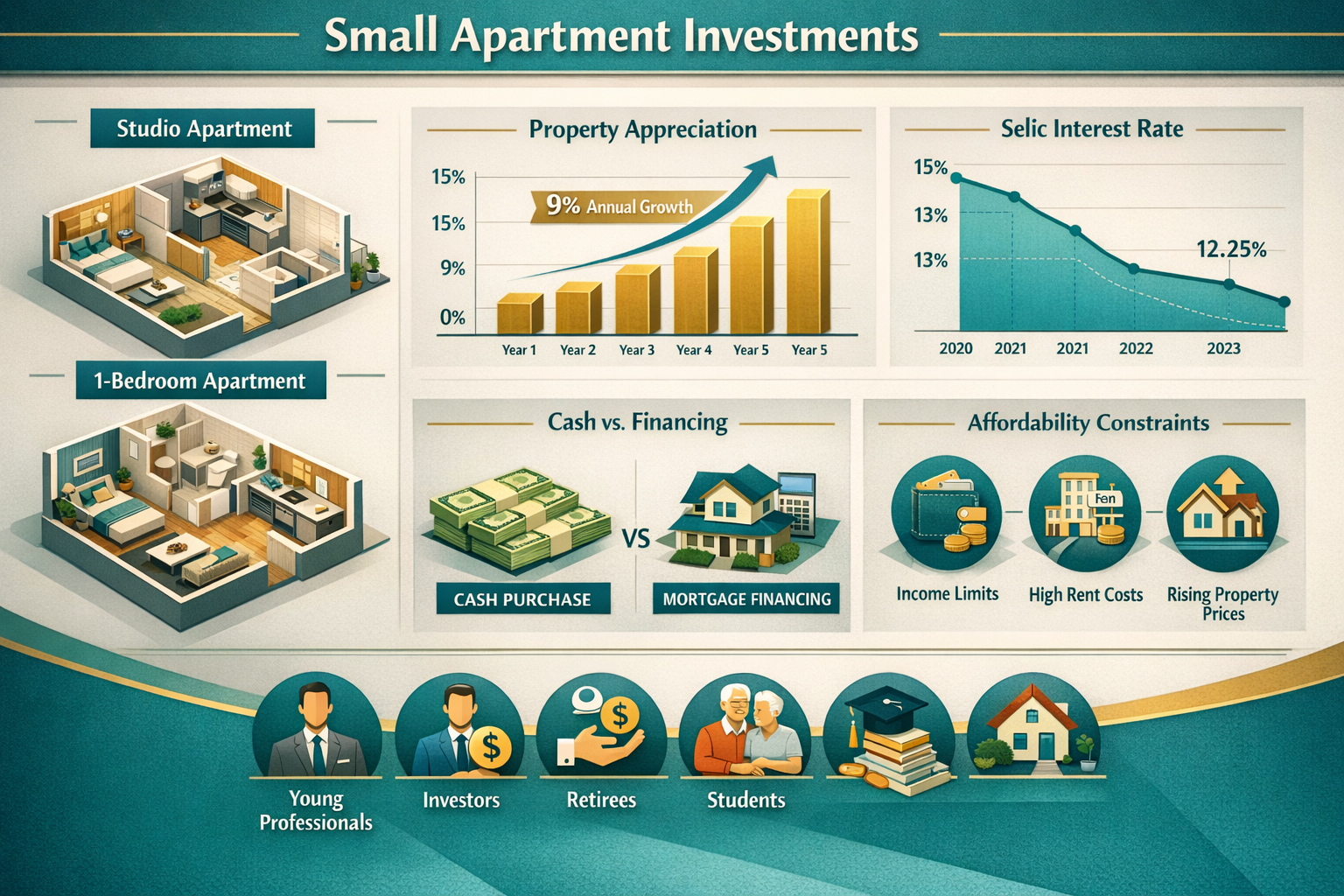
Studios and one-bedroom apartments are outperforming larger properties with growth rates near 9% annually, driven by affordability constraints and strong demand from buyers priced out of premium segments.[2]
Why Small Units Win in 2026:
- Affordability ceiling: With Brazil’s Selic rate at 15%, mortgage qualification is challenging—smaller units remain accessible
- Cash buyer advantage: Investors can acquire multiple small units rather than single large properties
- Rental yield: Studio apartments typically generate higher yields (5-7%) than family units (3-5%)
- Liquidity: Smaller units sell faster when market conditions shift
Target Profile:
- 25-40 square meters
- Near metro stations (within 500-meter walk)
- Buildings with modern amenities (security, parking, fitness)
- Neighborhoods with young professional demographics
This strategy aligns with broader trends in Brazilian real estate markets, where affordability and accessibility drive demand.
Strategy 2: Pre-Completion Positioning ⏰
Properties near infrastructure projects begin appreciating 12-24 months before completion as informed buyers anticipate benefits.[1][2] This creates a timing opportunity for strategic investors.
Implementation Timeline:
- 18-24 months before opening: Acquire properties at pre-appreciation prices
- 12-18 months before opening: Market awareness increases, early price movement begins
- 6-12 months before opening: Acceleration phase as completion becomes certain
- Opening month: Peak media attention and buyer interest
- 6-12 months after opening: Stabilization at new price level with 10-25% premium
For Line 6-Laranja opening in October 2026, the ideal acquisition window for maximum gains was late 2024 through mid-2025. However, secondary appreciation waves occur as the metro proves its impact on daily life, creating continued opportunities through 2027-2028.
Strategy 3: Novo PAC Corridor Identification 🗺️
Beyond São Paulo’s metro expansion, the federal Novo PAC program is funding infrastructure across multiple cities. Identifying these corridors early provides similar upside potential.
Research Process:
- Review public announcements: Government websites publish PAC project lists
- Assess completion probability: Prioritize projects with secured funding and active construction
- Evaluate current pricing: Seek neighborhoods where infrastructure benefits aren’t fully priced in
- Verify development pipeline: Confirm residential projects are planned near infrastructure
São Paulo state alone plans to invest R$30 billion (US$5.62 billion) in infrastructure projects throughout 2026, supporting broader economic development beyond metro expansion.[6]
Strategy 4: Diversified Neighborhood Portfolio 📊
Rather than concentrating capital in a single neighborhood, sophisticated investors build portfolios spanning different risk profiles:
Sample Portfolio Allocation:
- 40% Conservative (Perdizes, established areas): Wealth preservation with steady 8-10% annual gains
- 40% Moderate (Pompéia, Vila Formosa): Balanced risk-return with 9-11% annual gains
- 20% Aggressive (Brasilândia, emerging areas): High-risk/high-reward with 10-12% annual gains
This approach captures upside from emerging neighborhoods while maintaining downside protection through established areas.
Strategy 5: Interest Rate Timing 📉
Brazil’s Selic benchmark rate remains at 15% as of January 2026, the highest level since 2006, constraining mortgage availability and favoring cash purchases.[1][2] However, market forecasters expect the rate to decline to approximately 12.25% by year-end 2026, potentially expanding the buyer pool.[2]
Tactical Considerations:
- Current environment: Cash buyers have negotiating leverage as financed buyers face qualification challenges
- Mid-2026 transition: As rates begin declining, mortgage-dependent buyers re-enter market
- Late 2026 acceleration: Lower rates combined with metro opening create demand surge
Investors who acquire properties in the high-rate environment of early 2026 position themselves to benefit from both infrastructure appreciation and expanded buyer demand as rates decline.
Risk Factors and Mitigation Strategies
While Brazil’s 2026 Property Price Boom: Top Neighborhoods Poised for 50-80% Gains Driven by Metro Line 6 and Novo PAC presents compelling opportunities, prudent investors must acknowledge and manage risks.
Infrastructure Completion Delays ⚠️
Risk: Metro Line 6-Laranja or other projects experience construction delays, postponing anticipated appreciation.
Mitigation:
- Focus on projects with advanced completion status (>80% complete)
- Diversify across multiple infrastructure catalysts
- Maintain longer investment horizons (5+ years) to accommodate delays
- Monitor construction progress through official channels
The October 2026 opening date for Line 6-Laranja is well-supported by current construction progress, reducing this risk compared to earlier-stage projects.
Interest Rate Volatility 📊
Risk: Brazil’s central bank maintains high rates longer than expected, constraining buyer demand and price appreciation.
Mitigation:
- Target properties attractive to cash buyers (small units, affordable price points)
- Focus on rental yield in addition to appreciation potential
- Avoid overleveraging—maintain equity cushions
- Select neighborhoods with fundamental demand drivers beyond financing availability
The current 15% Selic rate represents a near-term headwind, but the long-term trajectory favors normalization as inflation moderates.
Economic Downturn 📉
Risk: Brazilian economy enters recession, reducing employment and housing demand.
Mitigation:
- Prioritize neighborhoods with diverse employment bases
- Focus on essential worker housing near infrastructure
- Maintain cash reserves for extended holding periods
- Consider defensive sectors (healthcare, education proximity)
Infrastructure-connected properties historically demonstrate greater resilience during downturns as commute savings become more valuable when household budgets tighten.
Oversupply in Specific Neighborhoods 🏗️
Risk: Developer enthusiasm leads to excessive new construction, creating local oversupply.
Mitigation:
- Research development pipelines before acquiring
- Favor neighborhoods with geographic constraints limiting new supply
- Monitor absorption rates for new projects
- Diversify across multiple neighborhoods
Brasilândia, despite its strong growth prospects, faces this risk as developers rush to capitalize on metro opening. Careful project selection within the neighborhood is essential.
Currency Risk for International Investors 💱
Risk: Brazilian real depreciation against investor’s home currency reduces returns when repatriated.
Mitigation:
- Hedge currency exposure through financial instruments
- Reinvest returns in Brazil rather than repatriating
- View as long-term local currency investment
- Consider natural hedges (export-oriented tenant base)
The real’s volatility is a persistent feature of Brazilian markets, requiring explicit strategy for international investors.
Developer Perspectives: Capitalizing on Infrastructure Premiums
For real estate developers and incorporation companies operating in Brazil, understanding infrastructure-driven appreciation enables strategic project positioning and timing.
Pre-Launch Market Analysis 🔍
Successful developers conduct detailed analysis 18-24 months before infrastructure completion to identify optimal project locations:
Key Analysis Components:
- Walkability mapping: Properties within 500-meter radius of stations command highest premiums
- Competitive inventory: Assess existing and planned projects to avoid oversupply
- Demographic targeting: Match unit mix to neighborhood buyer profiles
- Pricing strategy: Balance early-bird discounts with anticipated appreciation
Projects launched 12-18 months before metro opening can offer attractive entry prices while still capturing substantial appreciation during construction and sales periods.
Unit Mix Optimization 🏢
Given the outperformance of small units, developers are adjusting product mix:
2026 Optimal Mix for Infrastructure Corridors:
- 40-50% studios (25-30 sqm)
- 30-40% one-bedroom (35-45 sqm)
- 15-20% two-bedroom (55-70 sqm)
- 5-10% three-bedroom (80-100 sqm)
This contrasts with traditional mixes that emphasized larger family units. The shift reflects both affordability constraints and changing household formation patterns among younger buyers.
Amenity Prioritization 🎯
Infrastructure-connected projects can command premiums for specific amenities that complement metro access:
High-Value Amenities:
- Bicycle storage: Metro commuters often bike to stations
- Co-working spaces: Remote workers value occasional home office alternatives
- Package lockers: E-commerce growth drives demand for secure delivery
- EV charging: Forward-looking buyers value electric vehicle infrastructure
These amenities cost relatively little to incorporate but significantly enhance marketability and pricing power.
Marketing Timing and Messaging 📢
Developers must calibrate marketing campaigns to infrastructure completion timelines:
Phase 1 (12-18 months before opening): Emphasize “Coming Soon” infrastructure benefits, early-bird pricing
Phase 2 (6-12 months before opening): Highlight construction progress, countdown to opening
Phase 3 (Opening month): Maximum media push, grand opening events, limited availability messaging
Phase 4 (Post-opening): Demonstrate actual commute times, resident testimonials
Effective messaging connects infrastructure improvements to lifestyle benefits rather than technical details.
Comparative Analysis: Brazil vs. Other Latin American Markets
Brazil’s 2026 Property Price Boom: Top Neighborhoods Poised for 50-80% Gains Driven by Metro Line 6 and Novo PAC stands out even within the broader Latin American context.
Regional Price Growth Comparison
| Country | 2026 Growth Forecast | Infrastructure Investment | Market Maturity |
|---|---|---|---|
| Brazil | 6-10% (12% in top neighborhoods) | R$30B+ (São Paulo alone) | Mature |
| Mexico | 5-8% | Moderate | Mature |
| Colombia | 4-7% | Limited | Developing |
| Chile | 3-5% | Stable | Mature |
| Argentina | Volatile (inflation-dependent) | Constrained | Uncertain |
Brazil’s combination of substantial infrastructure investment, market size, and political stability creates a unique opportunity set within the region.
Infrastructure Impact Precedents 🚇
International examples demonstrate the wealth-creation potential of infrastructure-driven appreciation:
São Paulo Metro Line 4 (Yellow) – Opened 2010:
- Properties within 500m of stations appreciated 35-45% in first three years
- Neighborhoods like Vila Sônia transformed from peripheral to connected
- Premium persisted over subsequent decade
Rio de Janeiro Metro Line 4 (Olympics) – Opened 2016:
- Barra da Tijuca properties gained 40-60% in anticipation and early operation
- Tourist-oriented areas captured additional premium from improved access
Bogotá TransMilenio BRT – Various phases:
- Corridor properties consistently outperformed city average by 15-25%
- Effect strongest in previously underserved neighborhoods
These precedents validate the 50-80% five-year gain projections for Brazil’s current infrastructure wave.[1][2]
Financing Strategies in High-Rate Environment
With Brazil’s Selic rate at 15%, traditional mortgage financing is challenging, requiring creative approaches for investors seeking to maximize returns.
Cash Purchase Advantages 💰
Current Market Dynamics:
- Negotiating power: Sellers prefer cash buyers, enabling 5-10% discounts
- Speed: Close transactions in 30-45 days vs. 90+ days for financed purchases
- Certainty: No financing contingencies or qualification requirements
For investors with capital, the high-rate environment creates opportunities to acquire properties below market value from sellers motivated to close quickly.
Developer Financing Programs 🏗️
Many developers offer in-house financing with more flexible terms than banks:
Typical Developer Terms:
- 20-30% down payment
- 24-36 month payment plans during construction
- Interest rates 2-4% below bank mortgages
- Balloon payment at completion (often refinanced)
This approach enables investors to control properties with less upfront capital while benefiting from appreciation during construction.
Partnership Structures 🤝
Sophisticated investors are forming partnerships to pool capital and share risk:
Common Structures:
- Joint ventures: 2-4 investors co-own properties, sharing appreciation and rental income
- Fund vehicles: Larger groups pool capital for diversified portfolios
- Developer partnerships: Investors provide capital for specific projects in exchange for unit allocations
These structures provide access to larger or multiple properties while maintaining manageable individual capital commitments.
International Financing Considerations 🌎
Foreign investors face additional complexity but can access advantages:
Opportunities:
- Lower home-country rates: Borrow against assets in low-rate markets (US, Europe) to invest in Brazil
- Currency arbitrage: If real appreciates, returns amplified for foreign investors
- Portfolio diversification: Brazilian property exposure reduces correlation with home markets
Challenges:
- Regulatory compliance: Foreign ownership requires specific legal structures
- Repatriation rules: Profit remittance subject to regulations and taxation
- Currency risk: Real volatility can erode returns
For international investors exploring Brazilian property opportunities, partnering with experienced local advisors is essential for navigating these complexities.
Long-Term Outlook: Beyond 2026
While 2026 represents a peak year for infrastructure-driven appreciation, the long-term trajectory for well-positioned neighborhoods remains positive.
2027-2030 Projections 📅
Post-Infrastructure Stabilization:
Following the initial 10-25% premium captured in 2026-2027, infrastructure-connected neighborhoods typically settle into steady appreciation 2-4% above citywide averages.[1][2]
Five-Year Cumulative Outlook (2026-2030):
- Top-tier neighborhoods (Brasilândia, Pompéia): 50-80% cumulative
- Established areas (Perdizes, Anália Franco): 40-60% cumulative
- Citywide average: 30-45% cumulative
These projections assume moderate economic growth, gradual interest rate normalization, and successful infrastructure operation.
Secondary Appreciation Waves 🌊
Infrastructure appreciation doesn’t end with project completion. Secondary waves occur as:
- Commercial development: Retail and office projects cluster near stations, enhancing neighborhood appeal
- Gentrification: Higher-income residents move in, improving local amenities
- Network effects: Additional transit connections amplify accessibility benefits
- Density increases: Zoning changes allow taller buildings, increasing land values
Neighborhoods like Brasilândia may experience multiple appreciation cycles as these secondary effects compound over 5-10 years.
Emerging Infrastructure Catalysts 🚀
Looking beyond Line 6-Laranja, future infrastructure projects will create new opportunities:
2027-2030 Pipeline:
- Metro Line 18-Bronze (São Paulo): Connecting southern suburbs
- Metro Line 20-Pink (São Paulo): Serving eastern neighborhoods
- Rio de Janeiro Metro Line 3: Expanding western zone coverage
- High-speed rail: São Paulo-Rio connection (long-term)
Investors who successfully capitalize on the 2026 boom can redeploy capital into these next-generation opportunities.
Demographic Tailwinds 👥
Brazil’s urbanization continues, with 87% of the population now living in cities and rising. This creates sustained demand for well-connected urban housing:
Key Demographic Trends:
- Household formation: Younger generations establishing independent households
- Middle-class growth: Expanding pool of homeownership-capable buyers
- Aging population: Demand for accessible, transit-connected housing for seniors
- Remote work: Flexibility enables residence in previously inconvenient locations with good transit
These structural trends support long-term property appreciation beyond cyclical infrastructure booms.
Actionable Implementation Checklist
For investors ready to capitalize on Brazil’s 2026 Property Price Boom: Top Neighborhoods Poised for 50-80% Gains Driven by Metro Line 6 and Novo PAC, here’s a practical implementation roadmap:
Phase 1: Research and Planning (Weeks 1-4) 📋
- Review Metro Line 6-Laranja station locations and neighborhood profiles
- Analyze current price per square meter in target neighborhoods
- Research development pipelines and planned supply
- Assess personal investment criteria (budget, risk tolerance, time horizon)
- Consult with local real estate professionals and legal advisors
- Review financing options (cash, developer financing, partnerships)
Phase 2: Market Intelligence (Weeks 5-8) 🔍
- Visit target neighborhoods in person (if possible)
- Walk 500-meter radius around metro stations to assess walkability
- Evaluate local amenities (schools, shopping, healthcare)
- Interview local brokers about buyer demand and absorption rates
- Review recent comparable sales data
- Assess rental demand and yields for target unit types
Phase 3: Property Selection (Weeks 9-12) 🏠
- Identify 3-5 specific properties or projects meeting criteria
- Conduct detailed due diligence on each option
- Verify developer track record for new construction
- Review building quality and amenities
- Analyze unit mix and target buyer profile
- Calculate projected returns under various scenarios
Phase 4: Acquisition (Weeks 13-16) 💼
- Negotiate purchase terms and pricing
- Secure financing (if applicable)
- Engage legal counsel for contract review
- Complete due diligence period
- Finalize purchase and transfer ownership
- Establish property management (if investment property)
Phase 5: Ongoing Management (Months 5+) 📊
- Monitor infrastructure completion progress
- Track neighborhood price trends
- Optimize rental operations (if applicable)
- Reassess hold vs. sell decision as metro opening approaches
- Plan for tax-efficient exit strategy
- Identify next investment opportunities
Conclusion: Seizing Brazil’s Infrastructure-Driven Opportunity
Brazil’s 2026 Property Price Boom: Top Neighborhoods Poised for 50-80% Gains Driven by Metro Line 6 and Novo PAC represents a generational opportunity for informed investors and developers. The convergence of substantial infrastructure investment, strategic neighborhood positioning, and favorable market dynamics creates the potential for exceptional returns.
The evidence is compelling: properties near completed infrastructure projects command 10-25% premiums, with the highest gains concentrated in currently undervalued neighborhoods like Brasilândia that will experience the most dramatic accessibility improvements.[1][2] The October 2026 opening of Metro Line 6-Laranja, combined with billions in Novo PAC investments, provides concrete catalysts for near-term appreciation.
Key Success Factors 🎯
Winners in this market will:
✅ Act decisively: The optimal acquisition window narrows as metro opening approaches
✅ Focus on fundamentals: Prioritize walkable distance to stations and strong underlying demand
✅ Manage risk: Diversify across neighborhoods and maintain appropriate leverage
✅ Think long-term: Infrastructure benefits compound over 5-10 years, not just immediate opening
✅ Stay informed: Monitor construction progress and market conditions continuously
Immediate Next Steps
For investors ready to capitalize on this opportunity:
- Research target neighborhoods using the detailed profiles provided in this analysis
- Connect with local expertise through established Brazilian real estate platforms and professionals
- Visit properties in person to assess walkability and neighborhood character
- Secure financing or partnership structures appropriate for your capital position
- Execute acquisitions before metro opening drives prices to new equilibrium levels
The infrastructure is being built. The neighborhoods are being transformed. The question is whether you’ll position yourself to capture the 50-80% gains that accompany this historic urban development wave.
The Brazilian property market in 2026 offers a rare combination of tangible value drivers, quantifiable timelines, and asymmetric upside potential. For those who conduct thorough research, manage risk appropriately, and act with conviction, the rewards can be substantial and sustained.
The metro trains will begin running in October 2026. The only question is whether you’ll be invested before they do. 🚇💰