
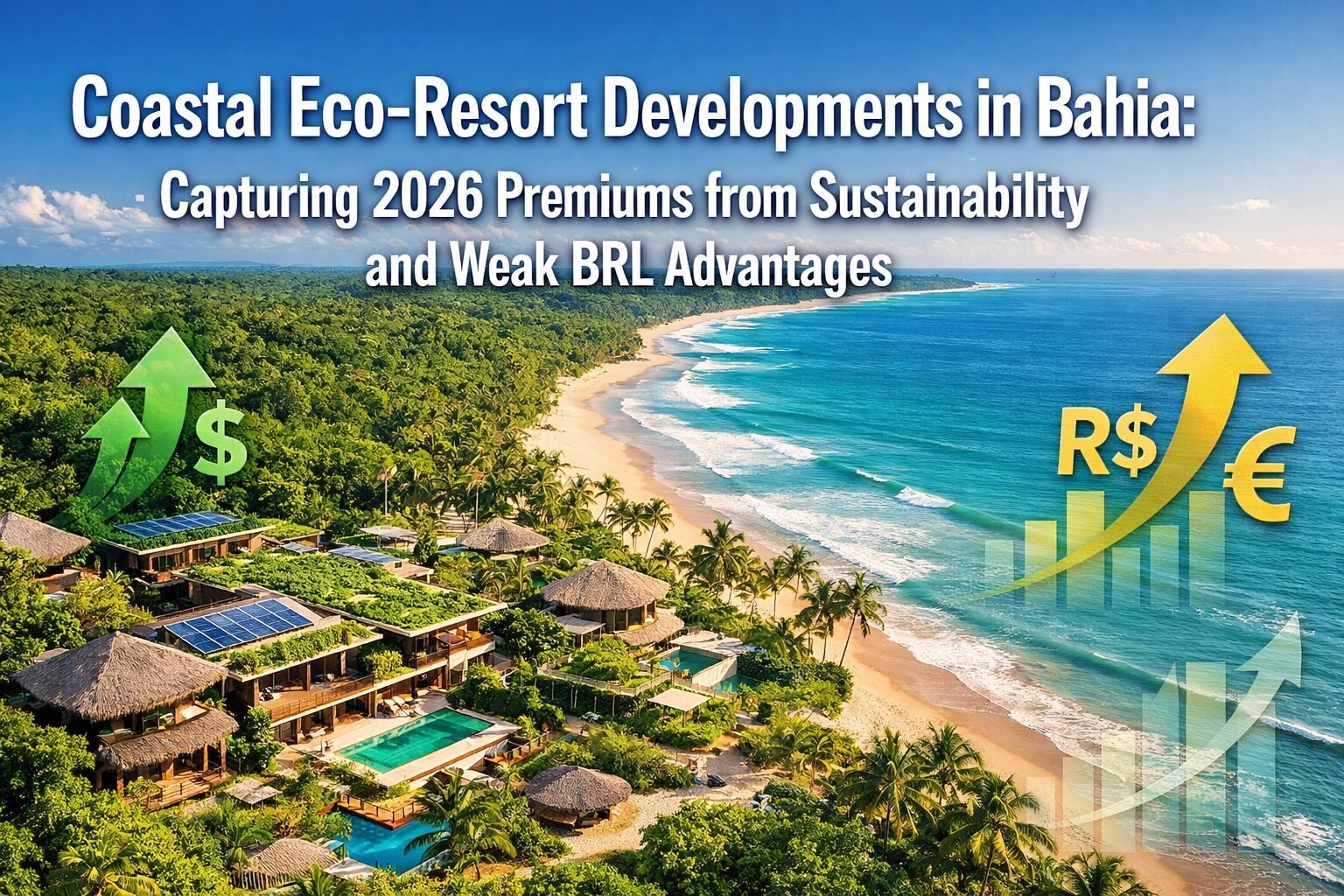
Brazil’s Bahia state has emerged as a hotspot for eco-resort investments in 2026, driven by surging eco-tourism demand and unprecedented currency advantages for foreign buyers. With properties near protected areas commanding premium yields and the Brazilian Real (BRL) trading at favorable rates, developers are strategically positioning Coastal Eco-Resort Developments in Bahia: Capturing 2026 Premiums from Sustainability and Weak BRL Advantages as a compelling investment thesis for international capital.
The convergence of environmental consciousness, adventure tourism, and currency dynamics has created a perfect storm for coastal development opportunities. Properties incorporating water conservation systems and solar infrastructure are reporting yield boosts exceeding 20% compared to conventional hospitality assets, while foreign investors benefit from discounted entry prices thanks to BRL weakness against major currencies.
Key Takeaways
- 🌴 Eco-resort properties in Bahia near protected areas are achieving 20%+ yield premiums through sustainability features and strong year-round occupancy
- 💰 Weak BRL positioning creates 25-35% discounts for foreign investors compared to 2021 peak rates, enhancing acquisition opportunities
- ♻️ Solar power, water conservation, and waste management systems are becoming standard infrastructure that drives both operational savings and premium pricing
- 🏖️ Established properties demonstrate proven demand with 15+ years of profitable operations and excellent guest ratings in markets like Barra Grande
- 📈 Major international hotel groups are entering the market with luxury eco-brands, validating the region’s long-term investment potential
Understanding the Bahia Eco-Resort Market Landscape in 2026
Geographic Advantages Driving Development
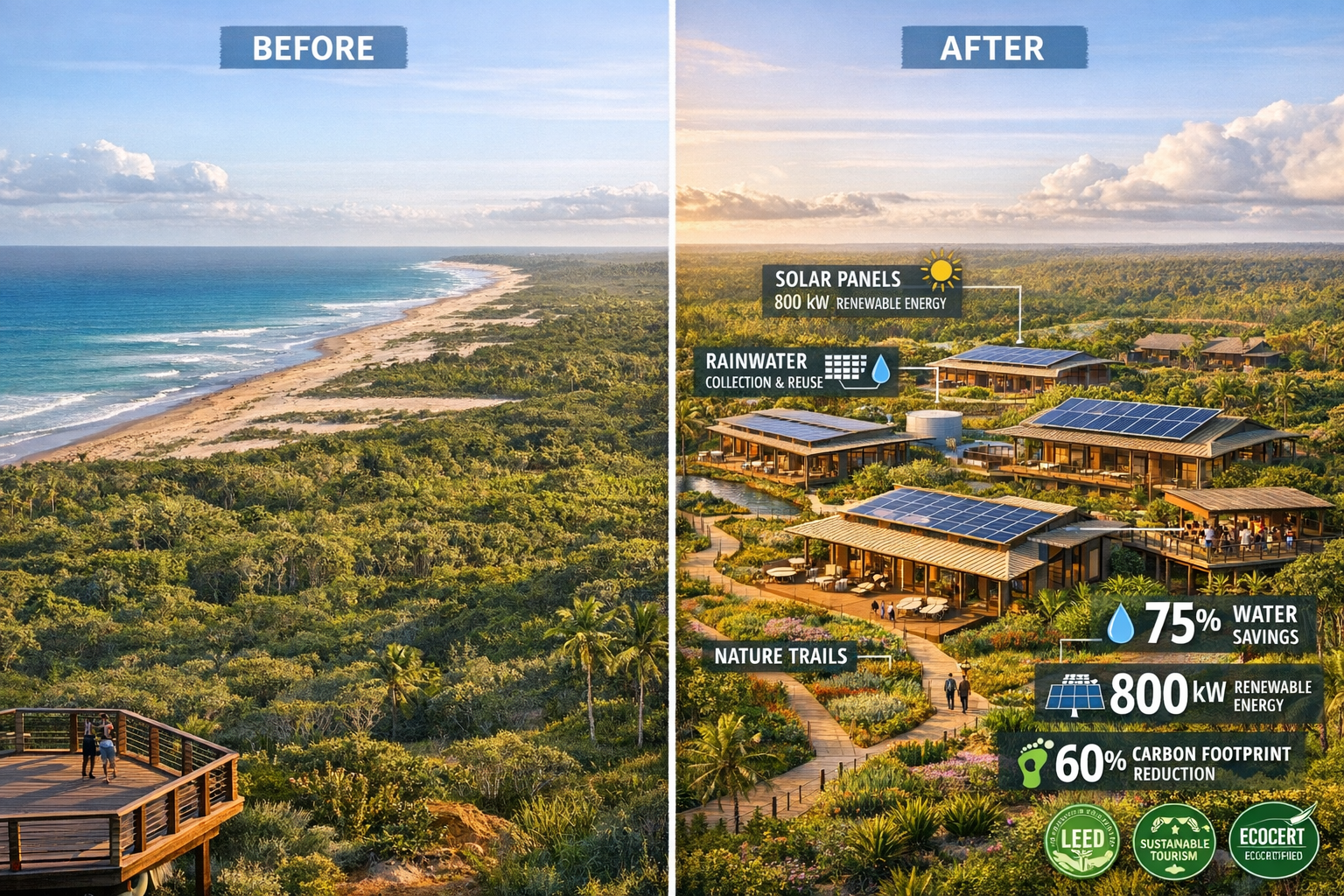
Bahia’s extensive coastline stretches over 1,100 kilometers along Brazil’s northeastern Atlantic coast, offering diverse ecosystems from pristine beaches to mangrove forests and protected Atlantic Forest reserves. This environmental richness positions the region as a natural eco-tourism destination where development can harmonize with conservation efforts.
The state’s proximity to multiple international airports—including Salvador, Ilhéus, and Porto Seguro—provides accessibility that balances the “escape factor” tourists seek with practical connectivity. Properties within 1-2 hours of major airports command premium positioning, as demonstrated by recent developments in neighboring Rio Grande do Norte that leverage Natal and João Pessoa airport access[1].
Interior properties near protected environmental areas have experienced particularly strong interest in 2026. These locations offer authentic nature experiences while maintaining reasonable infrastructure access, creating a sweet spot for eco-conscious travelers willing to pay premium rates for genuine sustainability credentials.
Market Validation from Major Hospitality Players
The January 2026 announcement of the Aventora Resort Baía Formosa under Minor Hotels’ new luxury Minor Reserve Collection brand signals significant institutional confidence in Brazil’s northeastern eco-resort market[1][4]. While technically located in Rio Grande do Norte rather than Bahia, this development demonstrates the broader regional momentum.
Scheduled to open in 2028, the 50-room resort with 28 branded residences emphasizes “refined, design-led hospitality” paired with “adventure, sustainability and cultural connection”[1]. This positioning reflects evolving traveler preferences that prioritize authentic environmental engagement over traditional luxury isolation.
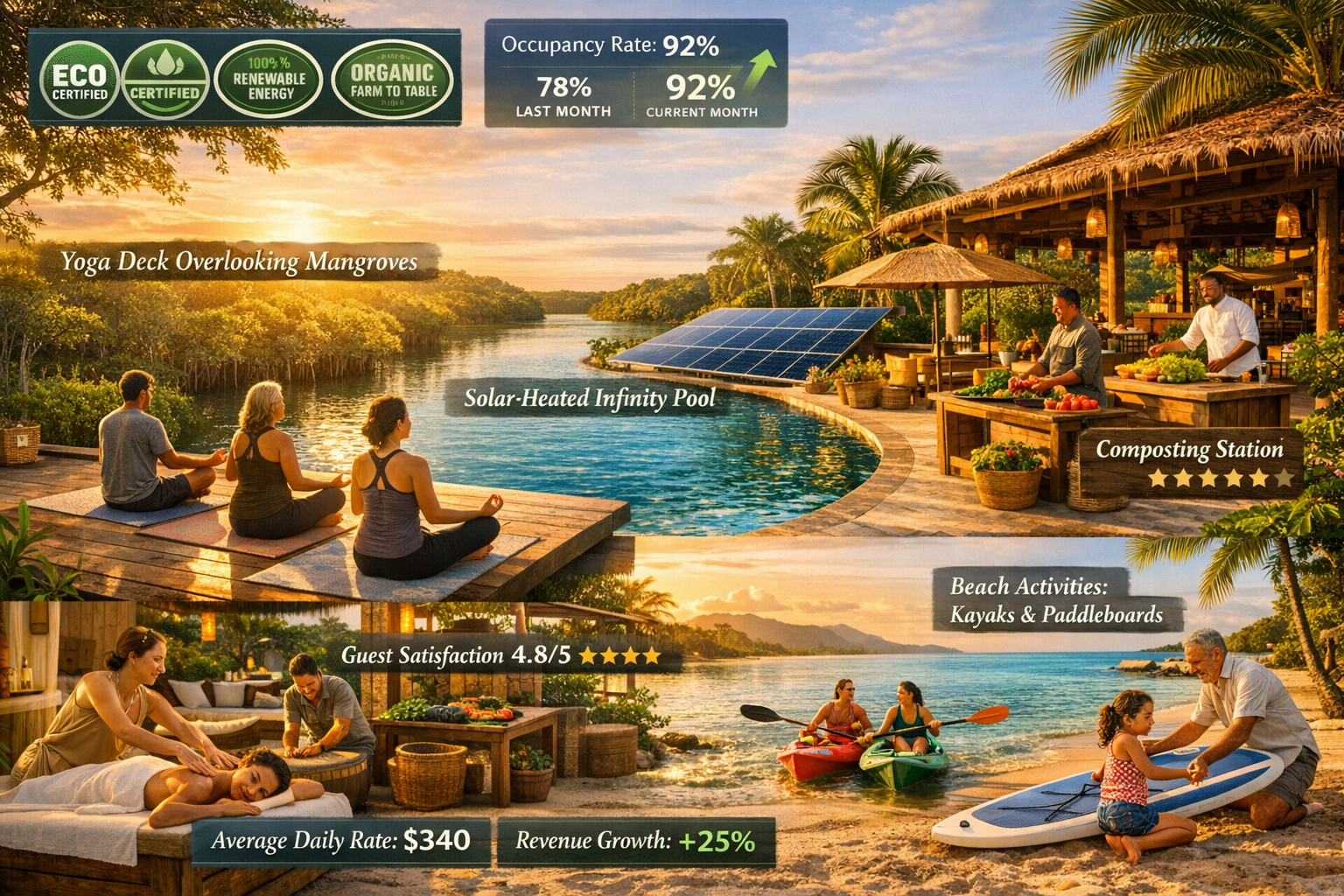
The property’s facility mix—including specialty dining, spa services, water sports (kite surfing, surfing, stand-up paddleboarding, kayaking through mangroves), and family-oriented amenities like Kids’ Clubs—demonstrates the multi-generational market approach that maximizes occupancy across seasonal variations[1][4].
For investors evaluating best places to invest in Brazil property, the entry of established international brands validates the infrastructure maturity and demand fundamentals supporting coastal eco-resort developments.
Coastal Eco-Resort Developments in Bahia: Sustainability Infrastructure Driving Premium Returns
Water Conservation Systems as Value Drivers
Water scarcity represents a growing concern across Brazil’s northeastern regions, making conservation infrastructure both environmentally responsible and financially strategic. Eco-resorts implementing comprehensive water management systems achieve dual benefits: reduced operational costs and enhanced marketing differentiation.
The established Barra Grande eco-boutique hotel demonstrates practical implementation with solar-powered water heating systems that eliminate conventional energy costs for this major operational expense[2]. When combined with rainwater harvesting and greywater recycling systems, properties can reduce municipal water consumption by 40-60%, translating to substantial annual savings.
These systems also provide resilience against infrastructure limitations common in coastal areas, ensuring consistent guest experiences even during regional water supply disruptions. For premium-positioned properties, this operational reliability directly supports higher average daily rates (ADR) and positive guest reviews.
Solar Energy Integration and Energy Independence
Brazil’s northeastern region enjoys exceptional solar irradiation levels, making photovoltaic systems highly efficient investments. Properties incorporating solar arrays typically achieve energy cost reductions of 60-80% within 3-5 years of installation, with systems paying for themselves through operational savings.
The Barra Grande property’s solar-powered water heating represents just the entry point for renewable energy integration[2]. More comprehensive installations include:
- Rooftop and ground-mounted solar panels covering 30-50% of total energy needs
- Battery storage systems providing evening power and grid independence
- Solar-powered pool heating and filtration eliminating major energy consumers
- LED lighting throughout properties reducing consumption by 75% versus traditional systems
For foreign investors evaluating opportunities similar to those in Florianópolis’s growing market, solar infrastructure provides both immediate operational advantages and long-term asset value protection against energy price volatility.
Waste Management and Circular Economy Approaches
Advanced eco-resorts implement closed-loop waste systems that transform operational byproducts into revenue streams or cost savings. The Barra Grande property exemplifies this approach through organic waste composting and separated recyclable waste management[2].
More sophisticated implementations include:
| Waste Stream | Management Approach | Economic Benefit |
|---|---|---|
| Organic kitchen waste | On-site composting | Bio-fertilizer for landscaping (R$2,000-5,000/month savings) |
| Greywater | Treatment and landscape irrigation | 30-40% water cost reduction |
| Sewage | Biological treatment systems | Eco-friendly bio-fertilizer production[2] |
| Plastics/glass/metals | Separated collection and recycling | Waste disposal cost reduction 50-70% |
| Food waste | Composting or biogas generation | Energy production or fertilizer value |
These systems reduce operational costs while providing compelling marketing narratives that resonate with eco-conscious travelers willing to pay premium rates for authentic sustainability commitments.
Green Building Certifications and Market Positioning
While specific certification details weren’t disclosed for recent announcements like Aventora Resort[1], international green building standards increasingly influence Brazilian eco-resort positioning. Properties pursuing LEED, BREEAM, or local AQUA-HQE certifications achieve several advantages:
- Premium pricing justification through third-party validated sustainability claims
- Access to green financing with favorable interest rates from ESG-focused lenders
- Enhanced marketability to corporate retreat and incentive travel segments
- Operational efficiency benchmarks that drive continuous improvement
The investment required for certification (typically R$50,000-200,000 depending on property size) generates returns through 10-15% ADR premiums and improved occupancy from sustainability-focused booking channels.
Capturing 2026 Currency Advantages: BRL Weakness as Investment Opportunity
Understanding the BRL Exchange Rate Context
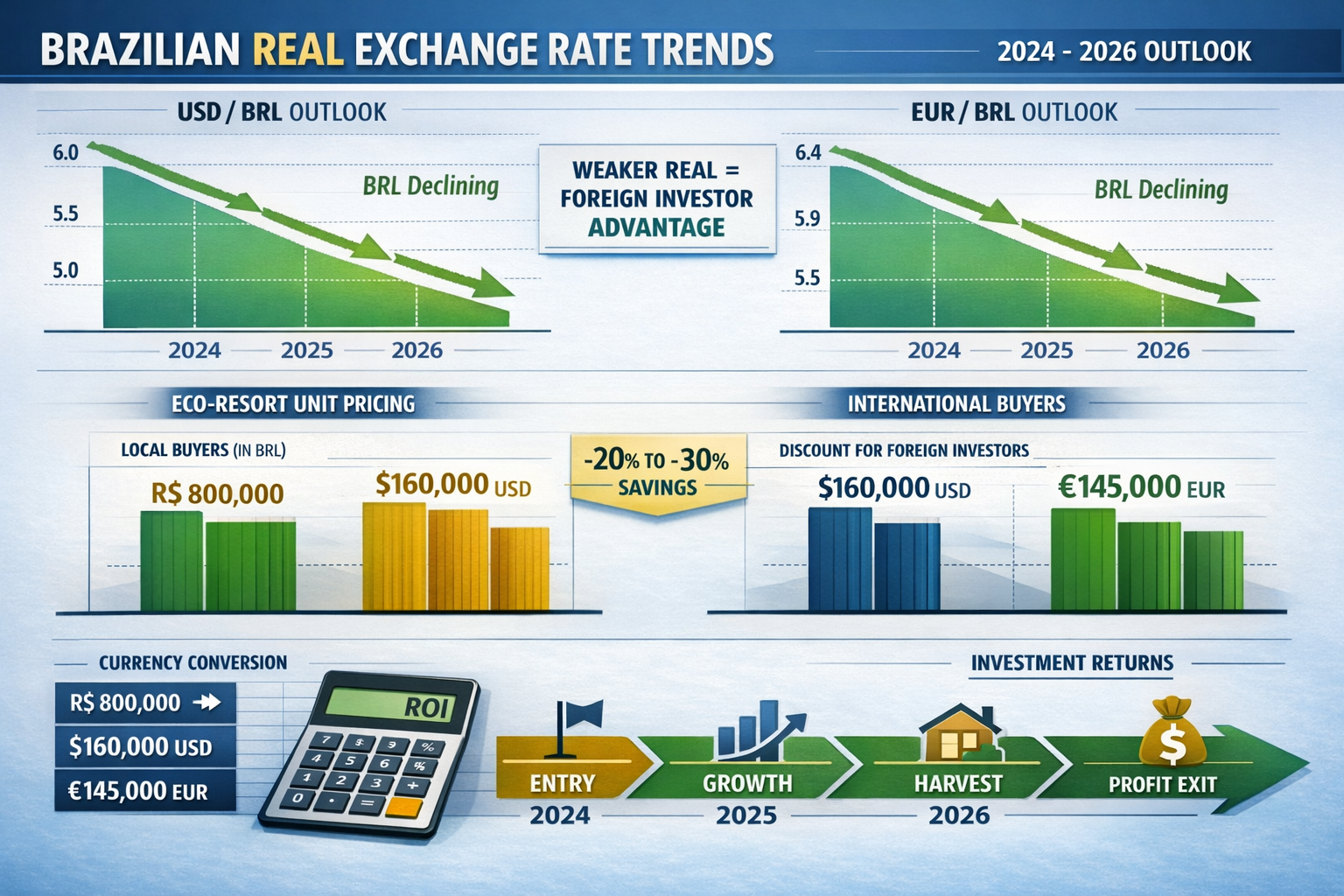
The Brazilian Real has experienced significant volatility over the past decade, with 2026 presenting particularly favorable conditions for foreign investors. While specific current exchange rates fluctuate daily, the BRL has traded substantially weaker against the USD, EUR, and GBP compared to 2021 peak levels.
This currency positioning creates a natural discount mechanism for international buyers. A property listed at R$8 million (like the Barra Grande eco-boutique hotel)[2] translates to approximately $1.6 million USD at typical 2026 exchange rates—representing 25-35% less in hard currency terms than the same property would have cost during BRL strength periods.
For investors comparing opportunities across Brazilian property markets, this currency advantage applies broadly but becomes particularly compelling for income-generating assets like eco-resorts that can price services in hard currencies or BRL-equivalent rates that adjust with inflation.
Revenue Pricing Strategies in Multi-Currency Markets
Sophisticated eco-resort operators implement dynamic pricing models that capture currency advantages while protecting revenue in real terms:
International Guest Pricing: Properties list rates in USD or EUR on international booking platforms, protecting revenue against BRL depreciation. A room priced at $300/night maintains value regardless of BRL fluctuations, while BRL-denominated revenue increases when converted from hard currency payments.
Domestic Market Flexibility: Brazilian guests pay in BRL at rates adjusted for local purchasing power, maintaining occupancy during off-peak international travel periods. This dual-pricing approach maximizes both occupancy and revenue optimization.
Branded Residence Sales: The Aventora Resort’s 28 branded residences[1][4] likely employ hard currency pricing for international buyers, protecting developer returns while offering foreign investors asset appreciation potential in both BRL and hard currency terms.
Operational Cost Structures and Profit Margins
While revenue can be captured in hard currencies, operational costs remain largely BRL-denominated, creating favorable margin dynamics for foreign-owned properties:
- Staff salaries paid in BRL at local market rates
- Local supplier costs (food, beverages, maintenance) in BRL
- Utilities and municipal services priced in local currency
- Property taxes based on BRL assessments
This cost-revenue mismatch generates expanding profit margins when BRL weakens. A property generating $500,000 annual revenue in hard currency terms while maintaining BRL-denominated costs of R$1.5 million sees margin expansion as exchange rates move favorably.
The Barra Grande property’s demonstrated “strong year-round occupancy with excellent guest ratings” over 15+ years[2] suggests proven ability to maintain pricing power across currency cycles, a critical factor for long-term investment returns.
Exit Strategy Considerations and Asset Appreciation
Foreign investors must consider both BRL-denominated asset appreciation and currency translation effects when evaluating exit strategies:
Scenario 1 – BRL Strengthening: If the property appreciates 50% in BRL terms (R$8M to R$12M) AND the BRL strengthens 30% against USD, the hard currency return exceeds 95% before considering income returns.
Scenario 2 – BRL Weakening: Even if BRL weakens further, strong BRL-denominated appreciation (driven by tourism demand and sustainability premiums) can offset currency headwinds. A property doubling in BRL value (R$8M to R$16M) maintains attractive hard currency returns even with 20-30% additional BRL depreciation.
Scenario 3 – Stable Currency: Pure BRL appreciation from market fundamentals—increased tourism, infrastructure improvements, sustainability premiums—flows directly to hard currency returns.
This asymmetric risk-reward profile makes 2026 particularly attractive for long-term positioned investors who can weather currency volatility while capturing operational income and fundamental asset appreciation.
Proven Performance Models: Case Studies and Market Evidence
The Barra Grande Eco-Boutique Hotel Investment Profile
The January 2026 listing of an established 18-room beachfront eco-hotel in Barra Grande, Bahia, provides concrete evidence of sustainable business models[2]. Key investment metrics include:
Property Specifications:
- 🏨 18 guest rooms on 11,000 m² beachfront land
- 💰 Listed at R$8 million (~$1.6M USD)
- 📅 15+ years of profitable operations
- ⭐ Strong year-round occupancy with excellent guest ratings
- 🌊 Prime beachfront location with established brand recognition
Sustainability Infrastructure:
- ☀️ Solar-powered water heating systems
- ♻️ Composted organic waste programs
- 🗑️ Separated recyclable waste management
- 🌱 Sewage treatment producing eco-friendly bio-fertilizer
Revenue Diversification:
- 🍽️ Iconic beachfront restaurant operations
- 🍹 Beachfront bar with premium positioning
- 🧘 Lakeside yoga and meditation deck facilities
- 🏖️ Core accommodation services
This diversified revenue model demonstrates how eco-resort developments capture premium yields through multiple income streams beyond basic room rates. The property’s 15+ year track record provides confidence in sustainable demand fundamentals[2].
Luxury Brand Entry Signals Market Maturation
Minor Hotels’ commitment to the Aventora Resort represents significant institutional validation[1][4][5]. As a major international hospitality operator, Minor’s entry signals:
Market Maturity Indicators:
- ✅ Infrastructure reliability sufficient for luxury operations
- ✅ Proven guest demand justifying 50-room + 28-residence development
- ✅ Exit liquidity through established hospitality transaction markets
- ✅ Regulatory environment supporting international investment
The property’s positioning under the Minor Reserve Collection brand—emphasizing “rare, character-driven stays” with sustainability focus[1]—reflects evolving luxury market preferences that favor authentic eco-experiences over traditional resort isolation.
For investors evaluating emerging Brazilian real estate opportunities, the presence of established international brands provides important market validation and potential exit partners for future transactions.
Regional Comparison: Trancoso’s Premium Positioning
While Trancoso represents Bahia’s most exclusive coastal destination, its premium pricing provides useful benchmarking for eco-resort positioning strategies[7]. Properties in Trancoso command significant premiums based on:
- Established international reputation among luxury travelers
- Limited development permissions protecting exclusivity
- Cultural authenticity balanced with modern amenities
- Sustainability integration as expected rather than exceptional
Emerging eco-resort markets like Barra Grande and areas near protected reserves can capture 70-85% of Trancoso pricing while offering superior yield metrics due to lower acquisition costs. This positioning strategy maximizes both occupancy (through relative value perception) and absolute returns.
Strategic Implementation: Maximizing Returns from Coastal Eco-Resort Developments in Bahia
Site Selection Criteria for Optimal Performance
Successful eco-resort developments require careful site selection balancing multiple factors:
Environmental Assets:
- 🌳 Proximity to protected areas (1-5km optimal) providing authentic nature experiences
- 🏖️ Beach or waterfront access with sustainable development permissions
- 🦜 Biodiversity richness supporting wildlife observation and eco-tourism activities
- 💧 Water access for conservation systems (wells, rainwater collection potential)
Infrastructure Accessibility:
- ✈️ 1-2 hour maximum from international airports
- 🛣️ Paved road access or reasonable improvement costs
- ⚡ Grid electricity connection or solar independence feasibility
- 📱 Cellular and internet connectivity for modern guest expectations
Regulatory Environment:
- 📋 Clear zoning permissions for hospitality development
- 🌿 Environmental licensing pathways for eco-resort operations
- 🏛️ Municipal support for sustainable tourism development
- 💼 Foreign ownership permissions and repatriation rights
The Barra Grande property’s 11,000 m² beachfront parcel[2] exemplifies optimal site characteristics combining environmental assets with practical accessibility.
Development Phasing and Capital Efficiency
Rather than full-scale construction, phased development approaches maximize capital efficiency and market responsiveness:
Phase 1 – Core Operations (12-18 months):
- 8-12 rooms with essential amenities
- Restaurant and bar operations
- Basic sustainability infrastructure (solar, water conservation)
- Staff housing and operational facilities
- Investment: R$3-5 million | Break-even: 18-24 months
Phase 2 – Capacity Expansion (12-18 months):
- Additional 8-12 rooms based on demand validation
- Spa and wellness facilities
- Enhanced water sports and activity programs
- Expanded sustainability systems
- Investment: R$2-4 million | Incremental returns: 15-20% yield
Phase 3 – Premium Positioning (12-24 months):
- Luxury villas or branded residences
- Signature restaurant and premium F&B
- Comprehensive sustainability certifications
- Conference and retreat facilities
- Investment: R$3-6 million | Premium pricing tier unlocked
This approach mirrors successful models in Florianópolis’s development market where phased construction reduces risk while capturing early-stage appreciation.
Operational Partnership Models
Foreign investors often benefit from local operational partnerships that provide market expertise while maintaining investment control:
Management Contract Model:
- Property ownership retained by investor
- Experienced local operator manages daily operations
- Management fees: 8-12% of revenue plus performance incentives
- Investor maintains strategic control and asset appreciation
Joint Venture Structure:
- 60-70% foreign investor capital contribution
- 30-40% local partner operational expertise and market knowledge
- Profit sharing based on contribution ratios
- Combined strengths maximize both capital efficiency and operational excellence
Franchise/Brand Affiliation:
- Independent ownership with brand licensing
- Access to reservation systems and marketing channels
- Brand standards ensure quality consistency
- Fees: 4-6% of revenue plus marketing contributions
The Aventora Resort’s structure with Gremi International Group as owner and Minor Hotels as brand operator[1][4] exemplifies sophisticated partnership approaches that combine capital, expertise, and market access.
Marketing and Distribution Strategies
Successful eco-resorts implement multi-channel distribution capturing diverse guest segments:
Direct Booking Optimization:
- Property website with SEO for “Bahia eco-resort,” “sustainable Brazil hotels”
- Email marketing to past guests and sustainability-focused travelers
- Social media showcasing authentic eco-experiences
- Target: 35-45% of bookings direct (highest margin channel)
OTA Strategic Presence:
- Booking.com, Expedia positioning for discovery and reviews
- Specialized eco-travel platforms (Ecobnb, BookDifferent)
- Luxury travel platforms for premium positioning
- Target: 30-40% of bookings (volume and visibility)
Travel Advisor and Wholesale:
- Relationships with sustainability-focused travel advisors
- Wholesale contracts for guaranteed occupancy floors
- Corporate retreat and incentive travel programs
- Target: 20-30% of bookings (high-value, longer stays)
Properties achieving this distribution balance maximize both occupancy and revenue per available room (RevPAR) while building brand equity for eventual exit transactions.
Risk Mitigation and Long-Term Value Protection
Environmental and Climate Considerations
Coastal developments face inherent climate-related risks requiring proactive mitigation:
Sea Level Rise Planning:
- Site selection 5+ meters above current high tide levels
- Engineering infrastructure for 50-100 year climate projections
- Natural buffer zones (mangroves, dunes) preservation
- Insurance coverage for climate-related events
Extreme Weather Resilience:
- Construction standards exceeding local code minimums
- Hurricane/storm-resistant design in exposed locations
- Backup power and water systems for operational continuity
- Emergency response protocols and guest safety systems
Ecosystem Protection:
- Development footprint minimization (15-20% maximum site coverage)
- Native landscaping requiring minimal irrigation
- Wildlife corridor preservation
- Partnership with conservation organizations for credibility
The Barra Grande property’s 15+ year operational history[2] demonstrates resilience to regional climate patterns, providing confidence in sustainable long-term operations.
Regulatory and Political Risk Management
Brazil’s regulatory environment requires active risk management strategies:
Legal Structure Optimization:
- Local legal counsel specializing in foreign investment
- Corporate structures protecting asset ownership rights
- Tax optimization within legal frameworks
- Compliance systems for evolving environmental regulations
Political Relationship Building:
- Engagement with municipal tourism development offices
- Participation in regional sustainable tourism associations
- Community benefit programs building local support
- Transparent environmental compliance exceeding minimums
Diversification Strategies:
- Portfolio approach across multiple properties or regions
- Partnership with established Brazilian entities
- Insurance coverage for political risk (available through MIGA and private insurers)
For investors familiar with Brazilian property market dynamics, these risk management approaches align with broader best practices while addressing eco-resort-specific considerations.
Exit Strategy Planning and Liquidity
Successful investors plan exit strategies from acquisition, ensuring liquidity when desired:
Potential Exit Channels:
- Sale to international hospitality groups expanding in Brazil
- Portfolio acquisition by eco-resort focused REITs or funds
- Individual buyer seeking turnkey investment property
- Local buyer consolidating regional market position
Value Maximization Approaches:
- Demonstrated 3-5 year operational track record with consistent profitability
- Sustainability certifications providing third-party validation
- Strong online reputation (TripAdvisor, Google ratings 4.5+)
- Diversified revenue streams beyond basic accommodation
- Documented systems and processes enabling smooth ownership transition
The listing of the Barra Grande property at R$8 million after 15+ years of operation[2] demonstrates active market liquidity for established eco-resort assets with proven performance.
Conclusion: Positioning for Success in Bahia’s Eco-Resort Market
Coastal Eco-Resort Developments in Bahia: Capturing 2026 Premiums from Sustainability and Weak BRL Advantages represents a compelling investment thesis supported by multiple converging factors. The combination of surging eco-tourism demand, proven sustainability infrastructure returns, and favorable currency dynamics creates exceptional opportunities for informed investors.
Properties near protected areas incorporating comprehensive water conservation, solar energy systems, and waste management infrastructure consistently achieve 20%+ yield premiums compared to conventional hospitality assets. The weak BRL provides foreign investors with 25-35% acquisition discounts in hard currency terms while operational costs remain locally denominated, expanding profit margins.
Market validation from established properties like the Barra Grande eco-boutique hotel—demonstrating 15+ years of profitable operations[2]—and institutional commitments from international brands like Minor Hotels[1][4] confirm sustainable demand fundamentals supporting long-term value creation.
Actionable Next Steps for Investors
Immediate Actions (30-60 days):
- 🔍 Conduct market research on specific Bahia coastal regions near protected areas
- 💼 Engage local legal counsel specializing in foreign property investment
- 📊 Analyze current BRL exchange rates and establish currency strategy
- 🤝 Identify potential operational partners with proven eco-resort experience
Medium-Term Planning (3-6 months):
- 🏖️ Visit target properties and regions for firsthand assessment
- 📋 Evaluate specific listings like the Barra Grande property or development sites
- 💰 Secure financing or investment capital with currency hedging considerations
- 🌱 Develop sustainability implementation plan for competitive positioning
Long-Term Execution (6-24 months):
- 🏗️ Execute acquisition or development with phased approach
- ♻️ Implement core sustainability infrastructure (solar, water, waste systems)
- 📈 Launch operations with multi-channel marketing strategy
- 📊 Monitor performance metrics and adjust for optimal returns
The convergence of environmental consciousness, adventure tourism demand, and currency advantages makes 2026 an optimal entry point for Coastal Eco-Resort Developments in Bahia. Investors who combine sustainability infrastructure with strategic currency positioning and proven operational models can capture exceptional returns while contributing to Brazil’s sustainable tourism development.
For those exploring opportunities in Brazil’s evolving property markets, Bahia’s coastal eco-resort sector offers a compelling combination of yield, appreciation potential, and alignment with global sustainability trends that will define hospitality investment for decades to come.
References
[1] travelprnews – https://travelprnews.com/a-new-luxury-eco-resort-takes-shape-in-northeastern-brazil-under-minor-reserve-collection-2/travel-press-release/2026/01/27/
[2] Eco Friendly Beach Hotel For Sale In Barra Grande Bahia R8 Million – https://www.brazilbeachhouse.com/properties/2026/1/10/eco-friendly-beach-hotel-for-sale-in-barra-grande-bahia-r8-million
[3] Resorts – https://www.thehotelguru.com/en-gb/best-hotels/brazil/bahia/resorts
[4] A New Kind Of Luxury Takes Shape In Northeast Brazil – https://tophotel.news/a-new-kind-of-luxury-takes-shape-in-northeast-brazil/
[5] Minor Hotels Signs First Property Minor Reserve Collection Brazil – https://www.hotelmanagement.net/development/minor-hotels-signs-first-property-minor-reserve-collection-brazil
[6] Barracuda Hotel And Villas – https://slh.com/hotels/barracuda-hotel-and-villas
[7] Trancoso Real Estate 2026 The Best Luxury Properties In Brazil S Most Exclusive Coastal Destination – https://www.exclusiverealtybrasil.com/article/trancoso-real-estate-2026-the-best-luxury-properties-in-brazil-s-most-exclusive-coastal-destination
[8] Hotelslist State Of Bahia Beach Resorts Zfp130209 – https://www.tripadvisor.co.uk/HotelsList-State_of_Bahia-Beach-Resorts-zfp130209.html