
Brazil’s urban landscape is undergoing a profound transformation. As 2026 unfolds, Compact Urban Apartments in Brazil: Meeting 2026 Demand from Single-Person Households and Migration Waves has become the defining narrative of the nation’s real estate sector. Amid an 8-million-unit housing deficit, soaring interest rates reaching 15%, and fundamental demographic shifts, compact apartments—studios and one-bedroom units under 35 square meters—are emerging as the solution to Brazil’s urban housing challenge. Young professionals, divorced adults, and waves of domestic and international migrants are reshaping demand patterns, while developers respond with high-density projects designed to deliver stable rental yields in transit-accessible corridors of São Paulo, Rio de Janeiro, Salvador, and coastal metros like Florianópolis.
This seismic shift isn’t merely about building smaller units. It represents a complete reimagining of urban living, investment strategies, and city planning frameworks that will define Brazil’s metropolitan future for decades to come.
Key Takeaways
- One-bedroom apartments led Brazil’s price appreciation with a remarkable 9.44% surge over the past 12 months, outpacing all other property formats[3]
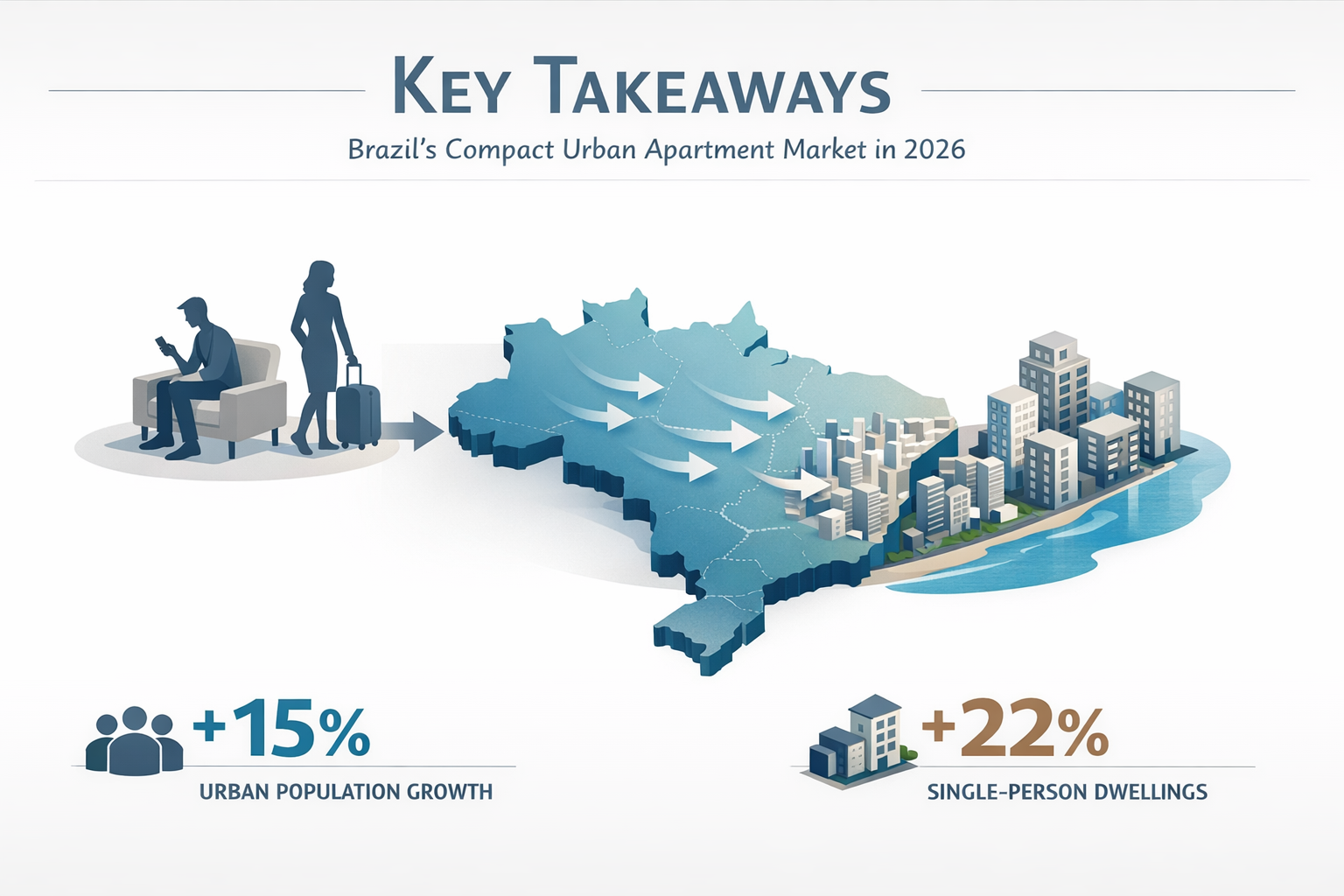
- Single-person households and migration waves are driving unprecedented demand for compact units in coastal cities and established capitals, fundamentally reshaping urban demographics
- Five-year investment returns of 60-90% are projected for compact apartments in transit-accessible locations when combining rental income and price appreciation[2]
- Historic supply expansion saw housing under 30 m² multiply by 35 times between 2016 and 2022 in São Paulo, reflecting massive market transformation[1]
- Interest rate headwinds at 15% Selic are pushing buyers toward more affordable compact formats, creating sustained demand despite financing constraints[2]
The Demographic Revolution Reshaping Brazilian Cities
Single-Person Households: The New Urban Majority
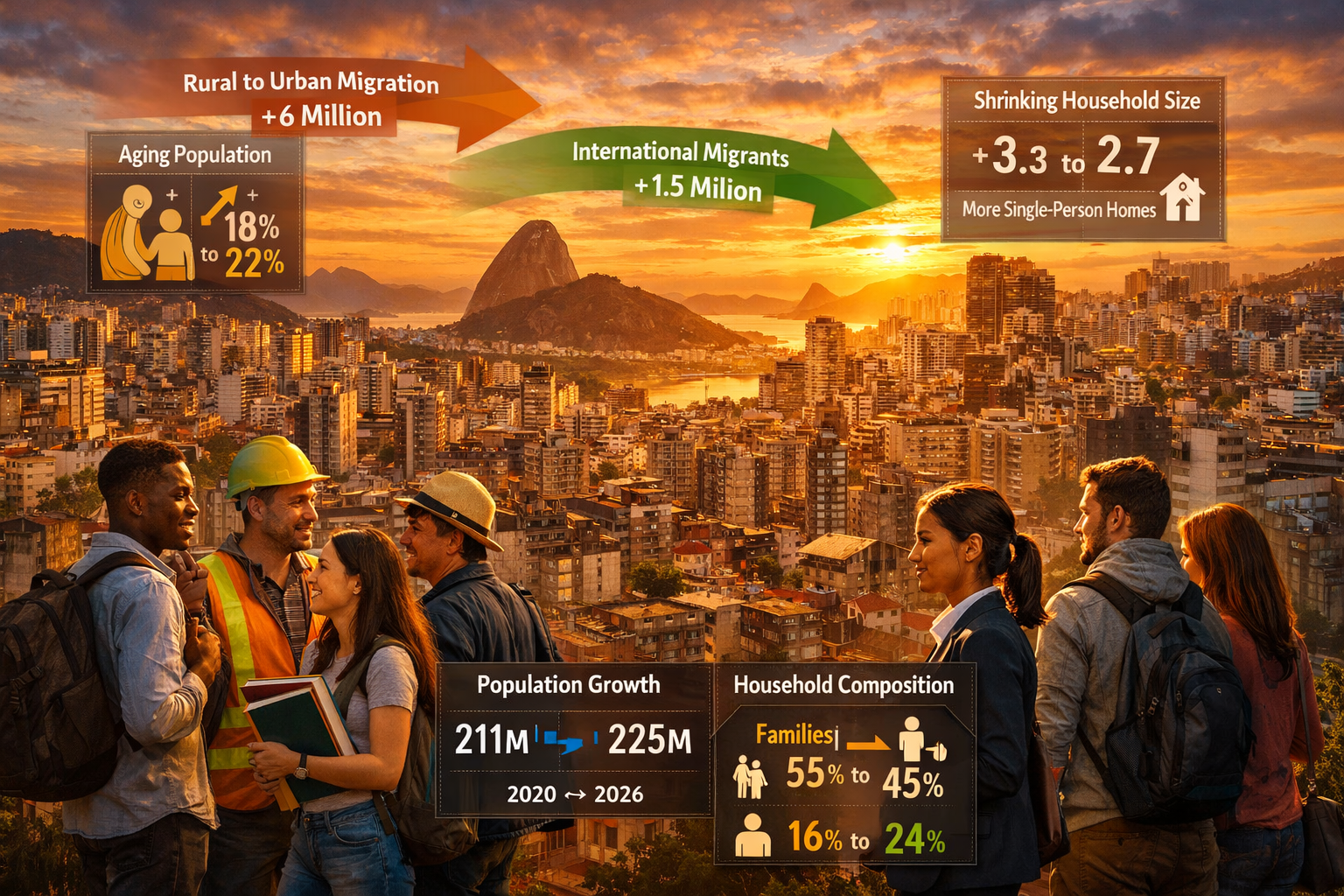
Brazil’s household composition is experiencing a fundamental transformation that directly impacts housing demand. The continued growth of single-person and small households represents one of the most significant demographic shifts in modern Brazilian history[2]. Young professionals entering the workforce, divorced adults re-entering the housing market, and elderly individuals choosing independent living are all contributing to this trend.
In major metropolitan areas like São Paulo, Rio de Janeiro, and Brasília, the traditional multi-generational household model is giving way to solo living arrangements. This shift creates natural demand for compact urban apartments that offer:
✅ Affordability for single-income budgets
✅ Location convenience near employment centers
✅ Lower maintenance requirements
✅ Access to urban amenities without suburban isolation
The impact on the real estate market has been dramatic. Apartments and condominiums now hold 77.17% of 2025 activity in the Brazilian residential market, consolidating their role as the standard format in dense corridors[4]. This dominance reflects not just preference, but necessity—compact apartments are the only viable entry point for first-time buyers and single professionals facing Brazil’s challenging affordability landscape.
Migration Patterns Concentrating Demand in Coastal Metros
Domestic migration from smaller towns to major metropolitan areas continues to accelerate in 2026. Economic opportunities, educational institutions, and cultural amenities draw Brazilians from the interior toward established capitals and coastal cities. This internal movement creates concentrated housing demand in specific corridors where infrastructure and employment density support urban lifestyles.
International migration adds another layer to this phenomenon. Brazil’s relatively weak currency has made the country attractive for digital nomads, retirees from neighboring countries, and professionals seeking opportunities in Latin America’s largest economy. These arrivals naturally gravitate toward coastal cities with international connectivity, further supporting values in markets like Florianópolis, where infrastructure development and quality of life continue to attract new residents.
The migration pattern concentration is particularly visible in:
- Salvador and João Pessoa: Leading Brazil’s price growth with increases above 20%, far outpacing São Paulo and Rio de Janeiro[2]
- Florianópolis: Experiencing sustained demand from quality-of-life migrants and remote workers
- Brasília: Attracting government workers and young professionals seeking career opportunities
- Recife and Fortaleza: Benefiting from Northeast economic development and tourism infrastructure
These migration waves create sustained rental demand, making compact apartments particularly attractive for investors seeking stable cash flow from transient populations who prefer flexibility over ownership.
Compact Urban Apartments in Brazil: Meeting 2026 Demand Through Developer Innovation
High-Density Project Blueprints for Transit Corridors
Developers across Brazil have responded to demographic shifts with innovative high-density projects specifically designed for transit-oriented locations. The framework for this transformation was established through zoning revisions in São Paulo that expanded transit-oriented densification zones around metro and high-capacity bus corridors[4]. These regulatory changes encouraged launches of compact units and translated into stronger sales velocity throughout 2025.
The typical blueprint for these projects includes:
| Project Element | Design Specification | Market Rationale |
|---|---|---|
| Unit Size | 25-35 m² studios and one-bedrooms | Maximizes affordability while maintaining livability |
| Location | Within 500m of metro/BRT stations | Reduces car dependency, appeals to young professionals |
| Amenities | Shared coworking spaces, fitness centers, rooftop gardens | Compensates for smaller private space with quality common areas |
| Technology | Smart home integration, app-based building management | Appeals to tech-savvy demographic |
| Sustainability | Green building certification, energy efficiency | Reduces operating costs, attracts ESG-conscious buyers |
This approach has proven particularly successful in São Paulo, where the supply of housing under 30 m² multiplied by 35 between 2016 and 2022[1]. This historic expansion reflects not just developer opportunism, but a fundamental market response to affordability constraints and changing lifestyle preferences.
Investing in studios in Florianópolis offers similar advantages from an incorporation perspective, with developers focusing on efficient layouts that maximize rental appeal while controlling construction costs.
Absorption Rates Signal Sustained Market Confidence
Market performance data from 2025 demonstrates healthy absorption for well-located compact units. Compact studios and two-bedroom units sized for transit access saw healthy absorption in mid-2025, signaling sustained preference for location and price alignment[4]. This absorption pattern indicates that developers have successfully calibrated product offerings to match buyer capacity and preferences.
The velocity advantage of compact apartments stems from several factors:
🏃 Lower price points bring more buyers into qualification range
🏃 Investor appeal from superior rental yields attracts capital
🏃 Faster decision cycles as buyers face less financial complexity
🏃 Reduced inventory risk for developers due to broader buyer pool
For investors considering the best places to invest in Brazil property, compact apartments in transit corridors offer a compelling combination of appreciation potential and rental income stability.
Investment Performance: Compact Urban Apartments in Brazil Delivering Superior Returns
Price Appreciation Leadership Across Market Segments
The financial performance of compact apartments has exceeded broader market trends across multiple metrics. One-bedroom properties surged 9.44% in price over the past 12 months according to the FipeZAP Index[3], establishing this segment as the clear leader in appreciation. Meanwhile, compact apartments overall are appreciating at approximately 8-10% annually, outpacing larger formats by 2-3 percentage points[2].
This appreciation premium reflects fundamental supply-demand dynamics:
Demand Drivers:
- Growing single-person household formation
- Migration concentration in urban centers
- First-time buyer affordability constraints
- Investor preference for liquid, high-yield assets
Supply Constraints:
- Limited land availability in prime transit corridors
- Zoning restrictions in established neighborhoods
- Construction cost inflation favoring efficient formats
- Developer focus on projects with fastest absorption
The combination creates pricing power for well-located compact units that larger apartments cannot match. In secondary cities experiencing rapid growth, the appreciation advantage becomes even more pronounced. Salvador and João Pessoa’s price increases above 20%[2] demonstrate how migration-driven demand in emerging markets can generate exceptional returns for early investors.
Rental Yield Outperformance and Cash Flow Stability
Beyond price appreciation, compact apartments deliver superior rental yields that enhance total investment returns. Studios and one-bedroom units tend to outperform larger properties in yield due to lower entry costs and higher rental liquidity, capturing strong rental demand from young professionals and students[1].
The rental yield advantage stems from several structural factors:
💰 Higher rent-to-price ratios: Smaller units command proportionally higher monthly rents relative to purchase price
💰 Broader tenant pool: More renters can afford studios than three-bedroom apartments
💰 Lower vacancy risk: Faster re-leasing due to larger qualified tenant population
💰 Reduced turnover costs: Smaller spaces require less maintenance and cleaning between tenants
For investors, this translates to more predictable cash flow and faster capital recovery. When combined with appreciation, compact apartments combining price appreciation and rental income are projected to deliver 60-90% total returns over five years when purchased at fair value in transit-accessible locations[2].
Understanding how performance in sales is transforming the market provides additional context for why developers and investors are increasingly focused on compact formats in high-demand corridors.
The Interest Rate Headwind Creating Opportunity
Brazil’s Selic interest rate stands at 15% in January 2026, the highest level since 2006[2]. This elevated rate environment creates significant headwinds for mortgage financing, constraining buyer budgets and reducing qualification capacity across all income segments.
However, this challenge simultaneously creates opportunity for compact apartment investors:
- Affordability becomes paramount: Buyers priced out of larger units shift demand to compact formats
- Rental demand strengthens: High mortgage rates push potential buyers into rental market longer
- Competition decreases: Fewer investors can afford larger properties, reducing competition for compact units
- Yield spreads widen: Rental yields become more attractive relative to fixed-income alternatives
The period of lower interest rates from 2018-2021 stimulated developer investment in compact formats and accelerated production of micro-units[1][2]. While current elevated rates constrain financing growth, they also ensure that supply expansion remains measured, preventing the oversupply that could undermine pricing power.
Investors who can access capital or purchase without heavy leverage are positioned to capture exceptional value during this high-rate environment, particularly in markets where property purchased at fair value during construction can deliver appreciation before completion.
Regional Market Dynamics: Where Compact Urban Apartments in Brazil Are Thriving
São Paulo: The Compact Apartment Laboratory
São Paulo represents the epicenter of Brazil’s compact apartment revolution. The city’s 35-fold multiplication of housing under 30 m² between 2016 and 2022[1] demonstrates the scale of transformation in Latin America’s largest metropolitan area.
Several factors make São Paulo the ideal testing ground for compact urban living:
🏙️ Transit Infrastructure: Extensive metro and bus rapid transit networks support car-free lifestyles
🏙️ Employment Density: Concentrated job opportunities in finance, technology, and professional services
🏙️ Cultural Amenities: Restaurants, theaters, museums, and nightlife within walking distance
🏙️ Educational Institutions: Major universities attracting student renters
The city’s zoning framework actively encourages densification near transit stations, creating a regulatory environment favorable to compact apartment development. Developers have responded with increasingly sophisticated projects that maximize space efficiency while delivering amenities that compensate for smaller private areas.
Coastal Cities: Salvador, João Pessoa, and Florianópolis Lead Growth
While São Paulo pioneered the compact apartment model, coastal cities are now experiencing the most dramatic growth. Salvador and João Pessoa are leading Brazil’s price growth with increases above 20%[2], driven by migration, tourism development, and quality-of-life appeal.
Florianópolis deserves particular attention as a case study in balanced growth. The city combines:
- Natural beauty and beach access attracting lifestyle migrants
- Technology sector growth creating high-income professional demand
- Infrastructure investment improving connectivity and urban services
- Development pipeline delivering quality compact units in strategic locations
The real estate market in Greater Florianópolis demonstrates how secondary cities can outperform established metros when demographic trends align with quality development.
Brasília and Secondary Capitals: Government and Services Drive Demand
Brazil’s capital and secondary state capitals present unique demand drivers for compact apartments. Government employment, universities, and service sector concentration create steady rental demand from professionals on fixed-term assignments and students.
These markets offer:
✓ Stable employment base less vulnerable to economic cycles
✓ Predictable rental demand from government workers and students
✓ Lower price volatility compared to coastal markets
✓ Development opportunity as compact formats remain undersupplied
For conservative investors seeking steady cash flow over speculative appreciation, these markets provide compelling risk-adjusted returns.
Design Innovation: Maximizing Livability in Compact Formats
Space Efficiency and Multifunctional Design
The success of compact apartments depends on design innovation that maximizes livability within constrained square meters. Brazilian developers and architects have embraced international best practices while adapting them to local preferences and climate conditions.
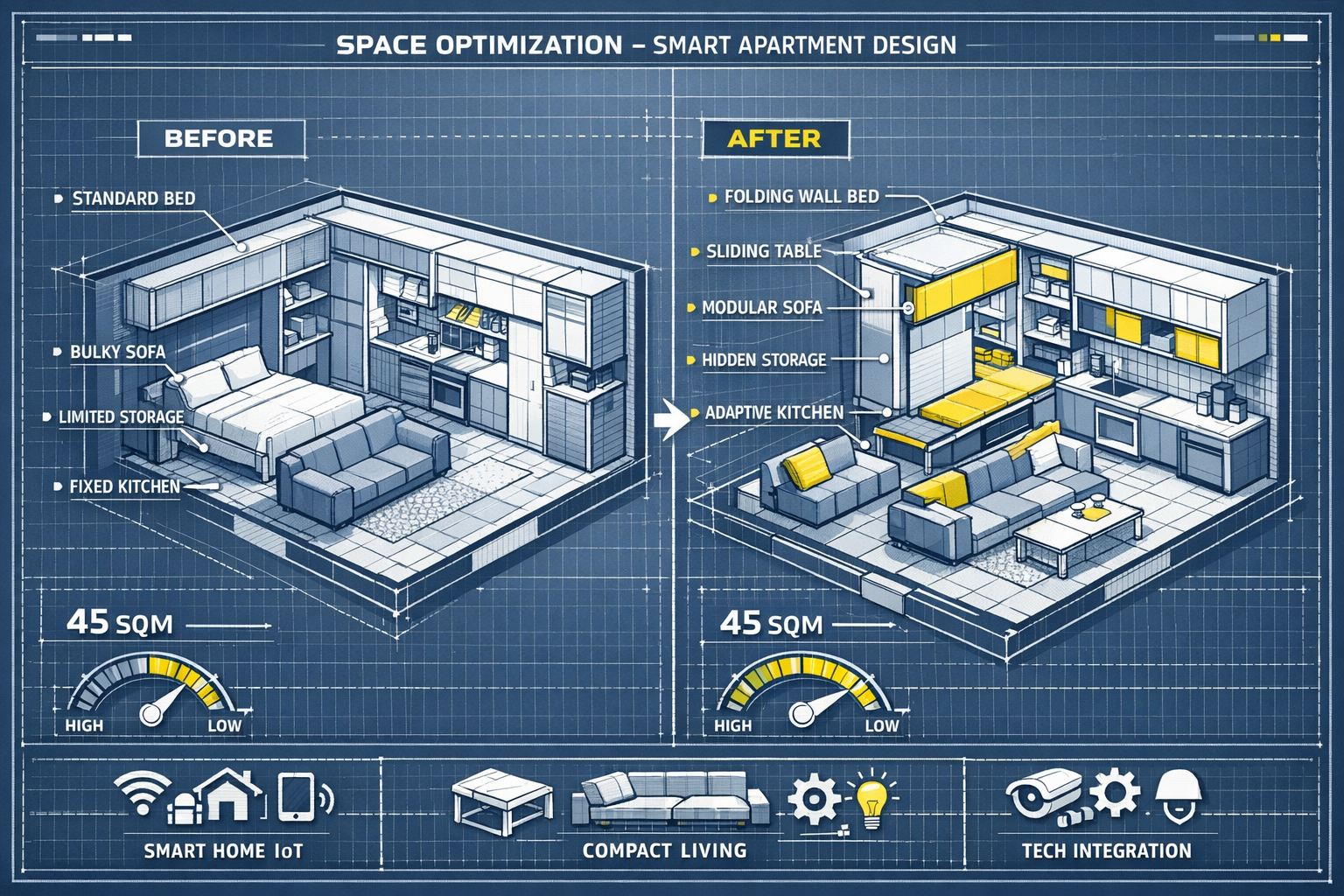
Key design strategies include:
Flexible Layouts:
- Murphy beds that fold into walls, converting bedrooms to living spaces
- Sliding partitions creating temporary privacy zones
- Convertible furniture serving multiple functions
Vertical Space Utilization:
- Lofted sleeping areas in units with higher ceilings
- Wall-mounted storage maximizing floor space
- Overhead cabinets and shelving systems
Natural Light and Ventilation:
- Large windows creating visual spaciousness
- Cross-ventilation reducing air conditioning dependence
- Light color palettes enhancing brightness
Integrated Technology:
- Smart home systems controlling lighting, climate, and security
- Space-saving appliances and fixtures
- Wireless connectivity eliminating cable clutter
These innovations transform potentially cramped spaces into comfortable, functional homes that appeal to quality-conscious renters and buyers.
Shared Amenities Compensating for Private Space
Modern compact apartment projects recognize that smaller private areas require exceptional common spaces. Developers are investing in amenities that would be impractical for individual unit owners:
🏊 Rooftop pools and sun decks providing recreation without private balconies
🏋️ Fitness centers and yoga studios eliminating gym membership costs
💼 Coworking spaces and meeting rooms supporting remote work
🍳 Shared kitchens and dining areas enabling entertaining beyond unit capacity
🌳 Gardens and green spaces offering nature access in dense urban settings
This amenity-rich approach shifts the value proposition from private square meters to lifestyle access, appealing particularly to younger buyers who prioritize experiences over space.
Financing Strategies in the High-Rate Environment
Creative Financing Solutions for Buyers
The 15% Selic rate environment[2] demands creative financing approaches for buyers seeking to enter the compact apartment market. Traditional 30-year mortgages carry prohibitive monthly payments, requiring alternative strategies:
Developer financing with lower rates and flexible terms
Larger down payments reducing financed amounts and monthly obligations
Shorter loan terms minimizing total interest paid
Family co-signers improving qualification capacity
Cryptocurrency payments for international buyers (see cryptocurrency and real estate development)
For investors, the high-rate environment creates opportunities to negotiate favorable terms with motivated sellers or developers seeking to maintain sales velocity.
Investment Structures Maximizing Returns
Sophisticated investors are employing various structures to optimize returns in the compact apartment segment:
Buy-to-Rent Strategy:
- Purchase units for immediate rental income
- Target 60-90% total returns over five years[2]
- Focus on transit-accessible locations with stable tenant demand
Pre-Construction Purchase:
- Lock in prices before appreciation during construction
- Negotiate extended payment terms during development
- Capture appreciation before taking possession
Portfolio Diversification:
- Spread capital across multiple compact units rather than single larger property
- Reduce vacancy risk through geographic and tenant diversification
- Optimize tax treatment through multiple smaller assets
Partnership Structures:
- Pool capital with other investors to access better locations
- Share management responsibilities and costs
- Achieve scale benefits in property management
Challenges and Risk Factors for Compact Urban Apartments in Brazil
Oversupply Risk in Specific Corridors
While overall demand remains strong, specific corridors face potential oversupply as developers rush to capitalize on compact apartment popularity. Markets experiencing rapid construction booms may see:
⚠️ Rental rate compression as new units compete for tenants
⚠️ Extended absorption periods for projects launched late in cycle
⚠️ Appreciation slowdown when supply temporarily exceeds demand
⚠️ Quality competition forcing amenity upgrades and concessions
Investors must carefully evaluate pipeline supply relative to demographic fundamentals in target markets, avoiding corridors where speculative development exceeds sustainable absorption.
Regulatory and Zoning Uncertainty
Changes in zoning regulations and building codes can significantly impact compact apartment viability. Potential regulatory risks include:
- Minimum unit size requirements limiting compact formats
- Parking mandates increasing development costs
- Amenity requirements reducing project feasibility
- Height restrictions limiting density in transit corridors
Successful investors monitor municipal planning processes and engage with developer partners who maintain strong government relationships and regulatory expertise.
Economic Volatility and Currency Risk
Brazil’s economic volatility presents ongoing challenges for real estate investors. Currency fluctuations, inflation cycles, and political uncertainty can impact:
💱 International investor returns when converting back to home currencies
💱 Construction costs affecting project completion and pricing
💱 Employment stability influencing tenant payment capacity
💱 Interest rate policy changing financing availability and costs
Diversification across markets and property types helps mitigate these macro risks while maintaining exposure to Brazil’s long-term growth trajectory.
Future Outlook: Compact Urban Apartments in Brazil Beyond 2026
Sustained Demographic Tailwinds Through 2030
The demographic forces driving compact apartment demand show no signs of reversal. Single-person household formation, urbanization, and migration toward major metros represent multi-decade trends that will support this segment well beyond 2026.
Population projections indicate:
📈 Continued urban concentration as rural-to-urban migration persists
📈 Household size reduction as family structures evolve
📈 Delayed marriage and childbearing extending the single-professional demographic
📈 Immigration growth as Brazil’s regional economic leadership attracts talent
These trends ensure sustained fundamental demand for compact, well-located urban housing across Brazil’s major metropolitan areas.
Technology Integration and Smart Building Evolution
The next generation of compact apartments will feature increasingly sophisticated technology integration:
Artificial Intelligence:
- Predictive maintenance reducing operating costs
- Energy optimization minimizing utility expenses
- Security systems enhancing safety
Internet of Things:
- Connected appliances maximizing space efficiency
- Automated environmental controls
- Remote property management capabilities
Shared Economy Integration:
- Car-sharing and bike-sharing partnerships
- Tool libraries and equipment sharing
- Community platforms connecting residents
These innovations will further differentiate premium compact developments from commodity housing, supporting pricing power for quality projects.
Sustainability and Green Building Standards
Environmental consciousness is reshaping development standards across Brazil. Future compact apartment projects will increasingly incorporate:
🌱 Solar power generation reducing energy costs
🌱 Rainwater harvesting improving water efficiency
🌱 Green roofs and walls providing insulation and air quality benefits
🌱 Sustainable materials reducing environmental impact
🌱 LEED or equivalent certification attracting ESG-focused investors
These features not only reduce operating costs but also appeal to environmentally conscious younger buyers who represent the core compact apartment demographic.
Conclusion: Strategic Positioning for the Compact Apartment Opportunity
Compact Urban Apartments in Brazil: Meeting 2026 Demand from Single-Person Households and Migration Waves represents far more than a temporary market trend. This transformation reflects fundamental demographic, economic, and social changes reshaping Brazilian cities for generations to come.
The evidence is compelling: one-bedroom apartments surging 9.44% in price[3], compact units delivering 60-90% five-year returns[2], and supply multiplying 35-fold in São Paulo[1] all point to a market segment that has moved from niche to mainstream. The 8-million-unit housing deficit ensures sustained demand, while the 15% Selic rate environment[2] makes affordability paramount—conditions that uniquely favor compact formats.
For developers, the blueprint is clear: high-density projects in transit corridors with exceptional shared amenities and smart design can capture sustained demand from single professionals, students, and migrants seeking urban convenience. For investors, compact apartments offer superior rental yields, appreciation potential, and portfolio diversification compared to larger formats, particularly in coastal metros experiencing above-average growth.
Actionable Next Steps
For Investors:
- Evaluate transit-accessible locations in São Paulo, Salvador, João Pessoa, and Florianópolis for maximum appreciation potential
- Analyze rental yield data to identify markets offering optimal cash flow relative to entry cost
- Consider pre-construction purchases to capture appreciation during development phase
- Diversify across multiple compact units rather than concentrating capital in single larger properties
- Monitor absorption rates and pipeline supply to avoid oversupplied corridors
For Developers:
- Prioritize locations within 500m of metro/BRT stations to maximize appeal to car-free demographics
- Invest in exceptional shared amenities that compensate for smaller private spaces
- Incorporate smart home technology to appeal to tech-savvy buyer demographic
- Pursue green building certification to attract ESG-conscious capital and reduce operating costs
- Maintain flexible payment terms to support sales velocity in high-rate environment
For Homebuyers:
- Evaluate total lifestyle cost including transportation savings from transit-accessible locations
- Prioritize quality over size focusing on well-designed units with efficient layouts
- Consider shared amenities as extensions of private living space
- Explore creative financing including developer terms and family co-signers
- Think long-term appreciation in established corridors with sustained demographic demand
The compact apartment revolution in Brazil is not merely meeting 2026 demand—it’s defining the future of urban living in Latin America’s largest economy. Those who recognize this transformation early and position strategically will capture the substantial returns this historic market shift offers.
Explore current development projects to see how leading developers are implementing these principles in practice, or contact specialists to discuss specific investment opportunities in Brazil’s most promising compact apartment markets.
References
[1] Micro Apartments Brazil Solution Small Budgets – https://www.jarniascyril.com/international-real-estate/investing-brazil-real-estate/micro-apartments-brazil-solution-small-budgets/
[2] Brazil Price Forecasts – https://thelatinvestor.com/blogs/news/brazil-price-forecasts
[3] Brazils Small Apartments Lead Real Estate Boom With Price Surge Near 10 – https://www.riotimesonline.com/brazils-small-apartments-lead-real-estate-boom-with-price-surge-near-10/
[4] Residential Real Estate Market In Brazil – https://www.mordorintelligence.com/industry-reports/residential-real-estate-market-in-brazil