

Southern Brazil’s green capital is quietly outperforming major metropolitan markets. While investors flock to São Paulo and Rio de Janeiro, Curitiba is delivering extraordinary property yields through strategic infrastructure investments and urbanization-driven demand. With properties now selling in just 45 days and emerging neighborhoods posting gains exceeding 32%, this untapped market presents compelling opportunities for developers and investors seeking 15-25% yields in 2026.
The transformation of Curitiba’s real estate landscape centers on apartment-condo dominance, transit-oriented development premiums, and sustainability-focused construction. As the city continues expanding its renowned Bus Rapid Transit (BRT) system and developing peripheral zones through the Linha Verde corridor, Curitiba Property Yields 2026: Infrastructure-Led Gains in Southern Brazil’s Untapped Markets represent a strategic entry point into one of Brazil’s most stable and growth-oriented property markets.
Key Takeaways
- Rapid market velocity: Properties average just 45 days on market in 2025, down from 140 days in 2023, indicating strong seller-favorable conditions and robust demand
- Transit premium: Properties near public transportation hubs experienced an 18% value increase over 12 months, with infrastructure-connected neighborhoods posting 13.2%-32.2% gains
- Apartment dominance: 70-75% of residential listings are apartments, with new developments averaging 70 m² and luxury segments growing 24.1% annually
- Projected growth: Local analysts forecast 8-10% annual appreciation through 2026-2028, driven by limited central land supply and economic fundamentals
- Financing surge: 40% of 2024 sales were bank-financed, reflecting rising prices and increased accessibility for middle-income buyers
Understanding Curitiba Property Yields 2026: Market Fundamentals and Growth Drivers
The Southern Brazil Advantage
Curitiba distinguishes itself from Brazil’s coastal capitals through economic stability, quality of life, and sustainable urban planning. As the capital of Paraná state, the city hosts a diversified economy spanning automotive manufacturing, technology, and services. This economic foundation supports consistent housing demand from both local professionals and interstate migrants seeking better living conditions.
The city’s property market has demonstrated remarkable resilience. Over the past five years, property prices have risen 20% cumulatively, with an exceptional 18% spike in residential property prices in 2024 alone—making Curitiba the Brazilian capital with the highest property value increase.[1] This growth trajectory continues into 2026, with condo prices increasing 9% year-over-year through December 2025.[3]
Infrastructure Investment as Value Catalyst
The transformation of the old highway into the Linha Verde corridor represents Curitiba’s most significant infrastructure project in decades. This urban renewal initiative, combined with continuous improvements to the city’s pioneering BRT system, is unlocking value in previously peripheral neighborhoods. Properties benefiting from these infrastructure projects are experiencing 5-10% annual rent increases above general inflation.[1]
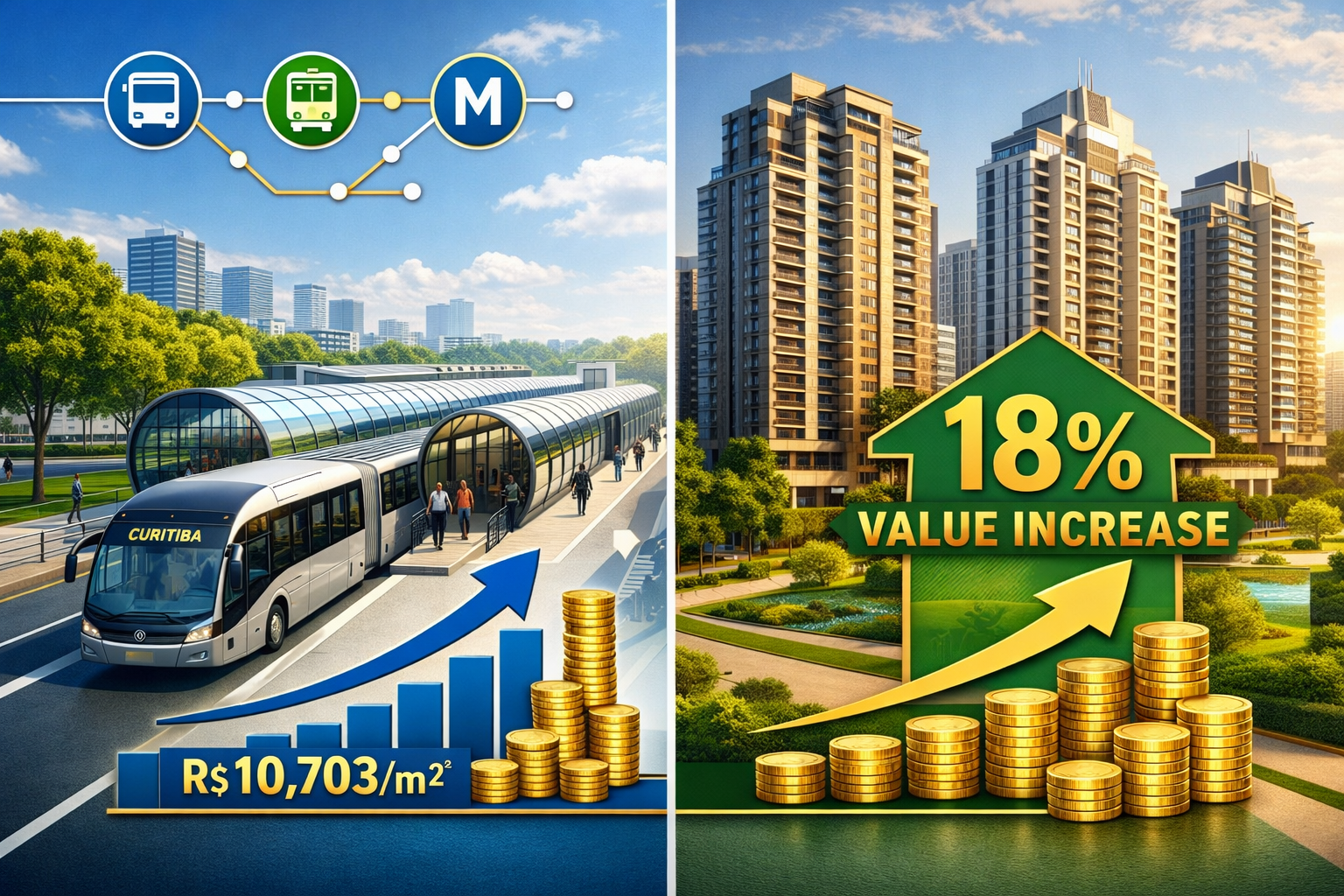
The correlation between transportation accessibility and property values is unmistakable. Properties near public transportation hubs saw an 18% increase in values over the last 12 months,[2] creating a clear investment blueprint for developers and buyers. This transit premium extends beyond immediate station proximity—entire neighborhoods connected to the BRT network are experiencing accelerated appreciation.
For investors exploring best places to invest in Brazil property, Curitiba’s infrastructure-led growth presents a compelling alternative to saturated coastal markets.
Market Velocity and Seller-Favorable Conditions
One of the most striking indicators of market strength is the dramatic reduction in time-on-market. Properties now average just 45 days on market in 2025, down dramatically from 140 days in 2023.[1] This acceleration reflects:
- Limited central land supply constraining inventory
- Strong demand from local and interstate buyers
- Competitive pricing driving quick decision-making
- Improved financing access expanding the buyer pool
This seller-favorable environment creates opportunities for developers who can bring quality inventory to market quickly, particularly in emerging neighborhoods where demand outpaces supply.
Infrastructure-Led Gains: Emerging Neighborhoods and Transit Premiums
High-Growth Peripheral Zones
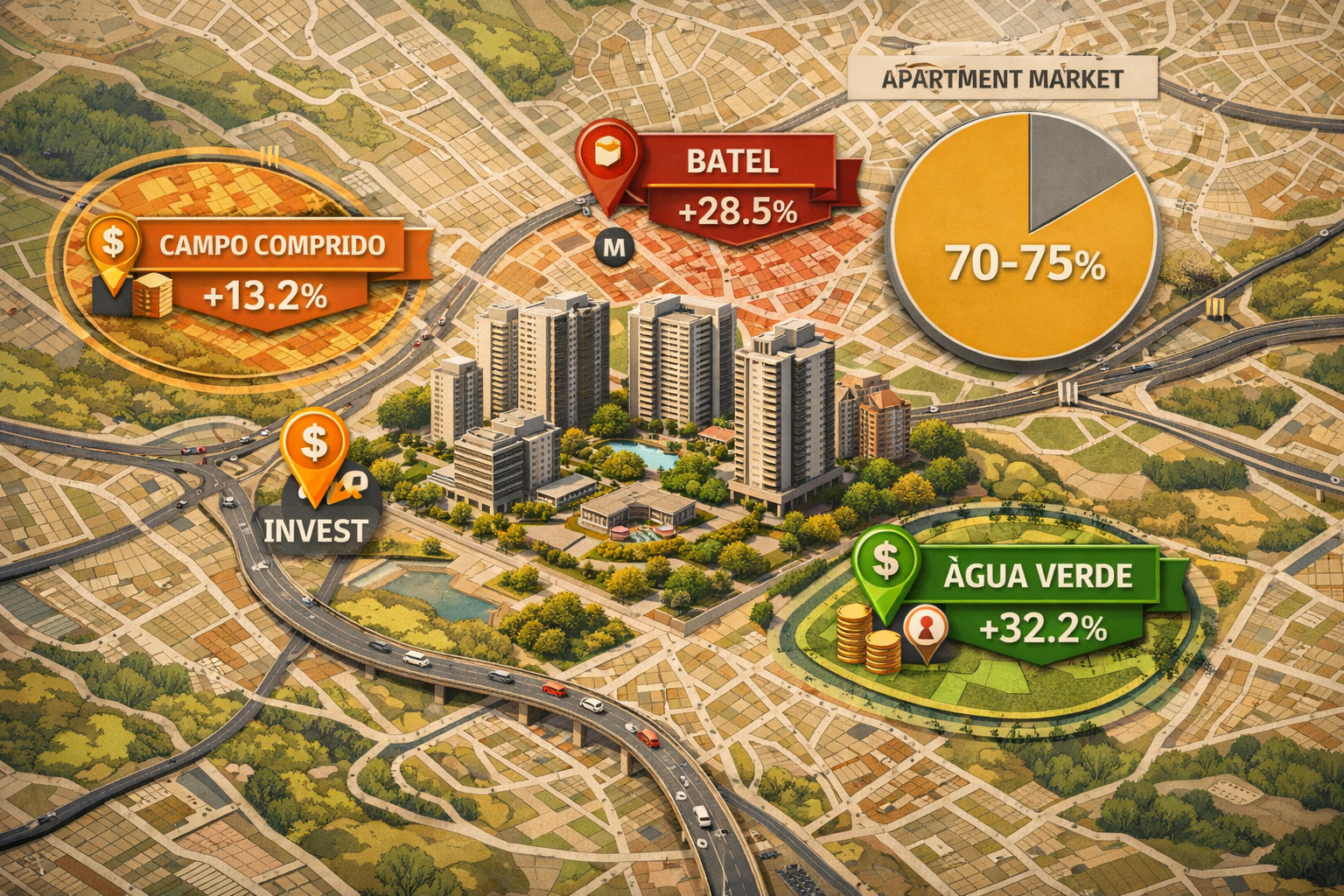
The most compelling Curitiba Property Yields 2026: Infrastructure-Led Gains in Southern Brazil’s Untapped Markets opportunities exist in neighborhoods benefiting from recent infrastructure investments. Three areas stand out for exceptional performance:
Campo Comprido 🏗️
Once considered peripheral, Campo Comprido recorded spectacular increases between 13.2% and 32.2% in 2024 as new BRT connections and commercial development transformed the area.[1] The neighborhood now attracts young families and professionals seeking affordable entry points with strong appreciation potential.
Batel 🌆
Traditionally upscale, Batel continues strengthening its position as a premium residential zone. The neighborhood combines excellent transit access with high-quality amenities, driving consistent demand in the luxury segment. Properties here command premium pricing but deliver stable yields through rental income and appreciation.
Água Verde 🌳
Positioned between central districts and emerging zones, Água Verde offers balanced investment opportunities. The neighborhood’s mix of established infrastructure and ongoing development creates diverse property options from compact apartments to larger family units.
The Transit-Oriented Development Premium
Curitiba’s BRT system, pioneered in the 1970s, continues driving property values in 2026. The 18% premium for transit-proximate properties[2] reflects several factors:
- Reduced transportation costs for residents
- Time savings in daily commutes
- Enhanced accessibility to employment centers
- Environmental benefits attracting sustainability-conscious buyers
Developers focusing on sites within 500-800 meters of BRT stations can capitalize on this premium through higher sales prices and faster absorption rates. The transit premium extends to rental markets, where tenants willingly pay 10-15% more for convenient transportation access.
Linha Verde Corridor Opportunities
The Linha Verde transformation is creating a new development axis through Curitiba. This former highway-turned-urban boulevard features:
- Mixed-use development zones combining residential, commercial, and retail
- Improved pedestrian infrastructure enhancing neighborhood livability
- Green spaces and cycling paths supporting sustainable mobility
- Strategic land parcels available for development
Analysts estimate properties along the Linha Verde corridor will experience 5-10% annual appreciation above citywide averages through 2028.[1] Early-stage investments in these zones offer the highest yield potential for developers willing to navigate longer development timelines.
Apartment-Condo Dominance: Investment Blueprints for 2026
Market Composition and Unit Mix
Apartments represent 70-75% of all residential listings in Curitiba,[1] reflecting urbanization trends and buyer preferences. This apartment dominance creates specific opportunities for developers:
Standard Units (60-70 m²) 📐
These compact two-bedroom apartments form the market’s backbone. Priced at R$640,000-750,000 depending on location, they attract first-time buyers and young families. New developments averaging 70 m² deliver optimal balance between affordability and functionality.
Mid-Range Units (80-120 m²) 🏠
Three-bedroom apartments in this range appeal to established families and upgraders. Average pricing reaches approximately R$800,000 for three-bedroom houses,[1] with apartments commanding similar values in premium locations.
Luxury Segment (150-300+ m²) 💎
The luxury segment surged 19.5% in recent years, while the superluxury segment saw an impressive 24.1% increase.[2] High-net-worth buyers seek properties exceeding 300 m² with premium finishes, smart home technology, and sustainability features.
Pricing Metrics and Yield Calculations
As of January 2025, Curitiba’s market averaged R$10,703 per square meter.[1] This baseline enables straightforward yield calculations:
| Property Type | Size (m²) | Purchase Price | Monthly Rent | Gross Yield |
|---|---|---|---|---|
| Compact 2BR | 60 | R$642,180 | R$2,800 | 5.2% |
| Standard 2BR | 70 | R$749,210 | R$3,200 | 5.1% |
| Mid-Range 3BR | 100 | R$1,070,300 | R$4,500 | 5.0% |
| Luxury 3BR | 150 | R$1,605,450 | R$7,500 | 5.6% |
These gross yields represent baseline performance. Properties in emerging neighborhoods with infrastructure improvements can achieve 15-25% total returns when combining rental yield with annual appreciation of 8-10%.
Financing Trends and Buyer Profiles
In 2024, 40% of property sales in Curitiba were financed through bank loans,[2] a significant increase attributed to rising property prices making cash purchases less feasible. This financing surge expands the buyer pool and supports continued price appreciation.
Key buyer segments include:
- Young professionals (25-35 years) seeking compact apartments near employment centers
- Growing families (35-45 years) upgrading to larger units in established neighborhoods
- Interstate migrants attracted by quality of life and economic opportunities
- Investors targeting rental income and appreciation in emerging zones
Understanding these buyer profiles helps developers optimize unit mix, pricing, and marketing strategies. Similar trends are visible in other Southern Brazilian markets, as discussed in analyses of Florianópolis property market performance.
Risk Assessment and Investment Considerations for Non-Capital City Developers
Market Cooling Signals and Volatility
While Curitiba’s market demonstrates strong fundamentals, investors should note the 0.6% dip in December 2025,[3] potentially signaling moderate cooling after rapid acceleration. This minor correction doesn’t undermine long-term growth prospects but suggests:
- Price sensitivity emerging at higher price points
- Seasonal fluctuations affecting short-term performance
- Buyer caution as affordability stretches
- Market normalization after exceptional 2024 growth
Prudent developers should model conservative appreciation scenarios (6-8% annually) rather than extrapolating peak performance indefinitely.
Regulatory and Development Challenges
Curitiba’s strict urban planning regulations, while supporting long-term sustainability, can complicate development timelines. Key considerations include:
- Zoning restrictions limiting density in certain areas
- Environmental requirements for green space and sustainability features
- Building code compliance for smart home and eco-friendly systems
- Approval processes potentially extending project timelines
Developers should budget additional time and resources for navigating regulatory requirements. Working with experienced local partners familiar with municipal processes can mitigate these challenges.
Competitive Landscape and Market Saturation
With 7,643 residential units sold in 2023 generating R$5.4 billion in total sales value,[2] Curitiba’s market attracts increasing developer attention. This competition creates pressure on:
- Land acquisition costs in prime locations
- Construction quality expectations as buyers become more sophisticated
- Marketing differentiation in crowded submarkets
- Profit margins as input costs rise
Successful developers will differentiate through superior location selection, innovative design, and sustainability features that command premium pricing.
Currency Risk for International Investors
International investors must consider Brazilian real volatility when calculating returns. Currency fluctuations can significantly impact dollar or euro-denominated returns, even when local currency performance remains strong. Strategies to manage currency risk include:
- Hedging instruments to lock in exchange rates
- Local currency financing to match assets and liabilities
- Long-term holding periods to ride out currency cycles
- Diversification across multiple Brazilian markets
For international developers exploring Brazilian opportunities, understanding investment strategies in emerging markets is essential for risk-adjusted returns.
Sustainability and Technology: Value Drivers for 2026
Eco-Friendly Construction Standards
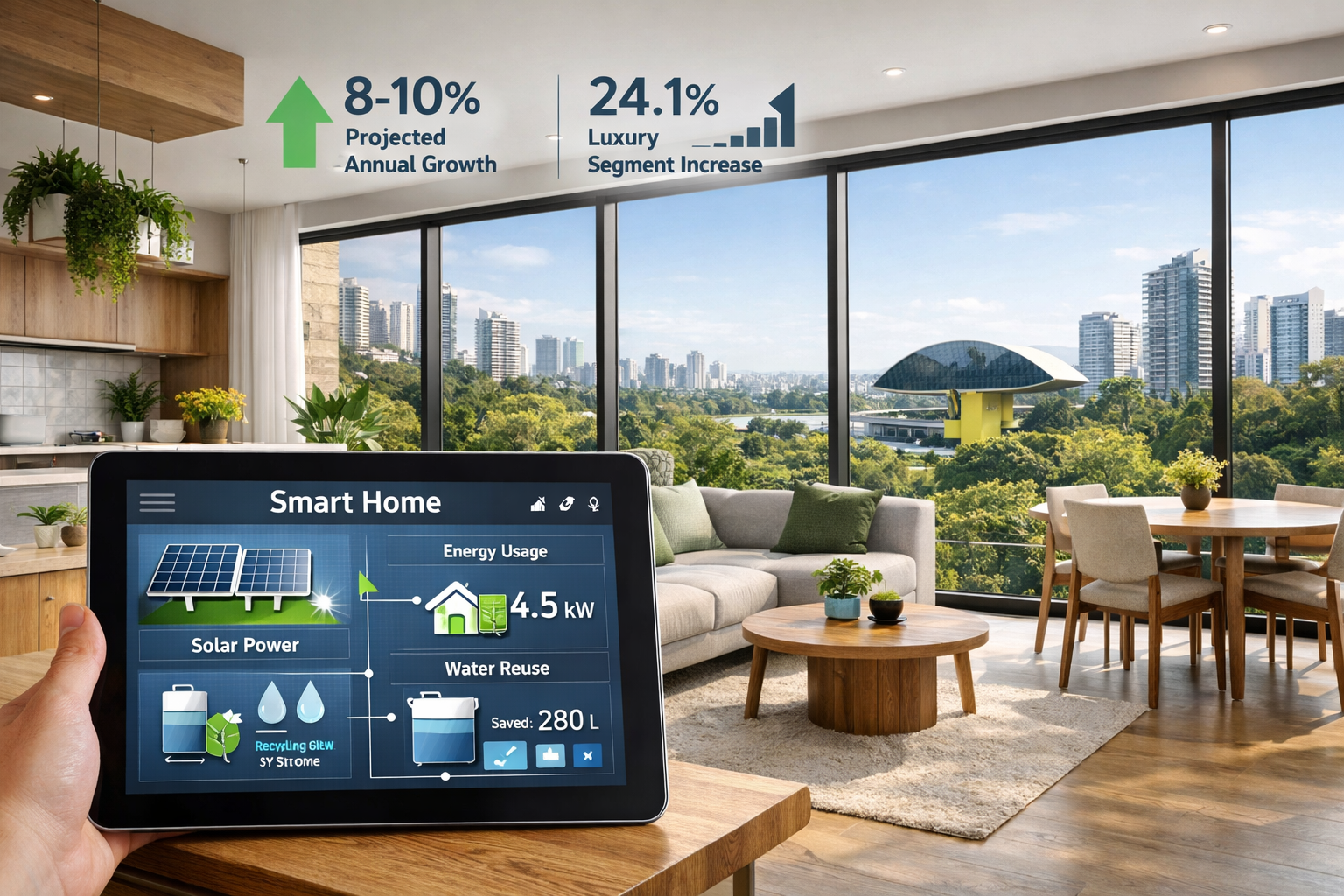
Curitiba’s environmental consciousness extends to real estate development. The city is pushing eco-friendly construction with solar systems, water reuse, and smart home solutions.[1] These sustainability features are transitioning from luxury amenities to standard expectations, particularly among younger buyers.
Properties incorporating green building practices command premium pricing and faster sales velocity. Key features include:
- Solar photovoltaic systems reducing energy costs
- Rainwater harvesting for irrigation and non-potable uses
- High-efficiency HVAC systems minimizing environmental impact
- Sustainable materials in construction and finishes
- Green spaces and native landscaping enhancing livability
Developers who integrate these features from project inception—rather than retrofitting—achieve better cost efficiency and marketing differentiation.
Smart Home Technology Adoption
Properties featuring 360° virtual tours and smart home technology are selling faster and at premium prices—a key value appreciation factor for younger buyers and families.[1] Technology integration includes:
- Home automation systems controlling lighting, climate, and security
- Energy management platforms optimizing consumption
- High-speed internet infrastructure supporting remote work
- Digital access control replacing traditional keys
- Integrated appliances with IoT connectivity
The premium for tech-enabled properties ranges from 5-8% in standard segments to 10-15% in luxury developments. As remote work continues normalizing, technology infrastructure becomes increasingly essential for competitive positioning.
The Sustainability-Technology Nexus
The intersection of sustainability and technology creates the most compelling value proposition for 2026. Properties combining solar systems with smart energy management, or water reuse systems with IoT monitoring, deliver both environmental benefits and operational cost savings that justify premium pricing.
This approach aligns with broader trends in Brazilian real estate, where property appreciation strategies increasingly emphasize sustainability and innovation.
Strategic Entry Points: Actionable Investment Blueprints
Portfolio Allocation Strategies
For developers and investors seeking to capitalize on Curitiba Property Yields 2026: Infrastructure-Led Gains in Southern Brazil’s Untapped Markets, strategic portfolio allocation maximizes risk-adjusted returns:
Conservative Approach (Lower Risk, Stable Returns) 🛡️
- 60% allocation to established neighborhoods (Batel, Centro)
- 30% to mid-tier emerging zones (Água Verde)
- 10% to high-growth peripheral areas (Campo Comprido)
- Expected blended return: 8-12% annually
Balanced Approach (Moderate Risk, Enhanced Returns) ⚖️
- 40% established neighborhoods
- 40% emerging zones with infrastructure improvements
- 20% high-growth peripheral areas
- Expected blended return: 12-18% annually
Aggressive Approach (Higher Risk, Maximum Returns) 🚀
- 20% established neighborhoods for stability
- 30% emerging zones
- 50% high-growth peripheral areas near Linha Verde
- Expected blended return: 18-25% annually
Due Diligence Checklist
Before committing capital to Curitiba developments, investors should complete comprehensive due diligence:
✅ Location Analysis
- Proximity to BRT stations and major employment centers
- Neighborhood demographic trends and income levels
- Planned infrastructure improvements and timelines
- Competitive supply within 1-2 km radius
✅ Financial Modeling
- Conservative appreciation assumptions (6-8% annually)
- Realistic rental yield projections (4-6% gross)
- Comprehensive cost analysis including taxes and fees
- Exit strategy scenarios and holding period optimization
✅ Legal and Regulatory Review
- Title verification and ownership clarity
- Zoning compliance and development rights
- Environmental permits and sustainability requirements
- Tax obligations and incentive programs
✅ Partner Evaluation
- Developer track record and completed projects
- Financial stability and funding sources
- Construction quality and timeline performance
- Post-sale support and property management
Timing Considerations for 2026
The current market environment presents favorable entry conditions for strategic investors:
Q1-Q2 2026: Optimal for land acquisition and project planning as the December 2025 cooling creates negotiating opportunities without undermining fundamentals.
Q3-Q4 2026: Launch timing for new developments to capture seasonal demand peaks and benefit from continued infrastructure progress.
2027-2028: Anticipated harvest period as projects complete and appreciation accelerates with Linha Verde corridor maturation.
Investors should monitor real estate market trends regularly to adjust timing strategies as conditions evolve.
Comparative Analysis: Curitiba vs. Other Brazilian Markets
Curitiba vs. São Paulo
While São Paulo offers larger scale and liquidity, Curitiba provides superior risk-adjusted returns:
- Lower entry costs: 30-40% less expensive per square meter
- Faster appreciation: 18% residential price increase vs. São Paulo’s 12-14%
- Better quality of life: Lower crime, less congestion, cleaner environment
- Sustainable growth: More measured development avoiding oversupply risks
Curitiba vs. Florianópolis
Both Southern Brazilian cities offer compelling opportunities with distinct profiles:
- Curitiba advantages: Larger economy, better infrastructure, year-round demand
- Florianópolis advantages: Beach tourism, seasonal rental premiums, international appeal
- Yield comparison: Curitiba delivers more stable 5-6% rental yields vs. Florianópolis’s variable 4-8% depending on seasonality
Investors comparing these markets should review detailed analyses of Florianópolis investment opportunities to understand relative positioning.
Curitiba vs. Rio de Janeiro
Rio’s challenges create opportunities for Curitiba:
- Security concerns in Rio drive migration to safer cities like Curitiba
- Infrastructure deficits in Rio contrast with Curitiba’s well-maintained systems
- Price appreciation: Curitiba’s 18% exceeds Rio’s stagnant 3-5% in many zones
- Economic stability: Paraná’s diversified economy outperforms Rio’s tourism-dependent model
Conclusion: Capitalizing on Curitiba’s Infrastructure-Led Growth
Curitiba Property Yields 2026: Infrastructure-Led Gains in Southern Brazil’s Untapped Markets represent one of the most compelling opportunities in Brazilian real estate. The convergence of strategic infrastructure investments, apartment-condo market dominance, sustainability focus, and strong economic fundamentals creates conditions for 15-25% total returns through combined rental income and appreciation.
The city’s transformation through the Linha Verde corridor, continuous BRT system improvements, and transit-oriented development premiums provide clear investment blueprints. Properties near transportation hubs command 18% value premiums, while emerging neighborhoods like Campo Comprido, Batel, and Água Verde post exceptional gains of 13.2%-32.2% as infrastructure improvements mature.
Actionable Next Steps
For Developers 🏗️
- Conduct site selection analysis focusing on properties within 800m of BRT stations
- Design apartment-centric projects (70-75% of units) with 60-120 m² unit mix
- Integrate sustainability features (solar, water reuse) and smart home technology
- Model conservative 6-8% annual appreciation with 5-6% rental yields
- Plan Q3-Q4 2026 launches to capture seasonal demand peaks
For Investors 💼
- Allocate portfolio across established, emerging, and high-growth zones based on risk tolerance
- Prioritize properties near completed or planned infrastructure improvements
- Verify financing options to leverage 40% market financing trend
- Partner with experienced local developers familiar with regulatory environment
- Plan 3-5 year holding periods to capture full appreciation cycle
For International Capital 🌎
- Establish local partnerships to navigate regulatory requirements
- Implement currency hedging strategies to manage real volatility
- Focus on emerging neighborhoods with highest growth potential
- Consider diverse Brazilian property opportunities for portfolio diversification
- Monitor market indicators monthly to adjust strategies as conditions evolve
With properties selling in just 45 days, projected 8-10% annual growth through 2028, and infrastructure investments unlocking peripheral value, Curitiba’s market offers rare combination of momentum and opportunity. Investors who act strategically in 2026 can position themselves for exceptional returns as Southern Brazil’s green capital continues its transformation into one of the country’s premier real estate markets.
The time to capitalize on Curitiba Property Yields 2026: Infrastructure-Led Gains in Southern Brazil’s Untapped Markets is now—before the broader investment community fully recognizes the potential of this infrastructure-led growth story.
References
[1] Investing Real Estate Curitiba Guide Market Prices Returns – https://www.jarniascyril.com/international-real-estate/investing-brazil-real-estate/investing-real-estate-curitiba-guide-market-prices-returns/
[2] Curitiba Real Estate Market – https://thelatinvestor.com/blogs/news/curitiba-real-estate-market
[3] Curitiba How Much Condo – https://thelatinvestor.com/blogs/news/curitiba-how-much-condo