
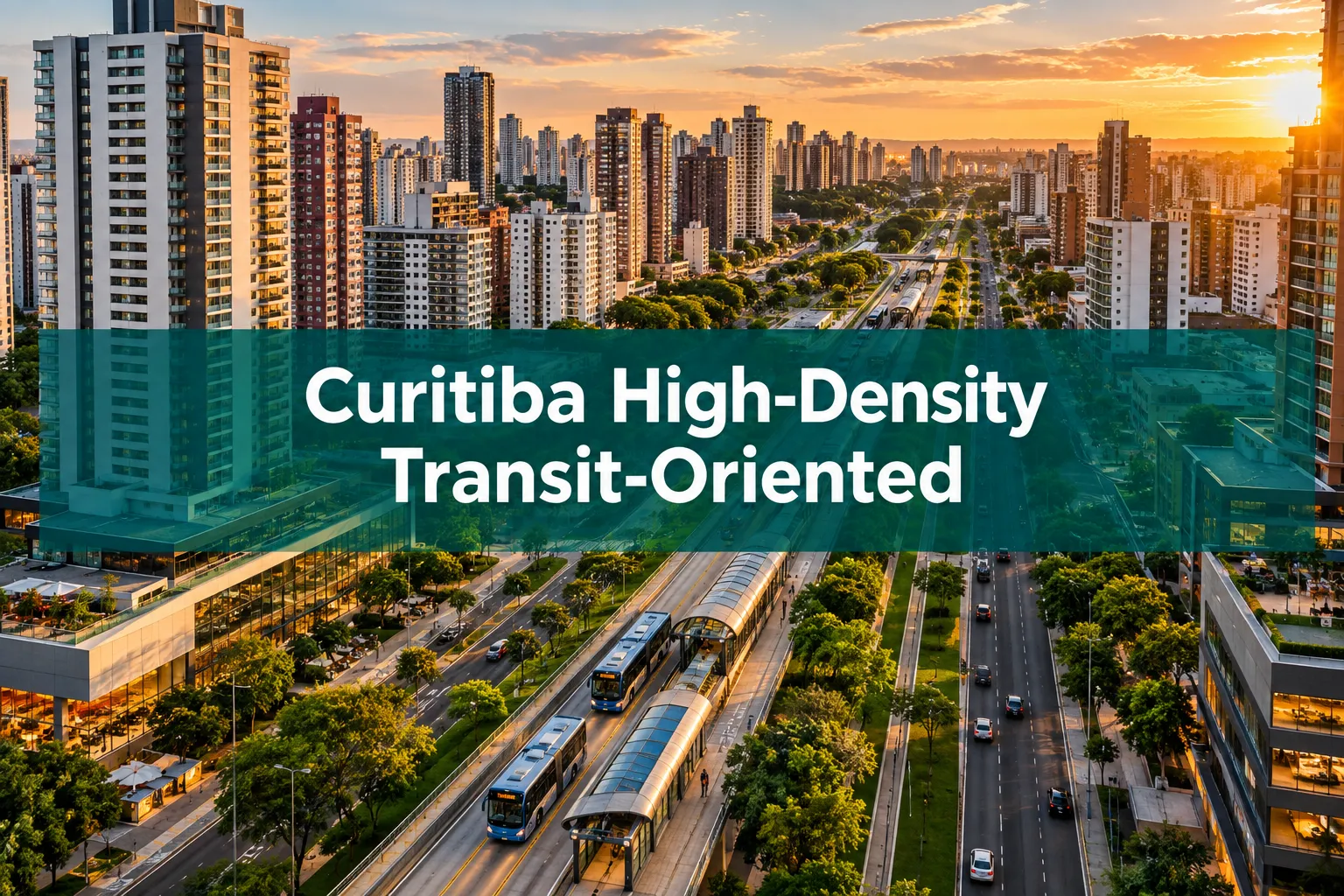
Property values within 400 meters of Curitiba’s Bus Rapid Transit stations show statistically confirmed appreciation, and yet the city’s legacy BRT network, now entering a new phase of Novo PAC-funded expansion, remains underexploited by developers chasing saturated markets in São Paulo and Rio. For investors and developers paying attention, Curitiba’s High-Density Transit-Oriented Projects: Capturing 25% Value Uplift from BRT Expansions in 2026 represents one of the most structurally sound development theses in Brazil’s current real estate cycle.
The city has spent six decades aligning its master plan with BRT corridors, building a replicable framework of density bonuses, Floor Area Ratio (FAR) incentives, and value-capture instruments that no other Brazilian city has matched at scale [10]. With new corridor completions, electric bus integration, and the “Bairro Novo da Caximba” smart neighborhood project advancing in 2026, the window for early-mover advantage is open, but it requires understanding exactly how value is created, where it concentrates, and how to capture it before land prices adjust.
Key Takeaways
- Curitiba’s BRT corridors generate measurable property value premiums, with econometric studies confirming appreciation of roughly 4-7% within 400 meters of stations, a foundation for higher uplifts when combined with FAR bonuses and mixed-use zoning.
- The 25% value uplift target sits at the upper bound of international BRT experience and is achievable in Curitiba primarily through strategic stacking of proximity premiums, density bonuses, and timing advantage on newly completed corridors.
- Active infrastructure projects in 2026, including the Linha Verde BRT, Inter 2 corridor upgrades, and the Ligeirão Leste-Oeste line, are creating fresh development windows in neighborhoods such as Atuba, Xaxim, and Capão Raso.
- Curitiba’s CEPAC (Certificates of Additional Development Potential) system provides a formal value-capture mechanism, but timing relative to market cycles is critical to maximizing returns.
- Multi-family residential projects on structural axis zones, designed with eco-integrated features, are positioned to benefit from both transit proximity premiums and Brazil’s projected 3.3% real estate sector growth in 2026.
How Curitiba Built the World’s Most Studied BRT-TOD Framework
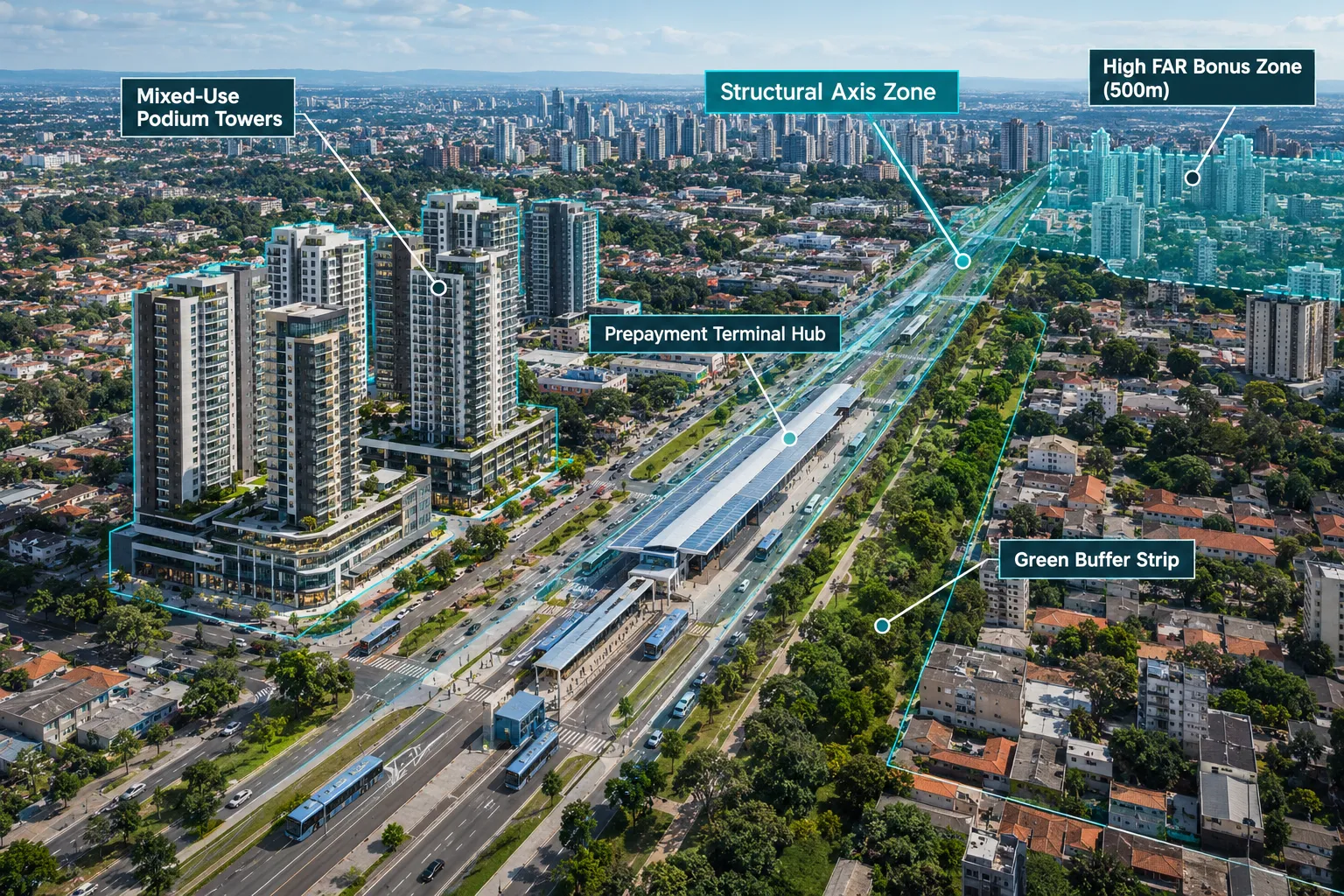
Curitiba’s transit-oriented development model did not emerge from a single policy decision. It evolved over roughly 60 years through the consistent application of an integrated master plan that treated BRT corridors as the structural backbone of urban growth [10]. The city deliberately concentrated density along these routes through special zoning designations and FAR incentives, achieving roughly 300-400 persons per hectare around key terminal stations in the central business area and approximately 150-200 persons per hectare in suburban residential areas [1].
The mechanism is straightforward: parcels within 500 to 1,000 meters of BRT corridors receive density bonuses that allow developers to build significantly more floor area than baseline zoning would permit. This creates a direct financial incentive to develop near transit, which in turn generates the ridership that justifies continued BRT investment, a self-reinforcing cycle that has made Curitiba a benchmark for the World Bank and the Inter-American Development Bank alike [1].
Three structural elements define this framework:
- Structural Axis Zoning: High-density, mixed-use development is legally concentrated along BRT “structural axes,” creating predictable demand corridors for multi-family residential projects.
- FAR Bonus System: Developers near BRT stations receive additional buildable area in exchange for contributions to public infrastructure or affordable housing.
- CEPAC Value Capture: Along the Linha Verde corridor, Certificates of Additional Development Potential are auctioned to developers seeking above-baseline floor area, channeling land-value uplift back into infrastructure finance [6].
The Linha Verde project, a 22-kilometer conversion of a major highway into a BRT corridor running from Pinheirinho to Atuba, has been the most prominent testbed for these mechanisms. Initial CEPAC auctions during a depressed market raised less than 60% of anticipated funding, but values recovered as the corridor matured, illustrating both the potential and the timing risk inherent in value-capture strategies [6]. This lesson is directly relevant for developers evaluating 2026 entry points along newly completed or expanding corridors.
“Curitiba has institutionalized transit-oriented planning to a degree that no other Brazilian city has replicated, dense, mixed-use development, strong public transit accessibility, affordable fares, and prepayment transfer terminals collectively support high land values along BRT corridors.”
For context on how similar transit infrastructure drives property premiums in other Brazilian cities, the analysis of BRT TransBrasil corridor development opportunities in Rio de Janeiro provides a useful comparison of corridor-based value creation strategies.
The Real Numbers Behind the 25% Value Uplift Claim
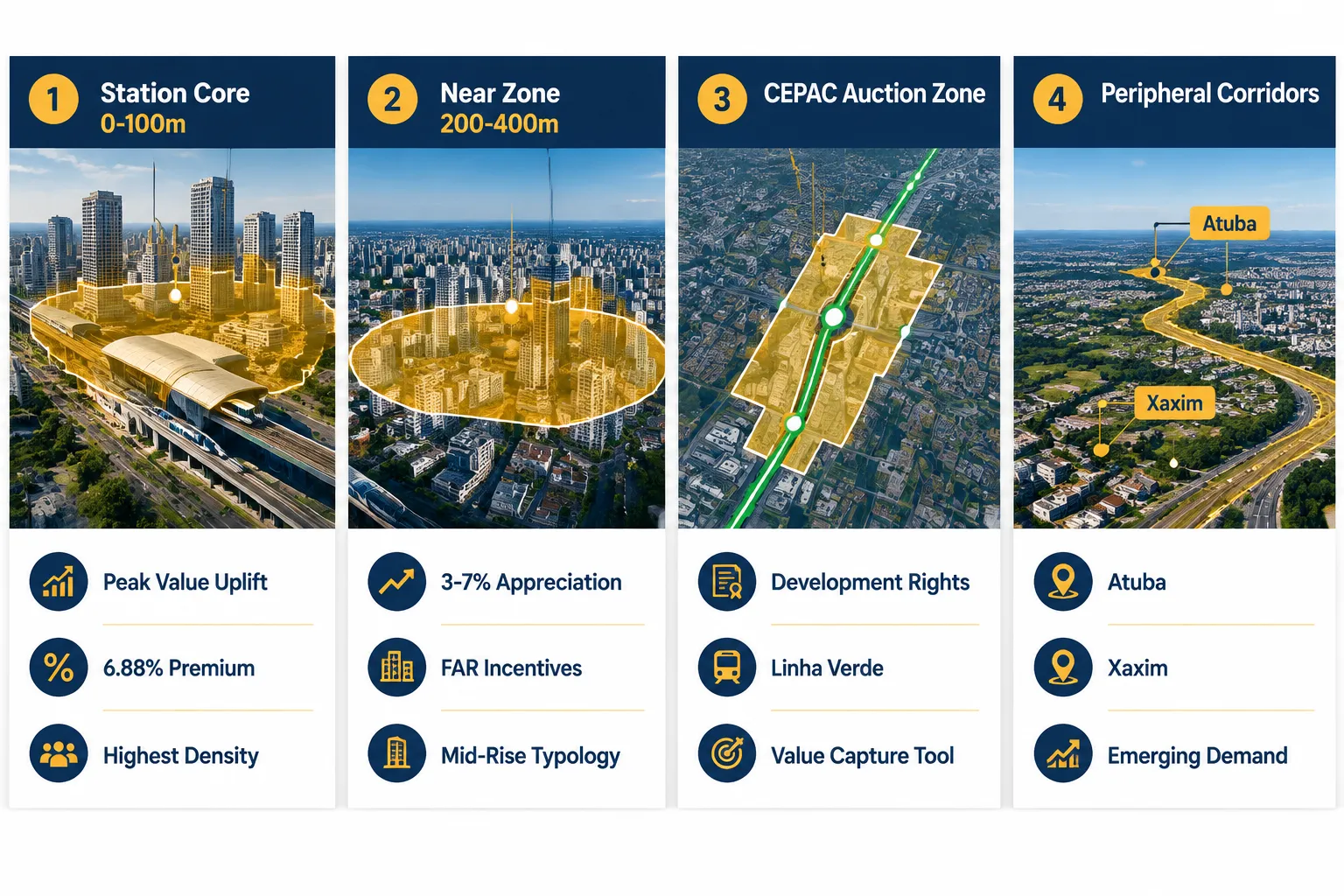
Curitiba’s High-Density Transit-Oriented Projects: Capturing 25% Value Uplift from BRT Expansions in 2026 is a target figure that demands honest scrutiny. The empirical evidence from Curitiba itself is more nuanced than a single headline number suggests.
Econometric analysis of apartment prices near Curitiba’s BRT lines, conducted by the Federal University of Paraná, finds statistically significant value increases only within approximately 400 meters of stations. The estimated appreciation figures are [4]:
| Distance from Station | Estimated Price Premium |
|---|---|
| 100 meters | 6.88% |
| 200 meters | 6.97% |
| 300 meters | 3.97% |
| 400 meters | 4.20% |
| Beyond 400 meters | Not statistically significant |
These figures represent baseline proximity premiums in isolation. A global meta-analysis of BRT impacts on land and property values reports typical value changes ranging from single-digit percentages to approximately 15-20% premiums depending on local context [8]. A 25% uplift therefore sits at the upper bound of documented international experience, it is not an average outcome but a ceiling achievable under specific conditions.
The conditions that push toward the upper bound include:
- First-mover timing: Acquiring land before a corridor is fully operational captures the full appreciation curve rather than paying post-announcement prices.
- FAR bonus stacking: Combining proximity premiums with maximum density bonuses multiplies the effective value creation per square meter.
- Mixed-use programming: Ground-floor retail and service uses in residential towers generate additional income streams that capitalize into asset values.
- Eco-integrated design: In 2026, green-certified buildings along BRT corridors command additional premiums as ESG considerations enter mainstream residential purchasing decisions.
A 2024 IPEA study on TOD equity in Curitiba confirms that property prices are “considerably higher” in central areas with BRT access and high construction limits compared with peripheral zones [5][7]. However, the same research notes that these benefits have disproportionately favored high-income households and premium property segments, pointing to a spatial inequality pattern that developers must navigate carefully in terms of community engagement and regulatory compliance.
The IPEA findings also highlight that TOD strategies in Curitiba have had limited impact on overall population density increases but have significantly shaped the spatial distribution of real estate value, meaning the premium is real, but it is concentrated in specific micro-locations rather than distributed evenly across BRT-served areas [5].
For developers exploring how transit infrastructure drives value in other Brazilian growth corridors, the Salvador Novo PAC transit yield strategies for residential projects offers parallel analysis of transit-led residential investment.
Active BRT Projects and Development Corridors in 2026
The 2026 landscape for Curitiba’s High-Density Transit-Oriented Projects: Capturing 25% Value Uplift from BRT Expansions in 2026 is defined by three major infrastructure developments that are reshaping development opportunity zones across the metropolitan area [9].
Linha Verde (Pinheirinho, Atuba, 22 km)
Largely completed by early 2025, this corridor has transformed the former BR-116 highway alignment into a full BRT route with dedicated lanes, elevated stations, and structured development zones on both sides. The neighborhoods of Atuba (northern terminus) and Xaxim (southern approach) are experiencing heightened housing demand and redevelopment interest as the corridor reaches operational maturity. Land costs in these areas remain significantly below central Curitiba benchmarks, creating the cost-basis advantage that makes 25% uplift scenarios mathematically viable.
Inter 2 Corridor Upgrades
Approximately 70 kilometers of road improvements and 13 new stations are advancing under the Inter 2 program, extending BRT connectivity across Curitiba’s ring-road system. This infrastructure creates new development zones in neighborhoods that previously lacked high-quality transit access, effectively expanding the geographic footprint of FAR bonus eligibility and transit-proximity premiums.
Ligeirão Leste-Oeste to Pinhais (Electric BRT)
The integration of electric buses on the Leste-Oeste express line, expected to reach full operational status in 2026, adds both environmental credibility and service quality to this east-west corridor. The Pinhais extension into the metropolitan fringe opens previously underserved land parcels to transit-oriented development potential for the first time.
Neighborhood-Level Opportunity Map
| Neighborhood | Corridor | Development Stage | Key Advantage |
|---|---|---|---|
| Atuba | Linha Verde North | Post-completion | Full premium capture potential |
| Xaxim | Linha Verde South | Active demand growth | Lower land costs, rising rents |
| Capão Raso | Ligeirão Leste-Oeste | Emerging | First-mover land pricing |
| Pinhais fringe | Leste-Oeste extension | Pre-maturity | Maximum appreciation curve |
The “Bairro Novo da Caximba” project, branded as Brazil’s first smart neighborhood, reinforces Curitiba’s commitment to integrating transit, technology, and eco-design in new urban districts [10]. For developers, this signals that municipal approvals for transit-aligned, green-certified projects are likely to move faster than comparable applications in São Paulo or Rio, where regulatory backlogs are longer and land costs are substantially higher.
The Linha 6 Laranja metro impact analysis for São Paulo developments provides a useful benchmark for understanding how new transit infrastructure triggers price surges in previously undervalued neighborhoods.
Developer Strategies for Maximizing Value Capture
Translating BRT proximity into a 25% value uplift requires deliberate strategy rather than passive land holding. The following framework synthesizes the most effective approaches for multi-family residential developers operating in Curitiba’s BRT corridors in 2026.
Site Selection and Timing
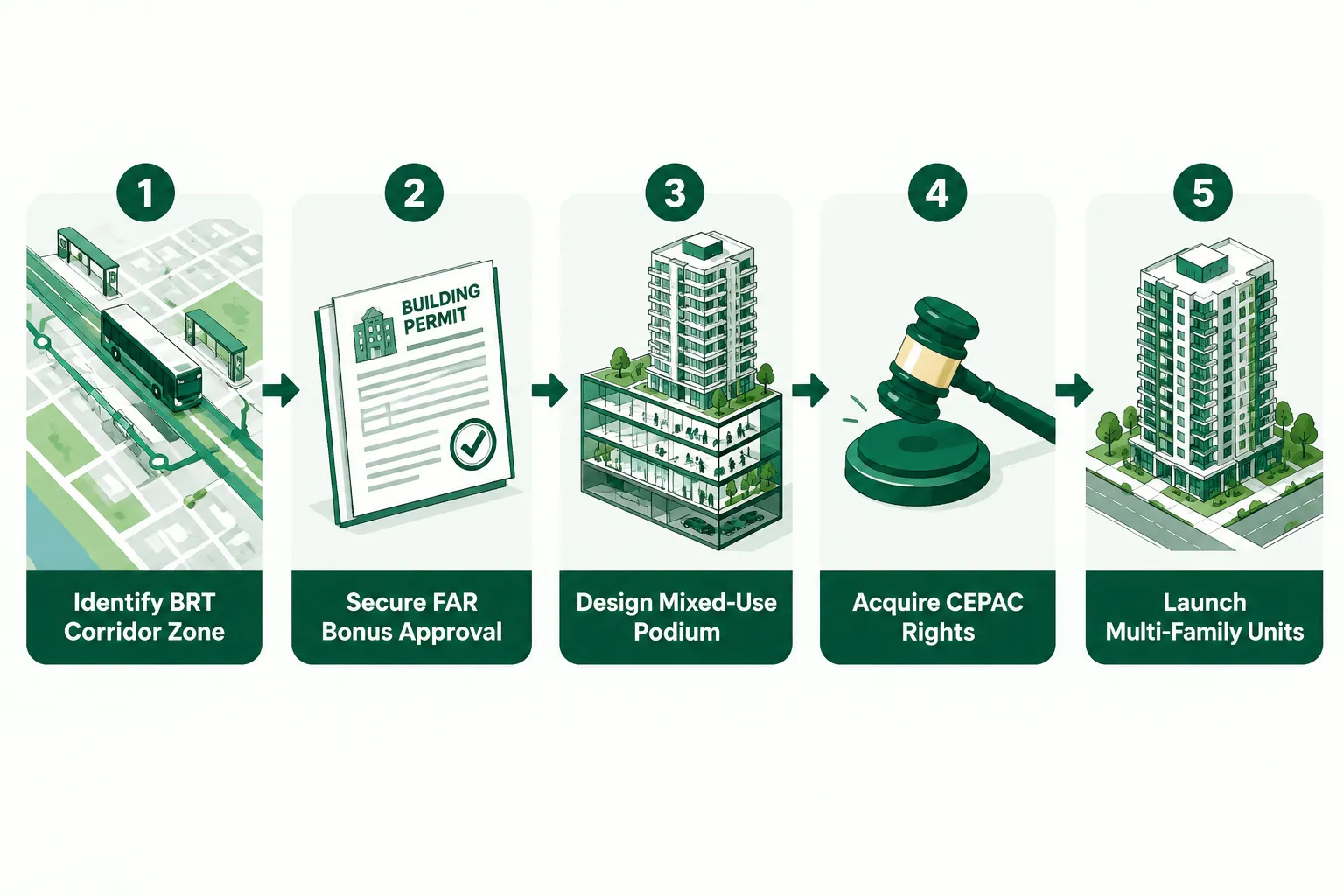
The econometric evidence is clear: the premium is strongest within 400 meters of stations, with the peak concentrated at 100-200 meters [4]. Site acquisition should target this zone on corridors that are operational but not yet fully priced into land values, specifically the Atuba and Xaxim zones along Linha Verde and the Capão Raso area on the Ligeirão Leste-Oeste corridor.
Timing relative to CEPAC auctions matters significantly. The Linha Verde experience showed that entering the market during a depressed auction cycle, when CEPAC values are low, allows developers to secure additional development rights at below-market cost, then benefit as values recover [6]. Monitoring the Inter 2 CEPAC auction calendar in 2026 is therefore a concrete tactical priority.
Product Design and Density Optimization
Maximize FAR bonus utilization. Structural axis zoning in Curitiba allows significantly higher floor area ratios than baseline residential zones. A project that captures the full FAR bonus on a 500-meter-from-station parcel will generate substantially more sellable area from the same land cost, directly improving margin without requiring premium land pricing.
Integrate eco-certified design from the outset. Brazil’s real estate sector is projecting 3.3% growth in 2026, with green-certified projects commanding measurable premiums in urban markets. Combining BRT proximity with LEED or AQUA-HQE certification creates a dual-premium product that appeals to both end-users and institutional buyers. The ESG compliance and green certification premium strategies for São Paulo’s Grade A market documents how green credentials translate into measurable price premiums.
Program for mixed-use ground floors. Retail, food service, and co-working spaces at street level generate rental income, improve walkability scores, and increase the residential premium for upper floors by creating the amenity-rich environment that transit-oriented buyers expect.
Financing and Value-Capture Instruments
The CEPAC system is Curitiba’s primary formal value-capture mechanism, but developers can also access:
- Novo PAC infrastructure co-investment: Federal funding for BRT-adjacent public realm improvements reduces developer contribution requirements and accelerates approval timelines.
- FII (Real Estate Investment Fund) structures: Institutional capital is increasingly flowing into transit-oriented residential projects through FII vehicles, providing equity at competitive rates for well-located multi-family projects. The FII market surge and high-yield funds fueling mixed-use developments outlines how institutional capital is being deployed in 2026.
- Fixed-rate mortgage expansion: Brazil’s 14% credit expansion forecast for 2026 is improving end-buyer financing access, directly supporting absorption rates for transit-adjacent residential launches.
Risk Management
The IPEA equity research is a reminder that TOD benefits in Curitiba have historically concentrated among higher-income segments [5][7]. Developers targeting mid-market price points along BRT corridors should conduct detailed demand analysis to confirm that target buyers qualify for available mortgage products at projected price points. The compact urban apartment demand analysis for Brazil’s 2026 single-person household growth provides relevant demand-side context for smaller unit formats that perform well in transit-accessible locations.
Additionally, the Inter-American Development Bank’s ongoing multi-year investment framework for Curitiba’s BRT system (BR-L1532) confirms sustained institutional backing for BRT-based urban restructuring, reducing the infrastructure delivery risk that has undermined TOD projects in other cities [11].
Comparing Curitiba’s TOD Model to Other Brazilian Growth Markets
Curitiba’s structural advantage over competing Brazilian markets for transit-oriented investment rests on three differentiators that are difficult to replicate quickly.
First, regulatory predictability. Six decades of consistent master plan application means that developers can model FAR bonuses, setback requirements, and permitted uses with high confidence. São Paulo and Rio offer larger markets but far greater regulatory uncertainty and longer approval timelines.
Second, lower land costs relative to transit access quality. Curitiba’s BRT network serves a metropolitan population of approximately 3.7 million with a frequency and reliability that rivals metro systems in larger cities, but land prices within BRT corridors remain substantially below comparable transit-accessible zones in São Paulo.
Third, active infrastructure investment. The combination of Novo PAC federal funding, IDB institutional backing, and EU-funded innovation programs (including an eBRT2030 service contract focused on BRT performance improvement) means that Curitiba’s transit infrastructure is actively improving in 2026 rather than stagnating [14]. This ongoing investment sustains the demand fundamentals that underpin property value premiums.
For developers with capital allocated to Brazilian transit-oriented projects, the high-speed rail Rio-São Paulo infrastructure boost for regional property valuations provides a useful macro-level perspective on how infrastructure investment cycles translate into property market dynamics across different city tiers.
Conclusion
Curitiba’s High-Density Transit-Oriented Projects: Capturing 25% Value Uplift from BRT Expansions in 2026 is not a guaranteed outcome, it is an achievable ceiling that requires disciplined execution across site selection, product design, and financial structuring. The empirical evidence confirms that BRT proximity generates real, measurable premiums in the 4-7% range at the station level [4], and that these premiums can be amplified significantly through FAR bonus utilization, CEPAC timing, and mixed-use programming.
The 2026 infrastructure pipeline, Linha Verde at operational maturity, Inter 2 corridor upgrades adding 13 new stations, and the electric Ligeirão Leste-Oeste extension to Pinhais, creates a specific, time-bounded window for developers to acquire land at pre-maturity prices in Atuba, Xaxim, and Capão Raso before the market fully prices in the transit premium.
Actionable next steps for developers and investors:
- Conduct micro-location analysis within 400 meters of active Linha Verde and Ligeirão Leste-Oeste stations, prioritizing parcels with FAR bonus eligibility under structural axis zoning.
- Monitor the 2026 CEPAC auction calendar for Inter 2 corridor rights, targeting acquisition during periods of lower competition to secure additional development potential at below-peak cost.
- Design for dual premium capture by integrating eco-certification (LEED or AQUA-HQE) with transit proximity to maximize both end-user pricing and institutional buyer appeal.
- Engage FII capital structures early in the project cycle to access institutional equity at competitive rates and improve project feasibility at mid-market price points.
- Build community benefit components into project programs, including affordable unit quotas or public realm contributions, to accelerate municipal approvals and align with the equity considerations raised by IPEA research on TOD benefit distribution [5][7].
Curitiba’s six-decade track record of transit-oriented planning is not a historical footnote, it is an active competitive advantage for developers willing to move beyond the saturated capitals and engage with one of Brazil’s most structurally sound property value creation frameworks.
References
[1] Volume 3 Benchmarking Transit Oriented Development – https://documents1.worldbank.org/curated/en/818701555088451429/pdf/Volume-3-Benchmarking-Transit-Oriented-Development.pdf
[4] acervodigital.ufpr.br – https://acervodigital.ufpr.br/xmlui/handle/1884/43088
[5] 2024 Cstp Equity Implications Tod Curitiba – https://www.ipea.gov.br/acessooportunidades/en/publication/2024_cstp_equity_implications_tod_curitiba/
[6] Linha Verde Curitiba Brazil Highway Conversion To Brt – https://valueuplift.org.nz/linha-verde-curitiba-brazil-highway-conversion-to-brt/
[7] 2024 Turbay Equity Implications Of Tod In Curitiba – https://www.ipea.gov.br/acessooportunidades/files/2024_Turbay_equity_implications_of_tod_in_curitiba.pdf
[8] 1359 680 Bus%20bogota – https://www.lincolninst.edu/app/uploads/legacy-files/pubfiles/1359_680_Bus%20Bogota.pdf
[9] Curitiba Real Estate Market – https://thelatinvestor.com/blogs/news/curitiba-real-estate-market
[10] Brazils Curitiba Has Been Following Its Master Plan For 60 Years – https://www.asce.org/publications-and-news/civil-engineering-source/civil-engineering-magazine/issues/magazine-issue/article/2025/07/brazils-curitiba-has-been-following-its-master-plan-for-60-years