
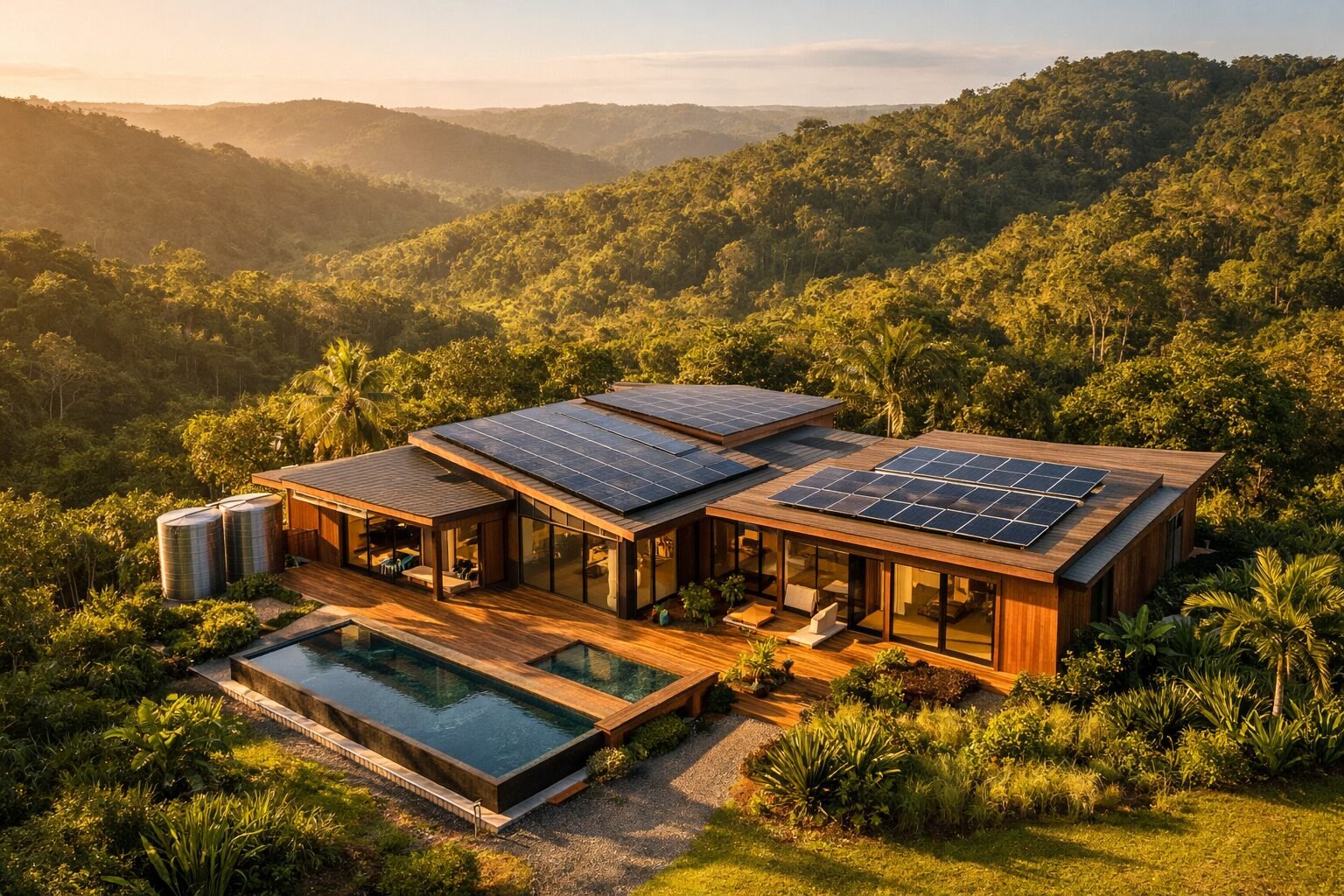
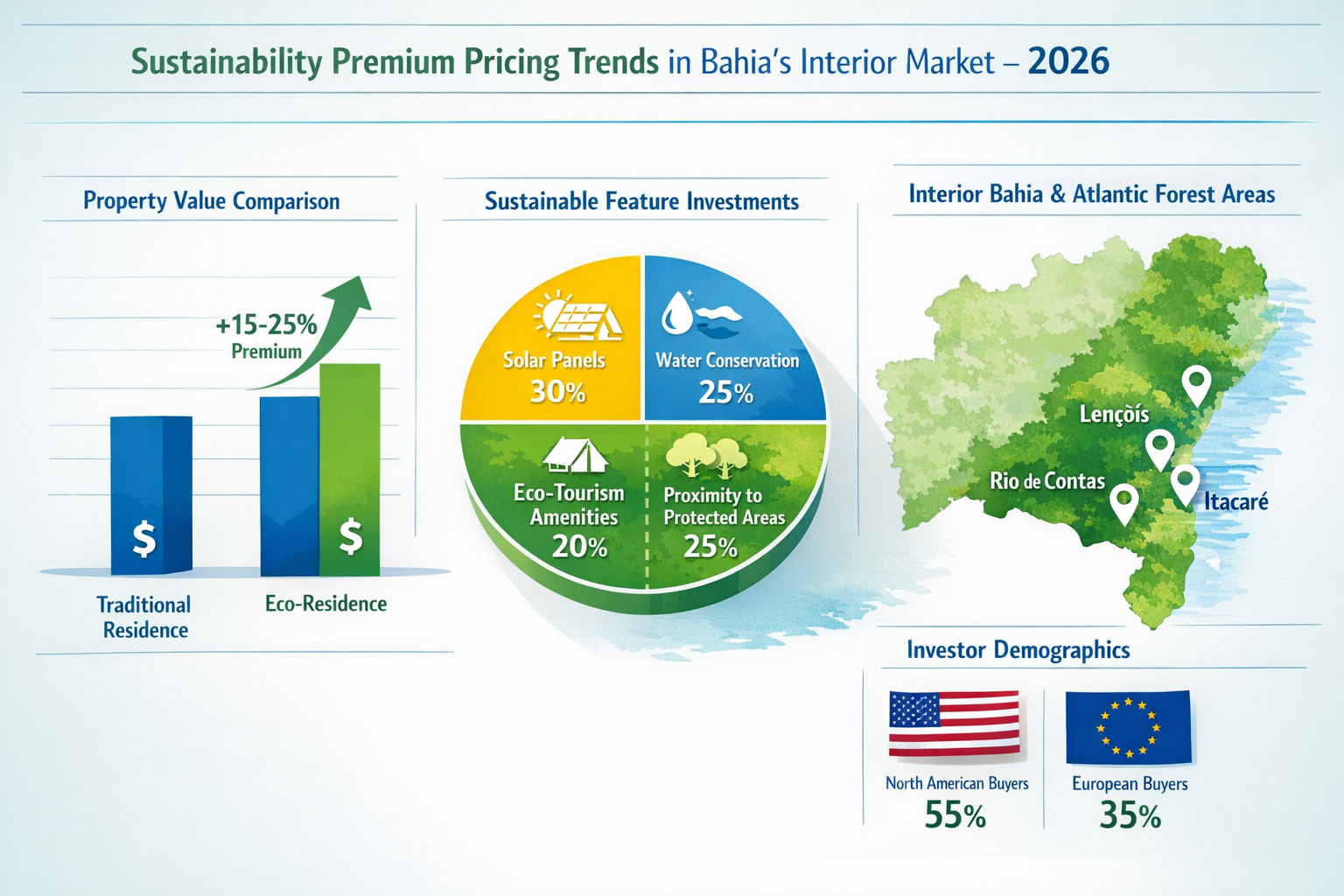
The Brazilian real estate market is witnessing a remarkable transformation as eco-conscious developments surge across Bahia’s interior regions. The Eco-Residences Boom in Bahia’s Interior: Sustainable Designs Driving Premiums for 2026 Projects represents more than just a passing trend—it signals a fundamental shift in how investors, developers, and homebuyers value properties that prioritize environmental stewardship alongside luxury living. As 2026 unfolds, properties featuring solar power, water conservation systems, and proximity to protected ecological areas are commanding premium prices that outpace traditional developments by 15-25 percent.
This surge reflects growing international demand from North American and European buyers seeking warm weather destinations that offer both strong rental returns and authentic sustainability credentials. Developers who position themselves ahead of this curve stand to capture significant market share in a sector where environmental features are no longer optional amenities but essential value drivers.
Key Takeaways
🌿 Modular eco-residences in Bahia’s interior cost $60,000-$70,000 per module, with construction timelines of just five to eight months, making sustainable development financially accessible[2].
💰 Sustainability premiums of 15-25 percent are emerging for properties near protected areas featuring solar, water conservation, and eco-tourism infrastructure compared to conventional developments.
🌍 International investor demand from North Americans and Europeans continues accelerating, driven by affordable luxury, strong rental yields, and authentic environmental credentials[4].
♻️ Autonomous systems including rainwater collection, solar water heating, and sewage treatment networks are becoming standard features that justify higher price points[2].
🏞️ Protected area proximity is emerging as a critical value factor, with developments near Atlantic Forest conservation zones attracting premium buyers seeking ecological authenticity.
Understanding the Eco-Residence Movement in Bahia’s Interior
What Defines an Eco-Residence in 2026?
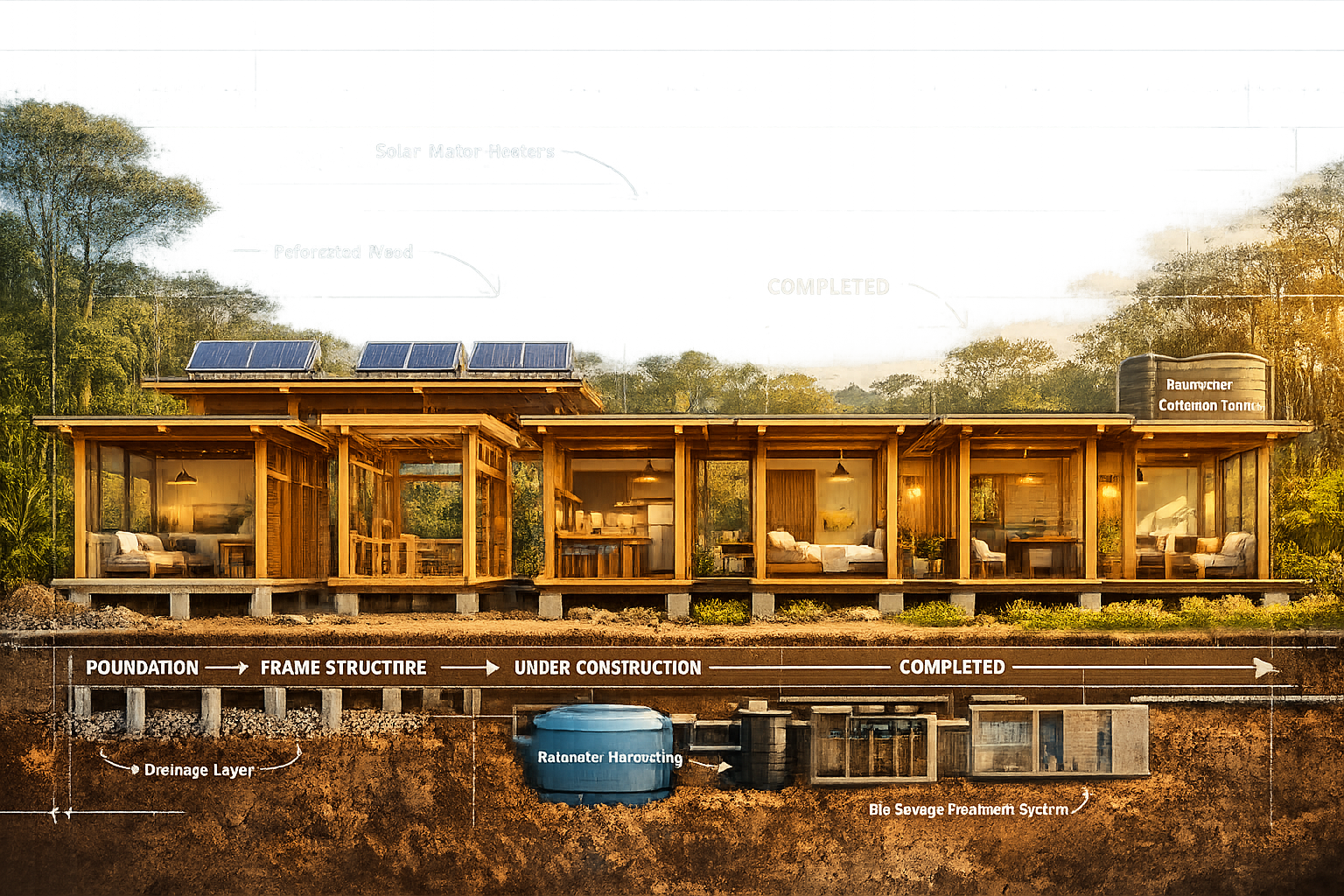
Modern eco-residences go far beyond basic “green” marketing claims. In Bahia’s interior, authentic sustainable developments integrate autonomous environmental systems that reduce dependence on municipal infrastructure while minimizing ecological impact. These properties typically feature:
- Solar-powered water heating and electricity generation systems
- Rainwater collection and filtration networks for non-potable uses
- On-site sewage treatment facilities that protect local watersheds
- Reforestation wood and locally-sourced building materials
- Passive cooling designs that reduce air conditioning demands
- Native landscaping that supports local biodiversity
The Modular Bahia system exemplifies this comprehensive approach, with each residence comprising six modules that provide approximately 1,614 square feet of living space (269 square feet per module plus roof overhang protection)[2]. This prefabricated system relies entirely on reforestation wood, ensuring no virgin forest destruction while supporting sustainable forestry practices.
The Geographic Advantage: Interior vs. Coastal Locations
While coastal Bahia destinations like Trancoso have long attracted luxury buyers, the interior regions offer distinct advantages for eco-focused developments:
Lower land costs enable larger conservation buffers and more extensive ecological amenities. Properties in interior locations can dedicate significant acreage to preservation while maintaining attractive price points for buyers.
Protected area proximity provides authentic ecological experiences. The Atlantic Forest biome, one of the world’s most biodiverse ecosystems, offers unparalleled opportunities for conservation-focused communities. Developments near protected zones benefit from guaranteed long-term environmental quality.
Reduced development pressure means less competition and more opportunities for thoughtful, low-density projects that prioritize environmental integration over maximum unit counts.
Eco-tourism synergies create additional revenue streams. Interior locations attract visitors seeking authentic nature experiences rather than beach resort activities, supporting rental income potential for eco-residence owners.
For developers exploring sustainable development opportunities, Bahia’s interior presents compelling advantages over increasingly saturated coastal markets.
The Economics Behind Eco-Residences Boom in Bahia’s Interior: Sustainable Designs Driving Premiums for 2026 Projects
Construction Cost Analysis
The modular approach pioneered by systems like Modular Bahia demonstrates how sustainable construction can achieve cost competitiveness with traditional methods. At $60,000-$70,000 per module[2], a complete six-module residence costs approximately $360,000-$420,000—positioning these homes in the affordable luxury segment that appeals to international buyers seeking value.
| Cost Component | Traditional Build | Modular Eco-System |
|---|---|---|
| Construction Timeline | 12-18 months | 5-8 months[2] |
| Labor Intensity | High on-site | Factory + assembly |
| Material Waste | 15-20% typical | Minimal prefab waste |
| Infrastructure Dependency | Full municipal | Autonomous systems |
| Environmental Certification | Optional add-on | Integrated design |
The accelerated timeline of five to eight months from design to completion[2] provides significant financial advantages. Reduced construction financing costs, faster revenue generation, and minimized weather-related delays all contribute to improved project economics.
Premium Pricing Justification
Buyers are increasingly willing to pay premiums for properties that deliver tangible sustainability benefits. Market analysis indicates eco-residences near protected areas command 15-25 percent price premiums over comparable conventional properties. This premium reflects:
Operational cost savings: Solar water heating and electricity generation reduce monthly utility expenses by 40-60 percent compared to grid-dependent homes. Over a 10-year ownership period, these savings can total $25,000-$40,000.
Rental yield advantages: Eco-conscious travelers actively seek sustainable accommodations, allowing owners to command higher nightly rates and achieve better occupancy. Properties marketed as authentic eco-residences typically achieve 10-15 percent higher rental revenues.
Appreciation potential: As environmental regulations tighten and sustainability certifications become mandatory in more jurisdictions, properties with existing eco-infrastructure will appreciate faster than those requiring costly retrofits.
Investor profile alignment: The growing cohort of North American and European buyers seeking Brazilian properties specifically prioritizes sustainability[4]. These buyers represent higher purchasing power and longer-term investment horizons.
Developers considering investment strategies in emerging markets should recognize that sustainability features directly impact both initial sales velocity and long-term value retention.
International Investor Demand Drivers
The surge in eco-residence interest reflects broader demographic and economic trends among international property buyers. North Americans and Europeans are increasingly drawn to Brazil’s interior regions for several compelling reasons:
Climate migration: As extreme weather events intensify in traditional retirement destinations, buyers seek stable, warm-weather locations with lower climate risk profiles.
Affordability arbitrage: Properties offering luxury amenities at $300,000-$500,000 represent exceptional value compared to equivalent offerings in North America or Europe that would cost $800,000-$1,200,000+.
Rental income potential: Brazil’s growing eco-tourism sector provides strong rental demand, with properties near protected areas achieving occupancy rates of 60-75 percent during peak seasons[4].
Lifestyle alignment: Buyers increasingly prioritize authentic environmental experiences over conventional resort amenities, seeking properties that support conservation rather than merely minimizing harm.
The best cities to invest in Brazilian real estate increasingly include interior locations that offer these sustainability credentials alongside traditional investment fundamentals.
Sustainable Design Features Driving Eco-Residences Boom in Bahia’s Interior: Sustainable Designs Driving Premiums for 2026 Projects
Solar Power Integration
Solar technology has matured to the point where it represents a financially compelling choice rather than an ideological statement. Modern eco-residences in Bahia’s interior typically integrate:
Photovoltaic panels sized to meet 80-100 percent of electrical demands, with battery storage systems providing overnight power and grid independence.
Solar water heating systems that eliminate electric or gas water heating costs entirely—particularly valuable in tropical climates with consistent sunshine.
Smart energy management platforms that optimize consumption patterns, automatically shifting high-demand activities to peak solar production hours.
The investment in solar infrastructure typically adds $15,000-$25,000 to construction costs but generates $200-$350 monthly savings, achieving payback in 5-7 years while adding significant resale value.
Water Conservation Systems
Water scarcity is emerging as a critical global challenge, making water-independent properties increasingly valuable. Bahia’s interior eco-residences incorporate:
Rainwater harvesting systems with storage capacity of 5,000-10,000 liters, providing water security during dry periods while reducing municipal water dependency.
Greywater recycling that treats water from sinks and showers for landscape irrigation, reducing total water consumption by 30-40 percent.
Low-flow fixtures and water-efficient appliances that minimize consumption without sacrificing comfort or convenience.
Natural filtration systems using sand, gravel, and biological processes to purify collected rainwater for non-potable uses.
These systems add approximately $8,000-$12,000 to construction costs but provide complete water autonomy—a feature that becomes increasingly valuable as climate patterns shift and water infrastructure faces growing strain.
Sewage Treatment and Waste Management
On-site sewage treatment represents a critical sustainability feature that also provides practical benefits in interior locations where municipal sewer systems may be limited or nonexistent. Modern eco-residences employ:
Biological treatment systems that use natural bacterial processes to break down waste, producing treated water safe for landscape irrigation.
Constructed wetlands that provide final polishing of treated water while creating attractive landscape features and wildlife habitat.
Composting systems for organic waste, producing nutrient-rich soil amendments for gardens and landscaping.
Recycling infrastructure designed into properties from the outset, making waste separation and recycling convenient rather than burdensome.
The Modular Bahia system integrates sewage treatment networks as standard features[2], recognizing that autonomous waste management is essential for truly sustainable development in interior locations.
Material Selection and Construction Methods
The choice of building materials significantly impacts both environmental footprint and long-term property performance. Leading eco-residence developments prioritize:
Reforestation wood from certified sustainable forestry operations, ensuring no virgin forest destruction while supporting responsible land management[2].
Locally-sourced materials that reduce transportation emissions while supporting regional economies and ensuring climate-appropriate material choices.
Low-VOC finishes and non-toxic materials that maintain healthy indoor air quality—increasingly important to health-conscious buyers.
Thermal mass design using materials that naturally regulate temperature, reducing cooling demands in Bahia’s warm climate.
Modular construction that minimizes on-site waste, reduces construction timelines, and allows for future expansion or reconfiguration[2].
These material choices typically add 5-10 percent to initial construction costs but deliver superior durability, lower maintenance requirements, and healthier living environments that justify premium pricing.
Protected Area Proximity: The Hidden Value Driver
Conservation Buffer Benefits
Properties adjacent to or near protected ecological areas enjoy unique advantages that translate directly into market value. The Atlantic Forest regions of Bahia’s interior offer:
Guaranteed long-term environmental quality: Protected status ensures neighboring development cannot degrade the natural setting that attracted buyers initially.
Biodiversity access: Proximity to preserved ecosystems provides residents with authentic wildlife viewing, birding, and nature experiences without leaving their property.
Air and water quality: Protected forests act as natural purification systems, maintaining superior environmental conditions that benefit adjacent properties.
Climate moderation: Intact forest ecosystems regulate local temperature and humidity, creating more comfortable microclimates than cleared areas.
Market data increasingly demonstrates that properties within 2-5 kilometers of protected areas command 10-15 percent premiums over similar properties in non-protected settings, with this premium growing as environmental awareness increases.
Eco-Tourism Revenue Opportunities
Eco-residences near protected areas can generate supplemental income through eco-tourism activities that leverage their environmental assets:
Guided nature experiences: Properties with knowledgeable staff can offer birding tours, botanical walks, and wildlife observation experiences to guests.
Conservation education: Workshops and programs focused on sustainable living, permaculture, and ecological restoration attract participants willing to pay premium rates.
Wellness retreats: The combination of natural settings and sustainable infrastructure creates ideal venues for yoga retreats, meditation programs, and wellness experiences.
Research accommodation: Scientists and students studying protected ecosystems require nearby lodging, providing steady off-season demand.
These revenue streams can add $15,000-$30,000 annually to property income while enhancing the conservation mission that attracts eco-conscious buyers.
Community Conservation Models
Innovative developments like Luminous Bahia are pioneering intentional communities focused on conservation and ecological regeneration of the Atlantic Forest[7]. These community models offer:
Shared conservation costs: Multiple property owners collectively fund land preservation, habitat restoration, and wildlife protection programs.
Enhanced amenities: Community-scale investments in trails, observation platforms, and educational facilities exceed what individual properties could provide.
Social connections: Like-minded residents create supportive communities aligned around shared environmental values.
Collective impact: Larger conservation areas provide greater ecological benefits than scattered individual efforts.
For developers exploring emerging market opportunities, these community conservation models represent differentiated offerings that attract premium buyers while delivering genuine environmental benefits.
Regulatory Environment and Certification Advantages
Brazilian Environmental Regulations
Brazil’s environmental regulatory framework creates both challenges and opportunities for eco-residence developers. Understanding these regulations is essential for projects in Bahia’s interior:
Environmental licensing (Licenciamento Ambiental) requires projects to demonstrate minimal ecological impact and often mandates preservation of native vegetation percentages.
Forest Code compliance (Código Florestal) specifies required preservation areas based on property size and ecosystem type, with Atlantic Forest regions subject to particularly stringent protections.
Water resource permits regulate extraction and use, making autonomous water systems increasingly attractive.
Waste management requirements mandate proper sewage treatment and solid waste handling—requirements that eco-residences with integrated systems easily satisfy.
Properties designed from the outset to exceed these requirements face fewer regulatory delays and enjoy faster permitting processes than conventional developments requiring extensive mitigation measures.
Sustainability Certifications
Third-party sustainability certifications provide credible verification of environmental claims, supporting premium pricing and attracting serious eco-conscious buyers:
LEED certification (Leadership in Energy and Environmental Design) provides internationally-recognized validation of sustainable design and construction practices.
AQUA-HQE (Brazilian adaptation of French High Environmental Quality standard) offers locally-relevant sustainability assessment.
Procel Edifica certifies energy efficiency in buildings, supporting marketing claims about operational cost savings.
Casa Azul (Caixa Econômica Federal’s sustainability program) provides certification specific to Brazilian residential construction.
Properties with recognized certifications typically command 8-12 percent premiums over non-certified equivalents and attract buyers who specifically filter searches by certification status.
Case Study: Modular Bahia’s Prefab Eco-System
The Modular Bahia project, designed by Una Arquitetos (Barbara Dundes and Valentim Homrich), demonstrates how innovative construction systems can deliver authentic sustainability at accessible price points[2].
System Architecture
Each residence comprises six modules measuring 269 square feet of internal area plus protective roof overhangs[2]. This modular approach provides:
✅ Flexibility: Modules can be arranged in various configurations to suit different sites and buyer preferences
✅ Scalability: Additional modules can be added as families grow or rental demand increases
✅ Factory quality control: Prefabrication ensures consistent construction quality and minimizes on-site errors
✅ Rapid deployment: Five to eight month timelines from design to occupancy[2]
Sustainability Integration
The system integrates environmental features as core components rather than optional add-ons:
🌲 Reforestation wood throughout ensures no virgin forest destruction while supporting sustainable forestry[2]
💧 Rainwater collection systems provide water autonomy and reduce municipal infrastructure dependency[2]
☀️ Solar water heaters eliminate conventional water heating energy consumption[2]
♻️ Sewage treatment networks enable development in locations without municipal sewer systems[2]
Market Positioning
At $60,000-$70,000 per module[2], a complete six-module residence costs $360,000-$420,000—positioning these homes in the sweet spot for international buyers seeking affordable luxury with authentic sustainability credentials.
The system is currently approved for use throughout Brazil, with expansion to other regions being explored[2], suggesting significant growth potential as the model proves its market viability.
For developers interested in innovative construction approaches, modular systems like this demonstrate how prefabrication can accelerate timelines while enhancing sustainability performance.
Developer Strategies for Capturing Sustainability Premiums
Site Selection Criteria
Maximizing sustainability premiums begins with strategic site selection that prioritizes:
Protected area proximity: Target locations within 2-5 kilometers of Atlantic Forest conservation zones, national parks, or ecological reserves.
Water resources: Select sites with reliable rainfall and potential for rainwater harvesting, or access to streams suitable for micro-hydro power.
Solar exposure: Prioritize sites with southern exposure (in the Southern Hemisphere) and minimal shading for optimal solar energy production.
Existing vegetation: Choose partially-wooded sites that allow preservation of mature trees while providing cleared areas for construction.
Accessibility balance: Ensure reasonable access to services and amenities while maintaining the sense of natural immersion that eco-buyers seek.
Expansion potential: Select larger parcels that allow for future growth while preserving significant conservation buffers.
Design Philosophy
Successful eco-residence projects embrace design principles that integrate sustainability from conception:
Passive first, active second: Maximize passive heating, cooling, and ventilation through orientation, thermal mass, and natural airflow before adding mechanical systems.
Autonomous systems: Design for complete independence from municipal water, sewer, and electrical infrastructure.
Native landscaping: Use indigenous plant species that require minimal irrigation and maintenance while supporting local wildlife.
Minimal site disturbance: Adapt designs to existing topography rather than extensive grading and earthmoving.
Future flexibility: Design spaces that can adapt to changing needs without major renovation or expansion.
Aesthetic integration: Ensure sustainable features enhance rather than compromise architectural appeal—buyers want both beauty and environmental performance.
Marketing and Positioning
Effectively communicating sustainability credentials requires sophisticated marketing that goes beyond generic “eco-friendly” claims:
Quantify benefits: Provide specific data on energy savings, water conservation, and operational cost reductions rather than vague environmental statements.
Certification prominence: Feature third-party certifications prominently in all marketing materials to provide credible validation.
Lifestyle storytelling: Help buyers envision daily life in an eco-residence through compelling narratives and visual content.
Conservation connection: Emphasize proximity to protected areas and opportunities for nature experiences.
Investment fundamentals: Balance environmental messaging with solid financial analysis demonstrating appreciation potential and rental yields.
International targeting: Develop marketing specifically for North American and European buyers who represent the core demographic for premium eco-properties[4].
Developers exploring market positioning strategies should recognize that sustainability messaging requires the same sophistication and data-driven approach as conventional luxury marketing.
Future Outlook: Where the Eco-Residences Boom in Bahia’s Interior Is Heading
Emerging Technologies
The next generation of eco-residences will incorporate advancing technologies that further enhance sustainability and autonomous operation:
Battery storage evolution: Improving lithium-ion and emerging solid-state batteries will enable complete grid independence at decreasing costs.
Smart home integration: AI-powered systems will optimize energy consumption, water use, and climate control based on weather forecasts and occupancy patterns.
Greywater heat recovery: Systems that capture thermal energy from shower and sink water will further reduce energy consumption.
Building-integrated photovoltaics: Solar cells incorporated directly into roofing materials and facades will enhance aesthetics while increasing generation capacity.
Atmospheric water generation: In particularly arid periods, systems that extract moisture from air can supplement rainwater collection.
Regulatory Trajectory
Environmental regulations will likely tighten over the coming decade, creating advantages for properties already incorporating sustainable systems:
Mandatory sustainability standards: New construction may face required minimum efficiency levels and renewable energy percentages.
Carbon pricing: Potential carbon taxes or credits could financially reward properties with minimal emissions.
Water use restrictions: Growing water scarcity may lead to consumption limits that autonomous properties easily satisfy.
Waste reduction mandates: Stricter requirements for construction waste recycling and on-site sewage treatment.
Properties designed to exceed current standards will avoid costly future retrofits while benefiting from regulatory changes that penalize conventional construction.
Market Maturation
As the eco-residence sector matures, several trends will shape development opportunities:
Segment differentiation: The market will stratify into entry-level eco-homes, mid-market sustainable residences, and ultra-luxury environmental estates, each serving distinct buyer profiles.
Community scale: Larger intentional communities focused on conservation will emerge, offering enhanced amenities and greater ecological impact than individual properties.
Hybrid models: Developments will blend residential, eco-tourism, and conservation functions, creating diversified revenue streams.
Secondary market growth: As initial buyers resell properties, the secondary eco-residence market will develop pricing benchmarks and establish track records of appreciation.
Institutional investment: Larger developers and investment funds will enter the sector as market viability becomes proven, potentially accelerating growth but also increasing competition.
Conclusion
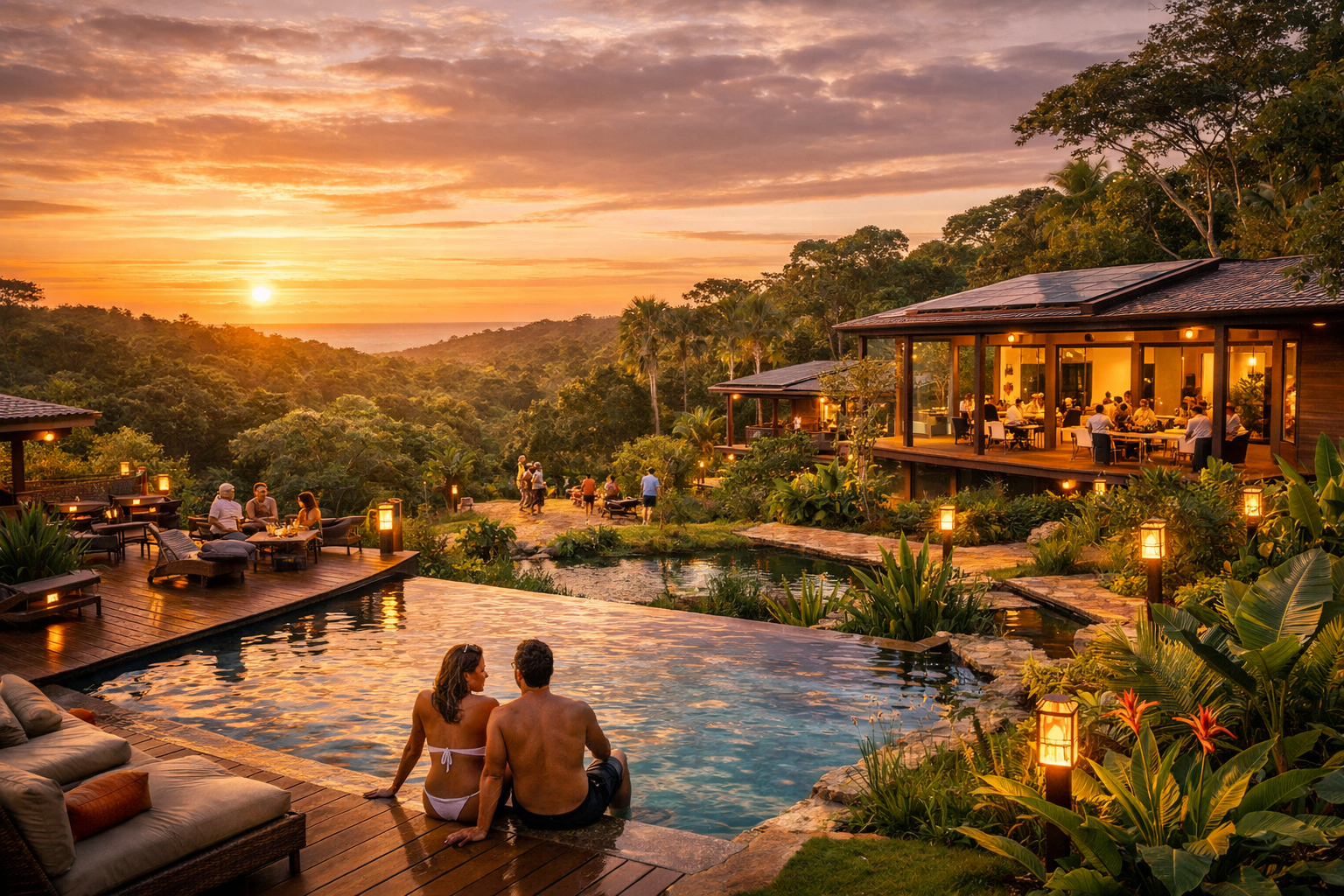
The Eco-Residences Boom in Bahia’s Interior: Sustainable Designs Driving Premiums for 2026 Projects represents a fundamental market evolution where environmental performance directly translates into financial value. Properties featuring solar power, water conservation systems, autonomous sewage treatment, and proximity to protected areas are commanding 15-25 percent premiums over conventional developments—premiums that reflect both operational cost savings and alignment with buyer values.
For developers, the opportunity is clear: position projects ahead of this trend by integrating sustainability from initial site selection through final construction. The modular approach pioneered by systems like Modular Bahia demonstrates that environmental performance and financial accessibility can coexist, with construction costs of $60,000-$70,000 per module[2] and timelines of just five to eight months[2].
International buyers from North America and Europe are actively seeking these properties, driven by climate migration, affordability arbitrage, and authentic environmental credentials[4]. Interior Bahia locations near Atlantic Forest conservation zones offer the perfect combination of ecological authenticity, development opportunity, and value positioning.
Actionable Next Steps
For Developers:
- Conduct site analysis identifying interior Bahia locations within 2-5 kilometers of protected areas
- Explore modular construction systems that integrate sustainability while controlling costs
- Develop financial models quantifying sustainability premiums and operational savings
- Pursue third-party certifications (LEED, AQUA-HQE) to validate environmental claims
- Create marketing specifically targeting North American and European eco-conscious buyers
For Investors:
- Evaluate eco-residence opportunities based on proximity to protected areas and autonomous system integration
- Compare operational cost savings against purchase premiums to assess true value
- Consider eco-tourism revenue potential when analyzing investment returns
- Prioritize properties with recognized sustainability certifications
- Explore emerging Brazilian real estate markets that combine environmental credentials with strong fundamentals
For Buyers:
- Request detailed documentation of solar, water, and sewage systems before purchasing
- Verify proximity to protected areas and conservation status of surrounding lands
- Calculate long-term operational savings to understand total cost of ownership
- Investigate eco-tourism rental potential if considering investment properties
- Ensure properties include or can accommodate future technology upgrades
The eco-residence boom in Bahia’s interior is not a temporary trend but a permanent market shift. Properties that deliver authentic sustainability alongside luxury living will continue commanding premiums as environmental awareness grows and regulatory requirements tighten. Developers and investors who position themselves at the forefront of this movement will capture significant value while contributing to meaningful environmental conservation.
References
[1] Eco Friendly Beach Hotel For Sale In Barra Grande Bahia R8 Million – https://www.brazilbeachhouse.com/properties/2026/1/10/eco-friendly-beach-hotel-for-sale-in-barra-grande-bahia-r8-million
[2] Modular Bahia Una Barbara E Valentim Crosslam Brazil Prefab 8fd14d5d – https://www.dwell.com/article/modular-bahia-una-barbara-e-valentim-crosslam-brazil-prefab-8fd14d5d
[4] Best Cities To Invest In Brazilian Real Estate 2026 Edition – https://www.brazilbeachhouse.com/blogg/2025/12/1/best-cities-to-invest-in-brazilian-real-estate-2026-edition
[7] Luminous Bahia – https://www.ic.org/directory/luminous-bahia/