
The global real estate landscape is experiencing a profound transformation, and nowhere is this shift more evident than in Brazil’s property market. ESG and Sustainability Premium: Why International Buyers Are Paying More for Eco-Certified Brazilian Properties in 2026 represents a fundamental change in how international investors—particularly from Europe—evaluate and acquire Brazilian real estate. This phenomenon combines environmental consciousness with strategic investment, creating unprecedented opportunities for developers and property owners who embrace sustainable building practices.
European investors are increasingly targeting ESG-compliant Brazilian properties with sustainable building materials and solar energy systems, creating a pricing premium that developers can capitalize on. This trend reflects a broader global movement toward responsible investing, where environmental, social, and governance factors directly influence property valuations and buyer decisions.
Key Takeaways
- Eco-certified properties command 10-12% higher prices than conventional units in Brazilian markets, with international buyers driving this premium [2]
- European investors enjoy effective 30-50% currency discounts on Brazilian real estate compared to similar properties in Miami or Lisbon, amplifying the appeal of premium eco-certified properties [1]
- 50% of new developments in major Brazilian cities are incorporating eco-friendly elements by 2025, indicating mainstream market adoption [2]
- Nature-connected properties near protected areas and sustainable resort developments are predicted to command the highest premiums in 2026 [3]
- Secondary and coastal markets are experiencing explosive growth as international buyers target ESG-compliant properties for investment portfolios [3]
Understanding the ESG and Sustainability Premium in Brazilian Real Estate
What Defines an ESG-Compliant Property?
Environmental, Social, and Governance (ESG) criteria have evolved from corporate buzzwords to concrete investment standards in the real estate sector. In Brazil’s 2026 market, ESG-compliant properties incorporate specific measurable features that distinguish them from conventional developments.
Environmental criteria include:
- ✅ Solar energy systems and renewable power integration
- ✅ Water conservation technologies and rainwater harvesting
- ✅ Sustainable building materials with low carbon footprints
- ✅ Energy-efficient appliances and smart home systems
- ✅ Green spaces and native landscaping that support biodiversity
Social criteria encompass:
- 🏘️ Community integration and local employment during construction
- 🏘️ Accessibility features for diverse populations
- 🏘️ Proximity to public transportation and essential services
- 🏘️ Support for local artisans and sustainable supply chains
Governance criteria involve:
- 📋 Transparent development processes and certifications
- 📋 Third-party verification of sustainability claims
- 📋 Compliance with international building standards
- 📋 Long-term maintenance plans for sustainable features
The 2026 market is experiencing an accelerating trend toward properties meeting these ESG criteria, with international buyers particularly from Europe increasingly sensitive to sustainability factors [3].
The Quantifiable Premium: Numbers That Matter
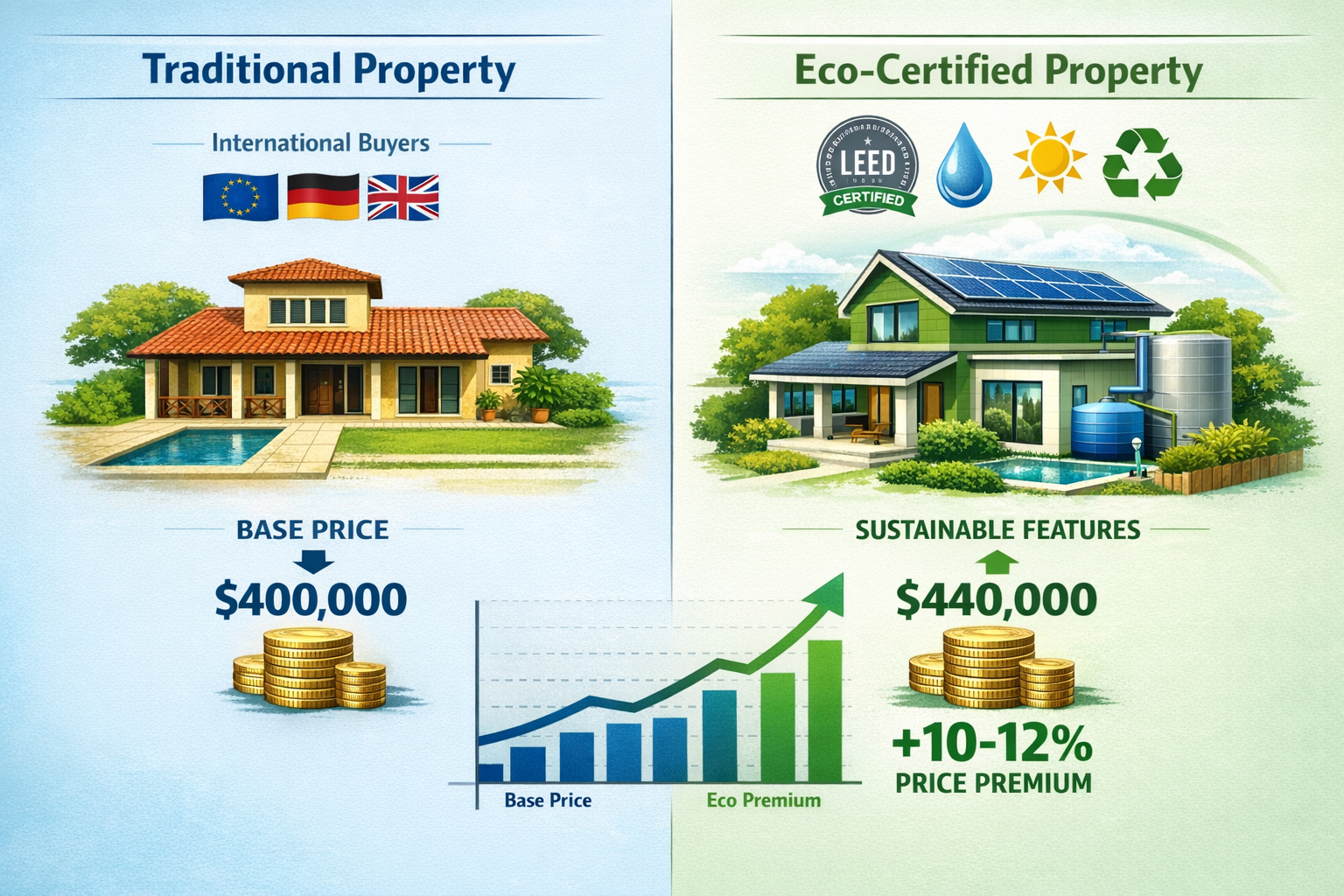
The sustainability premium in Brazilian real estate is not theoretical—it’s backed by concrete market data. Properties featuring eco-friendly elements command 10-12% higher prices than conventional units in Brasília’s market as of 2025 [2]. This premium reflects both the tangible benefits of reduced operating costs and the intangible value that environmentally conscious buyers place on sustainable living.
| Property Type | Conventional Price | Eco-Certified Price | Premium Percentage |
|---|---|---|---|
| Luxury Apartment | R$ 1,000,000 | R$ 1,100,000-1,120,000 | 10-12% |
| Coastal Villa | R$ 2,500,000 | R$ 2,750,000-2,800,000 | 10-12% |
| Resort Unit | R$ 750,000 | R$ 825,000-840,000 | 10-12% |
This premium extends beyond purchase price to include faster sales cycles, higher occupancy rates for rental properties, and superior long-term appreciation. For developers and investors exploring best places to invest in Brazil property, understanding this premium is essential for maximizing returns.
Mainstream Market Adoption
By 2025, approximately 50% of new developments in Brasília are expected to incorporate eco-friendly elements, indicating a mainstream market shift toward sustainability [2]. This rapid adoption signals that sustainable features are transitioning from luxury differentiators to standard expectations, particularly in markets targeting international buyers.
The implications for developers are clear: properties without ESG compliance may face discount pressure in coming years, while eco-certified developments will maintain premium positioning. This creates a compelling incentive for developers to integrate sustainable features from the planning stage rather than retrofitting later.
Why International Buyers Are Driving the ESG Premium in 2026
European Investor Preferences and Regulatory Pressures
International buyers are driving demand for projects incorporating sustainable building materials, water conservation systems, and solar energy, particularly from European markets [3]. This preference stems from multiple factors that make European investors uniquely positioned to value ESG-compliant Brazilian properties.
Regulatory familiarity: European investors operate in markets where ESG compliance is increasingly mandatory. The European Union’s Sustainable Finance Disclosure Regulation (SFDR) and taxonomy for sustainable activities have created a generation of investors who automatically evaluate properties through an ESG lens.
Portfolio diversification: European institutional investors and high-net-worth individuals seek geographic diversification while maintaining ESG standards. Brazilian eco-certified properties offer exposure to emerging market growth without compromising sustainability commitments.
Value alignment: Beyond regulations, many European buyers personally prioritize environmental responsibility. For these investors, ESG compliance is non-negotiable, and they willingly pay premiums for properties that align with their values.
The Brazil property market in 2026 has adapted to these preferences by increasing the supply of certified sustainable developments, particularly in regions popular with international buyers.
The Currency Advantage Amplifying Premium Appeal
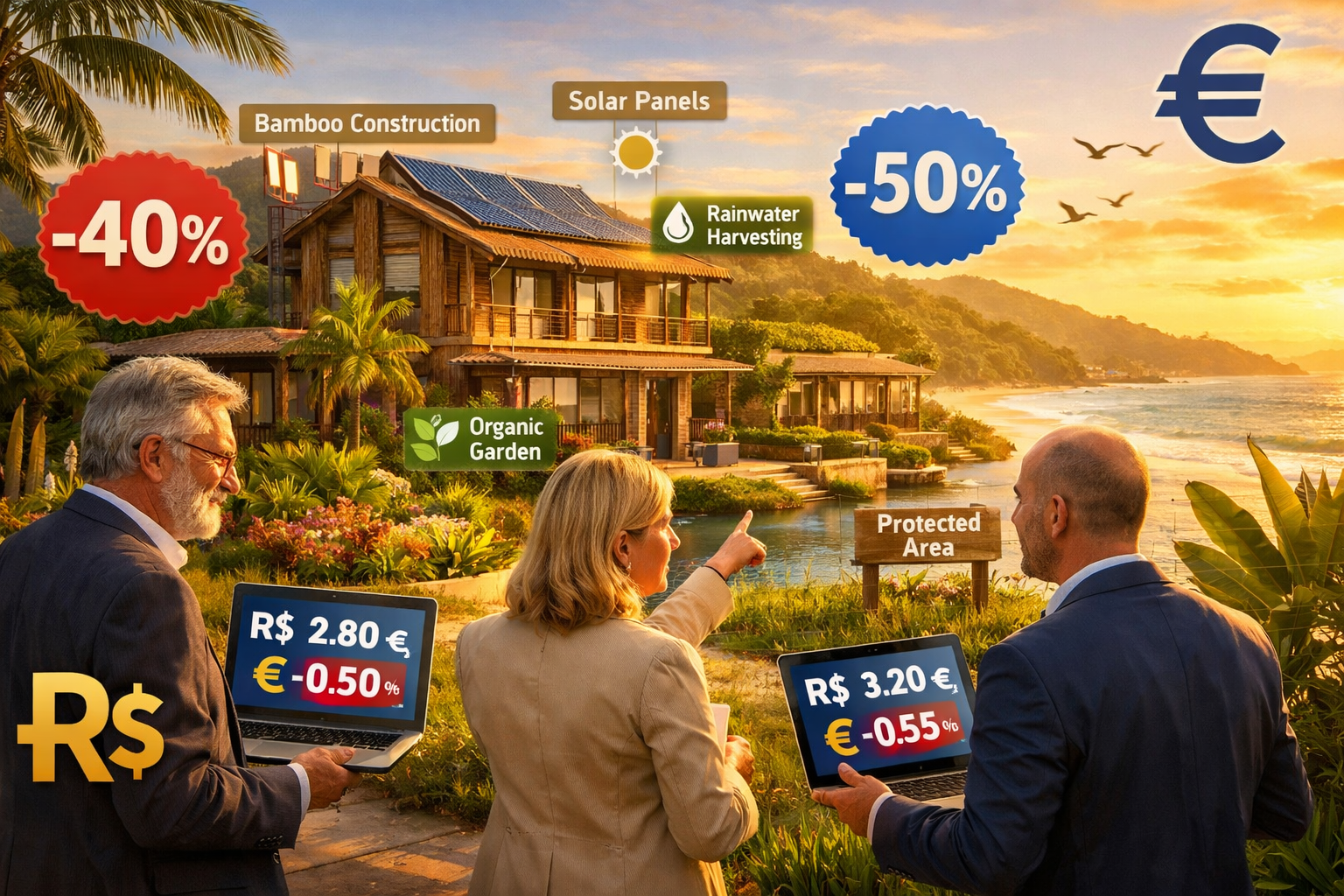
International buyers currently enjoy an effective 30-50% discount on Brazilian real estate compared to similar properties in Miami or Lisbon due to the weak Brazilian Real [1]. This currency advantage creates a unique opportunity where buyers can afford both the base property price and the sustainability premium while still achieving significant savings compared to their home markets.
“The combination of currency discounts and sustainability premiums creates a sweet spot for European investors. They’re paying 10-12% more for eco-certified properties but still saving 30-50% overall compared to European markets—and they’re getting properties that meet their ESG requirements.”
This dynamic explains why international buyers are disproportionately represented in the premium eco-certified segment. They can absorb the sustainability premium more easily than domestic buyers while securing properties that would be prohibitively expensive in their home countries.
Investment Performance and Long-Term Value
European investors recognize that ESG-compliant properties deliver superior long-term performance through multiple channels:
Lower operating costs: Solar energy systems, water conservation technologies, and energy-efficient designs reduce ongoing expenses by 20-40%, improving net rental yields.
Higher occupancy rates: Eco-certified properties attract premium tenants willing to pay above-market rents for sustainable living environments, particularly in the short-term rental market.
Appreciation potential: As ESG standards become mainstream, properties with established certifications and sustainable infrastructure will appreciate faster than conventional alternatives.
Regulatory future-proofing: Properties meeting current ESG standards are better positioned for future regulatory requirements, reducing obsolescence risk.
For investors considering cryptocurrency and real estate investment opportunities, the ESG premium represents another dimension of value creation in Brazilian property markets.
Geographic Hotspots for ESG and Sustainability Premium Properties
Coastal Markets Leading the Transformation
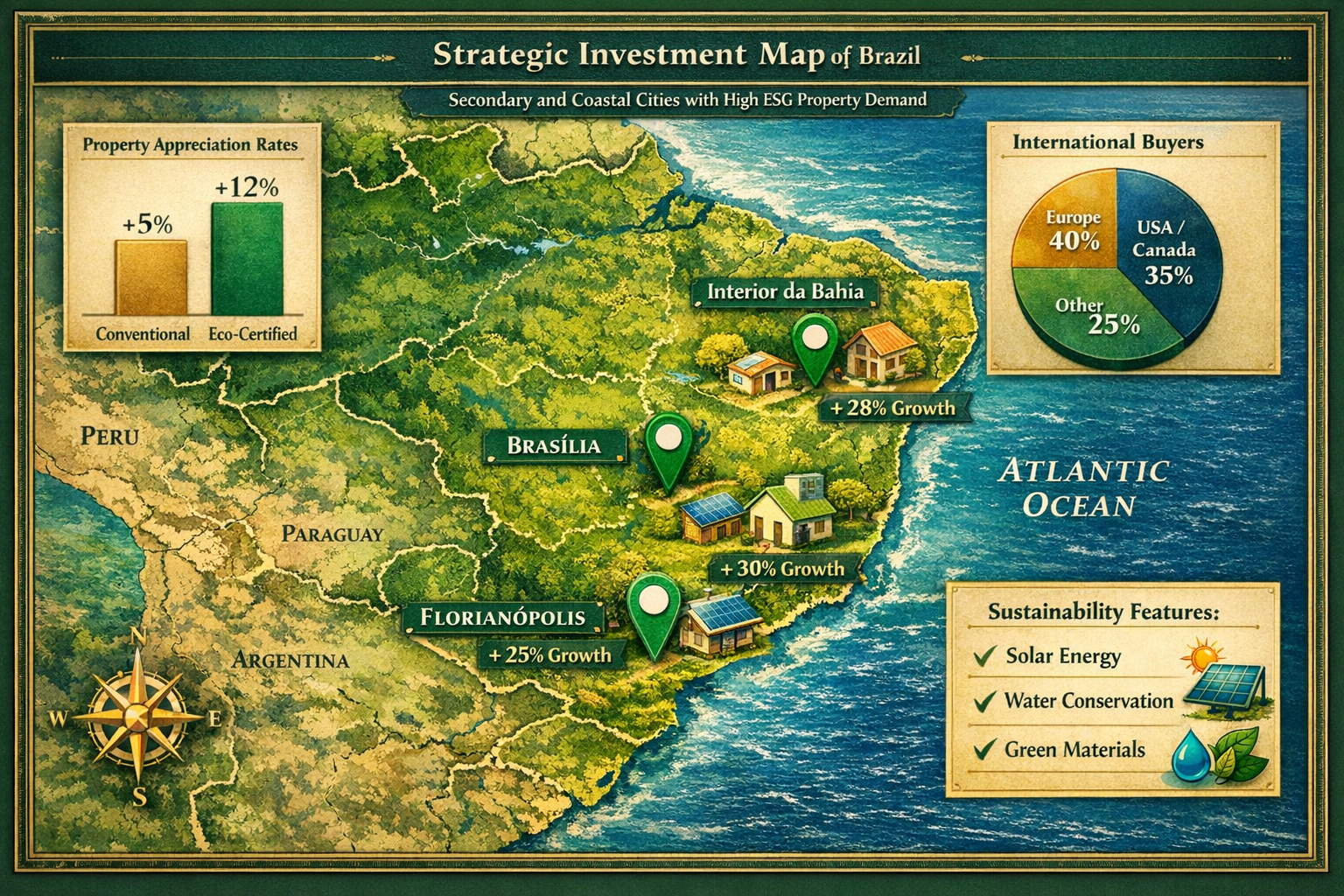
Secondary and coastal cities where supply struggles to meet international and short-term rental demand are forecasted to see the most explosive returns, with international buyers specifically targeting these properties [3]. These markets combine natural beauty with development potential, creating ideal conditions for premium eco-certified projects.
Florianópolis stands out as a premier destination for sustainable development. The city’s natural environment, including beaches, mountains, and protected areas, creates inherent demand for properties that respect and integrate with the ecosystem. International buyers targeting Florianópolis specifically seek developments that preserve the region’s environmental character while providing modern amenities.
The growth of regions like Ingleses in Florianópolis demonstrates how infrastructure improvements combined with environmental preservation create premium property values. Properties in these areas that incorporate sustainable design command the highest premiums from international buyers.
Bahia’s interior regions offer another compelling opportunity. Properties located near protected areas or offering genuine connection to nature—such as properties in the interior of Bahia or resort developments focused on ecological tourism—are predicted to command premium prices [3]. These developments appeal to European buyers seeking authentic nature experiences combined with luxury amenities.
Urban Centers Embracing Sustainability
Brasília has emerged as a laboratory for sustainable urban development. The city’s planned infrastructure and relatively recent construction make it easier to integrate modern ESG features. The fact that 50% of new developments incorporate eco-friendly elements demonstrates the market’s rapid evolution [2].
For developers and investors, Brasília offers a template for how urban markets can transition to sustainability-focused development. The 10-12% premium commanded by eco-certified properties provides clear financial incentive for incorporating sustainable features [2].
São Paulo and Rio de Janeiro are also experiencing ESG transformation, though the premium dynamics differ due to market maturity and existing building stock. In these cities, retrofit projects that add sustainable features to existing buildings are becoming increasingly common, though new eco-certified developments still command the highest premiums.
Resort and Nature-Connected Developments
Properties that offer genuine connection to nature represent the highest tier of the ESG premium market. These developments combine luxury amenities with environmental stewardship, creating unique value propositions for international buyers.
Ecological resort developments integrate sustainable architecture with natural landscapes, offering buyers the opportunity to own property in pristine environments while minimizing environmental impact. Features like:
- 🌴 Native landscaping that supports local biodiversity
- 🌴 Minimal site disruption during construction
- 🌴 Integration with protected areas and conservation initiatives
- 🌴 Eco-tourism infrastructure that generates sustainable income
These properties command the highest premiums because they’re inherently limited in supply—truly pristine natural locations suitable for development are finite, and ESG-compliant development in these areas requires significant expertise and investment.
Those exploring life in Florianópolis will find that nature-connected properties offer both lifestyle benefits and investment performance, particularly when targeting international buyers who prioritize environmental values.
Specific ESG Features Commanding the Highest Premiums
Solar Energy Systems and Renewable Power
Solar energy integration represents one of the most valued ESG features for international buyers. Brazil’s abundant sunshine makes solar power exceptionally cost-effective, with systems typically achieving payback periods of 5-7 years while providing decades of free electricity.
Premium impact: Properties with comprehensive solar systems command 3-5% additional premium beyond the base ESG premium, particularly when systems cover 80%+ of energy needs.
Buyer appeal: European investors familiar with solar incentives in their home markets immediately recognize the value proposition. They understand both the environmental benefits and the financial returns from reduced energy costs.
Technical considerations: The most valued solar installations include:
- High-efficiency panels with 25+ year warranties
- Battery storage systems for energy independence
- Smart monitoring systems accessible via mobile apps
- Grid-tie capabilities allowing energy sale to utilities
Developers incorporating solar energy from the planning stage can market properties as “net-zero” or “energy-positive,” terms that resonate strongly with ESG-focused buyers.
Water Conservation and Management Systems
Water scarcity concerns make conservation systems increasingly valuable, particularly in regions experiencing climate variability. International buyers view water management as both environmental responsibility and risk mitigation.
Rainwater harvesting: Systems that collect, filter, and store rainwater for irrigation and non-potable uses reduce municipal water consumption by 40-60%. These systems are relatively inexpensive to install during construction but difficult to retrofit, giving new eco-certified developments a distinct advantage.
Greywater recycling: Advanced developments incorporate systems that treat and reuse water from sinks and showers for toilet flushing and irrigation, further reducing water consumption.
Native landscaping: Properties using drought-resistant native plants rather than water-intensive lawns reduce irrigation needs by 70-80% while supporting local ecosystems.
Premium impact: Comprehensive water management systems add 2-4% to property values, with the premium highest in regions experiencing water stress or where municipal water costs are rising.
Sustainable Building Materials and Construction
The materials used in construction significantly impact a property’s environmental footprint and long-term performance. International buyers increasingly scrutinize material choices, seeking properties built with:
Low-carbon concrete: Alternative concrete formulations that reduce CO2 emissions by 30-70% compared to traditional Portland cement.
Sustainably sourced timber: Wood products certified by the Forest Stewardship Council (FSC) or similar organizations, ensuring responsible forestry practices.
Recycled and local materials: Using recycled content and locally sourced materials reduces transportation emissions and supports regional economies.
Non-toxic finishes: Low-VOC paints, natural flooring materials, and formaldehyde-free products improve indoor air quality and occupant health.
Premium impact: While sustainable materials may increase construction costs by 5-8%, they enable developers to command 8-12% premiums from ESG-focused buyers, creating net positive returns.
For those interested in buying pre-construction properties, selecting developments that specify sustainable materials from the planning stage ensures access to the ESG premium market.
Certification Systems and Third-Party Verification
International Certification Standards
Third-party certification provides credible verification of ESG claims, significantly increasing buyer confidence and property premiums. The most recognized certification systems in Brazil’s international market include:
LEED (Leadership in Energy and Environmental Design): The most widely recognized green building certification globally, LEED certification signals to international buyers that a property meets rigorous sustainability standards. LEED-certified properties command 5-8% premiums beyond non-certified sustainable properties.
AQUA-HQE: Brazil’s adaptation of the French HQE (High Environmental Quality) certification, AQUA-HQE is particularly valued by European buyers familiar with the original French system.
Procel Edifica: Brazil’s national energy efficiency certification program, while less known internationally, provides valuable verification of energy performance.
EDGE (Excellence in Design for Greater Efficiencies): Focused on emerging markets, EDGE certification demonstrates measurable resource savings in water, energy, and materials.
The Certification Premium
Properties with recognized third-party certifications command measurable premiums:
| Certification Level | Premium Range | Buyer Segment |
|---|---|---|
| LEED Platinum | 12-15% | Ultra-high-net-worth international |
| LEED Gold | 10-13% | High-net-worth international |
| LEED Silver | 8-11% | International and domestic premium |
| AQUA-HQE | 9-12% | European buyers specifically |
| EDGE | 6-9% | Emerging market investors |
These premiums are additive to location and property-specific factors, meaning a well-located eco-certified property can command substantial total premiums compared to conventional alternatives.
Documentation and Transparency
Beyond formal certifications, international buyers value comprehensive documentation of sustainable features:
- 📊 Energy performance data and modeling
- 📊 Water consumption projections and actual usage
- 📊 Material sourcing documentation and certifications
- 📊 Construction waste management and recycling reports
- 📊 Indoor air quality testing results
- 📊 Long-term maintenance plans for sustainable systems
Developers who provide detailed sustainability documentation differentiate their properties and build buyer confidence, facilitating faster sales at premium prices.
Market Dynamics and Investment Strategies for 2026
Supply-Demand Imbalances Creating Opportunity
The rapid increase in international buyer demand for ESG-certified properties is outpacing supply growth in key markets, creating favorable conditions for developers and early investors. While 50% of new developments incorporate eco-friendly elements [2], truly comprehensive ESG-certified properties with third-party verification remain scarce.
This supply-demand imbalance manifests in several ways:
Faster sales cycles: Eco-certified properties in prime locations often sell during pre-construction phases, with international buyers willing to commit based on sustainability specifications and certifications.
Bidding competition: Limited inventory of certified sustainable properties in desirable locations creates competitive bidding situations, pushing prices above asking levels.
Developer pricing power: Developers with established track records in sustainable construction can command higher margins and pre-sell inventory more readily.
For investors exploring high-return property locations in Brazil, focusing on markets with strong international buyer presence and limited eco-certified supply offers optimal risk-reward profiles.
The Short-Term Rental Factor
International buyers increasingly target ESG-certified properties for short-term rental income, particularly in coastal and resort markets. This strategy combines:
Premium nightly rates: Eco-certified properties command 15-25% higher nightly rates on platforms like Airbnb and Vrbo, as travelers increasingly seek sustainable accommodations.
Higher occupancy: Properties marketed with authentic sustainability credentials attract environmentally conscious travelers, a growing demographic willing to pay premiums for eco-friendly stays.
Regulatory advantages: Some Brazilian municipalities are implementing preferential regulations for certified sustainable short-term rentals, including streamlined permitting and lower fees.
Marketing differentiation: Sustainability certifications provide compelling marketing narratives that help properties stand out in crowded short-term rental markets.
The combination of purchase price premiums and superior rental performance creates attractive total returns for international investors who can access favorable currency exchange rates [1].
Portfolio Diversification and Risk Management
European institutional investors view ESG-certified Brazilian properties as portfolio diversification tools that provide:
Geographic exposure: Access to emerging market growth while maintaining ESG compliance requirements.
Currency diversification: Real-denominated assets provide hedge against euro concentration.
Inflation protection: Real estate with hard assets (solar panels, water systems) provides inflation hedge superior to conventional properties.
Regulatory alignment: Properties meeting international ESG standards reduce compliance risk as regulations tighten globally.
Climate resilience: Sustainable design features like water conservation and renewable energy provide resilience against climate-related risks.
These factors explain why institutional capital is increasingly flowing into Brazilian eco-certified developments, further supporting premium valuations.
Developer Strategies for Capturing the ESG Premium
Integrating Sustainability from Planning Stage
The highest ESG premiums accrue to developments where sustainability is integrated from initial planning rather than added as afterthought. Successful developers follow these principles:
Site selection: Choose locations that minimize environmental disruption while maximizing natural amenities. Properties near protected areas or with genuine nature connections command highest premiums [3].
Master planning: Design communities that reduce car dependency through walkability, mixed-use development, and public transportation access.
Infrastructure investment: Install community-level sustainable systems (solar farms, water treatment, waste management) that serve multiple properties, reducing per-unit costs while maximizing environmental impact.
Architectural integration: Work with architects experienced in sustainable design to create buildings where eco-features enhance rather than compromise aesthetics.
Developments like Tramonto demonstrate how thoughtful integration of sustainable features from the planning stage creates properties that appeal to international buyers seeking both environmental responsibility and luxury.
Marketing to International ESG-Focused Buyers
Capturing the ESG premium requires targeted marketing that reaches international buyers and communicates sustainability value effectively:
Digital presence: Develop multilingual websites with detailed sustainability documentation, certifications, and performance data. European buyers conduct extensive online research before engaging with properties.
Certification prominence: Feature third-party certifications prominently in all marketing materials, using recognized logos and clear explanations of what certifications mean.
Performance data: Provide concrete numbers on energy savings, water conservation, and carbon footprint reduction. European buyers respond to quantifiable sustainability metrics.
Virtual tours: Offer comprehensive virtual tours highlighting sustainable features, allowing international buyers to evaluate properties remotely.
Partnership with international brokers: Work with real estate agencies specializing in European clients who understand ESG requirements and can effectively communicate property value.
Sustainability storytelling: Create compelling narratives around how properties integrate with natural environments, support local communities, and contribute to environmental preservation.
Financial Structuring and Pricing
Developers must carefully structure pricing to capture ESG premiums while remaining competitive:
Transparent cost breakdown: Show buyers how sustainable features add value through reduced operating costs and environmental benefits, justifying premium pricing.
Flexible payment terms: Offer payment structures that accommodate international buyers, including cryptocurrency options as explored in crypto and real estate development.
Performance guarantees: Provide warranties on sustainable system performance (solar output, water savings) that give buyers confidence in long-term value.
Resale support: Offer programs that help buyers market sustainability features when reselling, protecting premium values long-term.
Challenges and Considerations
Greenwashing Risks and Buyer Skepticism
As ESG premiums grow, the risk of “greenwashing”—making misleading sustainability claims—increases. International buyers are increasingly sophisticated and skeptical of unverified claims.
Mitigation strategies:
- Obtain third-party certifications from recognized organizations
- Provide detailed documentation and performance data
- Offer post-occupancy verification of sustainability performance
- Build track record through multiple certified projects
Developers who establish reputations for authentic sustainability will command the highest premiums and fastest sales.
Cost-Benefit Analysis for Developers
While eco-certified properties command 10-12% premiums [2], sustainable features increase construction costs. Developers must carefully analyze whether premiums justify investments:
Favorable scenarios:
- Markets with strong international buyer presence
- Locations where sustainable features align with natural environment
- Projects targeting premium buyer segments
- Developments with scale to amortize certification costs
Challenging scenarios:
- Markets dominated by price-sensitive domestic buyers
- Locations where sustainable features conflict with buyer expectations
- Small-scale projects where certification costs are prohibitive
For most developers targeting international buyers in prime locations, the ESG premium substantially exceeds incremental costs, creating compelling business cases for sustainable development.
Regulatory Evolution and Future-Proofing
Brazil’s environmental regulations are evolving, with increasing requirements for sustainable development. Properties built to current best practices will be better positioned for future regulatory changes.
Anticipated regulatory trends:
- Mandatory energy efficiency standards for new construction
- Water conservation requirements in drought-prone regions
- Waste reduction and recycling mandates
- Carbon footprint disclosure requirements
- Incentives for renewable energy integration
Developers who exceed current requirements position properties to maintain premiums as regulations tighten and conventional properties face compliance costs.
Future Outlook: ESG Premium Trajectory Through 2026 and Beyond
Accelerating Adoption and Mainstream Integration
The trajectory for ESG premiums in Brazilian real estate points toward continued growth and mainstream adoption. Several factors support this outlook:
Increasing buyer awareness: As climate change impacts become more evident, buyer preference for sustainable properties will intensify, expanding beyond European investors to include North American and Asian buyers.
Regulatory momentum: Both Brazilian and international regulations are moving toward mandatory ESG disclosure and compliance, making certified properties increasingly valuable.
Technology advancement: Improving solar efficiency, battery storage, and smart home technologies will make sustainable features more cost-effective and attractive.
Generational wealth transfer: Younger buyers inheriting wealth disproportionately prioritize sustainability, ensuring long-term demand for ESG-certified properties.
The Florianópolis real estate market trends suggest that sustainability will transition from premium differentiator to baseline expectation in coming years, with properties lacking ESG features facing discount pressure.
Premium Sustainability Becoming Standard Sustainability
An interesting dynamic is emerging where today’s “premium” sustainable features become tomorrow’s standard expectations. Features that commanded significant premiums in 2024—solar panels, water conservation, sustainable materials—are becoming baseline expectations for international buyers in 2026.
This creates a “sustainability treadmill” where developers must continuously innovate to maintain premium positioning:
Current premium features (2026):
- Net-zero energy performance
- Comprehensive battery storage systems
- Greywater recycling and treatment
- LEED Platinum or equivalent certification
- Biodiversity enhancement programs
Emerging premium features (2027-2028):
- Carbon-negative construction
- Regenerative design that improves environmental conditions
- Integration with community renewable energy grids
- Advanced climate resilience features
- Circular economy material sourcing
Developers who stay ahead of this curve will maintain premium positioning, while those who simply meet current standards will see premiums compress over time.
Geographic Expansion of ESG Markets
While coastal and resort markets currently lead ESG premium adoption, the trend is expanding geographically:
Emerging ESG hotspots:
- Interior cities with strong environmental assets
- Agricultural regions developing eco-tourism infrastructure
- Secondary cities investing in sustainable urban planning
- Areas near new protected reserves and conservation areas
This geographic expansion creates opportunities for early-mover developers to establish ESG leadership in emerging markets before competition intensifies.
For investors considering studio apartments in Florianópolis or other property types, understanding which markets are early in their ESG adoption curves offers optimal entry points for capturing appreciation as sustainability premiums expand.
Conclusion: Capitalizing on the ESG and Sustainability Premium
ESG and Sustainability Premium: Why International Buyers Are Paying More for Eco-Certified Brazilian Properties in 2026 represents a fundamental shift in how international investors evaluate Brazilian real estate. The convergence of environmental consciousness, favorable currency dynamics, and superior investment performance has created a compelling value proposition for eco-certified properties.
The data is clear: properties with comprehensive ESG features command 10-12% premiums over conventional alternatives [2], with international buyers—particularly from Europe—driving demand. When combined with the 30-50% currency advantage that international buyers currently enjoy [1], the total value proposition becomes exceptionally attractive.
For developers, the path forward involves:
✅ Integrating sustainability from planning stage rather than retrofitting ✅ Obtaining third-party certifications to provide credible verification ✅ Targeting markets with strong international buyer presence where premiums are highest ✅ Investing in comprehensive sustainable features including solar energy, water conservation, and sustainable materials ✅ Marketing effectively to ESG-focused international buyers through digital channels and international partnerships
For investors, opportunities include:
🎯 Purchasing pre-construction eco-certified properties in high-growth markets 🎯 Targeting coastal and nature-connected developments that command highest premiums 🎯 Leveraging currency advantages to acquire premium properties at effective discounts 🎯 Focusing on markets where supply lags international demand for explosive appreciation potential 🎯 Considering short-term rental strategies to maximize returns from ESG premiums
The sustainability premium is not a temporary trend but a structural shift in real estate valuation. As climate change intensifies and regulations tighten, properties with authentic ESG credentials will become increasingly valuable while conventional properties face growing obsolescence risk.
Next Steps
For developers and investors looking to capitalize on the ESG and sustainability premium in Brazilian real estate:
- Conduct market research to identify locations with strongest international buyer presence and limited eco-certified supply
- Engage sustainability consultants early in the planning process to optimize ESG feature integration
- Develop certification strategy targeting LEED, AQUA-HQE, or other internationally recognized standards
- Build international marketing capabilities to reach European and other ESG-focused buyers
- Create financial models that accurately capture both premium pricing and reduced operating costs
- Monitor regulatory developments to ensure properties exceed current and anticipated requirements
- Establish partnerships with experienced sustainable development teams and international brokers
The Brazilian real estate market in 2026 offers exceptional opportunities for those who understand and can deliver the ESG features that international buyers increasingly demand. The sustainability premium is real, measurable, and growing—creating wealth-building opportunities for developers and investors who act strategically.
To explore eco-certified development opportunities and learn more about sustainable real estate investment in Brazil, contact experienced developers who can guide you through the process of capturing the ESG premium in this dynamic market.
References
[1] Brazil Price Forecasts – https://thelatinvestor.com/blogs/news/brazil-price-forecasts
[2] Brasilia Price Forecasts – https://thelatinvestor.com/blogs/news/brasilia-price-forecasts
[3] Brazil Property Market Predictions For 2026 – https://esalesinternational.com/2025/11/20/brazil-property-market-predictions-for-2026/