
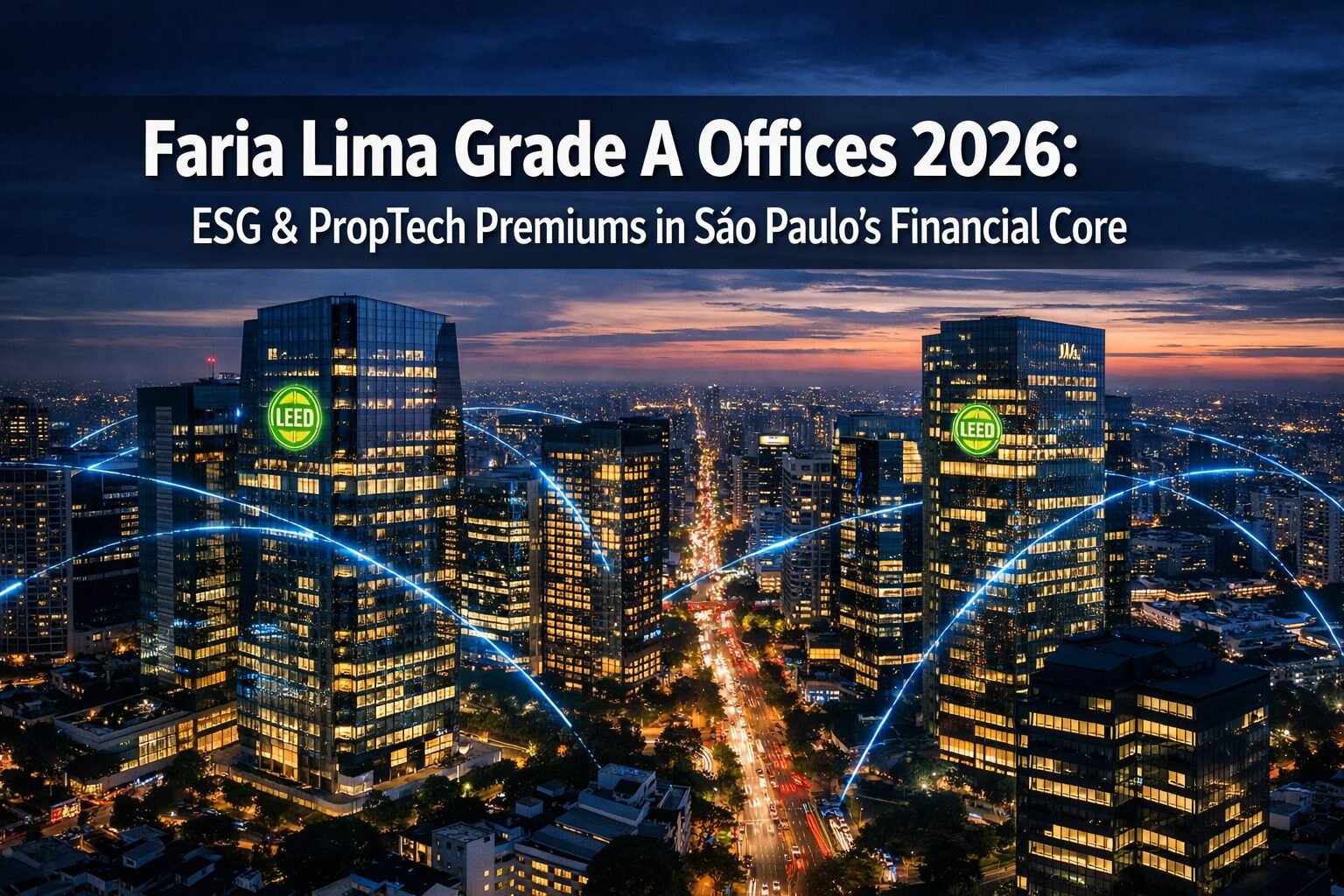
Grade A office towers along Faria Lima Avenue are commanding rent premiums of up to 15% over non-certified peers — not because of location alone, but because of what is now embedded in the walls, the lease contracts, and the digital infrastructure of every building that qualifies as truly prime. In 2026, the rules of São Paulo’s most prestigious office corridor have changed permanently.
The convergence of ESG mandates and PropTech integration has redrawn the competitive map of Faria Lima Grade A Offices 2026: ESG and PropTech Premiums in São Paulo’s Financial Core. Landlords who once competed on floor plates and lobby aesthetics now compete on LEED certifications, IoT sensor networks, and sustainability clauses baked directly into lease agreements. Tenants — from global investment banks to Brazilian fintech unicorns — are voting with their rental budgets, and the data is unambiguous.
Key Takeaways 📌
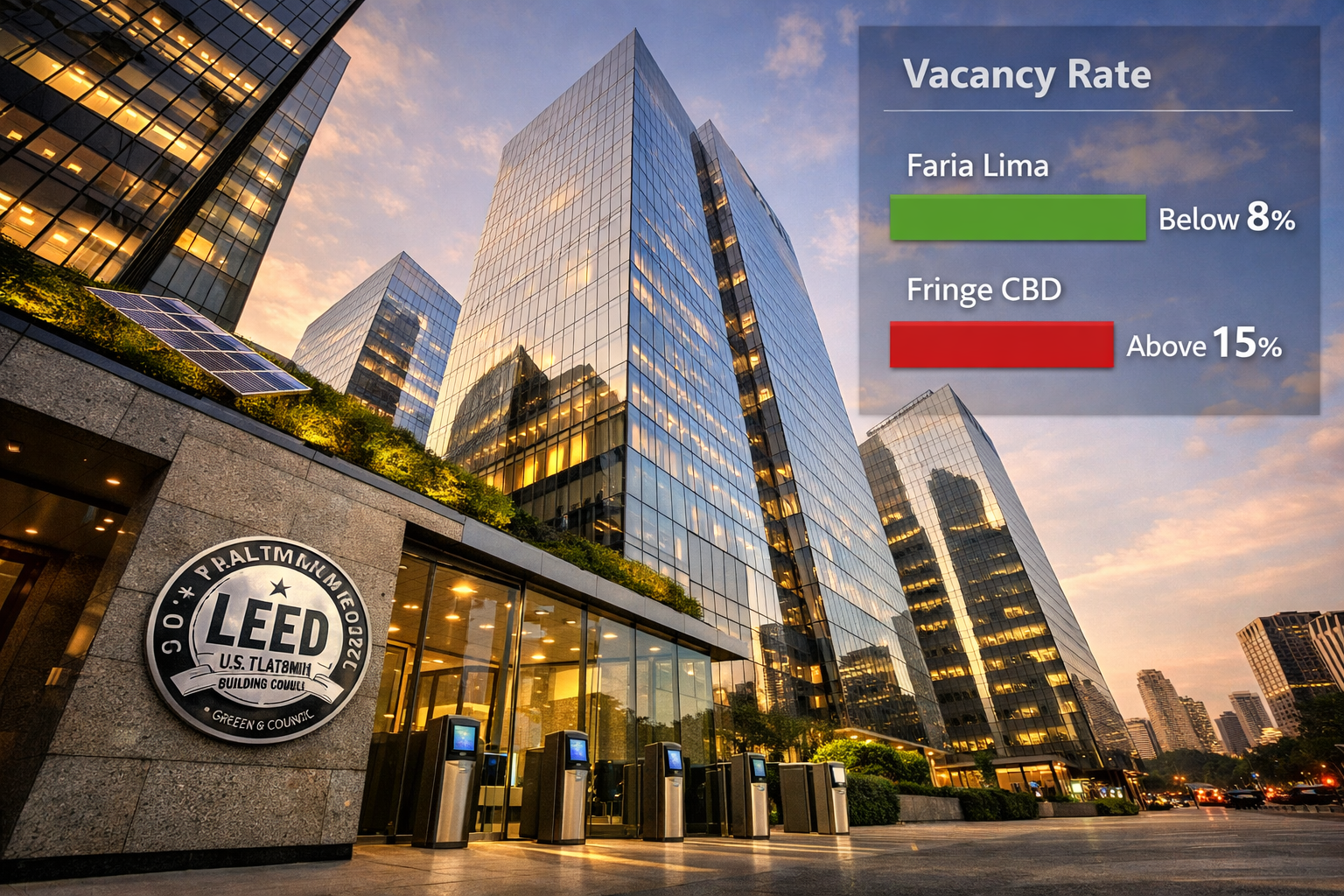
- Occupancy above 95% in prime Faria Lima Grade A stock, with vacancy below 8% — compared to 15%+ in non-certified fringe CBDs [2]
- ESG clauses are now standard in lease agreements, compelling landlords to invest in green certifications or lose top-tier tenants [1]
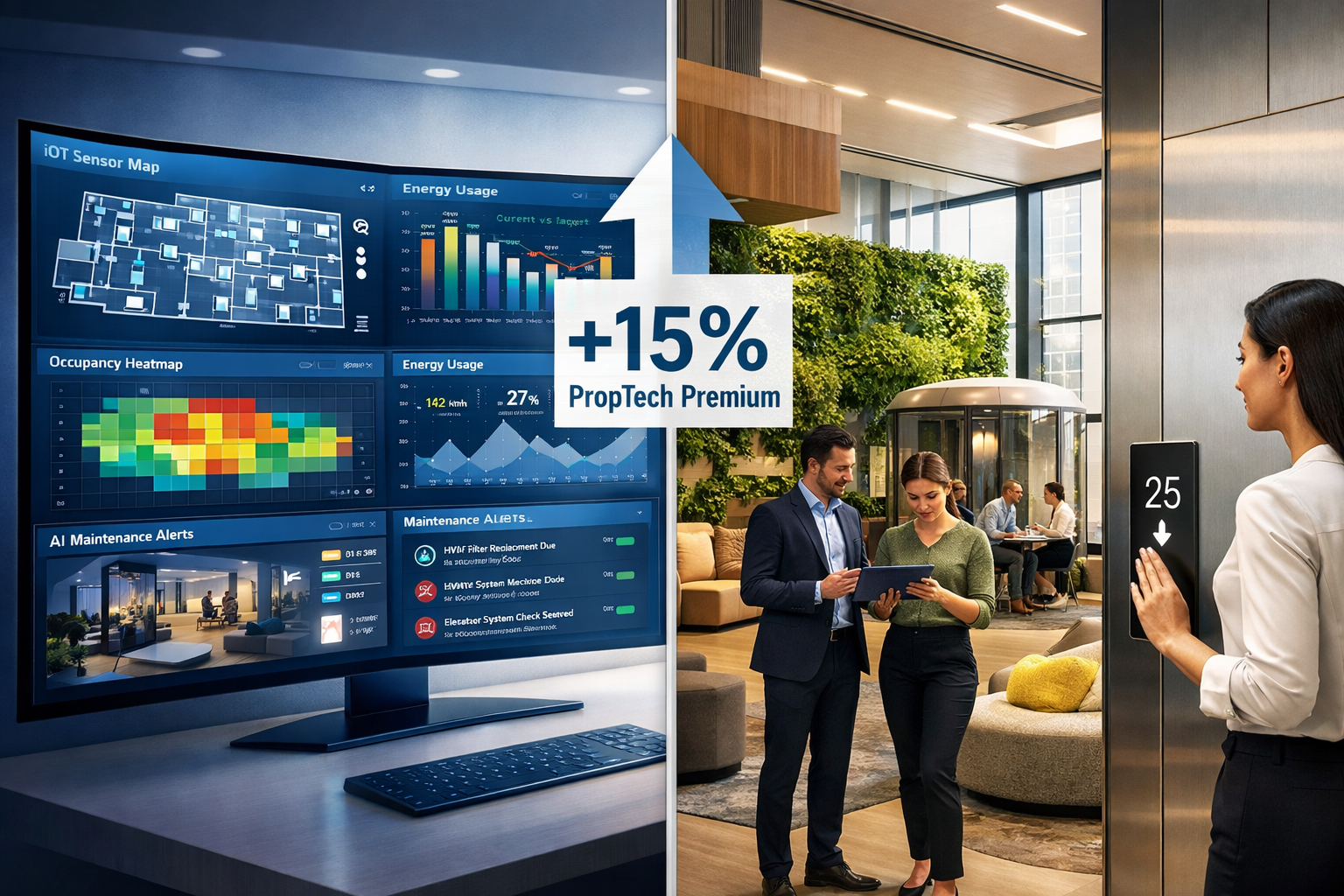
- PropTech integration drives a 15% rental premium in technologically advanced buildings, while green certifications add a further 10–15% premium [1][2]
- Fewer than one-third of existing assets meet green benchmarks, creating a sustained supply shortfall that benefits newly delivered stock [2]
- Grade A towers captured 55.2% of South America’s office market share in 2025, with a forecast 5.47% CAGR through 2031 [2]
The ESG Transformation: From Preference to Contract Clause
Why ESG Is No Longer Optional
The shift happened faster than most landlords anticipated. By 2026, stringent ESG criteria have become a standard clause in lease agreements across Faria Lima’s Grade A segment, compelling property owners to invest in green certifications and sustainable infrastructure or face tenant flight to compliant competitors [1].
This is not a soft preference expressed during negotiations. It is a contractual obligation. Multinational corporations with global sustainability reporting requirements — particularly those listed on European and North American exchanges — cannot sign leases in buildings that fail to meet minimum environmental and governance benchmarks. The result is a hard bifurcation in the market.
💬 “Vacancy remained below 8% in Faria Lima while non-certified towers in fringe central business districts exceeded 15% — underscoring the market’s ESG bias.” [2]
The Supply Shortfall Creating Lasting Premiums
Here is the structural advantage that makes Faria Lima’s prime corridor so compelling for investors: fewer than one-third of existing assets currently meet green building benchmarks [2]. This locked-in supply shortfall means that newly delivered, ESG-compliant stock faces demand that far exceeds available inventory.
Green-certified buildings now secure 10–15% rent premiums over non-certified properties, while Grade A towers broadly command a 12% rental premium over Grade B peers [2]. For investors underwriting new development or value-add repositioning, these are not speculative projections — they are observable market transactions.
What “Green” Means in Practice
New stock delivered to the Faria Lima corridor in 2026 arrives with a specific set of features that define the ESG standard:
| Feature | Standard | Benefit |
|---|---|---|
| Environmental Certification | LEED or EDGE plaque | Qualifies for ESG lease clauses |
| Energy Systems | Smart metering, solar integration | Reduces tenant operational costs |
| Entry Systems | Touchless biometric access | Wellness and hygiene compliance |
| Wellness Amenities | Lounges, green spaces, air quality monitoring | Talent branding, retention |
| Governance Reporting | ESG data dashboards for tenants | Supports corporate sustainability reporting |
[2]
The Gabriel Faria Lima Corporate building — a project recognized internationally for its design — exemplifies this approach, described as “a green oasis in the middle of São Paulo” with sustainable architecture integrated into every operational system [5]. Similarly, the Faria Lima Financial Center at 1941 represents the institutional-grade standard that anchor tenants now expect as baseline [6].
For investors exploring the broader landscape of Brazilian real estate opportunities, understanding the best places to invest in Brazil property provides essential context for comparing Faria Lima’s premium positioning against other high-growth markets.
PropTech Integration: The 15% Premium Explained
Smart Buildings Are Redefining Grade A
The second major force reshaping Faria Lima Grade A Offices 2026: ESG and PropTech Premiums in São Paulo’s Financial Core is the systematic integration of property technology — PropTech — into building operations, tenant experience, and asset management.
PropTech integration, spanning smart building management systems to IoT-enabled workspaces, is driving a rental premium of up to 15% in technologically advanced properties [1]. This premium reflects something specific: tenants are paying more because smart buildings demonstrably reduce their total occupancy costs while improving operational efficiency.
What PropTech Delivers at the Building Level
The technology stack in a 2026-standard Faria Lima Grade A tower operates across several layers:
🏢 Building Operations Layer
- AI-driven predictive maintenance that reduces downtime and repair costs
- Automated HVAC optimization based on real-time occupancy data
- Smart energy management that cuts utility consumption by measurable percentages
📱 Tenant Experience Layer
- Mobile apps for space booking, visitor management, and service requests
- IoT sensors monitoring air quality, temperature, and occupancy density
- Touchless entry systems integrated with corporate identity management
📊 Data and Reporting Layer
- Real-time ESG performance dashboards accessible to tenants for sustainability reporting
- Occupancy analytics that help tenants right-size their space requirements
- Predictive space utilization models that support hybrid work policies
Properties like those available on Rua Prof. Atílio Innocenti and Av. Horácio Lafer — both in the Faria Lima corridor — represent the current benchmark for this integrated offering [3][4].
The Tenant Calculus
For a CFO evaluating office costs, the PropTech premium makes straightforward financial sense. A building charging 15% more per square meter but delivering 20% lower energy costs, reduced maintenance disruptions, and data that satisfies ESG reporting requirements across multiple jurisdictions is not expensive — it is efficient.
This calculus is driving corporate decision-making at scale. In January 2026, Nubank allocated USD 500 million over five years to expand offices across São Paulo, Campinas, Rio de Janeiro, Belo Horizonte, and Bogotá [2]. That investment signal — from Brazil’s most prominent fintech — reflects corporate confidence in the Grade A, PropTech-enabled office model as a long-term operational asset.
For those interested in how technology is intersecting with real estate investment more broadly, the intersection of cryptocurrency and real estate development offers another lens on how digital innovation is reshaping property markets across Brazil.
Market Dynamics, Investment Signals, and Strategic Geography
The Numbers That Define the Market in 2026
The macroeconomic and transactional data supporting Faria Lima’s prime position is substantial and consistent across multiple research sources.
Grade A towers captured 55.2% of the South American office real estate market share in 2025, with a forecast CAGR of 5.47% through 2031 — significantly outrunning the broader South American office market [2]. ESG-certified Grade A office demand is expanding at 1.2% annually across Brazil, Chile, Colombia, and Argentina on a medium-term horizon [2].
Prime Grade A office spaces in Faria Lima maintain occupancy rates exceeding 95%, with district-wide vacancy staying below 8% [1][2]. These are not cyclical numbers — they reflect a structural undersupply of compliant, high-quality stock relative to demand from tenants who cannot accept lower-grade alternatives.
The February 2026 PPP Signal
Perhaps the most significant institutional signal of 2026 came from the São Paulo government itself. In February 2026, the city confirmed a USD 1.14 billion, 30-year Public-Private Partnership auction to house 22,700 civil servants in 288,000 square meters of Grade A offices, with major ESG benchmarks embedded in the procurement specifications [2].
A government committing to ESG standards at this scale and duration sends an unambiguous message to the private development community: the ESG premium is not a market cycle phenomenon. It is the new baseline for institutional-grade real estate.
Strategic Decentralization: The Back-Office Opportunity
While Faria Lima remains the dominant prime office corridor, a complementary trend is emerging that sophisticated investors should track. Corporations are strategically moving back-office and support functions to cost-effective hubs like Alphaville and Curitiba to optimize operational expenses [1].
This decentralization does not threaten Faria Lima’s prime positioning — it reinforces it. By relocating cost-sensitive functions to secondary markets, corporations free up budget to maintain or upgrade their Faria Lima footprint for client-facing, executive, and innovation functions. The result is a barbell strategy: premium space in the prime corridor, efficient space in secondary hubs.
This geographic diversification mirrors patterns visible in other Brazilian markets experiencing strong real estate momentum. The real estate market in greater Florianópolis offers a useful comparative case study of how regional markets absorb corporate overflow from primary business centers.
Institutional Transactions Setting Benchmarks
The transaction market confirms the premium thesis. Itaú’s acquisition of a Faria Lima tower for approximately BRL 1.5 billion established a benchmark valuation for prime, well-located Grade A assets [8]. Brookfield Properties’ management of the Faria Lima Financial Center at 1941 demonstrates the institutional appetite for long-term ownership of compliant, income-generating prime stock [6].
For investors considering how pre-construction and development-stage investments can amplify returns in rising markets, the dynamics of property appreciation for off-plan buyers apply across asset classes — including commercial real estate where new ESG-compliant supply commands immediate premium positioning upon delivery.
Navigating the ESG and PropTech Premium Landscape: Practical Considerations
For Tenants
🔍 Due Diligence Checklist for 2026 Lease Negotiations:
- Verify certification status — Confirm LEED, EDGE, or equivalent certification is current and not pending renewal
- Audit PropTech infrastructure — Request documentation of building management system capabilities, IoT sensor coverage, and data reporting outputs
- Review ESG lease clauses — Understand what sustainability obligations transfer to the tenant versus the landlord
- Assess total occupancy cost — Compare base rent plus utilities, maintenance, and technology costs rather than headline rent alone
- Evaluate wellness amenities — Wellness features directly impact talent acquisition and retention metrics
For Investors and Developers
The supply shortfall in ESG-compliant stock is the most durable investment thesis in the Faria Lima market. With fewer than one-third of existing assets meeting green benchmarks [2], the pipeline of compliant new supply is the critical variable to monitor.
Key metrics to track:
- New LEED/EDGE certifications issued in the Faria Lima submarket
- Pre-leasing velocity on development-stage projects
- Spread between certified and non-certified vacancy rates
- Government PPP procurement specifications as a leading indicator of ESG standard evolution
For a broader view of how Brazilian real estate development is performing and where institutional capital is flowing, exploring current real estate market developments provides ongoing market intelligence across multiple asset classes and geographies.
Conclusion: Actionable Next Steps in São Paulo’s Prime Office Market
The evidence assembled across Faria Lima Grade A Offices 2026: ESG and PropTech Premiums in São Paulo’s Financial Core points to a market that has undergone a structural — not cyclical — transformation. ESG compliance and PropTech integration are no longer differentiators; they are entry requirements for the prime segment.
The opportunity is clear and time-sensitive:
✅ For corporate tenants: Begin lease renewal negotiations 18–24 months in advance. ESG-compliant Grade A stock is absorbed quickly, and the premium for waiting is measured in both rent and operational disruption.
✅ For institutional investors: The 5.47% CAGR forecast through 2031 [2], combined with the structural supply shortfall in certified stock, creates a durable income and appreciation thesis. Prioritize assets with current LEED/EDGE certification and documented PropTech infrastructure.
✅ For developers: The February 2026 PPP auction has set ESG benchmarks that will cascade through private procurement. New developments that exceed these benchmarks — rather than merely meeting them — will command the upper tier of the rent premium curve.
✅ For market observers: Track the vacancy divergence between certified and non-certified stock as the leading indicator of premium sustainability. As long as non-certified vacancy exceeds 15% while prime Faria Lima stays below 8% [2], the premium thesis remains intact.
São Paulo’s financial core is not simply recovering from the disruptions of the early 2020s — it is redefining what a Grade A office market looks like in an era where sustainability and technology are the foundations of value, not the finishing touches.
References
[1] Brazil Real Estate Market Trends 2026 An Institutional Investors Guide – https://www.riotimesonline.com/brazil-real-estate-market-trends-2026-an-institutional-investors-guide/
[2] South America Office Real Estate Market – https://www.mordorintelligence.com/industry-reports/south-america-office-real-estate-market
[3] S117363411 228756 L – https://www.cushmanwakefield.com/en/brazil/properties/for-lease/office/sp/sao-paulo/r-prof-atilio-innocenti-165/s117363411-228756-l
[4] S117362645 256928 L – https://www.cushmanwakefield.com/en/brazil/properties/for-lease/office/sp/sao-paulo/av-horacio-lafer-160/s117362645-256928-l
[5] Gabriel Faria Lima Corporate A Green Oasis In The Middle Of So Paulo Perkinswill – https://www.theplan.it/eng/award-2025-Office-Business/gabriel-faria-lima-corporate-a-green-oasis-in-the-middle-of-so-paulo-perkinswill
[6] Faria Lima Financial Center 1941 – https://www.brookfieldproperties.com/en/our-properties/faria-lima-financial-center-1941
[7] Faria Lima Office – https://girimun.com/project/faria-lima-office/
[8] Itau Compra Torre Faria Lima 1 5 Bilhao Dsca00 – https://en.clickpetroleoegas.com.br/itau-compra-torre-faria-lima-1-5-bilhao-dsca00/