
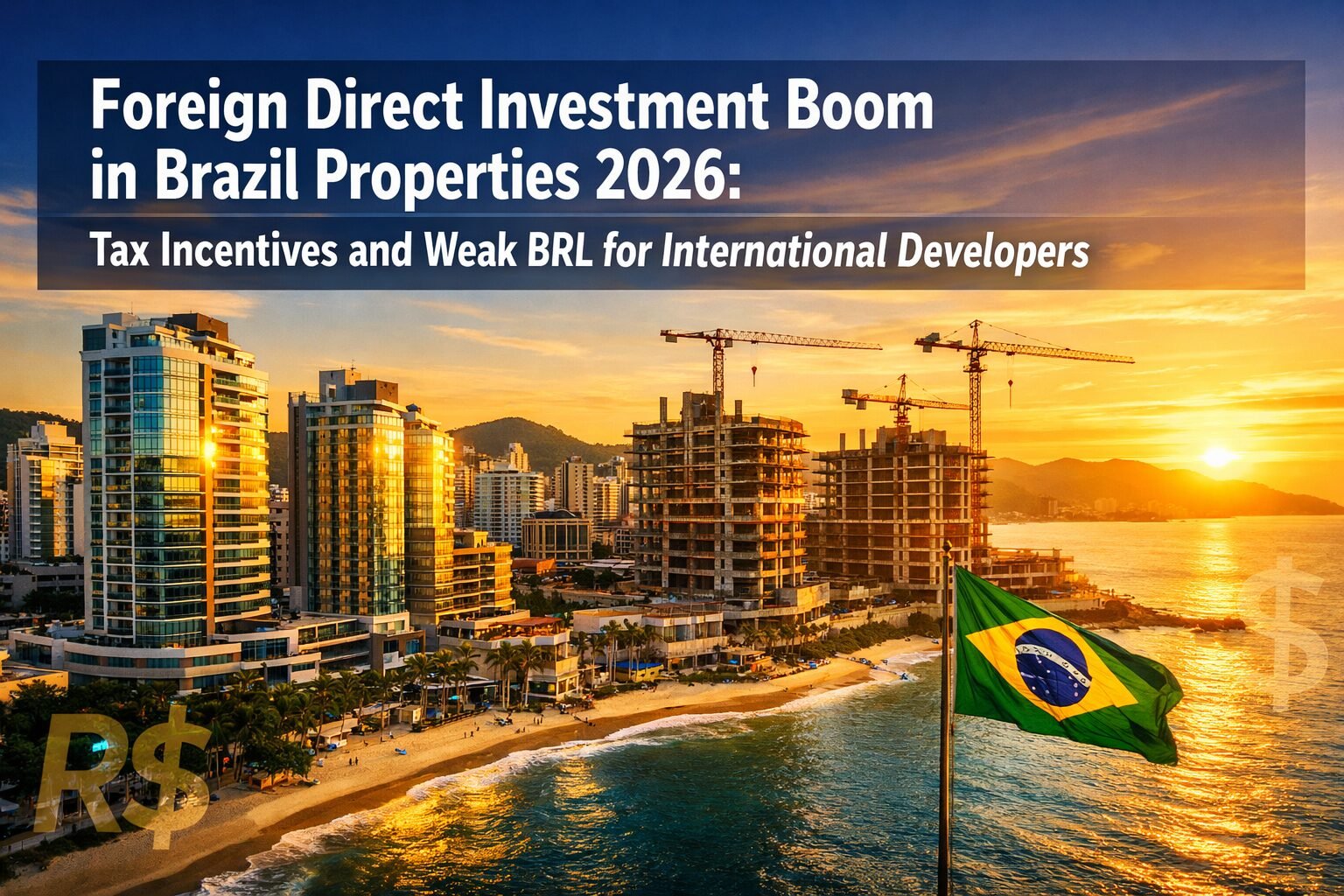
The global investment landscape is shifting, and savvy international developers are turning their attention to Brazil’s property market with unprecedented enthusiasm. The Foreign Direct Investment Boom in Brazil Properties 2026: Tax Incentives and Weak BRL for International Developers represents a once-in-a-generation opportunity that combines favorable currency exchange rates, attractive tax policies, and robust market fundamentals. With the Brazilian Real (BRL) trading at historically advantageous levels against major currencies and new tax incentives specifically designed to attract foreign capital, international developers are discovering that strategic partnerships in beachfront and urban edge projects can yield impressive 15-20% gains when calculated in USD.
This perfect storm of economic conditions has created an environment where foreign investors can leverage their purchasing power to acquire premium properties at significant discounts compared to just a few years ago. Brazil’s property market, long recognized for its potential but often hindered by economic volatility, has matured into a sophisticated investment destination that rewards those who understand its unique dynamics.
Key Takeaways
- 💰 Currency Advantage: The weak BRL provides international investors with 20-30% greater purchasing power compared to 2020 levels, making Brazilian properties exceptionally attractive for USD and EUR holders
- 📈 Record FDI Growth: Brazil attracted between $77.7 billion and $89 billion in foreign direct investment during 2025, with property and infrastructure sectors leading the surge[1][6]
- 🏖️ Strategic Focus Areas: Beachfront developments and urban edge properties offer the highest returns, with mid-to-high-end residential properties experiencing a 94% increase in sales value in Q2 2024[2]
- 🎯 Tax Incentives: New tax codes and investment frameworks introduced in 2025-2026 provide significant advantages for foreign developers, particularly in partnership structures
- 🤝 Partnership Model: Joint ventures with local developers minimize regulatory complexity while maximizing market knowledge and profit potential
Understanding the Foreign Direct Investment Boom in Brazil Properties 2026
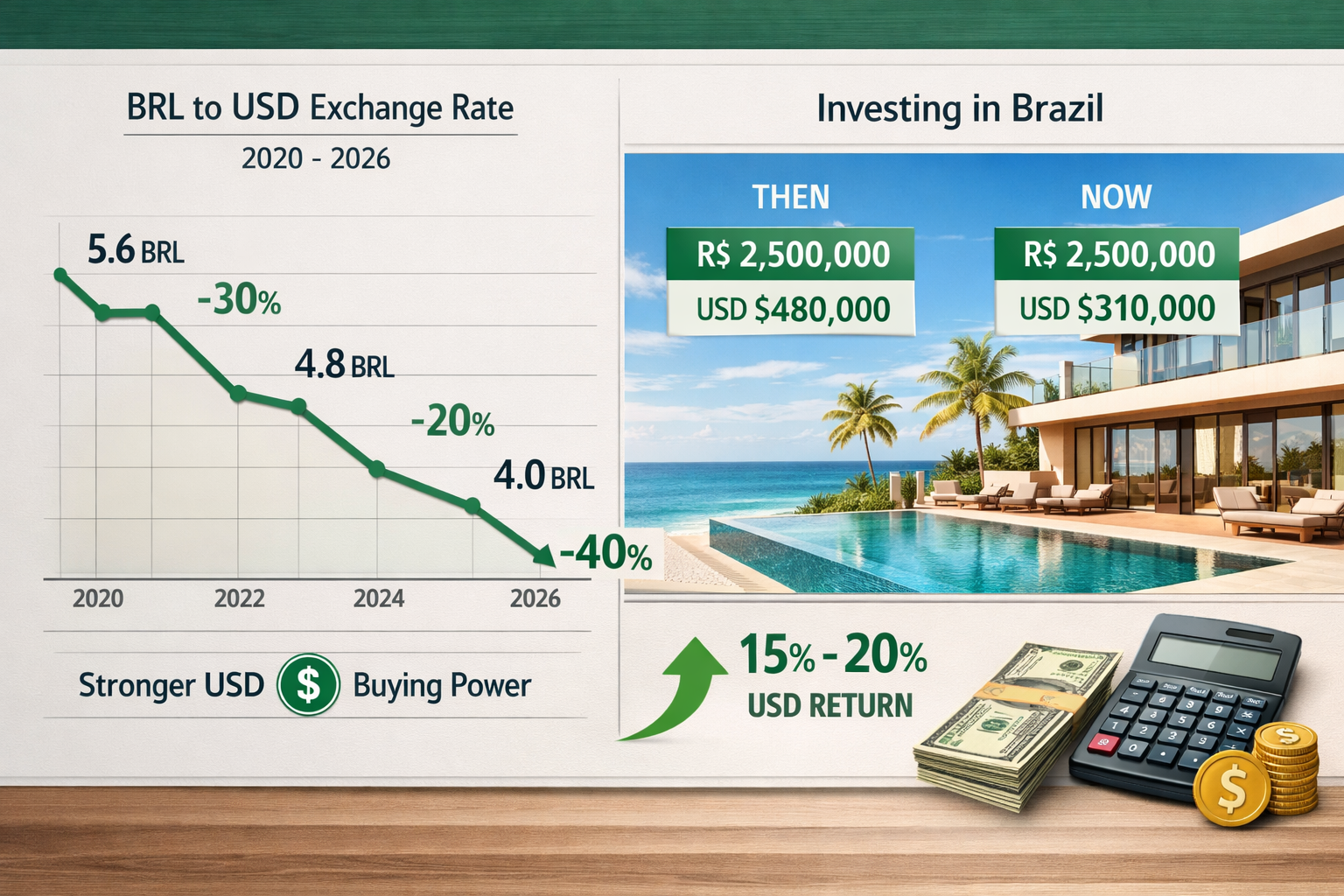
Brazil’s property market has experienced a remarkable transformation over the past 18 months, driven by macroeconomic factors that have aligned to create exceptional opportunities for international developers. The Foreign Direct Investment Boom in Brazil Properties 2026: Tax Incentives and Weak BRL for International Developers didn’t emerge overnight—it’s the result of deliberate policy changes, market maturation, and global capital seeking higher returns in emerging markets.
The Numbers Behind the Boom
The data tells a compelling story. Total FDI inflows reached $77.7 billion in 2025, representing a 4.8% increase from $74.1 billion in 2024, equivalent to 3.41% of GDP[1]. However, alternative estimates from UNCTAD suggest an even more impressive performance, with FDI inflows rising by 42% to an estimated $89 billion in 2025—the second-highest level on record[6].
This surge wasn’t limited to traditional sectors. The property market specifically benefited from increased international interest, with greenfield investment values jumping from $37.1 billion in 2023 to $49.5 billion in 2024[4]. This represents a fundamental shift in how international capital views Brazilian real estate—not merely as a speculative play, but as a core component of diversified global portfolios.
Why Brazil? Why Now?
Several factors converge to make 2026 the optimal entry point for international property developers:
Economic Stability: Brazil has demonstrated improved fiscal discipline and monetary policy management, creating a more predictable investment environment. While challenges remain, the trajectory is positive.
Market Maturity: The Brazilian property market has evolved significantly, with professional standards, transparent transactions, and sophisticated legal frameworks now matching international expectations.
Demographic Drivers: Brazil’s growing middle class and urbanization trends continue to fuel demand for quality residential properties, particularly in coastal cities and metropolitan areas.
Infrastructure Investment: Government commitments to infrastructure development are enhancing property values in strategic locations, creating appreciation potential beyond currency gains.
For investors exploring best places to invest in Brazil property, understanding these macro trends is essential for identifying opportunities with the highest return potential.
The Currency Advantage: How the Weak BRL Creates Unprecedented Opportunities
The Brazilian Real’s weakness against major international currencies represents the single most powerful driver of the Foreign Direct Investment Boom in Brazil Properties 2026: Tax Incentives and Weak BRL for International Developers. For developers holding USD, EUR, or GBP, the purchasing power differential has created what amounts to an automatic discount on Brazilian properties.
Quantifying the Currency Benefit
When the BRL trades at favorable exchange rates, international investors effectively receive:
- 20-30% greater purchasing power compared to 2020 exchange rates
- Immediate equity positions based on currency differentials alone
- Enhanced yield calculations when rental income is converted back to hard currencies
- Appreciation potential from both property value increases AND potential BRL recovery
Consider this practical example: A beachfront apartment in Florianópolis listed at R$ 2,000,000 would have cost approximately $400,000 USD in 2020. At 2026 exchange rates (averaging around 5.5 BRL/USD), the same property costs roughly $363,000—an immediate savings of nearly $40,000 before any negotiation. As properties in Brazil typically sell 6-8% below asking price[2], the combined discount can exceed 25-30%.
The Exit Strategy Advantage
Smart developers aren’t just thinking about acquisition—they’re planning their exits. The currency dynamic creates multiple profit scenarios:
- Hold and Convert: If the BRL strengthens against the USD over a 3-5 year holding period, developers gain from both property appreciation AND currency appreciation
- Sell to Locals: Exiting to Brazilian buyers at market rates in BRL, then converting proceeds at improved exchange rates
- Sell to Internationals: Marketing to other foreign investors who recognize the same currency advantages
The 15-20% USD gains that sophisticated developers are targeting come from layering these currency advantages with strategic property selection and value-add improvements. Properties in high-demand areas like those featured in Florianópolis developments offer particularly strong potential for this layered return approach.
Currency Risk Management
While the weak BRL creates opportunities, prudent developers implement hedging strategies:
- Diversified exit timelines to avoid forced sales during unfavorable exchange periods
- Natural hedges through BRL-denominated rental income
- Partnership structures that share currency risk with local developers
- Forward contracts for planned repatriation of profits
Tax Incentives Driving International Developer Interest
Beyond currency advantages, the Foreign Direct Investment Boom in Brazil Properties 2026: Tax Incentives and Weak BRL for International Developers is substantially supported by favorable tax policies designed to attract foreign capital. Brazil has recognized that competing for global investment dollars requires competitive tax treatment, and recent reforms have delivered exactly that.
Key Tax Benefits for Foreign Developers
Brazil’s evolving tax framework offers several specific advantages for international property developers:
Capital Gains Treatment: Foreign investors can benefit from preferential capital gains rates when properties are held for specified minimum periods, with rates potentially as low as 15% compared to higher brackets for short-term transactions.
Partnership Tax Efficiency: Joint ventures structured properly can optimize tax treatment by leveraging both Brazilian corporate structures and international tax treaties. Brazil has tax treaties with over 30 countries, providing opportunities for reduced withholding taxes on profit repatriation.
Depreciation Benefits: Brazilian tax law allows for depreciation of property improvements, creating tax shields that enhance after-tax returns. Commercial properties and mixed-use developments offer particularly attractive depreciation schedules.
Financing Deductions: Interest expenses on property development financing are generally tax-deductible, reducing the effective cost of leverage for developers using Brazilian bank financing or international credit facilities.
The 2025-2026 Tax Reform Impact
Recent tax reforms implemented in late 2025 and early 2026 have specifically targeted foreign investment barriers:
- Simplified compliance for foreign entities holding Brazilian property
- Reduced bureaucracy for profit repatriation
- Clearer rules on property transfer taxes for international transactions
- Incentive zones offering additional tax benefits in designated development areas
Financial services and auxiliary activities already account for 19.2% ($153.5 billion) of total FDI position in Brazil[4], demonstrating the country’s sophistication in attracting and accommodating foreign capital. The property sector is increasingly benefiting from similar frameworks.
Practical Tax Planning Strategies
Successful international developers implement several tax optimization approaches:
| Strategy | Benefit | Complexity Level |
|---|---|---|
| Treaty Shopping | Reduced withholding taxes via optimal jurisdiction | High |
| SPV Structures | Liability protection and tax efficiency | Medium |
| Holding Company Optimization | Centralized ownership with tax benefits | High |
| Development vs. Trading Classification | Lower tax rates on development activities | Medium |
| Timing of Profit Recognition | Deferral and rate optimization | Low-Medium |
Professional tax guidance is essential, but the fundamental structure is clear: Brazil’s tax environment for foreign property developers has improved dramatically and continues to evolve favorably. Developers working with established local partners like those behind quality Florianópolis projects can access expertise that maximizes these tax advantages while ensuring full compliance.
Comparing Brazil’s Tax Environment Globally
When benchmarked against other emerging market property destinations, Brazil offers competitive advantages:
- More favorable than Mexico for certain partnership structures
- Comparable to Colombia but with larger market scale
- More transparent than some Asian markets with clearer regulatory frameworks
- Better treaty network than many competitors in Latin America
Strategic Property Types and Locations for Maximum Returns
Not all Brazilian properties offer equal opportunity within the Foreign Direct Investment Boom in Brazil Properties 2026: Tax Incentives and Weak BRL for International Developers. Sophisticated developers focus their capital on specific property types and geographic locations that maximize the combined benefits of currency advantages, tax incentives, and market fundamentals.
Beachfront Developments: The Premium Play
Beachfront properties along Brazil’s extensive coastline represent the highest-value opportunity for international developers. These properties benefit from:
Limited Supply: Coastal development regulations restrict new beachfront construction in many areas, creating scarcity value that drives appreciation.
International Appeal: Beachfront properties attract both Brazilian buyers seeking vacation homes and international investors, creating liquid exit markets.
Premium Pricing Power: Coastal locations command significant premiums—often 40-60% higher than comparable inland properties—that persist across economic cycles.
Tourism Income Potential: Short-term rental markets in coastal areas generate yields of 8-12% annually, providing strong cash flow during holding periods.
Cities like Florianópolis have emerged as particularly attractive markets, with infrastructure improvements and quality of life factors driving sustained demand. The growth of regions like Ingleses in Florianópolis demonstrates how strategic coastal areas continue to appreciate even during broader economic uncertainty.
Urban Edge Properties: The Value Play
While beachfront developments offer premium positioning, urban edge properties—located on the expanding periphery of major metropolitan areas—provide compelling value opportunities:
Appreciation Runway: As cities expand, properties on the urban edge benefit from infrastructure development and increasing demand, often appreciating 12-18% annually in BRL terms.
Lower Entry Costs: Purchase prices are typically 30-50% lower than central urban areas, allowing developers to deploy capital more efficiently and achieve higher ROI percentages.
Development Flexibility: Less restrictive zoning in emerging areas allows for creative development approaches and higher density projects.
Middle-Class Demand: Brazil’s growing middle class seeks affordable quality housing in these areas, creating strong absorption rates for well-designed projects.
São Paulo’s expanding metropolitan region and the growth corridors around Rio de Janeiro offer particularly strong urban edge opportunities. Nearly 24,000 units were launched and over 12,000 units sold in 2024, reflecting a total value of approximately R$ 15 billion[2], with significant portions of this activity occurring in urban edge locations.
The Mid-to-High-End Residential Sweet Spot
Market data clearly indicates where demand is strongest. Mid-to-high-end residential properties saw a 94% increase in sales value in the second quarter of 2024 compared to Q2 2023[2]. This segment offers the optimal balance of:
- ✅ Strong demand from Brazil’s affluent and upper-middle classes
- ✅ Quality construction that maintains value and minimizes maintenance costs
- ✅ Financing accessibility as Brazilian banks favor lending on quality properties
- ✅ International buyer interest from investors seeking stable emerging market exposure
Properties in this category typically range from $200,000 to $600,000 USD equivalent, making them accessible to a broad pool of international investors while still offering significant absolute profit potential.
Smart Home Technology: The Differentiator
Forward-thinking developers are incorporating smart home technology to differentiate their projects and command premium pricing. The number of residential properties equipped with smart home technology is expected to reach approximately 20% of the market by 2026, with the smart home market revenue projected at $2.41 billion—a 91.06% increase from 2022[2].
Properties featuring integrated smart systems command:
- 5-8% price premiums at sale
- Higher rental rates of 10-15% above comparable units
- Faster absorption with reduced time on market
- Younger buyer demographics with stronger income growth potential
Partnership Strategies: Navigating the Brazilian Market Successfully

The most successful participants in the Foreign Direct Investment Boom in Brazil Properties 2026: Tax Incentives and Weak BRL for International Developers recognize that local partnerships are not just helpful—they’re essential. While Brazil’s property market has become more accessible to foreign investors, navigating regulatory requirements, identifying optimal opportunities, and executing development projects still requires local expertise.
Why Partnerships Matter
International developers who attempt to operate independently in Brazil face significant challenges:
Regulatory Complexity: Property development involves multiple government agencies, environmental approvals, and construction permits that require local knowledge to navigate efficiently.
Market Intelligence: Understanding neighborhood dynamics, pricing trends, and buyer preferences requires on-the-ground presence and relationships that take years to develop.
Execution Capability: Managing construction, contractors, and timelines in Brazil demands local management with established vendor relationships and problem-solving experience.
Risk Mitigation: Local partners can identify and manage risks—from title issues to political factors—that foreign developers might overlook.
Optimal Partnership Structures
Successful foreign-local partnerships typically follow several proven models:
Joint Venture (JV) Equity Split: Foreign developers provide 60-70% of capital in exchange for 50-60% of profits, with local partners contributing land, permits, and execution capability. This structure aligns incentives while leveraging each party’s strengths.
Development Management Agreement: Foreign investors provide 100% of capital while local developers manage the project for fees plus profit participation. This model offers foreign investors greater control while still benefiting from local expertise.
Land Banking Partnerships: Foreign capital acquires land identified by local partners, with development occurring in phases as market conditions optimize. This approach allows for strategic timing and risk management.
Fund Structures: Multiple foreign investors pool capital in a fund managed by experienced local developers, providing diversification across multiple projects and locations.
Selecting the Right Local Partner
Due diligence on potential Brazilian partners should evaluate:
- Track Record: Completed projects, financial performance, and reputation in the market
- Financial Stability: Balance sheet strength and access to local financing
- Regulatory Relationships: Established connections with government agencies and permitting authorities
- Technical Capability: In-house expertise in architecture, engineering, and construction management
- Market Position: Brand recognition and sales capability in target markets
Established developers with proven portfolios, such as those behind successful Florianópolis projects, offer the credibility and capability that international partners need for successful ventures.
Structuring the Agreement
Well-structured partnership agreements address several critical elements:
- Capital Contribution Schedule: Clear timelines and amounts for each partner’s investments
- Decision Rights: Defined authority for major decisions versus operational matters
- Profit Distribution: Waterfall structures that reward performance while protecting capital
- Exit Provisions: Clear mechanisms for partner buyouts or project sales
- Dispute Resolution: Arbitration clauses and governing law provisions
- Non-Compete Terms: Protections preventing partners from competing directly
Cultural Considerations
Successful partnerships also require cultural awareness and relationship management:
Relationship Focus: Brazilian business culture emphasizes personal relationships and trust-building over purely transactional interactions. Invest time in developing genuine partnerships.
Communication Style: Expect more informal and relationship-oriented communication than in some other markets, with decisions sometimes made through discussion rather than formal processes.
Timeline Expectations: Projects may take longer than in some markets due to regulatory processes and construction practices. Build appropriate buffers into pro formas.
Flexibility: Adaptability to changing conditions and creative problem-solving are valued traits in Brazilian business partnerships.
Financing Strategies and Capital Structures
Optimizing capital structures represents a critical component of maximizing returns within the Foreign Direct Investment Boom in Brazil Properties 2026: Tax Incentives and Weak BRL for International Developers. The financing landscape for property development in Brazil offers both opportunities and challenges that international developers must navigate strategically.
The Evolving Financing Environment
Brazil’s property financing market has undergone significant transformation. Cash purchases for residential properties are expected to decline to 30% by 2025, as financing options become more accessible with lower interest rates and flexible loan terms[2]. This shift creates opportunities for developers to leverage their equity more effectively.
Financing Sources for International Developers
Several capital sources are available for foreign developers:
Brazilian Bank Financing: Local banks offer construction financing and development loans, typically requiring:
- 30-40% equity contribution from developers
- Personal guarantees or additional collateral
- Established local presence or strong local partner
- Interest rates currently ranging from 10-14% annually
International Credit Facilities: Foreign developers can leverage credit lines from their home countries:
- Typically lower interest rates (5-8% for USD/EUR facilities)
- More flexible terms and covenants
- Currency mismatch risk requiring hedging
- May require offshore security structures
Mezzanine Financing: Bridge capital between senior debt and equity:
- Higher interest rates (15-20%) but greater flexibility
- Often provided by specialized real estate funds
- Can reduce equity requirements significantly
- Typically includes profit participation or conversion rights
Seller Financing: Land sellers may provide financing for land purchases:
- Common in Brazil for strategic parcels
- Terms vary widely based on negotiation
- Can significantly reduce upfront capital requirements
- May include development milestones or profit sharing
Optimal Capital Stack
Experienced developers typically target capital structures that balance return maximization with risk management:
| Capital Component | Percentage | Cost | Purpose |
|---|---|---|---|
| Senior Debt | 40-50% | 10-14% | Primary project financing |
| Mezzanine/Bridge | 10-20% | 15-20% | Reduce equity requirements |
| Developer Equity | 20-30% | ROI target | Control and upside |
| Partner Equity | 10-20% | Profit share | Local expertise and execution |
This structure typically generates levered returns of 18-25% on equity while maintaining manageable risk profiles.
Currency Considerations in Financing
The weak BRL creates specific financing opportunities and risks:
USD Financing Advantages:
- Lower interest rates than BRL financing
- Natural hedge if exit involves USD buyers
- Preserves BRL purchasing power for construction costs
BRL Financing Advantages:
- Eliminates currency mismatch risk
- Aligns debt service with rental income
- Simpler structure without hedging requirements
Many sophisticated developers use hybrid approaches, financing land acquisition with USD and construction with BRL to optimize the risk-return profile.
Pre-Sales as Financing
Brazilian property development traditionally relies heavily on pre-sales to finance construction:
- 30-50% of units are typically pre-sold before construction completion
- Buyer deposits fund ongoing construction costs
- Reduces developer capital requirements significantly
- Validates market demand before full commitment
Strong pre-sales performance, such as that seen in high-performing Florianópolis markets, not only provides financing but also de-risks projects and can improve terms from senior lenders.
Risk Management and Due Diligence
While the Foreign Direct Investment Boom in Brazil Properties 2026: Tax Incentives and Weak BRL for International Developers presents compelling opportunities, prudent investors implement comprehensive risk management frameworks to protect capital and ensure successful outcomes.
Key Risk Categories
International developers must address several distinct risk areas:
Political and Regulatory Risk: Brazil’s political environment can create uncertainty around property rights, taxation, and development regulations. Mitigation strategies include:
- Diversification across multiple projects and locations
- Partnership with well-connected local developers
- Conservative assumptions in financial models
- Political risk insurance for larger investments
Currency Risk: While the weak BRL creates opportunities, currency volatility can impact returns. Management approaches include:
- Natural hedges through BRL-denominated income
- Forward contracts for planned repatriation
- Diversified exit timelines
- Conservative exchange rate assumptions in pro formas
Construction and Execution Risk: Development projects face delays, cost overruns, and quality issues. Protection mechanisms include:
- Partnering with experienced local developers
- Fixed-price construction contracts where possible
- Contingency reserves of 10-15% of construction budgets
- Regular on-site inspections and milestone verification
Market and Absorption Risk: Demand may weaken or take longer to materialize than projected. Risk reduction includes:
- Conservative absorption assumptions
- Flexible exit strategies (rental vs. sale)
- Phased development approaches
- Pre-sales requirements before construction commitment
Title and Legal Risk: Property title issues can derail transactions or create future liabilities. Due diligence must include:
- Comprehensive title searches going back 20+ years
- Environmental compliance verification
- Zoning and permit confirmation
- Legal opinions from qualified Brazilian counsel
Due Diligence Checklist
Thorough due diligence is essential before committing capital:
✅ Legal Due Diligence:
- Title verification and chain of ownership
- Encumbrance searches
- Zoning compliance and development rights
- Environmental permits and compliance
- Corporate structure verification for partners
✅ Financial Due Diligence:
- Market comparables and pricing validation
- Construction cost verification
- Partner financial statements and creditworthiness
- Tax compliance verification
- Pro forma sensitivity analysis
✅ Technical Due Diligence:
- Site surveys and geotechnical studies
- Architectural and engineering review
- Construction methodology assessment
- Infrastructure availability (utilities, access)
- Environmental assessments
✅ Market Due Diligence:
- Demand analysis and absorption studies
- Competitive project inventory
- Demographic and economic trends
- Rental rate and sales price validation
- Exit market liquidity assessment
Insurance and Protection Mechanisms
Comprehensive insurance coverage protects against various risks:
- Title Insurance: Protects against title defects and ownership challenges
- Construction Insurance: Covers damage during construction phase
- Political Risk Insurance: Protects against government actions affecting property rights
- Liability Insurance: Covers accidents and injuries during construction and operation
- Business Interruption: Protects against income loss from covered events
Market Outlook and Future Trends
As we progress through 2026, several trends are shaping the continued evolution of the Foreign Direct Investment Boom in Brazil Properties 2026: Tax Incentives and Weak BRL for International Developers, providing insights into where the market is heading and how investors should position themselves.
Projected FDI Trends
Despite a concerning net outflow of $5.2 billion in December 2025[1], which reversed the $160 million in net inflows from December 2024, the overall trajectory for foreign investment in Brazilian properties remains positive. This monthly fluctuation reflects normal volatility rather than a fundamental trend reversal.
Brazil’s total FDI stock of approximately $1.1 trillion as of 2023[4] provides a foundation for continued growth. Analysts project that property-related FDI will continue growing at 8-12% annually through 2028, driven by:
- Sustained currency advantages for foreign investors
- Continued tax policy improvements
- Infrastructure development enhancing property values
- Growing domestic demand from Brazil’s middle class
Emerging Investment Themes
Several specific trends are creating new opportunities:
Sustainability and Green Building: Environmental consciousness is driving demand for sustainable properties. Developments incorporating:
- Solar energy systems
- Water conservation technology
- Green building certifications
- Sustainable materials
These features command premium pricing and attract environmentally conscious buyers, particularly from European markets.
Mixed-Use Developments: Projects combining residential, commercial, and retail components are gaining favor due to:
- Diversified income streams
- Higher overall returns
- Better financing terms
- Stronger community appeal
Technology Integration: Beyond basic smart home features, cutting-edge properties incorporate:
- Integrated building management systems
- Advanced security with facial recognition
- Electric vehicle charging infrastructure
- High-speed fiber connectivity
Senior Housing: Brazil’s aging population creates demand for age-appropriate housing with:
- Accessibility features
- Healthcare integration
- Community amenities
- Security and support services
Geographic Expansion Opportunities
While established markets like São Paulo, Rio de Janeiro, and Florianópolis continue to attract capital, emerging markets offer compelling opportunities:
Secondary Coastal Cities: Cities like Natal, Fortaleza, and Salvador offer beachfront opportunities at lower entry prices with strong appreciation potential.
Interior Growth Centers: Cities benefiting from agricultural prosperity and industrial development, such as Curitiba and Belo Horizonte, provide urban edge opportunities.
Infrastructure Corridors: Areas along new highway and rail developments are experiencing value creation as accessibility improves.
The Florianópolis real estate market trends demonstrate how even established markets continue to evolve and create new opportunities for informed investors.
Regulatory Evolution
Brazil’s regulatory environment continues to evolve in investor-friendly directions:
Streamlined Permitting: Digital systems and process improvements are reducing approval timelines in major cities.
Foreign Ownership Clarity: Continued clarification of foreign ownership rights and profit repatriation rules enhances investor confidence.
Tax Transparency: Ongoing reforms are creating more predictable tax treatment and reducing compliance complexity.
Environmental Regulations: While becoming more stringent, environmental rules are also becoming clearer and more consistently applied.
Technology Disruption
PropTech innovations are transforming how properties are developed, marketed, and managed:
Virtual Sales: 3D visualization and virtual reality are enabling pre-sales to international buyers who never physically visit properties.
Digital Transactions: Blockchain and digital signature technologies are streamlining purchase processes and reducing transaction costs.
Data Analytics: Sophisticated market analysis tools are improving site selection and project design decisions.
Construction Technology: Building Information Modeling (BIM) and prefabrication are reducing construction timelines and costs.
Actionable Steps for International Developers
For developers ready to capitalize on the Foreign Direct Investment Boom in Brazil Properties 2026: Tax Incentives and Weak BRL for International Developers, a systematic approach maximizes success probability while managing risks effectively.
Phase 1: Education and Planning (Months 1-3)
Step 1: Market Research and Education
- Study Brazilian property market fundamentals and regional variations
- Analyze currency trends and develop exchange rate assumptions
- Review tax frameworks and identify optimal structures
- Research top investment locations in Brazil for your investment criteria
Step 2: Define Investment Criteria
- Establish target returns (typically 15-20% USD for well-structured deals)
- Determine geographic focus based on risk tolerance and market knowledge
- Identify preferred property types (beachfront, urban edge, mixed-use)
- Set capital allocation limits and diversification requirements
Step 3: Assemble Advisory Team
- Engage Brazilian legal counsel with property expertise
- Retain tax advisors familiar with cross-border structures
- Identify potential local development partners
- Establish banking relationships for financing
Phase 2: Partner Selection and Deal Sourcing (Months 3-6)
Step 4: Evaluate Potential Partners
- Request detailed information on track record and completed projects
- Conduct reference checks with previous investors and partners
- Review financial statements and organizational capabilities
- Assess cultural fit and communication compatibility
Step 5: Source and Evaluate Opportunities
- Review deal flow from partners and market sources
- Conduct preliminary financial analysis on potential projects
- Visit sites and assess locations personally
- Validate market assumptions through independent research
Step 6: Structure Initial Deals
- Negotiate partnership terms and profit splits
- Define capital contribution schedules and decision rights
- Establish governance frameworks and reporting requirements
- Engage legal counsel to document agreements
Phase 3: Execution and Management (Months 6-24)
Step 7: Complete Due Diligence
- Execute comprehensive legal, financial, and technical due diligence
- Verify all permits, approvals, and regulatory compliance
- Validate construction budgets and timelines
- Confirm market assumptions and exit strategies
Step 8: Close Transactions and Fund Projects
- Finalize financing arrangements
- Complete legal documentation and closing
- Establish project accounts and fund initial capital
- Implement governance and reporting systems
Step 9: Monitor and Manage Investments
- Conduct regular site visits and progress reviews
- Monitor financial performance against projections
- Maintain communication with local partners
- Adjust strategies based on market developments
Phase 4: Exit and Repatriation (Months 18-36)
Step 10: Execute Exit Strategy
- Time exits to optimize currency exchange rates
- Implement pre-sales or marketing campaigns
- Negotiate sales to maximize proceeds
- Manage tax implications of exits
Step 11: Repatriate Profits
- Execute currency conversions strategically
- Complete required regulatory filings
- Document profit sources for tax purposes
- Evaluate reinvestment opportunities
Building Long-Term Success
The most successful international developers in Brazil think beyond individual transactions:
🎯 Develop Deep Relationships: Cultivate long-term partnerships with reliable local developers, creating deal flow advantages and execution capability.
🎯 Build Local Presence: Consider establishing a Brazilian entity or representative office as deal volume grows, improving market intelligence and operational efficiency.
🎯 Reinvest Strategically: Use profits from initial successful projects to fund subsequent deals, compounding returns while maintaining momentum.
🎯 Diversify Methodically: Expand across multiple locations and property types as experience grows, reducing concentration risk while capturing opportunities.
🎯 Stay Informed: Maintain active monitoring of currency trends, regulatory changes, and market developments that affect investment returns.
Conclusion: Seizing the Brazilian Property Investment Opportunity
The Foreign Direct Investment Boom in Brazil Properties 2026: Tax Incentives and Weak BRL for International Developers represents a compelling convergence of favorable conditions that sophisticated investors recognize as a rare opportunity. The combination of currency advantages providing 20-30% enhanced purchasing power, evolving tax incentives that improve after-tax returns, and robust market fundamentals supporting 15-20% USD gains creates an investment proposition that demands serious consideration.
Brazil’s property market has matured significantly, offering international developers the transparency, legal frameworks, and execution capability necessary for successful investments. With FDI reaching record or near-record levels of $77.7-89 billion in 2025[1][6], and greenfield investments surging to $49.5 billion in 2024[4], the market momentum is clear and sustained.
The strategic focus on beachfront developments and urban edge properties through partnership structures with experienced local developers provides the optimal path to capture these opportunities while managing risks effectively. Properties in high-growth markets like Florianópolis, São Paulo’s expansion corridors, and emerging coastal cities offer the best combination of appreciation potential, rental yields, and exit liquidity.
Your Next Steps
For international developers ready to participate in this boom:
Start Your Education: Begin researching Brazilian property markets, currency trends, and tax frameworks to build foundational knowledge
Visit Key Markets: Plan site visits to priority locations to assess opportunities firsthand and meet potential partners
Engage Advisors: Assemble your cross-border advisory team including Brazilian legal counsel, tax advisors, and financial professionals
Identify Partners: Begin conversations with established local developers who have track records in your target markets and property types
Structure Your First Deal: Move methodically but decisively to structure and close an initial transaction that validates your investment thesis
Build Your Portfolio: Use lessons from initial investments to expand strategically across multiple projects and locations
The window of maximum opportunity—combining optimal currency advantages, favorable tax treatment, and strong market fundamentals—is open now in 2026. While Brazil will remain an attractive market for years to come, the specific confluence of factors driving the current boom will evolve. International developers who act strategically today position themselves to capture outsized returns while building long-term platforms for continued success in Latin America’s largest property market.
The Brazilian property market is no longer an exotic frontier investment—it’s a sophisticated, accessible opportunity for international developers who approach it with proper preparation, local partnerships, and strategic focus. The 15-20% USD returns that leading developers are achieving aren’t speculative projections—they’re the documented results of combining currency advantages, tax optimization, and strategic property selection in a market experiencing genuine growth.
Your Brazilian property investment journey begins with a single step. Make that step today, and position yourself to benefit from one of 2026’s most compelling international real estate opportunities.
References
[1] Foreign Direct Investment – https://tradingeconomics.com/brazil/foreign-direct-investment
[2] Brazil Real Estate Market – https://thelatinvestor.com/blogs/news/brazil-real-estate-market
[4] Foreign Investment – https://santandertrade.com/en/portal/establish-overseas/brazil/foreign-investment
[6] Diaeiainf2026d1 En – https://unctad.org/system/files/official-document/diaeiainf2026d1_en.pdf