
“
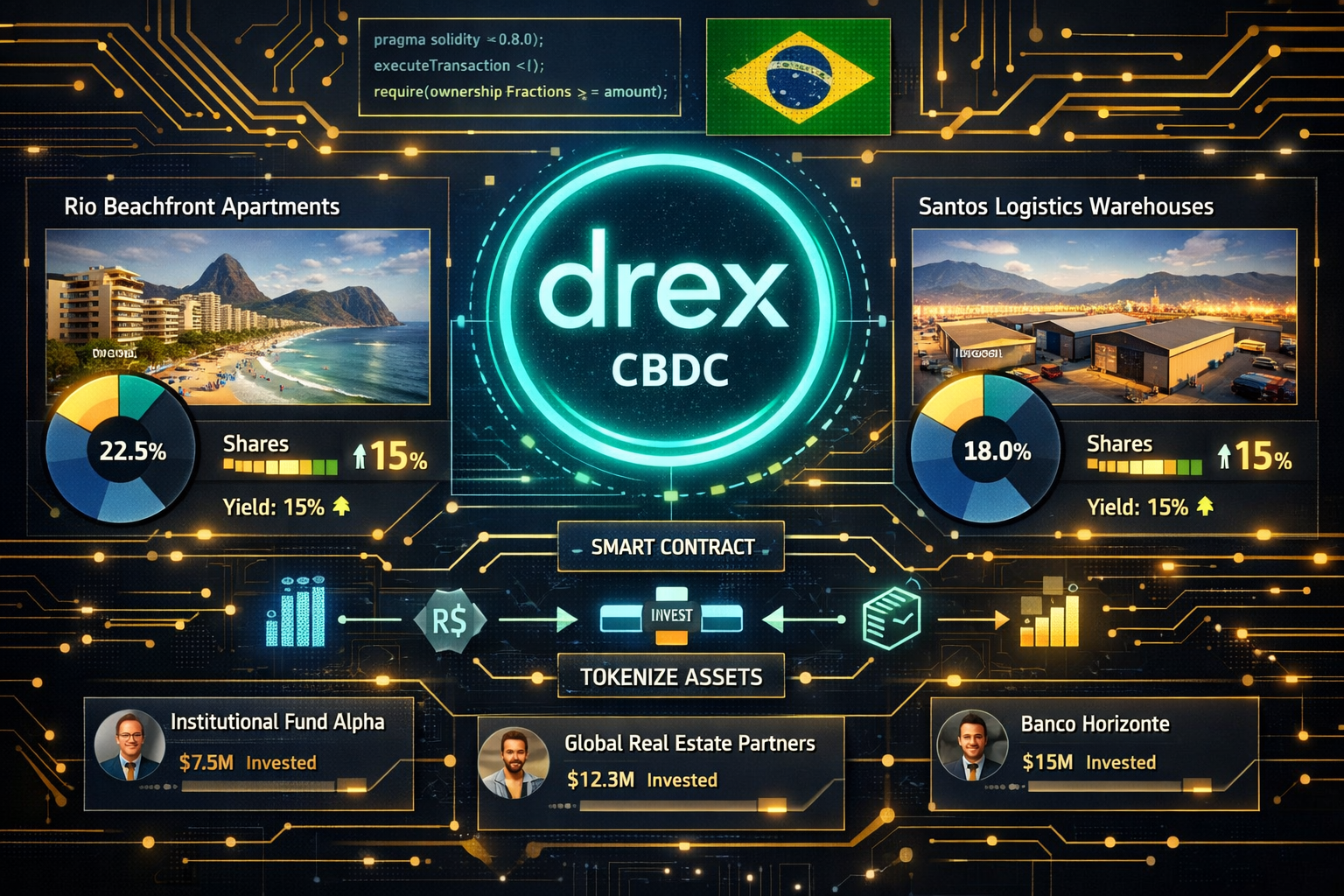
Brazil’s real estate tokenization market is outpacing every other country in Latin America — and the engine driving that acceleration is Drex, the country’s central bank digital currency (CBDC). With smart contracts on Drex projected to cut real estate transaction costs by up to 20% [1], global institutional funds are now mapping entry strategies into high-yield Brazilian assets ranging from Rio de Janeiro luxury residential towers to Santos port logistics hubs. The Fractional Ownership Boom via Drex: Tokenizing Brazil Property Assets for 2026 Institutional Access is not a future scenario — it is an active structural shift reshaping how capital flows into one of the world’s largest property markets.
Key Takeaways 🔑
- Drex’s “delivery versus payment” settlement enables atomic, instant property token transfers with no escrow or third-party intermediaries required. [2]
- Brazil leads all Latin American nations in dedicated real estate tokenization regulation, backed by a government CBDC and a live tokenized property exchange. [2]
- Foreign investors can own 100% of Brazilian urban property directly under their own name with only a CPF taxpayer number. [6]
- Registry integration (the cartório gap) remains the primary structural challenge, creating parallel on-chain and off-chain ownership records. [2]
- Private sector platforms are accelerating even as the official Drex launch evolves, with banks like Bradesco establishing dedicated Digital Assets divisions. [4]
What Is Drex and Why Does It Matter for Property Tokenization?
Brazil’s Central Bank launched Drex as the country’s programmable digital currency — a CBDC designed to go far beyond simple digital payments. Unlike a standard payment rail, Drex supports smart contract execution, meaning complex financial transactions like property sales can be automated, verified, and settled in a single ledger event. [3]
💡 Pull Quote: “Drex’s delivery-versus-payment mechanism means a tokenized property purchase settles atomically — the token moves to the buyer and the payment moves to the seller at the exact same moment, with zero waiting period.” [2]
The Architecture Behind the System
One of the most important 2026 updates is that Drex has shifted from a blockchain-based model to a centralized infrastructure design [3]. This was a deliberate strategic choice by Brazil’s Central Bank, prioritizing:
- ✅ Regulatory compliance over decentralized experimentation
- ✅ Functional security and fraud resistance
- ✅ Compatibility with existing financial infrastructure
- ✅ Programmability and instant settlement capabilities
The phased rollout begins with interbank transactions and government payments, then expands to public use while integrating credit services for previously unbanked populations. [3] This staged approach reduces systemic risk while building the infrastructure that will eventually support mass-market real estate tokenization.
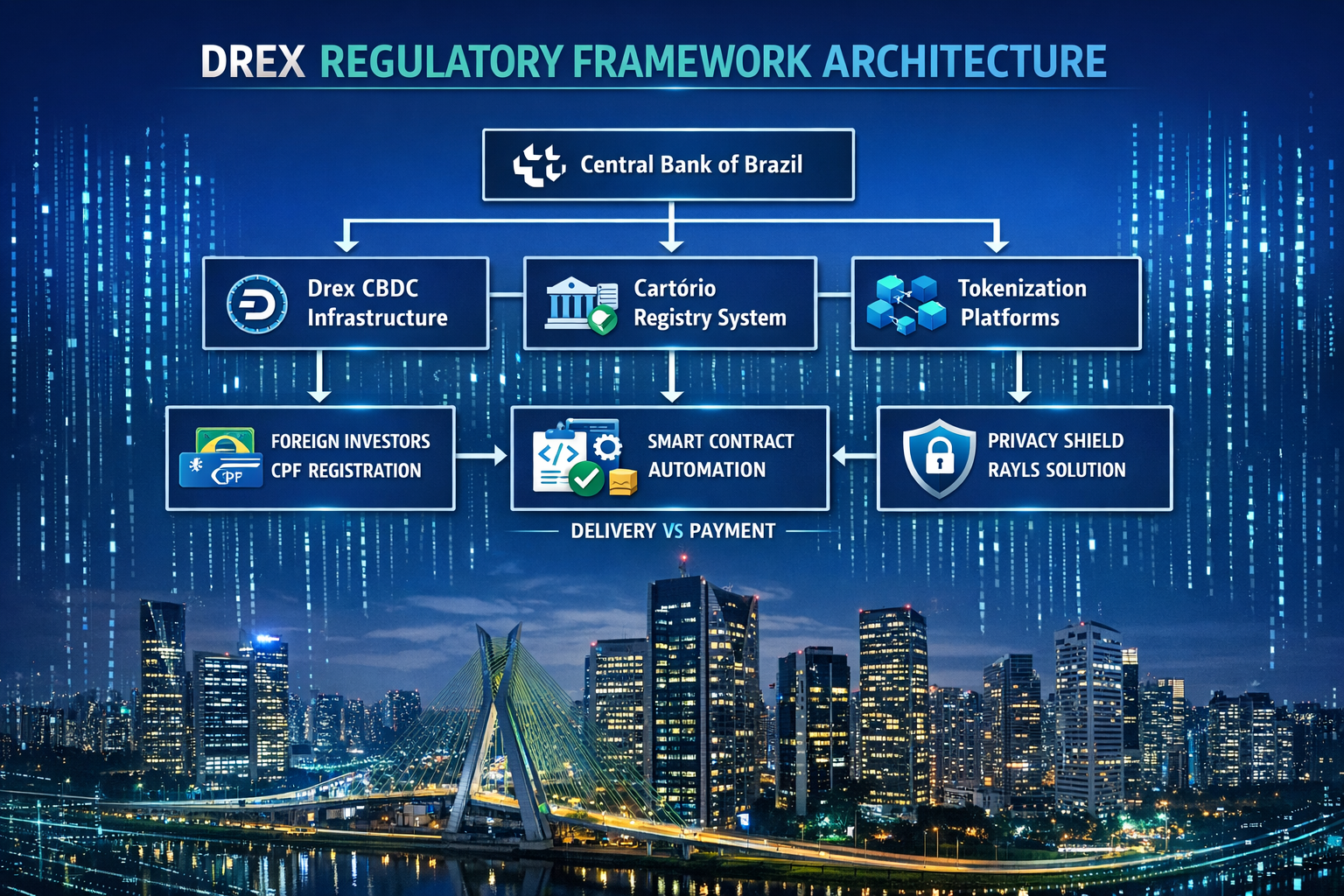
Rayls — a privacy-focused blockchain solution — was selected by Brazil’s Central Bank to serve as the privacy layer for Drex, addressing data protection and fraud prevention within the CBDC framework. [7] This integration is critical for institutional adoption, as large funds require confidentiality safeguards around their acquisition strategies.
The Regulatory Edge: Why Brazil Leads Latin America
Brazil has more dedicated real estate tokenization regulation than any other Latin American country. [2] That is not marketing language — it is a structural advantage that directly reduces legal risk for institutional allocators.
Key Regulatory Pillars in 2026
| Regulatory Element | Detail |
|---|---|
| CBDC Framework | Government-backed Drex provides legal settlement infrastructure |
| Live Tokenized Exchange | Brazil operates an active tokenized real estate trading platform |
| Foreign Ownership Rights | 100% direct ownership allowed for foreigners with CPF [6] |
| CVM Oversight | Brazil’s securities regulator provides token classification guidance |
| Privacy Standards | Rayls privacy solution integrated into Drex infrastructure [7] |
Foreign Investor Access: Simpler Than Expected
A common misconception is that foreign capital faces significant barriers in Brazilian property markets. The reality in 2026 is more welcoming. Foreign investors can own 100% of urban residential property directly under their own name, requiring only a CPF (Cadastro de Pessoas Físicas) Brazilian taxpayer registry number to legally register a property deed — no local partnerships required. [6]
This regulatory clarity, combined with tokenization infrastructure, creates a compelling entry point for global funds. An institutional investor in Singapore or Frankfurt can, in principle, hold fractional tokens representing ownership in a São Paulo commercial tower or a Florianópolis luxury development — with full legal standing.
For investors exploring the best places to invest in Brazil property, the combination of regulatory clarity and tokenized access is opening doors that were previously closed to non-resident capital.
The IMF Signal
The International Monetary Fund has formally recognized Brazil’s leadership in digital payments [1], and analysts are increasingly suggesting that Drex could establish a new global standard for property tokenization — not just within Latin America but as a model for emerging market CBDCs worldwide. That level of international validation accelerates institutional confidence.
How Fractional Ownership via Drex Works in Practice
Understanding the mechanics is essential before evaluating yield projections. The Fractional Ownership Boom via Drex: Tokenizing Brazil Property Assets for 2026 Institutional Access operates through a layered process that connects physical assets to digital tokens and ultimately to investor portfolios.
Step-by-Step: The Tokenization Flow
- Asset Selection & Valuation — A property (commercial, residential, or logistics) is independently valued and legally structured for tokenization.
- Token Issuance — A tokenization platform issues digital tokens representing fractional ownership stakes. Each token corresponds to a defined percentage of the underlying asset.
- Drex Settlement — When tokens are purchased, Drex’s delivery-versus-payment mechanism ensures simultaneous token transfer and payment settlement on the ledger. [2]
- Smart Contract Automation — Rental income distributions, maintenance fee deductions, and resale proceeds are managed automatically via smart contracts — reducing administrative overhead by up to 20%. [1]
- Registry Recording — Ownership is recorded both on-chain (token ledger) and, ideally, in the cartório (notary registry) system.
The Cartório Challenge ⚠️
Registry integration remains the primary structural challenge for the entire tokenization ecosystem. The gap between on-chain token ownership and the off-chain cartório property registry creates parallel records of ownership — a situation that poses real dispute risks until the two systems are directly connected. [2]
This is not a dealbreaker for institutional investors, but it is a due diligence item that requires legal structuring. Sophisticated funds are currently using SPV (Special Purpose Vehicle) structures to bridge this gap, holding the cartório-registered title within the SPV while issuing tokens against the SPV’s equity.
Target Asset Classes: Where Yield Meets Tokenization
Not all Brazilian property assets are equally suited to fractional tokenization. The following categories are attracting the most institutional attention in 2026.
🏢 Commercial Real Estate — São Paulo & Rio de Janeiro
São Paulo’s Faria Lima financial district and Rio’s Barra da Tijuca commercial corridor are the primary targets for institutional tokenization. Financial analysts project that efficiency gains from Drex smart contracts will accelerate fractional ownership adoption specifically in these commercial hubs. [1] Cap rates in prime São Paulo office space currently range from 7–9%, and tokenization’s cost reduction effect pushes net yields meaningfully higher.
🏗️ Logistics & Industrial — Santos Port Corridor
The Santos logistics corridor — Brazil’s busiest port zone — is attracting infrastructure capital at scale. Infrastructure giants are planning to invest approximately US$10 billion in Brazil in 2026 [8], with logistics infrastructure forming a significant portion of that allocation. Tokenized warehouse and distribution center assets in this corridor offer institutional-grade yields with strong demand fundamentals driven by e-commerce growth.
🌊 Luxury Coastal Residential — Florianópolis & Rio
Brazil’s premium coastal markets are generating strong short-term rental yields alongside capital appreciation. The growth of the Ingleses region in Florianópolis — combining quality of life, infrastructure investment, and property appreciation — makes it a compelling target for fractional tokenization. Similarly, life in Florianópolis continues to attract high-net-worth domestic and international buyers, supporting premium valuations.
For investors interested in specific development opportunities, projects like Solis and Tramonto represent the type of high-quality assets increasingly being structured for fractional access.
Projected Yield Uplift: The 15% Case
| Asset Class | Base Yield (Pre-Tokenization) | Projected Post-2026 Yield (Tokenized) | Uplift Driver |
|---|---|---|---|
| São Paulo Prime Office | 7.5% | 8.5–9.0% | Smart contract cost reduction |
| Santos Logistics Hub | 8.0% | 9.0–9.5% | Liquidity premium + automation |
| Rio Luxury Residential | 6.5% | 7.5–8.0% | Fractional demand premium |
| Florianópolis Coastal | 8.5% | 9.5–10.0% | Tourism yield + appreciation |
The 15% yield uplift projection cited by institutional analysts reflects the combined effect of transaction cost reduction, liquidity premiums from secondary token trading, and elimination of intermediary fees — all enabled by Drex’s smart contract infrastructure. [1]
Private Sector Momentum: Banks and Platforms Leading the Charge
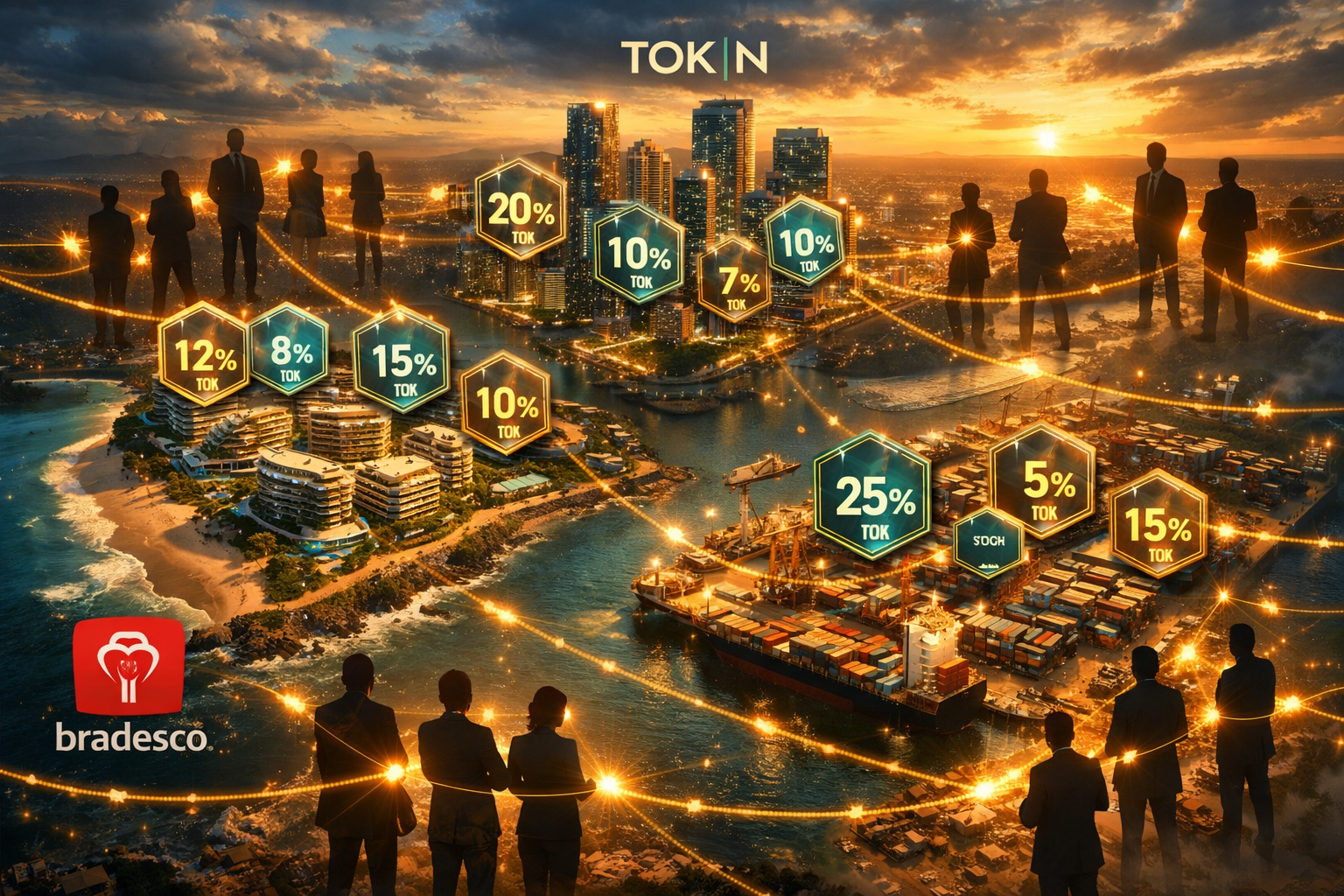
While the official Drex launch has evolved through several iterations, private sector tokenization platforms have accelerated regardless. Companies like Nexa Finance have expanded real asset tokenization from real estate into agricultural credit, capturing liquidity and efficiency gains ahead of the full CBDC rollout. [4]
Bradesco, one of Brazil’s largest banks, has established a dedicated Digital Assets division with institutional focus. The bank’s Head of Digital Assets has publicly noted that “the market is quite advanced,” with multiple international and independent tokenization players already developing live solutions. [4] This institutional banking validation is a critical signal for foreign funds assessing counterparty risk.
The intersection of cryptocurrency and real estate development is no longer theoretical in Brazil — it is an active market with measurable transaction volumes and established legal precedents.
Key Private Sector Players in 2026
- 🏦 Bradesco Digital Assets — Institutional tokenization services
- 🔐 Rayls — Privacy infrastructure for Drex [7]
- 🏗️ Nexa Finance — Multi-asset tokenization platform [4]
- 📊 Tokenizer.estate — Real estate-specific tokenization exchange [2]
Navigating the Fractional Ownership Boom via Drex: Tokenizing Brazil Property Assets for 2026 Institutional Access
For institutional investors ready to act, the navigation framework involves four parallel workstreams.
1. Legal Structure Selection
Choose between direct token ownership (suitable for smaller allocations with CPF registration) [6] or SPV-wrapped tokenization (preferred for large institutional positions requiring cartório alignment).
2. Platform Due Diligence
Evaluate tokenization platforms on: regulatory licensing status, Drex integration readiness, smart contract audit history, and secondary market liquidity depth.
3. Asset-Level Analysis
Apply standard real estate underwriting — location fundamentals, tenant quality, lease terms — then layer in tokenization-specific factors: token liquidity, distribution automation reliability, and registry status.
4. Currency & Repatriation Planning
Brazilian Real (BRL) exposure requires hedging strategy. Drex-settled transactions are BRL-denominated, so institutional investors must account for FX risk in their yield calculations. The advantages of investing in studio developments in Florianópolis — including strong rental demand and appreciation potential — can offset currency drag in favorable market conditions.
Investors tracking pre-launch appreciation opportunities in Brazilian development projects will find that tokenized off-plan purchases represent a new frontier for capturing early-stage value uplift.
Risks and Mitigation Strategies
No investment framework is complete without honest risk assessment.
| Risk | Severity | Mitigation |
|---|---|---|
| Cartório-token registry gap | 🔴 High | SPV legal structuring |
| Drex rollout timeline uncertainty | 🟡 Medium | Private platform diversification |
| BRL currency volatility | 🟡 Medium | FX hedging instruments |
| Smart contract vulnerability | 🟡 Medium | Third-party code audits |
| Liquidity risk on secondary markets | 🟡 Medium | Minimum holding period planning |
| Regulatory change risk | 🟢 Low | Brazil’s strong tokenization legal framework [2] |
Conclusion: Actionable Steps for Institutional Investors in 2026
The Fractional Ownership Boom via Drex: Tokenizing Brazil Property Assets for 2026 Institutional Access represents one of the most structurally sound emerging market property opportunities available to global institutional capital right now. Brazil’s combination of regulatory leadership, CBDC infrastructure, 215 million consumers, and high-yield property fundamentals creates a convergence that is difficult to replicate elsewhere.
Your Next Steps 🚀
- Register a CPF — The foundational legal step for any direct Brazilian property exposure. [6]
- Audit tokenization platforms — Prioritize those with live Drex integration or confirmed roadmaps.
- Target the Santos-São Paulo-Florianópolis corridor — These markets combine yield strength with tokenization readiness.
- Structure via SPV for large allocations — Bridge the cartório gap with proper legal architecture.
- Monitor Drex Phase 2 announcements — The expansion to public use will be the catalyst for secondary market liquidity. [3]
- Engage local development partners — Explore current development projects and contact specialist advisors to identify tokenization-ready assets.
Brazil is not waiting for the rest of the world to catch up on property tokenization. The infrastructure is being built now, the regulation exists, and the yield premiums are real. Institutional investors who establish positions in 2026 will benefit from first-mover advantages that are already beginning to compress as more capital identifies this opportunity.
References
[1] Brazil Real Estate Market Trends 2026 An Institutional Investors Guide – https://www.riotimesonline.com/brazil-real-estate-market-trends-2026-an-institutional-investors-guide/
[2] Real Estate Tokenization In Brazil 2026 Latin Americas Biggest Market Makes Its Move – https://blog.tokenizer.estate/real-estate-tokenization-in-brazil-2026-latin-americas-biggest-market-makes-its-move/
[3] Brazil Fast Tracks Drex Cbdc Launch 2026 Global Trends 2508 – https://www.ainvest.com/news/brazil-fast-tracks-drex-cbdc-launch-2026-global-trends-2508/
[4] Brazil Shelves Digital Currency For Now – https://www.fundssociety.com/en/news/alternatives/brazil-shelves-digital-currency-for-now/
[6] Brazil Foreigner Rights – https://thelatinvestor.com/blogs/news/brazil-foreigner-rights
[7] Drex The Future Of A Tokenised Economy In Brazil Leveraging Rayls Privacy Solution – https://www.rayls.com/blog/drex-the-future-of-a-tokenised-economy-in-brazil-leveraging-rayls-privacy-solution
[8] Infrastructure Giants Plan To Invest Around Us10 Billion In Brazil In 2026 – https://www.bnamericas.com/en/analysis/infrastructure-giants-plan-to-invest-around-us10-billion-in-brazil-in-2026