
The Brazilian real estate market is experiencing a remarkable transformation in 2026, driven by a powerful combination of currency dynamics and international capital flows. High-End Residential Recovery in Brazil 2026: Capitalizing on Weak BRL for International Developer Partnerships represents one of the most compelling investment opportunities in emerging markets today. With the Brazilian Real (BRL) weakening further against major currencies, foreign developers are discovering that luxury properties in São Paulo and Rio de Janeiro suburbs offer 15-25% USD-denominated gains—a windfall that’s attracting sophisticated international partnerships and reshaping Brazil’s residential landscape.
This currency advantage, combined with government credit expansion and surging demand from international buyers, has created a perfect storm for high-end residential development. Foreign investors are no longer simply purchasing finished properties; they’re forming strategic partnerships with local developers to build luxury projects from the ground up, capturing value at every stage of development.
Key Takeaways
- 💰 Currency Arbitrage Opportunity: The weak BRL creates 15-25% effective discounts for USD and EUR investors, making Brazilian luxury properties significantly undervalued by international standards
- 📈 Market Growth Trajectory: Brazil’s residential real estate market is valued at USD 106.97 billion in 2026, projected to reach USD 138.70 billion by 2031 at a 5.33% CAGR[2]
- 🌍 International Buyers Drive Premium Segment: Foreign capital is the primary engine of value appreciation in luxury and coastal markets, less sensitive to domestic interest rates and more focused on exchange rates[1]
- 🏗️ Mid-to-High-End Surge: The upscale residential sector saw a 94% increase in Value General of Sales (VGV) in Q2 2024 compared to Q2 2023[4]
- 🏖️ Geographic Diversification: Investment is shifting from major capitals toward high-yield coastal and secondary markets like Búzios, Balneário Camboriú, and premium Rio neighborhoods
Understanding the Currency Advantage: Why the Weak BRL Matters for Developers
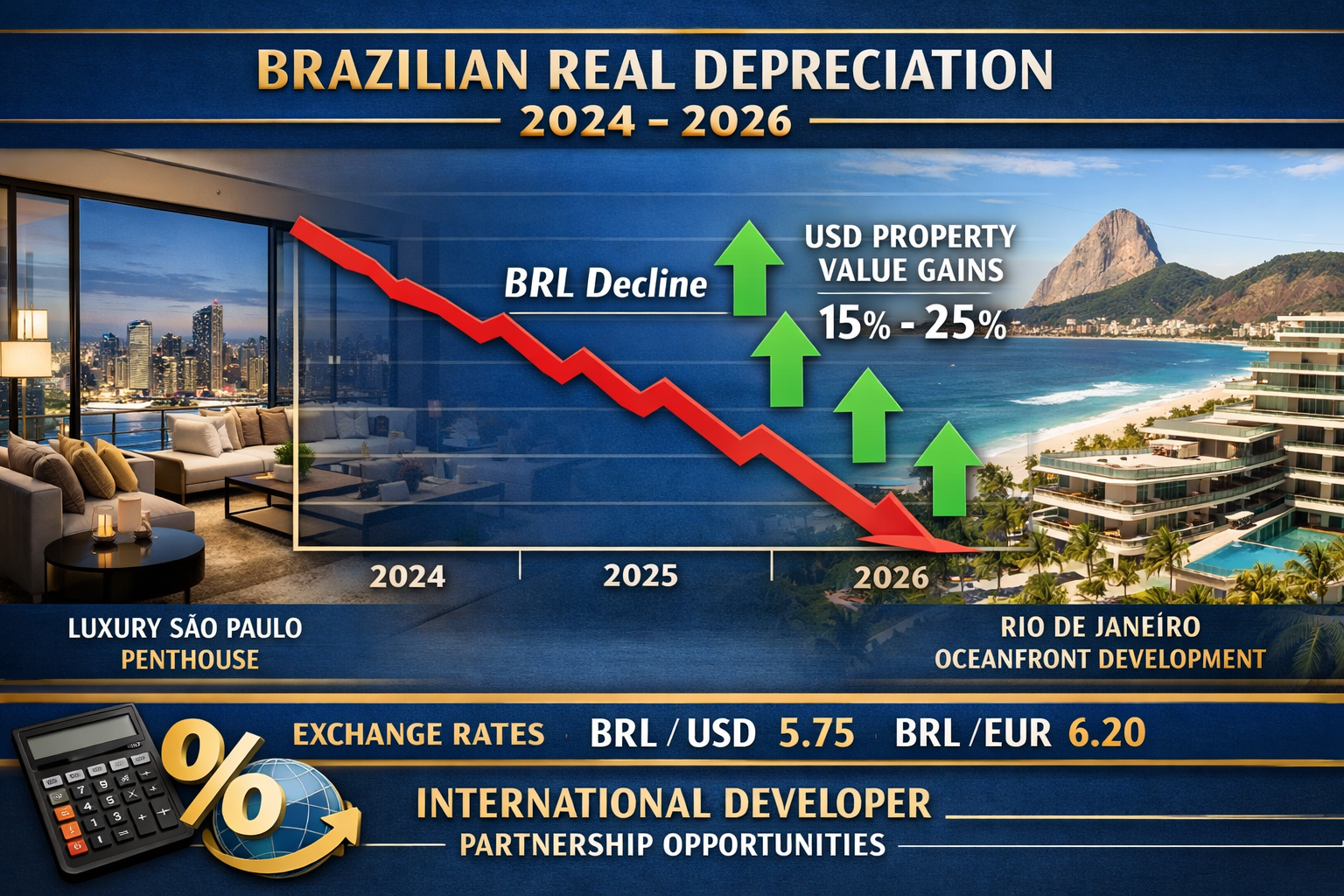
The weakening Brazilian Real has emerged as the dominant factor attracting foreign capital to Brazil’s high-end residential sector in 2026. This currency dynamic creates a unique arbitrage opportunity that savvy international developers are exploiting through local partnerships.
The Mathematics of Currency Arbitrage
When the BRL depreciates against hard currencies like the USD and EUR, Brazilian properties become effectively discounted for foreign buyers. A luxury apartment priced at R$ 3 million represents vastly different value propositions depending on exchange rates:
- At BRL 5.0 to USD: $600,000 USD
- At BRL 6.0 to USD: $500,000 USD (16.7% discount)
- At BRL 6.5 to USD: $461,538 USD (23% discount)
This currency fluctuation means that international developers partnering with Brazilian firms can lock in construction costs in BRL while planning to sell or rent to international buyers paying in hard currencies. The result is built-in profit margins that domestic-only developers cannot achieve.
Foreign Capital’s Insensitivity to Domestic Interest Rates
Unlike Brazilian buyers who face domestic financing constraints, international buyers and developer partnerships are primarily influenced by exchange rates and global portfolio diversification strategies[1]. This fundamental difference means that while local demand may fluctuate with Brazil’s interest rate cycles, foreign capital continues flowing into high-end segments regardless of domestic monetary policy.
For developers, this creates a more stable and predictable buyer base for luxury projects—one that values Brazil’s lifestyle offerings, rental yield potential, and currency-discounted entry points over traditional financing considerations.
Market Size and Growth: The Foundation for High-End Residential Recovery in Brazil 2026
Brazil’s residential real estate market presents substantial scale and consistent growth projections that support long-term development partnerships. Understanding these fundamentals helps international developers assess the sustainability of their Brazilian ventures.
Current Market Valuation and Projections
Brazil’s residential real estate market is valued at USD 106.97 billion in 2026, with analysts projecting growth at a compound annual growth rate (CAGR) of 5.33% to reach USD 138.70 billion by 2031[2]. Alternative projections show the market valued at $59.61 billion in 2025 with a CAGR of 5.40% through 2033, potentially exceeding $90 billion by the forecast end[5].
These growth trajectories indicate a stable, expanding market that can absorb new high-end inventory while maintaining value appreciation—a critical consideration for developers planning multi-year projects.
| Market Metric | 2026 Value | 2031 Projection | CAGR |
|---|---|---|---|
| Total Market Size (Projection 1) | USD 106.97B | USD 138.70B | 5.33% |
| Total Market Size (Projection 2) | USD 59.61B (2025) | USD 90B+ (2033) | 5.40% |
| Mid-to-High-End VGV Growth (Q2 2024 vs Q2 2023) | +94% | — | — |
The Mid-to-High-End Segment Explosion
The most compelling data point for luxury developers is the 94% increase in the Value General of Sales (VGV) in the mid-to-high-end residential sector during the second quarter of 2024 compared to the same period in 2023[4]. This explosive growth demonstrates that premium segments are outperforming the broader market by substantial margins.
This surge reflects several converging factors:
- ✅ Increased international buyer activity
- ✅ Pent-up demand from affluent Brazilian buyers
- ✅ Limited supply of truly luxury inventory in prime locations
- ✅ Currency-driven value perception among foreign buyers
For international developers considering partnerships in Brazil’s top investment locations, this growth trajectory validates the strategic focus on high-end segments rather than mass-market developments.
Government Credit Expansion: Fueling the Upper-Middle Market
In October 2025, the Brazilian federal government announced a modernized real estate credit model that directly impacts the high-end residential recovery. The Sistema Brasileiro de Poupança e Empréstimo (SBPE) property-value ceiling was raised from R$ 1.5 million to R$ 2.25 million, while the maximum loan-to-value ratio increased to 80%[2].
This policy change aims to inject R$ 40 billion into housing credit over two years and finance an incremental 80,000 units through 2026[2]. For developers, this expansion means that properties priced between R$ 1.5 million and R$ 2.25 million—the upper-middle segment—now have access to favorable financing that was previously unavailable.
Strategic Implication: International developers can target this newly-financeable price band, capturing both domestic buyers with improved credit access and international buyers paying cash or using foreign financing.
International Buyers: The Primary Engine of High-End Residential Recovery in Brazil 2026
International buyers are predicted to be the primary engine of value appreciation in Brazil’s luxury and coastal markets throughout 2026[1]. Understanding this buyer profile and their motivations is essential for developers structuring partnership agreements and project specifications.
Diverse International Buyer Demographics
The international buyer landscape in Brazil encompasses several distinct segments:
🌍 European Retirees and Lifestyle Buyers
- Portuguese, German, and Italian buyers drawn to cultural affinity, climate, and quality of life
- Seeking beachfront or near-beach properties for retirement or semi-retirement
- Typically cash buyers or using European financing
- Strong preference for established coastal communities with European expat populations
🇺🇸 North American Investors
- Focused on rental yield and portfolio diversification
- Attracted to short-term rental opportunities (Airbnb model)
- Often purchasing multiple units or partnering on small development projects
- Price-sensitive to USD/BRL exchange rate fluctuations
🇨🇳 Chinese and Asian Investors
- Seeking geographic diversification outside Asia
- Interested in both personal use and investment returns
- Preference for branded residences and internationally-recognized developments
- Often purchasing sight-unseen through trusted intermediaries
The Short-Term Rental Market as Investment Driver
The Airbnb and short-term rental market is identified as the single most powerful driver of foreign investment in Brazilian residential property[1]. Projected rental yields in specific micro-markets far outstrip traditional long-term rental returns, with some coastal locations achieving 8-12% net annual yields in hard currency.
For developers, this creates a clear design imperative: properties must be optimized for short-term rental operations. This means:
- Turnkey furnished delivery options
- Robust property management partnerships
- Locations within walking distance of beaches or attractions
- Amenities that photograph well for online listings (infinity pools, ocean views, modern design)
International developer partnerships that incorporate property management services and guaranteed rental programs have significant competitive advantages in attracting foreign buyers.
Why International Buyers Prefer Developer Partnerships
Foreign buyers increasingly prefer purchasing from international-local developer partnerships rather than individual sellers or purely domestic developers. The reasons include:
✅ Quality Assurance: International partners bring global construction standards and accountability ✅ Transparent Processes: Bilingual documentation, clear contracts, and familiar business practices ✅ Financing Facilitation: Access to international financing networks and payment structures ✅ After-Sale Services: Property management, rental programs, and ongoing support ✅ Resale Value Protection: International brand recognition enhances future marketability
Geographic Hotspots: Where International Developers Should Focus Partnerships
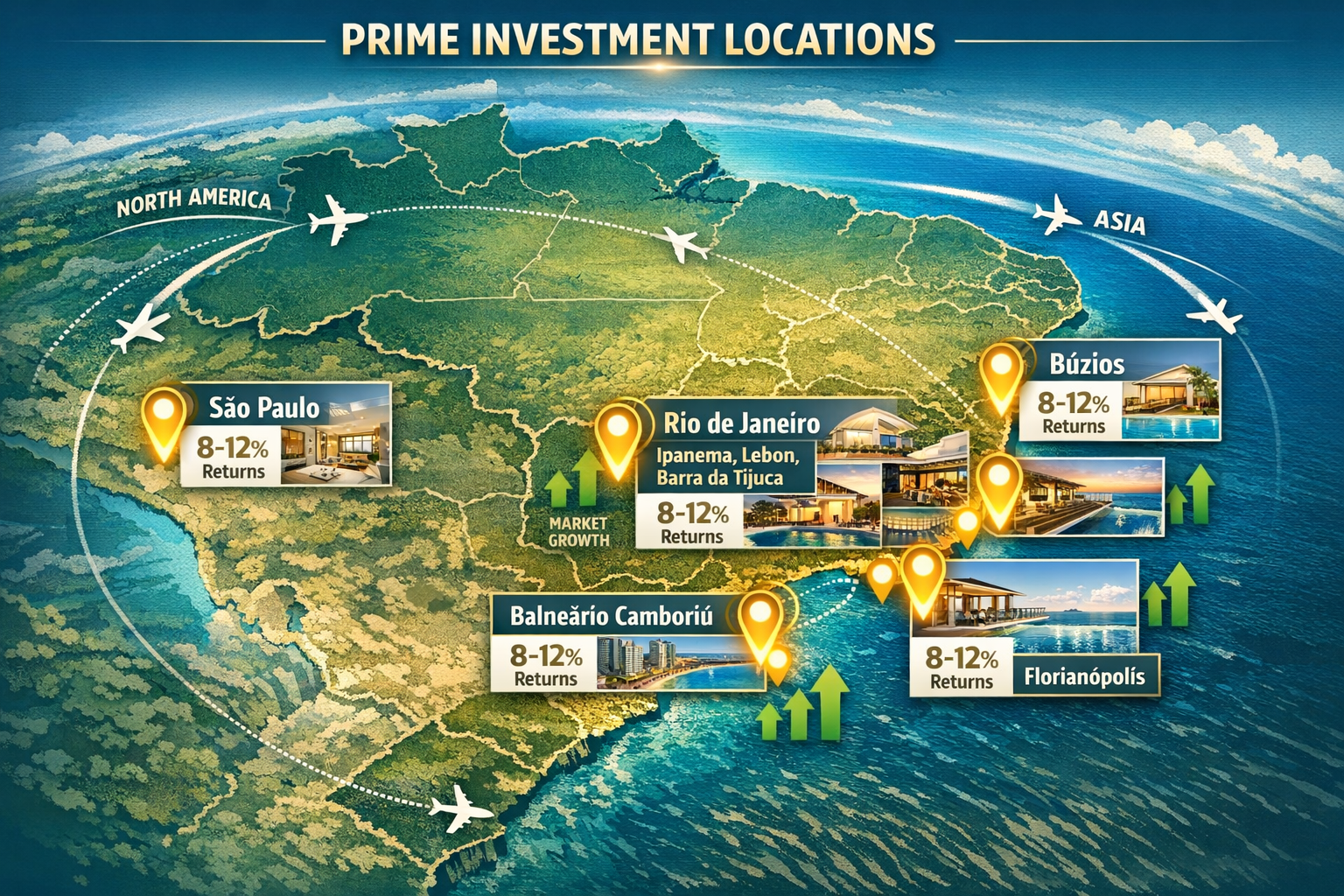
The geographic distribution of opportunity in Brazil’s high-end residential market is shifting. While São Paulo and Rio de Janeiro remain important, secondary and coastal markets are emerging as the highest-yield opportunities for international developer partnerships.
Rio de Janeiro: Selective Premium Neighborhoods
Rio de Janeiro maintains strong international appeal, but developers must be highly selective about neighborhoods. Prime zones include:
Ipanema and Leblon 🏖️
- The highest-value neighborhoods with guaranteed international resale value
- Limited new development opportunities due to density restrictions
- Properties here offer currency hedge and long-term appreciation
- Target: Ultra-luxury renovations and boutique new developments
Barra da Tijuca 🏗️
- Larger-scale development opportunities
- Modern infrastructure and planned communities
- Growing international school and expat infrastructure
- Target: Mid-to-high-end condominiums with resort amenities
Lagoa 🌅
- Scenic lagoon-side location with mountain views
- Established affluent Brazilian and international resident base
- Limited inventory creates pricing power
- Target: Boutique luxury projects with unique positioning
“Prime Rio neighborhoods—Ipanema, Leblon, Barra da Tijuca, and Lagoa—maintain strong international appeal, with the high-end zones of Ipanema and Leblon offering properties with guaranteed international resale value.”[1][3]
However, developers must acknowledge that parts of Rio face systemic security and infrastructure challenges[1]. Due diligence on specific micro-locations is essential, and partnerships with experienced local developers who understand neighborhood dynamics are critical.
Búzios: The Predictable High-Yield Winner
The resort town of Búzios is identified as a secure choice for high-yield holiday rentals in 2026[1]. Located approximately 170 kilometers from Rio de Janeiro, Búzios offers:
- 🏖️ Beautiful beaches with established luxury tourism infrastructure
- 🏨 Strong year-round demand from Brazilian and international tourists
- 📈 Proven short-term rental performance with 8-12% yields
- 🛡️ Lower security concerns compared to major cities
- 💰 More accessible entry prices than Rio’s prime neighborhoods
Developer Strategy: Focus on boutique condominium projects (20-40 units) with turnkey furnished options, professional property management partnerships, and proximity to João Fernandes or Geribá beaches. Pre-sales to international buyers can fund construction while locking in BRL-denominated costs.
Balneário Camboriú: Brazil’s “Vertical Luxury Capital”
Balneário Camboriú has emerged as a unique phenomenon in Brazilian real estate—a small coastal city with record-breaking architecture and a concentration of luxury high-rises that rivals Miami[6]. The city features:
- 🏙️ Strong domestic demand from affluent Brazilian buyers
- 🏗️ Excellent appreciation potential with ongoing development boom
- 🌊 Oceanfront locations with dramatic skyline
- 🏢 Established market for branded residences and international partnerships
Developer Strategy: Focus on pre-construction apartments and branded residences in oceanfront condos[6]. The market here is sophisticated enough to support international-standard pricing while construction costs remain favorable in BRL terms. This city represents one of the best opportunities for capitalizing on market performance trends that are reshaping coastal Brazil.
São Paulo Suburbs: The Overlooked Opportunity
While coastal markets capture headlines, São Paulo’s affluent suburbs present compelling opportunities for international developer partnerships focused on the domestic high-end market:
- 🏡 Alphaville and surrounding condominium communities
- 🌳 Jardins and upscale central neighborhoods
- 🏢 Mixed-use developments in emerging business districts
São Paulo’s advantage is scale and economic fundamentals—the city’s economy alone would rank among the world’s top 30 countries by GDP. High-end residential demand is driven by:
- Domestic wealth creation and executive housing needs
- Limited supply of internationally-standard luxury inventory
- Growing preference for branded residences and full-service buildings
- Security-conscious buyers seeking gated communities
Developer Strategy: Partner with established São Paulo developers on branded residence projects targeting domestic executives and affluent families. These projects can command premium pricing while avoiding the short-term rental dependency of coastal markets.
Property Types and Segment Performance
Understanding which property types are driving growth helps developers structure their Brazilian partnerships for maximum returns.
Apartment and Condominium Dominance
Apartments and condominiums led the Brazilian residential market with 77.17% share in 2025[2]. This dominance reflects several factors:
- 🏢 Urban land scarcity in prime locations
- 🔒 Security preferences among affluent buyers
- 🏊 Amenity expectations (pools, gyms, concierge services)
- 📊 Easier property management for international owners
For international developers, this means vertical development partnerships (apartment towers and mid-rise condominiums) should be the primary focus, particularly in urban and coastal locations.
Villas and Landed Houses: The Fastest Growing Segment
Despite apartments’ market dominance, villas and landed houses are projected to be the fastest growing segment at 6.31% CAGR through 2031[2]. This growth is driven by:
- 🌴 Demand for private outdoor space post-pandemic
- 🏖️ Coastal villa developments targeting international buyers
- 🏡 Gated community single-family projects in suburbs
- 💎 Ultra-luxury segment seeking exclusivity
Developer Strategy: Consider hybrid approaches that combine condominium efficiency with villa exclusivity—such as low-density villa communities with shared amenities, or “villa-style” townhomes within secure compounds.
The Studio and Compact Luxury Segment
In markets like Florianópolis and other coastal cities, there’s growing demand for high-end studios and compact units optimized for short-term rentals. These properties offer:
- 💰 Lower absolute price points attracting first-time international investors
- 📈 Higher yields per square meter than larger units
- 🔄 Easier rental turnover and management
- 🎯 Perfect for Airbnb and vacation rental strategies
Developers can explore the advantages of investing in studios from an incorporation perspective, particularly in high-demand coastal markets.
Structuring International Developer Partnerships: Key Considerations
Successfully capitalizing on High-End Residential Recovery in Brazil 2026: Capitalizing on Weak BRL for International Developer Partnerships requires careful structuring of the partnership itself. Several models have proven effective:
Partnership Models
1. Joint Venture Equity Partnerships 🤝
- International partner provides capital (typically 40-60% of project costs)
- Local partner contributes land, permits, and development expertise
- Profits split according to equity contribution and performance milestones
- Best for: Larger projects (50+ units) with experienced local partners
2. Development Management Agreements 📋
- International partner acts as developer/manager for a fee plus profit share
- Local partner provides land and local liaison
- International partner controls design, construction standards, and marketing
- Best for: Branded residence projects and quality-focused developments
3. Land Banking and Forward Purchase 🏗️
- International partner purchases land or secures forward purchase agreements
- Local developer builds to international partner’s specifications
- International partner pre-sells to foreign buyer network
- Best for: Smaller boutique projects in proven locations
4. Fund-Based Development 💼
- International real estate fund partners with multiple local developers
- Portfolio approach across several projects and locations
- Professional management and institutional governance
- Best for: Risk-averse institutional investors seeking diversification
Critical Legal and Regulatory Considerations
International developers must navigate Brazil’s complex legal environment:
⚖️ Foreign Ownership Regulations
- Foreign individuals and companies can own Brazilian property with some restrictions
- Coastal and border regions have additional requirements
- Proper legal structure (Brazilian entity vs. direct foreign ownership) impacts taxation
📄 Development Permits and Approvals
- Municipal approvals can be lengthy and politically influenced
- Environmental licensing (especially coastal projects) requires specialist navigation
- Local partner expertise in permit acquisition is invaluable
💰 Currency and Repatriation
- Profits can be repatriated but require proper documentation and tax compliance
- Currency controls and reporting requirements apply to large transactions
- Structuring payment flows to minimize currency risk is essential
🏦 Financing and Banking
- International developers typically use foreign financing for their equity contribution
- Brazilian bank financing is available but often at higher rates than international markets
- Hybrid financing structures can optimize cost of capital
Risk Mitigation Strategies
Smart international developers implement several risk mitigation approaches:
✅ Phased Development: Structure projects in phases to test market reception before full commitment
✅ Pre-Sales Requirements: Require minimum pre-sales (typically 30-50%) before breaking ground
✅ Currency Hedging: Use forward contracts or natural hedges to protect against BRL appreciation
✅ Local Partner Vetting: Conduct thorough due diligence on local partners’ track record, financial stability, and reputation
✅ Independent Quality Control: Employ independent construction monitors and quality assurance teams
✅ Title Insurance: Obtain title insurance through international providers familiar with Brazilian real estate
Marketing and Sales Strategies for International Buyer Acquisition
Capturing the international buyer market requires sophisticated marketing approaches that differ significantly from domestic Brazilian strategies.
Digital Marketing and Virtual Sales
International buyers often purchase sight-unseen or after minimal site visits. Effective digital marketing includes:
🖥️ Virtual Tours and 3D Visualization
- Professional architectural renderings and virtual reality walkthroughs
- 360-degree photography of model units and amenities
- Live virtual tours conducted by bilingual sales teams
🌐 Multi-Language Website and Content
- Websites in English, Portuguese, Spanish, and ideally German/Italian
- Content marketing focused on lifestyle, yields, and investment thesis
- SEO optimization for international search terms
📱 Social Media and Influencer Partnerships
- Instagram and YouTube content showcasing Brazilian lifestyle
- Partnerships with expat influencers and international real estate channels
- Targeted advertising to high-net-worth individuals in key markets
International Real Estate Networks
Partnering with established international real estate networks accelerates buyer acquisition:
- 🏢 Global Real Estate Franchises: Sotheby’s, Christie’s, Engel & Völkers
- 🌍 Expat-Focused Agencies: Specialists in international buyer representation
- 💼 Wealth Management Partnerships: Relationships with private banks and family offices
- ✈️ Migration and Residency Consultants: Professionals advising clients on Brazilian residency
Investment Migration and Residency Programs
While Brazil doesn’t have a formal “golden visa” program like Portugal or Spain, pathways to residency through real estate investment exist and can be marketed as value-adds:
- Investor visas for those establishing businesses or making significant investments
- Retirement visas for qualifying international retirees
- Family reunification and other pathways that real estate ownership can support
Developers who package properties with residency consultation services create additional value for international buyers considering relocation.
Financial Projections: The 15-25% USD Gain Opportunity
The headline opportunity driving High-End Residential Recovery in Brazil 2026: Capitalizing on Weak BRL for International Developer Partnerships is the potential for 15-25% USD-denominated gains through strategic development partnerships.
How the Gains Materialize
These gains come from multiple sources:
1. Currency Arbitrage (8-15% gain) 💱
- Lock in construction costs in BRL at current exchange rates
- Sell or rent to international buyers paying in USD/EUR
- Benefit from any further BRL depreciation during construction period
- Even if BRL stabilizes, the initial discount remains
2. Development Profit Margin (10-20% gain) 📊
- Traditional developer profit on successful projects
- Enhanced by international buyer willingness to pay premium prices
- Amplified by limited competition in high-end segments
- Optimized through efficient local partnerships
3. Market Appreciation (5-10% annual gain) 📈
- Underlying market growth at 5.33% CAGR[2]
- Premium segments outperforming broader market
- Location-specific appreciation in high-demand coastal areas
- Scarcity value in prime neighborhoods with limited new supply
4. Rental Yield Capitalization (8-12% annual yield) 🏖️
- Short-term rental yields in prime coastal markets
- Converts to capital value through cap rate compression
- International buyers purchasing for yield enhance exit values
- Professional property management maximizes rental performance
Example Project Pro Forma
Consider a hypothetical 50-unit luxury condominium in Búzios:
| Item | BRL Amount | USD Equivalent (@ 6.0) | Notes |
|---|---|---|---|
| Land Acquisition | R$ 6,000,000 | $1,000,000 | Beachfront parcel |
| Construction Costs | R$ 30,000,000 | $5,000,000 | R$ 600k per unit |
| Soft Costs & Marketing | R$ 4,000,000 | $667,000 | 10% of hard costs |
| Total Development Cost | R$ 40,000,000 | $6,667,000 | |
| Average Sale Price per Unit | R$ 1,000,000 | $166,667 | Premium pricing |
| Total Revenue (50 units) | R$ 50,000,000 | $8,333,333 | |
| Gross Profit | R$ 10,000,000 | $1,666,667 | 25% margin |
| ROI on USD Investment | — | 25% | On $6.67M investment |
If BRL depreciates further to 6.5 during the 18-month construction period, and units are sold at R$ 1,000,000 (now $153,846 USD), the developer maintains BRL profitability while international buyers perceive even greater value, accelerating sales velocity.
Downside Scenarios and Protections
Prudent developers also model downside scenarios:
⚠️ BRL Appreciation Risk: If BRL strengthens to 5.5, USD-denominated returns decrease, but BRL returns remain intact
⚠️ Sales Velocity Risk: Pre-sales requirements and phased development protect against slow absorption
⚠️ Construction Cost Inflation: Fixed-price contracts with local builders and contingency reserves (10-15%) mitigate this risk
⚠️ Regulatory Changes: Political risk insurance and diversification across multiple projects reduce exposure
The Florianópolis Opportunity: A Case Study in Regional Growth
Florianópolis and the surrounding region exemplify the geographic shift toward secondary and coastal markets that defines Brazil’s high-end residential recovery in 2026. This area demonstrates how international developer partnerships can capitalize on explosive regional growth.
Market Fundamentals in Greater Florianópolis
The Florianópolis real estate market is experiencing significant growth, driven by:
- 🏖️ 42 beaches offering diverse lifestyle options
- 🎓 Growing tech sector and university ecosystem attracting young professionals
- ✈️ Improved connectivity with expanded airport serving international routes
- 🌍 Established expat community providing social infrastructure for newcomers
- 📈 Property values appreciating faster than national averages
Neighborhood-Specific Opportunities
Different neighborhoods within Greater Florianópolis offer distinct opportunities:
Ingleses Region 🏘️ The Ingleses region is experiencing remarkable growth in quality of life, infrastructure, and property valuation. This area offers:
- Family-friendly beaches with calmer waters
- Developing commercial infrastructure
- More affordable entry points than central Florianópolis
- Strong rental demand from domestic tourists
Jurerê Internacional 💎
- Established luxury market with international buyers
- High-end beach clubs and dining
- Premium pricing but proven demand
- Best for ultra-luxury branded residence projects
Central Florianópolis 🏙️
- Urban lifestyle with cultural amenities
- Growing demand for high-end apartments
- Proximity to business districts
- Mix of domestic and international buyers
Development Projects in Progress
Active developments in the region demonstrate successful partnership models. Projects like Tramonto showcase how construction progress and accelerated timelines can be achieved through effective partnerships, while maintaining quality standards that appeal to international buyers.
Understanding life in Florianópolis from both resident and investor perspectives helps developers design projects that meet market needs.
Operational Excellence: Delivering Projects That Meet International Standards
International buyers expect construction quality, finishes, and building operations that meet global standards. Delivering on these expectations is critical for partnership success.
Construction Quality and Specifications
International developers must ensure local partners deliver to specification:
🏗️ Structural Standards
- Reinforced concrete construction meeting international seismic and wind load standards
- Proper waterproofing and moisture barriers (critical in coastal climates)
- Quality concrete mixes and proper curing procedures
- Independent structural engineering review
🎨 Finishes and Materials
- Imported or international-equivalent fixtures and appliances
- Stone countertops, quality cabinetry, and premium flooring
- Energy-efficient windows and climate control systems
- Finishes that photograph well for rental marketing
🏊 Amenities and Common Areas
- Resort-style pools with professional maintenance programs
- Fitness centers with modern equipment
- Co-working spaces and business centers
- Landscaping and outdoor areas designed for low maintenance
Property Management and Rental Programs
For investment-focused international buyers, professional property management is essential:
📋 Turnkey Rental Programs
- Furniture packages designed for short-term rentals
- Professional photography and listing optimization
- Dynamic pricing and revenue management
- Guest services and 24/7 support
🔧 Maintenance and Operations
- Preventive maintenance schedules
- Rapid response to owner and guest issues
- Financial reporting and owner portals
- Compliance with local regulations and tax requirements
💰 Guaranteed Rental Programs
- Some developers offer guaranteed rental yields (6-8%) for initial periods
- Reduces buyer risk and accelerates sales
- Requires careful financial modeling to ensure sustainability
- Can be structured as buyback options or rental guarantees
Competitive Landscape: Who’s Already Capitalizing on This Opportunity
Understanding the competitive landscape helps new entrants identify partnership opportunities and differentiation strategies.
International Developers Active in Brazil
Several international developer groups have established Brazilian operations:
- 🇺🇸 North American Developers: Focused primarily on São Paulo and Rio luxury segments
- 🇪🇺 European Groups: Portuguese and Spanish developers with cultural and linguistic advantages
- 🇦🇪 Middle Eastern Capital: Seeking diversification and yield in emerging markets
- 🌏 Asian Developers: Primarily Chinese groups exploring South American expansion
Local Developers Seeking International Partners
Brazil has numerous established local developers with strong track records seeking international partnerships:
- Proven execution capability and local market knowledge
- Access to prime land parcels and development rights
- Established relationships with municipalities and contractors
- Need for international capital and buyer networks
The best partnerships match international capital and market access with local execution expertise and regulatory navigation.
Differentiation Strategies
To succeed in an increasingly competitive market, developer partnerships should focus on:
✨ Branded Residence Partnerships: Collaborating with international hotel brands (Four Seasons, Ritz-Carlton, etc.)
🌱 Sustainability and Green Building: LEED certification and sustainable design appeal to European buyers
🎯 Niche Market Focus: Targeting specific buyer segments (digital nomads, retirees, family compounds)
💎 Unique Locations: Securing the last prime beachfront parcels or exclusive neighborhood sites
🤝 Integrated Services: Offering residency assistance, property management, and lifestyle concierge
Risks and Challenges: What Could Derail the Recovery
While the opportunity is substantial, international developers must acknowledge and plan for significant risks inherent in Brazilian real estate development.
Political and Economic Volatility
Brazil’s political and economic environment can shift rapidly:
⚠️ Policy Changes: New administrations may alter tax policies, foreign ownership rules, or development regulations
⚠️ Economic Cycles: Brazil’s economy remains volatile with periodic recessions and currency crises
⚠️ Interest Rate Fluctuations: While foreign buyers are less sensitive, domestic market conditions affect overall ecosystem
Currency Risk
While BRL weakness creates opportunity, currency volatility cuts both ways:
📉 Unexpected BRL Strengthening: Would reduce USD-denominated returns and potentially slow international buyer demand
💱 Conversion and Repatriation: Moving profits out of Brazil requires proper documentation and can face regulatory hurdles
🏦 Banking Restrictions: Capital controls or banking crises could complicate transactions
Regulatory and Permitting Challenges
Brazil’s regulatory environment can be opaque and unpredictable:
🏛️ Municipal Approval Delays: Permits that should take months can stretch to years
🌳 Environmental Restrictions: Coastal and environmentally sensitive areas face increasing regulation
👥 Community Opposition: Local resistance to high-density development can derail projects
Construction and Execution Risks
Delivering projects on time and budget in Brazil requires careful management:
🔨 Labor and Material Costs: Inflation in construction inputs can erode margins
⏰ Timeline Delays: Brazilian construction timelines are notoriously optimistic
🏗️ Quality Control: Ensuring international standards requires constant oversight
Market Absorption Risk
Even in strong markets, absorption risk exists:
📊 Oversupply: Multiple developers targeting the same micro-market can create inventory glut
🐌 Sales Velocity: International buyers make decisions more slowly than domestic buyers
💰 Pricing Pressure: Competition may force pricing below pro forma assumptions
Future Outlook: Beyond 2026
While this analysis focuses on 2026 opportunities, understanding longer-term trends helps developers make strategic decisions.
Sustained International Buyer Interest
Several factors suggest international buyer demand will remain strong beyond 2026:
- 🌍 Global wealth diversification trends favor emerging market real estate
- ☀️ Climate migration from northern latitudes to favorable climates like Brazil
- 💻 Remote work enabling location-independent lifestyles
- 📈 Continued yield compression in developed markets making Brazil’s returns attractive
Infrastructure Development
Brazil’s infrastructure improvements will enhance property values:
- ✈️ Airport expansions in secondary cities improving international access
- 🚇 Urban transit projects in São Paulo and Rio
- 🛣️ Highway improvements connecting coastal regions
- 💡 Telecommunications infrastructure supporting remote work
Regulatory Evolution
Brazil’s real estate regulatory environment is gradually modernizing:
- 📋 Streamlined permitting processes in some municipalities
- 🏦 Expanding financing options for higher-value properties
- 🌱 Green building incentives and certifications
- 🏘️ Urban planning reforms encouraging mixed-use development
Climate and Sustainability Considerations
Climate change will increasingly influence development decisions:
- 🌊 Sea level rise and coastal flooding risks require careful site selection
- ♨️ Extreme heat events make climate control and design critical
- 💧 Water scarcity in some regions affects development feasibility
- 🌱 Buyer preference for sustainable, resilient buildings growing
Conclusion: Seizing the High-End Residential Recovery Opportunity
High-End Residential Recovery in Brazil 2026: Capitalizing on Weak BRL for International Developer Partnerships represents a compelling opportunity for sophisticated international developers willing to navigate Brazil’s complexities. The combination of currency advantage, strong market fundamentals, government credit expansion, and surging international buyer demand creates conditions for exceptional returns.
The 15-25% USD-denominated gains available through strategic partnerships are real, but they require:
✅ Careful partner selection with thorough due diligence on local developers ✅ Strategic location choices focused on proven high-demand coastal and urban markets ✅ Product design optimized for international buyers and short-term rental operations ✅ Professional execution meeting international construction and management standards ✅ Sophisticated risk management addressing currency, regulatory, and market risks
Actionable Next Steps
For international developers ready to capitalize on this opportunity:
1. Market Research and Site Visits 🔍
- Visit priority markets (Rio, São Paulo suburbs, Búzios, Balneário Camboriú, Florianópolis)
- Meet with multiple potential local partners
- Engage local legal and tax advisors
- Analyze comparable projects and pricing
2. Partnership Structuring 🤝
- Define partnership model (JV, development management, land banking)
- Negotiate terms with 2-3 potential partners
- Structure legal entities and governance
- Establish decision-making processes and dispute resolution
3. Project Selection and Underwriting 📊
- Identify specific development opportunities
- Complete financial modeling with conservative assumptions
- Conduct title, environmental, and regulatory due diligence
- Secure preliminary permits and approvals
4. Capital Formation 💰
- Finalize partnership equity contributions
- Arrange financing for development
- Establish currency hedging strategies
- Create reserve funds for contingencies
5. Pre-Sales and Marketing Launch 🚀
- Develop marketing materials for international buyers
- Establish relationships with international real estate networks
- Launch pre-sales campaign targeting 30-50% minimum
- Begin construction upon pre-sales threshold
6. Execution and Delivery 🏗️
- Implement quality control and oversight systems
- Maintain regular communication with buyers
- Prepare property management and rental programs
- Plan for successful delivery and handover
The Brazilian high-end residential market in 2026 offers a rare convergence of favorable conditions. International developers who move decisively, partner wisely, and execute professionally can achieve exceptional returns while helping shape Brazil’s luxury residential landscape for years to come.
Those interested in exploring specific development opportunities or learning more about the Brazilian market should engage with experienced local partners who understand both international expectations and Brazilian realities. The window of maximum currency advantage may be limited—the time to act is now.