
How to Buy Property in Brazil: Your Complete 2025 Guide

Imagine waking up to the sound of ocean waves crashing on pristine beaches, sipping fresh açaí while watching the sunrise over tropical mountains, and owning a piece of paradise in one of the world’s most vibrant countries. Brazil’s real estate market has become increasingly attractive to foreign investors, offering remarkable opportunities from the bustling streets of São Paulo to the stunning coastlines of Florianopolis. Yet, navigating the process of How to Buy Property in Brazil can seem daunting without proper guidance. This comprehensive guide breaks down every step, legal requirement, and insider tip you need to successfully purchase Brazilian real estate in 2025.
Key Takeaways
- Foreign buyers have nearly equal rights to Brazilian citizens when purchasing property, requiring only a CPF (tax identification number) and legal representation
- No residency requirement exists for property ownership, making Brazil accessible to international investors
- Legal due diligence is critical – hiring a qualified Brazilian lawyer protects against title issues and ensures proper documentation
- The purchase process typically takes 60-90 days from offer acceptance to final deed registration
- Strategic location selection significantly impacts investment returns, with coastal cities like Florianopolis showing strong appreciation potential
Understanding the Brazilian Real Estate Market in 2025

The Brazilian property market has experienced significant transformation in recent years. Economic stabilization , improved infrastructure, and favorable exchange rates have created compelling opportunities for international buyers. Cities like Florianopolis have seen remarkable growth, with the real estate market in Greater Florianopolis showing strong momentum heading into 2025 .
Why Foreign Investors Choose Brazil 🇧🇷
Brazil offers unique advantages that distinguish it from other emerging markets:
- No restrictions on foreign ownership for most property types
- Strong rental yields in tourist destinations (6-10% annually)
- Diverse property options from urban apartments to beachfront estates
- Growing infrastructure development enhancing property values
- Favorable climate and exceptional quality of life
The country’s vast geography means investment opportunities vary dramatically by region. Coastal areas attract tourism-focused investors, while major cities like São Paulo and Rio de Janeiro appeal to those seeking commercial opportunities.
Legal Requirements: How to Buy Property in Brazil as a Foreigner
Understanding the legal framework is essential when learning How to Buy Property in Brazil . Foreign nationals enjoy nearly identical property rights as Brazilian citizens, with few exceptions related to rural land near borders and environmentally protected areas.
Essential Documentation 📋
Before initiating any property purchase, gather these critical documents:
- CPF (Cadastro de Pessoas Físicas) : Brazil’s tax identification number, obtainable through the Brazilian Federal Revenue Service.
- Valid passport : Must be current and authenticated
- Proof of address : From your home country (utility bill, bank statement)
- Marriage certificate : If applicable, translated and notarized
- Power of attorney : If not personally present for all transactions
Important Note: All foreign documents must be translated by a certified translator and notarized at a Brazilian consulate or through apostille certification under the Hague Convention [1].
The CPF Registration Process
The CPF number serves as your gateway to property ownership in Brazil. This unique identification number is required for all financial transactions, including property purchases. The registration process is straightforward:
- Apply online through the Brazilian Federal Revenue website
- Visit a Brazilian consulate in your home country
- Complete the process in person at a Banco do Brasil branch in Brazil
Processing typically takes 1-2 weeks, and the CPF remains valid indefinitely, even if you don’t become a resident [2].
Step-by-Step Guide: How to Buy Property in Brazil
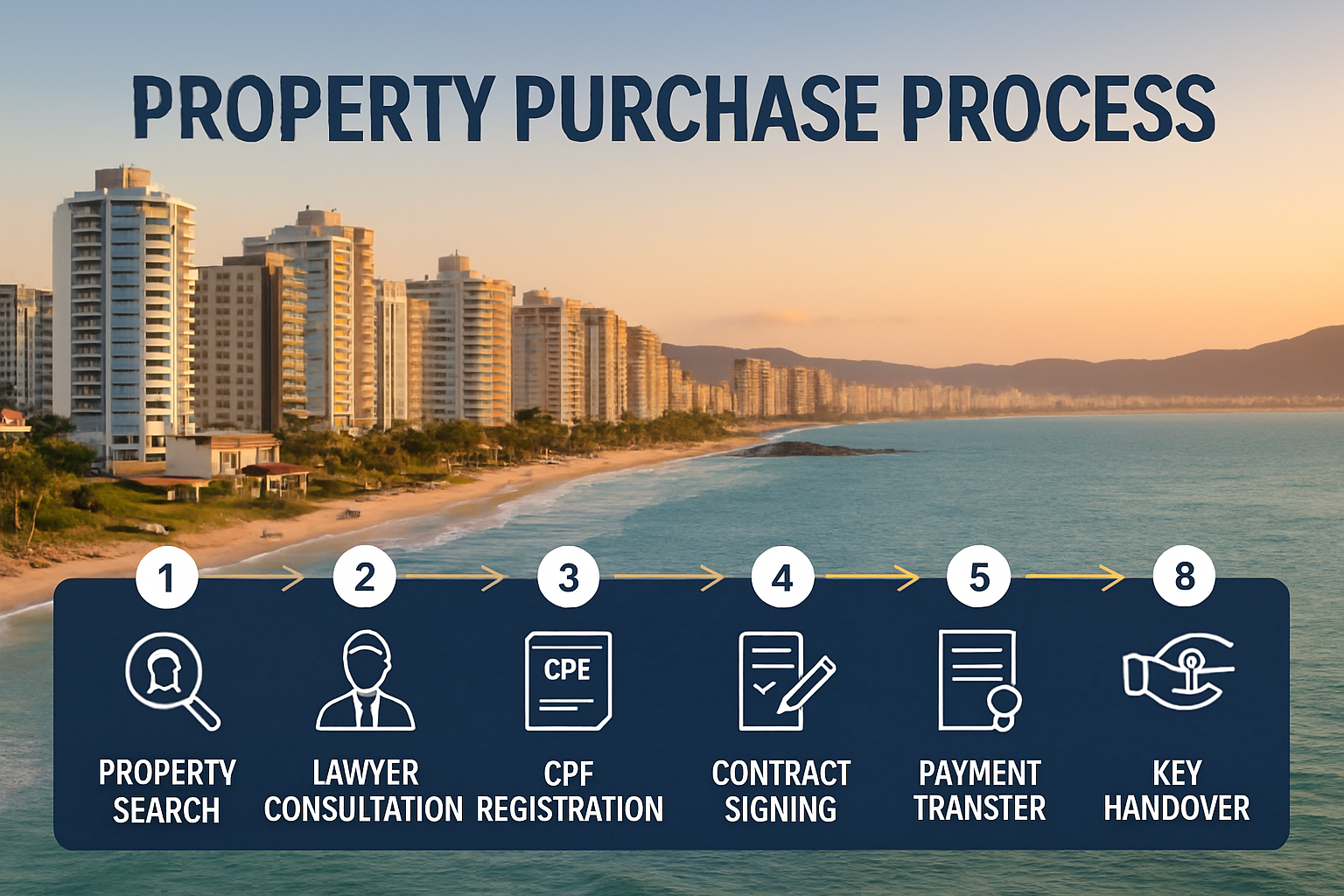
The property acquisition process in Brazil follows a structured path that protects both buyers and sellers. Understanding each phase helps prevent costly mistakes and ensures smooth transactions.
Step 1: Property Search and Selection 🔍
Begin by identifying your investment objectives:
- Investment purpose : Rental income, vacation home, or capital appreciation?
- Location preferences : Urban center, coastal resort, or suburban area?
- Budget constraints : Including purchase price, taxes, and ongoing costs
- Property type : Apartment, house, commercial space, or land?
Working with reputable real estate developers can streamline this process. Exploring quality developments provides insight into professionally managed projects with clear documentation and legal compliance.
For those considering Florianopolis specifically, understanding the growth of regions like Ingleses reveals areas with strong appreciation potential driven by infrastructure improvements and quality of life factors.
Step 2: Engage Legal Representation ⚖️
Hiring a qualified Brazilian real estate lawyer is non-negotiable. Your attorney will:
- Conduct comprehensive title searches ( real estate encumbrance certificate )
- Verify the seller’s legal ownership
- Check for outstanding debts, liens, or ecumbrances
- Review all contracts and documentation
- Ensure compliance with local zoning laws
- Represent your interests at closing
Legal fees typically range from 1-3% of the purchase price – a worthwhile investment that prevents significant future complications.
Step 3: Property Due Diligence 🔎
Thorough investigation protects your investment. Your lawyer should verify:
| Document Type | Purpose | Obtained From |
|---|---|---|
| Registration | Official property registry | Real Estate Registry Office |
| IPTU Records | Property tax payment history | Municipal Tax Office |
| Condominium Records | HOA fees and regulations | Building Administration |
| Construction Permits | Legal building authorization | Municipal Planning Department |
| Environmental Clearance | Compliance with environmental laws | Environmental Agency |
This due diligence phase typically requires 2-4 weeks but can extend longer for complex properties or those with unclear documentation.
Step 4: Make a Formal Offer 💰
Once satisfied with due diligence results, submit a written offer . This document should specify:
- Proposed purchase price
- Payment terms and schedule
- Contingencies (financing, final inspection)
- Proposed closing timeline
- Earnest money deposit amount
In Brazil’s market, earnest deposits typically range from 10-30% of the purchase price, demonstrating serious intent while protecting the buyer if contingencies aren’t met.
Step 5: Sign the Promissory Contract 📝
Upon offer acceptance, both parties sign a promissory purchase agreement . This legally binding document outlines:
- Complete property description
- Total purchase price and payment schedule
- Seller’s obligations (clear title, property condition)
- Buyer’s obligations (payment timeline, closing cooperation)
- Default penalties for either party
- Closing date
The promising contract protects buyers by establishing legal rights to the property even before final deed transfer. If the seller attempts to sell to another party, the promising contract holder has legal recourse [3].
Step 6: Complete Payment and Financing 💳
Payment options for foreign buyers include:
Cash Purchase : Most straightforward method, requiring international wire transfer to the seller’s Brazilian bank account. Brazil’s Central Bank monitors all foreign currency transactions exceeding USD 3,000, requiring proper documentation of funds’ origin.
Financing : Foreign nationals can access Brazilian mortgages, although requirements are stricter than for residents:
- Larger down payments (40-50% typical)
- Higher interest rates
- Proof of income from home country
- Brazilian guarantor may be required
Developer Financing : For pre-construction purchases, many developers offer payment plans allowing installments during construction. Buying off-plan can maximize appreciation potential as property values typically increase from groundbreaking to completion.
Step 7: Execute the Final Deed ( Scripture ) 🏛️
The final deed signing occurs at a notary public office ( notary ) with both parties present (or represented by power of attorney). The notary:
- Verifies all parties’ identities and legal capacity
- Confirms payment completion
- Reviews all supporting documentation
- Executes the official deed transfer
- Collects applicable transfer taxes
This formal ceremony transfers legal ownership from seller to buyer.
Step 8: Register the Deed 📑
The final critical step involves registering the executed deed at the local Real Estate Registry Office . Only upon registration does the buyer become the official legal owner with full property rights.
Registration typically requires:
- Original executed deed
- Proof of ITBI tax payment (property transfer tax)
- Updated property tax records
- Registration fees (approximately 1% of property value)
Processing takes 15-30 days, after which you receive the official property title ( registration ) bearing your name as the registered owner.
Costs and Taxes When Buying Property in Brazil
Understanding the complete financial picture prevents budget surprises. Beyond the purchase price, buyers face several mandatory expenses:
Upfront Costs 💵
| Expense | Typical Amount | Notes |
|---|---|---|
| ITBI Tax | 2-3% of property value | Municipal transfer tax, varies by city |
| Legal Fees | 1-3% of property value | Attorney representation |
| Notary Fees | 0.5-1% of property value | Deed execution and authentication |
| Registration Fees | 0.5-1% of property value | Property registry office |
| Real Estate Commission | 5-6% of property value | Usually paid by seller, but verify |
Total acquisition costs typically add 4-8% to the purchase price, depending on location and property value.
Ongoing Ownership Costs 🏠
Annual expenses include:
- IPTU (Property Tax) : 0.5-1.5% of assessed value annually
- Condominium Fees : For apartments, typically R$500-2,000 monthly depending on amenities
- Utilities : Water, electricity, gas, internet
- Insurance : Property and liability coverage recommended
- Maintenance : Repairs, upkeep, property management if renting
Tax Implications for Foreign Owners
Foreign property owners face specific tax considerations:
Rental Income : Subject to 15% withholding tax for non-residents (versus progressive rates for residents). Proper declaration to Brazilian tax authorities is mandatory.
Capital Gains : When selling, non-residents pay 15% capital gains tax on profits. Residents benefit from exemptions under certain conditions, such as selling a primary residence and purchasing another within 180 days [4].
Inheritance Tax : Brazilian states impose inheritance tax (ITCMD) ranging from 4-8% on property transfers upon death, regardless of owner’s nationality.
Choosing the Right Location for Your Investment
Location fundamentally determines investment success in Brazilian real estate. Different regions offer distinct advantages depending on investment goals.
Top Investment Locations 🌴
Florianopolis : Known as “Magic Island,” this Santa Catarina capital combines stunning beaches, strong infrastructure, and growing tech industry. The city offers some of the best places to invest in Brazil property , with consistent appreciation and strong rental demand.
São Paulo : Brazil’s economic powerhouse provides commercial opportunities, corporate rentals, and urban investment potential. Higher entry costs but stable long-term returns.
Rio de Janeiro : Iconic beaches and tourism drive rental income, although market volatility requires careful property selection and timing.
Búzios and Cabo Frio : Coastal resort towns offering vacation rental opportunities with strong seasonal demand.
Florianopolis: A Case Study in Strategic Investment
Florianopolis exemplifies smart property investment in Brazil. The city offers:
- Strong infrastructure development supporting population growth
- Technology sector expansion creating employment and rental demand
- Tourism appeal generating vacation rental income
- Quality of life attracting domestic and international residents
- Beach access with over 40 beaches across the island
Specific developments like Tramonto demonstrate how professional real estate development combines location advantages with quality construction and amenities.
For investors seeking rental income, studios in Florianopolis present particular advantages , offering lower entry costs with strong occupancy rates among students, young professionals, and tourists.
Working with Real Estate Developers and Agents
Choosing the right partners significantly impacts your property purchase experience and long-term satisfaction.
Benefits of Established Developers
Reputable real estate developers provide:
- Legal compliance with all construction and documentation requirements
- Quality assurance through professional construction management
- Transparent processes with clear contracts and timelines
- Post-sale support for property management and maintenance
- Financing options making purchases more accessible
Quadragon’s developments exemplify professional real estate development in Florianopolis, offering transparency, quality construction, and strategic locations.
Questions to Ask Real Estate Professionals
When evaluating agents or developers, inquire about:
- How long have you operated in this market?
- Can you provide references from previous foreign buyers?
- What legal protections exist for buyers in your contracts?
- How do you handle disputes or construction delays?
- What post-purchase services do you offer?
- Are you familiar with foreign buyer requirements and documentation?
Financing Options: How to Buy Property in Brazil with a Mortgage
While cash purchases remain most common for foreign buyers, financing options exist for those preferring leveraged investments.
Brazilian Bank Mortgages for Foreigners
Several Brazilian banks offer mortgages to non-residents, including:
- Bank of Brazil
- Federal Savings Bank
- Itaú Unibanco
- Bradesco
Typical requirements include:
- 40-60% down payment
- Proof of income (translated and notarized)
- Brazilian CPF number
- Local bank account
- Property appraisal
- Sometimes a Brazilian co-signer
Interest rates for foreigners typically range from 8-12% annually, higher than rates for Brazilian residents but competitive compared to many international markets.
Developer Financing Plans
For pre-construction purchases, developer financing offers advantages:
- Lower down payments (20-30% typical)
- Installment payments during construction
- No credit check in many cases
- Simpler approval process
- Flexible terms negotiable with developer
This approach allows investors to secure property at pre-construction prices while spreading payments over 24-36 months, maximizing leverage and potential appreciation.
Common Pitfalls and How to Avoid Them
Learning from others’ mistakes prevents costly errors when purchasing Brazilian property.
Title and Documentation Issues ⚠️
Problem : Unclear property titles, undisclosed liens, or fraudulent documentation.
Solution : Never skip comprehensive legal due diligence. Insist your attorney obtains and reviews the complete property history ( registration ) from the registry office, verifying no gaps or irregularities exist.
Unrealistic Rental Income Projections
Problem : Overestimating rental yields based on optimistic or seasonal data.
Solution : Research current rental rates for comparable properties during both high and low seasons. Factor in vacancy periods, management fees, and maintenance costs for realistic return calculations.
Currency Exchange Timing
Problem : Unfavorable exchange rate fluctuations between purchase agreement and final payment.
Solution : Consider currency hedging strategies or negotiate purchase price in your home currency. Monitor exchange rates and time large transfers strategically.
Ignoring Ongoing Costs
Problem : Focusing solely on purchase price while underestimating ownership expenses.
Solution : Calculate complete ownership costs including IPTU, condominium fees, utilities, insurance, and maintenance before committing to purchase.
Skipping Physical Inspection
Problem : Buying property sight-unseen based only on photos or virtual tours.
Solution : Always conduct in-person inspections, preferably with a qualified building inspector. For pre-construction, visit the construction site and review detailed plans.
Living in Brazil: Beyond Property Ownership
Property ownership often leads to extended stays or permanent relocation. Understanding residency options enhances your Brazilian experience.
Visa and Residency Options 🛂
Tourist Visa : Most nationalities receive 90-day tourist visas upon arrival, extendable once for an additional 90 days.
Temporary Residence : Available through various pathways including:
- Investment visa (minimum investment requirements)
- Retirement visa (proof of pension income)
- Family reunification (married to Brazilian citizen)
Permanent Residence : Obtainable after maintaining temporary residence for specified periods or through significant investment.
Important : Property ownership alone doesn’t grant residency rights, but demonstrates ties to Brazil that can support visa applications [5].
Quality of Life Considerations
Life in Florianopolis and other Brazilian cities offers unique advantages:
- Climate : Tropical to subtropical with year-round warmth
- Culture : Rich traditions, festivals, and welcoming communities
- Cuisine : Diverse, fresh, and internationally acclaimed
- Healthcare : Quality private healthcare at reasonable costs
- Safety : Varies significantly by neighborhood – research thoroughly
The Future of Brazilian Real Estate Investment
Understanding market trends helps position investments for maximum returns.
2025 Market Outlook 📈
Several factors support continued growth in Brazilian real estate:
Economic Stability : Controlled inflation and interest rate management create favorable conditions for property investment.
Infrastructure Development : Government and private investment in transportation, utilities, and public services enhance property values in developing areas.
Remote Work Trend : Global shift toward remote work increases demand for Brazilian properties offering quality of life at competitive prices.
Tourism Recovery : Post-pandemic tourism rebound drives vacation rental demand in coastal destinations.
Sales performance transforming Florianopolis’s market in 2025 demonstrates how specific markets are capitalizing on these trends.
Emerging Investment Opportunities
Pre-Construction Purchases : Buying during early construction phases maximizes appreciation potential as construction progress adds value .
Sustainable Developments : Eco-friendly properties attract premium buyers and renters while benefiting from government incentives.
Technology Integration : Smart homes and buildings command higher prices and rental rates.
Mixed-Use Developments : Properties combining residential, commercial, and recreational spaces show strong performance.
Conclusion: Your Path to Brazilian Property Ownership
How to Buy Property in Brazil involves navigating legal requirements, understanding market dynamics, and making strategic decisions aligned with your investment goals. While the process may seem complex initially, following the structured approach outlined in this guide ensures successful property acquisition.
Your Next Steps 🚀
Ready to begin your Brazilian property journey? Take these actionable steps:
- Obtain your CPF number through the Brazilian Federal Revenue Service or nearest consulate
- Define your investment criteria including budget, location preferences, and property type
- Research target markets focusing on areas with strong fundamentals and growth potential
- Engage qualified professionals including a real estate lawyer and reputable agent or developer
- Visit properties in person to evaluate neighborhoods, construction quality, and amenities
- Conduct thorough due diligence before committing to any purchase
- Contact experienced developers who can guide you through the process
Brazil’s real estate market offers remarkable opportunities for informed investors willing to navigate its unique landscape. Whether seeking rental income, capital appreciation, or a tropical lifestyle, Brazilian property ownership provides diverse pathways to achieving your goals.
The combination of favorable foreign ownership laws, growing economic stability, and exceptional quality of life makes Brazil an increasingly attractive destination for international property investors. By understanding the legal framework, following proper procedures, and choosing strategic locations, foreign buyers can successfully navigate How to Buy Property in Brazil and build valuable real estate portfolios in this dynamic South American market.
Start your journey today by exploring available opportunities and connecting with professionals who can transform your Brazilian property aspirations into reality.
References
[1] Brazilian Ministry of Foreign Affairs. (2024). “Document Legalization and Apostille Requirements.” Official GovernmentPublication.
[2] Brazilian Federal Revenue Service. (2024). “CPF Registration Guidelines for Foreign Nationals.” Federal Revenue of Brazil.
[3] Brazilian Civil Code. (2024). “Articles 1417-1418: Promissory Purchase Agreements.” Federal Law 10,406/2002.
[4] Brazilian Internal Revenue Service. (2024). “Tax Treatment of Real Estate Transactions by Non-Residents.” Technical Guidance.
[5] Brazilian Ministry of Justice. (2024). “Immigration and Residency Requirements.” National Immigration Council Resolution.