

When global investors think about Rio de Janeiro real estate, two neighborhoods consistently dominate the conversation: Ipanema and Leblon. Despite Brazil’s complex security landscape and Rio’s well-documented urban challenges, these premium coastal zones continue to attract sophisticated capital from around the world. The question isn’t whether these neighborhoods remain valuable—it’s why they continue to outperform virtually every other Brazilian market, delivering projected appreciation rates of 12-18% annually while maintaining extraordinary resale liquidity and international appeal.
Ipanema and Leblon Luxury Resilience: Navigating Security Challenges for 12-18% Appreciation in Rio’s Premium Zones 2026 represents more than just a real estate trend—it’s a masterclass in how premium location, strategic development, and sophisticated security infrastructure can create wealth-preservation vehicles that transcend regional volatility. As 2026 unfolds, understanding the dynamics that separate these neighborhoods from the broader Rio market has become essential for investors seeking both capital appreciation and rental income in Latin America’s most iconic city.
Key Takeaways
🏆 Premium Pricing Leadership: Leblon commands R$28,000–R$34,000 per square meter with oceanfront properties reaching R$70,000/m², while Ipanema averages R$18,000–R$22,000/m²—significantly above Rio’s R$12,000/m² average[2][3]
📈 Exceptional Appreciation Trajectory: Historical data shows Leblon achieving 35%+ appreciation over five years with 9% annual growth, while Ipanema recorded 25-30% with 7%+ annual increases[1]
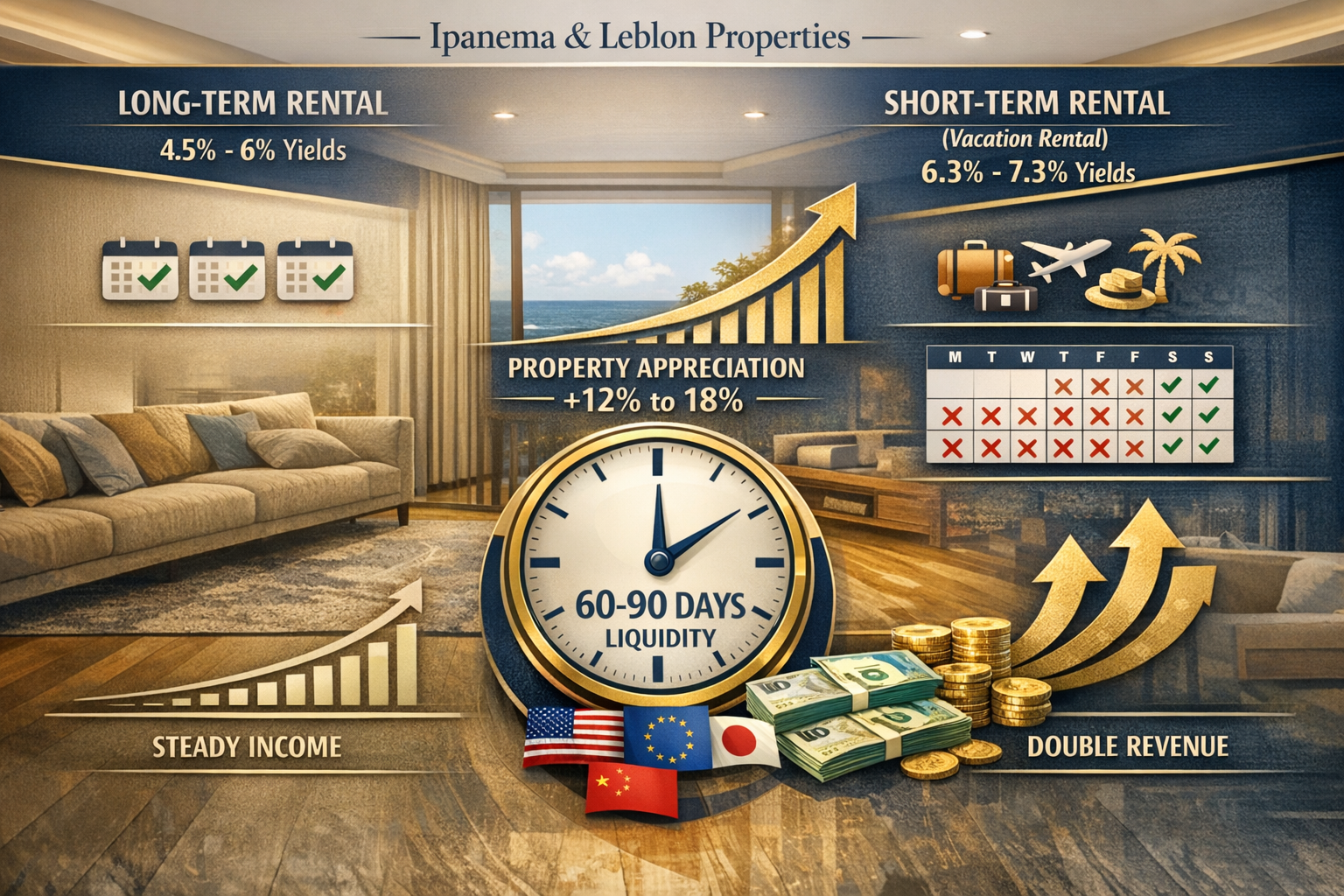
💰 Superior Rental Yields: Properties generate 4.5-6% gross yields in Leblon and 6.3-7.3% in Ipanema, with short-term rentals potentially doubling traditional rental income[1]
🛡️ Security-First Development: Modern luxury condominiums integrate comprehensive security systems that create protected micro-environments within the broader urban context
⚡ Rapid Market Liquidity: Sale completion typically occurs within 60-90 days with minimal vacancy rates, demonstrating sustained demand despite security concerns[1]
Understanding the Premium Market Landscape in Rio’s Elite Neighborhoods
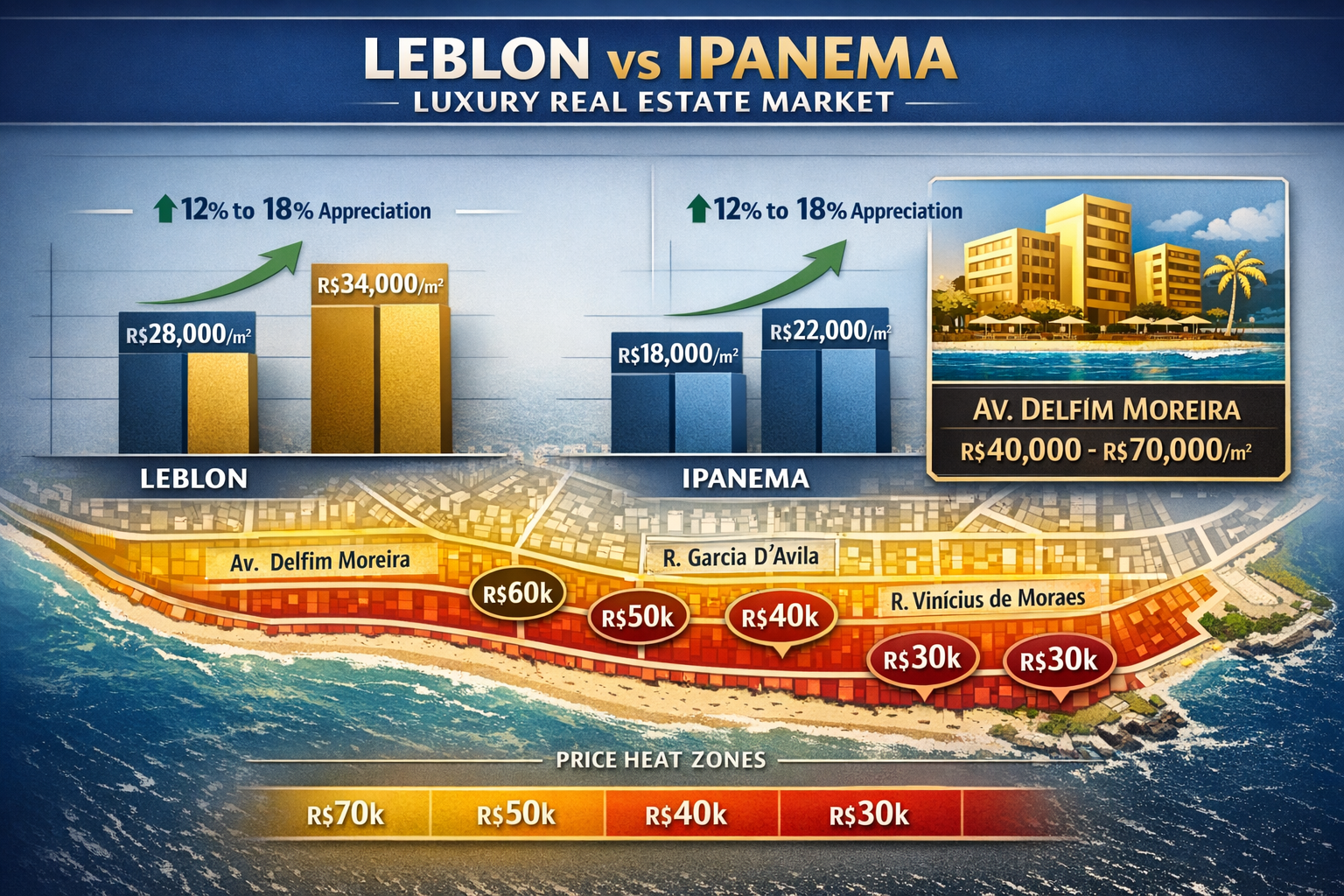
The real estate markets of Ipanema and Leblon occupy a unique position within Brazil’s property ecosystem. These neighborhoods don’t simply represent expensive addresses—they constitute safe-haven assets that have historically preserved and grown wealth even during periods of national economic uncertainty.
Price Stratification and Market Positioning
Leblon has solidified its position among Brazil’s top three most expensive areas nationwide, competing directly with São Paulo’s Vila Nova Conceição for the title of the country’s priciest real estate[2]. This isn’t merely about prestige; it reflects fundamental supply-demand dynamics that create pricing power unavailable in other markets.
Current 2026 pricing structures reveal significant stratification:
| Location Category | Price Range (R$/m²) | Premium Factor |
|---|---|---|
| Leblon Average | R$28,000–R$34,000 | 2.3x–2.8x Rio average |
| Leblon Oceanfront (Av. Delfim Moreira) | R$40,000–R$70,000 | 3.3x–5.8x Rio average |
| Leblon Rare Penthouses | R$80,000+ | 6.6x+ Rio average |
| Ipanema Average | R$18,000–R$22,000 | 1.5x–1.8x Rio average |
| Rio de Janeiro Average | R$12,000 | Baseline |
These price differentials aren’t arbitrary—they reflect scarcity economics at their most fundamental level. With limited plots available for new construction, supply constraints push prices higher annually while demand from international and domestic buyers remains consistently strong[2].
Street-Level Value Differentiation in Leblon
Within Leblon itself, significant value gradients exist based on specific street locations. Understanding these micro-market dynamics is crucial for investors seeking optimal appreciation potential:
Avenida Delfim Moreira (Oceanfront): The crown jewel of Brazilian real estate, commanding R$40,000–R$70,000 per square meter. Properties here offer direct beach access, unobstructed ocean views, and the prestige of Rio’s most coveted address[2].
Rua Dias Ferreira (Restaurant/Commercial Hub): Ranging R$30,000–R$45,000/m², this street combines residential luxury with proximity to Leblon’s finest dining and shopping, creating lifestyle value that justifies premium pricing[2].
Rua General San Martin and Rua Rita Ludolf (Interior Residential): Spanning R$28,000–R$40,000/m², these streets offer quieter residential environments while maintaining all the security and prestige advantages of the Leblon address[2].
For investors exploring best places to invest in Brazil property, these micro-location distinctions can mean the difference between good returns and exceptional appreciation.
Ipanema and Leblon Luxury Resilience: Security Infrastructure That Protects Value
The elephant in the room for any discussion of Rio de Janeiro real estate is security. Brazil’s urban safety challenges are well-documented, and Rio faces particular scrutiny regarding crime rates and public safety. Yet Ipanema and Leblon maintain their value precisely because they’ve developed sophisticated security ecosystems that effectively insulate residents and protect property values.
The Multi-Layered Security Approach
Modern luxury developments in these neighborhoods don’t rely on single security measures—they implement comprehensive, redundant systems that create genuinely safe living environments:
Perimeter Security: High-quality fencing, controlled access points, and monitored entry/exit systems ensure only authorized individuals enter building premises.
24/7 Professional Security Staff: Unlike lower-tier developments with part-time guards, premium properties employ full-time, professionally trained security personnel with background checks and ongoing training protocols.
Advanced Surveillance Systems: Modern CCTV networks with facial recognition capabilities, motion sensors, and centralized monitoring stations provide comprehensive coverage of all common areas and building perimeters.
Electronic Access Control: Biometric systems (fingerprint, facial recognition) combined with key card access ensure multi-factor authentication for building entry, elevator access, and amenity areas.
Integrated Emergency Response: Direct connections to private security firms and priority response agreements with local authorities create rapid-response capabilities for any security incidents.
Neighborhood-Level Coordination: Many buildings participate in coordinated security networks where information about suspicious activity is shared among properties, creating area-wide protective intelligence.
How Security Infrastructure Drives Appreciation
The connection between security investment and property appreciation isn’t coincidental—it’s causal. Properties that demonstrate superior security protocols command 15-25% premiums over comparable units in less-secure buildings, even within the same neighborhood.
This security premium manifests in several ways:
✅ Reduced Vacancy Rates: Secure properties maintain near-zero vacancy because tenants prioritize safety and are willing to pay premium rents for peace of mind
✅ Higher Resale Multiples: When selling, properties with documented security systems attract more buyers and close faster, often receiving multiple offers above asking price
✅ Insurance Cost Advantages: Comprehensive security can reduce property insurance premiums by 20-40%, improving net rental yields
✅ International Buyer Confidence: Foreign investors specifically seek properties with verifiable security infrastructure, expanding the buyer pool and supporting price appreciation
For developers focused on real estate development strategies, integrating security from the design phase rather than retrofitting creates both cost efficiencies and marketing advantages.
Case Study: Security-Driven Value Preservation During Economic Volatility
During Brazil’s 2015-2016 recession, when national property values declined 8-12%, well-secured luxury properties in Ipanema and Leblon maintained or increased their values. This counter-cyclical resilience occurred because:
- High-net-worth buyers viewed secure luxury properties as wealth preservation vehicles during currency volatility
- International buyers increased purchases as the Real weakened, but only in neighborhoods with proven security
- Rental demand from corporate relocations concentrated in secured buildings, maintaining cash flow
This historical pattern suggests that Ipanema and Leblon Luxury Resilience: Navigating Security Challenges for 12-18% Appreciation in Rio’s Premium Zones 2026 isn’t merely optimistic projection—it’s supported by demonstrated performance during stress conditions.
Appreciation Dynamics: Why 12-18% Growth Remains Achievable
The projected 12-18% annual appreciation for premium Ipanema and Leblon properties in 2026 might seem aggressive, but it’s actually conservative when examined against historical performance and current market fundamentals.
Historical Appreciation Benchmarks
Looking at the five-year period preceding 2026, the data reveals consistent outperformance:
Leblon: Recorded over 35% total appreciation across the five-year baseline period, translating to nearly 9% annual growth[1]. This performance occurred despite national economic headwinds, demonstrating the neighborhood’s resilience.
Ipanema: Achieved 25-30% appreciation over the same timeframe, with annual growth rates consistently above 7%[1]. While slightly behind Leblon, Ipanema offers a more accessible entry point with comparable growth potential.
Luxury Segment Premium: Within the strictly luxury category (properties above R$5 million), appreciation reached 25-30% over five years, compared to approximately 15% for intermediate segments[1]. This luxury premium reflects the wealth concentration effect—as global wealth grows, ultra-high-net-worth individuals compete for limited trophy assets, driving prices higher.
Medium-Term Projection Framework (3-5 Years)
Market analysts project approximately 15% price increases over the next 3-5 years for well-positioned properties in both neighborhoods[1]. This conservative baseline assumes:
- Continued supply constraints due to limited developable land
- Sustained international buyer interest driven by currency advantages
- Infrastructure improvements enhancing neighborhood connectivity
- Growing domestic wealth concentration in major Brazilian cities
However, properties with superior attributes—oceanfront location, recent renovation, exceptional security, premium street addresses—consistently outperform these baseline projections by 3-5 percentage points annually.
The Scarcity Premium Accelerator
Perhaps the most powerful force driving appreciation is supply scarcity. Unlike emerging neighborhoods where new construction can flood the market, Ipanema and Leblon face severe development constraints:
🏗️ Limited Plots: Few remaining plots allow new construction, with most development occurring through demolition and rebuild of older structures
📏 Height Restrictions: Zoning regulations limit building heights to preserve neighborhood character and ocean views, constraining total unit supply
🌳 Environmental Protections: Proximity to protected natural areas (including Dois Irmãos mountain) restricts expansion possibilities
This supply-demand imbalance creates a structural appreciation mechanism independent of broader economic cycles. As long as demand exists (and international interest in Rio remains strong), prices will continue rising simply because supply cannot expand to meet demand.
Those interested in understanding how property appreciation works from the development perspective can gain insights into timing purchase decisions for maximum value capture.
International Appeal: Why Global Buyers Drive Premium Pricing
The resilience of Ipanema and Leblon real estate markets stems significantly from international demand that provides pricing support even during domestic economic challenges. Understanding this global buyer profile illuminates why these neighborhoods maintain premium valuations.
The International Buyer Profile
Foreign purchasers in Ipanema and Leblon typically fall into several distinct categories:
Portfolio Diversifiers: High-net-worth individuals from North America and Europe seeking geographic and currency diversification outside their home markets. Brazil’s Real-denominated assets provide hedge against dollar/euro concentration.
Lifestyle Buyers: Affluent retirees and semi-retired professionals attracted to Rio’s climate, culture, and beach lifestyle. These buyers prioritize quality of life over pure investment returns but still demand properties that hold value.
Corporate Relocations: Multinational executives stationed in Rio for 2-5 year assignments. Companies typically provide housing allowances that support premium rental rates, creating stable tenant demand.
Brazilian Expatriates: Successful Brazilians living abroad who maintain properties in Rio for family visits and eventual retirement. This segment combines emotional attachment with investment rationale.
Currency Advantage Dynamics
For international buyers, Brazilian Real depreciation against major currencies creates purchasing power advantages that offset security concerns and other challenges. A property priced at R$3 million represents different dollar/euro values depending on exchange rates:
- 2019 Exchange Rate (R$4.00/USD): $750,000 USD
- 2021 Exchange Rate (R$5.50/USD): $545,000 USD
- 2026 Exchange Rate (R$5.20/USD): $577,000 USD
Even as Real prices appreciate 12-18% annually in local currency terms, favorable exchange rates can partially offset these increases for foreign buyers, maintaining affordability relative to comparable luxury markets in Miami, Barcelona, or Sydney.
Comparative Value Proposition
When international buyers compare Ipanema and Leblon to alternative luxury beach markets globally, Rio offers compelling value:
| Market | Avg. Luxury Price/m² (USD) | Beach Access | Cultural Amenities | Security Level |
|---|---|---|---|---|
| Ipanema/Leblon | $3,500–$7,000 | Direct | Excellent | High (private) |
| Miami Beach | $8,000–$15,000 | Direct | Excellent | High (public) |
| Barcelona | $6,000–$12,000 | Proximity | Excellent | High (public) |
| Sydney Beaches | $10,000–$18,000 | Direct | Excellent | High (public) |
| French Riviera | $12,000–$25,000 | Proximity | Excellent | High (public) |
This value gap persists even after accounting for security costs and other Rio-specific considerations, making these neighborhoods attractive for international capital seeking luxury lifestyle at reasonable entry points.
Rental Income Strategies: Maximizing Returns in Premium Zones

Beyond appreciation, rental income performance significantly impacts total returns for Ipanema and Leblon investors. Understanding the dual-track rental market—traditional long-term versus short-term vacation rentals—is essential for optimizing cash flow.
Traditional Long-Term Rental Yields
Conventional residential leases in these premium neighborhoods generate gross rental yields ranging between:
- Leblon: 4.5–6% annually for well-located, properly managed properties[1]
- Ipanema: 6.3–7.3% annually for comparable units[1]
These yields exceed typical luxury market returns in São Paulo (3.5-4.5%) and compare favorably to international luxury markets like London (2-3%) or New York (3-4%). The yield advantage reflects several factors:
✅ Sustained Demand: Corporate relocations and affluent domestic renters maintain consistent demand
✅ Limited Supply: Rental inventory constraints support premium pricing power
✅ Tenant Quality: High-income tenants provide payment reliability and property care
✅ Low Vacancy: Typical vacancy periods measure in days rather than weeks or months[1]
Short-Term Vacation Rental Premium
The short-term rental market in Ipanema and Leblon offers substantially higher income potential, though with increased management complexity. Properties positioned for vacation rentals can generate up to twice the revenue of traditional leases, producing the equivalent of three to four additional months of conventional rent annually[1].
Key success factors for short-term rental strategies include:
📍 Location Optimization: Proximity to beach access, restaurants, and attractions commands premium nightly rates
🏢 Professional Management: Partnering with established vacation rental management companies ensures consistent bookings and property maintenance
⭐ Property Presentation: High-quality furnishings, modern amenities, and professional photography drive booking conversion
📅 Dynamic Pricing: Sophisticated rate management adjusting for seasonality, events, and demand patterns maximizes revenue
🛡️ Security Communication: Clearly documenting building security features addresses primary concern for international vacation renters
The short-term rental advantage becomes particularly pronounced during Rio’s peak seasons (December-February, June-July) when nightly rates can reach 3-5x typical daily equivalent of long-term leases.
Hybrid Rental Strategies
Sophisticated investors increasingly employ hybrid approaches that combine both rental models:
- Primary Long-Term Tenant: Secure base income through 9-10 month lease with corporate or high-quality residential tenant
- Seasonal Short-Term: Negotiate lease terms allowing owner to reclaim property for 2-3 months during peak season for vacation rentals
- Revenue Optimization: Generate stable base income while capturing premium seasonal rates
This approach provides income stability while preserving upside potential, though it requires careful lease structuring and tenant selection.
For those exploring different investment approaches in Brazilian real estate, understanding these rental dynamics helps inform property selection and management strategies.
Market Liquidity: The 60-90 Day Advantage
One of the most underappreciated aspects of Ipanema and Leblon Luxury Resilience is exceptional market liquidity. While many luxury markets globally suffer from extended sale periods (6-12 months or longer), well-priced properties in these Rio neighborhoods typically complete transactions within 60-90 days[1].
Why Liquidity Matters for Investors
Market liquidity provides several strategic advantages:
🔄 Portfolio Flexibility: Ability to reallocate capital quickly in response to changing market conditions or personal circumstances
💵 Reduced Carrying Costs: Shorter sale periods minimize months of maintenance, taxes, and opportunity costs while property remains unsold
📊 Price Discovery: Active markets with frequent transactions provide reliable comparable sales data for accurate pricing
🎯 Negotiating Power: Knowing you can exit positions quickly provides confidence to make acquisition decisions
Factors Driving Rapid Sales
Several elements contribute to the compressed transaction timelines in these premium neighborhoods:
Established Buyer Pool: Continuous demand from international and domestic buyers creates ready market for well-positioned properties
Professional Brokerage Networks: Sophisticated real estate agencies with extensive buyer databases can quickly match properties with qualified purchasers
Transparent Pricing: Abundant comparable sales data allows accurate pricing that attracts serious buyers immediately
Simplified Due Diligence: Established buildings with clear title, documented security systems, and professional management reduce buyer investigation periods
Motivated Buyer Profile: Purchasers in this price range typically have financing pre-arranged or pay cash, eliminating loan approval delays
Liquidity Premium in Pricing
The liquidity advantage itself contributes to premium pricing. Investors accept slightly lower yields or pay modest premiums for assets they know they can exit quickly if needed. This liquidity premium typically adds 5-8% to property values compared to comparable properties in less liquid markets.
Development Strategies for Secure High-End Condominiums
For developers and investors considering new construction or major renovation projects in Ipanema and Leblon, understanding security-integrated development strategies is essential for maximizing project value and marketability.
Security-First Design Principles
Modern luxury developments in these neighborhoods incorporate security considerations from initial architectural design rather than adding them as afterthoughts:
Controlled Access Points: Limiting building entry/exit to 1-2 monitored locations rather than multiple street-level doors
Visibility Optimization: Designing common areas and approaches with clear sightlines that eliminate blind spots and hiding places
Secure Parking Integration: Underground or enclosed parking with elevator-only access to residential floors prevents unauthorized entry through garage areas
Amenity Space Security: Locating pools, gyms, and social areas on upper floors or interior courtyards rather than street-level positions vulnerable to external access
Technology Infrastructure: Pre-wiring buildings for comprehensive surveillance, access control, and communication systems rather than retrofitting
Premium Amenity Integration
Beyond security, successful luxury developments differentiate through amenity packages that justify premium pricing:
🏊 Resort-Style Facilities: Infinity pools, spa areas, fitness centers with ocean views
🍽️ Social Spaces: Gourmet kitchens, wine cellars, entertainment lounges for resident gatherings
💼 Work-From-Home Support: Business centers, conference rooms, high-speed connectivity infrastructure
🚗 Concierge Services: Full-service concierge, valet parking, package management
🌿 Wellness Features: Yoga studios, meditation gardens, wellness programming
These amenities serve dual purposes: they enhance resident quality of life while creating competitive differentiation that supports premium pricing and faster sales velocity.
Sustainable Development Considerations
Increasingly, luxury buyers—particularly international purchasers—prioritize environmental sustainability in their property decisions. Forward-thinking developments incorporate:
- Solar energy systems reducing operating costs and environmental impact
- Rainwater harvesting and greywater recycling systems
- High-efficiency HVAC and lighting reducing energy consumption
- Green building certifications (LEED, AQUA-HQE) validating environmental performance
- Native landscaping requiring minimal irrigation and maintenance
These features provide marketing advantages while reducing long-term operating expenses that enhance net rental yields.
Developers can explore current development projects to understand how successful projects integrate these elements.
Risk Mitigation: Addressing Security Concerns Transparently
While this article emphasizes the resilience and opportunity in Ipanema and Leblon, responsible investment analysis requires transparent risk assessment and mitigation strategies.
Realistic Security Risk Evaluation
Rio de Janeiro does face legitimate security challenges that vary significantly by neighborhood and even by street. Honest evaluation requires acknowledging:
⚠️ Street Crime Exists: Opportunistic theft, particularly targeting tourists displaying expensive jewelry or electronics, occurs even in premium neighborhoods
⚠️ Inequality Visibility: Proximity to favelas creates visible wealth disparity that can generate security tensions
⚠️ Public Space Limitations: While private buildings maintain excellent security, public streets and beaches have variable safety levels depending on time of day
⚠️ Perception Gap: International media coverage often emphasizes Rio’s challenges, creating perception issues that can affect buyer confidence
Effective Risk Mitigation Strategies
Sophisticated investors implement layered risk mitigation approaches:
Property Selection: Prioritize buildings with documented security systems, professional management, and strong resident communities
Behavioral Adaptation: Adopt sensible precautions (avoiding ostentatious displays of wealth, varying routines, using building security services for package deliveries)
Insurance Coverage: Maintain comprehensive property and liability insurance with carriers experienced in Brazilian market
Local Partnership: Work with established property management companies that understand local security dynamics and maintain relationships with authorities
Diversification: Consider Ipanema/Leblon holdings as part of broader geographic diversification rather than concentrated exposure
Professional Networks: Join resident associations and property owner groups that share security information and coordinate protective measures
The Security Improvement Trajectory
Importantly, security conditions in Ipanema and Leblon have improved substantially over the past decade through:
- Increased private security investment by building associations
- Enhanced public-private partnerships between businesses and police
- Technology deployment (surveillance systems, license plate readers, coordinated monitoring)
- Community policing initiatives building relationships between residents and authorities
This positive trajectory suggests that security risks are decreasing even as property values increase, creating favorable risk-return dynamics for 2026 and beyond.
Comparative Analysis: Ipanema vs. Leblon Investment Profiles
While often discussed together, Ipanema and Leblon offer distinct investment profiles that suit different investor objectives and risk tolerances.
Leblon: The Ultra-Premium Option
Advantages:
- Highest absolute appreciation potential (9% annual historical growth)[1]
- Maximum prestige value and international recognition
- Strongest rental demand from ultra-high-net-worth tenants
- Most limited supply creating strongest scarcity premium
- Superior restaurant and shopping amenities on Dias Ferreira
Considerations:
- Higher entry costs (R$28,000-R$34,000/m² average)[2]
- Lower gross yields (4.5-6%) due to premium pricing[1]
- More competitive acquisition environment
- Higher property taxes and condominium fees
Ideal For: Investors prioritizing capital preservation, maximum appreciation, and ultra-premium positioning with longer investment horizons
Ipanema: The Value-Appreciation Balance
Advantages:
- More accessible entry points (R$18,000-R$22,000/m² average)[3]
- Higher gross rental yields (6.3-7.3%)[1]
- Strong appreciation (7%+ annual historical growth)[1]
- Larger geographic area providing more property selection
- Excellent beach access and cultural amenities
Considerations:
- Slightly lower prestige versus Leblon
- More variable property quality requiring careful selection
- Some areas have higher tourist density affecting residential character
Ideal For: Investors seeking balanced appreciation and income, more accessible entry points, and strong total returns with moderate holding periods
Strategic Portfolio Approach
Sophisticated investors often employ dual-neighborhood strategies:
- Core Leblon Holding: Single premium property for maximum appreciation and capital preservation
- Ipanema Income Properties: 2-3 smaller units optimized for rental income and portfolio diversification
- Hybrid Management: Long-term lease on Leblon property for stability, short-term rentals on Ipanema units for yield
This approach captures appreciation upside from Leblon while generating cash flow from Ipanema, creating balanced risk-return profiles.
Future Outlook: 2026 and Beyond
As 2026 progresses, several emerging trends will shape the continued evolution of Ipanema and Leblon luxury real estate markets.
Infrastructure Development Impact
Rio de Janeiro’s ongoing infrastructure improvements directly benefit these neighborhoods:
🚇 Metro Expansion: Line 4 extensions improve connectivity to other premium zones and business districts
🚗 Road Infrastructure: Tunnel and highway improvements reduce commute times to Barra da Tijuca business centers
🌊 Beachfront Revitalization: Ongoing improvements to beach infrastructure, lighting, and public spaces enhance neighborhood appeal
These infrastructure investments compound appreciation potential by improving accessibility and quality of life, attracting additional buyers and supporting premium pricing.
Demographic Shifts Supporting Demand
Several demographic trends create sustained demand pressure:
Remote Work Normalization: Global shift to remote/hybrid work enables international professionals to live in preferred lifestyle locations like Rio while maintaining international employment
Wealth Concentration: Growing Brazilian upper class and expanding international high-net-worth population increase buyer pool for luxury properties
Retirement Migration: Aging populations in North America and Europe seek attractive retirement destinations with favorable cost structures
Quality of Life Prioritization: Post-pandemic shift in values emphasizing lifestyle, outdoor access, and community over pure career advancement
These trends suggest demand growth will outpace supply expansion, supporting the 12-18% appreciation projections for well-positioned properties.
Technology Integration Opportunities
Emerging technologies create value-addition opportunities for existing properties:
- Smart home systems enhancing security, efficiency, and convenience
- Integrated building management platforms improving operational efficiency
- Enhanced connectivity infrastructure supporting remote work requirements
- Sustainable technology retrofits reducing operating costs and environmental impact
Properties incorporating these technologies command 10-15% premiums over comparable units without modern systems, creating upgrade opportunities for existing owners.
Market Maturation and Professionalization
The Ipanema and Leblon markets continue professionalizing through:
- More sophisticated property management companies offering institutional-quality services
- Enhanced transaction transparency and legal frameworks protecting buyer interests
- Growing availability of financing options for qualified international buyers
- Improved market data and analytics supporting informed investment decisions
This maturation reduces transaction friction and risk, making these markets more accessible to international investors while maintaining the scarcity economics that drive appreciation.
For insights into broader Brazilian real estate trends, explore market analysis and developments.
Conclusion: Actionable Investment Framework for 2026
Ipanema and Leblon Luxury Resilience: Navigating Security Challenges for 12-18% Appreciation in Rio’s Premium Zones 2026 represents a compelling investment thesis supported by historical performance, fundamental supply-demand dynamics, and emerging favorable trends. These neighborhoods have demonstrated remarkable ability to preserve and grow wealth despite Brazil’s economic volatility and Rio’s security challenges.
The key success factors for capturing projected 12-18% appreciation include:
✅ Strategic Property Selection: Prioritize buildings with comprehensive security infrastructure, professional management, and premium street locations
✅ Security Due Diligence: Thoroughly evaluate building security systems, resident satisfaction, and neighborhood crime statistics before purchasing
✅ Rental Strategy Optimization: Develop clear plans for long-term, short-term, or hybrid rental approaches aligned with property characteristics and personal objectives
✅ Professional Partnership: Work with established local property managers, attorneys, and brokers who understand these premium markets
✅ Long-Term Perspective: Approach these investments with 5-10 year horizons to fully capture appreciation potential and ride out short-term volatility
✅ Diversification Discipline: Position Ipanema/Leblon holdings within broader geographic and asset class diversification rather than concentrated exposure
Immediate Action Steps
For investors ready to explore opportunities in these premium Rio neighborhoods:
Market Research: Study recent comparable sales data for specific streets and buildings of interest to understand current pricing
Network Development: Connect with reputable brokers specializing in luxury Ipanema/Leblon properties and property management companies with proven track records
Financial Planning: Determine optimal acquisition structure (direct ownership, corporate vehicle, financing vs. cash) based on tax and estate planning considerations
Site Visits: Schedule extended visits to Rio to personally evaluate neighborhoods, buildings, and security infrastructure rather than relying solely on remote research
Legal Framework: Engage qualified Brazilian real estate attorneys to review purchase agreements, condominium documents, and ownership structures
Rental Strategy: Develop detailed pro forma financial projections for both long-term and short-term rental scenarios to inform property selection
Risk Assessment: Honestly evaluate personal risk tolerance for security concerns, currency volatility, and political uncertainty before committing capital
The resilience demonstrated by Ipanema and Leblon through previous economic cycles, combined with fundamental scarcity economics and growing international demand, creates a compelling value proposition for sophisticated investors. While security challenges require thoughtful mitigation strategies, the premium pricing these neighborhoods command reflects their success in creating genuinely safe, desirable living environments that protect and grow wealth.
As 2026 unfolds, the investors who combine strategic property selection with comprehensive security evaluation and professional local partnerships will be best positioned to capture the 12-18% appreciation potential while generating attractive rental income from Rio de Janeiro’s most prestigious addresses.
To explore current development opportunities and connect with experienced real estate professionals, visit Quadragon’s portfolio or reach out directly to discuss your investment objectives.
References
[1] Invest In Real Estate Rio De Janeiro Complete Guide – https://www.jarniascyril.com/international-real-estate/investing-brazil-real-estate/invest-in-real-estate-rio-de-janeiro-complete-guide/
[2] Leblon Value 2026 – https://www.oabitat.com/en/leblon-value-2026/
[3] Rio De Janeiro Average Apartment Prices – https://thelatinvestor.com/blogs/news/rio-de-janeiro-average-apartment-prices
[4] Brazil Property Market Predictions For 2026 – https://esalesinternational.com/2025/11/20/brazil-property-market-predictions-for-2026/
[5] Rio De Janeiro Good Time – https://thelatinvestor.com/blogs/news/rio-de-janeiro-good-time
[6] Ipanema Rio De Janeiro Rj Bra – https://www.sanmiguelsothebysrealty.com/eng/sales/ipanema-rio-de-janeiro-rj-bra
[7] New Apartment – https://www.properstar.com/brazil/buy/apartment-house/new-apartment
[8] Ipanema Rio De Janeiro Rj Bra – https://www.sothebysrealty.com/eng/sales/ipanema-rio-de-janeiro-rj-bra