

São Paulo’s real estate landscape is undergoing a transformation driven by artificial intelligence, and nowhere is this more evident than in Itaim Bibi—the city’s premier financial district residential hub. As developers and institutional investors navigate Brazil’s complex property market in 2026, the Itaim Bibi Investment Blueprint 2026: AI-Forecasted Yields and Risks in São Paulo’s Prime Residential Zones emerges as an essential framework for understanding where capital preservation meets growth potential. With property prices commanding R$17,500–21,400 per square meter—roughly double the citywide average—this neighborhood demands sophisticated analysis beyond traditional market reports.
The convergence of machine learning models, micro-location data analytics, and real-time rental absorption metrics is reshaping how investors evaluate São Paulo’s prime residential zones. This comprehensive blueprint leverages AI-driven forecasts to decode Itaim Bibi’s superior upside through 2030, examining the critical factors that separate profitable ventures from costly missteps in Brazil’s highest-stakes property market.
Key Takeaways
- Premium Pricing Position: Itaim Bibi properties range from R$2.1M to R$5.0M per unit at ~R$19,400/m², commanding prices double São Paulo’s citywide average due to proximity to the Faria Lima financial corridor [1]
- AI-Forecasted Growth: Conservative models project 5-8% nominal appreciation in 2026, with Itaim Bibi demonstrating +54% capital appreciation over 2020–2024 [1][3]
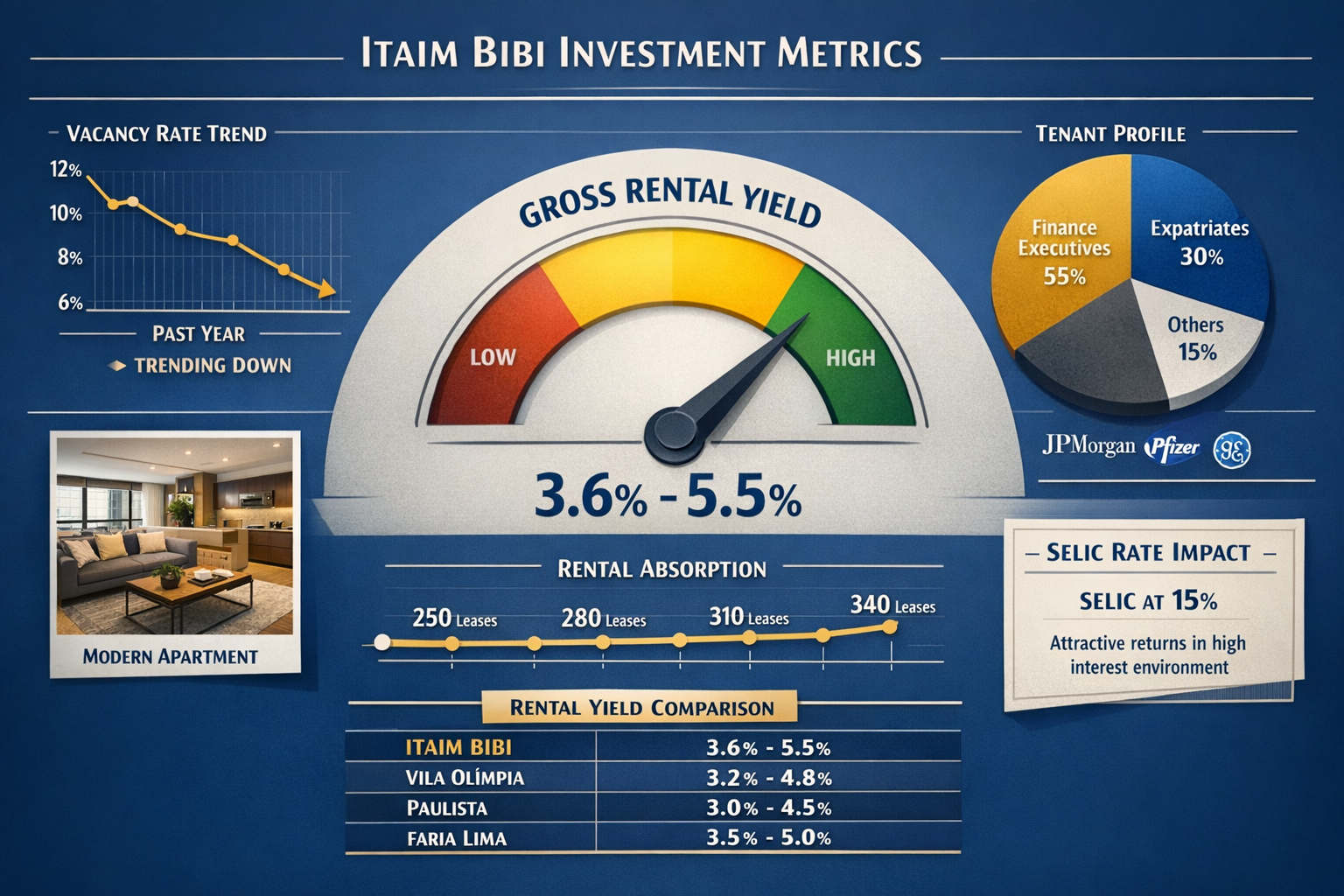
- Strong Rental Fundamentals: Gross yields of 3.6–5.5% annually supported by corporate tenant demand, expatriate professionals, and historically low vacancy rates [2]
- Liquidity Leadership: Itaim Bibi holds the strongest liquidity and institutional appeal among São Paulo’s prime zones, critical for capital preservation strategies [1]
- Interest Rate Headwinds: The Selic benchmark at 15%—highest since 2006—concentrates opportunities among cash buyers and yield-focused institutional investors [3]
Understanding Itaim Bibi’s Market Position in 2026

The Financial District Premium
Itaim Bibi functions as São Paulo’s equivalent to Manhattan’s Financial District or London’s Canary Wharf—a concentrated hub where finance executives, multinational corporations, and expatriates converge [2]. This positioning creates a unique investment dynamic distinct from other residential neighborhoods.
The neighborhood’s proximity to the Faria Lima corridor translates directly into pricing power. At approximately R$19,400 per square meter, Itaim Bibi properties command a significant premium over São Paulo’s R$10,000–12,000/m² citywide average [2]. This price differential reflects more than location—it represents access to corporate infrastructure, international schools, premium dining, and the professional ecosystem that drives rental demand.
Key Market Indicators (2026):
| Metric | Itaim Bibi | São Paulo Average |
|---|---|---|
| Price per m² | R$17,500–21,400 | R$10,000–12,000 |
| Unit Price Range | R$2.1M–5.0M | R$800K–1.8M |
| Gross Rental Yield | 3.6–5.5% | 4.0–6.0% |
| Vacancy Rate | Low (declining) | Moderate |
| Liquidity Ranking | #1 Prime Zone | Varies |
Historical Performance and Appreciation Trajectory
Between 2020 and 2024, Itaim Bibi demonstrated +54% capital appreciation, outperforming broader São Paulo market segments though trailing Vila Olímpia’s +62% gain during the same period [1]. This performance reflects the neighborhood’s maturation from speculative growth to stable, institutional-grade investment territory.
The appreciation trajectory reveals important nuances for developers and investors. Unlike speculative cycles driven by broad market sentiment, Itaim Bibi’s current market operates where micro-location performance matters more than headline trends [1]. Properties within 500 meters of premium corporate towers command different valuations than those on peripheral streets—a distinction that AI-powered valuation models now quantify with precision.
For investors exploring best places to invest in Brazil property, understanding these micro-location dynamics proves essential for maximizing returns.
AI-Forecasted Yields: The Itaim Bibi Investment Blueprint 2026 Data Model 📊
2026 Price Growth Projections
Artificial intelligence models analyzing São Paulo’s premium neighborhoods, including Itaim Bibi, project 5% to 8% nominal appreciation in 2026, with conservative scenarios at 3% and optimistic forecasts reaching 8% depending on Selic interest rate stability [3]. These projections integrate multiple data streams:
AI Model Input Variables:
- ✅ Comparable sales transactions (real-time)
- ✅ Rental absorption rates by micro-location
- ✅ Corporate tenant demand signals
- ✅ New construction pipeline analysis
- ✅ Macroeconomic indicators (Selic, inflation, GDP)
- ✅ Expatriate population trends
- ✅ Infrastructure development timelines
The AI-driven approach represents a fundamental shift from traditional appraisal methods. Machine learning algorithms process thousands of data points daily, identifying price trends weeks before they appear in conventional market reports. For Itaim Bibi specifically, these models highlight limited new supply relative to buyer interest, creating favorable conditions for price stability and rental absorption [4].
Rental Yield Analysis and Tenant Demographics
Itaim Bibi’s 3.6–5.5% gross annual yields position it competitively within São Paulo’s premium segment [2]. While these yields appear modest compared to emerging neighborhoods offering 6–8% returns, the risk-adjusted performance tells a different story.
Tenant Profile Breakdown:
- 🏢 Finance Executives: 40% of rental demand
- 🌍 Expatriate Professionals: 35% of rental demand
- 💼 Corporate Housing Programs: 15% of rental demand
- 👥 Affluent Local Professionals: 10% of rental demand
This tenant composition creates exceptional stability. Corporate-backed leases and expatriate contracts typically span 12–24 months with built-in renewal clauses, minimizing vacancy risk and turnover costs. As of early 2026, vacancy rates continue dropping across Itaim Bibi, with strong rental absorption supported by corporate-driven demand from multinational companies [4].
The rental market strength connects directly to São Paulo’s broader economic momentum. Property sales surged 40.6% year-on-year in early 2025, driven largely by cash buyers and investors, with Itaim Bibi maintaining particularly strong institutional investor interest [3].
Supply-Demand Dynamics Through 2030
One of the most compelling AI-forecasted insights for the Itaim Bibi Investment Blueprint 2026 involves the supply-demand imbalance. As of early 2026, new construction is lagging behind household demand, with limited fresh supply relative to buyer interest [4]. This constraint supports both price stability and rental absorption—critical factors for developers planning multi-year projects.
The supply lag stems from several factors:
- Land Scarcity: Prime Itaim Bibi parcels are increasingly rare
- Regulatory Complexity: Zoning and permitting timelines extend project cycles
- Construction Costs: Material and labor inflation impact feasibility
- Developer Selectivity: Focus on ultra-premium segments only
For developers considering valuation for those buying off-plan, this supply constraint creates opportunities for projects that deliver in 2027–2029, when the demand-supply gap is projected to widen further.
Risk Assessment: Critical Factors in the Itaim Bibi Investment Blueprint 2026 ⚠️
Interest Rate Impact and Financing Constraints
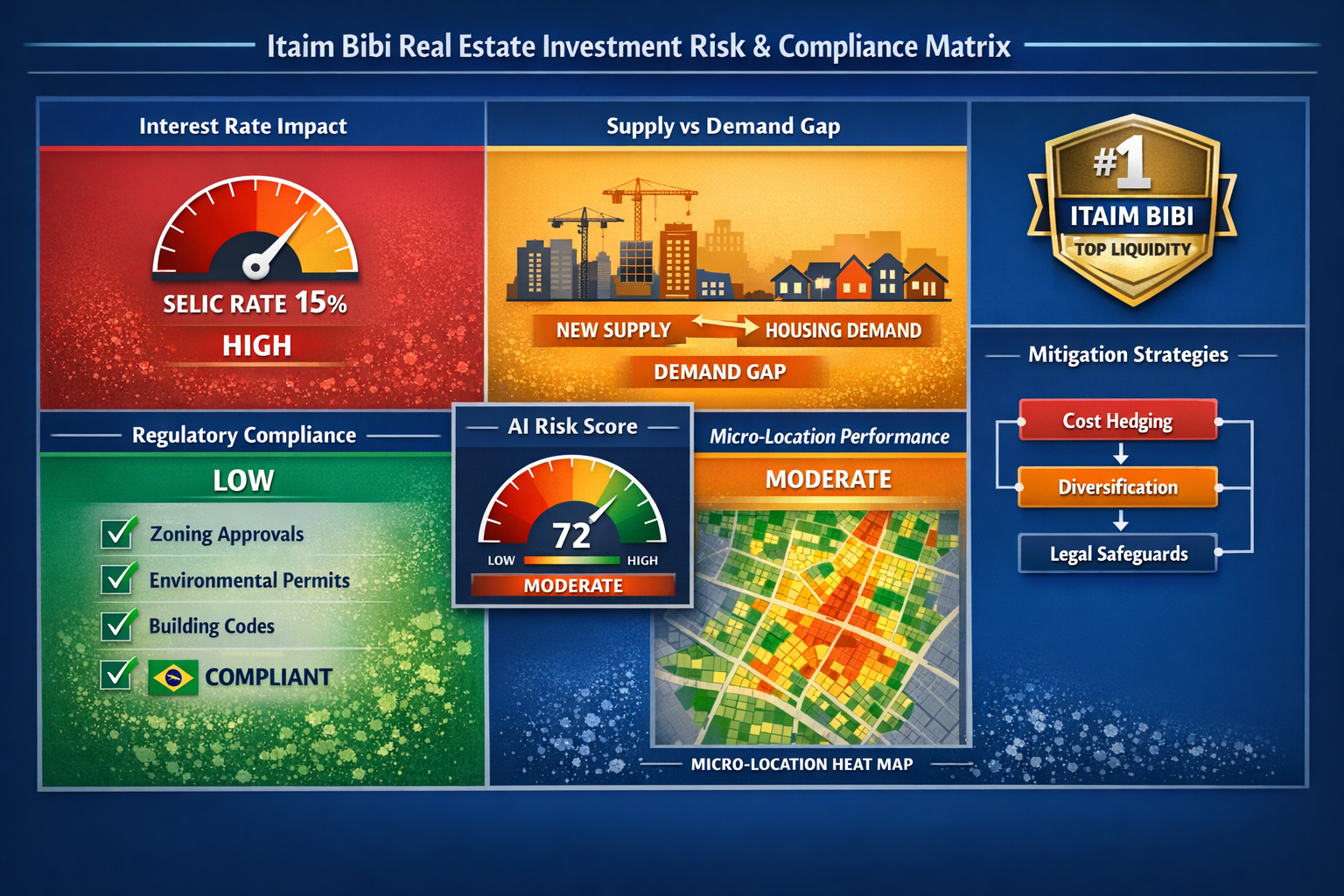
The elephant in the room for São Paulo real estate in 2026 is the Selic benchmark rate at 15%—the highest level since 2006 [3]. This elevated rate environment creates both challenges and opportunities for Itaim Bibi investors.
Interest Rate Implications:
| Impact Area | Effect | Investor Response |
|---|---|---|
| Mortgage Accessibility | Severely limited | Cash buyer concentration |
| Financing Costs | Prohibitively high | Institutional capital advantage |
| Buyer Pool | Narrowed significantly | Premium segment resilience |
| Rental Demand | Increased (ownership barriers) | Yield support |
| Capital Allocation | Competing with fixed income | Focus on total return |
The high Selic rate concentrates demand among cash buyers and yield-focused investors [3], fundamentally altering market dynamics. For developers, this means targeting institutional buyers, corporate housing programs, and high-net-worth individuals rather than retail buyers dependent on financing.
Paradoxically, the financing constraint strengthens rental fundamentals. Professionals who might otherwise purchase are forced into rental markets, supporting occupancy and allowing landlords to maintain pricing power. This dynamic particularly benefits Itaim Bibi, where the tenant base includes corporate-backed expatriates less sensitive to rental rate fluctuations.
Micro-Location Performance Variables
The Itaim Bibi Investment Blueprint 2026 emphasizes that micro-location analysis has become critical as the market matures [1]. Two properties separated by just 300 meters can demonstrate vastly different appreciation trajectories and rental absorption rates.
High-Performance Micro-Locations:
- 🎯 Within 500m of Faria Lima Avenue
- 🎯 Proximity to premium corporate towers (JK Iguatemi, Cidade Jardim)
- 🎯 Access to international schools (Graded, Chapel)
- 🎯 Near premium retail and dining clusters
- 🎯 Low-traffic residential streets with security infrastructure
Lower-Performance Micro-Locations:
- ⚠️ High-traffic arterial roads with noise pollution
- ⚠️ Distance from metro stations (>800m walk)
- ⚠️ Limited street-level amenities
- ⚠️ Older building stock without modern security
- ⚠️ Peripheral zones transitioning to commercial use
AI-backed valuation platforms now integrate these micro-location variables with comparable sales and demand signals, providing granular pricing guidance that traditional appraisals miss [1]. For developers conducting feasibility studies, investing in AI-powered location analytics delivers ROI through optimized site selection and pricing strategies.
Regulatory and Compliance Considerations
Brazil’s real estate regulatory environment presents unique challenges that demand specialized expertise. The Itaim Bibi Investment Blueprint 2026 must account for compliance pitfalls that can derail even well-capitalized projects.
Critical Compliance Areas:
- Zoning and Land Use: Itaim Bibi’s mixed-use zoning requires careful navigation of residential vs. commercial restrictions
- Environmental Licensing: São Paulo’s environmental agency (SVMA) imposes strict requirements for new construction
- Condominium Law: Brazil’s condominium regulations affect renovation, rental management, and owner rights
- Tax Obligations: IPTU (property tax), ITBI (transfer tax), and rental income taxation require structured planning
- Foreign Investment Rules: Non-resident investors face specific registration and remittance requirements
Developers should engage local legal counsel specializing in São Paulo real estate early in the planning process. The cost of compliance expertise pales compared to the expense of project delays, regulatory fines, or forced design modifications mid-construction.
For those interested in broader Brazilian property investment strategies, exploring cryptocurrency and real estate development reveals emerging payment and financing mechanisms gaining traction in São Paulo’s premium segments.
Institutional Investor Perspective: Liquidity and Capital Preservation 💼
Why Institutions Favor Itaim Bibi
Itaim Bibi holds the strongest liquidity and institutional appeal among São Paulo’s prime residential zones [1], making it the preferred allocation for investors prioritizing capital preservation alongside growth. This liquidity advantage stems from several factors:
Institutional Appeal Drivers:
- 📈 Transaction Volume: Consistent buyer interest ensures exit liquidity
- 📈 Price Transparency: Dense comparable sales data enables accurate valuation
- 📈 Tenant Quality: Corporate-backed leases reduce default risk
- 📈 Asset Recognition: International investors recognize Itaim Bibi brand
- 📈 Professional Management: Mature property management ecosystem
For pension funds, family offices, and real estate investment trusts (REITs), liquidity ranks alongside yield as a primary concern. The ability to exit positions within 90–180 days without significant price concessions distinguishes Itaim Bibi from emerging neighborhoods where sales cycles extend 12+ months.
Comparing Itaim Bibi to Alternative São Paulo Zones
While Itaim Bibi commands premium pricing, understanding its position relative to alternative zones helps investors optimize portfolio allocation:
São Paulo Prime Zone Comparison:
| Neighborhood | Price/m² | Yield | 2020-2024 Appreciation | Liquidity | Risk Profile |
|---|---|---|---|---|---|
| Itaim Bibi | R$17,500–21,400 | 3.6–5.5% | +54% | Highest | Low-Moderate |
| Vila Olímpia | R$16,000–19,000 | 4.0–5.8% | +62% | High | Moderate |
| Jardins | R$15,000–18,500 | 3.2–4.8% | +48% | High | Low |
| Pinheiros | R$12,000–15,000 | 4.5–6.2% | +51% | Moderate | Moderate |
| Moema | R$11,000–14,000 | 4.8–6.5% | +46% | Moderate | Moderate-High |
Itaim Bibi’s lower yield compared to Pinheiros or Moema reflects its premium positioning and lower risk profile. Investors seeking maximum current income might explore alternative zones, while those prioritizing capital preservation and institutional-grade liquidity find Itaim Bibi optimal.
This analysis mirrors considerations in other Brazilian markets, such as Florianópolis’s real estate market trends, where location-specific dynamics drive differentiated returns.
Developer Strategies: Maximizing the Itaim Bibi Investment Blueprint 2026 Through 2030 🏗️
Optimal Project Positioning and Unit Mix
For developers planning Itaim Bibi projects launching in 2026–2027 for delivery in 2028–2030, unit mix optimization directly impacts absorption and profitability. AI-driven demand analysis reveals specific preferences among the target buyer pool:
High-Demand Unit Profiles:
- 🏠 2-Bedroom Units (80–110m²): 40% of demand—ideal for expatriate couples and small families
- 🏠 3-Bedroom Units (120–160m²): 35% of demand—family-oriented executives
- 🏠 High-End Studios (45–60m²): 15% of demand—corporate housing and investment buyers
- 🏠 4+ Bedroom Penthouses (200m²+): 10% of demand—ultra-high-net-worth segment
The studio segment deserves special attention. While representing smaller demand volume, studios in Itaim Bibi deliver higher yields (5.0–6.5%) and faster absorption due to corporate housing programs. Developers might consider allocating 10–15% of units to this segment for cash flow optimization during lease-up.
For insights on studio investment dynamics, review strategies for investing in studios in Florianópolis, which share similar corporate tenant demand patterns.
Amenity Packages and Differentiation
In Itaim Bibi’s competitive landscape, amenity packages differentiate projects and justify premium pricing. AI analysis of recent successful launches reveals buyer preferences:
Must-Have Amenities (2026 Standards):
- ✅ 24/7 concierge and security
- ✅ Fitness center with modern equipment
- ✅ Coworking spaces with high-speed internet
- ✅ Pet-friendly facilities (grooming, play areas)
- ✅ Bike storage and EV charging stations
- ✅ Guest suites for visiting executives
- ✅ Rooftop leisure areas with São Paulo skyline views
Emerging Differentiators:
- 🌟 Wellness centers (yoga studios, meditation rooms)
- 🌟 Smart home integration (IoT-enabled units)
- 🌟 Sustainability certifications (LEED, AQUA-HQE)
- 🌟 Private dining rooms for corporate entertaining
- 🌟 Children’s spaces (playrooms, outdoor play areas)
The sustainability angle particularly resonates with multinational corporate buyers establishing ESG (Environmental, Social, Governance) criteria for real estate portfolios. Projects achieving LEED Gold or Platinum certification command 8–12% price premiums and demonstrate faster absorption.
Construction and Delivery Timeline Optimization
Given the supply-demand imbalance projected through 2030, developers who can accelerate delivery timelines gain competitive advantage. The Itaim Bibi Investment Blueprint 2026 suggests optimal project timelines:
Recommended Development Cycle:
- Q1-Q2 2026: Site acquisition and feasibility
- Q3-Q4 2026: Permitting and pre-launch marketing
- Q1 2027: Official launch and presales
- Q2 2027–Q4 2028: Construction phase (18–20 months)
- Q1 2029: Delivery and occupancy
This timeline positions delivery for Q1 2029, when AI models forecast the demand-supply gap reaching peak levels. Developers should build contingency buffers for São Paulo’s notoriously complex permitting environment, which can add 3–6 months to schedules.
For examples of efficient project execution, examine Tramonto development progress, which demonstrates accelerated construction methodologies applicable to São Paulo projects.
Practical Implementation: Actionable Steps for 2026 Investors 🎯
Due Diligence Framework
Investors deploying capital into Itaim Bibi in 2026 should implement comprehensive due diligence covering both traditional and AI-enhanced analysis:
Phase 1: Market-Level Analysis
- Review AI-forecasted appreciation models for Itaim Bibi micro-locations
- Analyze rental absorption trends by unit type and price point
- Assess competitive supply pipeline (projects under construction and planned)
- Evaluate macroeconomic scenarios (Selic rate trajectories, GDP forecasts)
Phase 2: Property-Level Analysis
- Conduct micro-location scoring (proximity to corporate hubs, amenities, transport)
- Review building quality, age, and condominium financial health
- Analyze comparable sales within 300m radius (last 6 months)
- Assess rental potential through corporate housing demand analysis
Phase 3: Legal and Compliance
- Verify clear title and absence of liens or encumbrances
- Review condominium bylaws and pending litigation
- Confirm zoning compliance and renovation restrictions
- Structure tax-efficient ownership (individual, corporate, trust)
Phase 4: Financial Modeling
- Project 5-year total return scenarios (appreciation + rental income)
- Model interest rate sensitivity (if using leverage)
- Calculate tax-adjusted cash-on-cash returns
- Stress-test vacancy and rental rate assumptions
Investors lacking in-house expertise should engage São Paulo-based real estate advisors with Itaim Bibi specialization. The cost of professional guidance (typically 2–3% of transaction value) provides insurance against costly mistakes.
Financing and Capital Structure Considerations
With Selic at 15%, traditional mortgage financing remains largely uneconomical for investment properties. Alternative capital structures merit consideration:
Optimal Capital Structures (2026 Environment):
- All-Cash Acquisition: Simplest structure; maximizes negotiating leverage; avoids financing costs
- Institutional Partnership: Partner with family offices or REITs; share equity for capital access
- Seller Financing: Negotiate direct financing with sellers (rare but possible in slow markets)
- Foreign Currency Leverage: USD or EUR financing for foreign investors with currency hedging
- Delayed Payment Plans: Developer-offered payment schedules for off-plan purchases
For off-plan purchases specifically, developers increasingly offer extended payment terms (24–36 months) to bridge the financing gap. These structures effectively provide zero-interest financing during construction, significantly improving project economics.
Portfolio Allocation Strategy
For investors building diversified Brazilian real estate portfolios, Itaim Bibi should represent the core, capital-preservation allocation rather than the entire portfolio. A balanced approach might include:
Sample Portfolio Allocation:
- 50% Itaim Bibi: Core holdings for stability and liquidity
- 25% Emerging São Paulo Zones: Higher yield, moderate risk (Pinheiros, Vila Madalena)
- 15% Secondary Cities: Geographic diversification (Florianópolis, Rio)
- 10% Development Projects: Off-plan purchases for appreciation upside
This allocation balances Itaim Bibi’s capital preservation characteristics with higher-yield opportunities in emerging markets. Investors might explore life in Florianópolis for secondary city diversification options offering lifestyle and investment value.
Technology Integration: AI Tools for Itaim Bibi Investment Analysis 🤖
Available AI Platforms and Data Sources
The Itaim Bibi Investment Blueprint 2026 leverages several AI-powered platforms transforming São Paulo real estate analysis:
Leading AI Real Estate Platforms (2026):
GRAI (Global Real Estate AI): Provides AI-forecasted price trends, comparable sales analysis, and micro-location scoring for São Paulo neighborhoods including Itaim Bibi [1]
QuintoAndar Data Intelligence: Brazil’s largest proptech offers rental market analytics, vacancy trends, and tenant demographic insights
Loft Data Platform: Machine learning-powered valuation models processing thousands of São Paulo transactions daily
VivaReal Market Insights: Real-time listing analytics, price per square meter trends, and absorption rate tracking
Custom AI Models: Institutional investors increasingly deploy proprietary models integrating multiple data sources
These platforms democratize access to institutional-grade analysis previously available only to large investment firms. Individual investors can access basic versions for R$200–500 monthly, while comprehensive institutional subscriptions range R$5,000–15,000 monthly.
Interpreting AI Forecasts and Confidence Intervals
AI-generated forecasts provide powerful insights but require proper interpretation. The 5–8% appreciation forecast for Itaim Bibi in 2026 comes with confidence intervals and scenario dependencies:
Understanding AI Forecast Ranges:
- Conservative Scenario (3% growth): Assumes Selic remains at 15%+, limited corporate hiring, global recession
- Base Case (5–6% growth): Assumes Selic gradual decline to 12–13%, stable corporate demand, moderate GDP growth
- Optimistic Scenario (8% growth): Assumes Selic drops to 10%, strong corporate expansion, robust GDP growth
Sophisticated investors use these scenarios for sensitivity analysis rather than treating the base case as guaranteed. The AI models assign probability weights to each scenario based on current macroeconomic indicators, but unforeseen events (political instability, global financial shocks) can shift probabilities rapidly.
Best Practice: Model investments across all three scenarios, ensuring acceptable returns even in conservative cases. Projects that only work in optimistic scenarios carry excessive risk.
Conclusion: Executing the Itaim Bibi Investment Blueprint 2026
The Itaim Bibi Investment Blueprint 2026: AI-Forecasted Yields and Risks in São Paulo’s Prime Residential Zones reveals a market at an inflection point. With properties commanding R$17,500–21,400 per square meter and delivering 3.6–5.5% gross yields, Itaim Bibi represents São Paulo’s premier institutional-grade residential investment opportunity [1][2]. The neighborhood’s +54% appreciation over 2020–2024 demonstrates proven capital growth, while AI models project continued 5–8% annual appreciation through 2026 supported by supply-demand imbalances [1][3].
However, success requires navigating significant headwinds. The Selic rate at 15%—highest since 2006—fundamentally alters market dynamics, concentrating opportunities among cash buyers and institutional investors [3]. Micro-location performance variations demand granular analysis beyond traditional market reports, with AI-powered valuation tools becoming essential for identifying optimal properties within Itaim Bibi’s diverse landscape [1].
For developers, the blueprint emphasizes optimal unit mix (2-3 bedroom focus), differentiated amenity packages (coworking, wellness, sustainability), and accelerated delivery timelines targeting 2028–2029 completion when supply constraints peak [4]. Compliance expertise and local partnership prove non-negotiable for navigating Brazil’s complex regulatory environment.
Actionable Next Steps
For Investors:
- Engage AI-powered valuation platforms to identify high-potential micro-locations within Itaim Bibi
- Structure all-cash acquisitions or creative financing to circumvent high Selic rate constraints
- Conduct comprehensive due diligence covering legal, financial, and market-level analysis
- Build diversified portfolios with Itaim Bibi as core allocation (40–50%) complemented by higher-yield opportunities
- Partner with local experts for regulatory compliance and property management
For Developers:
- Accelerate project timelines to capture 2028–2029 delivery window during peak demand-supply gap
- Optimize unit mix toward 2-3 bedroom configurations with 10–15% studio allocation
- Invest in differentiation through sustainability certifications and premium amenity packages
- Leverage AI analytics for site selection and pricing strategy optimization
- Establish institutional buyer relationships early in development cycle
For Both:
- Monitor Selic rate trajectory closely—rate declines below 12% significantly improve market dynamics
- Track corporate expansion announcements in Faria Lima corridor for rental demand signals
- Stay current on regulatory changes affecting São Paulo real estate taxation and foreign investment
- Review AI forecast updates quarterly as models incorporate new data and refine projections
The Itaim Bibi market in 2026 rewards sophisticated, data-driven investors who combine AI-powered analytics with local expertise and disciplined risk management. For those willing to navigate Brazil’s complexity, the neighborhood offers a rare combination of capital preservation, growth potential, and institutional-grade liquidity unmatched elsewhere in Latin America.
Ready to explore investment opportunities in Brazil’s prime real estate markets? Contact our team for personalized guidance on Itaim Bibi and São Paulo’s premium residential zones, or explore our current developments to see how institutional-quality projects deliver superior returns.
References
[1] Sao Paulo Brazil Real Estate Market Trends In 2026 Ai Forecast Prices And Investment Strategy – https://internationalreal.estate/insights/sao-paulo-brazil-real-estate-market-trends-in-2026-ai-forecast-prices-and-investment-strategy
[2] Invest In Real Estate Sao Paulo Market Neighborhoods Returns – https://www.jarniascyril.com/international-real-estate/investing-brazil-real-estate/invest-in-real-estate-sao-paulo-market-neighborhoods-returns/
[3] Sao Paulo Price Forecasts – https://thelatinvestor.com/blogs/news/sao-paulo-price-forecasts
[4] Sao Paulo Good Time – https://thelatinvestor.com/blogs/news/sao-paulo-good-time